Anatomy of an Alibi Summary, Characters and Themes
Anatomy of an Alibi by Ashley Elston is a Southern crime thriller about secrets, power, and the cost of protecting the wrong people. The story follows Camille Bayliss, Aubrey Price, and Hank Landry as a murder investigation exposes a decade-old coverup tied to Aubrey’s parents’ deaths.
Camille’s controlling marriage, Aubrey’s hunt for justice, and Hank’s uneasy loyalty to his dead law partner all collide around one dangerous question: who benefits when the truth stays buried? The book mixes legal suspense, family corruption, false alibis, and moral compromise into a sharp mystery about who gets punished and who gets protected.
Summary
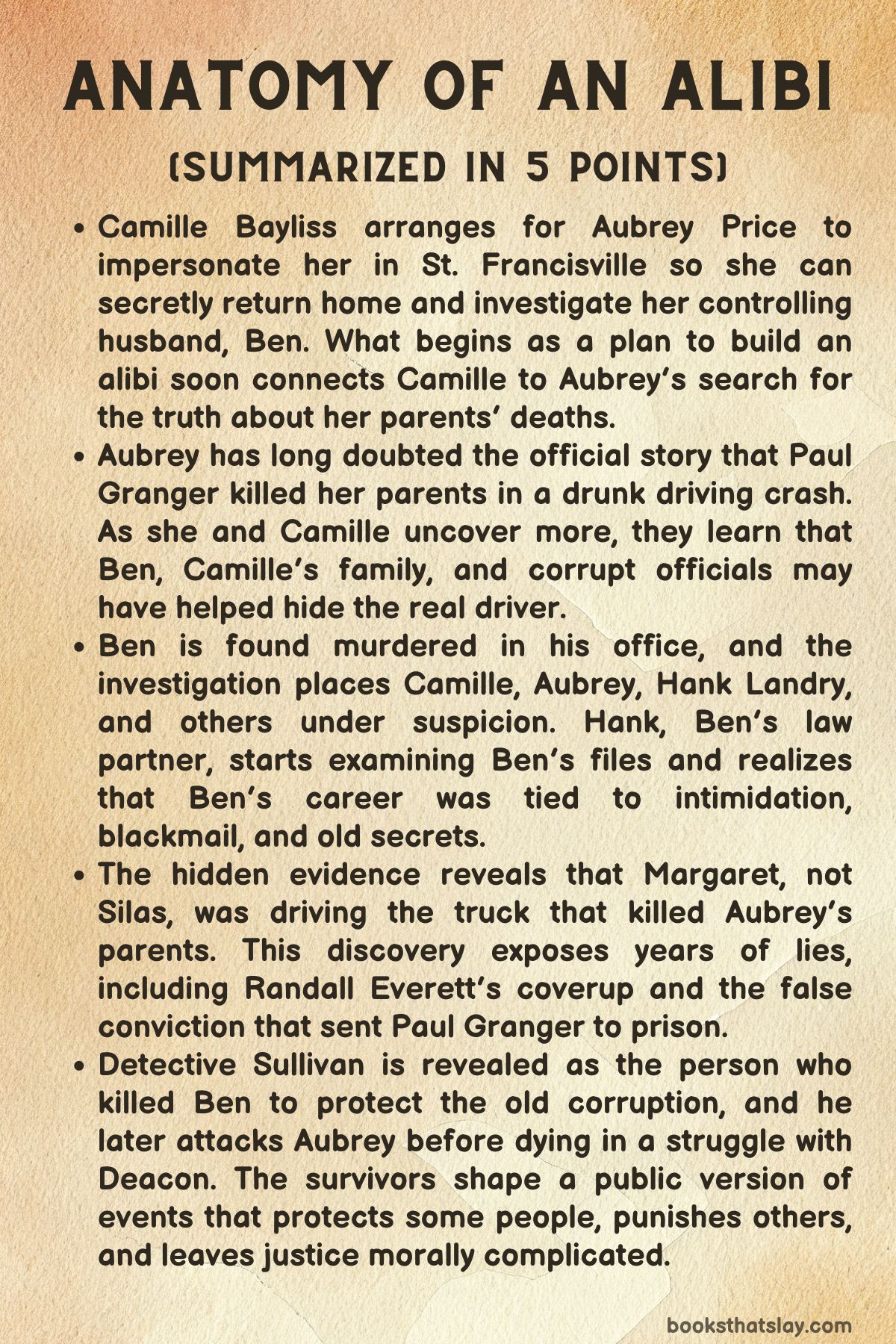
Anatomy of an Alibi begins with Aubrey Price pretending to be Camille Bayliss. Dressed in Camille’s clothes and wig, she drinks at a bar in St. Francisville so that Camille will appear to have been away from Baton Rouge.
Camille has arranged the switch because her husband, Ben Bayliss, tracks her phone, watch, and car. While Aubrey creates a public record of Camille’s presence, Camille secretly returns home to uncover what Ben is hiding.
Camille and Ben’s marriage has long been built on control. Ben monitors her movements, shapes her life, and keeps her financially dependent through a prenuptial agreement.
Camille knows she can leave with money only if she proves Ben has committed certain kinds of misconduct. When she finds Aubrey’s name and contact information in Ben’s briefcase, she assumes he may be having an affair.
Instead, her search leads her to something much larger: the old case of Paul Granger, the man convicted of killing Aubrey’s parents in a drunk driving crash ten years earlier.
Aubrey has always doubted the official story of her parents’ deaths. Paul has written to her from prison insisting that he was not driving the truck that killed them.
Camille’s visit to Aubrey’s workplace connects the two women, though they do not fully trust each other. Aubrey’s housemates, including Deacon, Eddie, Shane, and Serenity, help her investigate Ben.
They learn that Ben has been looking into Aubrey, Paul, and a hidden piece of evidence that could prove Paul’s innocence.
On the night of the alibi, Camille hides cameras inside her house and waits for Ben. Eddie and Shane arrive with a restored red Mustang, giving Camille her first sign that Ben has been using Aubrey’s housemates as a way to get close to Aubrey.
Ben later watches a video of Aubrey asking questions about her parents’ deaths. A phone call reveals that Ben is searching for a key to a gun safe at the home of Kevin Foster, the former Corbeau police chief.
Foster is dead, but he seems to have left behind evidence tied to Paul’s case.
Then Margaret, Camille’s sister-in-law, visits Ben. Camille overhears enough to understand that the story she has believed for years is false.
Ten years earlier, someone from her own family caused the crash that killed Aubrey’s parents, and Randall Everett, Camille’s powerful father, helped cover it up. Ben was part of the coverup.
He gave Silas, Camille’s brother, an alibi because Randall promised him approval, money, and access to the Everett family’s influence.
Flashbacks reveal what really happened after the crash. Silas and Margaret came to Ben’s house injured and terrified.
Randall created a false story, making it appear that Paul Granger was responsible while Ben vouched for Silas’s whereabouts. Ben accepted the bargain because he wanted status and security.
Over time, Randall used that secret to control him. Ben became a successful but corrupt attorney, winning cases through threats, favors, and intimidation.
Yet by the time the main story begins, Ben wants out from Randall’s hold and is trying to find the hidden evidence for himself.
Camille’s spying is discovered. Ben destroys the camera memory cards and confronts her.
Camille escapes and calls Silas, who admits the old coverup. He believes he was the driver, but he also claims he has lived under the weight of that guilt for ten years.
Camille returns to St. Francisville, where Aubrey is still maintaining the false alibi. Silas also appears there and later becomes part of Camille’s official story.
The next day Ben is found dead in his office. Camille says she came home from her trip and discovered his body.
Hank Landry, Ben’s law partner and Camille’s friend, arrives before the police. Detective Sullivan, known as Sully, investigates.
Hank quickly sees that Camille’s alibi may look too neat, but he also knows many people had reasons to want Ben dead. Camille would inherit money, Hank would gain control of the firm, Aubrey wanted justice, and Randall’s circle had plenty to lose if Ben exposed the old crime.
Hank begins examining Ben’s files and learns how corrupt Ben really was. He finds information on Aubrey, Paul, Kevin Foster, and Ben’s private investigator.
He also learns that Ben planned to dissolve their law partnership, leaving Hank with little. This makes Hank a possible suspect, though he is more focused on keeping Camille from being blamed and uncovering why Ben died.
The murder weapon appears to be a decorative knife that Camille had given Ben. The knife is missing, and later it is secretly planted in Aubrey’s room, making it look as if she killed Ben.
Aubrey’s housemates hide it before the police search the house. Hank, now aware that Aubrey and Camille are connected, visits Aubrey and realizes that any defense of Camille may also require protecting Aubrey.
The investigation shifts toward Kevin Foster’s safe. Camille and Silas retrieve Ben’s key and break into Foster’s house, only to find the safe empty.
Deacon is there too, also searching for the evidence. Meanwhile, Hank speaks with Paul in prison and learns that Foster sent Aubrey a jewelry box with a hidden compartment.
Aubrey finds a USB drive inside, but Serenity’s boyfriend Frank steals it before she can view it.
Frank turns out to be working for Silas. When Camille and Silas finally view the USB drive, they learn the shocking truth: Silas was not driving the truck that killed Aubrey’s parents.
Margaret was. She let Silas believe he was responsible all these years, while Randall and Foster protected the lie.
When Margaret realizes Camille knows the truth, she attacks Camille and leaves her badly injured. Hank finds Camille and gets her medical help.
A final clue points Hank toward Sully. As a younger man, Sully had ties to Foster and to the same corrupt network that framed Paul.
Foster’s effort to confess threatened Sully’s career and freedom. Ben’s search for the evidence made him dangerous, so Sully killed Ben and tried to frame Aubrey by planting the knife.
Sully goes to Aubrey’s house and attacks her, demanding to know what she has learned. Deacon arrives and fights him off.
During the struggle, Sully is shot and killed. Silas and Frank arrive, and the group decides how to protect Deacon and close the case.
They shape the story so Sully is blamed not only for Ben’s murder but also for the old crash. This is not the full truth, but it protects the living people they choose to save and gives the public a clean villain.
Camille, Hank, Aubrey, and Silas all end the story changed by what they have learned and what they have chosen to hide. Camille wants to help Aubrey by buying her rental house and giving it to her.
Silas plans to take control of the Everett family’s business and claims he will improve it, though Camille sees that he has inherited some of Randall’s ruthless methods. Margaret soon dies in a car accident after Silas visits Aubrey’s bar, strongly suggesting that Silas arranged her death and used Aubrey and Deacon as part of his alibi.
The novel closes on an uneasy form of justice. Paul’s innocence is finally understood, Aubrey knows who killed her parents, and Ben’s murder is officially explained.
Yet the truth is still partly managed by powerful people. Aubrey gains answers, but not pure closure.
Camille escapes Ben’s control, but not the moral stain of her family. Silas punishes Margaret, but becomes more like the people who trapped him.
Anatomy of an Alibi ends by showing that an alibi can protect the innocent, shield the guilty, or create a new lie that everyone agrees to live with.
Characters
Aubrey Price
Aubrey Price is one of the emotional centers of Anatomy of an Alibi, because her life has been shaped by a crime she never fully understood. After losing her parents as a teenager, she is told to accept Paul Granger’s guilt, but the gaps in the case leave her unable to settle into that version of the truth.
Aubrey is wary, practical, and used to surviving without much help. Her distrust comes from experience: the justice system failed her, her relatives used up her inheritance, and powerful people treated her parents’ deaths as a problem to be buried.
Her decision to impersonate Camille is risky, but it also shows her courage and desperation. She is not simply seeking revenge; she wants the truth that was denied to her.
Her relationship with Deacon reveals a softer side that she usually keeps guarded. Around him, she allows herself comfort, attraction, and trust, though even that trust is tested by danger.
Aubrey’s arc is painful because justice arrives in an incomplete form. She learns who killed her parents, but the public truth is reshaped again for protection and survival.
Her ending leaves her with answers, yet also with the burden of knowing that the truth can still be controlled by people with power.
Camille Bayliss
Camille Bayliss begins as a woman trapped inside an elegant but suffocating life. Her marriage to Ben is built around surveillance, dependence, and emotional control.
She is wealthy by association but powerless in practice, and her prenuptial agreement keeps her tied to Ben unless she can prove his wrongdoing. Camille’s need to investigate him grows from both fear and self-preservation.
At first, she is willing to use Aubrey’s connection to Ben for her own escape, which makes her morally complicated. She knows Aubrey deserves the truth, yet she also considers protecting herself first.
As the story continues, Camille becomes more active and less willing to be managed by Ben, Randall, or Silas. Her discovery of the old coverup forces her to face not only Ben’s corruption but also the rot within her own family.
Camille’s emotional conflict is especially strong because she once loved Ben and still remembers the version of him she believed in. Her grief is therefore tangled with relief, anger, guilt, and shame.
By the end, Camille wants to repair some of the damage done to Aubrey, but she also understands that money cannot undo the years stolen from her.
Hank Landry
Hank Landry functions as the story’s uneasy moral observer. He is close enough to Ben, Camille, and the law firm to be personally compromised, yet principled enough to recognize that something is deeply wrong.
His loyalty is divided from the start. Ben was his friend and business partner, but Ben had also planned to destroy their partnership.
Camille is someone he wants to protect, but his concern for her risks clouding his legal judgment. Hank is not a flawless hero; he is cautious, sometimes slow to see the full truth, and aware that his own motives may look suspicious.
Still, he stands apart from Ben because he has limits. As he studies Ben’s files, he realizes that the firm’s success was partly built on intimidation and corruption.
That realization forces him to reassess the man he thought he knew and the career they built together. Hank’s strength lies in his ability to keep asking questions even when the answers threaten him.
His role grows from lawyer and executor into investigator and protector. By the end, he chooses a controlled version of truth, not because it is pure justice, but because it can save people who might otherwise be destroyed.
Ben Bayliss
Ben Bayliss is dead for much of the present-day action, but his choices drive nearly every conflict in Anatomy of an Alibi. He is ambitious, controlling, image-conscious, and deeply shaped by his hunger for status.
As a younger man, he accepts Randall Everett’s bargain because it gives him access to power, approval, and financial security. That bargain turns him into a keeper of secrets and later into a man trapped by the same influence he once wanted.
In marriage, Ben repeats the logic of control that helped build his career. He monitors Camille, limits her independence, and uses charm and authority to make dominance look like protection.
Yet he is not written as a simple villain. Near the end of his life, he appears to be trying to free himself from Randall’s hold and locate evidence connected to Paul Granger’s case.
This does not erase his corruption or his cruelty, but it does make his death more layered. Ben is both a beneficiary and a prisoner of the corrupt system he helped maintain.
His murder happens because he becomes dangerous to people who need the past to stay hidden.
Silas Everett
Silas Everett is one of the most conflicted characters in the story. For years, he believes he caused the crash that killed Aubrey’s parents, and that belief turns his life into a long sentence under Randall’s control.
His guilt makes him easier to manipulate, and he becomes tied to the Everett family machine even when he claims to hate what it has done. Silas shows real remorse, especially toward Aubrey, but remorse does not make him innocent.
He participates in concealment, intimidation, and later another form of arranged justice. His tragedy is that he was shaped by a lie before he had the strength to question it fully.
When he learns Margaret was the driver, the guilt he carried shifts into rage and betrayal. His response to Margaret’s death suggests that he has absorbed Randall’s methods more than he wants to admit.
Silas wants to become better than his father, yet his actions show how difficult it is to escape a family culture built on threats, favors, and controlled stories. He ends as a man who wants reform but still uses violence and manipulation when it suits him.
Margaret Everett
Margaret Everett is central to the old crime even before the full truth about her role is revealed. For years, she allows Silas to believe he was responsible for the crash, protecting herself while letting his guilt define his life.
Her behavior shows a sharp instinct for self-preservation. She is not as publicly powerful as Randall or as professionally powerful as Ben, but she knows how to survive inside their world.
Her visit to Ben proves that she understands the danger of the evidence and the threat it poses to her. Margaret’s cruelty lies not only in the original accident but in her long silence afterward.
She benefits from the coverup while Aubrey loses her parents, Paul loses his freedom, and Silas loses his sense of self. When Camille learns the truth, Margaret attacks her, which reveals how far she is willing to go to keep the past buried.
Margaret’s later death carries the feel of revenge rather than lawful justice. Her character shows that guilt can harden into aggression when a person values safety over accountability.
Randall Everett
Randall Everett represents inherited power at its most dangerous. He controls Corbeau through money, history, fear, and political influence.
His family’s wealth has roots in illegal dealings, and his present-day authority still depends on corruption. Randall’s response to the crash is not grief, responsibility, or moral concern; it is damage control.
He immediately invents a cover story, protects his son, frames Paul, and pulls Ben into his orbit. Randall’s greatest weapon is not violence alone, but the ability to make others believe resistance is useless.
Camille fears him, Silas is trapped by him, Ben is used by him, and even law enforcement is touched by his influence. He also treats family as property.
Camille’s marriage, Silas’s guilt, and Ben’s career all become pieces in his larger system of control. Randall is frightening because he rarely needs to act directly.
Other people carry out his wishes because they know what he can do. His presence explains why truth is so hard to recover in the novel: the facts were not lost by accident; they were buried by someone with the resources to make lies official.
Deacon
Deacon is Aubrey’s protector, partner, and emotional refuge. He has ties to a criminal world through his cousin’s bookmaking connections, but he is guided by loyalty more than greed.
His willingness to help Aubrey comes from affection, but also from a strong sense that Ben and the people around him have abused their power. Deacon’s methods are not clean.
He uses leverage, tracking, intimidation, and underworld contacts to get information. Yet the story often positions him as more trustworthy than the supposedly respectable lawyers, police officers, and wealthy families.
His relationship with Aubrey develops slowly through acts of care: driving her, helping her destroy evidence, offering her a safe place to rest, and standing between her and danger. When Sully attacks Aubrey, Deacon’s response is instinctive and protective.
His killing of Sully happens in defense, but it also places him in legal danger. The final cover story is partly designed to save him.
Deacon’s character shows the novel’s blurred moral line: the person with a criminal connection may act with more honor than those protected by institutions.
Detective Sullivan
Detective Sullivan, or Sully, first appears to be the official investigator, but he is later exposed as part of the old corruption. His role is effective because he stands inside the system that should bring justice.
As a detective, he controls questions, evidence, suspicion, and public direction. This makes him especially dangerous.
His connection to Foster and the events around Paul Granger’s conviction reveals that the coverup did not end with Randall’s influence; it extended into law enforcement. Sully kills Ben because Ben’s search for the evidence threatens to expose him.
He then tries to shift suspicion toward Aubrey by planting the missing knife, using police authority to make the frame-up look credible. His attack on Aubrey shows the violence beneath his official role.
Sully is not merely a bad officer; he is an example of how an institution can protect its own corruption when no one powerful enough challenges it. His death allows the case to close, but it also allows others to reshape the public truth again, proving that even when a corrupt man is gone, the habit of controlled storytelling remains.
Paul Granger
Paul Granger is the man punished for a crime he did not commit. His life in prison is the clearest example of how the powerful can sacrifice someone with less social value in order to protect their own.
Paul was not an ideal victim of injustice. He had a history with drugs and crime, and characters such as Silas use that fact to rationalize what happened to him.
But the novel refuses to let that excuse stand. Paul’s flaws do not make it acceptable to steal his freedom.
His letters to Aubrey are an attempt to reach the one person who might care enough to question the official story. He also shows restraint by worrying about the people connected to the evidence, even after he has been wronged for years.
Paul’s character reveals the cruelty of selective justice: because he was easy to blame, the system accepted his guilt. His innocence matters not because he is perfect, but because truth and due process should not depend on whether a person is socially respectable.
Kevin Foster
Kevin Foster is dead before much of the main action unfolds, but his choices shape the investigation. As a former police chief, he helped create the false case against Paul and protected Randall’s version of events.
Later, after illness and approaching death, he appears to seek some form of repentance. His hidden evidence, prison visit, religious posts, and attempt to get information to Aubrey suggest a man trying to correct part of the damage he caused.
Yet his remorse is late and incomplete. He had years to reveal the truth, and during those years Paul remained imprisoned, Aubrey lived without answers, and Randall’s circle remained safe.
Foster’s secretive method of confession also creates new danger. By hiding the evidence in indirect ways, he leaves others to fight over it after his death.
Foster represents the problem of delayed conscience. His guilt pushes the truth back into motion, but it cannot undo the consequences of his silence.
Eddie and Shane
Eddie and Shane bring practical skill, humor, and loyalty to Aubrey’s side of the story. Their work on Ben’s Mustang gives them a direct connection to the mystery, and their access to cars, tracking devices, and mechanical spaces becomes useful in the group’s plan.
They are not passive side characters; they help gather information, protect Aubrey, and respond quickly when the knife is planted in the house. Their decision to hide the knife before the police find it shows both their loyalty and their comfort operating outside legal boundaries.
Like Deacon, they complicate the idea of respectability. They may not have the clean public image of Ben, Hank, or the Everett family, but their loyalty to Aubrey is steadier than the conduct of many powerful characters.
Their relationship also adds warmth to Aubrey’s household, making the home feel chaotic but protective. Eddie and Shane help show that chosen family can become a shield when blood family and legal systems fail.
Serenity
Serenity plays a smaller but meaningful role as part of Aubrey’s household and support network. Her yoga connection to Camille creates one of the early links between Camille’s world and Aubrey’s.
She is not as deeply involved in the investigation as Deacon, Eddie, or Shane, but her presence contributes to the sense that Aubrey has built a nontraditional family around herself. Serenity’s relationship with Frank also becomes important because Frank is not who he appears to be.
Through Serenity, the story introduces the danger of hidden loyalties inside even the safest spaces. Her party creates the setting for the planted-knife crisis, and her boyfriend’s theft of the USB drive briefly places the evidence beyond Aubrey’s control.
Serenity is not malicious, but she is a reminder that trust can be exploited by people working for larger forces. Her role helps widen the circle of consequence around Aubrey.
Frank
Frank first seems like a minor figure connected to Serenity, but he is eventually revealed as someone placed near Aubrey on Silas’s behalf. His role is deceptive but not purely villainous.
He steals the USB drive, which is a betrayal from Aubrey’s perspective, yet he is working within Silas’s attempt to monitor and manage the fallout from the old crime. Frank’s actions place him in the morally gray middle of the story.
He is part spy, part helper, part opportunist, and part protector. When Camille is injured, he helps get medical care quickly, suggesting that he is not indifferent to harm.
Frank shows how deeply surveillance runs through the novel. Ben tracks Camille, Randall tracks threats, Silas watches Aubrey, and even people who seem ordinary may be serving someone else’s plan.
Frank’s character reinforces the idea that privacy is almost impossible when powerful people want control over the truth.
Lila
Lila, Hank’s assistant, offers a grounded view of the law firm after Ben’s death. She supports Hank in practical ways, bringing him clothes, helping him manage schedules, and reminding him that the staff respects him.
Her presence shows that Bayliss and Landry is not just a symbol of Ben’s ambition; it is also a workplace full of people affected by his death and by the firm’s uncertain future. Lila’s loyalty to Hank helps establish that he is different from Ben in how he treats people.
She also gives the story brief moments of steadiness amid suspicion and grief. Though she is not involved in the central crime, Lila matters because she reflects the human cost of Ben’s corruption.
If the firm collapses or becomes publicly disgraced, ordinary employees will suffer too. This adds pressure to Hank’s later choices about how much truth to reveal.
Vic
Vic, Ben’s private investigator, is a morally weak but useful figure. He works for Ben and helps gather information through questionable means, but his gambling debts make him vulnerable to pressure from Deacon’s circle.
Once his debts are controlled by Chris, Vic becomes a source of information for Aubrey and her allies. Vic represents the transactional world surrounding Ben.
Loyalty is not based on ethics; it is bought, threatened, or traded. His work also shows how Ben’s control depends on surveillance.
Ben does not simply suspect people; he hires others to watch, follow, photograph, and report. Vic is not powerful in the way Randall or Ben is, but he enables powerful men by doing their dirty work.
His eventual cooperation with Aubrey’s side does not make him noble. It shows that corruption can be redirected when someone else gains leverage.
Chris
Chris remains mostly outside the central action, but his influence matters through Deacon. As a prominent bookie and Deacon’s cousin, he gives Aubrey’s side access to leverage that respectable channels cannot provide.
By taking over Vic’s gambling debts, Chris helps turn Ben’s investigator into a source. His role expands the story’s moral landscape.
Criminal networks are not shown as innocent, but they can be effective in ways the legal system is not. Chris’s presence also explains part of Deacon’s confidence.
Deacon is not acting alone; he has access to people and pressure systems that can compete with Ben’s influence. Through Chris, the story contrasts official corruption with unofficial power.
Neither is clean, but one helps Aubrey get closer to the truth when the official system has already failed her.
Themes
Power, Class, and Controlled Truth
In Anatomy of an Alibi, truth is not treated as something that naturally rises to the surface. It has to fight against money, family influence, legal pressure, and police corruption.
Randall Everett’s power over Corbeau allows him to turn a fatal crash into a false criminal case. He can pressure witnesses, shape police behavior, and decide which lives matter enough to protect.
Ben benefits from that system early on, using his connection to Randall to gain approval, money, and career opportunities. Later, he becomes trapped by the same system because the secret that helped him rise can also destroy him.
Aubrey’s parents die, Paul loses his freedom, and Aubrey grows up with a false explanation because none of them has enough status to challenge the people in control. The theme is not simply that wealthy people lie.
It is that their lies become official when institutions repeat them. Police records, legal strategies, family stories, and public reputations all work together to make the false version seem stable.
The novel shows that truth without power is fragile, while a lie backed by influence can last for years.
Alibis and Moral Compromise
An alibi in the story is never just a practical detail in a murder investigation. It becomes a symbol of how people protect themselves, protect others, and sometimes help injustice survive.
Aubrey creates an alibi for Camille by pretending to be her, but that act also leaves Aubrey exposed. Ben once created an alibi for Silas, believing it would secure his future with Camille and earn Randall’s approval.
That choice becomes the foundation for years of corruption. Silas later uses Aubrey and Deacon as part of his own implied alibi when Margaret dies, repeating the same pattern of managed truth.
These acts raise difficult moral questions because some lies are told to protect vulnerable people, while others are told to shield the guilty. The book does not present honesty as easy or even always safe.
Characters often face situations where the full truth may lead to more harm, more punishment, or more control by corrupt forces. Still, every false alibi leaves damage behind.
The story suggests that moral compromise may solve an immediate danger, but it also creates future debts. Someone always pays for the lie, even if not the person who first told it.
Surveillance, Control, and Loss of Freedom
Control in the novel often begins with watching. Ben tracks Camille’s phone, watch, car, and movements, turning marriage into a system of monitoring.
His surveillance is presented as a form of emotional abuse because it limits Camille’s ability to act freely even before he directly confronts her. She has to plan secretly, buy a car in cash, use an iPad carefully, and arrange for Aubrey to impersonate her just to move outside his gaze.
But Ben is not the only watcher. Randall’s people follow threats, Silas has Aubrey watched, Vic photographs people for Ben, and the police use searches and questioning to pressure suspects.
The repeated use of tracking shows how power often works quietly before it becomes violent. A person who is watched can be predicted, cornered, and discredited.
Camille’s fight for freedom begins when she learns to move outside Ben’s systems. Aubrey’s danger increases when others start watching her too.
The theme is especially unsettling because surveillance is treated as both intimate and institutional. A husband, a family empire, a private investigator, and the police all use observation as a tool of control.
Justice, Revenge, and Uneasy Closure
Justice in the story arrives late, damaged, and partly false. Aubrey learns that Paul did not kill her parents and that Margaret was responsible, but this truth does not restore her childhood or return her parents.
Paul’s innocence is revealed after years in prison, showing how slowly justice moves when the wrong person has been chosen as a convenient culprit. Ben’s murder is solved, but the official version is shaped to protect Deacon, preserve Hank’s firm, and give the public a cleaner explanation.
Margaret’s death feels like punishment, but it is not lawful justice. It appears to be arranged by Silas, which turns his grief and betrayal into revenge.
This creates one of the story’s darkest questions: when the law has already failed, what does justice even mean? Aubrey is not fully satisfied by revenge because Margaret’s death cannot balance what was taken.
Camille’s attempt to help Aubrey financially is meaningful, but it cannot erase the past either. The ending refuses a simple sense of victory.
The guilty are exposed in private, some are punished, and some survivors are protected, but closure remains uneasy because the truth is still edited for survival.