And the River Drags Her Down Summary, Characters and Themes
And the River Drags Her Down by Jihyun Yun is a contemporary supernatural novel set in the rainy coastal town of Jade Acre. It follows seventeen-year-old Soojin Han as she tries to live inside a grief that never stops moving.
After her sister Mirae drowns, Soojin is left with a father who is also breaking and a secret inheritance from the women in her family: the ability to revive small dead animals by burying a bone or body part. What begins as a private, fragile form of comfort becomes a dangerous choice that pulls Soojin into family history, town corruption, and the cost of refusing to let go.
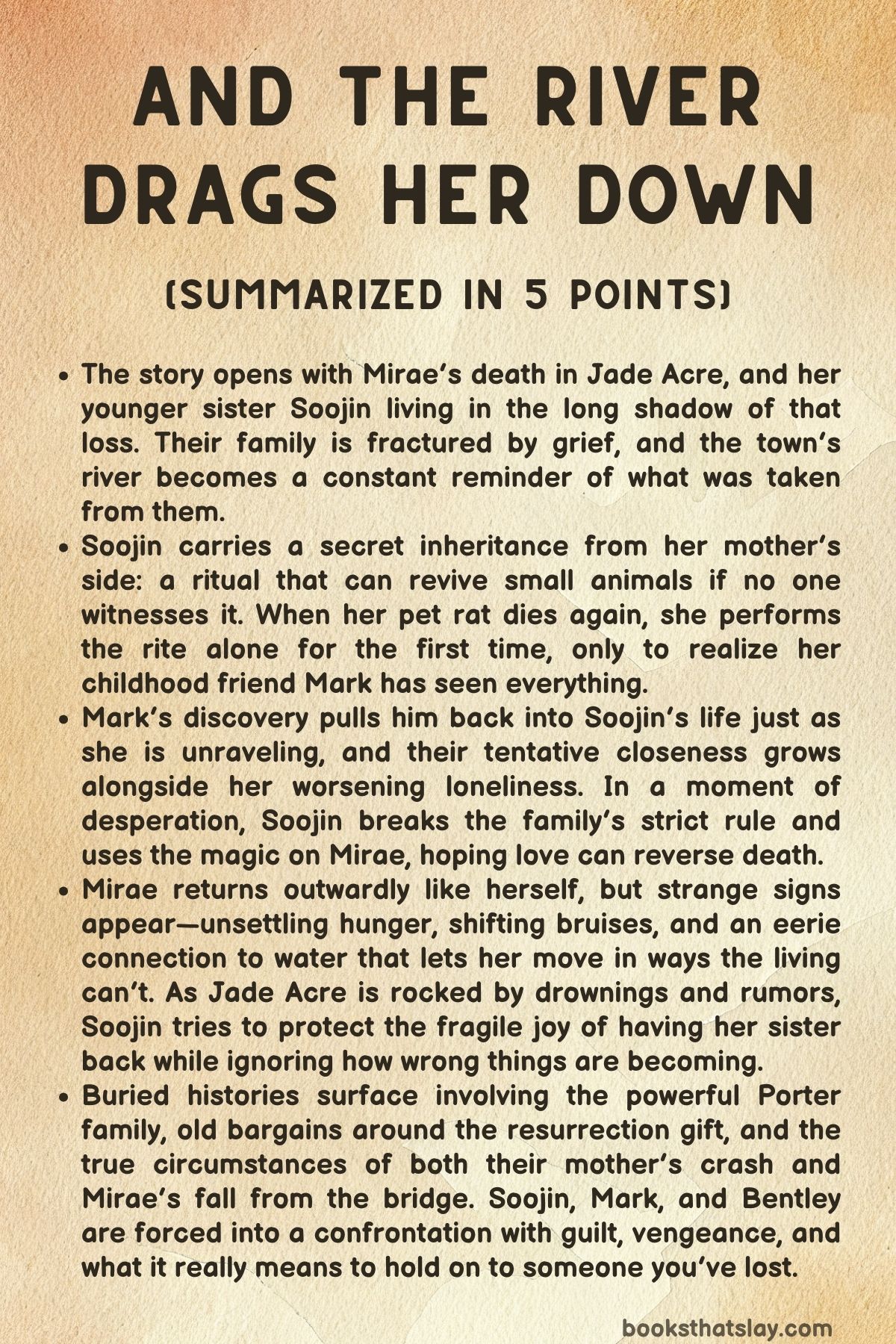
Summary
Mirae narrates the opening moments after her death. On a windy day in Jade Acre, she slips from a trestle bridge into the swollen Black Pine River.
The water takes her fast. Searchers fail to find her for days, and when her body is recovered, images leak online.
Her family grieves in Korean tradition, and her younger sister Soojin is inconsolable. Even in death, Mirae senses Soojin calling for her, and she promises she will return.
Ten months later, Soojin finds her pet rat, Milkis, dead again. This is not the first time; their mother taught the sisters a secret ritual that allows the women of their maternal line to bring small animals back by burying a healthy piece of the body.
Mirae used to handle the hard parts, but now Soojin must do it alone. She cuts off Milkis’s tail, seals it for the ritual, and takes the rest of the body to Peaceful Paws Pet Cemetery.
There she meets Mark Moon, her childhood friend. Mark cremates Milkis for free and notices she has brought “Milkis” before, teasing her gently.
His mother arrives and tries to comfort Soojin about her losses, but Soojin withdraws, uncomfortable with pity, and leaves without the ashes.
Back home in the woods, Soojin performs the ritual in a clearing before rain ruins the ground. She buries the tail, waits with her palms above the soil, and feels the usual signs: a hush in the air, tingling in her hands, and the whispering presence of dead women in her bloodline.
The grass around her drains of life as the earth turns wet and red. Slowly, bone and flesh rebuild until Milkis is whole again, biting her finger in startled life.
Soojin cries with relief, but the moment shatters when Mark steps from the trees carrying soup his mother sent. He has seen everything.
Panicked, Soojin drags Mark inside and makes him stay for dinner to keep him quiet. Mark swears he won’t tell, stunned but curious.
Soojin explains the rules: only one buried part can exist, which is why cremation matters. She makes him discard the ashes and shows him the living rat.
In her room she shares the origin of their power through family stories—an ancestor who resurrected a hen during famine, saving her family but earning the village’s fear. She also tells Mark the darker side: a great-aunt once tried to revive her war-killed brother from a severed finger, and he returned wrong, then died again, taking the aunt’s life with him.
Soojin insists reviving humans is forbidden. Yet she keeps one of Mirae’s baby teeth hidden in a bag, and Mark realizes what she is considering.
He begs her not to try. She lashes out, saying she cannot lose anyone else.
Despite the tension, Mark reaches out. He invites Soojin to a beach bonfire.
Under a clear September sky, they roast marshmallows and laugh for the first time since Mirae’s death. Soojin feels a thin seam of joy reopen.
The mood shifts when older students arrive, including Jay, Mark’s best friend, and Bentley Porter, a wealthy boy Soojin dislikes. Soojin drinks too much, wanting to disappear.
Mark tries to slow her down and leaves briefly to say goodbye to Jay. Bentley sits beside her, points out the Cygnus constellation, and Mirae’s love of stargazing flashes through Soojin.
Bentley’s comments turn cruel. He claims Mirae needed space from her, then says their father must wish the “wrong daughter” survived.
Soojin snaps, elbows him hard, and he nearly falls into the fire. Mark returns and defends her; a fight breaks out before others separate them.
On the drive home Soojin spirals into panic. She jumps out of the car and runs back alone.
Her father is awake, terrified that she has vanished like Mirae. He smells vodka, and Soojin locks herself in her room, deleting his frantic texts.
When he finally enters, exhausted more than angry, she lies that she is fine. After he leaves, she clutches Mirae’s tooth and vomits, hollowed out.
The next day she is late to work and cuts her palm, sent home early. The empty house and her father’s departure for his week away crush her.
The silence feels like a second death. Holding the tooth, she decides she cannot endure this loss.
That night she digs in the woods and performs the forbidden ritual. The ground drains of life, and strange signs erupt—withered plants, a rain of teeth, a thick smell of river mud.
A gray, soaked body forces itself from the earth. Soojin embraces it, believing she has succeeded, and passes out.
At dawn she wakes to Mirae standing nearby, naked but calm, as if only recently woken. Mark, shaken, insists what came out of the ground wasn’t right, but Mirae brushes him off, saying he must have imagined it.
Her normal tone unsettles him into silence. Back at the house, Mirae speaks clearly of her life and drowning, yet struggles to hold her name, practicing it when Soojin writes it down.
Soojin is radiant in a way she hasn’t been in months. She and Mark buy a strawberry cake to celebrate Mirae’s missed eighteenth birthday.
They sing in secret, three of them trying to pretend the world hasn’t tilted.
Yet cracks appear quickly. Mirae hides in a cottage behind the house.
She stares at wallpaper as if it is decaying, but refuses to explain. Her body begins showing bruises that spread and fade unnaturally.
Hunger hits her in waves, fierce and impossible to satisfy. On homecoming night, Soojin wears Mirae’s red dress and feels a bruise bloom on her own wrist.
Mark brings her flowers and takes her to the dance, where for a few hours she feels almost like herself. While Soojin is gone, Mirae waits in darkness and remembers how she became the family caretaker after their mother Sunny died.
Death has changed her: she is bound to water, able to hear voices through rain and pipes and slip through wet places unseen.
Mirae uses that pull to enter Christopher Porter’s house during a storm. Possessing him while he sleeps, she digs through his memories and sees Sunny as a teen resurrecting animals as Christopher watched and later grew greedy for her power.
Mirae tries to reach the truth about Sunny’s death, but Christopher’s mind forces her out. She leaves weak, shaken, and hungrier.
Soon after, she takes revenge on those tied to the past. The police chief Joe Silas and his wife Claire die in their home, both drowned in ways that look like accidents.
Jade Acre panics, whispering about cursed water and ghost stories. Mark hears Korean legends about female water spirits, and Bentley Porter grows frightened, suspecting a connection to his father and to Sunny.
In heavy rain Mark calls Soojin while driving with Bentley. Bentley admits he knows Mirae is alive again.
He explains that their parents were once friends, and that his father Christopher pressured Sunny to use her gift for him. She refused, and after a confrontation on a cliff road, her car went off a ravine.
Bentley overheard Silas confess that Sunny survived the crash at first and begged for help, but Christopher bribed Silas to leave her to die. Bentley says Mirae learned this while resurrecting animals and hearing their mother’s voice.
Soojin is stunned, realizing both deaths in her family trace back to Christopher and Silas.
Bentley then confesses more. He and Mirae had a secret friendship and tried to uncover Christopher’s crimes together.
On the night Mirae died, Bentley texted her to meet at the trestle bridge. They argued, he grabbed her in panic, and she fell.
Silas found Bentley and forced him to erase evidence and stay silent. Bentley insists it was an accident, but his guilt is total.
During the call, Bentley suddenly sees a pale figure in the rain. Mark swerves and crashes.
Mirae appears outside, now in a ghostly water-form. She touches Bentley and reads his memories—his loneliness, their hidden nights together, his betrayal.
Their closeness overwhelms him, and she asks him to come with her into the river so she won’t be alone. He follows, entranced, leaving Mark bleeding in the wreck.
Soojin and her father find the crashed car. Mark wakes and tells them Mirae took Bentley toward Black Pine River.
Guided by the glowing spirit of Milkis, Soojin and Mark race through the woods. At the river, Mirae stands coaxing Bentley into the water.
Her rage is terrible, her need for punishment fused to the river that killed her. Soojin and her father beg her to stop.
When Mirae starts drowning Bentley, Soojin runs in, pries her sister’s hands away, and shouts for Mark to drag Bentley out. Mirae’s river-hair lashes around Soojin and pulls her under.
In the depths, Soojin enters a flood-vision of their childhood home. She finds a younger Mirae during her first period, terrified and alone after Sunny’s death.
Soojin comforts her, and the scene shifts until they are both children. Soojin reveals the buried tooth, forcing Mirae to witness what her return has done: the hunger, the bruises, the killings, the way grief twisted love into possession.
The tooth reappears in Mirae’s mouth, restoring her full awareness. She tells Soojin the only way to free her is to remove that molar and end the magic holding her here.
Soojin agrees, sobbing, and pulls it free. Mirae’s last wish is for the family’s power to leave their bloodline and for Soojin and their father to survive without it.
The vision floods and Mirae dissolves.
Back on the riverbank, Mirae is gone. Mark revives Bentley.
Soojin’s father hauls her up, alive but shaking, the bloody tooth in her hand. Bentley flees.
Soon Christopher Porter and Silas are found dead, and Bentley confesses publicly. With the town’s truth exposed and the magic ended, Soojin and her father pack to leave Jade Acre.
She returns Mark’s hoodie and thanks him; they part quietly, knowing some goodbyes don’t fit into words. On Christmas Eve, Soojin and her father throw the molar into the night sky, believing Mirae’s spirit and their family’s burden are finally released as they drive away from the river and the town that took so much.
Characters
Soojin Han
Soojin is the emotional and moral center of And the River Drags Her Down, a seventeen-year-old navigating layered grief, adolescence, and inherited power. After losing her mother and then Mirae, she lives in a state of raw absence that shapes every choice: she drifts between numbness and panic, craving disappearance at parties yet terrified of being left behind again.
The resurrection gift gives her agency but also traps her in secrecy and fear, because the magic is tied to lineage, gender, and taboo. Her love for Mirae is fierce and complicated—part devotion, part dependency—and that tension drives her to cross the ultimate boundary by resurrecting her sister despite knowing the cost.
Over the story, Soojin shifts from desperate clinging to a more painful maturity: she learns that love without acceptance of mortality can become selfishness, and her final act of pulling the tooth is both a surrender and a grown kind of care. She ends as someone who has looked straight at the worst parts of herself—rage, longing, denial—and still chooses release, which makes her grief transformative rather than terminal.
Mirae Han
Mirae begins as a voice from beyond death and gradually becomes a haunting embodiment of love twisted by betrayal. In life she was the family’s stabilizer, forced into caretaker adulthood early, and her drowning cuts short a girlhood already burdened with responsibility.
When Soojin resurrects her, Mirae returns altered: physically present yet spiritually unstable, marked by insatiable hunger, bruising, and a growing pull toward water that reflects both her death and her new nature. She is not simply “back”; she is a liminal being who remembers everything but cannot fully anchor herself into human normalcy.
Her bond with rain, pipes, and rivers turns her into something like a local myth made real, and her revenge killings show how grief can ferment into predatory justice when memory is fused to elemental power. Yet Mirae is not reduced to a monster—her tenderness with Soojin, her loneliness with Bentley, and her final request to end the family magic reveal a core that still wants mercy more than vengeance.
Her arc is a tragedy of restoration gone wrong: she is both the beloved sister Soojin needs and the consequence Soojin must face, and in the end she chooses release not because she stops loving, but because she loves enough to let go.
Mark Moon
Mark functions as the story’s human conscience and Soojin’s most consistent tether to ordinary life. He is quiet, steady, and observant, someone who shows care through deeds—cremating Milkis for free, delivering soup, driving Soojin home—rather than grand declarations.
His initial calm around death is shaped by his upbringing in a pet funeral home, giving him an unusual comfort with mourning that contrasts with Soojin’s frantic denial. When he witnesses the magic, his fear is real, but what defines him is his refusal to weaponize that knowledge.
Mark’s loyalty is not passive; he argues, pleads, and tries to stop Soojin when he senses danger, and his skepticism about resurrected Mirae is grounded in love for Soojin rather than disrespect for Mirae. He also represents a possible future for Soojin—connection, softness, a life not ruled by secrecy.
Still, he is not a savior figure: he can’t control the supernatural tide, and he fails to protect Bentley or fully understand Mirae’s interior collapse. By the end, his quiet separation from Soojin feels true to his role: a witness who helps her survive the storm, even if he cannot stay in the cleared aftermath.
Bentley Porter
Bentley is a knot of privilege, guilt, yearning, and harm, and his complexity lies in how sincerely all of those coexist. He comes from the town’s ruling family and carries the entitlement and defensive cruelty that power can breed, shown most sharply in his vicious fight with Soojin at the bonfire.
Yet that cruelty masks an inner rupture: he is a boy who knows he helped kill Mirae and has lived inside that knowledge, half-punished by shame and half-protected by his father’s control. His secret bond with Mirae reveals a different Bentley—someone lonely enough to connect with a girl who understood rot beneath beauty, someone who wanted, at least in flashes, to be better than the world he inherited.
His confession to Soojin is not clean redemption; it is an unburdening that comes late, after years of silence, and it forces the reader to sit with the fact that remorse does not erase consequence. In Mirae’s ghost-rain encounter, Bentley becomes the most tragic mirror of the novel’s themes: he longs for absolution, but what he is offered is not forgiveness, it is the seductive pull of drowning with the person he wronged.
His survival and public confession later suggest the story’s insistence on living with what you’ve done, rather than escaping into death.
Christopher Porter
Christopher is the central human antagonist, the embodiment of exploitation disguised as respectability. He is revealed as a man who saw Sunny’s resurrection gift not as sacred family inheritance but as a resource to own, and his greed metastasizes into lethal control.
The memories Mirae extracts show a trajectory from fascination to entitlement, and then to outright violence when Sunny refuses him. His orchestration of corruption with Chief Silas and the abandonment of Sunny after the crash frame him as someone who believes power places him above consequence, even above death.
Importantly, Christopher is not portrayed as a distant villain; his evil is intimate, threaded through friendships, town politics, and paternal influence on Bentley. That everyday proximity makes his crimes feel more chilling—you don’t need monsters when a respected man can quietly decide who lives and dies.
His eventual death off-page fits the novel’s tone: he is swallowed by the same currents he tried to command, a reminder that domination of life and death is always borrowed, never owned.
Sunny Han
Sunny is the quiet gravitational force of the story even in absence, shaping the sisters’ identities through both love and the legacy of magic. She taught Mirae and Soojin resurrection with care and caution, anchoring it in secrecy and responsibility rather than thrill.
Her refusal to resurrect large beings—including her own potential return—marks her as someone who understood the moral boundary the gift demands, and her stance becomes the ethical standard Soojin later struggles against. Sunny’s death is not just a tragedy but a theft: it is the moment when patriarchal greed violently interrupts maternal lineage, making the resurrection gift feel less like a blessing and more like a curse that invites predation.
Her voice through ancestral whispers is also emotionally vital; she becomes the bridge between generations of women, reminding Soojin that grief is shared history, not solitary punishment. In that way, Sunny represents both the tenderness of inheritance and its danger—what mothers give their daughters can save them, but it can also make them a target.
Mr. Han
The father is a portrait of quiet, exhausted love, a man trying to keep a family standing after repeated catastrophes. He is practical, focused on survival through work, but his strict rule about hiding the magic shows his deep fear that the gift will bring more harm than solace.
His grief is understated yet constant, surfacing in late-night worry, church visits, and moments when Soojin resembles Mirae so much it pains him. He is neither fully emotionally available nor cruel—he is a parent who has run out of language for loss and thus clings to routine and discipline.
What makes him moving is how he continues to show up even when Soojin lies, locks doors, or spirals; he chooses fatigue over rage because he understands that anger won’t bring anyone back. In the climax he stands not as an authority figure but as a fellow mourner begging a ghost child to stop, and his decision to leave Jade Acre with Soojin afterward feels like an act of rescue for them both—a commitment to a life not permanently haunted by the town’s river and its crimes.
Mrs. Moon
Mrs. Moon serves as a contrast to the Han family’s guarded isolation. Her warmth is direct, practical, and a little clumsy, the kind of neighborly compassion that tries to feed grief even when grief refuses to be fed.
She doesn’t understand the magic, but she senses pain and responds with food, sympathy, and invitations to lean on community. Soojin’s instinctive recoil from her kindness shows how loss can make help feel like threat.
Mrs. Moon’s role is small but important: she represents a world in which care is offered without secret bargains, and her presence reinforces that Soojin’s exile from ordinary comfort is partly chosen, partly forced by the burden of resurrection.
Jay
Jay is the social spark of the teen world around Mark, a figure of easy charisma and casual risk. He brings the party energy that Soojin both desires and resents, and his friendliness highlights how far she has drifted from normal adolescence.
Jay isn’t deeply developed, but his function is clear: he represents the temptation of forgetting through noise, drinking, and crowd identity. His willingness to break up fights and help get Soojin into the car shows he isn’t shallow so much as unaware of the abyss his friends are standing near.
In a story saturated with secrecy, Jay is what life looks like when you don’t know the secret.
Joe Silas
Joe Silas, the police chief, is a portrait of institutional rot. He is not merely corrupt; he is complicit in murder, choosing money and allegiance to Christopher over the life of Sunny.
His later death by drowning at Mirae’s hands turns the river into a moral executor, but his character matters most for what he symbolizes: the betrayal of public trust, and the way authority can become a shield for the wealthy. The fact that his death is ruled accidental is a final bruise from the system he represented—truth gets buried as easily as bones.
Claire Silas
Claire Silas exists in the story mainly through the lens of Mirae’s vengeance. She is not portrayed as a mastermind, but as part of the domestic world built on Joe’s complicity.
Her drowning feels like collateral punishment for a household steeped in silence, reinforcing the novel’s bleak point that corruption harms not only perpetrators but the lives entwined with them. Her death also intensifies town paranoia about water, feeding the mythic atmosphere Mirae increasingly inhabits.
Margaret
Margaret, Soojin’s boss at the Half Moon Diner, grounds the story’s grief in everyday consequence. She is stern, impatient, and visibly tired of Soojin’s unreliability, but that bluntness comes from the ordinary logic of survival: shifts need covering, customers need service, tragedies don’t stop bills.
Margaret represents the world that keeps moving while Soojin’s life is stuck, and her frustration underscores Soojin’s growing divide between human routines and supernatural obsession. She is not cruel so much as a reminder that grief does not grant immunity from responsibility.
Amber Porter
Amber appears mainly in Christopher’s memories, but her presence adds texture to the Porter household’s coldness. She is part of the domestic legitimacy that allows Christopher’s power to look respectable, and the shadow around her death suggests how even those closest to men like Christopher can become casualties of their secrecy.
Amber’s role is to show that the rot in the Porter family is not limited to one crime or one victim; it is a pattern that poisons everything around it.
Milkis
Milkis, the resurrected rat, is more than a pet—he is the story’s smallest mirror of its biggest questions. His repeated deaths and returns normalize resurrection for Soojin early on, making the later resurrection of Mirae feel like a step on the same staircase rather than a leap into the void.
The ritual with his tail establishes the bodily cost of magic and its parasitic relationship with the environment. When Milkis reappears as a glowing guide near the end, he becomes a symbol of what resurrection can be when kept within bounds: a gentle thread between worlds rather than a chain that drags the living backward.
Milkis’s loyalty to Soojin also reinforces the motif of companionship that persists even through death, but without demanding that death be undone.
Themes
Grief as a living presence
Mirae’s death is not treated as a closed event but as something that keeps occupying space in Soojin’s mind, body, and daily routine. The story begins with a loss so public and grotesque that it refuses to stay private: the search, the delayed discovery, the photos spreading online.
That violation shapes how Soojin experiences mourning. She is not only sad; she is angry, defensive, and reflexively guarded when others offer sympathy, because grief in Jade Acre feels like spectacle.
Her refusal to eat during the funeral rites and her later drinking at the bonfire show grief as a force that distorts self-care and judgment. It doesn’t move in a straight line.
It returns in waves through small triggers—constellations, a red dress, a tooth in a baggie, the quiet of an empty house—making the past feel as immediate as the present. The resurrection ritual becomes an extreme version of what grief already does psychologically: it revives the dead in the mind until the mourner can barely tell what is memory, wish, and reality.
When Soojin brings Mirae back, the relief is real, but the grief doesn’t vanish; it mutates. Instead of absence, she now fears collapse, exposure, and the cost of keeping something unnatural alive.
Mirae’s hunger and bruising mirror the way unresolved loss eats at the living. Even joy is suspect to Soojin at first—laughing with Mark feels like betrayal until he reframes it as survival.
The final river confrontation shows grief reaching its limit. Soojin realizes that clinging to the resurrected Mirae is another form of drowning: it keeps both sisters trapped in a moment that should have passed.
Letting Mirae go is not forgetting her; it is accepting that love can outlast proximity. By the end, grief remains part of Soojin’s story, but no longer the engine driving every choice.
It becomes something she carries without surrendering her future to it.
Inheritance, womanhood, and the burden of care
The family magic in And the River Drags Her Down is an inheritance that arrives wrapped in obligation. It is passed only through the maternal line, with a mythic origin rooted in famine, survival, and whispered accusations of demonic behavior.
That origin matters: the gift was first a tool to keep a family alive when the world was starving, and it required morally hard choices—killing a hen, eating it, bringing it back, repeating the cycle. The women who inherit the power inherit that history of necessity and secrecy.
Soojin and Mirae learn early that their bodies and hands can become instruments of life and death, and that control over resurrection is also control over guilt. When their mother dies, Mirae slips into the caretaker role at eleven, cooking and cleaning, becoming a second parent to Soojin and emotional anchor for their father.
After Mirae’s drowning, Soojin faces the inheritance alone. The first resurrection without Mirae is described as physically draining and frightening, with ancestral voices pressing in around her.
That scene ties womanhood to a lineage that is both empowering and isolating: the only people who can fully understand Soojin’s experience are dead women she can barely grasp. The ritual also steals vitality from surrounding grass, suggesting that inherited power is never free; it demands some kind of payment from the living world.
Mirae’s return intensifies this theme. She comes back with a body that is failing and a hunger that resembles a wound passed down across generations.
The sisters’ relationship becomes a study in how women are trained to preserve family at personal cost. Soojin hides Mirae’s bruises, hides her killings, hides her fear, because protecting the fragile unit matters more than honesty.
Even their final act—removing the tooth to end the magic—reads like a refusal to keep inheriting a duty that destroys them. Mirae’s last wish is not for revenge but for the power to leave their bloodline, so that Soojin will not have to become the next exhausted caretaker.
The theme argues that inheritance is not only blood and tradition; it is also expectation. True liberation may require breaking the chain, even if that chain once kept an ancestor alive.
Secrecy, complicity, and the corrupt uses of power
Nearly every major conflict is propelled by secrets: who knows the magic, what the Porters did to Sunny, what happened on the trestle bridge, what Soojin has chosen to do in her own backyard. The family’s rule—no one must ever see the resurrection—starts as protection, but secrecy becomes a way of life that shapes morality.
It teaches Soojin that survival depends on hiding the truth, and that hiding the truth is worth almost any cost. That belief makes her vulnerable to manipulation by people like Christopher Porter and Silas, men who build their own power through concealment.
Their corruption is not abstract; it is intimate and deadly. Sunny’s refusal to share the magic leads to harassment, a chase, and a crash that could have been survived if the police chief had acted like a protector rather than a bought witness.
Mirae’s death repeats the pattern: Bentley’s panic, Silas’s cover-up, Christopher’s intimidation, and the town’s easy acceptance of “accidents” show how secrecy spreads through a community until it becomes a shared lie. Bentley’s role is especially sharp.
He is not a cartoon villain; he is a terrified teenager who chooses silence to keep his father’s love and status. That choice makes him complicit, and his guilt corrodes him from inside.
Mark, by contrast, represents the risk and value of breaking secrecy. He sees the ritual, is brought into the circle, and tries to be a moral tether.
His fear is not irrational; he has watched what happens when secrets stay buried. Yet he also understands that exposure without care could destroy Soojin.
The narrative keeps asking what secrecy protects and what it enables. Soojin’s own secret resurrection protects her from loneliness, but it enables Mirae’s violence and traps them both in danger.
The town’s secrets protect the Porters’ wealth, but enable murder and the slow poisoning of communal trust. When truths finally surface—Bentley’s confession, the deaths of Christopher and Silas—the story suggests that secrecy is not neutral.
It is a structure of power. Ending it is painful, but necessary to stop harm from repeating.
By leaving Jade Acre, Soojin chooses a life where survival does not require constant concealment, a life not governed by someone else’s hidden crimes.
Love, sisterhood, and the ethics of letting go
Soojin’s love for Mirae is fierce and messy, shaped by childhood dependence and the vacuum left by their mother’s death. Their bond is not idealized as purely nurturing; it carries resentment, protectiveness, and the ache of roles forced on them too early.
Mirae became a caretaker, which meant she loved Soojin through responsibility as much as affection. Soojin loved Mirae as a shelter from grief and as a guide into adolescence and magic.
After Mirae dies, love becomes action rather than feeling. Soojin’s decision to resurrect her is not presented as heroic or monstrous in a simple way; it is the raw logic of a grieving teenager who cannot bear another empty chair in the house.
The ethical tension is that love can be selfish without ceasing to be love. Soojin revives Mirae for Mirae, but also for herself, and the story does not let her forget that.
Mirae’s return exposes love’s limits. She is alive, yet altered—haunted by water, starving for something she cannot name, increasingly driven by rage.
Soojin responds by doubling down on loyalty, hiding bruises and bodies alike to preserve a fragile reunion. Her love becomes a form of control, because admitting the truth might mean losing Mirae again.
Mark’s growing connection with Soojin acts as both comfort and mirror. He offers a different kind of love—steady, present, willing to argue when something is dangerous.
Through him, Soojin learns that caring for someone does not require erasing one’s own needs or pretending everything is fine. The climax forces the deepest ethical question: can you love someone while refusing what they have become?
In the river vision, Soojin sees Mirae’s loneliness in childhood and Mirae sees Soojin’s future grief, and they meet in a space where blame softens into understanding. Pulling the tooth is a brutal kind of tenderness.
It is choosing Mirae’s peace over Soojin’s desire, and choosing truth over fantasy. Mirae’s final wish for the magic to leave the family is another act of love that refuses to cling.
The sisters’ story argues that love is not proven by keeping someone with you at any price. Sometimes it is proven by giving them back to the place where they can rest, even when your arms are empty afterward.
Water, vengeance, and the search for justice
Water in And the River Drags Her Down is not background scenery; it is a force that shapes identity, memory, and consequence. Mirae dies in Black Pine River, and the manner of her death defines her afterlife.
She hears voices through rain and pipes, moves through water, and kills by filling lungs with river silt. This makes water a conduit between worlds, but also a medium of anger.
The town begins to fear water as accidents multiply, echoing folklore of female water ghosts who return when wronged. That folklore frames Mirae’s transformation as part of a cultural memory about women who were silenced in life and refused silence in death.
Her vengeance is not random. She targets people tied to the family’s destruction—Silas and his wife, Christopher Porter, and eventually Bentley.
The killings expose a gap between legal justice and moral justice in Jade Acre. The law is compromised; the police chief is paid off; wealth bends reality.
In that environment, vengeance becomes a substitute for a system that failed. Yet the narrative refuses to romanticize revenge as healing.
Mirae’s hunger grows with each act, and her body deteriorates. Her rage binds her to the river and to the moment of betrayal, turning her into something she never wanted to be.
Bentley’s fate shows how vengeance can blur guilt and victimhood. He caused Mirae’s fall by grabbing her, then chose silence under pressure.
He is responsible, but he is also a son trapped in a cruel hierarchy. Mirae’s impulse to take him into the river so she won’t be alone shows vengeance shifting into loneliness seeking company.
Soojin’s intervention becomes a moral turning point. She recognizes that killing Bentley will not free Mirae; it will only tighten the knot between death and anger.
By embracing Mirae underwater instead of fighting, she enters her sister’s damage and refuses to treat her as a monster. The vision that follows turns water into a space of truth, where past and present meet and where the cost of revenge becomes clear.
Justice, the story suggests, is not achieved by repeating pain. It is achieved when the truth comes to light and the living choose a different path.
Mirae’s release, Bentley’s confession, and the family’s departure together show water’s final meaning: not only a site of death, but a boundary that must be crossed to move from vengeance to freedom.