And Then There Was the One Summary, Characters and Themes
And Then There Was the One by Martha Waters is a light, witty village mystery with a strong romantic thread. Set in the tiny English hamlet of Buncombe-upon-Woolly, it follows Georgiana “Georgie” Radcliffe, a practical young woman who keeps getting pulled into solving crimes despite desperately wanting a quieter life.
When a new death occurs and is brushed off as natural, Georgie can’t ignore the pattern of violence staining her community. Enter Sebastian Fletcher-Ford, a charming Londoner sent in place of a famous detective. What begins as reluctant teamwork turns into a sharp, funny partnership that tests Georgie’s resolve, Sebastian’s self-image, and the village’s secrets.
Summary
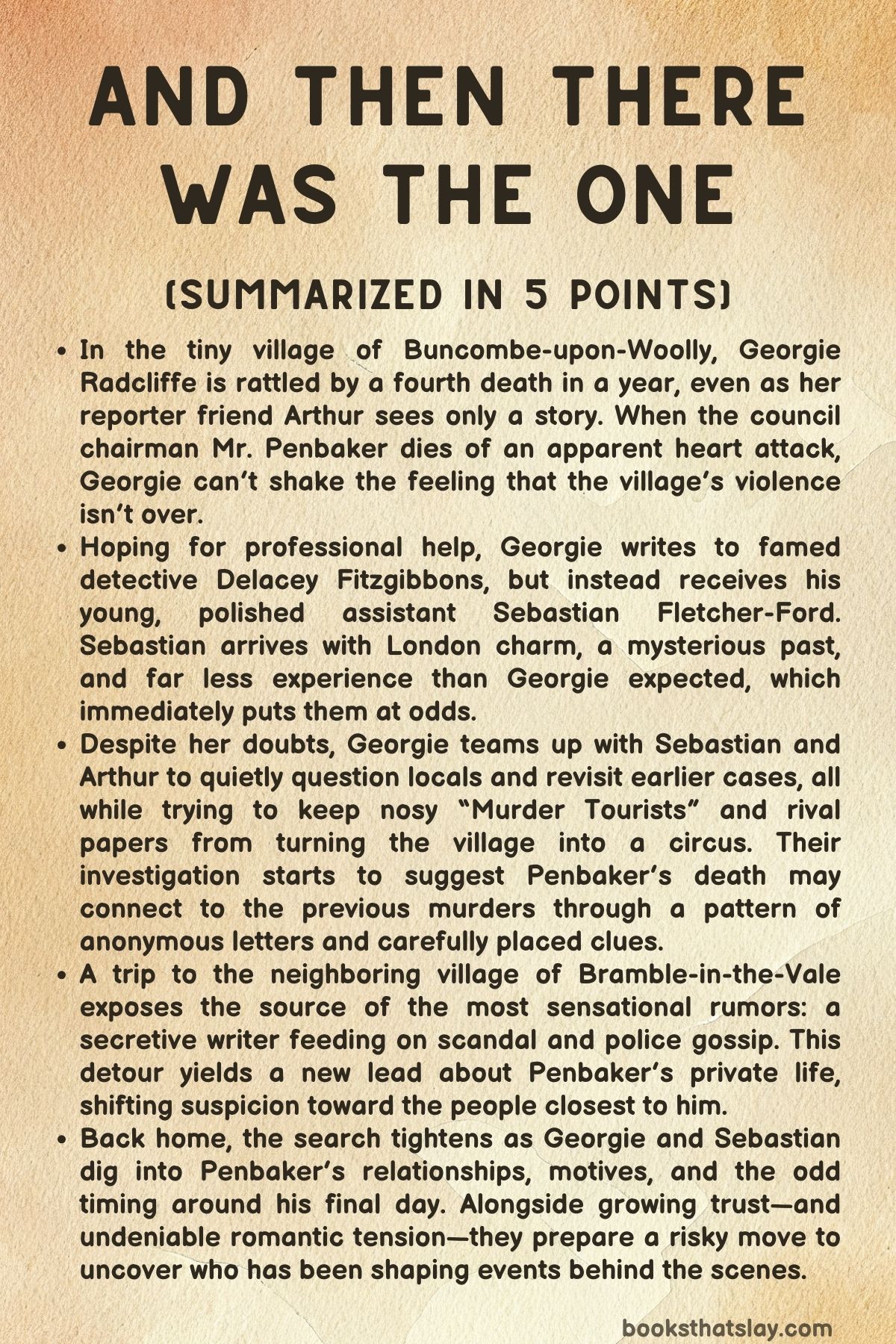
Georgie Radcliffe is standing in front of Mr. Marble’s cheese shop when Constable Lexington arrests Mrs. Marble for poisoning her husband. The scene rattles Georgie more than she wants to admit.
Buncombe-upon-Woolly is tiny, and this is now the fourth violent death in a single year. Her friend Arthur Crawley, a reporter for the local paper, reacts very differently: he’s excited by the flow of stories the murders provide.
Georgie lists the earlier deaths—the vicar, the Fieldstones, and a killing at Radcliffe Hall during Christmas—while Arthur cracks jokes about headlines. Their banter has an edge.
Georgie helped solve the earlier cases through her knowledge of plants and poisons, something she insists is ordinary sense, while Arthur enjoys teasing her for studying weeds like they’re a second religion.
At the village library, Georgie searches botany books to reassure herself she hasn’t missed any details, while Arthur checks old newspapers for crime patterns. The librarian, Miss Halifax, invites Georgie to a crime-novel book club that has sprung up because of the murders.
Georgie refuses; she’s sick of murder changing her life. Back at Radcliffe Hall, her younger sister Abigail is being theatrical in a nightgown and hinting she should send for Dr. Severin, the handsome village doctor.
Georgie suspects Abigail wants attention more than treatment. When she mentions Mrs. Marble’s arrest, Abigail is shocked, insisting Mrs. Marble always seemed kind.
Alone in her turret room with her elderly beagle Egg, Georgie tries to convince herself the case is over, but the village’s new reputation and the flood of gawking visitors make her uneasy.
Two weeks later, the village council chairman, Mr. Penbaker, dies at home after sudden chest pain. Dr. Severin rules it a heart attack, and the county police accept the verdict without question.
But Georgie can’t shake the feeling that Buncombe is seeing more than bad luck. In the Shorn Sheep pub, she and Arthur trade theories until Constable Lexington admits he shares her suspicion, even if his superiors don’t.
Georgie feels responsible for the village’s welfare; her family has been its steward for generations, and another scandal could ruin Buncombe entirely. She also notices tourists clustering with copies of a vicious rival broadsheet, The Deathly Dispatch, written by an anonymous “Agent Arsenic” who keeps publishing wild theories about the murders.
Arthur hates the paper for stealing readers and stirring hysteria.
Arthur suggests calling in a professional private detective, so Georgie writes to Delacey Fitzgibbons, a famous former Scotland Yard investigator. To her surprise, Fitzgibbons replies quickly, refusing to come himself but sending an assistant, Sebastian Fletcher-Ford.
Georgie worries they’ll inflame the county police if they look like they’re undermining the official case, so Lexington urges discretion. The plan is to pass Sebastian off as a visiting friend of the Radcliffes.
When Georgie and Arthur meet the noon train, she expects a severe, seasoned sleuth. Instead, Sebastian steps down looking like he belongs on a London boulevard: young, polished, gorgeous, and carrying expensive luggage.
He briefly mistakes Georgie for hired help and is too breezy to notice he’s offended her. Over tea, they recount all four murders for him.
Sebastian remarks lightly on how often Georgie has been nearby when deaths occur, as if she’s a magnet for trouble. His approach is casual: meet locals, wander about, and appear harmless.
Arthur likes the idea. Georgie, wary and irritated, accepts only because she doesn’t see another way forward.
Georgie gives Sebastian a village tour. His flirtation and easy confidence grate on her, especially when he insists she call him Sebastian for the sake of their cover and retaliates by calling her “Georgiana.” In the pub, Georgie finally presses him about Penbaker’s death and wants real strategy.
Sebastian dodges, then admits a humiliating truth: he isn’t a trained detective. He’s Fitzgibbons’s secretary, sent away because his affair with a policeman’s wife caused a scandal.
Furious at being misled, Georgie storms outside, ready to send him back to London—only to be struck on the head by a falling roof shingle. Sebastian rushes to help, and Georgie realizes she’s not being targeted; the village is simply old and unlucky.
Still, the scare makes her listen when Sebastian bargains for one week to prove himself. Reluctantly she agrees.
Because of her injury, Sebastian is introduced at Radcliffe Hall sooner than planned. Papa is delighted by a Cambridge man staying with them.
Abigail and Mrs. Fawcett, the housekeeper, are immediately charmed. Georgie tries to keep everything professional, but Sebastian’s presence changes the mood of the household.
Over cocktails, they debate Penbaker’s death. Georgie believes poison could mimic a heart attack; Abigail thinks Georgie is seeing danger everywhere.
The next day Georgie and Sebastian start properly. They visit Dr. Severin under the pretense of checking Georgie’s head.
Severin describes Penbaker’s final hours: dizziness, breathlessness, chest pain, then collapse before help could arrive. He noticed nothing suspicious but mentions the Penbakers didn’t seem happy together.
Georgie files that away. At the tearoom they meet two eager visitors, Miss de Vere and Miss Singh, who call themselves “Detective Devotees” and treat Georgie like a celebrity for solving earlier cases.
Georgie finds them exhausting, but their chatter about crime novels and The Deathly Dispatch reminds her how far the village’s notoriety has spread.
At the murder exhibition in the village hall, Georgie is appalled by the tacky displays of the recent killings. Mrs. Penbaker appears to defend the heart-attack ruling and insists her husband had no enemies beyond his public rivalry with Bramble-in-the-Vale, a neighboring village led by Councillor Lettercross.
Penbaker had been obsessed with tourism, and Bramble has benefited from Buncombe’s bad press. Georgie begins to suspect Lettercross may have motive.
They travel to Bramble-in-the-Vale with Arthur and the two Devotees as loud cover. Lettercross swiftly tries to steer tourists away from Buncombe’s “danger.” While he is distracted, Georgie and Sebastian snoop around his office and end up drugged, knocked unconscious, and hidden in a cellar.
When they wake, Lettercross’s daughter Meg confesses she panicked after overhearing them. She is “Agent Arsenic,” the Dispatch writer, and feared Georgie would expose her.
Meg admits she got her details from Detective Inspector Harriday, who has been leaking information to her because they are romantically involved. Instead of public scandal, Sebastian offers a deal: Arthur gets an exclusive interview, Meg keeps Harriday’s name out of print, and Georgie gets answers.
During questioning, Lettercross mentions catching Penbaker with a dark-haired woman in his office—hinting at an affair.
Back home, Georgie pieces that clue together with something else: Penbaker recently became a fan of mysteries and spent time with Miss Halifax, the librarian. Georgie and Sebastian visit Miss Halifax, with Sebastian pretending to be a star-struck tourist desperate to join her book club.
The ruse works. Pressed gently, Miss Halifax admits she and Penbaker had a secret relationship fueled by their shared reading.
She broke it off after he behaved selfishly and skipped her birthday. She insists she didn’t harm him and even suspects someone else might have.
Georgie believes her, leaving Mrs. Penbaker as the likely culprit.
Tensions rise as their investigation continues. Arthur reveals he has a serious job offer in London and has been delaying his choice until the case ends.
Georgie worries everyone around her is ready to leave Buncombe while she remains stuck being its caretaker. Despite friction, the trio plans a final gamble: sneak into Mrs. Penbaker’s home while she is distracted at the village hall.
Before they do, Sebastian draws attention to a pattern Miss Singh casually mentioned: letters have played a role in every murder. Georgie remembers a distinctive smudged “O” on typed notes in earlier cases.
Sebastian recognizes it as a typewriter flaw, and they match it to a letter connected to a past case. The Penbakers’ typewriter produced at least one of the key letters that pushed earlier tragedies forward.
With Mr. Penbaker dead, suspicion sharpens on his wife—unless he was the one behind them all.
They confront Mrs. Penbaker directly. Under pressure, she reveals a stunning truth: she didn’t kill her husband, and Mrs. Marble didn’t kill hers either.
Bertie Penbaker orchestrated the murders to turn Buncombe into a tourist destination. He used typed letters to blackmail, manipulate inheritances, and fan old secrets until other people committed violence.
He also poisoned Mr. Marble himself with arsenic. When Mrs. Penbaker discovered his scheme, he planned to fake his own poisoning with herbal tea and frame her.
But he mislabeled plants in the poison garden and brewed monkshood instead of foxglove. Trying to stage illness, he killed himself by mistake.
Terrified, Mrs. Penbaker hid the evidence and let the doctor assume a natural death.
To clear the remaining suspects, Georgie asks Miss Halifax for the draft of the mystery novel Penbaker had been writing. The pages, along with the typewriter evidence, confirm he authored the manipulative letters.
Constable Lexington finally has enough to free Mrs. Marble and close the chain of cases.
The village celebrates, but goodbye looms. Arthur accepts his London job.
Sebastian says he must return there too. Georgie feels abandoned and bikes away, refusing to look vulnerable.
Sebastian follows, admits he’s falling in love with her, and they argue about what the future could be. Georgie assumes he will forget her in the city; Sebastian insists she is settling for a life too small for her.
The next morning Sebastian turns up at Radcliffe Hall disheveled, announcing he bought a return ticket. He plans to quit Fitzgibbons, start his own agency, and split his time between London and Buncombe.
He asks Georgie to visit London with him for a few days—see gardens, possible apprenticeships, and imagine a broader life. Georgie realizes she has been bored and trapped by duty.
She agrees to go, while encouraging Sebastian to chase work that matters to him. They declare love, kiss, and head upstairs together, relieved that the village is safe again and that this time, the outcome isn’t another funeral but a beginning.
Characters
Georgie Radcliffe
Georgie is the story’s steady center: intelligent, dutiful, and quietly restless under the weight of responsibility. As a Radcliffe and longtime steward of Buncombe-upon-Woolly, she feels personally accountable for the village’s safety and reputation, which drives her back into sleuthing even when she wants no more of it.
Her botanical knowledge is not a quirky add-on but her moral compass and method—she trusts observation, patterns in nature, and practical inference more than gossip or theatrics. Emotionally, Georgie is cautious to the point of self-armoring; she’s been through multiple murders and has learned that curiosity can be dangerous, so she resists both the thrill of investigation and the vulnerability of romance.
Yet beneath the stern surface is someone who wants meaning beyond caretaking and crisis-management. Her arc in And Then There Was the One is a move from reluctant amateur detective to a woman who allows herself ambition, desire, and a future not wholly defined by village duty.
Sebastian Fletcher-Ford
Sebastian arrives as sparkle and irritation—handsome, polished, and apparently unserious—but the plot steadily reveals a more complicated man. He has been trapped by his own charm: raised to be impressive, he becomes skilled at social ease and flirtation yet insecure about being underestimated.
His “secretary” status to Fitzgibbons stings because he once admired real detection, and because it represents a life of near-misses rather than achievements. In Buncombe he uses charm as a tool, not just a habit, showing genuine instinct for people, misdirection, and subtle evidence like the typewriter flaw.
His romantic scandals in London frame him as reckless, but they also underline his hunger for attention and belonging in a world that hasn’t offered him a role he can respect. With Georgie he shifts from performative flirt to something earnest and daring, culminating in his decision to quit Fitzgibbons and risk starting anew.
Sebastian’s arc is the transformation of charm into competence and of drifting into chosen purpose, matched by a love that is not a conquest but a commitment.
Arthur Crawley
Arthur is both comic counterweight and emotional catalyst. As the local reporter, he’s opportunistic about the “crime wave,” which initially reads as callousness but is also a survival strategy in a small-town profession that needs stories to matter.
Arthur treats murders as headlines because that’s his craft, yet he is loyal to Georgie and repeatedly shows up when the stakes rise, agreeing to quietly gather intel and even play risky roles in their investigation. His teasing of Georgie’s botany is affectionate but also a way to keep her grounded, even while he benefits from her skill.
The London job offer exposes his internal tension: he loves his village but yearns for a bigger stage, and his eventual departure is not betrayal but recognition that he cannot shrink his ambitions forever. Arthur’s journey parallels Georgie’s in a gentler key—he chooses a future that fits his talents, showing that leaving home can be an act of honesty, not abandonment.
Abigail Radcliffe
Abigail is Georgie’s foil: theatrical where Georgie is restrained, romantic where Georgie is skeptical, and hungry for attention in ways Georgie has trained herself to avoid. Her feigned ailments and Victorian dramatics aren’t pure frivolity; they signal a young woman stuck in a small village where performance is one of the few tools available for shaping her world.
Abigail’s crush on Dr. Severin and instant fascination with Sebastian show her yearning for glamour, passion, and a story larger than Buncombe’s routines. She also serves as a barometer for the hall’s social temperature, quickly sensing and amplifying tensions that Georgie tries to suppress.
Even when she seems shallow, her warmth and openness create bridges—she charms Sebastian, keeps the household lively, and represents the life Georgie might have had if she weren’t so burdened by duty. Abigail’s presence keeps reminding Georgie that youth, desire, and possibility still exist within Radcliffe Hall.
Constable Lexington
Lexington is the principled local lawman caught between professional limits and personal integrity. He respects procedure but is realistic about the county force’s pride and politics, recognizing that official closure can be more about reputation than truth.
His willingness to admit suspicion about Penbaker’s death, and to quietly collaborate with Georgie and Arthur, shows a humility rare in authority figures in village mysteries. Lexington functions as both ally and conscience: he warns them against provoking Chief Constable Humphreys, highlighting the precariousness of amateur investigation, yet he ultimately uses the evidence they gather to right earlier wrongs, especially Mrs. Marble’s arrest.
His steadiness helps legitimize Georgie’s instincts, and his role underscores that justice in Buncombe depends on cooperation between lived knowledge and formal power.
Delacey Fitzgibbons
Fitzgibbons looms more as myth than presence, the national legend whose reputation shapes others’ expectations. His decision to send Sebastian—partly to remove a scandal liability and partly to keep attention on himself—reveals a man protective of status and perhaps past his sharpest days.
He represents an older model of detection: centralized, celebrity-driven, and unwilling to share the spotlight with apprentices. Even without appearing, he exerts gravitational force on the plot, because Sebastian’s insecurity and ambition are sharpened in contrast to Fitzgibbons’s fame.
In effect, Fitzgibbons is the gatekeeper Sebastian must outgrow, and the reminder that hero worship can become a cage for both admirer and idol.
Dr. Severin
Dr. Severin is the village’s attractive professional figure, but his key narrative role is that of mistaken certainty. He is competent and sincere, yet too willing to accept surface explanations like heart attacks in a village recently rattled by poison.
His affectionate attentiveness to Abigail paints him as a romantic ideal from her perspective, while Georgie’s suspicion suggests he might be naïve or easily manipulated. Severin’s testimony about Penbaker’s death becomes crucial not because he is deceptive, but because his clinical assumptions create the blind spot Bertie Penbaker exploits.
He embodies the danger of expertise that is not paired with imagination, which is why Georgie’s botanical skepticism matters so much.
Mrs. Penbaker
Mrs. Penbaker begins as a chilly widow defending a simple narrative, then unfolds into one of the most emotionally layered characters. Her marriage to Bertie is described as unhappy and complicated, and her initial resistance to murder theories comes from exhaustion, grief, and perhaps fear—not just innocence.
When confronted, she displays sharp bitterness about justice mishandled in the past, showing that she has watched authority fail before. Her confession is not a villain’s reveal but a tragic unburdening: she loved or at least endured a man who turned their community into a stage for bloodshed, and she is left carrying the mess of his ambition and the shame of her silence.
Her decision to hide the truth is partly self-preservation and partly shock, making her morally gray in a way that fits the story’s theme of ordinary people trapped by extraordinary events.
Bertie Penbaker
Bertie is the quiet architect of chaos, a manipulator who prefers ink and suggestion to open violence—until he doesn’t. As council chairman he casts himself as savior of Buncombe through tourism, but his obsession curdles into a grotesque belief that murders are marketing.
The revelation that he orchestrated killings through letters reframes him as someone who weaponizes narrative: he doesn’t just want visitors, he wants a story he controls. His arrogance is central—he thinks he can choreograph death without consequence, even planning to frame his wife, and that hubris literally kills him when he misidentifies poison plants.
Bertie is less a charismatic monster than a bureaucrat corrupted by ambition, which makes him chillingly plausible: a man who convinces himself that human lives are acceptable collateral for the “greater good.”
Meg Lettercross
Meg is a sharp example of the story’s fascination with performance and authorship. As “Agent Arsenic,” she turns tragedy into sensational copy, thriving on rumor and cultivating mystery around her identity.
Her kidnapping of Georgie and Sebastian stems from panic more than malice, showing she is reckless and self-protective rather than homicidal. Meg’s relationship with Detective Inspector Harriday reveals her skill at social engineering; she seduces information out of authority and feeds it to the public, blurring the line between journalism and exploitation.
She is not redeemed so much as negotiated with, reflecting how modern scandal economies persist even when exposed. Meg is a mirror of Bertie in miniature: another person who believes narrative power excuses moral compromise.
Councillor Lettercross
Lettercross plays the role of plausible rival, which makes him a useful decoy in the investigation. His rivalry with Bertie is real—rooted in competing visions for their villages and a personal friendship gone sour—but he is not driven to murder.
Instead, he represents conventional ambition: protective of Bramble-in-the-Vale, proud of its success, and politically wily enough to steer tourists away from Buncombe’s danger. His key contribution is the affair clue, which cracks open Bertie’s double life and forces Georgie to consider motives beyond public rivalry.
Lettercross is a reminder that conflict and ego exist everywhere, but not all rivalry is lethal.
Miss Halifax
Miss Halifax is gentle and discreet on the surface, the kind of librarian who seems designed to soothe communities. The affair reveal recasts her as someone who stepped outside her own rules, seduced less by passion than by shared intellectual intimacy and the thrill of being truly seen.
Her regret is palpable, and her willingness to speak once confronted suggests she still values truth more than reputation. She also subtly symbolizes how crime novels shape reality in Buncombe: she introduced Bertie to mysteries, and his obsession warped into real violence.
Miss Halifax is neither femme fatale nor fool—she is a lonely, intelligent woman who misjudged a man’s character and then had to live with the consequences.
Miss de Vere and Miss Singh
These two “Detective Devotees” are comic on first glance, but they also function as a kind of Greek chorus for the village’s new murder-tourism identity. Their enthusiasm for crime fandom highlights how tragedy can become entertainment, and their idolization of Georgie pressures her into a public role she resents.
Yet they are not merely shallow gawkers; their conversation supplies an essential observation about letters connecting the murders, proving that even amateurs can notice patterns when they’re paying attention. They embody the story’s playful critique of true-crime culture while also acknowledging its odd usefulness.
Mrs. Marble and Mr. Marble
Mrs. Marble is the wrongfully accused widow whose case demonstrates the danger of tidy conclusions. She is mostly offstage, but her shadow carries weight: a local woman sacrificed to the police’s desire for closure and to Buncombe’s raging gossip mill.
Mr. Marble, similarly marginal in presence, matters as proof that Bertie’s ambition escalated to direct killing. Together, they represent the human cost of the village’s transformation into a spectacle, and their eventual exoneration is one of the narrative’s moral repairs.
Papa Radcliffe
Papa is genial, tradition-minded, and eager for anything that affirms the Radcliffes’ dignity. His delight in hosting Sebastian shows his love of old-world manners and status, but also a sincere warmth that keeps Radcliffe Hall from feeling bleak.
He trusts Georgie’s competence while remaining oblivious to the emotional labor she performs daily. Papa’s role is subtle: he is the inheritance Georgie feels she must honor, and also the comforting anchor that makes leaving—or changing her life—feel like betrayal.
His kindness makes Georgie’s internal conflict sharper.
Mrs. Fawcett
Mrs. Fawcett, the housekeeper, provides the household’s practical stability and social glue. She quickly accepts Sebastian, reinforcing the Hall as a place where charm is welcomed and where Georgie’s sternness is not the only tone.
Mrs. Fawcett’s presence signals continuity in village life—the domestic world that keeps running even when murder intrudes. She also quietly validates Georgie as caretaker, reflecting the theme that women’s labor is often invisible but essential.
Detective Inspector Harriday
Harriday appears through Meg’s confession, but his function is important: he personifies institutional weakness under the lure of intimacy and ego. By leaking details to Meg, he enables the Dispatch’s sensationalism and indirectly fuels the village’s feverish atmosphere.
He isn’t presented as evil, just careless and compromised, which aligns with the story’s broader skepticism of authority. His offstage scandal is another example of how private desires distort public duty.
Egg
Egg, Georgie’s elderly beagle, is more than a pet cameo. He is Georgie’s steady companion in solitude, a soft counterweight to her sharp mind and high stress.
Egg’s presence in her turret room and long walks underscores her loneliness and emotional containment—he’s the one being she allows to witness her fears without performance. In a story about people turning murder into spectacle, Egg represents simple, loyal reality.
Themes
Community Under Pressure and the Performance of Safety
Buncombe-upon-Woolly is shown as a place that used to rely on routine, familiarity, and quiet trust, but the run of deaths turns that comfort into something shaky and performative. People keep saying everything is fine, officials want tidy conclusions, and the village tries to move on quickly because acknowledging danger would mean admitting that their shared identity as a safe, sleepy place has cracked.
The speed with which Mrs. Marble is arrested and the relief that follows reveal how badly the community wants closure, even if it is premature. Dr. Severin’s heart-attack ruling and the county police’s refusal to dig deeper extend that pattern: authority prefers calm appearances to messy truth.
Against this atmosphere, Georgie’s unease feels less like paranoia and more like a moral response to denial. The village also starts rearranging itself around the murders, not just emotionally but socially and economically.
The crime-novel club, the murder exhibition, the “Murderous Meander,” and the sudden rise of rival publications all show a community learning to live with fear by turning it into spectacle. Safety becomes a story they sell to themselves and to outsiders.
Even those who dislike the morbid attention, like Georgie, get forced into participating because the village now runs on curiosity and rumor. The tourists represent the outside world reshaping the village’s priorities, pushing locals to either monetize the chaos or resent it.
Meanwhile, the revelation that Bertie Penbaker was manipulating events to generate tourism is the sharpest example of safety as performance: the person charged with protecting civic welfare is willing to manufacture danger for profit. The theme lands in how the village collectively drifts toward accepting staged versions of reality, and how difficult it is for an honest person to insist on uncertainty until the facts are clear.
The story keeps returning to the cost of that insistence: Georgie risks her reputation, relationships, and peace because she refuses to let comfort substitute for truth.
Ambition, Stagnation, and the Fear of Wanting More
Georgie and Sebastian are both people who have learned to downplay their own ambitions, but for different reasons. Georgie has grown into a role of caretaker and steward, tied to Radcliffe Hall, her family name, and a sense of responsibility for village stability.
Her botanical skill gives her pride, yet she describes it as “common sense,” a habit that signals how she has been trained to shrink her expertise into something modest and domestic. She is not just avoiding attention; she is avoiding the vulnerability of admitting she wants a life shaped by her own choices rather than by inherited duty.
Sebastian mirrors that suppression in a flashier form. He jokes, flirts, and acts unserious, but his backstory shows a man who has internalized failure: he scraped through university, disappointed his parents, failed the Foreign Office interview, and ended up in a job that uses his organization rather than his intelligence.
His charm reads as laziness to Georgie at first, yet it is also armor, a way to avoid confronting how stuck he feels under Fitzgibbons’s shadow. Their partnership forces both to face what they have been avoiding.
Georgie sees that competence and leadership are not accidents in her life; she has been doing real investigative work for years. Sebastian sees that his instincts and people-skills translate into actual detective ability when he stops treating himself like a side character.
Arthur adds another angle to the theme. Murder has been a strange career boost for him, and he is tempted by bigger opportunities in London.
His delay in deciding shows the pull between loyalty to place and the desire to grow beyond it. The story refuses to condemn ambition; instead, it frames ambition as necessary for a healthy selfhood.
What is criticized is ambition warped by insecurity or greed, as with Bertie Penbaker’s tourism schemes. By the end, both Georgie and Sebastian move toward growth without throwing away their roots.
Sebastian chooses to quit, start his own agency, and build a life that is not dictated by someone else’s ego. Georgie chooses to test the world beyond the village, not as an escape but as a chance to see who she becomes when she is not required to manage everything for everyone else.
The theme is less about leaving home and more about granting yourself permission to imagine a bigger life, even when that imagination feels selfish or frightening.
Truth, Storytelling, and the Ethics of Curiosity
Nearly every conflict in the plot is tied to who controls the story of the murders and why. Arthur and Meg Lettercross represent storytelling as profession and as power.
Arthur wants facts, headlines, and readership, and although he is sometimes insensitive, he cares whether the record is accurate. Meg, as “Agent Arsenic,” shows the darker side: she uses rumors, exaggeration, and police leaks to fuel a narrative that keeps people hooked.
Her kidnapping of Georgie and Sebastian is extreme, but it grows out of the same impulse that makes the murder exhibition so unsettling: the belief that real suffering can be justified if it produces a good story. The tourists occupy a more innocent version of that ethics problem.
Miss de Vere and Miss Singh are enthusiastic, supportive, and not malicious, yet their fandom turns living tragedy into entertainment. Their excitement pushes Georgie to confront how fame and attention can flatten victims and suspects into characters.
Bertie Penbaker is the final and most corrosive form of this theme. He does not merely exploit stories; he engineers reality so that the stories will exist.
His letters function as narrative triggers. He manipulates people into violence, counting on predictable motives—inheritance, blackmail, secrets, shame—to turn private tensions into public drama.
The recurring typewriter clue underlines that all these events are connected by authored text. It is not chance but writing that knots the murders together.
Georgie’s approach to truth stands in contrast. She uses observation, plant knowledge, and pattern-thinking to reconstruct events, but she resists turning them into spectacle.
Her refusal to join the crime-novel club and her disgust at the exhibition show someone who understands that curiosity has a moral edge. The story keeps asking what curiosity owes to the people it examines.
Is it enough to be interested, or must interest be paired with responsibility? Arthur’s final exclusive interview deal with Meg offers a compromise: curiosity can serve truth rather than distort it if it is handled carefully.
In the celebration scene, where they explain the scheme to tourists, the village still consumes the story, but now the story is honest. That shift suggests the book is not anti-storytelling; it is anti-dishonesty and anti-profiteering at others’ expense.
The theme settles on a simple but demanding idea: stories shape communities, so the ethics of how you gather and spread them matter as much as the facts themselves.
Love as Trust Built Through Respect Rather Than Fantasy
The romance between Georgie and Sebastian is not treated as a sudden rescue fantasy; it develops through friction, negotiation, and growing respect. At first, Georgie interprets Sebastian’s charm as carelessness and entitlement.
He arrives assuming she is staff, forgets her name, and behaves like a man used to being indulged. Her irritation is not just personal dislike; it is a defense against being reduced to a novelty in someone else’s adventure.
Sebastian, meanwhile, expects to coast on charisma because that has been his survival strategy in London. Their early scenes show how attraction without respect turns quickly into resentment.
What changes is the work they do together. As they investigate, Sebastian proves he can listen and notice details, and Georgie proves she is sharp, brave, and far more capable than she allows herself to claim.
Their banter becomes less about teasing for sport and more about testing each other’s ideas. The kiss in the garden happens only after he acknowledges her intelligence directly and she allows herself to believe he means it.
Even then, the relationship dips into mistrust when Georgie fears he is flirting out of boredom. Her suspicion makes sense given his past scandals and his easy social manner.
His anger also makes sense: he is tired of being seen as shallow. Their intimacy grows because they confront these fears rather than bypassing them.
The night they spend together is framed as mutual choice in a moment of shared conviction, not as a prize for solving the case. After the case, the difficult conversation about leaving shows the relationship under real pressure.
Georgie assumes he will forget her because she measures herself by village limits; Sebastian assumes she is hiding from life because he sees how much talent she is holding back. They hurt each other, but that conflict forces honesty.
His return the next morning, rumpled and without performance, is crucial to the theme. He does not ask her to abandon her world for his.
Instead, he reshapes his own plans, proposing a life that honors her pace and her ties. Likewise, Georgie does not cling to him only as romance.
She pushes him toward work he loves and admits her own boredom and desire for purpose. Love here is built as a partnership of equals: two people choosing each other while also choosing growth.
The theme closes on the idea that lasting affection is not a fantasy of perfect fit, but a trust earned through seeing the other clearly, respecting their autonomy, and being willing to change alongside them.