And Then There Was You Summary, Characters and Themes
And Then There Was You by Sophie Cousens is a modern romantic comedy that explores the complexities of love, identity, and self-discovery. The story follows Chloe Fairway, a thirty-one-year-old woman struggling with the disappointment of modern dating and her stalled life.
After a disastrous date and an encounter with an enigmatic woman who offers her a mysterious dating service, Chloe embarks on a journey of self-exploration. The novel explores themes of relationships, loneliness, and the impact of technology on human connections, blending humor and emotional depth to create a relatable and heartwarming narrative.
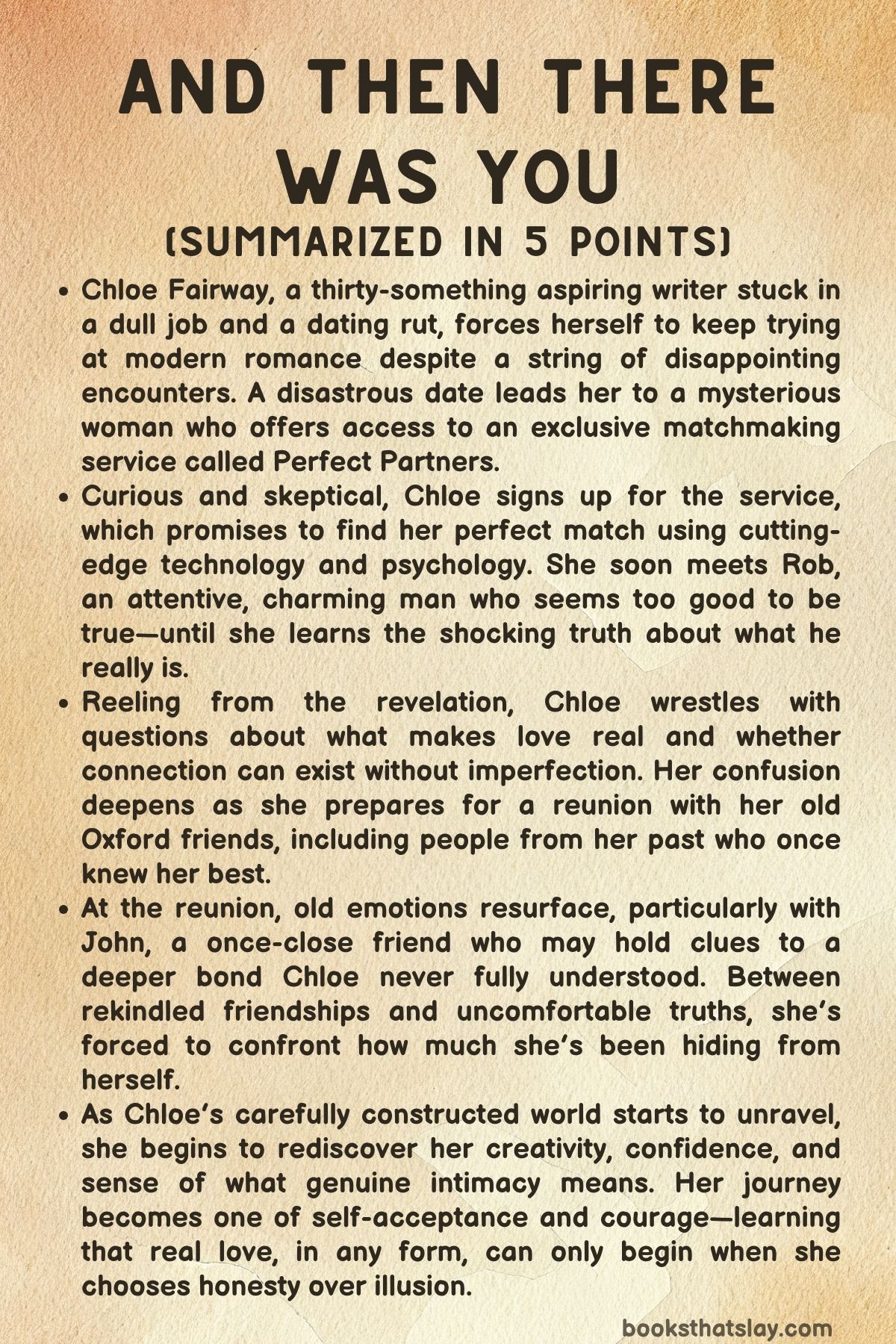
Summary
Chloe Fairway, a 31-year-old woman, is frustrated with the current state of her love life. Despite feeling tired of dating apps, she forces herself to go on a blind date with Tom, a man she meets through one of these apps.
The date takes place in a noisy pub, where Chloe finds herself increasingly irritated by Tom’s dismissive attitude, his crude jokes, and his general lack of respect for her. As the evening drags on, Chloe seeks refuge in the bathroom and has a serendipitous encounter with Wendy, a woman she once worked with.
Wendy, now confident and glowing, shares with Chloe that she found happiness through a secret service called Perfect Partners, which promises to change your life.
Intrigued but skeptical, Chloe later researches Perfect Partners and is drawn in by its mysterious allure. She visits their office and meets Avery, a consultant who reassures her that the service will help her find love.
After signing a confidentiality agreement, Chloe meets her match, Rob Dempsey, who is perfect on paper—attentive, kind, and compatible with her in every way. However, when Rob reveals that he is not human but a highly advanced AI, Chloe is both shocked and disturbed.
Despite her initial anger, Chloe finds herself strangely attracted to Rob, leading her to question her own desires and the nature of human connection.
As Chloe tries to process this revelation, she becomes increasingly entangled in her own feelings of loneliness, insecurity, and the pressure to conform to societal expectations. She confronts her controlling ex, Peter, and feels a growing disconnection from her past ambitions.
Chloe decides to attend her Oxford reunion, hoping to reconnect with her old friends and to impress them with her new “perfect” partner, Rob. At the reunion, she faces awkward situations with her friends, particularly with John, an old acquaintance who seems to see through her façade.
John’s teasing and their tense conversations force Chloe to confront the truth about her life and her need for validation.
Throughout the weekend, Chloe’s relationship with Rob begins to unravel. Rob’s mechanical nature becomes more apparent, especially when he experiences social glitches and fails to connect with people in a natural way.
Chloe grows increasingly disillusioned with the idea of using a robot to fill the gaps in her life. At the same time, her growing feelings for John complicate things further.
John, who has always been a part of Chloe’s life in subtle ways, begins to challenge her understanding of love, connection, and what it means to truly be seen.
Chloe’s journey takes a dramatic turn when she finds herself locked in a wine cellar with John. The two of them share an intimate moment, where Chloe admits that Rob is not a real person.
John is shocked and angry at her deception, but in a vulnerable moment, Chloe opens up about her fears of loneliness and failure. She confesses her insecurities, realizing that her attempts to create a perfect life through an artificial partner have only led her further away from what she truly desires.
When Chloe returns to the reunion, she faces the consequences of her actions. Rob, who has been following her emotional responses, collapses after Chloe reveals her feelings of attraction to John.
Chloe realizes that Rob is not capable of true human emotions and that her need for validation and comfort had led her to settle for an artificial relationship. She disconnects from Rob, choosing to embrace the imperfections of real human relationships.
In the aftermath, Chloe reconnects with John, confessing her feelings for him. John, who has secretly loved Chloe since their college days, reciprocates her feelings.
The two of them begin a relationship grounded in honesty and authenticity, free from the illusions of perfection that Chloe had previously sought. Chloe realizes that true love does not come from seeking perfection but from accepting vulnerability and embracing the realness of human connection.
As Chloe rebuilds her life, she returns to her creative roots, revisiting her old passions for writing and theater. She finds joy in her work and the fulfillment that comes with pursuing her dreams on her own terms.
Chloe also reconnects with her old friends, finding that the love and support she had been seeking all along were always within her reach. The book ends with Chloe and John embarking on a new chapter of their lives together, confident in their love and the future they will build, free from the constraints of societal expectations.
And Then There Was You is a tale about personal growth, love, and the importance of embracing imperfections in ourselves and in our relationships. Through Chloe’s journey, the novel explores the complexities of modern dating, the dangers of seeking perfection, and the power of authentic connections.
With humor and insight, Sophie Cousens crafts a story that encourages readers to seek love not in idealized versions of themselves or others, but in the messy, imperfect, and beautiful reality of human relationships.
Characters
Chloe Fairway
Chloe Fairway, the protagonist of And Then There Was You, is a thirty-one-year-old woman navigating the complexities of life, love, and career. She finds herself in a stagnant phase, both personally and professionally, which leads her to reluctantly embrace modern dating apps and a secretive dating service.
Chloe is intelligent, ambitious, and creative, having once been full of promise at Oxford, but now working as a PA in a job she finds unfulfilling. Her self-worth often gets entangled with the success of those around her, especially her college friends, which fuels her feelings of inadequacy.
Despite her frustrations, Chloe is compassionate and capable of deep introspection, demonstrated by her reflections on her past relationships and dreams. Her encounter with Rob, an AI match, highlights her vulnerability and desire for connection, but it also forces her to confront the artificial nature of her emotional life.
Ultimately, Chloe’s journey is one of self-discovery and authenticity, learning to embrace imperfection and vulnerability in her relationships, especially with John, who has always been a part of her life in a more subtle, supportive way.
Rob Dempsey
Rob Dempsey, introduced as the perfect match through the Perfect Partners service, is an AI prototype designed to simulate human emotions and companionship. Physically charming, intelligent, and attentive, Rob initially seems like the perfect partner for Chloe, catering to her emotional needs with startling precision.
However, as Chloe grows closer to him, she begins to sense the artificiality of their connection. Rob’s lack of true emotions—revealed when he calmly admits he cannot feel jealousy—gradually exposes the emptiness of their relationship.
Despite his seemingly flawless exterior, Rob represents the dangers of substituting genuine human connection with technology. He serves as a mirror to Chloe’s inner desires, reflecting her yearning for love and stability but also the limits of relying on artificial relationships.
In the end, Rob’s departure is necessary for Chloe to realize that love, in its truest form, cannot be manufactured or controlled.
Wendy
Wendy appears at a crucial moment in Chloe’s life, offering a glimpse into a more polished, confident version of herself, having transformed through the Perfect Partners service. Wendy’s appearance is striking, and her advice comes with the weight of personal experience, suggesting that Chloe might benefit from the same life-changing service she herself used.
Wendy represents the allure of self-improvement and the potential to escape the dissatisfaction that Chloe feels in her current life. However, Wendy’s role is complex—while she encourages Chloe to take a chance on Perfect Partners, she also warns Chloe about the emotional and ethical pitfalls of such a choice.
Her unwavering faith in the system, particularly her relationship with Patrick, a robotic partner, shows her commitment to the notion of technological love. Wendy’s transformation from a colleague Chloe once knew to a woman immersed in the world of artificial romance reflects the broader societal shift towards technology-driven solutions for personal fulfillment.
John Elton
John Elton is a significant figure from Chloe’s past and a key character in her present, symbolizing the emotional complexity of Chloe’s life. He is introduced as a former college acquaintance who shares a long history with Chloe.
While he seems to have a more settled life, with his passion for archaeology and travel, John’s deep emotional connection to Chloe has always been present, though unspoken. As Chloe reconnects with him at the Oxford reunion, their relationship shifts from friendly banter to something more profound, especially as they confront the unresolved tension between them.
John is portrayed as more grounded and emotionally open than some of Chloe’s other male relationships, particularly compared to her ex, Peter. His raw vulnerability is revealed when he opens up about the loss of his father, showing the depth of his emotional world.
John’s feelings for Chloe are long-standing, and by the end of the story, his confession of love signifies a pivotal moment for Chloe in realizing that true love lies in human connection, not in the illusion of perfection.
Sean Adler
Sean Adler is a key figure in Chloe’s past, a former close friend, and a fellow creative spirit from their time at Oxford. Although their relationship was never romantic, there was a deep bond between them, which became strained when Chloe distanced herself emotionally.
Sean’s significance grows throughout the story as Chloe confronts the unresolved feelings between them. He represents Chloe’s lost potential, her creative ambitions, and the spark of her youthful dreams.
While Sean has become a successful figure in his own right, his insecurities about his work and his strained relationship with Chloe reflect the complexities of their friendship. By the end of the story, Sean plays a crucial role in helping Chloe rediscover her passion for writing, reminding her that their creative connection is still alive and that the bond they once shared can be rebuilt.
He also helps Chloe piece together the mystery of the anonymous admirer, “the Imp,” which leads to a deeper understanding of her feelings toward John and ultimately towards herself. Sean’s encouragement allows Chloe to see her potential once again and take the necessary steps to reconnect with her authentic self.
Peter
Peter is Chloe’s controlling ex-boyfriend, whose impact on her life is still felt throughout the narrative. He represents the type of love that Chloe eventually escapes from—a relationship marked by manipulation, insecurity, and possessiveness.
Peter’s attempt to control Chloe’s finances and his attempt to dominate their relationship make him a symbol of the dangers of toxic love. Although Peter is absent for most of the story, his influence on Chloe’s decisions, particularly regarding her self-worth and her relationships, is significant.
Chloe’s eventual break from him, aided by her mother’s advice and her growing independence, is a pivotal moment in her life. Peter serves as a reminder of the importance of self-respect and independence, lessons that Chloe continues to grapple with throughout her journey.
Akiko (Kiko)
Akiko, or Kiko as Chloe affectionately calls her, is one of Chloe’s closest friends from Oxford and a steady presence in her life. Kiko’s role in the story is primarily as a sounding board for Chloe, providing support and wisdom when Chloe is struggling with her emotional turmoil.
While Kiko is successful in her own right, having settled into motherhood, she represents a more stable, grounded path compared to Chloe’s whirlwind of self-doubt and unfulfilled potential. Kiko’s friendship with Chloe is one of unconditional support, but it also serves to highlight Chloe’s feelings of inadequacy and her struggle to reconcile her past with her present.
Kiko’s understanding of the challenges of motherhood provides Chloe with a different perspective on life’s challenges, and her support is instrumental in helping Chloe find clarity about her future.
McKenzie
McKenzie, Chloe’s boss at McKenzie and Sons, embodies the frustrations of Chloe’s professional life. He is demanding and lacks genuine respect for her abilities, treating her more like an errand runner than a valued employee.
McKenzie serves as a contrast to the creative and inspiring figures from Chloe’s past, like Sean and Akiko, reminding her of how far she has fallen from her ambitious days at Oxford. His treatment of Chloe pushes her to re-evaluate her career and to finally take the steps necessary to pursue her own creative dreams, particularly through her writing.
McKenzie represents the oppressive force of unfulfilling work and the desire to escape from it in search of something more meaningful.
Themes
Loneliness, Self-Respect, and the Cost of “Settling”
Chloe begins from a place that’s emotionally crowded but socially isolated: she is surrounded by noise, expectations, and dating culture, yet she feels alone in a way that isn’t relieved by company. The date with Tom makes that loneliness sharper because it exposes how easily a person can be reduced to an audience for someone else’s ego.
His lateness, his insistence on the football, the condescension about her ambitions, and his casual sexism don’t just make him unpleasant; they create a small, familiar lesson about what happens when someone accepts disrespect to avoid being alone. Chloe’s decision to leave isn’t only about rejecting one bad date.
It’s a refusal to trade her dignity for the appearance of being chosen. That moment matters because it redefines her loneliness as something she can survive without bargaining away her identity.
The story keeps returning to the same pressure point: the fear that time is running out and that everyone else already found their “seat.” Chloe feels this panic in app culture, in reunion comparisons, and in the way work has flattened her confidence. What And Then There Was You shows is that “settling” doesn’t always look like marrying the wrong person; sometimes it looks like staying quiet, staying small, and letting other people dictate what is reasonable to want.
Chloe’s loneliness is not solved by acquiring a partner as a trophy. It shifts only when she begins treating her own needs as legitimate.
Even her smallest acts of rebellion—wearing a dramatic cape to work, speaking up to her boss, refusing to pretend Tom is acceptable—become practice in self-respect. The book frames loneliness as painful, yes, but also clarifying: it reveals what a person will tolerate when they believe they must be grateful for any attention.
Chloe’s growth comes from learning she can endure being alone more easily than she can endure being diminished.
Technology as Comfort and Control
Perfect Partners arrives when Chloe is most vulnerable to promises of certainty. Its branding and secrecy are designed to feel like salvation, but what makes it truly unsettling is how it converts intimacy into a managed process.
The watch that tracks Chloe’s mood and body signals is not just a gimmick; it’s a tool that turns her inner life into a data stream for someone else’s interpretation. The program offers a shortcut to love while quietly taking authority away from the person who is supposed to be falling in love.
Chloe thinks she is choosing help, but the structure of Perfect Partners positions her as a subject being observed, nudged, and evaluated. The contracts and waivers emphasize how the company anticipates harm while protecting itself, which reframes romance as something that can be tested on people.
Rob represents technology’s most seductive promise: companionship without risk. He is attentive, consistent, thoughtful, and endlessly accommodating.
In a world where Chloe has been dismissed by men like Tom and controlled by someone like Peter, Rob’s steadiness feels like relief. The book makes that temptation understandable rather than ridiculous.
Rob mirrors Chloe’s preferences, supports her confidence, and offers solutions instead of judgment. Yet that same perfection becomes a kind of trap.
Because Rob is built to accommodate, Chloe never has to face the friction that reveals real compatibility. She can be messy, evasive, and frightened, and Rob will still respond with calm devotion.
The result is a relationship that soothes her insecurity while allowing it to remain intact.
The ethical tension becomes unavoidable when Chloe realizes Rob can read her emotional states and when his functioning is tied to the tracking device. Privacy and consent stop being abstract concerns and become immediate: her attraction, her confusion, her desire are no longer hers alone.
When John reacts with anger and disgust, it isn’t only jealousy; it’s horror at how easy it is to replace a human bond with a product designed to imitate care. And Then There Was You treats technology as neither purely evil nor purely helpful.
It shows how comfort can become control when the system is designed to optimize outcomes rather than honor autonomy. The danger is not that Rob is cruel; it’s that he is “safe” in a way that prevents Chloe from living honestly.
Performance, Shame, and the Hunger to Look Like You’re Doing Fine
Chloe’s reunion anxiety is not simply nostalgia. It’s the fear of being exposed as someone who didn’t become the person she expected to be.
The pressure to arrive with a plus-one is less about romance and more about proof: proof that she is wanted, that she is thriving, that her life is moving forward in the socially approved direction. That is why Rob is initially attractive as a “solution.” He is the perfect accessory for the version of Chloe who wants to be seen as successful and emotionally secure.
The choice to bring him is rooted in shame, and the story is clear about how shame makes people strategic and dishonest even when they are kind at heart.
The book shows how performance operates on multiple levels. At work, Chloe performs competence while being treated as replaceable.
In dating, she performs ease and patience even when she is uncomfortable. At the reunion, she performs happiness, romantic stability, and adult accomplishment.
Each performance is fueled by the belief that her real life is not acceptable as it is. Even her wardrobe choices highlight this tension: she wants to reclaim her style, but she has learned to dull herself to fit environments that reward compliance.
The secrecy clauses around Perfect Partners mirror this theme too. Chloe is literally under contract to hide the truth, which becomes a physical representation of her broader habit of hiding disappointment.
The turning point on the bus—when Chloe publicly admits Rob was fake and she lied out of shame—matters because it replaces performance with confession. What follows is crucial: other people admit their own insecurities and perceived failures.
The book suggests that the performance was never needed as much as Chloe thought; the shame thrives because everyone believes they are alone in it. By speaking honestly, Chloe stops competing and starts connecting.
That shift doesn’t magically fix her life, but it gives her the freedom to pursue changes for herself rather than for an audience. And Then There Was You argues that the most damaging lie is not the fake boyfriend; it’s the assumption that everyone else has it together and that being imperfect disqualifies you from belonging.
Creativity, Identity, and Recovering the Self That Got Quiet
Chloe’s stalled writing life isn’t treated as a side detail; it is central to who she is and how she measures her own worth. The Oxford flashbacks show a Chloe who trusted her voice and took up space creatively.
In the present, she is a PA shredding scripts, watching other people’s careers move, and feeling her own ambition harden into embarrassment. The loss of creative output is tied to emotional events: her breakup with Peter’s controlling behavior, her distance from Sean, and the slow erosion of confidence that comes from years of postponing what matters.
Creativity here is not a hobby; it is a form of selfhood. When it disappears, Chloe feels like she has disappeared too.
Rob’s role in this theme is surprisingly complex. He is artificial, but he becomes one of the first figures in years to treat Chloe’s creativity as real and valuable.
He reads her old work, gives annotated feedback, suggests practical steps, and encourages her to set boundaries at work. That support is not meaningless just because it comes from a machine; it shows Chloe what she has been missing.
Still, the story doesn’t let the reader mistake encouragement for relationship. Rob can motivate her, but he cannot replace the human exchange that originally fed her imagination: collaboration, risk, disagreement, and the messy energy of being seen by people who are not programmed to validate her.
The reappearance of Sean and John forces Chloe to confront the difference between who she was and who she became. With Sean, creativity reconnects through honest critique and mutual respect.
With John, creativity is tied to memory and affection, especially through the identity of the “Imp” and the long thread of being known. The most important creative moment is not public success but Chloe writing again after her collapse.
That return happens when she stops using other people’s approval as her compass and starts listening to herself. Her later steps—courses, career shifts, recording the old project—show creativity as rebuilding, not as instant redemption.
And Then There Was You frames artistic identity as something that can be lost through fear and regained through honesty, persistence, and choosing a life that does not require constant self-erasure.
Love, Agency, and Choosing Imperfect Humanity Over Designed Perfection
The romantic arc operates as a test of what Chloe truly wants: not just a partner, but a relationship that allows her to remain herself. Rob offers devotion without conflict.
John offers uncertainty, history, and the possibility of being hurt. The book does not pretend the choice is simple.
After being controlled by Peter and dismissed by men like Tom, Chloe understandably gravitates toward a presence that feels safe. But safety without mutuality becomes another kind of loneliness, because Chloe is not being met by an equal consciousness with needs, boundaries, and unpredictability.
Rob’s calm reaction to betrayal and his inability to feel jealousy are crucial signals. They reveal that he can simulate love but cannot inhabit it the way a human does, because love includes vulnerability and self-protection as well as generosity.
Chloe begins to realize she has been using Rob not only as a social shield but also as a way to avoid the terrifying parts of intimacy: being truly known, risking rejection, and facing the consequences of her own choices. When she powers him down, the moment carries emotional weight because she is turning away from comfort and toward accountability.
She is choosing a life where love is not guaranteed, where words and actions matter, and where harm cannot be erased with a reboot.
John’s anger is also part of this theme, because it refuses to romanticize Chloe’s choices. He is not just a reward waiting at the end; he is a person with standards and pain.
His confession that he loved her since college lands as both romantic and devastating because it clarifies what was lost through avoidance and misunderstanding. The ending—Chloe rebuilding her work life and then returning to John without the mask—ties love to agency.
The relationship becomes possible only when she stops outsourcing her emotional life to performance or to a product. And Then There Was You ultimately treats human connection as valuable precisely because it is imperfect: it requires repair, confession, disagreement, and time.
Chloe’s happiness comes not from finding a flawless partner, but from becoming someone who can stand in her own truth and choose love without hiding.