Animal Farm Summary, Characters and Themes
Animal Farm by George Orwell is a political fable about power, revolution, betrayal, and the way noble ideas can be corrupted by those who seek control. Set on a farm where animals overthrow their human owner, the book uses a simple story to expose how oppression can return under a new name.
Orwell presents the rise of tyranny through animals who begin with hopes of equality but slowly lose their freedom to manipulation, fear, and propaganda. Though brief and direct, this classic remains one of the sharpest warnings about leadership without accountability.
Summary
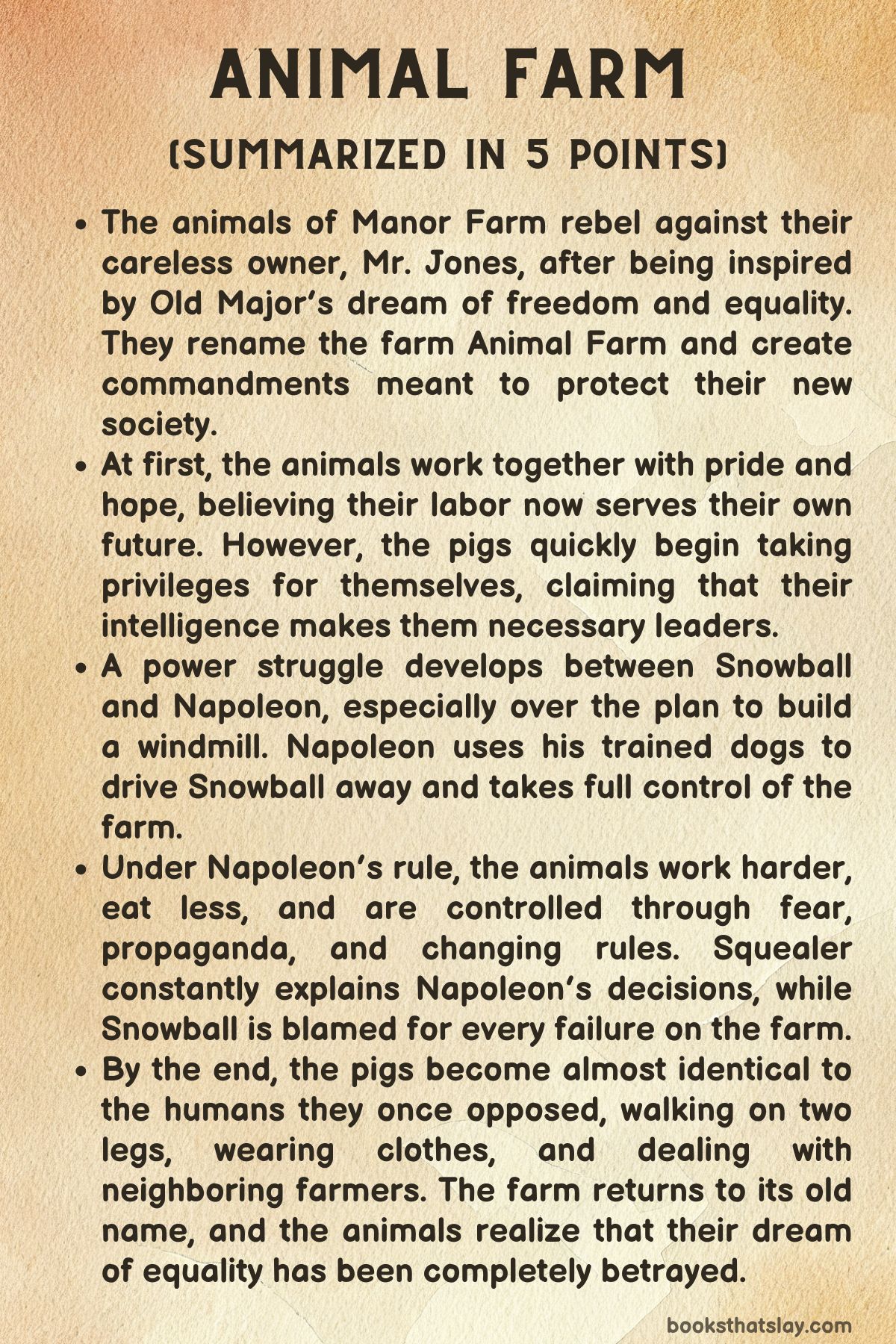
Animal Farm begins on Manor Farm, where the animals live under the careless rule of Mr. Jones. Jones drinks heavily, neglects the farm, and treats the animals as tools for his own benefit.
One night, after he goes to bed, the animals gather in the barn to hear Old Major, a respected old boar, speak about his vision for a better future. Major tells them that humans are the source of their misery because they take everything the animals produce while giving them only enough to survive.
He urges them to rebel one day and build a society where animals are free, equal, and no longer exploited.
Major’s words inspire the animals deeply. He teaches them a song about liberation, and for a moment the barn fills with hope and unity.
Though Jones interrupts the gathering by firing a gun, the idea of rebellion has already taken root. After Major dies, the pigs, who are the cleverest animals on the farm, develop his teachings into a system called Animalism.
Snowball, Napoleon, and Squealer become its chief organizers. They teach the other animals that all animals are comrades and that humans must be overthrown.
At first, many animals struggle to understand the ideas fully. Mollie, a vain horse, worries about sugar and ribbons, while Moses the raven speaks of a paradise called Sugarcandy Mountain.
Still, loyal workers like Boxer and Clover accept the cause sincerely. Boxer, a powerful cart horse, becomes especially important because of his strength, patience, and simple faith in the movement.
The rebellion arrives sooner than expected. Jones and his men neglect the animals so badly that hunger drives them to break into the food store.
When the men try to beat them back, the animals rise together and chase them off the farm. Manor Farm becomes Animal Farm, a place meant to belong entirely to animals.
They destroy the tools of human control and write the Seven Commandments on the barn wall, the most important being that all animals are equal.
The early days after the rebellion are full of excitement. The animals work hard and bring in a successful harvest.
They feel proud because they are working for themselves, not for a human master. Boxer’s motto, “I will work harder,” becomes a symbol of devotion.
Snowball organizes committees and tries to educate the animals, though many are unable to learn much beyond simple slogans. The pigs, however, quickly begin to place themselves above the others.
They take the milk and apples for themselves, claiming that their brainwork requires special nourishment.
News of the rebellion spreads, alarming nearby farmers. Jones and other men eventually try to retake the farm, but the animals defeat them in a violent battle.
Snowball plays a brave and strategic role, and the animals celebrate their victory as proof that their new society can defend itself. Yet the success also increases the importance of leadership, and a rivalry grows between Snowball and Napoleon.
Snowball wants to build a windmill that will generate electricity and make life easier for everyone. Napoleon opposes the plan, but his real concern is power.
During a meeting, he releases a group of fierce dogs he has secretly raised from puppies. The dogs chase Snowball away, and Napoleon takes control.
He ends public debates, cancels open meetings, and announces that a small committee of pigs will make decisions for all. Squealer, his persuasive spokesman, explains each change in a way that confuses and calms the animals.
Boxer, unable to judge the politics around him, adopts a second motto: Napoleon is always right.
Napoleon soon reverses his earlier position and orders the animals to build the windmill after all. The work is exhausting, and the animals labor like servants while receiving little comfort in return.
Napoleon also begins trading with humans through Mr. Whymper, even though dealings with humans had once been condemned. The pigs move into the farmhouse and begin sleeping in beds.
When the animals remember that this violates the commandments, they find the wording has been quietly changed. This pattern continues: whenever the pigs break a rule, the rule is altered to excuse them.
The first windmill is destroyed in a storm, but Napoleon blames Snowball, turning him into a permanent enemy. From then on, Snowball is accused of every problem on the farm.
Food shortages grow worse, but Napoleon hides the truth from outsiders and uses propaganda to convince the animals that conditions are better than they seem. He also begins using fear openly.
Animals are forced to confess to working with Snowball, and Napoleon’s dogs kill them. The killings horrify the others because the rebellion was supposed to create peace and equality, not terror.
The old song of freedom is banned because the pigs claim the rebellion has already achieved its purpose. In its place, the animals are given weaker songs and rituals praising the farm and its leader.
Napoleon builds a public image around himself, accepting titles, honors, and poems. The farm’s original ideals fade as loyalty to Napoleon replaces loyalty to equality.
Napoleon’s dealings with humans become more complicated. He negotiates with neighboring farmers and eventually sells timber to Mr. Frederick, only to be cheated with forged money.
Frederick and his men attack Animal Farm and blow up the rebuilt windmill. The animals fight back and drive the humans away, but many are hurt or killed.
The pigs call it a great victory, although the animals are left with heavy losses. Soon after, the pigs discover whiskey and begin drinking, then alter another commandment so that alcohol is no longer forbidden.
As time passes, the difference between the pigs and the other animals becomes more obvious. The pigs eat better, drink beer, live comfortably, and do little physical work.
The dogs protect them, while Squealer continues to explain that every sacrifice is necessary. The other animals suffer through hunger, cold, and exhaustion, yet they are repeatedly told that life is better than it was under Jones.
Boxer remains the most loyal worker. Even after being injured, he pushes himself to help rebuild the windmill.
He dreams of retirement, trusting that the farm will care for him after years of service. But when he collapses, Napoleon sells him to a horse slaughterer instead of sending him to a hospital.
The animals realize the truth too late as Boxer is taken away. Squealer later lies, claiming Boxer died peacefully under medical care and that the van had only once belonged to a slaughterer.
The pigs use the money from Boxer’s death to buy whiskey.
Years pass, and many animals who remember the rebellion die. A new generation grows up with no real memory of Jones or the original dream.
The farm becomes larger and more productive, but ordinary animals remain hungry and overworked. The windmill is completed, yet it is used for profit rather than comfort.
The pigs and dogs benefit most from the farm’s progress, while the rest continue to live in hardship.
The final transformation comes when the pigs begin walking on two legs. The old slogan changes from “Four legs good, two legs bad” to “Four legs good, two legs better.” The Seven Commandments are reduced to a single statement: all animals are equal, but some animals are more equal than others.
The pigs start carrying whips, wearing clothes, reading newspapers, smoking, and behaving exactly like the humans they once condemned.
In the end, human farmers visit the farmhouse and praise Napoleon for running the animals with discipline and efficiency. Napoleon announces that Animal Farm will return to its old name, Manor Farm, and that the language of comradeship will be abandoned.
Outside, the animals look through the window as pigs and humans argue over a card game. They can no longer tell the difference between them.
Characters
Old Major
Old Major is the ideological starting point of the book and the figure whose vision gives the animals their first sense of political purpose. He is presented as wise, respected, and almost prophetic, and the other animals gather to hear him because he carries moral authority.
His speech identifies human beings as the cause of animal suffering, and this gives the animals a simple explanation for their misery. Old Major’s dream is generous in spirit: he wants a world where animals are free, equal, and no longer exploited.
However, his ideas are also abstract, and once he dies, he cannot guide how those ideas should be put into practice. This makes him important not only as a reformer but also as a symbol of how revolutionary ideals can be reshaped after the original thinker is gone.
In Animal Farm, his vision begins as a promise of justice, but the later leaders use it for control. Old Major never becomes corrupt himself, but his teachings are simplified, altered, and eventually betrayed by those who claim to follow him.
Napoleon
Napoleon is the main symbol of authoritarian power in the book. Unlike Snowball, he is not shown as a passionate speaker or creative planner; his strength lies in patience, secrecy, intimidation, and political calculation.
From early on, he understands that power depends not only on ideas but also on force. His decision to raise the puppies privately shows his long-term plan to build a personal security force.
Once the dogs are grown, he uses them to remove Snowball and silence opposition. Napoleon’s rule becomes increasingly harsh as he abolishes open debate, controls information through Squealer, changes the commandments, trades with humans, and turns Snowball into a permanent enemy.
He also understands the value of ritual and image, allowing poems, titles, ceremonies, and false statistics to create an illusion of greatness. His cruelty is clearest in his treatment of Boxer, whom he sells when the loyal horse is no longer useful.
Napoleon’s journey shows how a leader can rise by speaking the language of equality while slowly building a system based on privilege, fear, and obedience.
Snowball
Snowball is intelligent, energetic, and idealistic, and he represents the revolutionary leader who believes in planning, education, and progress. He helps develop Animalism and works to make the new society functional after the rebellion.
His committees, reading programs, and windmill plan show that he wants the animals to improve their lives through organization and invention. He is also brave, especially during the battle against Jones and the other humans.
Yet Snowball is not perfect. Like the other pigs, he benefits from the special status given to the pigs and does not fully challenge their early privileges.
Still, compared with Napoleon, he is far more open and constructive. His greatest weakness is that he underestimates Napoleon’s hunger for power and the danger of force.
Once Napoleon drives him away, Snowball becomes less a real character in the farm’s life and more a political tool. The regime blames him for every failure, using him as a scapegoat to distract the animals from Napoleon’s misrule.
In this way, Snowball’s absence becomes almost as important as his presence.
Squealer
Squealer is the voice of propaganda in the story. He does not rule directly like Napoleon, but he makes Napoleon’s rule possible by controlling how the animals understand events.
His talent lies in twisting language, softening cruelty, and making contradictions sound reasonable. When the pigs take extra food, sleep in beds, drink alcohol, or change policies, Squealer explains each action as necessary for the good of the farm.
He often uses fear, especially the threat that Jones might return, to stop the animals from questioning the pigs. He also uses statistics and official-sounding language to create confusion, making the animals doubt their own experiences.
Squealer is dangerous because he turns words into instruments of control. He shows that tyranny does not survive by violence alone; it also needs someone to explain away injustice and make victims feel guilty for noticing it.
In Animal Farm, Squealer’s role proves that language can be used not to reveal truth but to bury it.
Boxer
Boxer is one of the most tragic figures in the book because his virtues are exactly what make him vulnerable. He is strong, loyal, patient, and hardworking, and he genuinely believes in the ideals of the rebellion.
His motto, “I will work harder,” shows his sense of duty, while his later belief that Napoleon is always right reveals his dangerous trust in authority. Boxer does not seek power or privilege; he wants to contribute to the common good.
Yet his limited education prevents him from recognizing how badly he is being used. The pigs exploit his labor while praising his loyalty, and he continues to work even when his body begins to fail.
His collapse marks the moral low point of the regime, because instead of honoring him, Napoleon sells him to a slaughterer and lies about it afterward. Boxer represents the working class whose strength sustains political systems but whose trust can be manipulated by selfish leaders.
His fate is painful because he deserves care, dignity, and rest, but receives betrayal.
Clover
Clover is compassionate, observant, and protective, especially toward Boxer and the younger animals. She does not have the intellectual confidence to challenge the pigs openly, but she often senses that something has gone wrong.
Her importance lies in her emotional memory of the rebellion’s original hope. She remembers that the animals wanted a society without cruelty, hunger, or fear, and she feels the difference between that dream and the reality Napoleon creates.
Clover’s tragedy is that she can recognize injustice but cannot fully express or resist it. When the commandments are changed, she suspects deception but depends on others to read for her.
Her character reflects the pain of ordinary individuals who know morally that their society has betrayed its promises but lack the tools, education, or courage to fight the system. She is not foolish; she is powerless in a world where truth has been rewritten by those in charge.
Benjamin
Benjamin is the cynical observer of the book. He is intelligent, literate, and aware, but he refuses to become emotionally involved in the politics of the farm.
His attitude is shaped by pessimism: he seems to believe that life is always hard and that no revolution will truly change the condition of ordinary animals. This makes him different from Boxer, who trusts too much, and from the other animals, who are easily misled.
Benjamin’s intelligence gives him a clearer view of events, but his passivity raises difficult moral questions. He can read the changing commandments and he understands the danger Boxer faces when the van arrives, yet he rarely acts until it is too late.
His failure is not ignorance but detachment. Benjamin shows that seeing the truth is not enough if one refuses to speak or resist.
By the end, his bitterness appears justified, but his lack of action also makes him part of the tragedy.
Mr. Jones
Mr. Jones is the original oppressor whose neglect and cruelty lead to the rebellion. He represents a failing ruling class that has grown careless, selfish, and irresponsible.
His drinking, poor management, and mistreatment of the animals create the conditions for revolt. Jones is not a complex villain; his role is to show why the animals want change in the first place.
Under him, the animals are hungry, overworked, and treated as property. However, his removal does not automatically create justice.
This is central to the book’s warning: overthrowing one oppressor is not enough if the structures of power are later rebuilt by someone else. Jones remains important even after he is gone because Napoleon repeatedly uses his memory as a threat.
The pigs warn that Jones might return whenever the animals question them, turning the fear of the old master into a tool for defending the new one.
Mollie
Mollie is vain, shallow, and attached to comfort, but she also represents a recognizable human weakness: the desire for personal luxury over collective responsibility. She is less interested in freedom than in sugar, ribbons, admiration, and an easy life.
After the rebellion, she struggles to accept the new values of the farm because they require sacrifice and equality. Her contact with humans and eventual departure show that she never truly commits to Animalism.
Mollie is not cruel or power-hungry, but she is self-centered and politically weak. Her character shows that not everyone joins a revolution for the same reason, and some may prefer dependence if it gives them comfort.
She also contrasts sharply with Boxer, who gives everything to the farm. While Boxer sacrifices too much, Mollie sacrifices almost nothing.
Through her, the story explores the problem of individuals who cannot see beyond personal pleasure.
Moses
Moses, the raven, is a religious storyteller who speaks of Sugarcandy Mountain, a paradise where animals supposedly go after death. His stories distract the animals from their present suffering by promising comfort in another world.
The pigs initially dislike him because his tales compete with their political teachings, but later they tolerate him because his message helps keep the animals passive. Moses does not work, yet he is allowed to remain, which suggests that Napoleon’s regime sees some use in him.
His character represents belief systems that can either comfort the oppressed or keep them from demanding change. Moses is not shown as a direct agent of violence or political control, but his stories make hardship easier to endure without challenging the causes of that hardship.
In a world where the animals are hungry and exhausted, Sugarcandy Mountain becomes an escape from reality rather than a solution to it.
Mr. Pilkington
Mr. Pilkington is one of the neighboring human farmers and represents the outside world’s self-interest. He dislikes the idea of an animal-run farm, not because he cares about the animals, but because rebellion threatens human authority everywhere.
His relationship with Napoleon shifts according to advantage, showing that politics between rulers often depends less on principle than on convenience. By the end, Pilkington and the other humans are willing to cooperate with Napoleon because they recognize that he runs the farm in a way that benefits those in power.
His admiration for the pigs’ strict control over the animals is revealing. He does not see Napoleon as an enemy anymore; he sees him as a fellow ruler.
Pilkington’s presence in the final scene confirms that the revolution has failed so completely that the old human authorities and the new pig authorities now understand and respect each other.
Mr. Frederick
Mr. Frederick is another neighboring farmer, and he is presented as harsh, cunning, and untrustworthy. He becomes especially important through his business dealings with Napoleon.
The timber sale shows Napoleon’s willingness to bargain with humans while pretending to act for the animals’ benefit. Frederick’s use of counterfeit money exposes Napoleon’s political arrogance and poor judgment, while his attack on the farm shows that human hostility remains dangerous.
He is also linked to rumors of cruelty, making him a figure of fear among the animals. Yet Frederick’s role is not simply to be a villain outside the farm.
He reveals how Napoleon’s compromises with human power leave the animals exposed. The destruction of the windmill is both a military loss and a symbolic blow, because the windmill has consumed so much labor and hope.
Frederick’s betrayal shows that corrupt leaders are often deceived by the same ruthless methods they use against others.
Mr. Whymper
Mr. Whymper is the human agent who helps Napoleon trade with the outside world. His role is practical but significant because he marks the farm’s open break from its early principles.
At first, the animals believed they would avoid human habits and human business, but Whymper’s arrival makes trade with humans official. He does not need to understand the full truth of life on the farm; Napoleon only needs him to carry a carefully managed impression to the outside world.
When Napoleon hides the food shortage by making the grain bins look fuller than they are, Whymper becomes part of the regime’s false image of success. He represents those outside a corrupt system who enable it through business, convenience, or indifference.
He may not be as cruel as Jones or Frederick, but he helps normalize Napoleon’s rule by treating it as legitimate.
The Dogs
The dogs are Napoleon’s instruments of fear. Raised privately from puppies, they grow into a loyal force that answers only to him.
Their first major political action is chasing Snowball away, which changes the farm from a debating society into a dictatorship. After that, they stand beside Napoleon, threaten dissenters, and carry out executions.
The dogs do not persuade; they enforce. Their presence shows that propaganda alone is not enough for tyranny.
A regime that lies to its subjects also needs the ability to punish those who refuse to accept the lie. The dogs are frightening because they were born into the farm’s new order and trained to serve power without independent judgment.
They represent the police, military, or security forces that protect rulers rather than justice. In Animal Farm, their loyalty to Napoleon replaces any loyalty to the wider animal community.
The Sheep
The sheep represent the easily manipulated masses who repeat slogans without understanding their meaning. They are not individually developed characters, but as a group they play an important political role.
Their chanting interrupts debate, drowns out criticism, and creates the impression of public agreement. Snowball first uses simplified slogans to teach the less intelligent animals, but Napoleon turns this simplicity into a weapon.
The sheep’s repeated phrases make serious thought almost impossible in public settings. Later, when the pigs begin walking on two legs, the sheep are retrained to chant a new slogan that supports the exact opposite of the original principle.
Their character shows how language can be reduced to noise when people repeat political messages without reflection. The sheep are not evil, but their lack of thought helps evil succeed.
The Hens
The hens are important because they stage one of the few open acts of resistance against Napoleon. When he orders them to surrender their eggs for sale, they understand that this is a violation of the freedom the rebellion promised.
Their protest is brave, but it is crushed through starvation and force. The death of several hens reveals the true nature of Napoleon’s rule: he is willing to kill his own subjects for economic and political control.
The hens’ rebellion also shows that resistance still exists among the animals, even after fear has spread across the farm. However, their defeat teaches the others a harsh lesson about the cost of disobedience.
Through them, the book shows how authoritarian leaders break opposition not only by argument but by making survival depend on submission.
Muriel
Muriel, the goat, is one of the animals who can read better than most, though not with the same confidence as the pigs or Benjamin. Her ability makes her useful in moments when the animals suspect the commandments have changed.
She represents partial awareness: she has enough knowledge to notice words on the wall, but not enough power to stop their manipulation. Muriel’s presence highlights the importance of literacy in the story.
The pigs dominate partly because they control reading, writing, records, and explanations. Animals like Muriel can access truth only in fragments, and by the time they read the altered commandments, the political reality has already shifted.
She is a quiet but meaningful character because she shows that limited education can reveal injustice, yet without collective courage and authority, recognition alone cannot defeat deception.
Jessie and Bluebell
Jessie and Bluebell are the mother dogs whose puppies are taken by Napoleon. Their role is brief but important because the removal of their young shows Napoleon’s early instinct for control.
He understands that loyalty can be shaped through isolation and training, and by separating the puppies from their mothers, he creates a private force loyal only to him. Jessie and Bluebell also represent the ordinary animals whose family bonds and natural lives are disrupted by political ambition.
The puppies should belong to the wider animal community, but Napoleon turns them into tools of personal power. This moment is easy to overlook, yet it foreshadows the violence that later defines his rule.
Their loss marks one of the first signs that the new society is already being shaped by secrecy and domination.
Minimus
Minimus is the poet who writes verses praising Napoleon. He represents the artist or writer who serves authority rather than truth.
His work helps build Napoleon’s public image by turning political obedience into celebration. In a healthy society, poetry might express freedom, memory, or criticism, but under Napoleon it becomes a tool of worship.
Minimus is not shown as physically violent, yet his role supports the regime’s emotional control over the animals. By producing praise for the leader, he helps replace the original ideals of the rebellion with personal devotion to Napoleon.
His character suggests that culture can be corrupted when art is used to flatter power. He also shows how dictatorships often need songs, poems, ceremonies, and symbols to make domination appear noble.
Themes
The Corruption of Revolutionary Ideals
The rebellion begins with a genuine desire for justice. The animals want food, dignity, rest, and freedom from human exploitation.
Their early hopes are not foolish; Jones really is negligent and cruel, and the farm truly needs change. The tragedy is that the ideals of equality are gradually separated from the reality of power.
The pigs first claim special privileges in small ways, such as taking milk and apples. These early advantages seem minor, but they create a hierarchy that grows stronger over time.
Once Napoleon removes Snowball and ends public meetings, the revolution no longer belongs to all the animals. It belongs to the ruling pigs.
The commandments, which should protect the animals, are altered whenever they become inconvenient. This shows how political language can preserve the appearance of principle even after the principle itself has been destroyed.
By the end, the animals still live under discipline, hunger, and fear, while the leaders enjoy comfort. Animal Farm presents revolution as morally necessary in the face of oppression, but it also warns that revolution can fail when ordinary members surrender judgment, education, and accountability to a new ruling class.
Language, Propaganda, and Control
Language is one of the strongest weapons in the story because the pigs use it to shape memory, excuse injustice, and prevent rebellion. Squealer’s role is central to this process.
He does not merely lie; he makes lies sound practical, loyal, and intelligent. When the animals notice that the pigs are receiving better food, sleeping in beds, trading with humans, or drinking alcohol, Squealer offers explanations that make resistance seem dangerous or selfish.
The repeated threat that Jones might return is especially effective because it turns fear into obedience. The changing commandments show how written language can be manipulated when most of the population lacks the confidence or education to challenge those who control records.
Slogans also reduce thought. Phrases repeated by the sheep replace discussion with noise, making it difficult for more thoughtful animals to question decisions.
Propaganda works because it attacks both reason and memory. The animals often remember that something is wrong, but they are talked out of trusting themselves.
The book shows that political control depends not only on force but also on the ability to define what is true.
Class, Labor, and Exploitation
The working animals produce nearly everything of value on the farm, yet they receive the least benefit from their labor. Boxer is the clearest example of this injustice.
His strength sustains the farm through harvests, battles, and the building of the windmill, but his loyalty is rewarded with betrayal. The pigs praise him while he is useful and dispose of him when he becomes weak.
This treatment exposes the cruel logic of exploitation: workers are honored in speeches but denied real protection, comfort, or power. The windmill is another important symbol of labor being redirected.
It is presented as a project that will improve life for everyone, but the animals’ sacrifices do not produce the promised ease. Instead, the farm becomes more profitable while ordinary animals remain hungry and tired.
The pigs and dogs, who do little physical work, receive the best food and safest lives. This division shows how a society can speak of equality while organizing itself around class privilege.
The tragedy is that the workers often believe their suffering has a noble purpose. Their pride in the farm makes them endure conditions that closely resemble the oppression they once rebelled against.
Memory, Education, and Power
The ability to remember and understand the past is essential to freedom in the story. The pigs gain power partly because they are more educated than the other animals.
They can read, write, revise records, and explain policies in ways that others cannot easily challenge. The less educated animals depend on memory, but memory proves fragile under pressure.
Clover often feels that the farm’s current life does not match the original dream, yet she cannot fully prove it. Benjamin can read and understand more than most, but his refusal to act limits the value of his knowledge.
Over time, the animals who remember life before the rebellion die, and the younger generation accepts Napoleon’s version of history without comparison. This loss of memory allows the regime to redefine success, loyalty, and equality.
Education in the book is not simply about reading words; it is about having the confidence and independence to question authority. When knowledge is concentrated in the hands of a ruling group, history becomes easy to edit.
The story shows that freedom requires more than good intentions. It requires shared education, active memory, and the courage to defend truth before it disappears.