Anna O by Matthew Blake Summary, Characters and Themes
Anna O by Matthew Blake is a psychological thriller about sleep, memory, guilt, and the stories people build around crime. At its center is Anna Ogilvy, a young woman accused of murdering two friends while sleepwalking, then falling into a four-year sleep before she can face trial.
Dr. Benedict Prince, a sleep specialist, is asked to wake her, but his treatment draws him into a case full of hidden motives, old experiments, family betrayal, and revenge. The novel asks whether the mind can protect the body from unbearable truth, and whether justice can survive when memory itself is uncertain.
Summary
Dr. Benedict Prince is a sleep expert whose life has been marked by the famous Anna Ogilvy case. Anna, publicly known as Anna O, became a national obsession after she was found asleep beside the bodies of her friends Douglas Bute and Indira Sharma, holding the knife used to kill them.
She had sent her parents a message saying she thought she had killed them, then entered a long, unexplained sleep. For four years she has remained unresponsive, physically alive but unreachable.
Ben has written about her condition and about resignation syndrome, a state in which the mind seems to shut down after unbearable trauma. When the Ministry of Justice secretly brings Anna to the Abbey Sleep Clinic, Ben is asked to wake her so she can stand trial.
Ben is cautious but fascinated. His boss, Virginia Bloom, and government official Stephen Donnelly make it clear that Anna’s presence must stay secret.
The public, the press, and online followers are obsessed with her. Ben’s ex-wife Clara, who was the first police officer at the murder scene, is also involved.
Clara believes Anna is guilty and wants Ben to complete his work quickly, while Ben insists on treating Anna as a patient first. Their strained relationship adds pressure.
They share a young daughter, Kitty, and the old case has already damaged their family.
Ben begins treatment by using sensory memories. He plays songs from Anna’s past, touches her arm gently, speaks to her as if she can hear him, and tries to surround her sleeping mind with safety.
He believes Anna’s mind is hiding from something terrifying and that hope may bring her back. When Anna reacts to the song “Yesterday,” Ben gains confidence.
He interviews Anna’s mother, Emily, now a church minister after losing her political life. Emily reveals that Anna had a history of violent sleepwalking.
As a child, Anna killed the family dog while asleep. At boarding school, she stole things without memory of doing so.
Later, she attacked Emily during another episode. Emily covered these incidents to protect the family’s reputation.
Anna’s past also shows ambition, jealousy, and obsession. She had founded a true crime magazine called Elementary with Douglas and Indira, but she discovered they planned to sell it and push her out.
She was fascinated by sleep crimes, Freud’s case of Anna O, and the story of Sally Turner, a woman held at Broadmoor Hospital after killing her stepsons. Sally’s case involved possible sleepwalking, trauma, and a mysterious psychological treatment called MEDEA.
Anna began researching Sally and communicating with someone online called Patient X, who claimed inside knowledge of Broadmoor and the MEDEA project.
The case grows darker when Bloom reacts with fear to the Sally Turner connection. She realizes the date of Anna’s murders matches the twentieth anniversary of Sally Turner’s crimes.
Before Bloom can explain what she knows, she is murdered. Ben finds her body and, following her last instructions, takes a hidden folder from her home.
The file contains notes from Bloom’s sessions with Patient X, Sally Turner’s child. Patient X appeared intelligent, wounded, and full of violent thoughts.
They spoke of a special friend and hinted at uncertainty over whether Sally had truly been sleepwalking when she killed. Ben senses that Anna’s case, Sally’s past, Bloom’s death, and Patient X are connected, but he cannot see how.
Meanwhile, an online sleuth known as Lola watches the case closely. She runs the @Suspect8 account and has secret knowledge because she was at the Farm, the retreat where Douglas and Indira were killed.
She also stole Anna’s notebook from the crime scene. The notebook shows Anna’s growing fear of herself, her fury at Douglas and Indira, her discovery of her father Richard’s affair with Indira, and her plan to confront several people at the Farm.
Anna had learned that her mother Emily, as a political figure, had approved the MEDEA method years earlier. This project involved harsh psychological control, isolation, surveillance, sensory overload, and sleep deprivation.
Anna believed Sally Turner’s story could expose a major scandal and save her career as a writer.
Ben continues his treatment and eventually succeeds. Anna opens her eyes, begins responding, and slowly returns to consciousness.
At first she is confused and may have amnesia, believing the past is still close. Ben wants to protect her from immediate trial until her mind stabilizes, while Donnelly pushes for legal progress.
The situation worsens when the police raid the clinic. Donnelly and Clara believe Lola may actually be Harriet, Anna’s nurse.
Harriet is arrested, and Ben is questioned about whether he helped drug Anna with scopolamine, a substance that can affect memory and obedience. Anna had described feeling as if the devil were breathing through her, which Clara connects to the drug.
Harriet, revealed as Lola, dies by suicide in custody after leaving a confession online. Her final statement appears to clear Ben and admits involvement in Bloom’s murder and the larger plot.
Because Harriet has tainted the case, charges against Anna collapse. Anna walks free, while Ben’s career and reputation are ruined.
He leaves England for the Cayman Islands, separated from Clara and Kitty, trying to protect them from the media and public anger. Still, he cannot stop reviewing the case.
He becomes convinced Harriet was not the mastermind. She was someone’s devoted helper, perhaps Patient X’s friend, and Patient X is still hidden.
In the Cayman Islands, Ben works as a sleep therapist under the shadow of the scandal. One day Anna arrives under an assumed name.
She has changed her appearance and manner, and Ben immediately feels threatened. Anna says she is writing her autobiography and wants his help reconstructing the truth.
Ben fears she may have come to destroy him. During their meetings, Anna questions him about sleep, crime, psychology, and narrative.
She wants to control her own story after years of being turned into a symbol by the public.
Anna eventually accuses Ben of being Patient X. She claims he is Sally Turner’s child, that he blamed Emily for approving MEDEA, and that he used Anna to take revenge. According to Anna’s theory, Ben and Harriet drugged her, forced her to kill Douglas and Indira, created her four-year sleep, then let Ben “cure” her to complete the design.
She also believes Ben killed Bloom when Bloom came close to the truth. Ben denies everything, but Anna has drugged him with scopolamine.
As his body fails, he continues to insist he is innocent. Anna leaves him to die, believing she has confronted the person who ruined her life.
A year later, Clara reads Anna’s bestselling memoir. The world now sees Anna as a survivor who exposed Ben.
Clara, however, knows Ben was innocent. She has left the police and appears to be living quietly with Kitty.
Then the final truth is revealed: Clara herself was Patient X. She was Sally Turner’s daughter, and Harriet was her old friend and lover. Clara had discovered scopolamine through police work and used Harriet to help carry out her revenge.
She drugged Anna at the Farm, used her as the instrument of murder, and later allowed suspicion to fall on Harriet and Ben.
Clara’s motive reaches back to childhood. She had killed her abusive stepbrothers herself and framed her mother Sally, believing Sally would be safer in a hospital than at home.
Sally’s later fate, the MEDEA project, and Emily’s approval of that project hardened Clara’s desire for revenge. Anna became the perfect weapon because of her sleepwalking history, her anger, and her connection to Emily.
Bloom had to die because she saw the pattern. Ben’s death was not part of the original plan, but he became another loose end once Anna began searching for answers.
By the end, Clara has escaped suspicion, Anna has published her version of the truth, and the real architect of the crimes remains free.
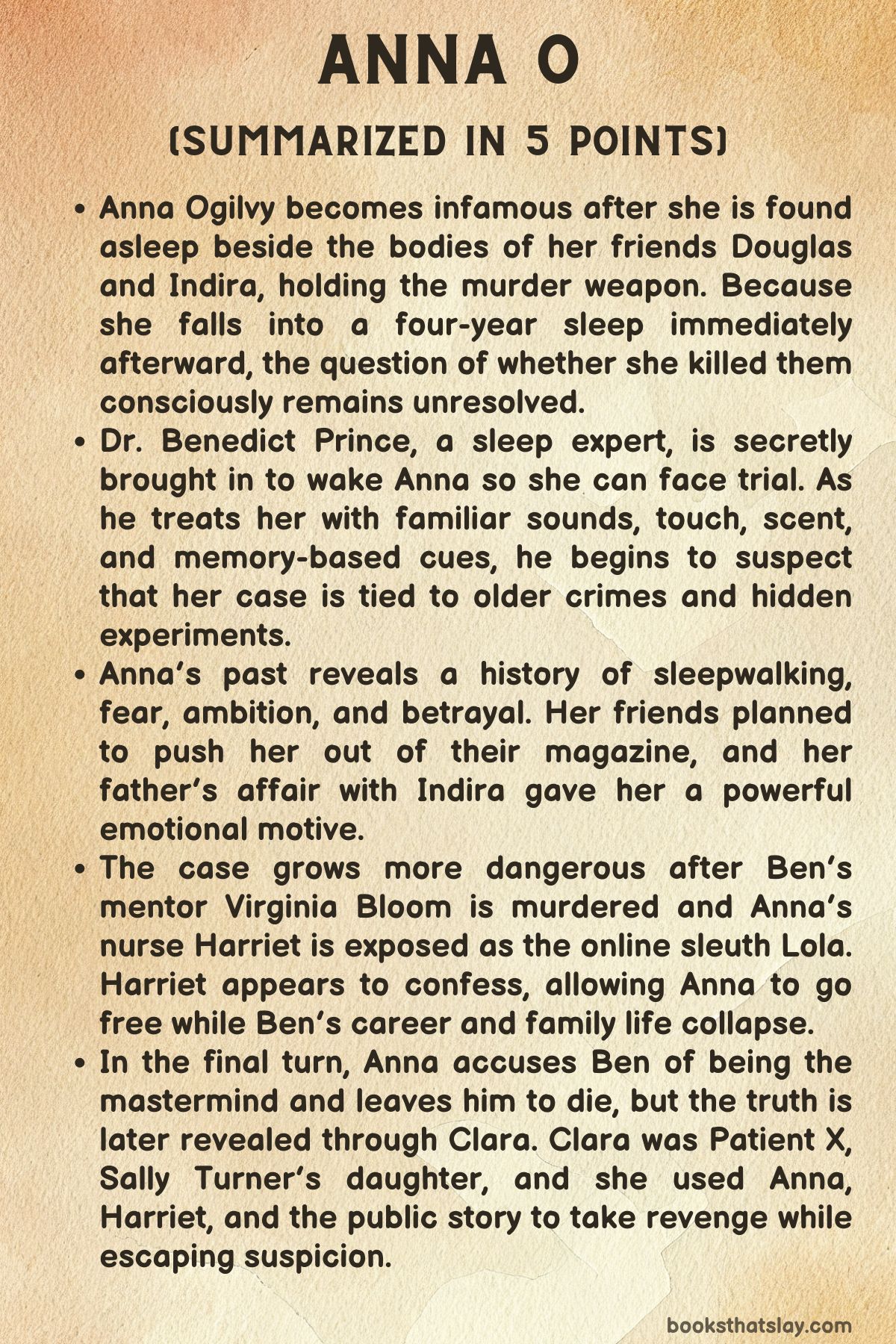
Characters
Dr. Benedict Prince
Dr. Benedict Prince is the central investigator figure in the book, but he is not a conventional detective. He approaches mystery through psychology, sleep science, trauma, and the fragile border between consciousness and unconscious action.
As a sleep expert, he is drawn to Anna’s case because it represents the kind of rare medical and legal problem that can define a career. Yet his interest is never purely professional.
He wants to heal, to prove the value of his theories, and to recover some sense of purpose after the breakdown of his marriage and family life. His treatment method is built around the idea that Anna’s mind has withdrawn because it has lost hope, so he tries to restore safety through memory, touch, music, scent, and familiar emotional cues.
This makes him compassionate, but also vulnerable to manipulation. He becomes emotionally invested in Anna’s awakening and begins to see himself as someone chosen to unlock a hidden truth.
Ben’s weakness is that he often mistakes empathy for insight. He believes that because he understands trauma, he can recognize the shape of truth, but the book repeatedly shows that intelligence does not protect him from deception.
His relationship with Clara also reveals a man full of guilt and longing. He misses his daughter Kitty, regrets the distance in his family, and still carries pain from Clara’s affair.
These personal wounds make him easier to misdirect because he wants reconciliation, stability, and moral clarity. In Anna O, Ben is tragic because he is not guilty of the crimes that destroy him, yet he participates in the conditions that make his ruin possible.
He touches evidence, hides Bloom’s file, withholds full truths, and keeps chasing answers after the official story seems settled. His final confrontation with Anna shows him stripped of professional authority.
The sleep doctor becomes the helpless patient, drugged and unable to make others believe him.
Anna Ogilvy
Anna Ogilvy is both victim and suspected killer, which makes her one of the most unstable moral centers of the novel. To the public, she becomes Anna O, a symbol more than a person: the sleeping murderer, the rich girl with blood on her hands, the woman who may have escaped justice by disappearing into unconsciousness.
Before the murders, Anna is ambitious, restless, and hungry for literary importance. Her obsession with true crime and In Cold Blood reveals her desire not only to report crime but to turn violence into lasting art.
She wants to be remembered, and that desire becomes dangerous when combined with betrayal, insomnia, family resentment, and her fear of what she does while asleep.
Anna’s sleepwalking history makes her frightening to others and terrifying to herself. As a child, she kills the family dog without memory.
Later, she steals and attacks while asleep. These incidents blur the line between her conscious personality and her night self.
The book never treats her simply as innocent or monstrous. She has violent thoughts, envies Indira, resents Douglas, and wants revenge after discovering their business betrayal and her father’s affair.
Yet the final revelation shows that she was also used as a tool by Clara and Harriet. Her body committed murder under drugged control, but the emotional conditions around her made the frame-up believable.
In Anna O, Anna’s later self is colder, sharper, and more calculating. After being turned into a public myth, she tries to reclaim authorship through her memoir.
Her killing of Ben, based on a false conclusion, shows that victimhood has not purified her. She survives, but survival leaves her capable of cruelty.
Clara
Clara is the most carefully hidden character in the story because she appears for most of the book as a figure of law, order, and wounded domestic realism. As Ben’s ex-wife and the first officer at Anna’s crime scene, she seems connected to the case by duty and coincidence.
She is practical, emotionally controlled, and often sharper than Ben. Her skepticism toward Anna seems professional, and her concern for Kitty seems maternal.
These qualities help conceal the truth: Clara is Patient X, Sally Turner’s daughter, the person behind the long revenge plot.
Clara’s character is built on concealment. She hides her childhood, her relationship with Harriet, her role in the Farm murders, her part in Bloom’s death, and her responsibility for Ben’s destruction.
Her past explains her motives without excusing them. As a child, she killed her abusive stepbrothers and framed her mother Sally, believing she was protecting her.
When Sally later suffered under the MEDEA project, Clara’s guilt and rage hardened into a desire to punish those connected to it, especially Emily. Clara chooses Anna because Anna gives her the perfect weapon: a young woman with a public sleepwalking history, private rage, and access to the family Clara wants to hurt.
By the end of Anna O, Clara is revealed as the true architect of the crimes, and the revelation changes the entire book. What looked like grief, professionalism, and family stress becomes performance.
Her greatest power is not violence itself, but her ability to make others see the story she wants them to see.
Harriet / Lola Ridgeway
Harriet, also known as Lola Ridgeway and @Suspect8, is one of the book’s most deceptive supporting figures. As Anna’s nurse, she appears caring, competent, and quietly observant.
Her constant presence beside Anna gives her access to the patient, the clinic, and Ben’s treatment process. At the same time, her online identity as Lola reveals another side: obsessive, theatrical, and deeply invested in the mythology of the Anna case.
She writes about Anna, tracks Ben, studies evidence boards, and treats the case as both mystery and performance. This double life makes her a bridge between private crime and public spectacle.
Harriet’s deepest loyalty is to Clara. Their relationship, hidden behind Clara’s supposed affair with a man, explains why Harriet acts with such devotion.
She is not the mastermind, but she is far more than a passive helper. She assists in drugging Anna, helps shape the frame, infiltrates the clinic as Anna’s nurse, and becomes the person who absorbs blame when the plan begins to collapse.
Her death by suicide functions as a final act of loyalty and misdirection. By leaving behind a confession, she protects Clara and allows the world to believe the case has been solved.
Harriet’s tragedy lies in the way love becomes servitude. She gives Clara not only secrecy and assistance, but ultimately her life.
Her intelligence and obsession could have made her an investigator of truth, yet she uses those skills to protect a lie.
Virginia Bloom
Virginia Bloom is Ben’s mentor, the head of the Abbey Sleep Clinic, and one of the few people capable of recognizing the deeper pattern beneath Anna’s case. She first appears as a strict, experienced clinician who understands secrecy, reputation, and the risks of treating a famous patient.
Her authority gives Ben access to Anna, but her past at Broadmoor connects her to the older crime involving Sally Turner and Patient X. Bloom is important because she stands at the intersection of medicine, institutional power, and buried guilt.
Bloom’s treatment notes on Patient X are among the most revealing materials in the story. They show that she once encountered a young person with intelligence, rage, trauma, and a disturbing uncertainty about violence.
Bloom did not understand the full danger at the time, and years later that past returns through Anna’s case. When she hears Sally Turner’s name and recognizes the significance of the murder date, she begins to piece together the pattern.
This makes her dangerous to Clara. Bloom’s death is not random violence; it is the removal of a witness whose memory threatens the hidden design.
Her role also raises questions about professional responsibility. She is not portrayed as evil, but she is part of a system that handled damaged people without fully understanding what they might become.
Her murder marks the point where Ben’s clinical task becomes a personal search for truth.
Emily Ogilvy
Emily Ogilvy is Anna’s mother and one of the figures most burdened by guilt. Once a public political figure, she becomes a church minister after Anna’s alleged murders, suggesting a life reshaped by shame, loss, and a search for moral repair.
Her relationship with Anna is marked by love, fear, denial, and ambition. When Anna shows signs of dangerous sleepwalking as a child, Emily chooses secrecy over treatment.
She hides the killing of the family dog and protects Anna’s reputation because scandal would damage the family and her political career. That decision becomes one of the book’s early moral failures, because private concealment allows future danger to grow.
Emily is also connected to the older MEDEA project, having approved it during her political career. This connection makes her a target of Clara’s revenge.
Emily does not understand that her past decision helped create the force that later destroys her family. Her grief after Anna’s arrest and long sleep is sincere, but the book does not let sincerity erase responsibility.
She repeatedly acts too late. She loves Anna, but often protects appearances before truth.
As a mother, she wants to believe in her daughter’s innocence or at least her lack of control. As a former politician, she knows how public narratives can ruin lives.
Her movement from power to ministry reflects an attempt to seek forgiveness, but the story suggests that forgiveness cannot undo consequences that have already entered other people’s lives.
Richard Ogilvy
Richard Ogilvy is Anna’s father, and his charm hides selfishness, emotional distance, and betrayal. He appears polished and socially confident, the kind of man who can make unpleasant facts feel manageable.
Yet his relationship with Anna is shallow in key ways. He does not fully understand her mental health history, does not take her creative ambitions seriously, and fails to see how isolated she has become.
His affair with Indira is one of the emotional triggers that intensifies Anna’s rage before the murders. For Anna, discovering that her father is romantically involved with her friend is not just a private betrayal; it confirms that the people closest to her are willing to humiliate and discard her.
Richard’s character represents the careless entitlement of wealth and status. He does not need to be a mastermind to cause damage.
His irresponsibility creates emotional wreckage that others exploit. Clara’s plan works partly because Anna already has reasons to feel betrayed by her family and friends.
Richard gives that plan credibility by behaving badly enough that Anna’s anger seems plausible. His presence also shows how families can maintain elegant surfaces while hiding rot underneath.
He is not the most violent person in the story, but he contributes to the conditions that allow violence to be believed.
Kitty
Kitty, Ben and Clara’s daughter, is a child caught in the emotional and public fallout of adult crimes. She has no direct role in the central violence, but her presence gives the book a human measure of consequence.
Through Kitty, Ben’s failures become more personal. He is not only a doctor under pressure; he is a father who arrives late, misses calls, and struggles to shield his daughter from darkness.
Kitty sees disturbing police images and becomes aware of Anna through media attention, showing how crime stories escape official spaces and enter family life.
Kitty also reveals Clara’s double nature. Clara appears protective and maternal around her, and there is no reason to doubt that Clara loves her daughter.
Yet Clara’s hidden crimes put Kitty’s life inside a lie. This contrast makes Clara more disturbing, because she can be both caring mother and calculating murderer.
Kitty’s innocence does not soften the plot; it sharpens it. She represents the future that adults claim they are protecting while actually poisoning it with secrecy.
Ben’s separation from Kitty after the scandal is one of the saddest costs of the case, because he loses the ordinary fatherhood he wanted, while Clara remains close to the child under false innocence.
Stephen Donnelly
Stephen Donnelly represents state power, legal urgency, and institutional secrecy. As Deputy Director at the Ministry of Justice, he is less interested in Anna as a suffering patient than in Anna as a legal problem that must be solved.
His goal is to wake her so she can stand trial. He pushes Ben for results, controls information, and frames the case as a matter of justice and public order.
Donnelly’s presence reminds the reader that Anna’s body is not simply under medical care; it is also under government pressure.
Donnelly is not a villain in the same way Clara is, but he is morally limited. He wants procedure, prosecution, and containment.
His secrecy helps create the tense environment in which mistakes happen. He monitors sessions, gathers intelligence on online followers, and moves quickly when he suspects Harriet.
His actions are often logical, but they are also shaped by the assumption that institutions can manage truth through control. The irony is that the real criminal has been inside those institutions all along.
Donnelly’s failure is not stupidity; it is trust in official categories. He sees suspects, evidence, threats, and legal timelines, but he cannot imagine that the most dangerous person may be someone already protected by authority.
Douglas Bute
Douglas Bute is one of the murder victims, but he is also part of the emotional and professional betrayal that makes Anna vulnerable. As Anna’s friend and co-founder of Elementary, he shares her creative world, yet he and Indira secretly plan to sell the magazine and cut Anna out of its future.
This betrayal wounds Anna because Elementary is not simply a business to her. It is her identity, her ambition, and her attempt to become the kind of writer she idolizes.
Douglas helps turn that dream into another place where Anna is excluded.
Douglas is not developed as deeply as the surviving characters, but his function is important. He is a victim, yet not an innocent presence in Anna’s emotional life.
His secrecy and opportunism make Anna’s anger believable, which Clara later exploits. The book uses Douglas to show how ordinary betrayals can become part of extraordinary crimes.
He does not deserve death, but his actions help create the story others use to explain why Anna might have killed him. His role demonstrates the danger of confusing motive with guilt: Anna had reasons to hate him, but those reasons do not mean she consciously murdered him.
Indira Sharma
Indira Sharma is Anna’s friend, business partner, rival, and one of the two victims at the Farm. She is central to Anna’s emotional collapse because her betrayal operates on multiple levels.
Professionally, Indira helps push Anna out of Elementary. Personally, she is involved with Richard, Anna’s father.
This makes her both a symbol of stolen ambition and a figure of intimate humiliation. Anna’s jealousy toward Indira includes envy of her beauty, resentment of her confidence, and anger at her secrecy.
Like Douglas, Indira is seen mostly through the memories and reactions of others, yet her role is powerful. She becomes the person Anna feels has taken everything: her magazine, her trust, and even part of her family.
Clara’s plan depends on this existing resentment. If Anna had no anger toward Indira, the frame would be less convincing.
Indira’s death also shows how women in the book can be positioned against each other by ambition, betrayal, and male selfishness. Richard’s affair with Indira is not only his moral failure; it places Indira directly in the path of Anna’s pain and Clara’s revenge plot.
Indira remains a victim, but the story refuses to make the emotional world around her simple.
Sally Turner
Sally Turner is mostly absent from the present action, but her life and death shape the entire story. She is the mother of Patient X and the woman whose Broadmoor case becomes Anna’s obsession.
Sally was accused of killing her stepsons, and the uncertainty around whether she acted while sleepwalking becomes a dark mirror of Anna’s own case. Her story involves abuse, fear, institutional treatment, and the MEDEA project.
Whether seen as murderer, victim, patient, or scapegoat, Sally is the original wound behind the later crimes.
Sally’s importance lies in how others use her. Anna sees her as material for a major true crime article.
Bloom sees her through old clinical records and professional memory. Clara sees her as a mother she tried to protect but ultimately harmed.
Emily’s political approval of MEDEA links Sally’s suffering to the Ogilvy family, making her the emotional source of Clara’s revenge. Sally is not given the same active voice as Anna or Clara, but her presence haunts the book.
Her fate shows how institutional decisions can outlive the people who make them, returning years later through damaged children and unresolved guilt.
Theo Ogilvy
Theo Ogilvy, Anna’s brother, is a minor but useful figure in the book because he helps show Anna’s family life outside the central triangle of Anna, Emily, and Richard. He appears as someone Anna can spend time with when she feels unseen by her parents.
His presence suggests that the Ogilvy family is not only a public unit of wealth and reputation but also a private household with neglected emotional bonds. Theo does not drive the mystery, but he gives the reader a glimpse of Anna as a sister rather than only a suspect or patient.
His limited role also reflects Anna’s isolation. Even when she has family nearby, she experiences herself as alone with her ambition, insomnia, fear, and anger.
Theo’s presence cannot stop the forces building around her. In that sense, he functions as part of the ordinary life that gets swallowed by the larger crime.
He reminds the reader that major public scandals contain quieter family casualties who may not understand the full truth but still live with its effects.
Melanie Fox
Melanie Fox, the owner of the Farm, is a smaller character, but her resort provides the controlled setting where Clara’s plan can unfold. The Farm is designed as an exclusive wilderness retreat for wealthy clients, complete with staged games and private cabins.
Melanie’s statement helps Ben reconstruct the night of the murders, and her establishment becomes a place where performance and violence meet. The Hunters and Survivors game is supposed to be entertainment, but under Clara’s design it becomes a structure that separates people, creates confusion, and places Anna near the emotional shocks that will make the later crime seem understandable.
Melanie’s importance is mostly environmental. She represents the kind of privileged leisure space where people believe danger is managed because it is packaged as a game.
The Farm’s decline after the murders shows how quickly luxury can become associated with horror. Through Melanie and her resort, the book suggests that carefully arranged experiences can be turned against people when someone understands the rules well enough to exploit them.
Themes
Sleep, Responsibility, and the Limits of Conscious Control
The central question of responsibility in Anna O comes from the terrifying possibility that a person can commit an act without conscious intent. Anna’s history of sleepwalking makes this question impossible to dismiss.
She has harmed, stolen, moved, and behaved strangely while apparently asleep, which means the legal and moral categories around action become unstable. If a body kills while the mind is not fully present, can guilt attach to the person in the same way?
Ben’s work focuses on this uncertainty. He sees sleep not as simple rest, but as a condition in which hidden fears, memories, and impulses may gain power.
The story keeps returning to the difference between doing something and choosing to do it. Yet the novel refuses to make sleep an easy excuse.
Anna has conscious anger toward Douglas and Indira, and her waking life contains resentment, ambition, and revenge fantasies. That makes her a believable suspect even when she is also a victim.
The final revelation complicates responsibility further because Anna’s body was used by others through drugs and suggestion. The theme asks readers to separate motive, action, intent, and blame, showing that justice becomes fragile when consciousness itself cannot be trusted.
Memory, Narrative, and the Power to Control the Truth
Memory in the novel is never treated as a perfect record. Anna wakes with gaps, Ben misreads his own past and relationships, the public accepts whatever version of the case is most dramatic, and Clara survives by controlling what others believe.
The story is deeply concerned with who gets to narrate crime. Anna becomes famous before she can speak for herself, turned into Sleeping Beauty, killer, victim, monster, and mystery by strangers.
Later, she writes a memoir to reclaim her identity, but that act of self-authorship is also built on a false accusation against Ben. Her version becomes popular not because it is fully true, but because it satisfies the public hunger for a finished story.
Clara understands this better than anyone. She does not merely commit crimes; she arranges evidence, motives, confessions, and emotional explanations so others will build the wrong narrative on her behalf.
Harriet’s blog, Anna’s notebook, Bloom’s case files, Ben’s theories, and Anna’s memoir all compete as sources of truth. The novel shows that a story can become powerful enough to replace reality.
Once the public accepts a version of events, innocence may no longer matter, especially when the lie is more satisfying than the truth.
Trauma, Revenge, and Inherited Damage
Trauma in the book does not remain private. It travels across years, families, institutions, and crimes.
Sally Turner’s suffering at home and at Broadmoor creates the emotional ground for Clara’s future violence. Clara’s childhood act of killing her stepbrothers begins as an attempt to protect herself and her mother, but the consequences twist into lifelong guilt, rage, and calculation.
Instead of healing, Clara turns pain into a plan. Her revenge is not impulsive; it is patient, symbolic, and designed to make Emily experience a version of the helplessness Clara associates with Sally’s fate.
Anna becomes the tool through which Clara punishes the Ogilvy family, even though Anna herself is not responsible for MEDEA. This displacement is central to the theme.
Revenge often claims to answer one wrong, but it creates new victims who may only be connected by blood, history, or opportunity. Ben, Douglas, Indira, Bloom, Harriet, Anna, Kitty, and even Clara herself are all damaged by a crime rooted in older wounds.
The novel suggests that unprocessed trauma can become a form of authorship, shaping future events according to pain rather than justice. Clara’s freedom at the end is chilling because it shows revenge can succeed externally while leaving moral ruin behind.
Institutions, Secrecy, and the Failure of Authority
The book repeatedly places trust in institutions only to expose their weaknesses. Medicine, law enforcement, government, journalism, and the justice system all claim to manage truth, but each is limited by secrecy, reputation, ambition, or procedure.
Emily hides Anna’s childhood sleepwalking because public scandal would threaten her career. The Ministry of Justice hides Anna’s treatment because the case is politically explosive.
The Abbey Sleep Clinic protects confidentiality but becomes vulnerable to manipulation. Broadmoor’s MEDEA project represents institutional power at its most dangerous: a psychological method approved and concealed by authorities who can harm patients under the language of treatment.
Law enforcement also fails because Clara, the true criminal, operates from within its trusted ranks. Her badge, professional competence, and connection to the original crime scene make her look reliable rather than suspicious.
Donnelly monitors threats and pursues suspects, but his official tools still lead him to the wrong conclusion. The theme is not simply that institutions are corrupt; rather, they are often overconfident.
They depend on records, roles, and official stories, while people like Clara exploit those systems from inside. The result is a world where authority can document facts and still miss the truth.