Anowa by Ama Ata Aidoo Summary, Characters and Themes
Anowa by Ama Ata Aidoo is a dramatic play about a woman who resists the life planned for her and pays a terrible price for choosing her own path. Set in a Ghanaian village and later along the Guinea Coast, the play follows Anowa’s marriage to Kofi Ako, her break from family expectations, and her growing conflict with wealth, slavery, gender roles, and childlessness.
The play questions whether society punishes women for independence or whether personal choices can also lead to ruin. It is a sharp, unsettling story about freedom, marriage, power, and tradition.
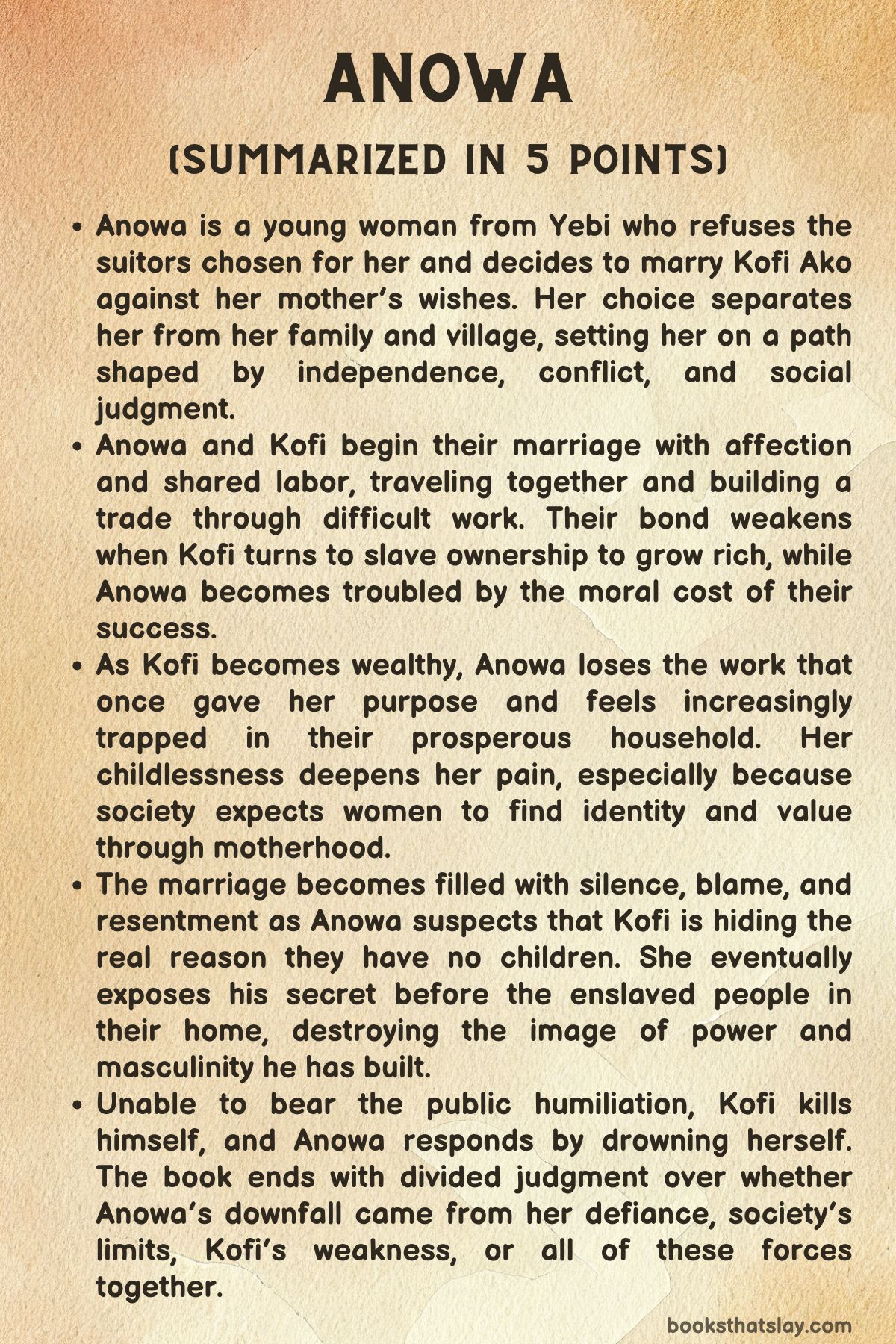
Summary
Anowa begins in the village of Yebi, a place described as fortunate and well supplied with food, shelter, and social order. The people of the village are presented as gentle and considerate, but beneath that calm surface lies anxiety about one young woman who refuses to behave as expected.
Anowa, the daughter of Badua and Osam, has reached an age when marriage is expected of her. Her mother keeps trying to arrange matches, but Anowa rejects every suitor brought before her.
This refusal becomes a public concern. The villagers blame Badua, assuming that a daughter’s resistance must be the mother’s failure.
Some people suggest that Anowa might be better suited to the life of a priestess, since she does not seem made for ordinary domestic life.
Anowa’s difference is clear from the beginning. She is attractive, confident, and self-possessed, but she does not easily accept other people’s plans for her.
When she meets Kofi Ako, a handsome young man, the attraction between them is immediate. Their shared glances and laughter suggest youthful desire and a sense of choice that belongs to them alone.
For Anowa, Kofi is not simply another suitor chosen by family or village custom. He is the man she decides to marry.
Her parents react very differently. Badua is deeply unhappy with the match.
She sees Kofi as lazy, arrogant, and lacking real substance. To her, his good looks hide weakness.
She also mistrusts the men of his family and believes they do not make reliable husbands. Osam, however, refuses to interfere.
He has long believed that Anowa should have become a priestess, and he seems to think that forcing her into or out of marriage would be useless. Badua pleads with Anowa not to leave with Kofi, but Anowa remains firm.
She rejects her mother’s warnings and leaves home, promising never to return.
This act marks Anowa’s break from tradition. Her choice of husband is also a choice against the authority of family and village.
The older voices who comment on the action do not fully agree on whether Anowa is foolish or courageous. They recognize that in an earlier generation she might not have been allowed to make such a decision.
They also understand that the villagers’ anger may come not only from her disobedience, but from fear that old customs are losing their power.
After leaving Yebi, Anowa and Kofi build a life on the road. Two years later, they are shown traveling through rain, carrying monkey skins to sell.
Their work is hard, but they still appear close and affectionate. They tease each other and face hardship together.
At this stage, their marriage has energy and equality. Both carry burdens, both contribute, and both seem bound by shared labor.
Yet trouble has already entered the marriage. Anowa is worried because she has not conceived a child.
She suggests that Kofi marry another woman who can give him children, but he refuses. He says he wants to seek help for their problem, but Anowa rejects magical cures or medicines.
Her fear is not only personal; it is shaped by the pressure placed on women to become mothers. Without a child, she feels incomplete in the eyes of society and perhaps in her own mind.
At the same time, another disagreement appears. Kofi wants to buy men to help with the business.
Anowa is horrified by the idea of owning slaves. She cannot bear the thought of human beings being bought and used as property.
This moral resistance becomes one of the most important conflicts in the story. Kofi sees slave labor as a practical way to grow rich.
Anowa sees it as a violation of human dignity.
Back in Yebi, Badua and Osam hear news of their daughter’s life. Badua knows that Anowa has not had a child and believes her barrenness is linked to her departure from home.
She also hears that Anowa and Kofi have become wealthy through trade and through the purchase of slaves. This confuses her, because Anowa had once clearly rejected slavery.
Osam reads the situation differently. To him, Anowa’s unhappiness confirms that she was never suited for ordinary marriage.
He still believes she should have become a priestess.
As the years pass, Kofi becomes increasingly prosperous. He no longer works as he once did.
Slaves carry the heavy loads, while he carries little himself. Wealth changes the balance between him and Anowa.
The shared hardship that once connected them disappears. Anowa, who once worked beside him, now has no meaningful work to do.
Instead of comfort, prosperity brings her restlessness and misery. She cannot accept a life of idleness built on the labor of enslaved people.
Her sense of alienation deepens. She tells Kofi again that he should marry another woman.
She feels that she has no place in his future and describes herself as a traveler who belongs only to herself. Kofi does not understand why she cannot enjoy their success.
To him, wealth should bring satisfaction. To Anowa, it has brought emptiness, moral compromise, and distance between husband and wife.
The contrast between them becomes sharper when they are later shown in a rich home. Kofi has become one of the wealthiest men on the Guinea Coast.
His house is full of signs of status: fine carpets, animal skins, portraits, attendants, and ceremony. He is carried by men, surrounded by comfort and display.
Yet Anowa appears plainly dressed, unhappy, and out of place in the household her husband’s wealth has built.
Anowa remembers a childhood scene in which she saw white men coming to her village to take away enslaved people. When she questioned what was happening, her grandmother told her to remain silent.
Later, Anowa dreamed of her body becoming huge and of boiling lobsters coming out of her and destroying the enslaved people. The dream suggests horror, guilt, rage, and helplessness.
Her mind has long been troubled by slavery, even before Kofi’s wealth made her part of a slaveholding household.
In Kofi’s house, the enslaved children call Anowa “mother,” though she has no biological children of her own. This creates a painful irony.
She has been denied the motherhood expected of her, yet she is surrounded by children who are forced to serve. Some of the child servants gossip about her, calling her strange or witchlike, but they also sense that she is different from Kofi.
Anowa’s bond with them is not simple, but she seems to recognize their humanity more than her husband does.
Anowa’s marriage has now become a place of accusation and resentment. She blames Kofi for taking away her purpose by buying slaves.
If they had continued working together, she believes she would still have had meaningful labor and dignity. Kofi, irritated by her refusal to behave like other women, tells her to leave if she cannot live normally.
Once again, she urges him to take another wife, but he resists. His refusal begins to seem less like devotion and more like concealment.
Anowa suspects that Kofi is hiding something. She knows he has spoken with a priest and believes that the conversation explains his sudden desire for her to go away.
Their inability to have children has long been treated as Anowa’s failure, and she has carried the shame of it. She even admits that she has slept with other men, knowing that the village would condemn her and claim her childlessness is punishment for infidelity.
But she begins to understand that the truth may lie with Kofi, not with her.
In a final public confrontation, Anowa summons the slaves and asks them to witness her questions. She asks whether anyone has heard of a man who wants to divorce his wife but refuses to tell her why.
She then reveals that she and Kofi have not shared a bed in years. Her questions move toward the secret Kofi cannot bear to have exposed: his impotence.
By forcing this truth into the open before the enslaved people, Anowa destroys the image of masculine power on which Kofi’s wealth and authority depend.
Kofi begs her to stop, but Anowa continues. Her words strip him of the status he has built for himself.
The man who owns slaves, commands servants, and displays wealth is revealed as powerless in the most private part of his marriage. For Kofi, the humiliation is unbearable.
He leaves the room, and soon a gunshot is heard. He has killed himself.
Anowa’s response is also fatal. After Kofi’s suicide, she drowns herself.
Her parents enter grieving, and the older commentators return to judge what has happened. One voice blames Anowa, arguing that she tried to become a new kind of woman and was punished for it.
From this view, her refusal to accept her place caused the destruction. The other voice is less certain.
He continues to admire Anowa’s independence, even though her life ended in pain. To him, there is value in the fact that she lived and died according to her own will.
The ending does not offer an easy moral. Anowa is neither simply a victim nor simply at fault.
She is rebellious, proud, morally awake, wounded, and destructive. Kofi is not only a weak husband; he is also a man shaped by greed, shame, and social expectations of masculinity.
Their marriage begins with choice and affection but collapses under childlessness, slavery, wealth, secrecy, and pride.
At its center, Anowa asks what happens to a woman who refuses the life arranged for her but cannot find a livable alternative. Anowa rejects obedience, arranged marriage, idleness, slavery, and false appearances.
Yet the world around her offers few ways for such resistance to survive. Her tragedy lies in the fact that she sees too much, speaks too sharply, and cannot make peace with a society built on silence.
Characters
Anowa
Anowa is the central figure of Anowa, and she is one of the most independent, restless, and difficult characters in the play. She refuses to accept the path that her village expects for her, especially when it comes to marriage.
Her rejection of suitors is not simple stubbornness; it shows her desire to make choices for herself in a world where women are usually expected to obey family, custom, and social pressure. When she chooses Kofi Ako, she believes she is choosing love and freedom, but that decision also separates her from her parents and community.
Anowa is strong-willed, sharp-tongued, and morally sensitive. She cannot ignore the wrongness of slavery, and even when wealth enters her life, she remains disturbed by the human suffering behind it.
Her tragedy comes from the gap between what she sees and what the world around her allows. She wants love, labor, dignity, and motherhood, but each of these becomes painful or impossible.
Her childlessness wounds her deeply, not only because society judges her, but because she herself feels denied a meaningful role. By the end of the play, her confrontation with Kofi reveals her courage and cruelty at once.
She exposes the truth, but she also destroys what little remains of their marriage. Anowa is not an easy heroine; she is proud, wounded, intelligent, and destructive.
Her life becomes a protest against silence, but that protest leaves her isolated.
Kofi Ako
Kofi Ako begins as a handsome and appealing young man whose charm draws Anowa toward him. At first, he seems like a partner in freedom, someone who joins her in leaving behind the restrictions of Yebi.
Their early life together suggests affection, physical attraction, and shared effort. They travel together, work together, and build a trade through hardship.
However, Kofi changes as success becomes possible. His decision to buy slaves marks a major shift in his character.
Where Anowa sees moral corruption, Kofi sees opportunity, comfort, and status. He becomes increasingly attached to wealth and public power, and his rise changes the balance of his marriage.
He no longer shares labor with Anowa; instead, he becomes a man carried by others and surrounded by symbols of importance. Yet beneath this display lies deep insecurity.
His inability to father children, and possibly his impotence, threatens the masculine identity he has built. Rather than speak honestly, he hides behind wealth, authority, and silence.
Kofi’s downfall comes because he cannot bear exposure. When Anowa reveals his secret before the enslaved people, he loses the image that has protected him.
His suicide shows that his pride is more fragile than his wealth suggests. He is not merely a villain; he is a man trapped by shame, ambition, and fear of being seen as powerless.
Badua
Badua is Anowa’s mother and one of the strongest voices of tradition in the play. She is anxious, controlling, and deeply concerned with her daughter’s social future.
Her constant attempts to arrange Anowa’s marriage show how strongly she believes in the accepted order of village life. To Badua, a daughter’s refusal to marry is not only a personal matter; it is a public embarrassment and a sign that something has gone wrong in the family.
Her opposition to Kofi Ako comes from maternal concern as well as social judgment. She sees him as lazy, vain, and unsuitable, and her warnings later appear partly justified.
Yet Badua’s problem is that she cannot understand Anowa’s need for self-direction. She loves her daughter, but her love takes the form of pressure, pleading, and fear.
She believes she knows what will protect Anowa, but she cannot imagine that Anowa must learn through her own choices. Badua also carries the pain of helpless motherhood.
She cannot stop Anowa from leaving, cannot repair the marriage, and cannot save her daughter from the final disaster. Her grief at the end is therefore heavy with regret.
She represents the older generation’s belief that survival depends on obedience, but she also shows how painful it is when parental wisdom becomes powerless.
Osam
Osam, Anowa’s father, is calmer and more detached than Badua. While Badua tries to direct Anowa’s life, Osam steps back and refuses to force his daughter into or out of marriage.
His attitude can seem wise because he respects Anowa’s will more than others do, but it can also appear passive. He believes Anowa was not made for ordinary domestic life and repeatedly suggests that she should have become a priestess.
This view is important because it recognizes something unusual in her nature. Osam understands that Anowa’s energy, independence, and intensity do not fit easily within the role of wife.
However, his insight does not help her. He sees the problem but offers no real solution.
His refusal to intervene may be a form of respect, but it also leaves Anowa to face the consequences of her choice without guidance. Osam’s character stands between tradition and freedom.
He does not defend social pressure as strongly as Badua does, yet he does not fully support Anowa’s rebellion either. By the end, his grief shows the limits of distance and observation.
He may have understood his daughter better than most people, but understanding alone cannot protect her.
Old Woman
The Old Woman is part of the pair known as Being-The-Mouth-That-Eats-Salt-And-Pepper, and she functions as a commentator on the action of Anowa. She is restless, agitated, and often severe in her judgments.
Her view of Anowa is shaped by tradition and by suspicion of women who refuse accepted roles. To her, Anowa’s refusal to behave like other women is dangerous, and she often reads the events as proof that disobedience leads to punishment.
The Old Woman sees social order as necessary, and she believes that a woman who does not know her place invites disaster. Her judgment of Anowa after the deaths of Kofi and Anowa is especially harsh.
She sees the tragedy as Anowa’s fault and treats her attempt to become a different kind of woman as arrogance. Yet the Old Woman is not simply cruel.
She represents a worldview built from caution, memory, and fear of social breakdown. She knows the patterns of old stories, especially stories in which women who reject marriage end badly.
Her role is to voice the pressure of communal judgment. Through her, the play shows how tradition can explain tragedy in a way that protects the old order, even when that explanation may be incomplete.
Old Man
The Old Man is the Old Woman’s calmer counterpart and offers a more thoughtful response to Anowa’s life. He does not fully excuse Anowa, but he is more willing to see dignity in her refusal to submit.
Unlike the Old Woman, he understands that Anowa’s independence may be a sign of change rather than merely a sign of disorder. He recognizes that the village’s anger toward her may come from fear that old customs are weakening.
His reflections often create balance in the play, preventing the reader from accepting a single moral explanation. He admires Anowa’s unpredictability and her desire to live on her own terms, even though her choices bring suffering.
At the end, he remains unsure rather than condemning her completely. This uncertainty is important because it keeps the tragedy open to interpretation.
The Old Man represents a more flexible kind of wisdom. He has respect for tradition, but he also sees that tradition can trap people, especially women.
His presence suggests that Anowa’s story cannot be reduced to a warning against rebellion. It is also the story of someone who tried to live freely in a world that had little room for such freedom.
Being-The-Mouth-That-Eats-Salt-And-Pepper
Being-The-Mouth-That-Eats-Salt-And-Pepper is the collective identity of the Old Woman and Old Man. Together, they act like a communal voice, observing the action, questioning it, and offering competing interpretations.
Their name suggests experience, age, and knowledge gained from life. They are not ordinary characters involved in the plot in the same way as Anowa, Kofi, Badua, or Osam.
Instead, they stand partly outside the action and help frame its meaning. Their disagreements are central to how the reader understands the story.
The Old Woman leans toward blame, order, and punishment, while the Old Man leans toward sympathy, complexity, and change. Together, they show that the meaning of Anowa’s life is contested.
Is she a warning against female pride, or is she a figure of resistance destroyed by a narrow society? The play refuses to settle the question completely, and this pair helps maintain that tension.
They also connect the personal story to oral tradition, folklore, and communal memory. Through them, the tragedy becomes more than a private marital collapse; it becomes a public debate about gender, freedom, and social change.
Girl
Girl is one of the young servants in Kofi and Anowa’s wealthy household. Though she is not a central figure, her presence reveals much about the world Kofi has built.
She helps show the everyday reality of slavery inside the home. Her conversation with Boy gives the audience a view of Anowa and Kofi from below, through the eyes of those who serve them.
Girl is curious, observant, and influenced by rumor. She refers to Anowa as strange and possibly witchlike, which reflects how Anowa’s difference is interpreted by people around her.
Yet Girl also seems drawn to Anowa in a complicated way. Her suggestion that she might follow Anowa if Anowa ran away hints that she senses a possible protector or alternative authority in her mistress.
Girl’s role is important because she shows that Anowa’s position in the house is unstable. Anowa is both mistress and outsider, both powerful over the servants and emotionally closer to them than Kofi is.
Through Girl, the play gives voice to the enslaved children who witness the collapse of the household but have little control over their own lives.
Boy
Boy is another young servant in the household, and he functions as both an observer and a participant in the domestic world of Kofi and Anowa. He is practical, alert, and aware of Kofi’s authority.
In his conversation with Girl, he suggests that “father” would never allow Anowa to run away, showing how the enslaved children have been made to use family language inside a system that is not truly familial. This false family structure is deeply disturbing.
Kofi and Anowa are called “father” and “mother,” but the children are servants, not free children of the house. Boy’s presence also matters in the final confrontation.
He is ordered to summon the wise men and bring the slaves into the room, helping create the public setting in which Anowa exposes Kofi’s secret. He therefore becomes part of the mechanism through which private shame becomes public knowledge.
Boy does not control the scene, but he helps move it forward. His character reminds the reader that the enslaved people are always watching, listening, and absorbing the failures of the people who claim power over them.
Panyin and Kakra
Panyin and Kakra are child servants who appear in Kofi’s house, fanning the throne where he sits. Their names and actions emphasize the luxury and hierarchy that now define Kofi’s life.
They do not receive deep individual development, but their presence is symbolically important. They show how far Kofi has moved from the man who once traveled and worked beside Anowa.
He now occupies a throne-like position, attended by children whose labor supports his comfort and image. Panyin and Kakra also sharpen the pain of Anowa’s childlessness.
She is surrounded by children, yet they are not her own in any free or natural sense. They serve inside a household where motherhood has been replaced by ownership and command.
Their presence turns the domestic space into a moral accusation. The wealth that should have made Anowa and Kofi secure has instead created a home filled with inequality, silence, and emotional emptiness.
Through these children, the play shows that slavery is not an abstract social issue; it enters rooms, relationships, gestures, and daily routines.
The Slaves
The enslaved people in the play are crucial even when they are not individually named. They carry loads, serve in the house, support Kofi’s business, and become the human foundation of his wealth.
Their presence marks the moral decline of Kofi and the growing misery of Anowa. At first, Anowa says she cannot bear to own slaves, but over time she becomes part of a household that depends on them.
This contradiction deepens her inner conflict. The enslaved people also become witnesses to the truth.
In the final confrontation, Anowa gathers them into the room before exposing Kofi’s impotence. This is significant because Kofi’s authority depends on their subordination.
To be shamed in front of them is, for him, the worst possible humiliation. Their silent presence gives the scene its force.
They represent the people whose suffering has made Kofi’s rise possible, but they also become the audience before whom his power collapses. In this way, the enslaved characters are not background decoration.
They are central to the play’s criticism of wealth built on human ownership.
The Villagers of Yebi
The villagers of Yebi represent communal judgment, tradition, and the pressure to conform. They are not developed as separate individuals, but they shape the world in which Anowa grows up.
Their expectations define what a young woman should do: marry properly, bear children, respect family authority, and avoid public scandal. When Anowa rejects suitors, the villagers turn their criticism toward Badua, showing how women are judged not only for their own behavior but also for the behavior of their daughters.
The villagers also preserve the social rules that make Anowa’s choices seem dangerous. Their imagined gossip follows her even after she leaves.
When she cannot conceive, their likely explanation is moral failure, especially female misconduct. The villagers matter because they show that Anowa and Kofi’s marriage is never only private.
It is shaped by public ideas about gender, fertility, obedience, and shame. Their presence gives the story its social weight.
Anowa is fighting not just her mother or husband, but a whole system of expectation.
Anowa’s Grandmother
Anowa’s grandmother appears through memory rather than direct dramatic action, but she has an important role in shaping Anowa’s consciousness. When Anowa recalls seeing white men come to take enslaved people away, her grandmother tells her not to question what she sees.
This moment teaches Anowa that society often survives by silencing moral discomfort. The grandmother represents an older generation that has learned to live with terrible realities by refusing to speak openly about them.
Her silence is not necessarily approval; it may come from fear, helplessness, or long experience. Still, for Anowa, that command to remain quiet leaves a lasting mark.
Her later dream about violence and enslaved people suggests that the memory never leaves her. The grandmother’s role helps explain why slavery troubles Anowa so deeply.
She has seen it, questioned it, and been told to bury the question. In adulthood, she can no longer obey that silence.
The grandmother therefore stands for inherited silence, while Anowa becomes the character who breaks it, even when breaking it destroys her.
Themes
Female Independence and Social Punishment
Anowa’s refusal to accept the life chosen for her places female independence at the center of the story. She rejects the suitors selected through social expectation and chooses Kofi Ako for herself.
This choice appears empowering at first because she claims authority over her own body, marriage, and future. Yet the play shows that independence does not free her from punishment.
Her village judges her, her mother fears for her, and her marriage becomes another form of confinement. Anowa’s tragedy lies in the fact that she can reject one system of control but cannot create a world where her freedom can safely exist.
She does not want to be an obedient daughter, a passive wife, or an idle rich woman. She wants work, meaning, truth, and moral agency.
The society around her has no stable place for such a woman. When she speaks too directly, she is treated as unnatural.
When she refuses silence, she becomes dangerous. Anowa presents independence as necessary but costly.
It does not romanticize rebellion. Instead, it shows how a woman who claims freedom may still be trapped by marriage, fertility expectations, public gossip, and social fear.
Marriage, Power, and Silence
The marriage between Anowa and Kofi begins with attraction and choice, but it gradually becomes a struggle over power, truth, and control. In the early years, their relationship seems balanced because both work and travel together.
Shared labor gives them intimacy. As Kofi grows wealthy, that balance disappears.
He gains social status, economic power, and command over enslaved workers, while Anowa loses the work that once gave her purpose. Their marriage becomes full of things they do not say directly.
The deepest silence concerns childlessness and Kofi’s sexual incapacity. Society assumes that the woman is responsible when a couple has no children, and Anowa carries that burden for years.
Kofi allows this false assumption to stand because it protects his pride. His silence is therefore not passive; it is a form of power.
Anowa’s final act of speech destroys that power by making the hidden truth public. Yet the exposure does not heal anything.
It leads to humiliation, suicide, and death. The play shows that marriage can become dangerous when reputation matters more than honesty, and when silence is used to protect one person at another person’s expense.
Slavery, Wealth, and Moral Corruption
Kofi’s rise depends on slavery, and this connection makes wealth morally unstable throughout the story. At first, Anowa and Kofi earn their living through hard travel and trade.
Their work is difficult, but it gives them a sense of shared purpose. When Kofi decides to buy men to help with the business, the nature of their success changes.
Wealth no longer comes mainly from their own effort; it comes from the forced labor of others. Anowa recognizes the wrongness of this, even though she eventually lives inside the system she once rejected.
This contradiction is central to her misery. Kofi, by contrast, becomes increasingly comfortable with the benefits of ownership.
His house, attendants, and public importance are all built on human suffering. The enslaved people are not merely signs of wealth; they are evidence of moral decay.
Their presence reveals the cost of Kofi’s success and the emptiness of the luxury around him. The richer he becomes, the smaller and more fearful he appears morally.
The play suggests that wealth gained through exploitation does not bring security. Instead, it creates guilt, distance, and spiritual damage that finally destroys the household.
Motherhood, Fertility, and Identity
The inability to have children shapes Anowa’s identity and her marriage in painful ways. In her society, motherhood is treated as one of the central measures of a woman’s value.
Because Anowa does not conceive, she feels incomplete and exposed to judgment. Her repeated suggestion that Kofi marry another woman shows how deeply she has absorbed the idea that a man needs children and that a wife who cannot provide them has failed.
Yet the tragedy is sharpened by the later suggestion that Kofi, not Anowa, may be the reason they remain childless. This reversal exposes the unfairness of a world that quickly blames women while protecting male pride.
Anowa’s childlessness also affects her sense of purpose. Once slaves take over the labor of the household and business, she is left without work and without children, the two roles that might have given her life structure.
The enslaved children calling her “mother” creates a painful false version of motherhood. She is surrounded by children but denied the free, loving bond she desires.
The play treats motherhood not only as biology, but as social identity, emotional need, and a source of both power and suffering.