Aphrodite Summary, Characters and Themes
Aphrodite by Phoenicia Rogerson is a reimagining of the ancient Greek mythological figure, exploring the origin story and journey of Aphrodite, the goddess of love. The novel, written with depth and intricacy, gives a new perspective on the creation of the world, the rise and fall of mighty gods, and the intricate threads of Fate that govern their destinies.
Through Aphrodite’s own voice, we learn of her unconventional birth, her struggles with her powers, and her eventual rise to prominence on Mount Olympus. The book explores themes of love, power, free will, and destiny, offering a rich tapestry of emotions and character dynamics set against the backdrop of epic mythological events.
Summary
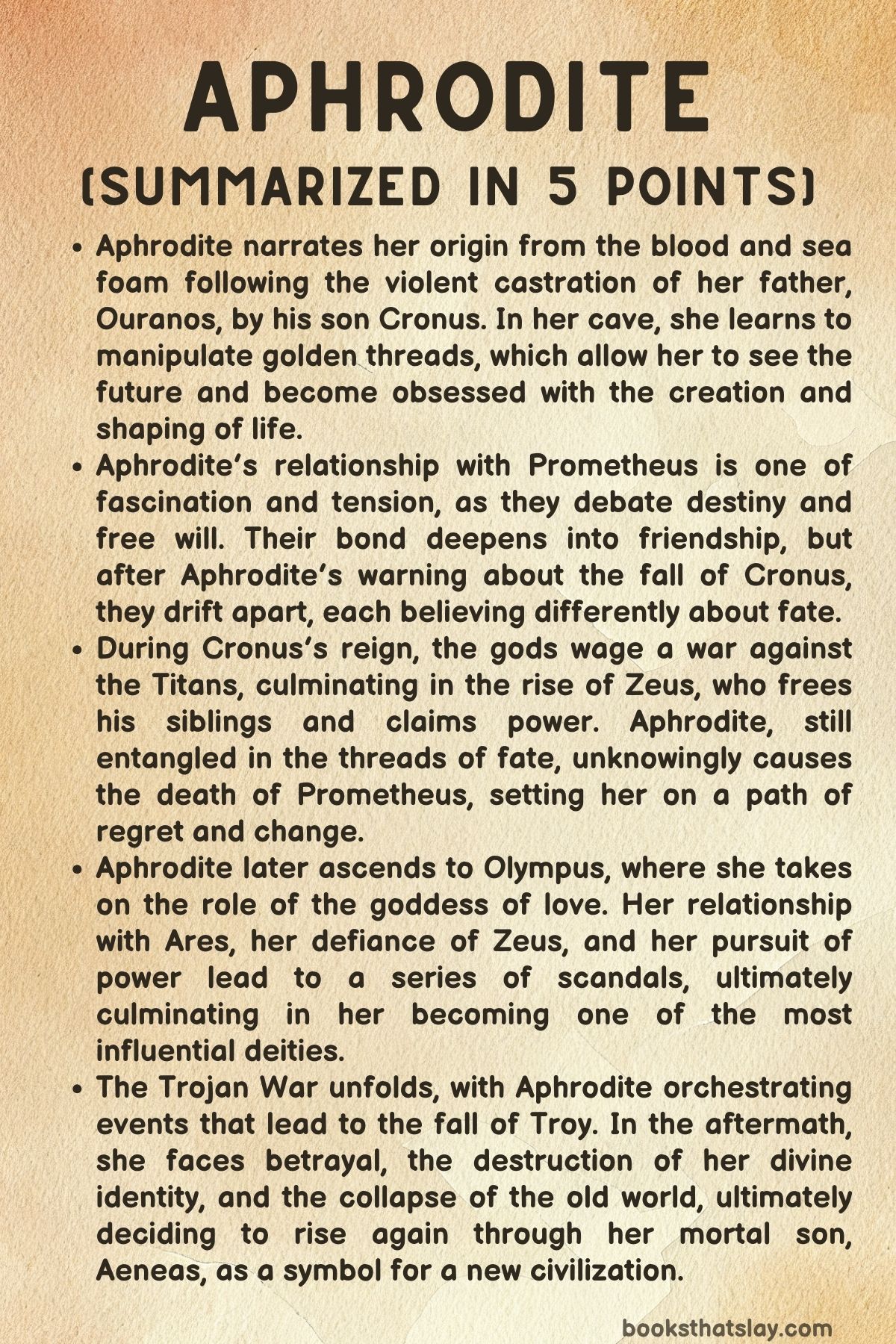
The novel opens with Aphrodite, narrating her origins from Chaos, the first existence. Chaos, along with Nyx (Night), gave birth to Earth, Sea, and Sky, who in turn gave rise to the mighty Titans, Cyclopes, and Hecatonchires.
Aphrodite emerges from a violent moment in myth—born from the sea foam after her father Ouranos was castrated by his son Cronus. Cast into the ocean, Aphrodite struggles to emerge from the depths, rescued by a golden thread sent by her grandmothers, Chaos and Nyx.
This thread guides her to safety and begins her journey of creation. She becomes fascinated by weaving the threads of Fate, seeing visions of the world’s creation and the rise and fall of gods.
Meanwhile, Cronus, the new ruler, seeks the remnants of his father’s power, particularly his severed testicles, which were thrown into the sea. His search is joined by two Titan brothers, Atlas and Prometheus.
Atlas stumbles upon Aphrodite in her cave and, after a brief struggle, drags her outside. Prometheus later visits, drawn by her mysterious nature.
Aphrodite reveals her ability to see the threads of Fate, and she shares her vision of Cronus’s failure in his search. She warns him of his impending defeat, which later comes true.
Prometheus, impressed by her abilities, names her Aphrodite, meaning “born of foam.” Their relationship grows into a friendship, but their differing views on fate and free will cause tension between them.
As Cronus continues to rule, haunted by a prophecy that one of his children will overthrow him, he devours each of his offspring as they are born to Rhea, his sister-wife. Rhea secretly hides Zeus, her sixth child, and tricks Cronus by giving him a stone wrapped in cloth instead of the newborn.
Zeus is raised in hiding, growing increasingly impatient and eager to fulfill his destiny. When he meets Aphrodite, who identifies herself as “Fate,” he becomes convinced that he will free his siblings and take control of the heavens.
As Zeus grows older, Prometheus and Metis, a wise Oceanid, train him in deception. They disguise him as Metis’s son and place him in Cronus’s service as a cupbearer.
Eventually, Zeus poisons Cronus’s wine, making him vomit up his siblings, fully grown. However, Zeus’s attempt to behead Cronus fails, and a great war, the Titanomachy, erupts between the Titans and the gods.
The gods are initially outnumbered, but they gain an advantage with the help of the Cyclopes and Hecatonchires, who forge powerful weapons for Zeus, Poseidon, and Hades. After a ten-year battle, Zeus and his allies manage to defeat the Titans and imprison them in Tartarus.
Zeus becomes the ruler of the gods.
During this time, Aphrodite continues to weave the threads of Fate. She is devastated when she sees the first mortal death, realizing that mortality has entered the world.
Her growing distress over fate and free will leads to a final, fractious argument with Prometheus, who chooses to defy Fate, while Aphrodite believes that Fate cannot be changed. Their relationship shatters, and Aphrodite withdraws into herself, while Prometheus continues his role in the gods’ war.
In the aftermath of the war, Aphrodite struggles with her isolation, unable to escape the destiny she perceives for herself and others. She engages in a passionate affair with Nerites, a vain sea nymph, before being summoned to Olympus.
There, she claims her divine status as the goddess of love and beauty, receiving adoration and gifts from Zeus. However, her actions lead to tension with Ares, her lover and the god of war, and Hephaestus, her husband.
The revelation of her infidelity with Ares creates a scandal, leading to a dramatic confrontation where Hephaestus traps the lovers in a bronze net. Eventually, Hephaestus releases them, but not before Aphrodite teaches him a lesson about control and power.
As Aphrodite settles into her divine role, she becomes increasingly involved in the lives of mortals and gods. Her daughter, Harmonia, born of her love for Ares, grows up on Olympus.
Harmonia falls in love with Cadmus, a mortal, which causes friction between the gods. Despite Ares’s anger and threats, Harmonia and Cadmus marry, becoming part of the new generation of heroes.
As Aphrodite watches the rise of the next generation, she reflects on her influence over love and relationships. Meanwhile, Eros, her son, experiences conflict with his mother, especially as he falls in love with a mortal woman named Psyche, without her blessing.
As Zeus grapples with his obsession with fathering powerful sons, he grows paranoid about the prophecies that predict his downfall. He swallows Metis to prevent a potential threat, but his paranoia intensifies as he faces more challenges to his rule.
Aphrodite, watching from her cave, learns of the destructive war over Troy, which she orchestrates through love. She manipulates events by using her son’s bow to control the hearts of mortals, setting the stage for the Trojan War.
In the war’s aftermath, Aphrodite sees her role as the weaver of love and power come to fruition. She confronts Zeus, who is determined to destroy her, only to have her reveal her true identity.
After a brutal battle, Zeus eventually acknowledges Aphrodite’s importance and makes her his “favorite daughter,” acknowledging her power. However, her journey is far from over, as she becomes part of the destruction of Troy, ensuring the survival of her mortal son, Aeneas.
As the gods turn on each other and Olympus is engulfed in chaos, Aphrodite declares that the old world is over. She rises from the ashes, determined to reshape the future.
Aeneas, carrying her story, becomes the foundation for a new civilization, carrying the legacy of Aphrodite and her influence over love, fate, and power into the future. The book concludes with Aphrodite’s evolution, as she moves beyond her past and starts a new journey, making her mark on the world anew.
Characters
Aphrodite
Aphrodite, the central character in Aphrodite, begins as a mysterious and powerful being born from the chaotic origins of the world. Created from the severed testicles of Ouranos and emerging from the sea foam, her birth itself speaks to her connection to both creation and destruction.
Initially, she finds herself alone, trapped in a dark cave where she learns to manipulate golden threads that reveal glimpses of the world’s fate. These threads become a symbol of her connection to destiny, yet also to her isolation.
Aphrodite perceives herself as a weaver of fate, someone who shapes the world’s course through her actions. However, her relationships with other characters, particularly with Prometheus and Zeus, illustrate her struggles with control, power, and the limitations of fate.
Throughout the story, she evolves from a solitary figure consumed by the beauty and creation of fate into a more complex character wrestling with her desires, her identity, and the consequences of her actions. Her manipulation of fate and love becomes a key element of the story as she defies Zeus and seeks to challenge the order of the gods, ultimately crafting her own path to power.
Aphrodite’s character arc explores the tension between free will and fate, her agency in shaping her own destiny, and the transformation from a passive observer of the world’s creation to an active participant in its destruction and rebirth.
Prometheus
Prometheus is portrayed as a thoughtful and calculating Titan, deeply invested in the welfare of humanity. His intelligence and strategic thinking set him apart from other gods, as he carefully plans and predicts the outcomes of events.
Though he initially serves Cronus and later Zeus, Prometheus is driven by a desire to protect humanity, seeing them as beings capable of greatness, unlike the tyrannical and paranoid Titans. His relationship with Aphrodite is one of intellectual curiosity and deep connection, marked by their conversations and exchange of ideas about fate, free will, and the future.
Despite his differences with Aphrodite, who is guided by instinct and emotion, Prometheus grows to respect her powers, though he remains skeptical of her influence. His relationship with her becomes strained when she accidentally alters his fate, breaking his thread and sealing his tragic end.
This event highlights Prometheus’s role as a tragic figure—one who tries to defy fate and yet is ensnared by it. His eventual downfall serves as a reminder of the limits of defiance against a predetermined universe, and his relationship with Aphrodite underscores the complexities of the gods’ interactions with destiny.
Cronus
Cronus, the former king of the Titans, is defined by his overwhelming paranoia and obsession with maintaining power. His reign is marked by fear of the prophecy that foretells his downfall at the hands of his children, which drives him to extreme measures.
Cronus’s decision to swallow each of his children to prevent their rise serves as a metaphor for his desperate attempt to hold on to control. However, his fear and tyranny are ultimately his undoing, as his youngest son, Zeus, escapes this fate and returns to overthrow him.
Cronus’s character embodies the destructive nature of unchecked power, the fear of losing control, and the lengths one will go to avoid their destiny. His eventual defeat at the hands of Zeus marks the end of an era and the beginning of a new order, one in which his former subjects take the reins of power.
Zeus
Zeus, the king of the gods, is a complex figure, embodying both the power and the flaws of divine rule. Throughout Aphrodite, he is shown to be deeply insecure, haunted by prophecies that suggest his downfall at the hands of a son.
His obsession with fathering the greatest heroes and his paranoia about losing control make him a figure both powerful and vulnerable. Zeus’s actions, from overthrowing Cronus to manipulating the Fates and his own children, reflect his desire to secure his reign at any cost.
His interactions with Aphrodite reveal his arrogance, as he underestimates her power and seeks to dominate her. However, when Aphrodite challenges him and threatens the very foundation of his power, he is forced to confront the limits of his control.
Zeus’s character arc is marked by his realization that his authority is not absolute and that his reign is vulnerable to the forces of fate, love, and rebellion.
Ares
Ares, the god of war, is depicted as a passionate and aggressive character, defined by his intense emotions and volatile actions. His relationship with Aphrodite is one of both love and conflict.
Despite his deep affection for her, their relationship is marred by infidelity, power struggles, and a lack of control. Ares’s reaction to Aphrodite’s actions, particularly her infidelity with other gods, is one of rage and frustration, yet he is unable to break free from his emotional attachment to her.
His relationship with Aphrodite is marked by a cycle of attraction, jealousy, and defiance. Ares’s character also reflects the destructive nature of war and conflict, with his actions contributing to the chaos of the divine world.
His relationship with Aphrodite, both tender and tumultuous, is emblematic of the broader themes of love, betrayal, and power that run throughout the narrative.
Hephaestus
Hephaestus, the god of fire and craftsmanship, is presented as the wounded and betrayed husband of Aphrodite. His character is defined by his intelligence, skill, and patience, yet he is continually overshadowed by the more dominant personalities around him, particularly Ares.
Despite his love for Aphrodite, Hephaestus’s devotion is met with betrayal, as she engages in a passionate affair with Ares. Hephaestus’s reaction to this betrayal is one of calculated revenge, trapping the lovers in a net as a public display of humiliation.
However, Hephaestus’s bitterness is tempered by his sense of practicality and stoicism, as he refrains from further emotional confrontation. His actions reflect his frustration with his situation, yet his deep attachment to Aphrodite keeps him from severing ties completely.
Hephaestus’s role in the narrative emphasizes themes of betrayal, powerlessness, and the struggle to assert one’s worth in a world dominated by stronger forces.
Harmonia
Harmonia, the daughter of Ares and Aphrodite, grows up in a world marked by intense love and emotional turmoil. Raised by her permissive parents, Harmonia is taught to value strength, independence, and emotional resilience.
Her relationship with her parents is one of admiration and tension, as she navigates the complexities of their love and the destructive nature of their power. Harmonia’s relationship with Cadmus, a mortal whom her father captures and makes his servant, becomes central to her narrative.
Despite the initial danger and disapproval from her parents, Harmonia’s connection with Cadmus deepens, and they eventually marry. Her character arc reflects themes of love, defiance, and the breaking of boundaries, as she chooses to follow her heart despite the expectations placed on her by her divine heritage.
Harmonia’s story highlights the tension between divine power and mortal love, as well as the consequences of defying fate and tradition.
Eros
Eros, the god of love and son of Aphrodite, experiences a profound sense of abandonment as his mother shifts her attention to her new family. This emotional distance creates a rift between them, as Eros feels neglected and ignored by Aphrodite.
His frustration leads him to pursue a mortal love, Psyche, but even this relationship is marred by Aphrodite’s absence. Eros’s narrative reflects themes of longing, abandonment, and the complexities of love.
His relationship with Aphrodite serves as a poignant reminder of the emotional consequences of shifting priorities and the difficulty of navigating familial expectations in the world of the gods.
Themes
Fate and Free Will
In Aphrodite, the tension between fate and free will plays a central role throughout the narrative. The story presents characters who grapple with the boundaries of their destinies, particularly Aphrodite, who believes herself to be the weaver of fate and can glimpse future events through the golden threads she manipulates.
However, her belief that she controls fate is repeatedly challenged by the chaotic unfolding of events, where even the most careful manipulation of threads seems insufficient to alter the inevitable. Throughout her journey, she encounters moments that force her to confront the powerlessness of her actions in the face of larger cosmic forces.
One key moment is when she attempts to change Prometheus’ fate, only to inadvertently seal his death. This accident reveals a profound truth: no matter how hard she tries, the threads of fate are uncontrollable, and their course cannot be altered by her will alone.
In contrast, Prometheus embodies a rebellious spirit, one that challenges fate by defying the gods and seeking freedom for humanity. This dichotomy highlights the ongoing conflict between submission to fate and the desire to transcend it, with Aphrodite caught in the bind between accepting her power as a fate-weaver and realizing that, like others, she is ultimately at the mercy of the greater cosmic design.
The clash between destiny and free will is also reflected in Zeus’s actions, as he constantly tries to alter prophecies that threaten his rule. He manipulates fate to ensure his survival, even resorting to drastic measures such as swallowing Metis to prevent the birth of a son who might overthrow him.
Yet, his obsession with controlling fate ultimately leads to his downfall, as the very nature of fate is shown to be uncontrollable and unpredictable. Aphrodite’s realization of this, particularly when she burns the threads of fate and disrupts the predetermined future, signifies the ultimate rejection of the idea that fate is unchangeable.
The story suggests that while characters can exert some influence over their lives, the forces of fate are often far greater and more unpredictable than any individual’s power, leaving them to navigate a world where the future is uncertain and changeable.
Power and Control
Throughout Aphrodite, power and control are explored in both personal and cosmic contexts, reflecting the complex relationships between the gods and their dominion over mortal lives. Aphrodite’s journey from a being born out of destruction and violence to becoming the goddess of love mirrors the shifting dynamics of power within the pantheon of gods.
Initially, she is isolated and powerless, only able to influence the fates through her golden threads. However, as she grows in confidence, her manipulation of those threads becomes an act of asserting control over the world and the lives of the gods and mortals alike.
Her transformation into a goddess capable of influencing love, desires, and relationships marks her ascendancy in the divine hierarchy. This newfound power, however, is not without consequences.
Her interactions with other gods, particularly her affair with Ares and her manipulation of Zeus, show the inherent instability and precariousness of power in the world of the gods. Aphrodite’s struggle for control over her own fate is mirrored by the tensions between the Olympian gods, particularly Zeus, whose own rule is based on manipulation, dominance, and subjugation of others.
Zeus’s character provides a stark contrast to Aphrodite’s evolving sense of power. He rules the cosmos with an iron fist, using manipulation, deception, and punishment to maintain control.
His paranoia about being overthrown by his children reveals his fear of losing his grip on power. He goes to great lengths to suppress any potential threat to his authority, even consuming his own offspring to prevent the prophecy of his downfall from coming true.
His actions ultimately lead to a destabilization of the power structure, as the gods begin to rebel against him, and Aphrodite herself becomes a force that challenges his authority. Her growing influence over the gods and mortals, along with her eventual defiance of Zeus, represents a shift in the cosmic balance of power.
The story ultimately portrays the cyclical nature of power: the rise and fall of gods, the manipulation of others, and the consequences of attempts to dominate and control.
Creation and Destruction
Aphrodite also deeply explores the themes of creation and destruction, particularly through the birth of Aphrodite herself and her later role in shaping the world. Aphrodite’s origin, emerging from the violent and destructive act of Ouranos’ castration, underscores the idea that creation often arises from destruction.
Her very existence is a product of violence, yet she becomes the goddess of love, embodying both the destructive and creative forces that shape life. Throughout the narrative, creation is often tied to pain, suffering, and upheaval, with the gods’ actions and conflicts causing widespread destruction.
However, even amid this destruction, Aphrodite finds beauty in creation, particularly when she observes the birth of life and the evolving patterns of the world through her golden threads. Her ability to weave the threads of fate symbolizes her power to influence creation, yet her inability to fully control it highlights the paradox that creation cannot exist without destruction.
This duality is seen in the conflict between the Titans and the Olympian gods. The war that leads to the fall of the Titans is an act of creation for the new world order under Zeus, but it also comes with immense destruction, particularly the imprisonment of the Titans and the devastation caused by the war.
Aphrodite’s involvement in this war, where she attempts to alter the course of fate and prevent the suffering she foresees, underscores the tension between these two forces. Despite her efforts, destruction still follows, and the cycle of creation and destruction continues.
This theme is further explored in the later parts of the story when Aphrodite, in her anger and defiance, burns the threads of fate, effectively destroying the very fabric of the universe’s order. In doing so, she challenges the established systems of creation and destruction, signaling that even the most entrenched structures of power and fate are susceptible to change.
Love and Desire
Love and desire are central themes that shape the actions of the characters in Aphrodite, especially Aphrodite herself, who becomes the embodiment of these emotions. Her rise to power as the goddess of love is not just about the romantic ideal but also the darker, more manipulative aspects of desire.
Aphrodite’s relationships with other gods, particularly her affair with Ares and her manipulations of Zeus, reveal the complex and often destructive nature of desire. Her beauty and allure become tools of influence, yet her desire for control over these emotions leads her into conflict with others, especially as she realizes that love itself cannot be confined to her own design.
Aphrodite’s power over love extends beyond romantic relationships, influencing the destinies of mortals and gods alike. Her ability to manipulate desire drives much of the narrative, from the initial creation of the world to the eventual downfall of the gods.
Love, in this context, is portrayed as both a force of creation and destruction, shaping the lives of those who experience it. In her interactions with Prometheus and other gods, Aphrodite’s love is shown to be a potent and often uncontrollable force that transcends reason and logic.
Her role as the goddess of love ultimately reveals the complex nature of human emotion: a force that can be beautiful and life-affirming but also destructive and unpredictable. Through her experiences, Aphrodite explores the paradox of love, demonstrating that while love can unite, it can also tear apart the very fabric of existence.