April Storm Summary, Characters and Themes
April Storm by Leila Meacham is a contemporary suspense novel set in the mountain-town world of Avon, Colorado, where polished appearances hide long-kept secrets.
Kathryn Walker, a respected civic leader and devoted mother, senses something is wrong long before she can name it: a stranger appears too often, her husband grows distant, and ordinary routines begin to feel staged. As April unfolds—an already painful month in her family history—Kathryn is pushed into a frightening search for answers. The story follows her as she tests who she can trust, reexamines her past, and fights to protect her family and reclaim the life she thought she understood.
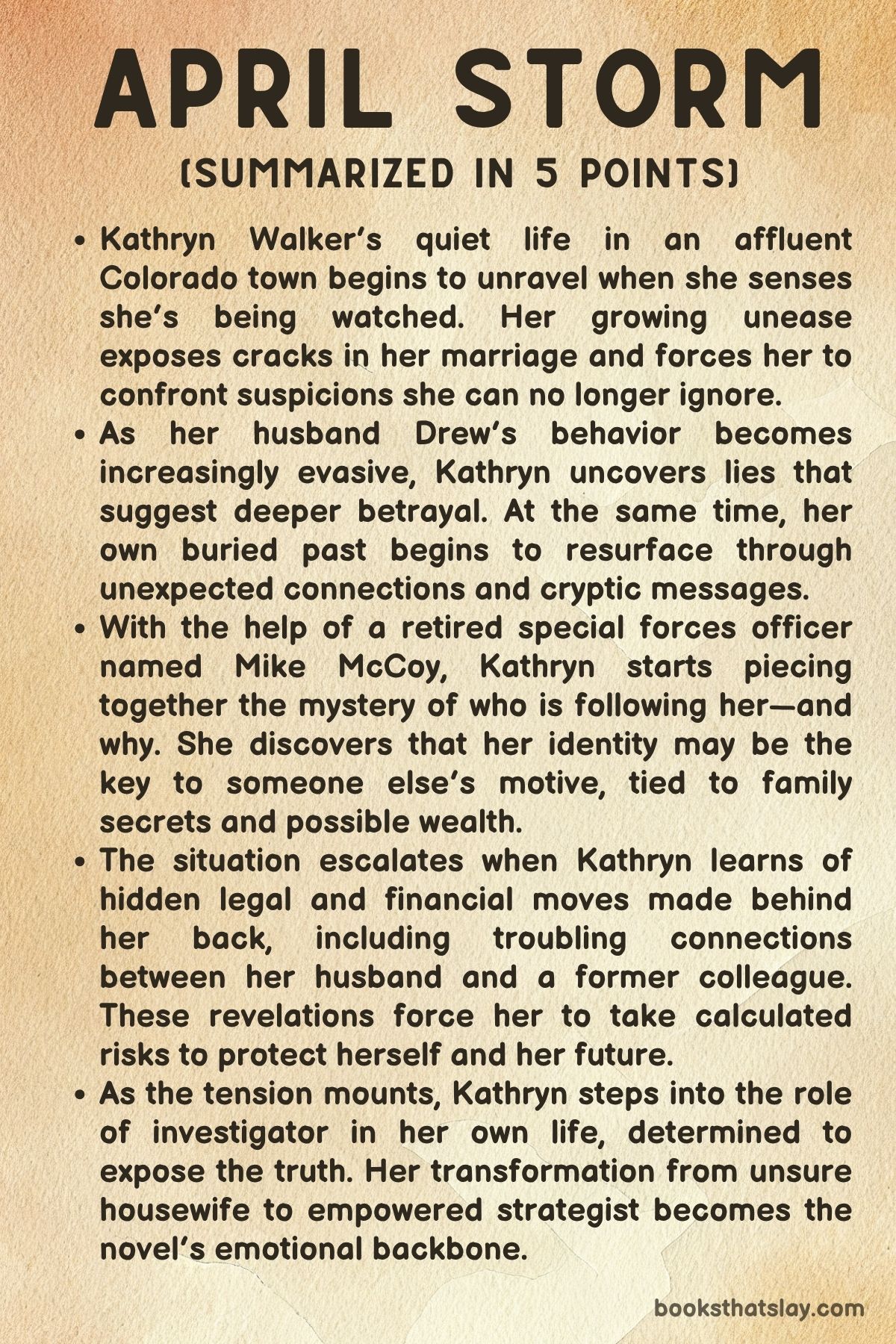
Summary
In the early hours of April 1, 2010, a private investigator sits concealed in an SUV in an upscale Avon neighborhood, watching Kathryn Walker’s morning habits. He’s been hired by an unseen client who pays in cash, insists on secrecy, and demands results within sixty days.
The investigator records everything: Kathryn’s jogging schedule, her volunteer work at the library, her book club, her painting lessons, her weekly lunch outings with an elderly woman named Natalie Hunt, her church attendance, and even small details about her home—alarm codes and a hidden spare key. He also learns something deeply personal that he keeps to himself: Kathryn visits a child’s grave twice, leaving flowers for Abby Gale Walker, a baby who lived only a few months.
The next day, Kathryn’s unease becomes fear. While shopping at City Market, she notices the same man in multiple aisles, always nearby, always watching.
She tries to stay calm, telling herself not to cause a scene, but dread follows her into the parking lot. In the rain, she drops her remote key, slips, and bangs her wrist against a vehicle hitch, losing a bracelet in the process.
Shaken, she calls her home security company and requests that a patrol officer meet her at home, framing it as a possible break-in rather than admitting she feels hunted.
At home, officers find no forced entry, but their presence offers Kathryn a thin layer of safety. While waiting, she calls her husband Drew’s gym to reach him.
The staff insist he isn’t a member. The manager confirms his membership ended months ago.
Kathryn’s shock lands just as Drew arrives in scrubs, acting like nothing is unusual. She tests him by asking about the gym, and his automatic answer doesn’t match what she just learned.
The gap opens a new kind of fear—one that has nothing to do with a stranger in a cap.
That evening, Drew pushes them into attending a last-minute birthday gathering for Barbara Stratton, his surgical nurse, at the townhouse of Elizabeth Camden, a young chief resident at Drew’s hospital. Kathryn feels out of place among hospital insiders and hears assumptions that Drew will buy into a new orthopedic hospital project—something he can’t afford due to a bad investment he’s been hiding.
Downstairs, Kathryn discovers Elizabeth has a fully equipped gym in her basement. The lie about Drew’s gym routine suddenly has a possible explanation.
Subtle exchanges between Drew and Elizabeth, and hints that Elizabeth’s future at the hospital depends on “terms,” leave Kathryn with a growing sense that her marriage has shifted into a life she doesn’t recognize. On the drive home, Drew admits he has “mistakes” and “confessions,” but insists they wait until morning.
That night, Kathryn thinks back to the foundation of their life: meeting in 1985, marrying quickly, and welcoming their daughter Abby Gale—then losing her to SIDS in April 1986. April became a month they learned to dread, a calendar page linked to grief and setbacks.
Their later children, Bobby and Lindsay, brought meaning and motion back into their home, but Abby’s absence remained a quiet wound that shaped everything.
On April 3, Drew’s “confession” turns out to be something that sounds practical: he cancels their long-planned Europe trip because he has a lucrative opportunity to perform surgeries for two Denver Nuggets players. Kathryn suspects there’s more underneath—money problems, ambition, or both—but he sidesteps direct answers.
When she finally admits she’s being followed, Drew believes her in theory yet offers only precautions, implying there’s little law enforcement can do without explicit threats. Kathryn wants protection; Drew offers advice.
Kathryn’s missing bracelet returns in an unexpected way. Mike McCoy, a rancher she noticed at the market, calls to say he found it near his vehicle and repaired the clasp.
They meet at a hotel bar, where he hands it back in a small box—then tells her bluntly that the man she’s been seeing isn’t a stalker in the usual sense. He’s a professional.
Mike recognizes surveillance patterns from his military background and warns her that someone paid to collect a detailed map of her life. He shares a hard-earned reason for intervening: his own pregnant wife was murdered, and he lives with what he couldn’t prevent.
Kathryn leaves with her bracelet and a new, sharper terror—because if this is hired surveillance, someone has a plan.
Back home, Drew returns late with a speeding ticket and claims his phone died. Kathryn notices an extra key labeled “E” on his ring.
He says it’s for Elizabeth’s townhouse “in case of emergency.” The explanation only deepens her isolation. Kathryn begins listing possible enemies, including shadows from her past—questions about family money, old losses, and things she never fully understood.
On Easter Sunday, she tries to find the man in the cap at church, but he slips out. Kathryn tracks him through motel records and learns he checked out and used a false name.
She grows more distracted and jumpy. Soon after, a horrifying incident confirms her instincts: Janet Foster, a fellow library volunteer who resembles Kathryn, is struck by a vehicle in a hit-and-run outside the library.
The timing feels like a message. That night, another odd pressure arrives when Frank Danton—connected to their circle—pushes Drew about renewing Kathryn’s life insurance policy.
It’s a detail that lodges in Kathryn’s mind like a thorn.
Then comes an even more direct attack. At her art studio, Kathryn is overcome by carbon monoxide and collapses.
Police enter using the hidden spare key location and find her unconscious. In the hospital, Drew suggests it was an accident—something about a damper sign—yet Kathryn insists she didn’t make the mistake.
She begs for the spare key to be removed. The pattern is getting too clean to dismiss: someone has access, someone is escalating, and someone is willing to make it look like misfortune.
Kathryn plans to confront the situation head-on, but her marriage ruptures in a new way. She goes to Drew’s office and overhears him comforting a crying Elizabeth.
Elizabeth wants marriage. Drew says it isn’t time to tell Kathryn yet and agrees to wait until the end of April.
Kathryn leaves devastated, no longer unsure about what she heard. In her shock, she drives toward Boulder to be with Lindsay.
On the highway, a dark Jeep follows too closely, triggering panic. She swerves into a truck stop full of police vehicles and begs for help—only to realize the Jeep belongs to an ordinary young mother with a baby.
The officers decide Kathryn is too shaken to drive, and Lindsay comes to get her. Kathryn stays at Lindsay’s sorority house, trying to steady herself while keeping the affair discovery locked inside her chest.
Deputy Dearborn later confirms that the investigator’s identity is fake. The license is bogus.
Kathryn’s fear hardens into certainty: the surveillance was real, and the person behind it is careful. Meanwhile, Mike McCoy takes action on his own, tracking down the private investigator, Reggie Morris.
Morris admits he was hired anonymously and fed inside information, including the Walkers’ alarm code and the spare key location. He also hints that the Walkers’ former housekeeper, Rosalie Deemer, may know more—yet Rosalie flees out of state, frightened and jittery.
Kathryn meets Mike again in Denver at the Brown Palace Hotel. There, he lays out the pattern as he sees it: the hit-and-run likely targeted Kathryn but struck Janet instead; the carbon monoxide incident was another attempt; and the pressure point appears to be late April.
Then he reveals a crucial motive: Kathryn has a five-million-dollar term life insurance policy set to expire at month’s end, with Drew as beneficiary. Kathryn is forced to consider the unthinkable—not only that her husband may be lying, but that her death could solve multiple problems for someone close to her.
That night, Mike believes the attacker is nearby. A man with shaggy hair and a goatee seems to shadow Kathryn in the hotel and even rides the elevator with them, pretending to be on the same floor.
Mike and Kathryn build a composite sketch from memory. As Kathryn adjusts the features, recognition hits like a blow: the man resembles Dr. Edmund Croft, her former doctoral adviser at Rice University, last seen more than twenty years earlier.
Searching online confirms Croft’s prominence. He is scheduled to speak at the NIH on April 24 about a heart device, with a patent expected near April 29.
Kathryn realizes the device matches the work she developed during her unfinished doctorate—work that was dismissed, sidelined, and then seemingly reborn under Croft’s name. The reason she is being watched, threatened, and nearly killed becomes horrifyingly clear: Croft appears to be erasing the person who can connect him to stolen research before the public recognition and patent filing.
The next morning, Kathryn’s car is vandalized—tires slashed, security cameras damaged—suggesting Croft is trying to delay her and buy time to search for evidence at her home. Kathryn finally calls Drew and tells him everything: Croft’s identity, the danger, and the need to secure her dissertation materials.
Drew retrieves her evidence and moves it out of reach. Kathryn files a report and then goes with Mike to his ranch, trusting the isolation more than any familiar place.
There, she finds a calm, controlled environment under the watch of Mike’s foreman, Lonnie Taggart, and begins planning how to confront Rice University.
Kathryn contacts Arthur Madison, the engineering dean, and accuses Croft of theft. Arthur responds cautiously and schedules an in-person meeting.
Kathryn decides not to go alone and chooses Drew as the best witness to bring—both credible and close to the evidence. They travel to Houston, keeping their true purpose hidden from friends.
Unseen, Mike follows, staying nearby as backup.
At Rice, Kathryn presents her documentation. Croft is summoned and walks into a room where Kathryn, Drew, the dean, and the university president are waiting with her old dissertation on the desk.
A trap question exposes his lack of firsthand knowledge, and the university withdraws his honors and NIH appearance. Plans are set in motion to challenge the patent and restore Kathryn’s rights, but Kathryn makes her priority clear: she wants her doctorate.
The university agrees to create a path forward for her to finish what was taken.
Afterward, Kathryn completes her oral defense and earns the doctorate, finally receiving formal recognition for work she never stopped carrying. She also interviews for a job in Houston, leases an apartment, and prepares herself for a future that might not include Drew.
When she returns, Drew confesses the full truth behind his secrecy: massive debt from a failed investment and hidden credit card bills. Kathryn admits she suspected an affair, but Drew reveals Elizabeth is gay and in a relationship with Barbara; his secrecy was about their situation and his financial collapse, not romance.
The marriage crisis shifts from betrayal to survival, and Kathryn proposes a fresh start in Houston. Drew agrees, and they reconcile with a shared decision to rebuild.
In the aftermath, Croft is arrested when forensic evidence links his vehicle to the hit-and-run that injured Janet. The Walkers sell their Avon home, pay down debts, and move to Houston with far less money but more honesty than they’ve had in years.
Their family gathers around new routines, not old appearances. Kathryn’s life is altered—by danger, by truth, and by the degree she earned at last—yet she steps into the next season with her eyes open and her name restored.
Characters
Kathryn Walker
Kathryn is the emotional and moral center of April Storm, presented first as a composed civic leader whose life looks orderly on the surface—charity boards, volunteer commitments, church, and carefully maintained routines—but whose private grief and unresolved past make her unusually vulnerable once she becomes the target of surveillance. Her strength is practical rather than flashy: she problem-solves, keeps lists, follows clues, and pushes forward even while frightened, which is why her growing alarm feels credible rather than melodramatic.
At the same time, Kathryn’s instinct to self-contain pain—especially surrounding Abby’s death and the family’s long dread of April—creates a pressure-cooker effect: when danger escalates and Drew minimizes her fears, her isolation intensifies into panic, misreads, and near-collapse. Her arc is ultimately about reclaiming authorship over her life in two ways: literally, by recovering stolen intellectual work and fighting for her doctorate, and personally, by refusing to remain passive inside a marriage shaped by secrets, guilt, and money shame.
Kathryn’s resolution is not simply “survival”; it’s renewal—she regains agency, confronts the past that was used against her, and chooses a future that isn’t dictated by fear or by the roles other people assigned to her.
Drew Walker
Drew is written as a man who appears steady and competent—an orthopedic surgeon with professional credibility—yet who quietly lives in avoidance, compartmentalizing problems until they become crises. His most defining trait is not cruelty but concealment: he hides financial ruin, dodges direct conversations, and reaches for reassurance and normalcy when Kathryn needs decisive partnership.
That dynamic makes him feel emotionally absent at the worst possible time, and his practical advice about safety reads less like care and more like dismissal because he won’t fully sit inside her terror with her. Drew’s secrecy also creates the story’s most corrosive misunderstanding: Kathryn’s belief that he is having an affair becomes believable because he behaves like a man protecting a second life—keys labeled “E,” evasive explanations, and a pattern of minimizing.
The twist that his “betrayal” is financial and protective (shielding Elizabeth and Barbara) rather than romantic doesn’t erase his failures; it reframes them as shame-driven rather than passion-driven, with shame becoming the engine of his worst choices. Drew’s growth comes when he finally stops hiding, helps Kathryn marshal evidence against Croft, admits the debt plainly, and accepts a new beginning that requires humility—moving, selling the house, and rebuilding from zero.
By the end, he isn’t transformed into a flawless partner; he becomes someone willing to be known, which is exactly what Kathryn needed all along.
Mike McCoy
Mike functions as both protector and accelerant in April Storm—the character who turns Kathryn’s dread into actionable reality by naming what others won’t: that she isn’t imagining patterns and that someone has tried to kill her. His military and special-operations background gives him a disciplined, tactical way of seeing, but what makes him compelling is the grief underneath that competence.
The murder of his pregnant wife, Beth, is the wound that shapes his morality; he is driven by a fierce corrective impulse—this time, he will not fail to protect a vulnerable woman. That intensity makes him reassuring and dangerous at once: he offers safety, but he also normalizes lethal force and covert tactics, placing him at the edge of the story’s ethical line.
Mike’s tenderness appears in small, grounded ways—showing up, staying nearby, thinking ahead—yet he resists emotional entanglement by framing his actions as duty and by returning repeatedly to “missions,” including the ominous black-bag work that suggests a life built to exclude ordinary permanence. He becomes a mirror to Kathryn’s own buried losses: both have been shaped by death and by the feeling that life can be stolen abruptly.
In the end, Mike remains somewhat unknowable by design—he helps Kathryn reclaim her future, then disappears back into a world of shadow obligations, leaving behind the bittersweet sense of a guardian who can’t stay.
Edmund Croft
Edmund Croft is the novel’s central antagonist not because he is physically imposing but because he weaponizes reputation, institutions, and time. He embodies a particular kind of predation: the powerful mentor who takes credit, buries the vulnerable, and then tries to erase witnesses when success is imminent.
Croft’s menace lies in his entitlement and panic—he has built a public identity as an engineering leader, and when the patent deadline and NIH appearance approach, his fear of exposure drives him toward murder rather than accountability. He is also deeply symbolic within April Storm: Kathryn’s stolen dissertation represents not only an intellectual theft but the theft of her voice and trajectory, and Croft’s obsession with silencing her becomes an attempt to freeze her permanently in the “unfinished” space he left her in twenty-one years earlier.
Croft’s self-justification is implied through his behavior—his certainty that Kathryn is a threat to “his” achievement, his paranoia, and his willingness to rationalize violence as necessity. Unlike villains who thrive in chaos, Croft depends on systems—patent timelines, honors, professional deference—until those systems are turned against him through evidence and confrontation.
His downfall is fitting: he is undone publicly, then legally, and the very forensic reality he tried to outrun catches him, reducing his grand narrative to something ordinary and prosecutable.
Elizabeth Camden
Elizabeth is introduced as striking, accomplished, and socially at ease in the medical world that makes Kathryn feel peripheral, which immediately positions her as a perceived rival and destabilizer. The story uses Elizabeth to intensify Kathryn’s distrust of Drew—especially through intimate details like the key and Drew’s familiarity with her townhouse gym—so for much of the novel Elizabeth exists in Kathryn’s mind as a symbol of replacement and humiliation.
What complicates her is that she is not the affair partner Kathryn imagines; she is ambitious, negotiating her “terms” at Winston, and her closeness with Drew is rooted in professional dynamics and in the secrecy of her relationship with Barbara. Elizabeth’s desire for marriage is real, but not with Drew, and that misdirection reveals a broader theme in April Storm: how secrecy breeds stories that feel true because the visible facts are incomplete.
Elizabeth is also a quiet commentary on gender and power—she navigates institutions strategically, understands leverage, and refuses to be boxed into expectations, which parallels Kathryn’s eventual refusal to remain diminished. By the epilogue, Elizabeth becomes part of the repaired social fabric rather than a threat, though her role still highlights that good intentions don’t excuse secrecy when someone else’s safety and sanity are on the line.
Barbara Stratton
Barbara initially appears through the lens of the hospital’s social ecosystem—Drew’s surgical nurse whose birthday event pulls the Walkers into a space where Kathryn feels exposed and judged. She seems, at first glance, like a catalyst for Kathryn’s suspicion because she is tied to Drew’s daily life, and the party becomes the setting where emotional subtext—career pressure, assumed partnerships, and Elizabeth’s proximity—turns into marital rupture.
As the story unfolds, Barbara’s real significance is in what she reveals about hidden lives: she is Elizabeth’s partner, and their relationship explains much of the secrecy that Kathryn misread as betrayal. Barbara therefore becomes a pivot point in the novel’s shift from paranoia to clarity, showing how fear can make even neutral figures feel conspiratorial.
Her commitment ceremony in the epilogue also functions as a thematic counterweight to the Walkers’ renewal: while Kathryn and Drew rebuild a marriage that survived secrecy, Barbara and Elizabeth formalize a love that required secrecy, underscoring the book’s interest in what people hide and what it costs them.
Lonnie Taggart
Lonnie is the grounded anchor of Mike’s ranch life—a scarred foreman whose competence and calm create a sense of order when Kathryn’s world is spiraling. He is not framed as a talkative confidant, but his presence communicates safety through routine: meals, household management, security-minded awareness, and the quiet dignity of someone who has endured hardship without turning it into performance.
Lonnie also serves as Kathryn’s window into Mike’s deeper reality, including Beth’s death and Mike’s pattern of vanishing on dangerous “missions,” which contextualizes Mike’s intensity and emotional distance. In a story filled with people who minimize Kathryn or hide truths, Lonnie stands out as someone who doesn’t manipulate; he observes, warns, and respects the stakes.
His role is subtle but important: he helps make the ranch a believable refuge and reminds Kathryn—and the reader—that real protection often looks like steady, unglamorous competence rather than grand declarations.
Lindsay Walker
Lindsay represents the adult child caught between dependence and independence, loving her parents while sensing fractures she can’t name. Her scenes show both her maturity and her limits: she steps up at the truck stop, brings Kathryn into the Chi Omega house, asks direct questions, and offers unwavering emotional support, yet Kathryn still shields her from the full truth—especially about Drew—revealing the protective instinct that can also isolate.
Lindsay’s connection to Deputy Dearborn adds an extra layer of risk and irony: Kathryn relies on him for help while fearing leaks, and Mike later worries that law enforcement proximity might compromise them. Lindsay is also positioned as a future-maker—planning graduate school and staying local—which contrasts with Kathryn’s life that was interrupted and derailed; Lindsay’s stable planning highlights what Kathryn has been denied and what she is fighting to reclaim.
By the end, Lindsay becomes part of the family’s gravitational pull toward Houston and reunion, symbolizing continuity and a reason to rebuild rather than break apart.
Bobby Walker
Bobby is portrayed as warm, practical, and emotionally available, offering Kathryn a kind of uncomplicated care she isn’t receiving in Avon. His attentiveness—preparing groceries, welcoming her without interrogation, sharing ordinary excitement about housing and a puppy—creates a pocket of normalcy that emphasizes how abnormal Kathryn’s fear has become.
Bobby’s instinct is protective but not controlling: he urges her to trust herself and confront danger publicly if needed, which validates her perceptions without escalating them into hysteria. The detail that he is watched by an unseen man reinforces that Kathryn’s danger radiates outward, and Bobby’s domestic milestones—new lease, new dog—become poignant because they are exactly the life events that danger threatens to shatter.
In the final movement of April Storm, Bobby helps embody what Kathryn is trying to preserve: family life that continues, grows, and stays tender even after trauma.
Frank Danton
Frank is a pressure figure who brings the novel’s financial and legal stakes into sharper focus, especially through his involvement with life insurance and his persistent probing of Drew. He operates like a man who believes he is being pragmatic—concerned with renewals, policies, appearances, and the responsible management of assets—but his timing and insistence feel ominous because Kathryn is already sensing lethal intent around her.
Frank’s role therefore heightens suspicion: he is close enough to Drew to be implicated by association, yet distinct enough to feel like an independent operator with his own priorities. He also functions as a social conscience that values perception and propriety, later objecting to the move and to the symbolic weight of leaving Abby’s body in Avon.
That makes him a thematic counterpoint to Kathryn and Drew’s choice: Frank clings to what things should look like, while the Walkers choose what they need to become whole. Whether or not Frank is “good,” he represents the world of respectable structures that can sometimes ignore the human cost underneath them.
Sandy Danton
Sandy exists in April Storm as an absence that hurts and as a reminder of Kathryn’s need for female intimacy and witness. Kathryn repeatedly notices how alone she feels without Sandy nearby, which matters because isolation is one of the antagonist’s most effective weapons; when you are alone, you doubt your own reality faster.
Sandy’s presence later in Houston is carefully constrained—Kathryn and Drew deliberately conceal the real reason for the trip—which highlights a pattern in Kathryn’s life: she withholds truths even from the people who might help her carry them. Sandy therefore becomes less a plot engine and more an emotional signpost, measuring Kathryn’s loneliness and the gradual reopening of trust.
Even when she isn’t at the center of action, Sandy’s role underscores that “support systems” are not abstract—they are specific people, and losing proximity to them can change what you are able to endure.
Janet Foster
Janet is one of the story’s most tragic “ordinary” characters: a fellow volunteer whose physical resemblance to Kathryn makes her an accidental target, turning Kathryn’s vague dread into undeniable proof that harm has moved from possibility to action. Janet’s injury is devastating, and that severity amplifies both Kathryn’s guilt and her urgency; it also exposes the brutal randomness of targeted violence, where the wrong person can pay the price simply for being in the wrong place with the wrong silhouette.
Janet’s later recollection of the vehicle details becomes a crucial anchor of reality in a narrative filled with misdirection—license plates, fake identities, and Kathryn’s own moment of mistaken panic at the truck stop. Janet’s function is not merely to raise stakes; she embodies the collateral damage of obsession, showing that the threat is not contained to Kathryn’s psyche or even to Kathryn’s body.
Natalie Hunt
Natalie is a quiet guardian of Kathryn’s origin story, someone who holds the hard facts Kathryn never fully integrated about money, family collapse, and the absence of a secret inheritance. Her role is crucial because she punctures one of Kathryn’s coping fantasies—that there might be hidden resources or a solvable mystery that explains her early losses—and replaces it with a grimmer but stabilizing truth.
In doing so, Natalie helps Kathryn redirect her search away from imaginary motives and toward the real one: Croft and the stolen work. Natalie also represents endurance and continuity; Kathryn taking her to lunch is part of the routines the investigator logs, which shows how Kathryn tries to keep faith with people who once helped her survive.
The scene with Natalie is less about plot and more about grounding—Kathryn is forced to face that some losses were simply losses, and that clarity paradoxically strengthens her because she stops chasing ghosts.
Rosalie Deemer
Rosalie is a peripheral figure with outsized importance because she is tied to the home’s intimate vulnerabilities—keys, codes, routines—the very knowledge that makes surveillance actionable. Her abrupt firing and later flight out of state suggest fear, coercion, or guilt, and even when the full mechanics aren’t foregrounded, Rosalie’s jittery disappearance reinforces the idea that someone has been gathering access points for a long time.
In a story where Kathryn’s safety is compromised through small domestic facts—the frog key, the alarm code, the predictable jog—Rosalie symbolizes how trust within a household can be converted into threat. She also reflects a recurring pattern in April Storm: people who know something choose self-preservation over disclosure until danger becomes unavoidable.
Reggie Morris
Reggie Morris is the professional observer whose work becomes a weapon in someone else’s hands, and his presence sharpens the novel’s focus on how modern danger often begins with information. He is methodical, paid in cash, controlled by a burner phone, and given a deadline—details that signal a client with urgency and resources.
Reggie’s most telling trait is selective honesty: he compiles exhaustive data, but he privately withholds the discovery of Abby’s grave visits, suggesting that beneath his job he still has a conscience and an instinct for what feels intimate or sacred. His interactions with Mike reveal him as neither hero nor villain; he is a freelancer caught inside a larger plot, aware enough to recognize the wrongness but not brave enough to dismantle it.
Reggie also functions as an early warning sign for Kathryn’s larger conflict with Croft: her life has been turned into a file, and once a person becomes “a file,” violence can start to look logistical rather than moral.
Officer Harmon
Officer Harmon represents the institutional response that is polite and procedural but limited, a contrast to Mike’s decisive, extralegal intensity. His questioning of Kathryn after the carbon monoxide incident forces her to articulate her shifting understanding—from “stalker” to “private investigator”—and highlights how difficult it is to be believed when events can be explained away as accidents.
Harmon is not portrayed as malicious; he is simply bounded by evidence thresholds and protocol, which becomes its own kind of danger when the threat is sophisticated and time-sensitive. Through him, April Storm underscores a painful realism: official systems can be attentive and still fail you if the story hasn’t yet become “provable.”
Deputy Dearborn
Deputy Dearborn sits at the uneasy intersection of help and risk. On one hand, he provides concrete movement—verifying that “Tim Grayson” is a fake identity, urging Kathryn toward a restraining order, and becoming a potential avenue for legal protection.
On the other hand, his personal connection to Lindsay complicates trust, making Kathryn and Mike fear that information might leak, even unintentionally. Dearborn therefore embodies a tension that runs throughout April Storm: Kathryn needs institutions, but institutions are made of people, and people have relationships, biases, and vulnerabilities.
His character doesn’t have to be corrupt to be dangerous; the mere possibility of conflict is enough to keep Kathryn feeling exposed.
Jim Kittredge
Jim is part of the neighborhood architecture of safety—someone close enough to help officers enter the house and close enough to notice patterns—but also part of the troubling reality that access to Kathryn’s home is broader than she realized. His assistance during the wellness check makes him look like a decent neighbor, yet the incident also demonstrates how easily physical boundaries can be crossed once the “spare key” ecosystem is known.
Jim’s role reinforces the novel’s theme that danger doesn’t always arrive by smashing windows; it often enters through the normal channels of community, courtesy, and familiarity.
Tessie Kittredge
Tessie is the neighborhood witness whose ordinary observations carry weight because the neighborhood itself is supposed to signify security and privilege. Her noticing Drew leaving early in dress clothes and connecting odd events reflects the way communities generate informal surveillance and gossip—sometimes protective, sometimes invasive.
Tessie doesn’t drive the plot directly, but she intensifies the sense that private crises don’t stay private, and that Kathryn’s life is being watched from multiple directions at once. Her presence also reminds the reader that Kathryn’s fear isn’t happening in a vacuum; it’s happening in a social ecosystem where appearances matter and where noticing can quickly become narrative.
Tiffany
Tiffany functions as immediate, practical support when Kathryn is at her most destabilized. She is present at the moment of public humiliation and vulnerability, helps escort Kathryn safely, and provides physical space—her bed, her environment—that allows Kathryn to decompress.
Tiffany’s role also emphasizes how care can come from unexpected places; while Drew fails Kathryn emotionally in key moments, Lindsay and Tiffany respond with direct, nonjudgmental action. In a story heavy with secrets, Tiffany represents a simpler kind of kindness: she doesn’t require the full story to show up for someone in distress.
Abby Gale Walker
Abby’s presence in April Storm is defined by absence, and yet she exerts gravitational force over Kathryn and Drew’s marriage, their relationship with April, and Kathryn’s private rituals of grief. The discovery that Kathryn visits Abby’s grave with flowers on specific dates reveals that Kathryn’s pain is not a closed chapter; it is a living current shaping her emotional baseline and her tolerance for uncertainty.
Abby’s death also contextualizes Kathryn’s later terror: someone trying to kill her doesn’t just threaten her life—it threatens to reopen the deepest wound her family has ever survived. Abby becomes, symbolically, the proof that catastrophe can arrive without reason, which is why Kathryn’s mind spirals when patterns appear again.
The insistence by others—like Frank—on the significance of Abby remaining in Avon also shows how grief becomes geography, and how moving forward can feel like betrayal even when it’s necessary for survival.
Dr. Arthur T. Madison
Arthur Madison represents institutional integrity and cautious courage. He does not immediately “save” Kathryn; instead, he insists on evidence and process, which both protects the university and ensures the confrontation with Croft is decisive rather than emotional.
His recognition of Kathryn from earlier academic life gives their meeting an added poignancy: Kathryn is not a stranger begging at a gate, but a once-promising mind returning to claim what was interrupted. Arthur’s handling of Croft—bringing in the university president, setting a trap question, withdrawing honors—demonstrates strategic competence, and his willingness to create a path for Kathryn to finish her doctorate shows belief in her as more than a victim.
In the architecture of April Storm, Arthur is the character who proves that systems can sometimes work—if someone inside them chooses to act with clarity and spine.
Themes
Surveillance and Violation of Privacy
Kathryn Walker’s experience begins under the unnerving gaze of an unseen observer, setting the tone for the novel’s exploration of surveillance and its corrosive psychological effects. A private investigator, hired by an anonymous client, observes and documents every detail of her daily life: her routines, habits, social circle, and even her grief rituals.
This encroachment, though initially invisible, becomes an insidious presence that destabilizes Kathryn’s perception of safety and control. The invasion is not merely physical but also symbolic—her home, once a place of sanctuary, is compromised by someone who knows her security code and possesses a copy of her key.
The slow erosion of her sense of autonomy makes her question her surroundings, her relationships, and eventually, her own judgment. Kathryn’s growing paranoia is not unfounded, as the novel ultimately confirms that this constant observation is tied to a far more dangerous intent: the desire to silence her permanently.
Her eventual confrontation with the knowledge that she is not just being watched, but targeted, deepens the emotional cost of this theme. The betrayal by someone she once trusted with her academic work becomes intertwined with the psychological violation she suffers from the persistent surveillance.
This theme is not limited to the literal act of being followed; it also encompasses the emotional surveillance within her marriage, where trust has eroded and evasiveness has replaced transparency. The loss of privacy becomes both the plot’s catalyst and a metaphor for the fragile illusion of control that underlies her public image and personal life.
Marital Disillusionment and Emotional Estrangement
Kathryn and Drew’s marriage, once forged in crisis and tested by tragedy, is now burdened by emotional neglect, ambiguity, and unspoken disappointment. Their initial bond—born from a traumatic accident and cemented through young parenthood and shared grief—has given way to distance, evasiveness, and a haunting sense of being strangers to each other.
Drew’s cold detachment in the face of Kathryn’s escalating fears about being followed speaks volumes about the emotional vacuum in their relationship. His dismissive attitude, compounded by secrets about his financial dealings and absence from key moments, indicates a growing divide that Kathryn can no longer ignore.
Even small omissions and inconsistencies begin to weigh heavily, especially when coupled with the discovery of a hidden gym in another woman’s house and the key marked with an unfamiliar initial. The relationship devolves from a partnership into a source of further confusion and fear.
Kathryn’s growing emotional isolation mirrors the physical threats looming over her, reinforcing the notion that betrayal is not just external but internal as well. Her attempts to reconnect—whether by confronting him directly or seeking reassurance—only expose the chasm between them.
However, by the story’s end, as truths are aired and misinterpretations clarified, a path to reconciliation opens. Yet even in its resolution, the theme insists on acknowledging the fragility of human relationships and the long shadow cast by emotional neglect.
Trust, once fractured, must be rebuilt brick by brick, and love requires more than shared history to endure.
Female Resilience and Reclamation of Power
Kathryn’s journey is fundamentally one of self-rescue and reclamation. Once a woman defined by her marriage, civic role, and public persona, she is forced by circumstance to become an investigator, a strategist, and ultimately, her own protector.
Her transition from passive target to active agent is neither abrupt nor effortless. It unfolds through a series of psychological awakenings and moral reckonings.
From questioning her husband’s loyalty to challenging institutional betrayal in academia, Kathryn refuses to be silenced or dismissed. She uncovers not only the plot to kill her but also a deeper theft—the intellectual robbery by her former advisor who claimed her invention as his own.
Rather than retreating into fear or allowing others to act on her behalf, Kathryn mobilizes her resources, draws boundaries, and demands accountability. Her growing alliance with Mike McCoy is not one of dependence, but of mutual respect and shared resolve.
Even when he takes protective measures on her behalf, she continues to direct her own course, including choosing where to live, how to confront her past, and which version of herself she wants to inhabit going forward. Her emotional strength is as evident as her strategic clarity—demonstrated when she comforts her children without alarming them, or when she presents her dissertation with dignity and resolve.
Kathryn’s evolution underscores a powerful narrative about female autonomy in the face of both patriarchal dismissal and physical danger. She reclaims her voice, her work, and her identity, not as someone else’s wife or mother, but as a woman determined to live on her own terms.
Betrayal and the Fragility of Trust
At the heart of April Storm lies the shattering impact of betrayal, particularly when it comes from those closest to the protagonist. Kathryn’s unraveling is catalyzed not just by the threat of a stalker, but by the suspicion that her husband may be concealing crucial truths from her.
This breach in their marriage magnifies every uncertainty: his absences, his dismissive responses, his financial secrecy, and the unexplained key. The betrayal is layered, implicating not only her emotional trust in Drew but also her long-held assumptions about the safety and transparency of their partnership.
This theme is echoed in the academic world, where Dr. Edmund Croft’s theft of her dissertation and ideas represents a different kind of betrayal—one that dismisses her intellectual contributions and sidelines her potential career.
The betrayal in both her personal and professional lives leaves her destabilized and questioning the integrity of everyone around her. Even the well-meaning Mike McCoy operates in shadows, never fully revealing his intentions or plans, though ultimately proving trustworthy.
Trust, then, becomes not a given but something earned slowly, tested repeatedly, and broken easily. The novel argues that betrayal does not always take the form of grand deceptions—it is found in the silences, the omissions, and the subtle betrayals of inattention and disregard.
Kathryn’s story demonstrates how the erosion of trust corrodes relationships and how difficult, yet essential, it is to reclaim trust through accountability, truth-telling, and courage.
Justice, Vindication, and Moral Reckoning
The closing arc of April Storm powerfully centers on themes of justice and vindication. Kathryn’s confrontation with Dr.
Croft is not merely a personal vendetta; it is a moral and intellectual reckoning. She was wronged not only through the theft of her dissertation but also by being systemically dismissed and disbelieved.
Her presentation at Rice University, the formal recognition of her doctoral achievement, and Croft’s subsequent disgrace form a triad of justice served—public, academic, and symbolic. Yet the theme extends beyond the courtroom or university hearing.
It involves Kathryn’s quiet decisions to restore balance in her personal life, whether by reconciling with Drew, rebuilding relationships with her children, or choosing a simpler, more honest life. Justice here is not punitive; it is restorative.
The dignity with which she pursues the truth stands in stark contrast to the desperation and duplicity of those who sought to silence her. Even Mike McCoy’s final act—ensuring Croft’s arrest for attempted murder—emphasizes that justice requires persistence, courage, and sometimes, the help of others willing to do what the law cannot.
The novel affirms that even when power structures fail to protect the vulnerable, individuals can still secure justice through resilience and collective action. Kathryn’s vindication is hard-won, not through revenge, but through integrity and perseverance.
Her story closes not with retribution, but with renewal. Justice, as rendered here, is both a personal triumph and a societal correction.