Arcadia by Tom Stoppard Summary, Characters and Themes
Arcadia by Tom Stoppard is a witty, intellectually rich play set in the same room of an English country house, moving between 1809 and the present day. It brings together mathematics, literature, history, desire, and the limits of knowledge through two groups of characters separated by nearly two centuries.
In the past, the brilliant young Thomasina Coverly begins to imagine ideas far ahead of her time, while her tutor Septimus Hodge navigates scandal and affection. In the present, scholars try to reconstruct what happened at the estate, often misreading clues as they chase fame, truth, and meaning.
Summary
Arcadia takes place in a large room at Sidley Park, an English country house in Derbyshire, but the action moves between two periods: the early nineteenth century and the present day. In 1809, Thomasina Coverly, a precocious thirteen-year-old, studies with her tutor, Septimus Hodge.
Thomasina is curious, sharp, and unusually gifted in mathematics. Septimus, only twenty-two, is clever, evasive, and often distracted by the romantic confusion around him.
At the beginning, Thomasina asks Septimus what “carnal embrace” means after overhearing servants gossiping about Mrs. Chater being discovered in the gazebo. Septimus first tries to deceive her with a comic false definition, but Thomasina soon exposes the lie.
The gossip matters because Septimus himself was the man with Mrs. Chater. Mr. Chater, a poet and her husband, finds out and challenges Septimus to a duel.
Septimus avoids danger by flattering Chater’s poetry and suggesting that Mrs. Chater’s actions may have been intended to secure him a favorable review.
At the same time, Thomasina’s mind turns toward problems that seem impossible for her age and era. She wonders about Fermat’s Last Theorem, free will, and whether the future of the universe might be expressed by mathematics.
Septimus recognizes her intelligence but does not fully understand how original her ideas are. Her early thoughts hint at modern chaos theory and thermodynamics, though neither field exists in her world.
The past scenes also introduce Lady Croom, Thomasina’s mother, who is displeased by the fashionable redesign of the estate’s garden. Richard Noakes, the landscape architect, wants to replace the old orderly garden with a Romantic design that includes rougher scenery and a hermitage.
Lady Croom resists these changes, preferring the beauty of what already exists. Lord Byron is also present at the estate, though he never appears onstage.
His unseen presence becomes a major source of confusion, desire, and later scholarly speculation.
In the present day, Hannah Jarvis, a writer and researcher, is studying the Sidley Park hermit and the history of the estate’s garden. She is skeptical of Romanticism and sees the hermitage as a symbol of a cultural shift toward emotional excess.
Bernard Nightingale, another scholar, arrives under a false name because he had once written a harsh review of Hannah’s book. He is researching the obscure poet Ezra Chater and believes he has found evidence linking Chater, Septimus, and Lord Byron.
Bernard has discovered a copy of Chater’s poetry collection connected to Byron’s library. Inside are notes that seem to suggest a scandal and a duel.
He believes Byron may have killed Chater in a duel and then fled England. Hannah is doubtful, but Bernard is excited by the possibility of making a major literary discovery.
He wants Hannah’s help because she has been working through documents from the estate.
Valentine Coverly, a modern descendant of Thomasina’s family, is also at Sidley Park. He is a graduate student in mathematics studying grouse population patterns using old game books from the estate.
He later examines Thomasina’s notebooks and realizes that her work resembles modern iteration: a process in which the result of an equation is fed back into the same equation again and again. Valentine is stunned because this kind of mathematics belongs to a much later period.
At first, he resists the idea that Thomasina truly understood what she was doing, but the evidence gradually becomes harder to dismiss.
As the modern researchers investigate, Bernard grows more confident in his theory about Byron. He argues from partial evidence, relying on bold assumptions and dramatic instinct.
Hannah challenges him, warning that he is confusing possibility with proof. Bernard, however, wants discovery, fame, and publication.
He prepares a lecture claiming that Byron killed Chater. His argument depends on Chater’s disappearance from English records, the letters found in the poetry book, and Byron’s sudden departure.
The past scenes reveal the truth behind the clues. There was no fatal duel.
Byron, Mr. and Mrs. Chater, and Captain Brice left Sidley Park after another sexual scandal, this time involving Mrs. Chater and Byron. Mr. Chater did not die in England.
He traveled abroad with Captain Brice and Mrs. Chater, eventually dying after being bitten by a monkey. Captain Brice then married Mrs. Chater.
The documents that Bernard treats as evidence of murder are really traces of comic embarrassment, jealousy, and social disorder.
Septimus, meanwhile, becomes increasingly important to both timelines. In the past, he flirts with Lady Croom and teaches Thomasina, while also trying to manage the consequences of his own actions.
In the present, Hannah begins to suspect that the mysterious Sidley Park hermit may have been Septimus himself. The hermit was known for filling pages with attempts to prove theories about the end of the world.
This connects with Thomasina’s ideas about heat, time, and the universe. Hannah’s research changes direction as she realizes that the hermit may not have been merely a Romantic symbol, but a grieving man preserving or pursuing Thomasina’s unfinished work.
Thomasina grows older in the later past scenes. By the time she is nearly seventeen, her genius has become even clearer.
She studies heat and realizes that while many processes can be reversed mathematically, heat moves in only one direction. Things cool, energy disperses, and time cannot simply run backward.
Her insight anticipates later scientific ideas about entropy. She creates a diagram and equations that Valentine, in the present, uses with his computer to produce a beautiful mathematical model he calls the Coverly set.
The timelines begin to echo each other more closely. In the present, Valentine recognizes that Thomasina’s work could have made her famous had she lived in another age.
Hannah reminds him that Thomasina died in a fire on the night before her seventeenth birthday. This knowledge casts a shadow over the final scenes.
In the past, Thomasina is alive, brilliant, excited, and unaware of how little time remains to her.
Bernard’s theory collapses when further evidence proves that Chater survived the supposed duel and died later abroad. Hannah prepares to refute him publicly.
Bernard is angry and embarrassed, but still tries to salvage parts of his claim. His failure contrasts with Hannah’s slower, more careful method.
The play shows that truth is often difficult to recover and that the past can be distorted by ambition, desire, and incomplete records.
In the final movement, the past and present occupy the stage together. Thomasina, dressed for bed, comes to Septimus because she wants him to teach her to waltz before her seventeenth birthday.
She kisses him as payment, but the moment becomes more serious as they recognize their affection. Septimus studies her work and begins to understand its significance.
He warns her to be careful with her candle, a painful detail because the audience knows she will die in a fire.
In the present, Gus, the silent younger Coverly son, gives Hannah a drawing of Septimus, helping confirm her belief about the hermit. Gus asks Hannah to dance.
At the same time, Septimus dances with Thomasina. The two pairs move together across different centuries, joining loss and discovery in one image.
The ending does not undo tragedy, but it gives Thomasina’s brilliance a kind of afterlife. Her ideas survive through fragments, notebooks, and the people who finally learn how to read them.
Arcadia closes with music, dance, and the sense that human knowledge is always incomplete, yet still worth pursuing.
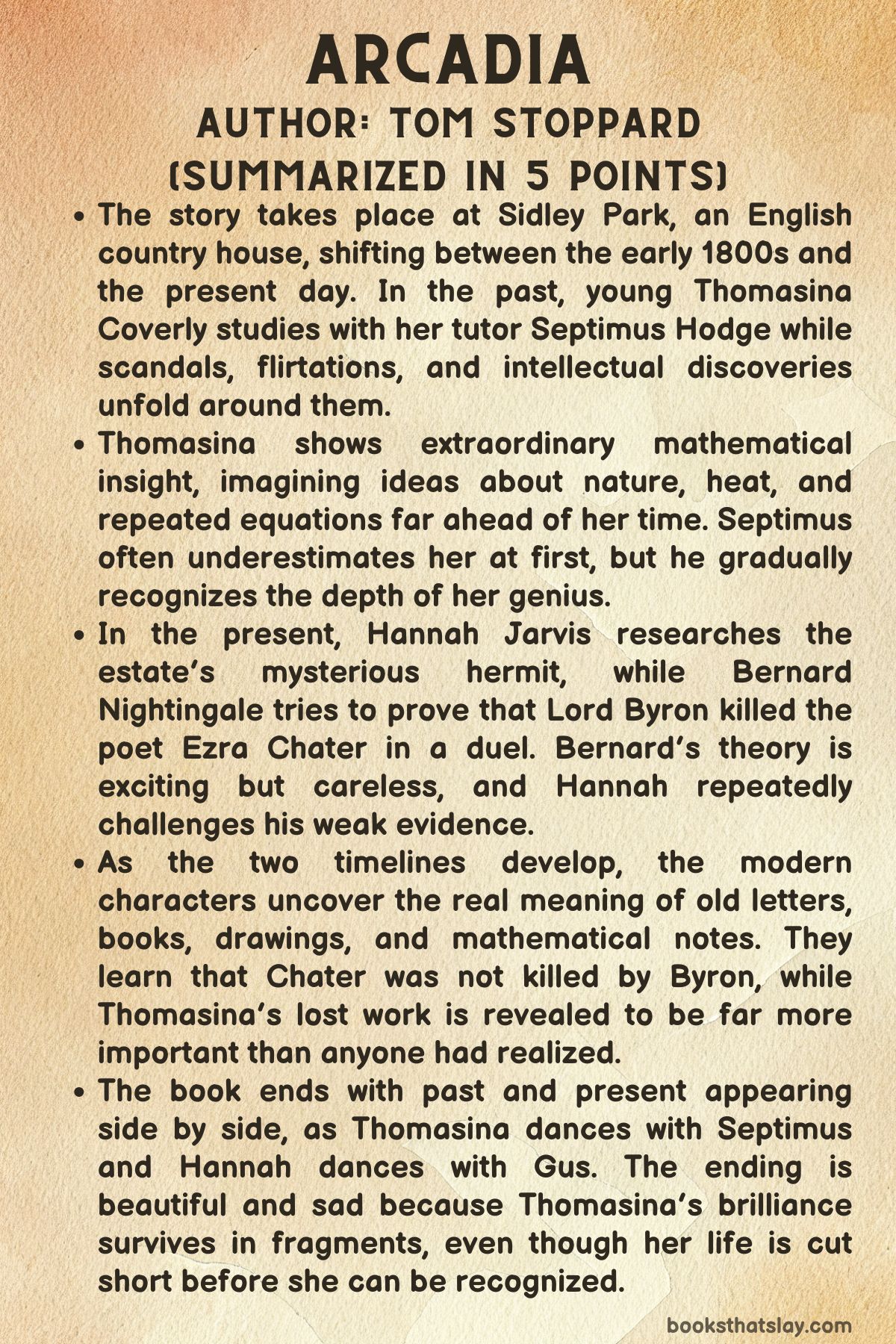
Characters
Thomasina Coverly
Thomasina Coverly is the intellectual center of the play and one of its most remarkable figures. At thirteen, she already thinks far beyond the limits of the adults around her, asking questions about mathematics, science, desire, history, and the nature of the universe with startling directness.
Her curiosity begins in apparently simple moments, such as asking Septimus what “carnal embrace” means, but her questions quickly reveal a mind that refuses to accept easy answers. She is playful and young, yet her mathematical imagination points toward ideas that belong to a much later age.
Her work on equations, iteration, heat, and the future of the universe shows her as a genius born too early, someone whose discoveries cannot be fully understood by her own time. What makes Thomasina especially moving is the contrast between her brilliance and her vulnerability.
She is still a child in many ways, excited by rabbits, dances, poetry, and romantic fantasies about Lord Byron. As she nears seventeen, she becomes more aware of feeling, attraction, and mortality, but she remains innocent of the tragedy awaiting her.
In Arcadia, Thomasina represents lost genius, the beauty of unfinished thought, and the painful truth that history does not always preserve its brightest minds in time.
Septimus Hodge
Septimus Hodge is Thomasina’s tutor, but his role in the play is far larger than that title suggests. He is witty, educated, attractive, and morally slippery, often using language and intelligence to escape the consequences of his behavior.
His affair with Mrs. Chater creates one of the early comic crises, and his ability to flatter Mr. Chater shows both his charm and his instinct for self-preservation. Yet Septimus is not merely a clever libertine.
His relationship with Thomasina gives him depth, tenderness, and eventual tragedy. At first, he underestimates her intellectual discoveries, treating some of her ideas as childish or impractical.
Over time, he begins to recognize that her mind is extraordinary. His later association with the hermit suggests that Thomasina’s death changes the course of his life completely.
If Hannah’s conclusion is correct, Septimus spends his later years trying to understand or continue Thomasina’s work, transforming from a social wit into a figure of grief and obsession. His character stands at the meeting point of comedy and sorrow.
He can be evasive and selfish, but he is also capable of loyalty, admiration, and deep feeling. Through Septimus, the play shows how love, guilt, and intellectual wonder can alter a person permanently.
Hannah Jarvis
Hannah Jarvis is a modern scholar whose discipline and skepticism make her one of the strongest voices of reason in the play. She is researching the Sidley Park hermit and the history of the estate’s garden, and she approaches the past carefully, resisting the temptation to turn uncertainty into dramatic certainty.
Hannah is sharply critical of Romantic excess, especially the tendency to glorify emotion, mystery, and ruin. This makes her a natural opponent to Bernard, whose scholarship is driven by ambition and theatrical confidence.
Hannah is not cold, however. Her restraint hides curiosity, loneliness, and a powerful desire to understand the truth.
Her interest in the hermit gradually shifts from abstract symbolism to human recognition when she suspects that the hermit may have been Septimus. This discovery matters because it forces her to see that the past is not only a subject for argument, but a record of grief, love, and persistence.
Hannah’s bond with Gus also reveals a softer part of her character. She responds to his silent gestures with care, and the final dance suggests that she is capable of accepting connection without surrendering her intelligence.
In Arcadia, Hannah represents patient inquiry, intellectual honesty, and the emotional value of evidence.
Bernard Nightingale
Bernard Nightingale is ambitious, energetic, vain, and often reckless. He arrives at Sidley Park in pursuit of a sensational literary discovery: the possibility that Lord Byron killed Ezra Chater in a duel.
Bernard is not unintelligent; he knows literature, understands the value of historical clues, and has the confidence needed to make bold connections. His weakness is that he wants his theory to be true so badly that he begins treating speculation as fact.
He dismisses objections, edits inconvenient details out of his argument, and turns scholarship into performance. His conflict with Hannah exposes the difference between wanting truth and wanting triumph.
Bernard’s charm is real, but it is mixed with arrogance and sexual opportunism. His treatment of Chloe and his crude remarks to Hannah reveal a self-centered streak that damages his credibility as a person as well as a scholar.
Still, Bernard is not a simple villain. He brings motion, conflict, and comic energy to the play.
He also raises a serious question about research: how much imagination is necessary before evidence becomes distorted? Bernard’s downfall comes because he mistakes a good story for a proven one.
His character warns against the glamour of certainty when the facts remain incomplete.
Valentine Coverly
Valentine Coverly is the modern mathematician of the Coverly family, and he serves as the bridge between Thomasina’s lost work and contemporary understanding. He is practical, intelligent, and often dryly humorous, but he is also limited at first by the assumptions of his own education.
When he looks at Thomasina’s notebooks, he recognizes the mathematical significance of what she was doing, yet he initially struggles to believe that someone from her era could have reached such ideas. His work on grouse populations gives him a modern version of the same problem that fascinated Thomasina: how patterns emerge from repeated processes and apparently irregular data.
Valentine’s computer allows him to extend Thomasina’s equations and see their beauty in ways she never could. This makes him both an interpreter and a late witness to her genius.
He is not as emotionally intense as Hannah or as flamboyant as Bernard, but his role is essential because he gives scientific weight to Thomasina’s achievement. He also expresses one of the play’s central ideas: discoveries may be lost, delayed, or misunderstood, but knowledge can return when someone finally has the tools to read it.
Valentine’s character shows the humility required when the present encounters intelligence from the past.
Chloe Coverly
Chloe Coverly is lively, impulsive, flirtatious, and emotionally open. She is not a scholar like Hannah, Bernard, or Valentine, but she often sees human behavior with surprising clarity.
Her idea that sex disrupts the possibility of a perfectly predictable universe is both comic and insightful. While Valentine thinks in mathematical terms, Chloe instinctively understands that desire makes people behave irrationally, causing disorder in systems that might otherwise seem logical.
Her attraction to Bernard reveals her vulnerability to charisma and intellectual glamour. She is drawn to his confidence, but Bernard treats her carelessly, and her anger near the end shows that she recognizes the humiliation of being used.
Chloe also represents the continuing life of Sidley Park in the present. She is part of a family that carries the traces of the past without fully understanding them.
Her Regency costume, party preparations, and emotional confusion mirror the earlier world of flirtations, scandals, and misunderstandings. Chloe may appear casual, but she gives the play an important reminder that ideas do not exist apart from bodies, attraction, jealousy, and embarrassment.
She sees that human unpredictability is not a minor complication, but a force powerful enough to disturb any neat theory of life.
Gus Coverly
Gus Coverly is Chloe and Valentine’s younger brother, and he never speaks during the play. His silence makes him mysterious, but it does not make him passive.
He observes closely, moves between scenes with quiet purpose, and often seems connected to the emotional truth of the house in ways others are not. His affection for Hannah is gentle and wordless.
He gives her an apple, later presents her with the drawing of Septimus, and finally asks her to dance. These gestures matter because Gus helps Hannah reach one of her most important conclusions.
By giving her the drawing, he assists in connecting Septimus to the hermit, even though he does not explain himself verbally. Gus functions almost like a guardian of memory.
He does not argue, publish, or theorize, yet he delivers the kind of evidence that scholars need. His silence also contrasts with the excessive speech of characters like Bernard, who talks confidently but often wrongly.
Gus suggests that understanding does not always come through eloquence. Sometimes it comes through attention, patience, and quiet acts of care.
His final dance with Hannah creates a moving parallel with Thomasina and Septimus, joining the present to the past through gesture rather than explanation.
Lady Croom
Lady Croom is Thomasina’s mother and the commanding presence of Sidley Park in the nineteenth-century storyline. She is intelligent, proud, socially powerful, and sharply verbal.
Her objections to Noakes’s garden redesign reveal more than a preference in landscaping; they show her resistance to artificial fashion and her attachment to order, beauty, and control. She dislikes the planned hermitage and the noisy machinery of improvement because they disturb the estate’s natural elegance and her authority over it.
Lady Croom is also a figure of desire and social complexity. Her flirtation with Septimus suggests that she is not merely a conventional aristocratic mother but a woman with her own appetites and emotional strategies.
At the same time, she tries to manage the reputation and future of her household. Her concern over Thomasina’s education and marriage reflects the social expectations placed on young women, even brilliant ones.
Lady Croom can be comic in her indignation, but she also represents the world that limits Thomasina. She admires intelligence only up to the point where it remains socially manageable.
Her character gives the play wit, authority, and a strong sense of the class structure surrounding knowledge, gender, and desire.
Ezra Chater
Ezra Chater is an insecure poet whose wounded pride sets much of the comic misunderstanding into motion. He is less important for the quality of his poetry than for the social chaos created by his jealousy and vanity.
When he discovers Septimus’s affair with Mrs. Chater, he challenges him to a duel, attempting to defend his honor according to the masculine codes of the period. Yet Chater is easily manipulated.
Septimus flatters his literary reputation, and Chater quickly softens, showing how deeply he craves recognition. His pride as a husband and his pride as a poet are closely connected; both depend on public validation.
In the modern storyline, Bernard’s theory depends on Chater’s disappearance from English literary records, but the truth is far less heroic than Bernard imagines. Chater does not become the victim of a grand Byronic duel.
Instead, he leaves England and later dies abroad after being bitten by a monkey. This anticlimax is central to the play’s humor.
Chater’s character shows how history can turn minor vanity into false mystery when records are incomplete. He is both ridiculous and useful, because through him the play exposes the gap between dramatic interpretation and ordinary fact.
Mrs. Chater
Mrs. Chater is never developed through long speeches, but her presence strongly affects the action. She is associated with sexual scandal, first through her affair with Septimus and later through her involvement with Lord Byron.
Her behavior causes jealousy, dueling threats, hurried departures, and later historical confusion. In many ways, she is less a fully explored psychological figure than a catalyst whose actions expose the desires and weaknesses of others.
Septimus is endangered by his affair with her, Mr. Chater is humiliated by her, Byron is implicated through her, and Bernard misreads the consequences of the scandal long afterward. She also reveals the double standards of the social world.
Male desire is often treated as witty or adventurous, while female sexual behavior becomes a source of banishment and reputation damage. Yet Mrs. Chater is not merely a victim.
Her repeated involvement in scandal suggests agency, appetite, and dissatisfaction with the limits placed upon her. The play gives only partial access to her inner life, which is itself meaningful.
Like many figures from the past, she is known through traces, gossip, and consequences rather than direct explanation. Her character reminds readers that history often preserves women as rumors before it preserves them as people.
Captain Brice
Captain Brice is Lady Croom’s brother and a figure tied to masculine order, military authority, and social procedure. He becomes involved in the dispute between Septimus and Mr. Chater, helping to arrange the formal language and expectations of a duel.
Yet Brice is not simply severe or honorable. He understands that much of Chater’s fury is bluster, and his handling of the situation suggests a practical awareness of how men perform outrage in public.
Later, his role shifts when he leaves with the Chaters and eventually marries Mrs. Chater after Ezra Chater’s death. This development helps disprove Bernard’s theory in the present and reveals the ordinary, messy truth behind what later appears to be a literary mystery.
Brice represents the way social order tries to contain scandal while also being part of it. His military bearing and formal manners do not prevent desire, embarrassment, or opportunism from shaping events.
He belongs to a world where reputation must be managed carefully, but his own life becomes folded into the very scandal he helps supervise. His character is useful because he connects family, honor, travel, and the later fate of the Chaters.
Richard Noakes
Richard Noakes is the landscape architect responsible for redesigning the grounds at Sidley Park. His character represents the changing taste of the period, especially the move toward Romantic artificial wildness: hermitages, ruins, irregular scenery, and dramatic effects.
Noakes is proud of his plans and his machinery, but Lady Croom sees his work as intrusive and absurd. Through him, the play explores the difference between nature and the human desire to stage nature.
His proposed hermitage becomes especially important because it later shapes Hannah’s research into the Sidley Park hermit. What begins as a fashionable garden feature eventually becomes part of a real human story when Septimus may have occupied that symbolic space.
Noakes himself is not a major emotional figure, but his work has lasting consequences. He alters the estate in ways that future scholars interpret, misinterpret, and debate.
His character shows how aesthetic choices can become historical evidence, even when their original purpose was superficial or fashionable. Noakes is also a comic figure because his practical pride clashes with Lady Croom’s aristocratic disdain.
He stands for progress, design, and modern improvement, but the play treats that progress with irony.
Jellaby
Jellaby is the butler at Sidley Park, and his role is quiet but important. As a servant, he moves through the household carrying letters, messages, and information.
He often knows more than the upper-class characters realize, especially about scandals and private behavior. His position allows him to observe the hidden mechanics of the house: who sends notes, who leaves rooms, who departs early, and who is trying to conceal what.
Jellaby’s presence reminds readers that aristocratic drama depends on servants who witness, manage, and circulate information. He is not emotionally central, but he is structurally significant because letters and timing matter greatly in the play.
The modern scholars later build theories from documents, while in the past Jellaby helps those documents move from hand to hand. He also adds comic realism.
His expectation of a tip before providing useful information shows that knowledge has social and economic value. Jellaby represents the practical intelligence of those who serve but are rarely credited in official history.
Though he does not control the major events, he helps make them visible.
Lord Byron
Lord Byron never appears directly, yet he is one of the most influential figures in the play. His absence gives him power.
In the nineteenth-century storyline, characters speak of him, desire him, admire him, resent him, or react to his behavior. Thomasina imagines romantic significance in his glances, Lady Croom has her own connection to him, Mrs. Chater becomes involved with him, and Septimus is linked to him through friendship and literary circles.
In the present, Bernard builds his ambitious theory around Byron, believing that the famous poet may have killed Chater in a duel. Byron’s fame makes the theory attractive because history pays more attention when a celebrated name is involved.
This is exactly why his character matters despite never entering the room. He exposes the distortion caused by celebrity.
Ordinary evidence becomes exciting when attached to a legendary figure. Byron also represents Romantic glamour, sexual danger, poetic fame, and the temptation to turn life into myth.
The truth, however, is less grand than Bernard imagines. By keeping Byron offstage, the play allows him to function as an idea as much as a person: a magnet for fantasy, scholarship, and error.
Augustus Coverly
Augustus Coverly, Thomasina’s younger brother in the past storyline, brings childish mischief and social comedy into the play. He threatens to reveal Thomasina’s secrets, asks awkward questions, and becomes curious about sex in a way that mirrors Thomasina’s earlier questions but without her intellectual range.
His presence helps show Thomasina within a family setting rather than only as a genius. Around Augustus, she becomes an older sister, capable of irritation, bargaining, and playfulness.
His apology to Septimus also gives him a small but recognizable moral shape; he is immature, but not cruel. Augustus’s curiosity about whether Septimus has an older brother and his eventual attempt to ask about sex extend the play’s recurring interest in education.
Young people are trying to understand the adult world, but adults often hide, distort, or joke their way around the truth. Augustus also creates a parallel with Gus in the modern storyline.
The names link past and present, though their personalities differ sharply. Augustus speaks, interrupts, and asks questions, while Gus remains silent and communicates through action.
Together, they strengthen the sense that family patterns repeat across generations in altered forms.
Themes
Knowledge, Evidence, and Misinterpretation
The search for truth depends on fragments: letters, books, mathematical notes, garden plans, drawings, and household records. Arcadia shows that evidence does not speak for itself; people arrange it according to desire, training, pride, and imagination.
Bernard looks at partial records and creates a dramatic story about Byron killing Chater. His theory is exciting, but it fails because he turns gaps into proof.
Hannah works differently. She is cautious, skeptical, and willing to wait for stronger evidence, even when her instincts suggest a powerful conclusion about Septimus and the hermit.
Valentine’s work with Thomasina’s notebooks adds another layer, because mathematical evidence can also be misunderstood when it appears before the world has the tools to interpret it. The play does not argue that imagination has no place in scholarship.
Bernard’s energy and Hannah’s intuition both matter. The danger comes when imagination outruns discipline.
History, the play suggests, is not a stable object waiting to be recovered whole. It is broken, partial, and vulnerable to the needs of those who study it.
The past can be approached, but never fully possessed, and honesty lies in knowing the difference between a conclusion and a wish.
Genius Before Its Time
Thomasina’s mind is one of the play’s great sources of wonder and sadness. She reaches toward ideas that later generations will recognize as connected to iteration, chaos, thermodynamics, and entropy, but she lives in a period unable to support or validate her discoveries.
Her tragedy is not only that she dies young, but that her intelligence cannot fully enter history when it first appears. Septimus sees flashes of her brilliance, yet even he cannot grasp its full scale at once.
Valentine, with the help of modern mathematics and a computer, finally understands that she was working toward concepts far beyond her age. This delayed recognition creates a painful irony: Thomasina’s work becomes visible only after her life has vanished.
The theme raises questions about how many discoveries have been lost because they appeared in the wrong place, the wrong body, or the wrong century. Thomasina is also a young girl in a social world more interested in her marriage prospects than her intellectual future.
Her genius challenges the assumptions of both her own time and the present. The play treats knowledge as fragile, dependent not only on intelligence but on survival, preservation, and the ability of others to understand what they have inherited.
Desire, Disorder, and Human Unpredictability
Desire repeatedly disrupts order in the story. Septimus’s affair with Mrs. Chater creates threats of violence, concealment, and social embarrassment.
Byron’s unseen romantic adventures cause departures and later confusion. Chloe’s attraction to Bernard produces emotional pain in the present, while Lady Croom’s flirtation with Septimus complicates the power dynamics of the household.
These incidents are often comic, but they also support a serious idea: human beings do not behave like clean equations. Chloe expresses this most directly when she suggests that sex is the force that disrupts determinism.
Her thought may sound playful, but it captures much of the play’s emotional logic. People make irrational choices because they want, fear, envy, desire, and regret.
These impulses create consequences that no perfect system can easily predict. Even scholarship is affected by desire.
Bernard wants fame, Hannah wants truth, Valentine wants patterns, and Septimus may spend his later life driven by grief and love. The play places scientific order beside emotional disorder and refuses to cancel either one.
Mathematics can describe patterns in nature, but it cannot remove the unruly force of human longing. Desire becomes a kind of chaos: comic, destructive, generative, and deeply human.
Time, Loss, and What Survives
Time moves through the play as both structure and subject. The same room contains two centuries, allowing past and present to appear side by side.
This creates dramatic irony because the audience knows things the characters do not. Thomasina worries about learning to waltz before turning seventeen, while the present-day characters know she will die before that birthday fully arrives.
Her candle becomes unbearable because it is ordinary to her and ominous to everyone aware of her fate. The theme of loss is everywhere: lost proofs, lost lives, lost letters, lost meanings, and lost chances for recognition.
Yet the play is not only about disappearance. Something always survives, though often in damaged or incomplete form.
Thomasina’s notebooks survive. Septimus’s image survives.
The garden survives in altered form. Rumors become records, records become theories, and theories sometimes lead back toward truth.
The final dance joins Thomasina and Septimus with Hannah and Gus, suggesting that the past is gone but not entirely unreachable. Human life ends, knowledge may be delayed, and love may fail to protect the beloved, but traces remain.
The work of the living is to read those traces with care.