Arcana Academy by Elise Kova Summary, Characters and Themes
Arcana Academy by Elise Kova is a dark romantic fantasy set in a kingdom where tarot cards hold real power and magical talent is controlled by class, fear, and royal ambition. The story follows Clara Graysword, a gifted illegal card inker and thief, after she is pulled from prison by Prince Kaelis, the headmaster of Arcana Academy.
Forced into a false engagement and a dangerous search for the mythical World card, Clara must survive court politics, academy trials, old enemies, and her own need for answers about her missing sister. It is a story of power, grief, survival, desire, and betrayal.
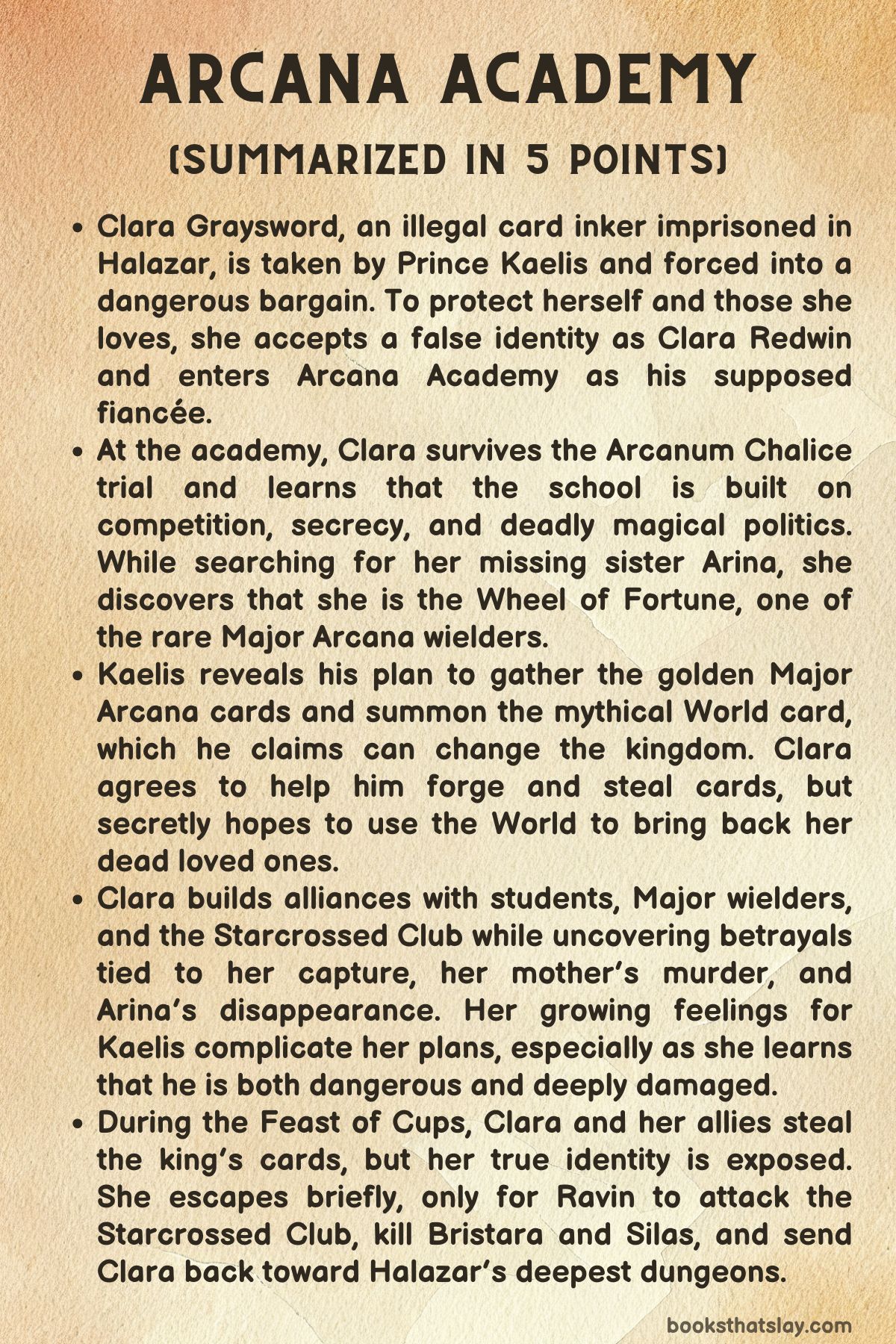
Summary
Clara Graysword has spent nearly a year in Halazar Prison, where she has been forced to ink magical tarot cards for the cruel warden. She expects another session of illegal labor when guards take her from her cell, but instead she is brought before Prince Kaelis, second son of Oricalis and headmaster of Arcana Academy.
Clara knows him as the man she believes ruined her life, killing her mother and sending her to prison. Kaelis uses the Nine of Swords to force the truth from her and learns that Clara’s younger sister, Arina, helped supply her illegal work.
Clara is condemned to death, but she uses hidden supplies, her own blood, and her rare ability to ink any suit with any powder to escape the prison walls and flee into the river. Kaelis catches her, revealing that her escape was a test.
Clara wakes at Arcana Academy. Kaelis explains that he needs her skills to obtain the World, the legendary twenty-first Major Arcana card.
When she refuses, he threatens everyone she loves. To protect his plan, he gives her a forged identity: Clara Redwin, the surviving heiress of Clan Hermit, and announces that she is his betrothed.
Clara agrees outwardly while privately planning to find Arina and escape.
At the academy, Clara is forced into the Arcanum Chalice trials. Initiates must sacrifice one possible future and battle the vision that forms from it.
Clara draws the Two of Cups and chooses it in defiance of Kaelis. The vision takes the shape of Liam, her first love, who had left her for the academy and an arranged marriage.
Clara almost gives in to the false comfort of the scene, but she remembers herself and destroys the vision. She survives, becoming an initiate, but quickly learns that survival is only the beginning.
There are fewer house placements than initiates, and noble-born students already hold the advantage.
Clara searches for Arina but finds no sign of her. She learns that her sister supposedly ran from the academy and may have been sent to a mill or killed.
Clara’s new life is a constant performance. She must pretend to be Kaelis’s loyal fiancée while hiding her true identity as a former prisoner and illegal Arcanist.
She forms cautious friendships with Luren, Kel, Sorza, and Dristin, and clashes with noble students such as Alor and Eza. Eza, who knows about Clara’s time in Halazar, attacks her with the Hanged Man, a Major Arcana card, trapping her in visions of prison, torture, and her mother’s death.
Kaelis saves her and reveals a deeper truth: Clara is one of the Twenty, a living wielder of a Major Arcana. Her card is the Wheel of Fortune.
Kaelis introduces Clara to other Major Arcana wielders, including Myrion, Sorza, Elorin, Eza, and others. She learns that each Major has special powers and that their abilities pass by destiny when the wielder dies.
Clara struggles to understand the cost of her own card. While trying to escape through hidden passages, she enters deadly rooms beneath the academy and nearly dies.
A young man named Silas rescues her. Clara recognizes him from Arina’s stories and learns that he is the Chariot, able to transport himself and others instantly to places he knows.
Silas confirms that Arina disappeared, though the official story says she was captured, sent to a mill, and killed.
Clara persuades Silas to take her to Eclipse City, where she searches for the Starcrossed Club, the refuge that became her family after her mother died. She finds the club destroyed, but later reunites with surviving members at a new safe house.
They tell her that enforcers raided the club the same night she was captured and that Arina has not been seen since. Clara refuses to believe her sister is dead without proof and returns to the academy.
Kaelis shows Clara records claiming Arina died in a mill explosion but admits no body was found. He then reveals the real reason he needs the World.
Beneath the academy is a cavern with a statue and slots for twenty golden Major cards. If all are gathered, the World can be summoned.
Kaelis has thirteen cards, his father has four, and Clara’s unusual inking talent can help forge replacements. His plan is for Clara to study the king’s cards, create counterfeits, and switch them during the Feast of Cups.
Clara agrees, but secretly plans to claim the World’s power for herself, hoping it can bring back her mother and sister.
As weeks pass, Clara trains, studies, and struggles to fit in. Her attraction to Kaelis grows despite her hatred and suspicion.
At a royal soiree, she meets Liam again and kisses Kaelis to sell their false romance. The kiss reveals a real desire between them, though both try to deny it.
Clara also grows closer to Silas, even while wondering if he has betrayed her.
Tragedy strikes during a class when Luren loses control of a reversed card, killing Kel. Luren is devastated and nearly gives up, but Clara urges her to survive.
Later, Luren’s reading predicts an assassination attempt on the king. On All Coins Day, the warning proves true.
Assassins attack, and Clara uses advanced magic to defend herself and save Alor from a reversing card. The king notices her value and invites her to his estate.
There, Clara presents her golden Wheel of Fortune card and earns the chance to examine his four golden cards: Death, the Hierophant, Judgment, and Temperance. Twino, disguised as a servant, studies them so forgeries can be made.
During the coin ceremony, Clara receives coins from House Cups and House Swords but gives her Cups coin to Luren to save her from being Marked. Kaelis is furious because Clara has risked her own safety, though his anger is mixed with concern.
Their bond deepens, but so does Clara’s uncertainty. The king pushes their fake engagement further, insisting that they live together.
Clara moves into Kaelis’s apartments, where desire, distrust, and alliance all exist at once.
Kaelis later guides Clara through the Fool’s deadly hidden workshop. In the final chamber, Clara finds Arina’s bracelet on a skeleton.
The remains confirm that Arina died there. Kaelis retrieves her bones, and Clara takes them to the Starcrossed Club for burial.
Bristara, the club’s matron, warns Clara not to trust Kaelis and reveals that Clara’s mother, Laylis, was tied to an ancient order guarding the World. Clara’s grief hardens into resolve: she will steal the World, no matter whom she must betray.
As the Three of Swords Trials approach, Clara learns that Eza plans to face her. She passes reading and inking, then defeats Eza in a brutal duel.
At the house placement ceremony, Clara earns the final spot in House Swords. Eza tries to expose her and attacks; Emilia kills him before he can do more harm.
Kaelis then sends Clara away from his apartments, trying to free himself from the pull between them. Clara confronts him, and they finally give in to their desire, beginning a physical relationship neither will admit is love.
The heist draws near. Silas confesses that he was the spy who helped lead Clara to her capture, acting under Ravin’s threats against his family.
He offers the schematics for the king’s card box to prove his loyalty. Bristara later reveals more: she and Laylis were Worldkeepers, protectors of the World card, and Laylis passed the secret inking knowledge to Clara.
She also tells Clara that Clan Tower was involved in Laylis’s murder and that Ravin hunts Worldkeepers.
At the Feast of Cups, Clara and her allies execute their plan. The king is drugged, the box is opened, and Clara swaps his Major cards for forgeries.
Alor gives Clara proof that Ravin was involved in Arina’s disappearance and that Alor’s mother ordered Laylis’s murder. Clara hides the real Death card for herself before giving Kaelis the others.
Then Warden Glavstone arrives and exposes Clara as the escaped prisoner from Halazar. Guards seize her, but she uses Silas’s Chariot card and escapes.
Clara returns to the Starcrossed Club as the safe house prepares to evacuate. She goes back for Silas, convincing him to flee with her.
When they return, the townhome explodes. Ravin attacks, revealing himself as the wielder of Death.
Clara counters him with Fortune, but Bristara is killed. Ravin tries to use Death on Clara but fails because he does not know her true name.
He beats her savagely and then kills Silas from a distance. The story ends with Clara broken, captured, and ordered back to Halazar’s deepest dungeons—where Ravin says her sister is waiting.
Characters
Clara Graysword
Clara Graysword is the central character of Arcana Academy, and the book builds her as a survivor shaped by loss, imprisonment, talent, and suspicion. At the start, she is a prisoner in Halazar, forced to use her forbidden card-inking ability for the warden.
This establishes her as someone who has lived under coercion for so long that escape, distrust, and self-protection have become instinctive. Clara is fiercely loyal, especially to her sister Arina and the people of the Starcrossed Club, and much of her motivation comes from protecting or recovering the family she has lost.
Her grief does not make her passive; it sharpens her. She is quick-thinking, physically resilient, and morally flexible when survival demands it.
Clara’s greatest strength is her rare ability to adapt. She can ink cards in ways others cannot, fight with cards creatively, survive the Arcanum Chalice, manipulate court appearances, and make alliances with people she does not fully trust.
Yet this flexibility also makes her emotionally divided. She wants revenge, freedom, love, safety, and power, but these desires often conflict.
Her bond with Kaelis becomes one of the most complicated parts of the story because he represents both danger and protection. Clara hates him, needs him, desires him, doubts him, and slowly sees the wounded person beneath his ruthless mask.
At the same time, she never fully surrenders her own agenda. Even when she grows closer to him, she plans to betray him if it will help her claim the World.
Her character is also defined by the tension between identity and performance. She must become Clara Redwin, noble heiress and royal fiancée, while hiding Clara Graysword, escaped prisoner and illegal Arcanist.
Later, the name Clara Chevalyer points toward a deeper inheritance connected to her mother and the Worldkeepers. These shifting identities show how Clara has been forced to survive by becoming whatever the moment requires.
By the end of the book, she has lost Arina, Bristara, Silas, and much of her sense of certainty, but she has also become far more dangerous. Her capture at the end does not erase her growth; it leaves her as someone who has learned the cost of power and betrayal, and who is likely to become even more formidable.
Prince Kaelis
Prince Kaelis is one of the book’s most morally complex characters. He first appears as a threatening royal figure who tortures Clara with truth magic, manipulates her into serving him, and uses her fear of Halazar and her loved ones to control her.
His early behavior makes him seem like a clear antagonist, especially because Clara believes he was responsible for her mother’s death and imprisonment. He is calculating, theatrical, and often cruel in the way he performs power.
He understands intimidation as a language and uses it fluently, whether against prison officials, academy students, guards, or Clara herself.
As the story develops, Kaelis becomes harder to define. He is not innocent, but he is also not simply the villain Clara first imagines.
His father has used him as a tool, forced him to sacrifice his futures, and shaped him through grief and political violence. Kaelis’s desire for the World card comes from ambition, but also from a genuine wish to undo the cruel system his family maintains.
His goal is large-scale change, not personal resurrection, which creates an important contrast with Clara. Where Clara wants the World to restore her mother and sister, Kaelis insists that the wish must serve a broader good.
This difference reveals his capacity for vision, but also his willingness to decide what “greater good” means for everyone else.
His relationship with Clara exposes his deepest contradictions. He threatens her, protects her, lies to her, heals her, desires her, and tries to push her away when his feelings become too strong.
His villainous persona is partly strategy and partly self-defense. He wants to be seen as untouchable because vulnerability has cost him too much.
Clara unsettles him because she sees both the monster he performs and the damaged man beneath it. By the end, Kaelis remains dangerous and emotionally compromised, but the book makes clear that his love, or something close to it, is real.
His tragedy is that he wants freedom from his father’s world while still using many of that world’s methods.
Prince Ravin
Prince Ravin is a polished and frightening antagonist because his cruelty is hidden beneath charm, rank, and political control. As heir to the throne and head of the city’s enforcers, he has institutional power that reaches into the academy, Eclipse City, Halazar, and the lives of the Worldkeepers.
Unlike Kaelis, whose menace is often open and dramatic, Ravin’s danger lies in strategy and concealment. He smiles, hosts social events, asks polite questions, and lets others underestimate how much he already knows.
Ravin’s role in Clara’s suffering becomes more severe as the book progresses. He is tied to her capture, the hunt for Worldkeepers, and the larger machinery of repression that destroyed parts of Clara’s life.
His connection to Death as a Major Arcana is fitting because he represents not only physical killing but also the state’s power to erase people through prisons, raids, missing records, and official lies. He does not need to appear constantly to dominate the story; his influence is felt through fear, secrets, and the violence carried out in his name.
What makes Ravin especially effective as an antagonist is his lack of emotional hesitation. Kaelis may be ruthless, but he is torn by grief, desire, and guilt.
Ravin is colder. He uses people as tools, including Silas, whose family he tortures to secure obedience.
In the final act, Ravin’s brutality becomes direct when he kills Bristara, beats Clara, and murders Silas from a distance. His failure to kill Clara with Death because he lacks her true name is symbolically important.
Ravin has power over institutions and bodies, but he does not fully possess Clara’s identity. That gap keeps her resistance alive.
Arina
Arina is Clara’s younger sister and one of the most important absent presences in the book. Although she is missing for much of the story, she shapes Clara’s choices from beginning to end.
Clara’s fear for Arina is what Kaelis exploits to force information from her, and Arina’s disappearance becomes one of Clara’s strongest reasons for entering the academy’s dangerous world. Arina represents family, innocence, and unfinished responsibility.
Clara sees herself as someone who should have protected her sister, and that guilt drives many of her decisions.
The uncertainty surrounding Arina’s fate gives the story much of its emotional pressure. She is said to have fled, been captured, sent to a mill, and died, but the lack of a body allows Clara to keep hoping.
That hope is not naive; it is a survival mechanism. Clara has lost too much to accept official truth without proof, especially in a kingdom built on lies.
When Arina’s bracelet and remains are finally found in the Fool’s deadly chambers, the discovery breaks Clara because it destroys the possibility she has been carrying. The burial that follows gives Arina dignity after the academy’s records reduced her to a disappearance.
Arina’s importance also extends beyond Clara’s grief. Her death exposes the academy as a place that consumes vulnerable students while disguising its violence as discipline, tradition, or accident.
She becomes proof that the institution is not merely competitive or unfair but deadly. Clara’s later decisions, including her determination to use or steal the World, are intensified by the knowledge that Arina was not simply lost; she was abandoned by systems that never valued her life.
Silas
Silas is a tragic figure caught between captivity, guilt, and the desire to do right after doing harm. As the Chariot, he has an extraordinary ability to transport himself and others, but that same power makes him valuable enough to be confined.
His gift should mean freedom, yet his life at the academy is defined by restriction. This contradiction makes him one of the clearest examples of how the crown turns magic into ownership.
Silas can move across distance, but politically and emotionally, he is trapped.
His relationship with Clara begins with rescue. He saves her from the Fool’s lethal traps and gives her information about Arina.
Because Arina trusted him, Clara wants to believe in him too. Their bond develops through shared risk, secret journeys, and mutual need.
Yet Silas carries a terrible secret: he helped lead Clara to her capture under Ravin’s coercion. His betrayal is serious, but the book does not frame it as simple malice.
Ravin tortured Silas’s family and forced him to cooperate, turning him into another victim of royal cruelty.
Silas’s attempt to make amends is quiet but meaningful. He gives Clara the schematics for the king’s card box, helps the club’s plan, and eventually chooses to flee with her despite his fear for his family.
His death at Ravin’s hands is especially cruel because it happens just as he begins to act freely. Silas’s arc shows that guilt does not erase victimhood, and victimhood does not erase responsibility.
He is someone who has harmed Clara, helped her, and died still trying to move toward courage.
Bristara
Bristara is the matron of the Starcrossed Club and a complicated maternal figure in Clara’s life. She provides shelter, structure, and belonging to people the kingdom has rejected, making her a protector of found family.
To Clara, the club is home, and Bristara is one of its central anchors. Yet Bristara is not simply warm or comforting.
She is secretive, stern, and willing to withhold information when she believes the time is not right. Her love is real, but it often comes wrapped in control.
Her warnings about Kaelis reflect both wisdom and fear. Bristara understands more about the World, the Oricalis family, and Clara’s inheritance than she initially reveals.
She knows that Clara’s mother was a Worldkeeper and that the World is too dangerous to fall into royal hands. Her conflict with Clara grows because Clara wants immediate truth and direct action, while Bristara thinks in terms of legacy, caution, and survival.
This creates emotional friction, especially when Clara learns that Bristara knew more about Arina and Laylis than she admitted.
Bristara’s death is a turning point because it removes one of Clara’s last elder protectors. It also transfers the burden of Worldkeeper knowledge more fully onto Clara.
Bristara dies resisting Ravin and defending a cause older than herself. Her flaws matter, but so does her commitment.
She represents the older generation’s resistance, including its courage, secrecy, and failures. Through her, the book shows how protection can become withholding, and how love can still leave wounds.
Luren
Luren begins as one of the more innocent and uncertain initiates, but her arc becomes one of grief, guilt, and survival. She enters the academy with a belief that talent and effort might be rewarded fairly, a view Clara quickly challenges.
Luren’s kindness and vulnerability set her apart from the more calculating students around her. She is not weak, but she lacks Clara’s hardened instincts, which makes the academy’s brutality especially devastating for her.
The death of Kel marks the defining trauma of Luren’s arc. Luren loses control of a reversed card, and Kel is killed in the accident.
This moment nearly destroys Luren’s will to continue. Her guilt is intensified by the fact that she had illegally read her own future and had seen Kel’s death without being able to stop it.
The tragedy reveals both her rare talent and the danger of knowledge without power. She can see possibilities, but seeing them does not mean she can control them.
Clara’s decision to give Luren her House Cups coin is one of the most important acts of loyalty in the story. It saves Luren from being Marked and proves that Clara’s survival instincts have not erased her compassion.
Luren’s later acceptance into House Cups suggests that she can still build a future from grief. Her character shows how the academy punishes mistakes harshly, especially among common-born students, and how friendship becomes a form of resistance inside an institution designed to isolate them.
Kel
Kel is a supporting character whose presence is brief but meaningful. She is practical, observant, and more socially aware than Luren.
As a common-born initiate, she understands that students like them survive partly by being overlooked. Her insight helps Clara see that information gathering can be its own kind of power.
Kel is not presented as a grand magical force, but she contributes to the small network of trust Clara begins to form among the initiates.
Her death during Luren’s reversed-card accident is one of the book’s harshest reminders that the academy’s training is not safe. Kel dies because students are pushed into dangerous magical practice inside a system that values discipline and results over care.
The response to her death is cold and procedural, which makes the loss even more disturbing. Thornbrow’s reaction treats the tragedy as a lesson rather than as the end of a young life.
Kel’s importance continues after her death through Luren’s guilt and Clara’s anger. She becomes part of the emotional cost of the academy.
Her character shows how easily ordinary students can be sacrificed by elite institutions. She also helps bring out Clara’s protective side, because Clara refuses to let Luren disappear under the weight of blame.
Sorza
Sorza is one of the more composed and morally steady figures among the initiates and the Major Arcana wielders. As Justice, her role naturally carries symbolic weight.
She is not as emotionally open as Luren or as volatile as Clara, but she becomes a reliable presence within Clara’s circle. Her gratitude toward Clara early in the academy helps establish her as someone capable of seeing kindness even in a competitive environment.
Sorza’s position as a Major gives her access to knowledge that Clara initially lacks, but she does not use that advantage to dominate Clara. Instead, she becomes part of Clara’s gradual education in the reality of the Major Arcana.
Her presence helps bridge the social world of ordinary initiates and the secret world beneath the academy. Because she belongs to both spaces, she understands the danger of power more clearly than many students.
As Justice, Sorza also contrasts with the kingdom’s corrupt version of justice. The official systems of Oricalis punish the vulnerable, erase records, and protect the powerful.
Sorza’s very existence as Justice quietly challenges that hypocrisy. She is not the loudest character in Arcana Academy, but she adds balance to Clara’s circle and represents the possibility of fairness in a world where law and morality have been separated.
Alor Ventall
Alor Ventall first appears as Clara’s noble roommate and rival, defined by suspicion, ambition, and the pressure of her family name. As a member of Clan Tower and sister to Emilia, she carries the weight of expectation.
Her desire to enter House Swords is not just personal ambition; it is tied to her need for her father’s approval. This makes her prickly, defensive, and often hostile toward Clara, whom she sees as a threat to the future she has been trained to pursue.
Alor becomes more sympathetic as her insecurity is revealed. Her aggression toward Clara is rooted in fear that she will fail to matter to her family.
The dagger she sleeps with and her intense discipline show how Clan Tower has shaped her into someone who treats safety and worth as things that must be earned through constant readiness. Clara’s decision to secretly train her changes their relationship from rivalry into a cautious alliance.
Alor’s later help is crucial. She investigates Arina, the Starcrossed Club raid, and Laylis’s murder, eventually giving Clara documents that expose Ravin’s role and Lady Ventall’s order against Clara’s mother.
This creates a painful conflict for Alor, because the truth implicates her own family. Her character is important because she shows that privilege does not mean freedom.
Alor benefits from noble power, but she is also trapped by family expectation, secrecy, and inherited guilt.
Emilia Ventall
Emilia Ventall, the King of House Swords, is stern, controlled, and dangerous. She initially appears as a threat to Clara, warning her to stay away from Alor and making clear that House Swords and Clan Tower are not to be challenged casually.
Emilia’s authority is rooted in competence. She is not merely noble; she is skilled, decisive, and respected.
Her coldness makes her intimidating, but it also reflects the values of House Swords: strength, discipline, and ruthless clarity.
Her relationship with Clara evolves through action rather than warmth. During the assassination attempt, Emilia steadies Clara while Clara maintains a difficult spell, and later she accepts Clara into House Swords.
Her most dramatic act comes when she kills Eza to protect Clara and preserve order after he attacks. This moment shows both her loyalty to the rules of her house and her willingness to use lethal force without hesitation.
Emilia’s role also complicates the reader’s understanding of Clan Tower. The clan is tied to Laylis’s murder through Lady Ventall, yet Emilia and Alor are not simply extensions of that crime.
Emilia can be harsh and politically guarded, but she is not presented as corrupt in the same way Ravin is. She represents a form of power that is severe but not necessarily dishonorable.
Eza
Eza is one of Clara’s most personal enemies at the academy. As the Hanged Man and Warden Glavstone’s son, he carries Halazar’s cruelty into the academy’s halls.
His knowledge of Clara’s prison identity makes him dangerous from the beginning, and he uses that knowledge to threaten, isolate, and psychologically attack her. His use of the Hanged Man to trap Clara in traumatic visions shows that he does not merely want to defeat her; he wants to break her.
Eza’s hostility comes from pride, cruelty, and fear. He resents Clara’s skill, her protection under Kaelis, and her ability to survive what should have destroyed her.
His connection to Glavstone links him to the physical abuse Clara endured in prison, making their conflict feel like an extension of Halazar itself. When Clara fights him, she is not only fighting a rival student but also the memory of captivity and humiliation.
His death at Emilia’s hands ends one immediate threat but does not solve the larger danger around Clara. Eza is replaceable within the broader system of violence.
He matters because he shows how cruelty reproduces itself through families, institutions, and magical power. He is not the source of Clara’s oppression, but he is one of its sharpest instruments.
Myrion
Myrion is the King of House Cups and the wielder of the Lovers, placing him in a role associated with connection, attraction, and emotional perception. He is socially skilled and more approachable than many nobles, which makes him useful to Clara when she needs information.
Early on, he helps her understand academy rules, including the limited ways students can be removed and the mystery of those who supposedly ran away.
As the Lovers, Myrion’s power and personality suggest a sensitivity to bonds and compatibility. His approval of Clara and Kaelis as a “destined” match carries weight because he is associated with relational truth.
This does not mean he fully understands everything between them, but his presence reinforces the idea that their bond is not merely an act, no matter how much they deny it.
Myrion also plays a practical role in Luren’s survival. When Clara gives Luren her Cups coin, Myrion accepts Clara’s argument and supports Luren’s placement.
That choice shows that he is not entirely bound by rigid procedure. He can recognize worth outside the expected path, making him one of the more humane figures within the academy’s hierarchy.
Elorin
Elorin, the High Priestess, is one of the characters most closely associated with hidden knowledge and sacrifice. Her power to read minds comes at the cost of her own memories, which makes her abilities both impressive and tragic.
She understands more than she says, but every use of her gift threatens her inner self. This cost makes her a living example of the book’s larger idea that magic is never free.
Her caution toward Clara is important. Elorin warns her against mastering her card because mastery would make her more valuable to the king and therefore easier to control.
This warning shows that Elorin understands the political reality of magical power. A strong Major Arcana wielder is not simply gifted; they are property waiting to be claimed by the crown.
Elorin’s presence gives Clara a glimpse of what long-term survival as a Major can look like. She is knowledgeable, disciplined, and wary, but also diminished by the costs she has paid.
Through her, the book suggests that power can preserve life while slowly taking pieces of identity away.
Liam
Liam is Clara’s first love and a figure tied to the life she might have had before prison, grief, and Kaelis. His appearance in Clara’s Chalice vision reveals that she still carries unresolved pain over him.
He represents romance, abandonment, and the temptation of an easier emotional past. Clara’s need to destroy the vision of him marks an early step in separating memory from reality.
When Liam reappears in the social world of the academy and court, the tension between him and Clara is awkward and painful. He is engaged to another woman, but he also claims to have written letters Clara never received.
This raises the possibility that their separation was manipulated by outside forces. Even so, Liam no longer occupies the center of Clara’s emotional life.
Her connection with Kaelis has become more dangerous, more immediate, and more transformative.
Liam’s main function is not to create a simple love triangle but to show how much Clara has changed. The girl who loved him before Halazar is not the same person who stands in the ballroom using desire, performance, and strategy to survive.
Liam belongs to a version of Clara’s past that she can grieve but cannot return to.
Warden Glavstone
Warden Glavstone embodies institutional cruelty at its most physical and degrading. As the warden of Halazar, he forces Clara to ink cards, abuses her, burns her, wounds her hands, and treats her as an object to be used.
He is not politically complex like Ravin or emotionally conflicted like Kaelis. His role is more direct: he represents captivity, sadism, and the prison system’s appetite for hidden exploitation.
The memories and visions involving Glavstone show how deeply he has damaged Clara. Even after she leaves Halazar, he continues to exist inside her body through pain, scars, fear, and reflexive distrust.
The fact that Eza is his son extends his influence into the academy, suggesting that Halazar’s violence is not separate from elite magical society but connected to it.
Glavstone’s later exposure of Clara in the ballroom proves that prison power follows her even into courtly spaces. He becomes a tool for those who want to strip away her false identity and return her to punishment.
In that sense, he is less an independent mastermind than a brutal servant of a larger system.
King Oricalis
King Oricalis is the figure at the center of the kingdom’s corrupt power. He controls the royal family, hoards Major Arcana cards, and treats magical descendants as assets.
His possession of Judgment, Death, Temperance, and the Hierophant shows the scale of his authority. He is not simply a monarch; he is a collector of sacred power, and his hunger for Clara’s golden card reveals how badly he wants the World within his reach.
His cruelty is most visible through what he has done to Kaelis. Forcing Kaelis to sacrifice all three futures to the Chalice shows that he sees even his son as a tool.
His approval of Clara and Kaelis’s betrothal is not fatherly warmth but political calculation. He studies, tests, and contains those around him.
Even generosity from him feels like a trap.
The king’s power depends on control of knowledge, bodies, and magical inheritance. He represents the old order that Kaelis claims he wants to destroy and that Clara increasingly understands she must resist.
His ability to survive through Judgment makes him seem nearly untouchable, but the heist proves that he can be deceived. That vulnerability matters because it shows that even entrenched power has weak points.
Twino
Twino is one of the Starcrossed Club members and a key part of Clara’s chosen family. He is practical, loyal, and skilled enough to contribute directly to the plan against the king.
His ability to study and help reproduce the golden cards makes him essential to the heist. While he is not as emotionally central as Bristara or Arina, he represents the competence and solidarity of the club.
His reaction to Clara’s engagement with Kaelis shows his protectiveness. He is shocked and angry because he understands what the Oricalis family represents.
Yet he does not abandon Clara. Instead, he becomes part of the planning network that allows her to act.
Twino’s loyalty is not blind approval; it is the kind of family bond that can argue, worry, and still stand together.
Through Twino, the Starcrossed Club is shown as more than a refuge. It is an organized resistance community with codes, disguises, skills, and strategy.
His role helps make Clara’s survival possible outside the academy’s walls.
Jura
Jura is another important member of the Starcrossed Club, associated with care, disguise, and quiet courage. At the Feast of Cups and other public moments, Jura helps carry out plans from within dangerous spaces.
Disguised as a servant or noblewoman, Jura shows how the club uses invisibility as a weapon against the powerful. People like the king often overlook servants and outsiders, and the club turns that arrogance into opportunity.
Jura’s grief over Arina’s remains is one of the emotional signs that Arina belonged not only to Clara but to the whole club family. The mourning rituals, including tea poured over the grave, show Jura’s tenderness and the club’s shared customs.
This makes the Starcrossed Club feel like a lived-in community rather than just a plot device.
Jura also helps soften the group’s suspicion toward Silas by eventually bringing him tea. This small act matters because it signals the possibility of trust after betrayal.
Jura’s character works through gestures more than speeches, but those gestures carry emotional weight.
Gregor
Gregor is loyal, alert, and protective. He is one of the first people from the Starcrossed Club Clara reunites with after discovering the old club’s destruction.
His search for her after rumors of a Halazar escapee begin spreading shows that Clara’s chosen family has not forgotten her. In a book filled with betrayal and surveillance, Gregor’s immediate recognition and embrace offer a rare moment of relief.
He also serves as a guard and protector during the Feast of Cups plan. His presence in security roles shows that he is trusted with physical danger and operational responsibility.
When Clara brings Kaelis to the club with Arina’s remains, Gregor is shocked, but he allows entry because the situation demands compassion and ritual.
Gregor’s anger toward Silas after learning of his betrayal is understandable and protective. He wants to defend the family that has already lost too much.
His character reflects the club’s fierce loyalty: love is not soft in this world; it is guarded, armed, and ready to fight.
Ren
Ren is a quieter but important member of the Starcrossed Club. His skill with plants and tinctures becomes essential to the plan to incapacitate the king.
By helping prepare the Duskrose mixture, he turns knowledge of dangerous magic into a tool of resistance. This makes him part of the practical intelligence behind the heist.
Ren’s role also shows that the club’s strength comes from many different kinds of expertise. Clara may be the central actor, but she cannot challenge royal power alone.
Ren contributes through preparation, patience, and specialized knowledge. His work makes the king vulnerable without open combat.
His planting of the white lily over Arina’s grave is one of the gentlest moments in the book. It gives beauty and care to a death that the academy tried to hide.
Ren’s character is tied to healing, memory, and the quiet rituals that keep the club human amid violence.
Professor Thornbrow
Professor Vaduin Thornbrow is a harsh instructor whose teaching style reflects the academy’s brutal values. As head of the Wielding Department, he demands discipline, control, and emotional toughness.
He pushes students hard and shows little outward softness, even in moments of tragedy. His response to Kel’s death is especially severe, as he uses pain and punishment to force lessons onto Clara and Luren.
Yet Thornbrow is not portrayed as foolish or incompetent. He understands magical danger and recognizes Clara’s vulnerabilities as someone trained outside official systems.
His advice that Clara avoid showing off is practical, even if cold. He knows that talent attracts threats.
His harshness comes from a worldview in which survival depends on control, and mistakes can be fatal.
Thornbrow represents the academy’s central contradiction. It teaches students how to survive magic while also exposing them to unnecessary cruelty.
He may believe he is preparing them for reality, but his methods also reproduce the same unforgiving system that harms them.
Professor Duskflame
Professor Duskflame teaches inking through rigid formulas and official methods, making her an important contrast to Clara’s intuitive talent. Clara’s ability does not fit neatly into the sanctioned curriculum, and Duskflame’s criticism shows how institutions often reject forms of knowledge they cannot categorize.
Clara is not less skilled because she works differently; she is more dangerous to the system because she proves its rules are incomplete.
Duskflame’s class reveals how the academy controls magic through standardization. Students are taught what is acceptable, repeatable, and authorized.
Clara’s illegal background gives her a wider understanding of what cards can do, but it also marks her as suspicious. Duskflame therefore represents the intellectual limits of official education in the book.
Her role is not deeply personal, but it is thematically important. Through her, the story shows that oppression does not only happen through prisons and guards.
It also happens through classrooms that decide which kinds of knowledge are legitimate.
Professor Las Rothou
Professor Las Rothou teaches reading with a strict, traditional approach. She dismisses reversed cards as meaningless and treats poor outcomes as signs of flawed wielding rather than as sources of deeper insight.
This puts her at odds with the lived reality of students like Luren and Clara, who encounter reversed cards as dangerous and meaningful forces.
Her reading for Clara’s autumn is notable because it recognizes difficulty ahead, even if Rothou’s broader framework remains limited. She is not entirely blind, but she is bound by the academy’s accepted methods.
Her authority depends on tradition, and tradition in Arcana Academy often conceals as much as it reveals.
Rothou’s character highlights the danger of intellectual rigidity. In a world where magic is volatile and fate is active, refusing nuance can become a form of ignorance.
Her classroom shows another side of the academy’s failure: students are trained to obey systems of interpretation even when reality exceeds them.
Laylis
Laylis, Clara’s mother, is another powerful absent figure whose influence shapes the entire novel. Clara remembers her as protective, secretive, and fearful of the academy.
Her warnings about the fortress gain deeper meaning as Clara uncovers the truth about the Worldkeepers and the Oricalis family. Laylis was not simply a mother trying to keep her children safe; she was part of an ancient duty to guard the World.
Her death is one of Clara’s original wounds. Clara’s search for answers about Laylis leads to dead ends, missing records, and eventually the revelation that Lady Ventall ordered her murder.
This transforms Laylis’s death from private tragedy into political violence. She was killed because of what she knew and what she protected.
Laylis also represents inheritance. She passed more to Clara than grief or memory; she passed knowledge, power, and obligation.
Clara’s ability to ink the vessel card connects her directly to Laylis’s legacy. By the end, Clara’s conflict is not only about revenge for her mother but about deciding what to do with the dangerous responsibility her mother left behind.
Lady Ventall
Lady Helena Ventall is not heavily present in person, but her influence is severe. The evidence that she ordered Laylis’s murder ties Clan Tower directly to Clara’s family tragedy.
This revelation complicates Clara’s alliance with Alor and Emilia because the Ventall family is not merely a noble house with harsh customs; it is connected to the destruction of Clara’s mother.
Lady Ventall represents inherited corruption within noble power. Her actions show that violence against Worldkeepers was not only driven by Ravin or the Oricalis line.
Other houses participated, benefited, or obeyed. This widens the scope of Clara’s enemies and makes the political world more dangerous.
Her importance lies in how she forces Clara to separate individual relationships from family guilt. Alor helps Clara, Emilia protects her, yet their mother ordered Laylis’s death.
That tension gives the story moral complexity, because Clara cannot simply divide the world into loyal commoners and evil nobles.
Rewina
Rewina is Kaelis’s maid and one of the quieter figures around the prince’s private world. She helps Clara dress, navigate appearances, and understand some unspoken boundaries in Kaelis’s apartments.
Her warnings, especially around Clan Hermit and Kaelis’s past, suggest that she knows more than she openly says.
Her role is subtle but useful because she gives the reader glimpses of Kaelis’s domestic life. Around Rewina, Kaelis is not only a prince or headmaster; he is someone with habits, rooms, secrets, and staff who have learned what not to mention.
Rewina’s carefulness shows how living near power requires silence and tact.
She also reflects the class structure of the book. Servants often witness more than nobles realize, but they must survive by speaking carefully.
Rewina’s restraint makes her part of the atmosphere of secrecy surrounding Kaelis and the royal family.
Themes
Power as Control Over Bodies, Magic, and Identity
Power in Arcana Academy is not only shown through crowns, titles, or armies. It works through prisons, schools, rituals, records, names, and cards.
Clara’s body is controlled in Halazar, where she is forced to ink cards for the warden. At the academy, students are controlled through trials, house placements, the threat of being Marked, and the fear of being sent to mills.
The Major Arcana wielders appear powerful, but their abilities make them targets for royal ownership. Silas can travel anywhere, yet he is confined because the crown wants his gift contained.
Kaelis is a prince, but his father has used him as a tool and forced him to sacrifice his futures. Even identity becomes a controlled object.
Clara must hide as Clara Redwin, while her true names carry danger and power. Ravin’s Death card fails against her because he does not know her true name, showing that identity can be a last defense against domination.
The story presents power as something that seeks to classify, possess, and use people, while resistance begins when characters reclaim their names, choices, and magic.
Found Family and the Cost of Loyalty
The Starcrossed Club gives Clara the emotional foundation that blood family alone cannot provide. After the death of her mother and the loss of stability, the club becomes home for Clara and Arina.
Its members shelter one another, use coded language, maintain rituals, and risk their lives for people the kingdom treats as disposable. This found family is not sentimental or effortless.
It includes arguments, secrets, anger, and painful disagreements. Bristara protects Clara but also withholds truths.
Twino is loyal but furious when he learns about Clara’s engagement to Kaelis. Gregor wants to punish Silas for betrayal, while others move more cautiously.
These tensions make the club feel real because loyalty does not erase conflict. Clara’s strongest choices often come from devotion to family, whether she is searching for Arina, burying her remains, saving Luren from being Marked, or returning for Silas when escape would be safer.
Yet the book also shows that loyalty can become dangerous when it narrows judgment. Clara’s love for her lost family pushes her toward the World, even when others warn her that using it for personal restoration could have terrible consequences.
Grief, Revenge, and the Desire to Undo Loss
Clara’s grief is active, restless, and often destructive. She does not simply mourn her mother, Arina, Kel, Bristara, or Silas; each loss changes what she wants from the world.
Her mother’s death leads her into investigation and danger. Arina’s disappearance keeps her tied to the academy even when escape is possible.
When Arina’s remains are found, hope turns into a harder, more desperate need to reverse what has happened. The World becomes tempting because it promises the impossible: not just justice, but restoration.
Clara’s desire to bring back the dead is emotionally understandable, especially because so many deaths around her are the result of cruelty rather than fate. At the same time, the story questions whether grief can be trusted when it seeks unlimited power.
Kaelis wants the World for systemic change, while Clara wants it for personal resurrection. Neither desire is simple.
Revenge also complicates grief because Clara has many valid targets: Ravin, Glavstone, Lady Ventall, the king, and the institutions that protected them. The book shows how grief can fuel courage, but also how it can push a person toward choices that may repeat the harm they are trying to repair.
Trust, Betrayal, and Moral Uncertainty
Almost every major relationship in the story is shaped by uncertain trust. Clara survives by doubting people, and the novel repeatedly proves that her caution is justified.
Kaelis threatens her before protecting her. Silas rescues her after helping cause her capture.
Bristara shelters her while hiding key truths. Alor begins as a rival and becomes an ally.
Even Liam, who seems tied to a simpler past, may have been separated from Clara through intercepted letters and manipulation. This constant instability makes trust less of a feeling and more of a risk.
Clara must decide who to rely on before she has complete information, because waiting for certainty would leave her powerless. Betrayal in the book is also rarely one-dimensional.
Silas betrays Clara under coercion. Kaelis manipulates her but may genuinely love her.
Bristara lies partly from protectiveness. These complications keep the story from offering easy moral categories.
The most dangerous figures, such as Ravin and the king, use betrayal as policy, turning family, servants, students, and magical descendants into tools. Against that world, trust becomes both necessary and hazardous.
Clara’s challenge is not learning to trust everyone, but learning whom to trust, how much, and at what cost.