Are You Mad at Me Summary and Analysis
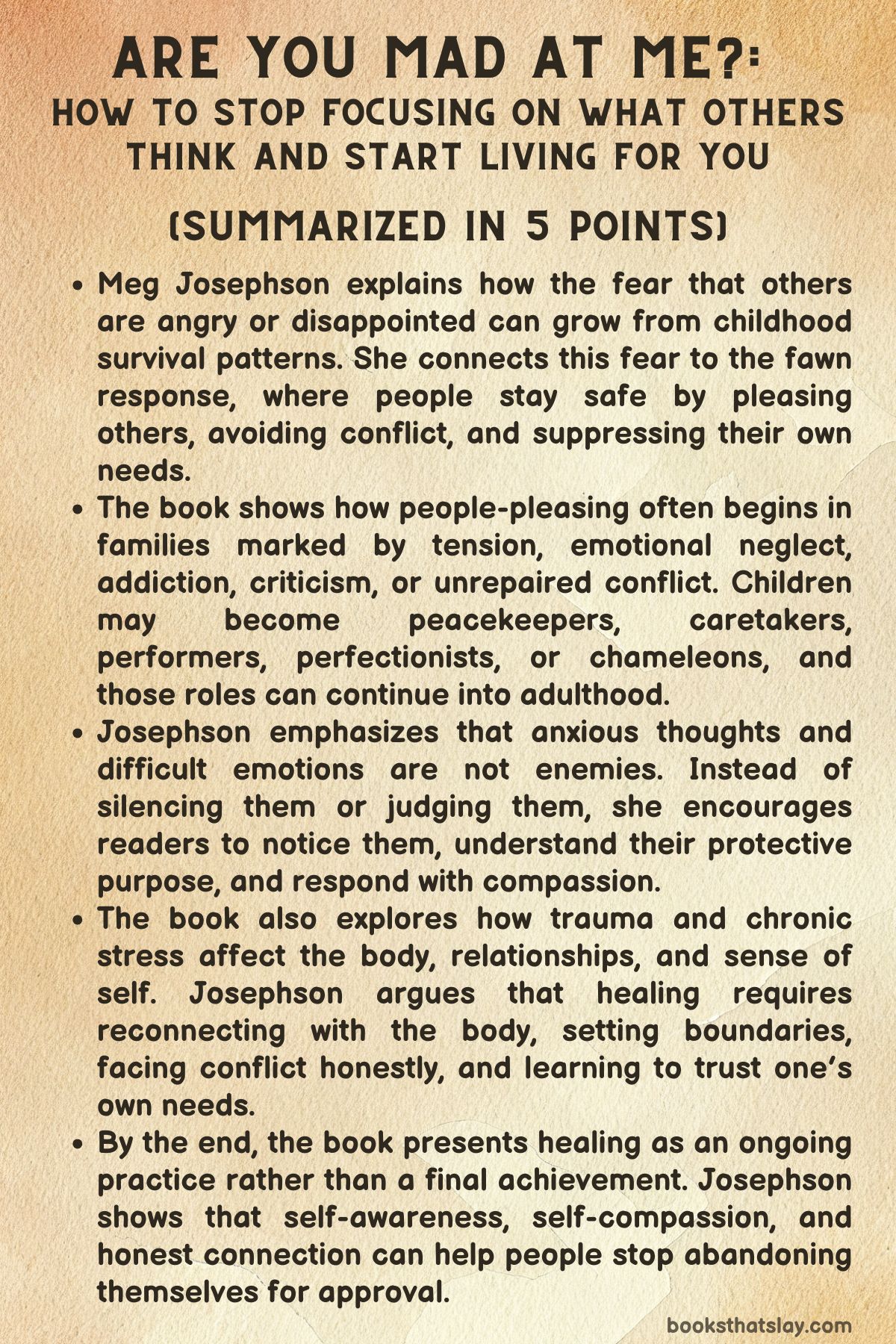
Are You Mad at Me? by Meg Josephson is a self-help book about the fear that others are angry, disappointed, or about to withdraw love.
Josephson connects this anxiety to the fawn response, a survival pattern in which people stay safe by pleasing others, avoiding conflict, and suppressing their own needs. Drawing on therapy, trauma theory, mindfulness, attachment, and her own life, she explains how childhood experiences can shape adult relationships. The book is not about blaming the past; it is about understanding old patterns, building self-trust, setting boundaries, and learning that healing can happen through compassion and honest connection.
Summary
Are You Mad at Me begins with Meg Josephson recalling a question she once brought to therapy: why did she so often assume people were angry with her? What seemed like a simple relationship anxiety turned out to be connected to childhood survival.
Growing up around a parent with alcohol dependency had taught her to study mood shifts, adjust herself quickly, and stay alert for signs of danger. In adulthood, that same alertness followed her into work, friendships, and digital communication.
A delayed text, a short message, or a small change in tone could feel like proof that she had done something wrong.
Josephson explains that this pattern is especially powerful in the modern world, where constant communication can make reassurance feel endless but fragile. When likes, replies, and messages slow down, people who depend on outside approval may feel abandoned or unsafe.
Her own healing began through therapy, meditation, and later her work as a therapist. When clients started asking versions of the same question, she saw that many people, especially those trained to be caretakers or peacekeepers, were living with the same fear.
The book centers on the fawn response. Unlike fight, flight, or freeze, fawning is the instinct to move toward a threat by pleasing, appeasing, and becoming useful.
Josephson makes clear that fawning is not the same as kindness. Kindness comes from genuine care; fawning comes from fear.
A person who fawns may say yes when they mean no, apologize when they have done nothing wrong, monitor everyone’s mood, and abandon their own needs to avoid conflict. These habits often begin in childhood, when being agreeable seems safer than being honest.
Josephson shows how different family environments can create different forms of fawning. Some children become peacekeepers in homes full of tension.
Some become performers, using humor or achievement to keep others calm. Some become caretakers, taking responsibility for family members who cannot manage themselves.
Others become isolated, perfectionistic, or highly adaptable, changing themselves to match whoever is around them. In each case, the child finds a way to survive.
The problem is that the same strategy can later become a cage, keeping the adult trapped in relationships where authenticity feels risky.
A major theme of Are You Mad at Me? is that people often mistake familiarity for safety.
If someone grew up around emotional neglect, criticism, chaos, or unrepaired conflict, they may unconsciously seek similar dynamics later because they feel known. Healthy relationships may feel strange at first, not because they are dangerous, but because they are unfamiliar.
Josephson offers hope through the idea that the brain can change. Old responses may be deeply learned, but they are not fixed forever.
The book also focuses on grief. Josephson argues that people may need to grieve not only what happened to them, but also what they never received.
A person can love their parents and still mourn the emotional support, protection, attention, or repair they lacked. Anger is part of this process, and Josephson treats it as a valid signal rather than something shameful.
She also warns against waiting for an apology before beginning to heal. Some parents or caregivers may never understand the harm they caused.
Healing begins when people stop depending on that recognition and start validating their own experience.
Josephson then turns to anxious thoughts. She explains that people are not their thoughts; they are the ones noticing those thoughts.
The anxious inner voice may sound cruel, but it often developed as a protective part of the self. It tries to prevent rejection by imagining everything that could go wrong.
Yet rumination rarely protects anyone. Instead, it makes people suffer before anything has happened.
Josephson encourages readers to meet this inner critic with gentleness, as they would respond to a frightened younger self. Her method asks people to notice anxiety, allow it to exist, become curious about it, respond with compassion, and return to what is real in the present.
Emotions are treated in the same way. Josephson argues that feelings are not the enemy.
Anger, sadness, fear, jealousy, resentment, and grief all carry information. The damage often comes from judging the emotion or reacting from it without pause.
A person may feel anger, then immediately feel shame for being angry, which creates a second layer of suffering. Josephson teaches that there is space between feeling and reacting, and that learning to pause is one of the most important steps in healing.
The body also plays a major role in Are You Mad at Me? Josephson describes how stress and suppressed emotion can show up through physical symptoms.
Chronic fawning keeps the nervous system on high alert, making rest, digestion, immunity, and clear thinking harder. She connects trauma to the body without suggesting that every illness has a simple emotional cause.
Her point is that the mind and body are not separate. Breathwork, grounding, and slow reconnection with bodily sensations can help people return to themselves.
She stresses that this work should be gradual, because people who have survived by disconnecting from their bodies may need time to feel safe again.
As the book moves forward, Josephson challenges the belief that everything is personal. People who fawn often assume someone else’s mood, silence, criticism, or rejection says something final about their own worth.
Josephson argues that other people’s reactions usually reveal their own histories, limits, and emotional states. This does not mean criticism never matters, but it does mean a person does not have to build their identity around everyone else’s opinion.
She asks readers to consider whether they even respect the people whose approval they are chasing. This shift helps move the focus from being liked by everyone to being grounded in oneself.
Conflict becomes another key lesson. Josephson argues that avoiding conflict may seem safe, but it often creates resentment and distance.
Real relationships require honesty, rupture, and repair. Many people who fawn fear that disagreement will end connection, because in childhood conflict may have led to withdrawal, punishment, or instability.
But healthy conflict is not the same as danger. It can be a place where people express needs, listen, take responsibility, and become closer.
Josephson separates reassurance-seeking from validation: reassurance asks someone else to erase anxiety, while validation allows feelings to be understood without making another person responsible for fixing them.
Boundaries are presented as acts of care rather than rejection. Josephson explains that people often confuse being nice with being compassionate.
Niceness tries to maintain approval at any cost. Compassion considers long-term well-being, including one’s own.
A person without boundaries may appear generous, but inside they may become exhausted and resentful. Boundaries help people show up honestly instead of performing goodness.
They are not attempts to control others; they are statements of what one will do, accept, or step away from. Josephson encourages readers to begin with small boundaries and to treat discomfort as a sign of new behavior, not wrongdoing.
The book then asks a deeper question: who are you when you are not trying to please everyone? Josephson explains that chronic fawning can leave people disconnected from their preferences, desires, values, and dreams.
If a child learned to focus on a caregiver’s needs, they may grow into an adult who does not know what they want. The book encourages time alone, less dependence on instant outside opinions, and a return to forgotten interests.
Josephson also distinguishes anxiety from intuition. Anxiety feels urgent and frantic; intuition tends to feel quieter and clearer.
Learning the difference helps rebuild self-trust.
In the end, Are You Mad at Me? presents healing as both personal and collective.
Josephson does not promise that old patterns will vanish. People may still overthink, seek approval, or fall back into fawning.
Progress lies in noticing the pattern sooner, meeting it with compassion, and choosing differently when possible. Healing also allows people to support others without abandoning themselves.
By learning to honor their own needs, people become steadier, kinder, and more honest in their relationships. The book closes with the idea that self-healing is not selfish.
It can interrupt inherited pain and create more freedom for the people around us.
Key Figures
Meg Josephson
Meg Josephson is the central figure of Are You Mad at Me?, both as the author and as the main personal example through which the book’s ideas are explored. She presents herself not as someone who has escaped anxiety completely, but as someone who has learned to understand it with more patience and clarity.
Her repeated fear that others were angry with her becomes the starting point for a wider study of fawning, people-pleasing, emotional neglect, and relational trauma. As a figure in the book, Josephson is open about her childhood, her father’s alcohol dependency, her mother’s illness, her own body-based stress symptoms, and her long search for emotional safety.
This honesty gives the book much of its credibility because she does not write from a detached clinical distance. She moves between the roles of therapist, patient, daughter, and survivor, showing how healing is rarely neat or final.
Her journey also reflects the larger movement of the book: from scanning others for signs of danger to learning how to notice her own feelings, needs, and limits. Josephson’s importance lies in how she turns personal pain into a framework for others, making her both the narrator of the work and one of its most developed human presences.
Josephson’s Father
Josephson’s father is a powerful figure in the book because his emotional volatility and alcohol dependency shape much of the author’s early understanding of safety. He is not presented as a one-dimensional villain, but as someone whose unpredictability left a lasting mark on his daughter’s nervous system.
For a child, a parent’s changing moods can become the center of the household, and Josephson shows how she learned to monitor his emotional state as a way to protect herself. His presence teaches her that love may come with uncertainty, that calm can disappear quickly, and that survival may depend on being careful, agreeable, and alert.
Later in life, the patterns created by this relationship appear in her adult interactions, where she anxiously reads texts, work messages, and social cues as if they carry the same threat as a parent’s unstable mood. His arrest for drunk driving also becomes a turning point in her emotional development, especially in her ability to recognize anger without immediately burying it under shame.
As a figure, he represents the parent whose unresolved pain becomes part of the child’s emotional inheritance.
Josephson’s Mother
Josephson’s mother carries a different kind of emotional weight in Are You Mad at Me?. Her early-onset Alzheimer’s diagnosis forces Josephson to confront grief in a complicated form: grief for the mother who is changing, grief for what has already been lost, and grief for the emotional support that may never have been fully available.
Her mother’s role in the book is connected to the idea that grief is not limited to death. People can mourn the care, attunement, and protection they needed but did not receive.
Josephson’s reflections on her mother help the book explore how love and pain can exist together. A person can feel tenderness, gratitude, anger, sadness, and disappointment toward a parent without having to choose only one truth.
This figure helps deepen the book’s understanding of family wounds, especially the difficulty of accepting that a parent may never become the person one hoped they would be. Through her mother, Josephson examines the emotional loneliness that can exist even inside families, and the painful need to stop waiting for perfect recognition before beginning to heal.
Josephson’s Therapist
Josephson’s therapist is an important guiding figure because she helps turn one anxious question into a deeper inquiry about childhood, survival, and relational patterns. When Josephson asks why she always thinks people are angry with her, the therapist does not simply give a quick solution.
Instead, she connects the fear to Josephson’s childhood environment and helps her see that adult anxiety may be rooted in old survival behaviors. This figure represents the value of therapeutic witnessing: someone who listens carefully enough to notice the pattern beneath the symptom.
The therapist’s role is also important because she does not treat people-pleasing as a personality flaw. She helps reveal it as an adaptation that once made sense.
In the structure of the book, the therapist stands for the beginning of self-understanding. She opens the door to the idea that healing requires looking inward, not in order to blame the past, but to understand how the past still speaks through the body, thoughts, and relationships.
The Anxious Inner Critic
The anxious inner critic functions almost like an internal figure in the book. Josephson describes it as a protective part of the self rather than an enemy to destroy.
This inner voice anticipates rejection, imagines criticism, and tries to prevent pain by keeping the person hyperaware and self-correcting. Its methods are harsh, but its motive is safety.
This makes the inner critic one of the most psychologically important presences in the book. It carries the voices of parents, society, siblings, school experiences, and past wounds, then repeats them as if constant self-monitoring will prevent abandonment.
Josephson’s approach asks readers to stop fighting this inner figure and instead meet it with curiosity and compassion. By imagining it as a younger self or frightened creature, a person can create enough distance to understand it.
The inner critic shows how deeply people can internalize fear, but it also shows that healing begins when one responds to that fear with steadiness instead of shame.
Brianna
Brianna represents the peacekeeper, a person who learns to manage tension by keeping everyone else calm. Her role in the book illustrates how children in volatile homes often become responsible for emotional balance long before they are mature enough to carry that burden.
When conflict is intense but never repaired, a child may assume that peace depends on their ability to smooth things over. Brianna’s pattern shows how fawning can look mature, helpful, and considerate from the outside, while internally it is driven by fear.
She becomes significant because she reveals the hidden cost of being the one who always tries to prevent conflict. The peacekeeper may gain approval, but they often lose access to their own anger, preferences, and needs.
Brianna’s example helps explain why some adults feel uneasy when others are upset, even when the conflict has nothing to do with them. Her figure shows that peacekeeping can begin as protection but later become self-erasure.
Theo
Theo represents the performer, the person who uses humor, charm, or entertainment to reduce tension. In the book, this role grows out of family unhappiness and emotional discomfort.
A child who senses that adults are unhappy may discover that making people laugh briefly changes the atmosphere. That discovery can become a lifelong strategy.
Theo’s importance lies in showing that performance can be a form of fawning, even when it looks socially rewarded. He does not simply seek attention; he tries to create safety by controlling the emotional temperature of the room.
This pattern can become exhausting because the performer may feel valued only when they are amusing, useful, or emotionally convenient. Theo’s figure reveals how approval can become a substitute for secure connection.
He also shows how people can be praised for the very behaviors that keep them disconnected from themselves. The performer’s task is not to become humorless, but to learn that they are allowed to exist even when they are not making others comfortable.
Sophie
Sophie is the caretaker figure, shaped by the expectation that she should take responsibility for others’ well-being. Her example shows how parentification can create people who are praised for being dependable but privately feel burdened and unseen.
Sophie’s role in the book is especially important because caretaking is often mistaken for pure goodness. Josephson shows that care can be loving, but it can also become a survival strategy when a child learns that being needed is the safest way to belong.
Sophie’s pattern reveals how fawning can hide behind responsibility. She may feel guilty for resting, uncomfortable receiving help, and anxious when others struggle.
Her identity becomes tied to being useful. As an adult, this can lead to relationships where she overfunctions while others underfunction.
Sophie’s figure helps clarify the difference between compassion and self-abandonment. She shows that healing requires learning to care without disappearing into another person’s needs.
Alicia
Alicia represents the lone wolf, a figure shaped by chronic emotional neglect. Unlike the more visibly pleasing types, Alicia’s adaptation is withdrawal.
Her presence in the book expands the understanding of fawning by showing that self-protection does not always look like constant agreeableness. Sometimes it looks like not needing anyone, not asking for help, and refusing vulnerability because dependency once felt unsafe.
Alicia’s emotional world is marked by the belief that no one will truly show up, so she might as well handle everything alone. This kind of independence can seem strong, but it often protects deep loneliness.
Her role is important because the book does not treat connection as simple or easy. For someone like Alicia, closeness may feel threatening because it awakens the old pain of being ignored or unmet.
Her healing involves learning that needing people is not weakness and that safe relationships can be built slowly.
Carter
Carter represents the perfectionist, shaped by family expectations, cultural pressure, and emotional invalidation. His figure shows how achievement can become a form of fawning when success is used to secure approval or prevent disappointment.
Carter’s perfectionism is not merely ambition; it is a strategy for avoiding shame. He learns that mistakes may threaten belonging, so he tries to become beyond criticism.
This makes him an important figure because he reveals the connection between people-pleasing and performance standards. In adults, this pattern can appear as overwork, fear of failure, difficulty relaxing, and constant self-surveillance.
Carter’s role also brings attention to the emotional burden carried by children of immigrant families or families shaped by sacrifice, where achievement may feel like proof of gratitude. The book treats this with care, recognizing that family hopes can coexist with emotional pressure.
Carter’s healing requires separating worth from performance and learning that imperfection does not equal failure or rejection.
Rachel
Rachel is one of the chameleon figures in the book, shaped by bullying and social rejection. Her adaptation is to change herself depending on the people around her, hoping that flexibility will prevent further harm.
Rachel’s role shows how fawning is not limited to family systems; peer environments can also teach a person that authenticity is unsafe. Bullying can make someone believe that visibility is dangerous and that the safest self is the one most acceptable to others.
Rachel becomes important because she represents the social version of self-abandonment. She may become skilled at reading a room, copying preferences, and hiding traits that might invite judgment.
Yet this skill comes at the cost of identity. Over time, a chameleon may struggle to know what they actually enjoy, believe, or want.
Rachel’s figure shows how healing includes reclaiming the parts of the self that were hidden in order to survive.
Lucy
Lucy is another chameleon figure, but her experience is connected to sexual abuse, which gives her role a darker and more explicitly traumatic weight. She represents the person who learns to adapt to danger because direct resistance may not feel possible.
Lucy’s presence in the book is important because Josephson acknowledges that fawning can sometimes be genuinely protective. In unsafe situations, appeasing a harmful person may help someone survive.
This matters because the book does not shame fawning as weakness. Lucy’s figure shows that self-abandonment may begin under conditions where the person had very little power.
Her later healing requires recognizing that the strategy was not foolish or morally wrong; it was an attempt to stay alive or reduce harm. At the same time, the book suggests that strategies formed in danger can continue even after danger has passed.
Lucy represents the painful task of learning where safety now exists and where old protective habits can slowly soften.
Alex
Alex appears in the book as a figure connected to boundary struggles. Having learned boundary-lessness from overextended parents, Alex shows how people inherit not only explicit beliefs but also emotional habits.
If a child sees adults constantly sacrificing themselves, ignoring their limits, or equating exhaustion with love, that child may grow up believing that boundaries are selfish. Alex’s role is important because he shows that people often repeat what was modeled, even when it harms them.
His difficulty is not simply saying no; it is believing he has the right to say no. Through Alex, the book explores how families can normalize self-neglect and call it devotion.
His figure helps reframe boundaries as necessary for sustainable connection. Rather than rejecting others, boundaries allow a person to remain present without resentment.
Alex’s growth depends on understanding that love does not require unlimited availability.
Stacey
Stacey represents the rescuer, someone who repeatedly steps in to save another person from consequences. Her relationship with her irresponsible brother shows how fawning can become enabling when compassion is confused with constant rescue.
Stacey’s role is important because it reveals the emotional logic behind overhelping. She may feel that if she does not intervene, she is cruel, selfish, or disloyal.
Yet her rescuing prevents both her and her brother from facing the truth of the situation. Stacey’s pattern shows that people-pleasing can maintain dysfunction, even when the intention is care.
Her figure also clarifies Josephson’s distinction between niceness and compassion. Niceness may protect someone from short-term discomfort, while compassion may allow discomfort in order to create long-term growth.
Stacey’s healing involves accepting that other people are allowed to face the results of their choices, and that refusing to rescue is not the same as abandoning them.
Elle
Elle is a figure connected to romantic self-compromise. She represents the person who adjusts her values, needs, or standards in dating because being chosen feels more urgent than being honest.
Her role in the book shows how fawning can distort intimacy. Instead of asking whether a relationship is right for her, Elle may focus on whether she is acceptable to the other person.
This pattern can lead to relationships where she becomes smaller, quieter, or less clear about what matters to her. Elle’s figure is significant because romantic relationships often activate old wounds around abandonment and worth.
The desire to be loved can make self-betrayal feel reasonable in the moment. Josephson uses figures like Elle to show that boundaries are not barriers to love; they are conditions for real love.
Elle’s healing involves learning that being wanted is not enough if she must abandon herself to keep the relationship.
Pete Walker
Pete Walker is an influential figure in the book because his naming of the fawn response gives Josephson a key framework for understanding people-pleasing as trauma-based survival. His importance is conceptual rather than narrative.
By identifying fawning alongside fight, flight, and freeze, Walker helps explain why appeasement can be as instinctive as running away or shutting down. This matters because many people blame themselves for being too needy, too agreeable, or too afraid of conflict.
The fawn response reframes those behaviors as adaptations to danger. Walker’s influence allows Josephson to place individual experiences inside a broader trauma vocabulary.
He helps make visible a pattern that is often socially rewarded and therefore easy to miss. In Are You Mad at Me?, his role is to provide language that turns shame into understanding.
Lindsay Gibson
Lindsay Gibson functions as an important intellectual figure through her work on emotionally immature parents. Her ideas help Josephson explain why some adults continue chasing the love, approval, or recognition they did not receive as children.
Gibson’s concept of the healing fantasy is especially important. It describes the belief that becoming successful, perfect, attractive, agreeable, or impressive enough will finally cause an emotionally unavailable parent to offer the care one has always wanted.
This figure matters because the book repeatedly challenges the idea that healing depends on winning someone else’s validation. Gibson’s influence helps Josephson show how childhood longing can become adult striving.
The person keeps trying to become enough, not realizing that the problem was never their lack of worth. Through Gibson’s framework, the book encourages readers to stop organizing their lives around impossible emotional bargains.
Bell Hooks
bell hooks appears as a broader philosophical and ethical influence in the book’s final movement toward collective healing. Her presence helps Josephson connect self-compassion with social responsibility.
Rather than treating healing as private self-improvement, hooks’s influence supports the idea that personal liberation affects the wider community. A person who learns to stop abandoning themselves may become more capable of honest love, clearer advocacy, and steadier care for others.
This figure is important because she prevents the book’s message from becoming narrow or self-centered. Healing is not presented as endless self-focus, but as a way to stop passing pain outward.
Through hooks’s influence, the book suggests that inner work can change how people participate in families, friendships, workplaces, and movements for justice.
Themes
Fawning as a Survival Strategy
Fawning is presented as a learned response to danger, not as a natural personality flaw. The person who fawns often appears kind, agreeable, responsible, or easygoing, but beneath those traits may be a nervous system trained to prevent conflict at any cost.
Are You Mad at Me? shows that this pattern often begins when children realize that anger, honesty, or resistance will not keep them safe.
If fighting increases danger, leaving is impossible, and freezing does not help, pleasing becomes the best available option. This theme is important because it removes moral judgment from people-pleasing.
Josephson does not describe fawners as dishonest or weak; she shows them as people who adapted to environments where their needs were unsafe or ignored. The book also recognizes that society rewards fawning, especially in women and marginalized people, by praising self-sacrifice and emotional labor.
This makes healing more difficult because the behavior that harms the self may be celebrated by others. The theme asks readers to examine not only what they do, but why they do it.
Genuine kindness can remain, but fear-based self-erasure must be recognized before it can change.
The Body as a Keeper of Emotional Truth
The body carries what the mind tries to dismiss. Josephson repeatedly shows that unprocessed emotion does not simply disappear because a person ignores it, intellectualizes it, or performs calmness for others.
Stress can appear through tension, stomach problems, exhaustion, hair loss, shallow breathing, disordered eating, and chronic unease. This theme challenges the idea that healing is only a mental process.
People who fawn often become highly skilled at reading other people’s bodies and moods while losing contact with their own. They may notice a slight shift in someone’s tone but miss their own anger, hunger, fatigue, or resentment.
Josephson’s focus on breath, grounding, and nervous-system regulation makes the body a source of information rather than an inconvenience. The body says no before the mouth can.
It signals danger, depletion, and unmet needs. At the same time, Josephson avoids making healing harsh or forceful.
Reconnecting with the body must happen slowly, especially for people who learned to disconnect in order to survive. The body is not treated as an enemy to control, but as a witness that has been waiting to be heard.
Boundaries, Conflict, and Real Connection
Avoiding conflict may protect a relationship on the surface while quietly damaging it underneath. Josephson shows that people who fawn often believe disagreement will lead to rejection, punishment, or abandonment, so they stay silent and call it peace.
But suppressed needs do not vanish. They become resentment, exhaustion, emotional distance, and private anger.
This theme reframes conflict as a necessary part of honest connection. Healthy relationships do not depend on never upsetting each other; they depend on repair, accountability, and the ability to speak truth without destroying safety.
Boundaries are central to this theme because they allow people to remain connected without abandoning themselves. Josephson rejects the belief that boundaries are selfish walls.
Instead, they are expressions of what a person needs in order to participate honestly. This matters because fawning often turns relationships into performances, where one person tries to be lovable by becoming low-maintenance.
The book argues that real intimacy requires more than being pleasant. It requires the courage to be known, to disappoint others sometimes, and to let relationships prove whether they can hold the truth.
Self-Trust and the Return to the Authentic Self
Chronic people-pleasing can leave a person unsure of who they are. If a child grows up organizing themselves around other people’s emotions, they may reach adulthood without a clear sense of their own desires, opinions, or limits.
Josephson treats self-trust as something that can be rebuilt through small, repeated acts of listening inward. This theme is not about sudden confidence or total independence.
It is about pausing before asking everyone else what to do, noticing the difference between anxiety and intuition, spending time alone without constant distraction, and letting old interests or dreams return. The book suggests that authenticity is not invented from nothing; it is often recovered from beneath years of adaptation.
Self-trust also requires grieving the fantasy that someone else’s approval will finally make the self feel complete. Many people keep chasing achievement, attractiveness, productivity, or perfect relationships because they believe these things will cure old wounds.
Josephson redirects that search inward. The authentic self begins to emerge when a person stops treating outside validation as proof of worth and starts believing their own experience.