As Long as the Lemon Trees Grow Summary, Characters and Themes
As Long as the Lemon Trees Grow by Zoulfa Katouh is a powerful, heart-wrenching young adult novel that blends contemporary war fiction with elements of magical realism. Published in 2022, it draws from the real horrors of the Syrian Revolution and Civil War while centering an intimate, deeply emotional story of survival, grief, guilt, love, and resilience.
The narrative unfolds primarily in besieged Homs, Syria, around 2011–2012, during the early, brutal crackdown following the Arab Spring protests. Katouh, a Syrian-Canadian author, crafts a story that feels both specific to the Syrian experience and universally human in its exploration of trauma and hope.
Summary
The story is told through the eyes of Salama Kassab, an 18-year-old former pharmacy student whose life shatters when the revolution erupts. Once a hopeful young woman dreaming of research and travel, Salama now volunteers at Zaytouna Hospital in Homs, a city ravaged by government forces.
With most trained doctors killed, arrested, or fled, she performs surgeries, treats shrapnel wounds, and dispenses dwindling medical supplies under the guidance of the steadfast head surgeon, Dr. Ziad. The hospital scenes are visceral and unflinching: blood-soaked floors, children dying from preventable injuries, the constant wail of ambulances or bombs, and the moral weight of triage decisions where resources force impossible choices.
Salama has already endured immense loss. Her mother died in a bombing that also left Salama with a head injury.
Her father and older brother Hamza were arrested by the regime for participating in protests; their fate remains uncertain, though rumors and occasional news suggest torture and imprisonment. Hamza’s wife, Layla—Salama’s best friend and sister-in-law—is seven months pregnant with Hamza’s child.
Before his arrest, Hamza extracted a promise from Salama: protect Layla and the unborn baby at all costs.
Living with Layla in their once-vibrant but now haunted family home, Salama clings to this promise amid daily scarcity—empty supermarkets, rationed food and water, and the ever-present threat of snipers, barrel bombs, and military raids. Yet Salama’s mind is fracturing.
Since her head injury and the accumulating trauma, she hallucinates Khawf (Arabic for “fear”), a sharply dressed, tall man with piercing eyes who appears as a physical embodiment of her anxiety and guilt. Khawf taunts her, warns her of dangers, and relentlessly urges her to flee Syria before it’s too late.
He represents not just personal fear but the broader psychological toll of war—PTSD, survivor’s guilt, and the paralyzing question of whether staying to help is noble or suicidal.
Salama is torn. Part of her feels a deep duty to the hospital and her city; she witnesses the revolution’s ideals of freedom and dignity firsthand through the injured protesters and civilians.
Another part desperately wants safety for Layla and the baby, especially as Layla’s pregnancy symbolizes fragile hope in a landscape of death. Layla encourages escape, dreaming of a future in Europe (often specified as Germany in the narrative) where they can raise the child in peace.
Their conversations—filled with laughter, tears, shared memories, and plans—provide Salama’s emotional anchor.
Into this chaos enters Kenan, a passionate young videographer documenting the revolution’s atrocities and the protesters’ resilience. He refuses to leave, believing his footage can bear witness to the world and fuel the movement.
Kenan has his own siblings to protect: his sister Lama (a young girl Salama treats after she is injured by shrapnel) and younger brother Yusuf, who has become selectively mute from trauma. Salama and Kenan’s relationship develops slowly and tenderly amid the ruins.
Their bond is marked by quiet moments of connection—shared glances during protests or anniversaries of the revolution, mutual understanding of loss, and a growing affection that respects cultural and religious boundaries. Kenan becomes a source of calm and inspiration for Salama, even as their views on staying versus leaving clash.
As conditions worsen, Salama confronts the smuggler Am, who arranges dangerous boat crossings for refugees. The price is steep—thousands of dollars they struggle to gather—highlighting the commodification of survival.
Hospital attacks intensify, including a devastating bombing that forces evacuations and more loss. Salama saves lives where she can (such as treating Lama) but fails others, like a young boy named Ahmad, deepening her guilt.
News about Hamza trickles in—he is alive but imprisoned and tortured—adding another layer of anguish.
A pivotal revelation comes late in the story: Layla has been dead for months. She died earlier in the war (likely from violence or related causes), and Salama’s mind, overwhelmed by grief and trauma, created a vivid hallucination of her as a coping mechanism.
The “conversations,” shared home life, and joint plans with Layla were all illusions born from Salama’s promise to Hamza and her desperate need for connection. This twist is devastating yet brilliantly executed; it reframes much of the preceding narrative and underscores the novel’s deep dive into mental health.
Khawf, too, is part of this internal landscape, though he claims a broader, almost universal existence as fear itself. When Salama finally confronts the truth, she must grieve anew while honoring Layla’s memory by pursuing the escape they “planned” together.
The climax builds around an impending assault on the hospital. Salama, Kenan, Lama, and Yusuf decide to flee.
They navigate chaos, military presence, and personal doubts before embarking on the perilous sea crossing arranged by Am. The overcrowded boat faces freezing Mediterranean waters, overcrowding, and near-drowning.
In these life-threatening hours, Salama clings to memories, love for Kenan, and a hard-won acceptance of fate. Khawf appears one last time, offering a poignant farewell: fear can paralyze or propel survival, and it lives in everyone.
Salama releases him, symbolizing growth beyond constant terror.
The survivors are rescued. In the epilogue, Salama and Kenan have reached safety in Toronto, Canada.
They share an apartment decorated with Syrian elements—a painted poem, mementos—to keep their roots alive. Salama tends a small garden, a quiet symbol of renewal and the lemon trees of home.
Kenan continues creative work. Their life is bittersweet: they mourn lost family and homeland, carry trauma, and wonder about Hamza’s fate, but they choose to rebuild with resilience, love, and hope.
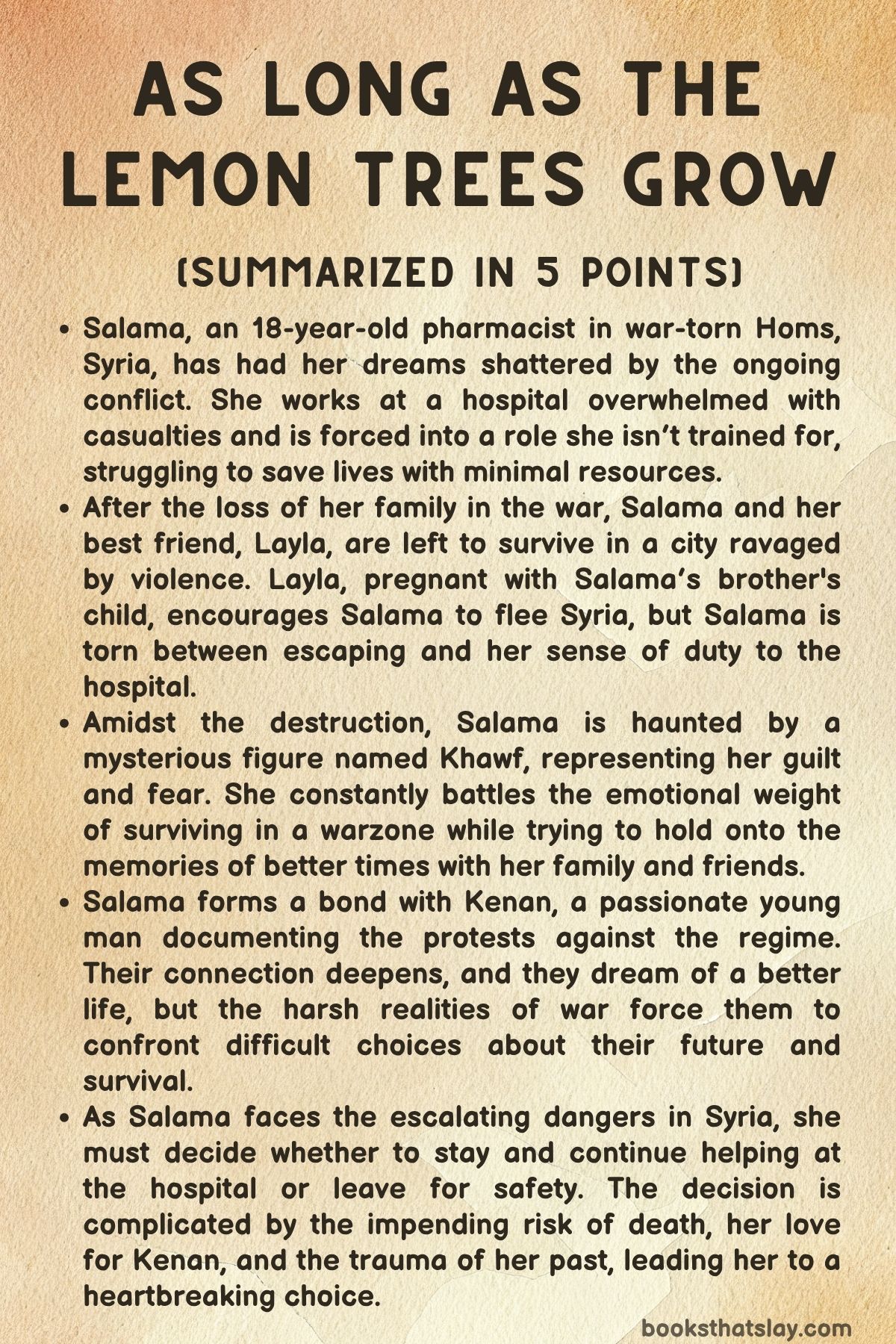
Characters
Salama
Salama, the protagonist of As Long as the Lemon Trees Grow, is a young woman who is caught in the throes of war and the harsh realities that come with it. She is already burdened with a heavy sense of responsibility.
She works as a pharmacist at Zaytouna Hospital in Homs, Syria, but due to the war’s impact, she often has to perform medical procedures far beyond her training. The destruction of her city, her family’s loss, and the pressure to save lives weigh heavily on her.
Salama’s emotional journey throughout the novel revolves around her internal battle between the sense of duty she feels to her patients and the personal sacrifices she must make to protect herself and the people she loves. Haunted by guilt, fear, and the memory of her lost family members, Salama struggles with the constant presence of Khawf, a symbolic figure representing her anxieties.
Her dreams of becoming a researcher and traveling the world have been crushed by the war, and her personal loss—the death of her mother, father, and brother—leaves her isolated. Throughout the novel, Salama is faced with impossible choices, such as deciding whether to stay in Syria and continue her work at the hospital or leave with her pregnant sister-in-law, Layla, in search of safety.
The horrors of war constantly remind her of the fragility of life, but it is her strong bond with Layla and the emerging connection with Kenan that provide her with moments of emotional solace amidst the destruction.
Layla
Layla, Salama’s best friend and sister-in-law, is another central character. Layla’s pregnancy serves as a symbol of hope amid the despair of war, yet it also adds to the immense pressure Salama feels to protect her.
Having lost her own family, Layla relies heavily on Salama, but also encourages her to seek safety in Europe, where they could escape the constant threat of violence. While she remains emotionally strong for Salama’s sake, the trauma of losing everything has left her vulnerable.
The weight of the pregnancy in such uncertain times, coupled with the emotional devastation, places Layla in a delicate situation. She is the one who provides a sense of normalcy in the household, turning their home into a temporary refuge in a city filled with destruction.
Despite the seemingly impossible circumstances, Layla, like Salama, is motivated by love and a desire to build a future for her unborn child, yet she also wrestles with the painful dilemma of leaving Syria, which she knows may cost her any hope of returning to the place she once called home.
Khawf
Khawf is an enigmatic figure who haunts Salama throughout the novel. Representing Salama’s inner turmoil, guilt, and fear, Khawf becomes an ever-present reminder of the dangers around her and the overwhelming responsibility she feels.
He embodies the weight of survival, constantly pushing Salama to take extreme actions, such as fleeing Syria or making life-altering decisions for the sake of her survival. His presence acts as a psychological pressure, tormenting Salama with the thought of what could happen if she stays.
The manifestation of Khawf reflects the emotional and psychological toll that the war has on Salama, as well as her struggle with guilt for not being able to do more for those around her. While Khawf’s figure is not physically present, his role in the story is crucial in portraying the internal conflict that Salama faces every day as she navigates the trauma of war.
Kenan
Kenan is a vital secondary character, playing an important role in Salama’s emotional journey. He is a passionate and idealistic young man who documents the protests against the Syrian regime, risking his life to expose the atrocities occurring in his country.
His drive to stay in Syria and continue his work contrasts sharply with Salama’s growing desire to escape the dangers of the war. Kenan’s internal battle between activism and the need for survival mirrors the larger struggle within the Syrian people during the conflict.
His bond with Salama deepens over time, and their shared moments of pain and grief allow them to form a strong emotional connection. Despite their differing views on how best to navigate the war, Kenan and Salama are united in their loss and their search for meaning in a world torn apart by violence.
Salama’s growing affection for Kenan adds complexity to her journey, as she is torn between the love she feels for him and the heavy burden of her duty to her family and the patients she must help. As their relationship evolves, Kenan offers Salama both emotional support and a sense of normalcy amidst the chaos of the war, making him a crucial figure in her emotional healing.
Dr. Ziad
Dr. Ziad is the head surgeon at Zaytouna Hospital and Salama’s mentor during the chaotic days of the war. Though overwhelmed by the constant influx of patients and the severe shortage of medical supplies, Dr. Ziad remains a calm and guiding presence in the hospital.
He acts as a figure of authority and wisdom for Salama, helping her navigate the difficult medical situations that arise due to the war. His deep commitment to saving lives, despite the odds, is one of the few constants in the hospital’s turmoil.
Despite his stoic exterior, Dr. Ziad is emotionally affected by the devastation around him, and his vulnerability becomes apparent as the war drags on. He provides Salama with crucial guidance as she navigates her role as an untrained surgeon and pharmacist, encouraging her to keep pushing forward even as the situation becomes increasingly dire.
His survival after the hospital’s destruction is a testament to his resilience, but the loss of life, particularly the deaths of innocent children, is a painful blow for him. His final words to Salama, urging her to keep moving forward, encapsulate his belief that survival is the key to honoring the sacrifices made by those lost in the war.
Am
Am is a character who plays a pivotal role in the decision-making process of Salama and Layla. He is the man who arranges escape routes for refugees seeking to flee Syria, and his character embodies the difficult and often morally ambiguous choices that people like Salama and Layla must make in order to survive.
Am’s presence serves as a reminder of the harsh realities of fleeing war, as he tells Salama and Layla the steep cost of escape. His conversations with Salama reveal the stark truth about the price of survival—four thousand dollars for a boat trip out of Syria.
This figure highlights the ongoing struggle that many face in trying to leave their homes for a safer life. Am is not portrayed as a villain but rather as a person navigating the grim task of facilitating escape in a time of profound crisis, making him a necessary and complex character in the narrative.
Themes
The Impact of War on Identity and Personal Aspirations
In As Long as the Lemon Trees Grow, Salama’s personal journey is defined by the stark contrast between her past dreams and the brutal reality she faces in war-torn Syria. Before the conflict, Salama had dreams of becoming a researcher and traveling the world, pursuits full of promise and optimism.
However, the war forces her to abandon these aspirations. Instead, she is thrust into a role she is not prepared for, performing surgeries at a hospital with inadequate resources.
This transformation illustrates how war can strip individuals of their identity, forcing them into survival mode where their previous desires are no longer relevant. Salama’s personal growth is stunted, as the war reshapes her sense of self, from a hopeful young woman to someone hardened by the trauma surrounding her.
Her internal conflict is rooted in the loss of the future she had once envisioned. This theme underlines how war can alter not only the physical landscape but also the emotional and psychological well-being of those involved.
Salama’s constant struggle to reconcile her previous aspirations with her present circumstances exemplifies the way war forces individuals to redefine their identities and purposes in life.
The Bonds of Family and Loss
The novel explores how war can destroy families and test the limits of familial bonds. Salama’s loss is overwhelming—her father and brother are taken by the military, and her mother dies in a bombing.
Despite this, Salama finds solace in her relationship with Layla, her best friend and sister-in-law, who is pregnant with Hamza’s child. Their bond becomes the last connection to the family Salama has lost.
The emotional weight of these relationships anchors Salama’s sense of purpose as she navigates the daily horrors of war. The novel also highlights the struggle of bearing witness to the suffering of loved ones while being unable to protect them fully.
Salama’s decision-making is constantly influenced by her desire to safeguard those she still holds dear, particularly Layla, but the unrelenting nature of war creates a sense of helplessness that she must reconcile. The theme of loss is not limited to death; it encompasses the gradual erosion of personal connections and the painful realities of being unable to fulfill promises made to loved ones.
Ultimately, the novel shows how the bonds of family can both be a source of strength and a constant reminder of the sacrifices demanded by war.
Guilt and Survival
The theme of guilt runs deeply through Salama’s emotional landscape, largely driven by the survival of herself and those around her. From the beginning, Salama is haunted by the image of her family’s death and the responsibility she feels to continue fighting in the hospital.
The figure of Khawf, a manifestation of her guilt and fear, represents the internal battle she faces every day. Khawf taunts her about her inability to save everyone, pushing her to make decisions that seem impossible.
In the face of overwhelming loss, Salama grapples with the crushing weight of guilt, questioning whether her survival is worth the cost of the many lives lost around her. This theme becomes particularly evident when Salama is forced to make the difficult choice of whether to stay and help at the hospital or leave Syria with Layla.
Each decision carries the potential to condemn or save lives, and Salama constantly struggles with the sense of responsibility she feels for others’ fates. The novel portrays how guilt can consume a person in times of war, often manifesting as a barrier to self-forgiveness and peace.
Salama’s journey is marked by this internal conflict, as she wrestles with whether she can truly forgive herself for the survival she holds, even as she fights to protect those who remain.
Hope and Resilience Amidst Destruction
Despite the overwhelming destruction surrounding her, Salama’s resilience and glimmers of hope persist. The novel emphasizes that even in the darkest times, the human spirit can find moments of light, whether through small acts of kindness, the support of loved ones, or the faint possibility of escape.
Salama’s strength is tested, but she draws on memories of happier times with her family and her dreams of a better future. The bond between Salama and Layla, both of whom have suffered immense loss, serves as a testament to their enduring hope.
While the world around them is crumbling, they continue to hold on to the belief that there could be a future beyond the war. Salama’s ultimate decision to leave Syria is rooted in this hope, as she chooses survival not just for herself but for the unborn child Layla carries.
Through moments of vulnerability and despair, Salama’s resilience shines through, portraying how hope can endure even when everything else seems lost. This theme speaks to the broader human experience, where survival often depends on holding on to small threads of hope, even in the face of overwhelming adversity.
The Ethics of Escape and Survival
Salama faces the painful moral dilemma of whether to stay in Syria and continue her work or leave for a safer future. The decision to escape is fraught with complications.
The cost of survival, both physically and emotionally, weighs heavily on Salama, particularly when she learns the price of fleeing the country—four thousand dollars, a sum they cannot afford. This theme explores the harsh realities of escape, where the very act of survival comes at a high price.
Salama’s internal conflict grows as she feels torn between the obligation to continue saving lives at the hospital and the need to protect herself and Layla from the war’s escalating violence. The ethical questions surrounding escape are complicated further when Salama considers the broader implications for her future.
Her relationship with Kenan highlights this theme, as they grapple with the idea of leaving their homeland behind while also acknowledging that their departure may be their only chance at survival. The novel ultimately raises important questions about the ethics of escape: Is it selfish to leave when so many others are left behind?
And is survival in itself an act of defiance or surrender? These questions become central to Salama’s journey, as she navigates the tension between personal safety and moral responsibility.