Astor: The Rise and Fall of an American Fortune Summary and Analysis
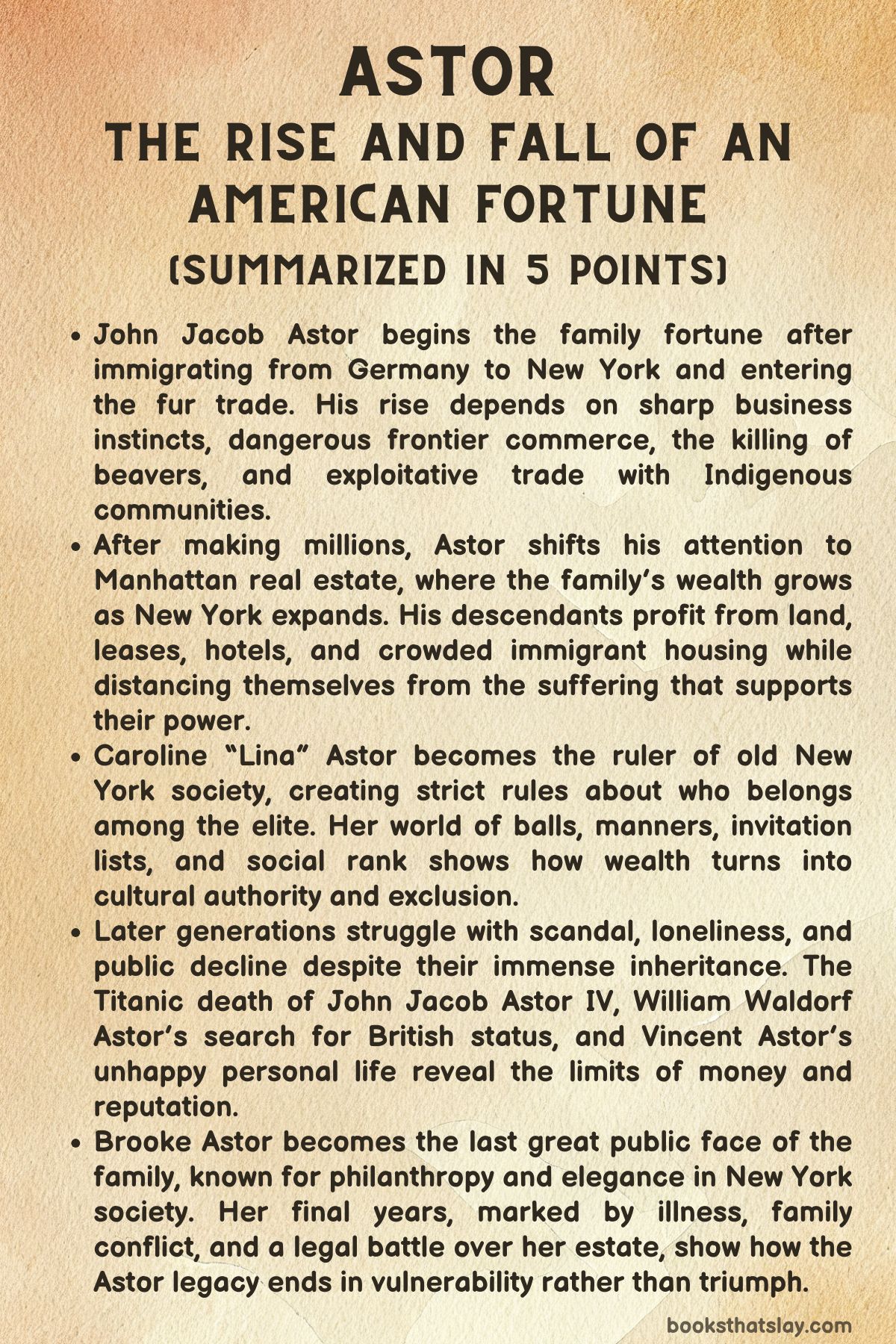
Astor: The Rise and Fall of an American Fortune by Anderson Cooper and Katherine Howe is a nonfiction account of one of America’s richest and most socially powerful families. It follows the Astors from John Jacob Astor’s fur-trading fortune to their reign over New York society, their real-estate empire, luxury hotels, scandals, and eventual decline.
The book is not only about wealth; it is also about what wealth costs others. Cooper and Howe show how the Astor name became a symbol of ambition, class, power, cruelty, philanthropy, and decay across more than two centuries of American history.
Summary
Astor begins with Anderson Cooper’s memory of Brooke Astor, the elegant and powerful figure who represented the height of old New York society in the late twentieth century. Cooper first saw her as a child while dining with his mother, Gloria Vanderbilt, at Mortimer’s, a fashionable restaurant.
Later, when he worked there as a waiter, Brooke Astor passed him without recognition, even though they had met before. That moment stayed with him because it revealed how class could make one person invisible to another.
From there, Cooper and Katherine Howe turn to the long history of the Astor family, aiming to show both how the family saw itself and how others experienced its power.
The Astor fortune began with John Jacob Astor, born Johann Jakob Astor in Walldorf, Germany, in 1763. He came from a modest background and left home as a teenager.
After spending time in England selling musical instruments, he sailed to New York with flutes to sell. On the voyage, he heard about the profits to be made in the fur trade.
In America, beaver pelts had become immensely valuable because European demand for fur hats and warm clothing was high. Astor learned the trade quickly and understood that pelts bought cheaply on the frontier could be sold for many times their cost in Europe and Asia.
Astor built his early fortune through determination, endurance, and a willingness to exploit every opportunity. He traveled into frontier regions, learned enough Indigenous languages to negotiate, and traded goods such as cloth, liquor, tobacco, and jewelry for beaver pelts.
His marriage to Sarah Todd gave him additional stability and money, allowing him to open a shop in New York. Over time, he expanded beyond local trade and used international routes to sell furs in China and bring back luxury goods.
By his mid-thirties, he was already extremely wealthy.
Astor’s ambition soon grew larger than ordinary trade. After the Louisiana Purchase opened western lands to American expansion, he dreamed of creating a vast commercial network that would move furs from the interior of North America to the Pacific and then to Asia.
He founded the American Fur Company and later the Pacific Fur Company to support this plan. His goal was to build trading posts across the continent and establish a western hub called Astoria, named after himself.
The plan was bold but dangerous. One expedition sailed on the Tonquin toward the Columbia River while another traveled overland.
The sea expedition suffered from poor leadership, conflict, and deadly misjudgment. After reaching the Pacific coast, tensions with local Indigenous people turned violent when the ship’s commander insulted and struck a chief.
The crew was killed, and the ship was destroyed. The overland journey was also brutal, with only some men reaching the destination.
Then the War of 1812 disrupted Astor’s plan, and the British captured Fort Astoria.
Astor abandoned his western dream but continued to grow richer through the American Fur Company. His business practices were often ruthless.
He undermined government trading posts that treated Indigenous communities more fairly and refused to sell alcohol. Astor used liquor as a key trading tool, profiting from addiction and debt.
Once he had secured enormous wealth from furs, he shifted into Manhattan real estate. This move made the Astors one of the defining families of New York.
Astor bought land, leased it to others, and let tenants improve the property. When leases ended, the improved land returned to him.
By the time he died in 1848, he was one of the richest men in America.
His son William Backhouse Astor inherited not only wealth but also the burden of maintaining it. William was quieter and less adventurous than his father.
He had been trained from youth to continue the family business, though he seemed to find little joy in it. Under his steady management, the Astor real-estate empire expanded.
As New York filled with immigrants, the family’s land became more valuable. Yet the Astors profited from crowded, poorly built housing without taking responsibility for the suffering of the people who lived there.
Their wealth rose alongside urban poverty.
The book uses the Astor Place Riot to show the anger simmering beneath New York’s glittering surface. The riot began around a conflict between supporters of a British actor and an American actor, but it reflected deeper class resentment.
Working-class New Yorkers saw elite spaces such as the Astor Opera House as symbols of exclusion and privilege. When crowds gathered and violence broke out, authorities opened fire, killing and injuring many people.
Though the Astor family was not directly responsible for the event, the riot revealed the social divisions that helped define the city the Astors profited from.
The family’s public identity later became tied to Caroline “Lina” Astor, wife of William Backhouse Astor Jr. She transformed herself into Mrs. Astor, the ruler of New York high society. With the help of Ward McAllister, she established strict rules for who belonged among the elite.
Wealth alone was not enough; one needed ancestry, manners, and acceptance by the right people. The famous “Four Hundred” became a symbol of this world, where invitation lists and social rituals mattered as much as money.
Mrs. Astor saw herself as creating order and refinement in American society, but her world was also built on exclusion. She resisted the newly rich, including Alva Vanderbilt, until their wealth and social force became impossible to ignore.
Lavish balls and parties became public spectacles, reported in newspapers and criticized during economic hardship. As ordinary people struggled, elite families spent fortunes on costumes, decorations, imported luxuries, and entertainment.
Mrs. Astor retained influence for decades, but by the end of her life her world was changing. She died in 1908, lonely and diminished, shortly after giving one last interview about society.
Another branch of the family produced William Waldorf Astor, who disliked New York and resented his aunt Caroline’s dominance. In a striking act of revenge, he demolished his family home next to hers and built the Waldorf Hotel.
The construction ruined her peace, blocked light from her house, and announced his contempt. The hotel became a great success under George Boldt, who helped turn elite private entertainment into public luxury.
Charity balls, grand dining rooms, and carefully managed exclusivity made the Waldorf a new center of high society.
Caroline Astor’s son Jack then joined the enterprise by replacing his own mansion with the Astoria Hotel, creating the Waldorf-Astoria. The hotel became a symbol of modern luxury and social aspiration.
It allowed people with enough money to buy proximity to elite culture. Oscar Tschirky, the hotel’s famous maître d’, helped shape its reputation through food, service, and social gatekeeping.
The original building was eventually demolished to make way for the Empire State Building, but the name lived on.
William Waldorf Astor left America for Britain, where he sought aristocratic status. He bought grand estates, collected art, owned newspapers, and tried to attach himself to British history.
He rebuilt Hever Castle, associated with Anne Boleyn, into his idea of a noble home. Though British elites often mocked his origins, his wealth finally gained him a title.
His life shows how Astor money could buy land, influence, and rank, but not full acceptance.
The book then turns to other Astor descendants and relatives whose lives complicate the family legend. At Rokeby, the Chanler children, connected to the Astors through Emily Astor, grew up orphaned, eccentric, and unruly.
Their story includes family tension, mental illness, scandalous marriages, and the gradual loss of inherited wealth. The grand estate remained, but the fortune thinned.
John Jacob Astor IV, Caroline Astor’s son, became the most famous Astor death when he died on the Titanic in 1912. He had recently scandalized society by divorcing his first wife and marrying the much younger Madeleine Force.
Returning to America because Madeleine was pregnant, he helped her into a lifeboat when the ship sank. Stories later turned him into a heroic figure, though the truth of his last moments is uncertain.
His death preserved him in public memory as both a symbol of wealth and a victim of disaster.
The authors contrast him with another John Jacob Astor, a poor immigrant from the same German town as the family founder. This man came to New York, worked as a cigar maker, lost his stability, and died in an almshouse.
His life represents the more common immigrant story: hard labor, poverty, illness, and obscurity. By placing him beside the famous Astors, the book questions the myth that America rewarded effort equally.
Later chapters follow the decline of Astor glamour through hotels, nightlife, and scandal. The Astor Hotel became a center of entertainment and a discreet meeting place for gay men at a time when same-sex relationships were criminalized and dangerous.
Its bar offered cover, coded communication, and risk. In the 1960s, criminals used that hidden world for blackmail, targeting men who feared exposure.
Vincent Astor, son of John Jacob Astor IV, inherited a vast fortune but lived unhappily. Unlike many relatives, he developed some sense of responsibility for the harm caused by Astor-owned slums.
He sold tenement properties, funded children’s charities, and supported public housing efforts. Yet his personal life was marked by failed marriages, control, loneliness, and emotional coldness.
His final wife was Brooke Marshall, who became Brooke Astor. When Vincent died, she inherited immense wealth and later became celebrated as a philanthropist.
The final family scandal centers on Brooke Astor’s son, Tony Marshall. Brooke had endured an abusive first marriage and had a complicated relationship with Tony.
As she aged and developed Alzheimer’s, Tony took greater control of her household and finances. He sold property, removed staff, and helped arrange changes to her will that benefited him and his wife.
Friends and relatives became alarmed, and his son Philip joined others in challenging him. After Brooke’s death, Tony was convicted on some charges connected to the handling of her estate and later received compassionate release from prison due to poor health.
Astor closes by reflecting on the name itself. It became a brand attached to hotels, streets, buildings, social prestige, greed, ambition, and American fantasy.
The family rose through fur, land, exploitation, and social control; it declined through scandal, inheritance battles, and changing public values. The book presents the Astors as more than a rich family.
They become a way to understand American wealth: how it is made, how it protects itself, how it harms others, and how even the grandest names eventually fade.
Key People
Anderson Cooper
Anderson Cooper appears in the book not only as one of its authors but also as a personal observer of old New York society. His early memory of seeing Brooke Astor with his mother, Gloria Vanderbilt, gives the book an intimate entry point into the world it examines.
Cooper’s later experience as a waiter at Mortimer’s, when Brooke seems to look through him because of his uniform, shapes his understanding of class as something lived in small, humiliating moments. He becomes a bridge between inherited privilege and critical distance.
Because he comes from the Vanderbilt family, he understands dynastic wealth from the inside, but he does not romanticize it. His role is reflective: he looks at the Astors with curiosity, discomfort, and moral awareness, trying to understand how families create grand public images while concealing exploitation, cruelty, loneliness, and decline.
Katherine Howe
Katherine Howe’s presence is less personal than Cooper’s, but her influence is central to the book’s historical structure and analytical tone. She helps shape the Astor family story into a broader study of American power, class, gender, and inheritance.
Her role is that of a researcher and storyteller who connects individual lives to larger social patterns. Through the book’s careful movement across generations, Howe’s historical sensibility is visible in the way private scandals are placed beside public events such as immigration, urban poverty, the fur trade, the Titanic disaster, the rise of luxury hotels, and elder abuse trials.
She helps prevent the family history from becoming a simple list of rich people and their possessions. Instead, the figures are examined as products of their time and as participants in systems that harmed many others.
Brooke Astor
Brooke Astor is one of the most important late figures in Astor, representing both the glamour and the decay of the family name. She appears first as a woman of extraordinary social polish, someone who moves through elite spaces with confidence and authority.
To the outside world, she becomes a grand philanthropist and a symbol of refined old New York. Yet the book also presents a colder side to her character, especially in her treatment of her son Tony.
Her emotional distance from him suggests that wealth and elegance did not translate into warmth or maternal generosity. Brooke’s life is shaped by survival, reinvention, and performance.
After an abusive first marriage and a happier second one, her marriage to Vincent Astor gives her the wealth and platform that define her public identity. In old age, her decline becomes the center of a painful legal and family conflict.
She is both powerful and vulnerable: a woman who controlled charity, society, and public image for decades, but who eventually became dependent on others to protect her body, property, and legacy.
Gloria Vanderbilt
Gloria Vanderbilt appears briefly but meaningfully as Anderson Cooper’s mother and as a contrast to Brooke Astor. Though she too comes from a great Gilded Age family, she does not admire Brooke’s embrace of social hierarchy.
Gloria represents a different kind of heiress, one who wants to make her own path rather than simply guard the rituals of inherited status. Her presence helps establish the book’s tension between those who celebrate dynastic identity and those who feel trapped or uneasy inside it.
Through Gloria, Cooper’s own position becomes clearer. He is not looking at the Astors as an outsider alone, but as someone raised near a similar world and shaped by a mother who had reason to question it.
John Jacob Astor
John Jacob Astor is the founder of the family fortune and one of the book’s most consequential figures. Born in Germany as Johann Jakob Astor, he arrives in America with little but ambition and quickly recognizes the vast profits available in the fur trade.
His intelligence, endurance, and business instincts are undeniable. He learns languages, studies markets, builds networks, and takes risks that other merchants avoid.
Yet the book refuses to present him as a simple self-made hero. His success depends on the killing of animals, the exploitation of Indigenous communities, the use of alcohol as a tool of trade, and a ruthless drive to dominate markets.
He is visionary in business but morally harsh in practice. His later shift into Manhattan real estate shows his ability to sense where wealth would grow next.
By buying land and allowing others to improve it, he creates a system that enriches his descendants for generations. In old age, he becomes suspicious, miserly, and consumed by protecting what he has accumulated.
He stands at the beginning of the Astor myth, but also at the beginning of the book’s critique of American fortunes built through violence, addiction, debt, and land control.
Sarah Todd Astor
Sarah Todd Astor, John Jacob’s wife, is important because she helps stabilize the early family enterprise. She comes from a hardworking background and brings both money and practical support into the marriage.
Her dowry helps John Jacob open his shop, and her domestic and social position strengthens his rise. Though the book gives her less attention than her husband, she represents the often-overlooked labor behind dynastic success.
Sarah’s role reminds readers that even when a fortune is publicly credited to one ambitious man, family wealth is often built through partnership, marriage strategy, and women’s invisible work. She is not portrayed as a public social force like later Astor women, but she belongs to the foundation of the family’s rise.
William Backhouse Astor
William Backhouse Astor inherits his father’s fortune and the burden of preserving it. He is not a daring founder like John Jacob, nor a dazzling public figure like Mrs. Astor.
He is quiet, dutiful, plain, and emotionally contained. His life seems shaped by obedience to his father’s expectations.
Even when he has moral discomfort about parts of the family business, especially the role of alcohol in the fur trade, he follows the path laid out for him. William’s importance lies in consolidation.
Under him, the family’s real-estate wealth grows massively as New York expands. Yet his passivity does not make him innocent.
He benefits from tenement conditions and shows little compassion for the poor tenants whose crowded lives enrich the family. He represents a form of power that is less dramatic than conquest but equally damaging: the steady, respectable accumulation of wealth through systems that keep others desperate.
Margaret Alida Rebecca Armstrong Astor
Margaret, called Peachy by William Backhouse Astor, appears as a woman of old New York lineage who enters the Astor family through marriage. She is socially acceptable, dutiful, and outwardly steady, but the book also hints at her private romantic imagination through her love of Gothic fiction.
This contrast makes her more than a decorative wife. She lives within a narrow social world where marriage, inheritance, and family reputation determine women’s roles, yet she has an inner life shaped by fantasy and feeling.
Her marriage to William is stable rather than passionate, and she becomes part of the family’s move into a more established elite identity. She also connects the Astors to the Rokeby estate, later important in the story of the Chanler children.
John Jacob Astor Jr.
John Jacob Astor Jr., the eldest son of John Jacob Astor, is significant because his disability changes the family’s inheritance pattern. He does not become the main heir, and the role passes instead to William Backhouse Astor.
The book does not center his interior life, but his position reveals how dynastic families often value children according to their usefulness in preserving wealth and power. His marginalization shows the harsh calculations behind inheritance.
In a family obsessed with continuity, control, and public strength, a disabled heir becomes inconvenient to the family design.
William Backhouse Astor Jr.
William Backhouse Astor Jr. is less commanding than his wife Lina, but his place in the family is important because his wealth gives her the stage on which she builds her social kingdom. As one of the sons who receives a large share of the family fortune, he enjoys leisure rather than disciplined business leadership.
His interests in horses, yachts, and affairs contrast sharply with Lina’s pursuit of order, dignity, and social rule. Their marriage becomes emotionally distant, with Lina choosing to ignore anything that threatens the family’s public image.
William Jr. represents the male privilege of inherited wealth: he can drift, indulge himself, and cause private pain while his wife must protect the family’s reputation.
Caroline “Lina” Astor
Caroline “Lina” Astor, known as Mrs. Astor, is one of the most powerful social figures in the book. She turns herself into the guardian of New York’s elite culture and makes her name almost a title.
Her authority comes not from business but from social judgment. With Ward McAllister, she defines who belongs and who does not, using ancestry, manners, wealth, and reputation as tools of exclusion.
Lina’s character is disciplined, proud, and theatrical in a controlled way. She believes that elite society needs rules and that she is the person best suited to enforce them.
Her rivalry with Alva Vanderbilt reveals both her strength and her limits, because new money eventually forces its way into spaces she tries to guard. Lina’s later loneliness and decline show the fragility of social power.
She spends her life deciding who may enter the room, but time, age, and changing values eventually move the room away from her.
Ward McAllister
Ward McAllister is Lina Astor’s ally, adviser, and social architect. He helps create the codes of elite New York society, including the idea of the Four Hundred.
His character is ambitious, observant, and deeply invested in status. He understands that social power depends on performance, scarcity, and public desire.
By making invitations rare, he makes them valuable. Yet his later decision to publish private details and expose elite lists suggests vanity and betrayal.
McAllister wants to be both insider and author of the insider’s world, and that desire damages his relationship with Mrs. Astor. He is useful to her because he understands social machinery, but he also shows how fragile loyalty becomes when status and self-display are involved.
Alva Vanderbilt
Alva Vanderbilt appears as the great challenger to Mrs. Astor’s social authority. She belongs to the newly rich world that Lina initially resists, but her wealth, ambition, and talent for spectacle make her impossible to ignore.
Alva’s masquerade ball becomes a turning point because it forces old society to recognize the power of new money. She is bold where Lina is controlled, aggressive where Lina is guarded, and modern in her understanding of publicity.
Alva does not wait to be accepted quietly; she creates an event so grand that exclusion becomes impractical. Her role in the book shows how American aristocracy was always unstable because money could challenge ancestry, and publicity could weaken inherited authority.
Rebecca Insley
Rebecca Insley, the journalist who interviews Mrs. Astor near the end of her life, serves as a witness to fading grandeur. Through her, readers see Lina Astor still trying to explain and defend the social order she created.
Insley’s presence is important because she captures Mrs. Astor at a moment when the old ruler of New York society is physically and mentally diminished but still attached to her ideals of decorum, hierarchy, and influence. As a journalist, Insley also represents the growing public fascination with elite private life.
The world Mrs. Astor helped build depends on exclusivity, yet it increasingly becomes material for newspapers and public consumption.
William Waldorf Astor
William Waldorf Astor, often called Will, is one of the most restless and resentful members of the family. He inherits enormous wealth but feels alienated from America and from his own relatives.
His decision to build the Waldorf Hotel beside Mrs. Astor’s home is an act of revenge disguised as business. Will’s character is marked by insecurity, pride, and a hunger for recognition that American wealth alone cannot satisfy.
He moves to Britain, renounces the United States, buys estates, collects art, owns publications, and seeks aristocratic status. Yet even when he receives titles, he remains haunted by the sense that old nobility sees him as an outsider with purchased rank.
His life reveals a central irony of inherited wealth: money can buy property, comfort, and influence, but not necessarily belonging.
Mary “Mamie” Dahlgren Paul Astor
Mamie, Will Astor’s wife, is part of his earlier attempt to follow the life expected of him. She is socially suitable and shares his enjoyment of European culture when he serves in Italy.
Her sudden death deepens Will’s isolation and helps explain his later withdrawal into art collecting, writing, estate-building, and aristocratic fantasy. Though she is not developed as extensively as others, her role is emotionally significant.
She belongs to the period before Will fully breaks with America, and her absence leaves him more solitary and severe.
George Boldt
George Boldt, the manager of the Waldorf and later the Waldorf-Astoria, is a crucial figure in transforming elite hospitality into public spectacle. He understands that luxury can be staged, sold, and used to attract both aristocrats and aspirants.
Under his management, the hotel becomes more than a building; it becomes a theater of class. Boldt’s genius lies in making public spaces feel exclusive.
He brings private society rituals into the hotel and uses charity galas, fine dining, and careful service to give the wealthy a new stage. He represents the commercialization of status, where the boundaries of high society become both guarded and profitable.
Oscar Tschirky
Oscar Tschirky, the famous maître d’ of the Waldorf-Astoria, represents the power of service within elite culture. Though not born into the world of the Astors, he helps define how that world looks, eats, enters rooms, and experiences luxury.
His creations and customs, including famous dishes and the use of velvet ropes, show how class is enforced through ritual. Oscar’s role is fascinating because he is both servant and gatekeeper.
He does not possess Astor wealth, but he helps decide who may access the atmosphere that wealth creates. He demonstrates how social hierarchy depends not only on owners but also on skilled intermediaries who manage desire, embarrassment, and exclusion.
John Garvin
John Garvin is a minor figure with major symbolic importance. When he enters Caroline Astor’s home and sleeps in a maid’s room, the Astors treat him as a criminal threat rather than a desperate man seeking shelter.
His punishment and the press reaction expose the family’s lack of sympathy for poverty. Garvin’s character shows how the elite imagination often turns need into danger.
To the Astors, he is an intruder; to the public, he becomes evidence of their coldness. His episode reveals how quickly social power can become a public relations disaster when private privilege meets visible suffering.
Henry Astor
Henry Astor, disowned for marrying beneath his social rank, reveals the cruelty of dynastic control. His father’s rejection of him shows that family loyalty is conditional when inheritance and class purity are at stake.
Henry’s choice of marriage challenges the family’s rigid boundaries, and the punishment is severe. He matters because he exposes the Astors’ internal hierarchy.
Even within the family, love and individuality can be treated as threats if they interfere with wealth management or social standards.
Emily Astor Ward
Emily Astor Ward, daughter of William Backhouse Astor, is important through the legacy she leaves behind. Her death in childbirth removes her from the story early, but her daughter Maddie Chanler becomes central to the Rokeby branch.
Emily’s life reflects the vulnerability of women in nineteenth-century elite families, where marriage and childbirth were expected duties but could be physically dangerous. Her absence also shapes the fate of her descendants, whose lives unfold with a mixture of privilege, instability, and loss.
Maddie Chanler
Maddie Chanler inherits Rokeby and becomes the emotional center of a large family before her early death. She is connected to Astor wealth but not defined by the same hard public ambition as the main line.
Her marriage to John Chanler is presented as happy, and her life at Rokeby suggests a more domestic, eccentric, and country-centered branch of the family world. Her death while pregnant with her twelfth child leaves her children orphaned and vulnerable.
Maddie’s character stands for the human cost hidden inside family trees: behind inheritance charts are bodies, pregnancies, deaths, and children left behind.
John Chanler
John Chanler, Maddie’s husband, is a political and family figure whose death shortly after hers leaves the Chanler children without parents. His role is defined by connection, promise, and absence.
He belongs to a world of elite networks, but those networks prove inadequate when ten children need care. His death leads to the strange household at Rokeby, where guardianship is formal, distant, and financial rather than deeply parental.
Through him, the book shows how wealth can arrange legal care but cannot replace emotional stability.
Mary Marshall
Mary Marshall becomes the practical caretaker of the orphaned Chanler children at Rokeby. Her role is essential because she provides continuity when elite guardians are unable or unwilling to take the children fully into their homes.
She represents care outside the central structures of inheritance. While the Astor guardians oversee finances from a distance, Mary is closer to the children’s daily lives.
Her presence reminds readers that families of wealth often depend on less celebrated women to manage the emotional and domestic consequences of death, scandal, and neglect.
Archie Chanler
Archie Chanler is one of the book’s most unusual and troubled figures. As one of the orphaned Rokeby children, he grows up in a world of privilege, mischief, and emotional disorder.
His marriage to Amélie Rives brings scandal because it defies family expectations and links him to a woman with an independent artistic reputation. Later, Archie’s belief in psychic powers and his claim of an “X-faculty” make him appear increasingly unstable to his relatives.
His confinement in a mental hospital raises questions about mental illness, family control, and the use of institutions to silence embarrassment. Archie is not simply comic or eccentric; he reveals how elite families manage members who disturb public respectability.
Amélie Rives
Amélie Rives is imaginative, bold, and socially disruptive. Her controversial writing and marriage to Archie Chanler make her a striking figure in the Rokeby story.
She is not passive within elite society; she brings literary ambition, sexuality, and unconventional energy into a family that values control. Her relationship with Archie begins romantically but becomes strained as his instability grows.
Amélie’s character helps show how women who expressed desire, creativity, or independence could be treated as scandalous, especially when they entered rigid families.
Margaret Chanler
Margaret Chanler is shrewd, controlled, and practical in a family full of disorder. Her role in securing Rokeby shares from Archie and later from other siblings shows her ability to manage inheritance and property with determination.
She is less flamboyant than Archie and less publicly dramatic than Amélie, but she has a strong instinct for preservation. Through Margaret, the book presents a different kind of power: not the grand social rule of Mrs. Astor, but the patient consolidation of family property.
Her descendants’ continued presence at Rokeby shows that her choices had lasting consequences.
John Jacob “Jack” Astor IV
John Jacob “Jack” Astor IV is remembered largely because of the Titanic, but the book gives him a broader identity. He is wealthy, precise, mechanically curious, and socially constrained.
His marriage to Ava is unhappy, and his later divorce and marriage to the much younger Madeleine Force make him a scandalous figure before his death turns him into a legend. Jack’s final actions on the Titanic are uncertain, though popular culture repeatedly reshapes him as hero, villain, or symbol of elite decadence.
His character shows how public memory simplifies wealthy men after death. In life, he is awkward, privileged, and emotionally unsatisfied; in death, he becomes an image others can use.
Ava Astor
Ava Astor, Jack’s first wife, is portrayed as beautiful, spoiled, and emotionally cold toward him. Their marriage belongs to the world of elite arrangement, where social suitability does not guarantee intimacy.
Ava’s contempt and distance contribute to Jack’s unhappiness, though the book does not reduce the marriage to a single villain. She represents the emotional barrenness that could exist behind grand houses and perfect pedigrees.
Her role also helps explain why Jack’s divorce was so socially explosive: among elites, marriage was not only personal but reputational, and breaking it threatened the public order that families like the Astors depended on.
Madeleine Force Astor
Madeleine Force Astor enters the book as Jack Astor’s young second wife and as a focus of scandal. Her marriage to a much older divorced millionaire makes her an object of public judgment, but the Titanic disaster changes her position almost instantly.
As a pregnant young woman placed into a lifeboat while Jack remains behind, she becomes part of the tragedy’s emotional mythology. Her character is shaped by other people’s narratives: society gossips about her, newspapers watch her, and history remembers her mainly through the disaster.
She represents how women connected to famous men can be reduced to symbols of innocence, scandal, or survival.
Vincent Astor
Vincent Astor is one of the most complex heirs in the book. He inherits immense wealth after his father dies on the Titanic, but he also inherits emotional damage.
His mother’s distance and his father’s absence leave him hungry for affection yet often unable to give it generously. Vincent enjoys luxury, yachts, cars, and influence, but he also develops a conscience about some parts of the family fortune.
His decision to sell tenement properties, support housing reform, create playgrounds, and fund children’s charities marks him as different from earlier Astors who ignored the suffering tied to their real estate. Yet Vincent’s personal life is controlling and unhappy.
His marriages fail, and his relationship with Brooke is marked by pressure, jealousy, and emotional difficulty. He is both reformer and tyrant, benefactor and wounded heir.
Helen Dinsmore Huntington Astor
Helen, Vincent’s first wife, represents another emotionally distant elite marriage. She and Vincent maintain appearances, share philanthropic interests, and move through society together, but their relationship lacks warmth.
The reasons for the marriage’s unhappiness remain uncertain, which gives her character a guarded quality. She is important because she helps show the difference between public partnership and private fulfillment.
In the Astor world, a marriage can be socially correct and still emotionally empty.
Mary Benedict “Minnie” Cushing Astor
Minnie Cushing, Vincent’s second wife, appears as socially skilled, pragmatic, and caught in the exhaustion of a failing marriage. Her role in helping Vincent find a new wife is revealing because it turns marriage into negotiation and management.
Rather than a romantic partner, she becomes almost an arranger of Vincent’s next domestic phase. Minnie’s character reflects the transactional side of elite relationships, where divorce, remarriage, money, and social ease are handled as strategic matters.
Janet Smith Bush
Janet Smith Bush appears briefly but memorably as the woman who refuses Vincent Astor. Her rejection is important because it cuts through the assumption that immense wealth automatically makes a man desirable.
When Vincent suggests that his doctors have given him only a few years to live, Janet’s response exposes the grim calculation behind his proposal. She brings wit and self-possession into a situation shaped by money and mortality.
Her role is small, but she stands out because she refuses to be absorbed into the Astor orbit.
Tony Marshall
Tony Marshall is one of the most controversial figures in Astor. As Brooke Astor’s son, he grows up with emotional distance, rejection, and dependence.
His mother’s lack of warmth shapes him deeply, and his later reliance on her for employment and status creates humiliation. The book presents him as needy, resentful, and eager for recognition, but also as someone who may have experienced real pain from a mother who never fully embraced him.
His marriage to Charlene worsens the conflict because Brooke dislikes her and structures her estate to limit Charlene’s benefit. As Brooke declines, Tony’s actions become increasingly suspect.
He takes control of her household, cuts expenses, sells items, and helps alter her will in ways that favor himself. Yet he continues to insist that he loved his mother.
His character is tragic not because he is innocent, but because love, resentment, money, and entitlement become impossible to separate.
Charlene Marshall
Charlene Marshall is central to the final family conflict. Her relationship with Tony begins in scandal because both are married when they fall in love, and her husband is connected to Brooke’s church.
To Brooke, Charlene seems like an outsider and a threat to the Astor fortune. Charlene’s presence intensifies Tony’s desire to secure money and property, especially because Brooke’s earlier estate plans leave her with little protection if Tony dies first.
She is often viewed through suspicion, but her role is also structural: she exposes how inheritance conflicts are rarely about money alone. They are about legitimacy, belonging, marriage, and who is considered family.
Philip Marshall
Philip Marshall, Tony’s son, becomes a moral counterforce in the final section of the book. By joining Brooke’s friends in challenging his father’s control, he risks money, family ties, and his own inheritance.
His action is presented as unusually selfless because it costs him financially and personally. Philip’s role complicates the family drama by showing that not every descendant responds to wealth with greed or silence.
He becomes part of an effort to protect Brooke when she can no longer fully protect herself, even though doing so means standing against his own father.
David Rockefeller
David Rockefeller appears as one of Brooke Astor’s powerful friends who becomes concerned about her condition. His role reflects the network of elite protection surrounding Brooke.
Unlike ordinary elderly people, Brooke has friends with enough status and influence to challenge what is happening around her. Rockefeller’s involvement shows both care and privilege.
He helps bring attention to her situation, but his presence also reveals that even vulnerability looks different when the person at risk belongs to the highest social circles.
Annette de la Renta
Annette de la Renta is another important figure in the effort to protect Brooke Astor. As a friend from Brooke’s social world, she notices signs of neglect and isolation and helps intervene.
Her role is rooted in loyalty and social conscience. She represents the side of elite society that does not simply protect reputation but can also act when someone vulnerable is being mistreated.
Her involvement helps transform private concern into legal action.
Francis Morrissey
Francis Morrissey, Tony’s lawyer, is important because he helps prepare the contested changes to Brooke Astor’s will. His presence brings the legal machinery of inheritance into the family drama.
He represents the professional enablers who can make questionable family desires appear official through documents, signatures, and codicils. His role shows that elder exploitation, when it occurs among the wealthy, often depends not on crude theft but on paperwork, influence, and legal language.
The Other John Jacob Astor
The poorer John Jacob Astor, an immigrant cigar maker from the same German town as the family founder, is one of the book’s most powerful contrasts. He shares a famous name but none of its advantages.
His life follows the more common immigrant path: hard labor, low wages, insecurity, failing health, and institutional death. By placing him beside the rich Astors, the book challenges the myth that America offers equal opportunity to all who work hard.
His character is not important because of public achievement but because of what his obscurity reveals. He is the shadow version of the founder’s success story, showing how many immigrants lived and died without fortune, land, or recognition.
Admiral William Church
Admiral William Church appears in the section about blackmail at the Astor Hotel’s bar. His death by suicide after being targeted in an extortion scheme reveals the danger faced by gay men or men perceived as vulnerable to exposure in a society that criminalized and shamed same-sex desire.
He represents the human cost of secrecy. His story shows how social respectability could become a trap, giving criminals power over men whose careers and lives depended on silence.
Mary Astor
Mary Astor, born Lucile Langhanke, is not part of the family by blood, but her adopted stage name shows the cultural power of the Astor identity. Her parents and supporters choose the name because it suggests elegance, wealth, and prestige.
Her story widens the book’s meaning by showing that “Astor” became more than a family name; it became a symbol that could be borrowed, sold, and performed. Mary’s own experience with exploitative parents also echoes the book’s larger concern with money’s ability to distort family relationships.
Themes
Wealth Built on Exploitation
The Astor fortune begins as a story of ambition, but its foundation is inseparable from violence, environmental destruction, and human exploitation. John Jacob Astor’s rise through the fur trade depends on the mass trapping of beavers, the expansion of trade networks into Indigenous lands, and the use of addictive goods such as alcohol to control exchange.
The book does not allow the reader to admire his business genius without also seeing what that genius required. Later, the family’s wealth shifts from fur to Manhattan real estate, but the moral pattern remains.
Astor-owned land becomes profitable while immigrants crowd into unsafe, unhealthy tenements. The family can appear respectable because it does not always directly manage the worst conditions, but it still benefits from the system that produces them.
This theme challenges the clean version of American success. It suggests that great fortunes are often praised after the suffering behind them has been hidden, outsourced, or made to look ordinary.
Astor presents wealth not as a neutral achievement but as something made through choices, pressures, and structures that leave others with the cost.
Class, Visibility, and Social Exclusion
Class in the book is not only about money; it is about who is recognized, welcomed, ignored, or humiliated. Anderson Cooper’s memory of Brooke Astor looking through him when he is dressed as a waiter captures this theme in a small but sharp moment.
The same person can be visible as Gloria Vanderbilt’s son and invisible as service staff. Mrs. Astor’s social world turns this logic into a formal system.
Through invitation lists, balls, manners, ancestry, and carefully guarded rooms, New York society creates rules for belonging. Ward McAllister and Mrs. Astor treat exclusion as culture, making social acceptance seem like a moral and aesthetic achievement rather than a defense of privilege.
The Waldorf-Astoria then changes the pattern by selling access to luxury, but even there class remains carefully managed through ropes, service, and judgment. The book shows that elite society depends on performance.
People must dress correctly, marry correctly, speak correctly, and be seen by the right observers. Those outside the circle are treated as threats, curiosities, workers, or background figures.
This makes class feel less like a private condition and more like a public script everyone is forced to read.
The Fragility of Dynastic Power
The Astors spend generations trying to turn money into permanence, yet the book repeatedly shows how fragile dynastic power really is. John Jacob Astor builds a fortune meant to secure his family for centuries, and for a time it seems to work.
His descendants inherit land, houses, hotels, titles, and social authority. But each generation reveals new forms of weakness.
Some heirs are lonely, resentful, emotionally damaged, or desperate for acceptance. William Waldorf Astor leaves America to buy aristocratic belonging in Britain, but old nobility still mocks him.
Mrs. Astor rules New York society, but changing wealth, public criticism, and age weaken her authority. Jack Astor’s death on the Titanic turns privilege into helplessness in a single night.
Vincent Astor inherits wealth but not emotional security. Brooke Astor becomes a public symbol of grace, only for her final years to be defined by vulnerability and legal conflict.
The family name survives, but the power behind it shifts, cracks, and becomes increasingly symbolic. The theme suggests that inherited wealth can preserve property more easily than identity, affection, dignity, or control over the future.
Family, Inheritance, and Emotional Damage
Inheritance in the book is never simply a legal matter. It shapes love, resentment, marriage, identity, and betrayal.
The Astor family repeatedly treats money as the center of family continuity, but that focus often damages the people meant to carry the legacy. John Jacob Astor trains William to preserve the fortune, leaving him dutiful but emotionally confined.
Henry Astor is punished for marrying outside acceptable social rank. The Chanler children inherit privilege but lose parental stability.
Vincent Astor receives a vast estate after his father’s death, yet he remains emotionally starved and controlling. Brooke Astor gives Tony money and position, but not the affection he longs for, creating a relationship poisoned by dependence and rejection.
In old age, Brooke’s estate becomes the battlefield on which decades of family pain are fought. Wills, codicils, properties, paintings, salaries, and bequests become substitutes for love and proof of worth.
The book suggests that dynastic families often confuse provision with care. They pass down wealth, but they also pass down insecurity, entitlement, loneliness, and the fear of being excluded from one’s own bloodline.