At Whit’s End Summary, Characters and Themes
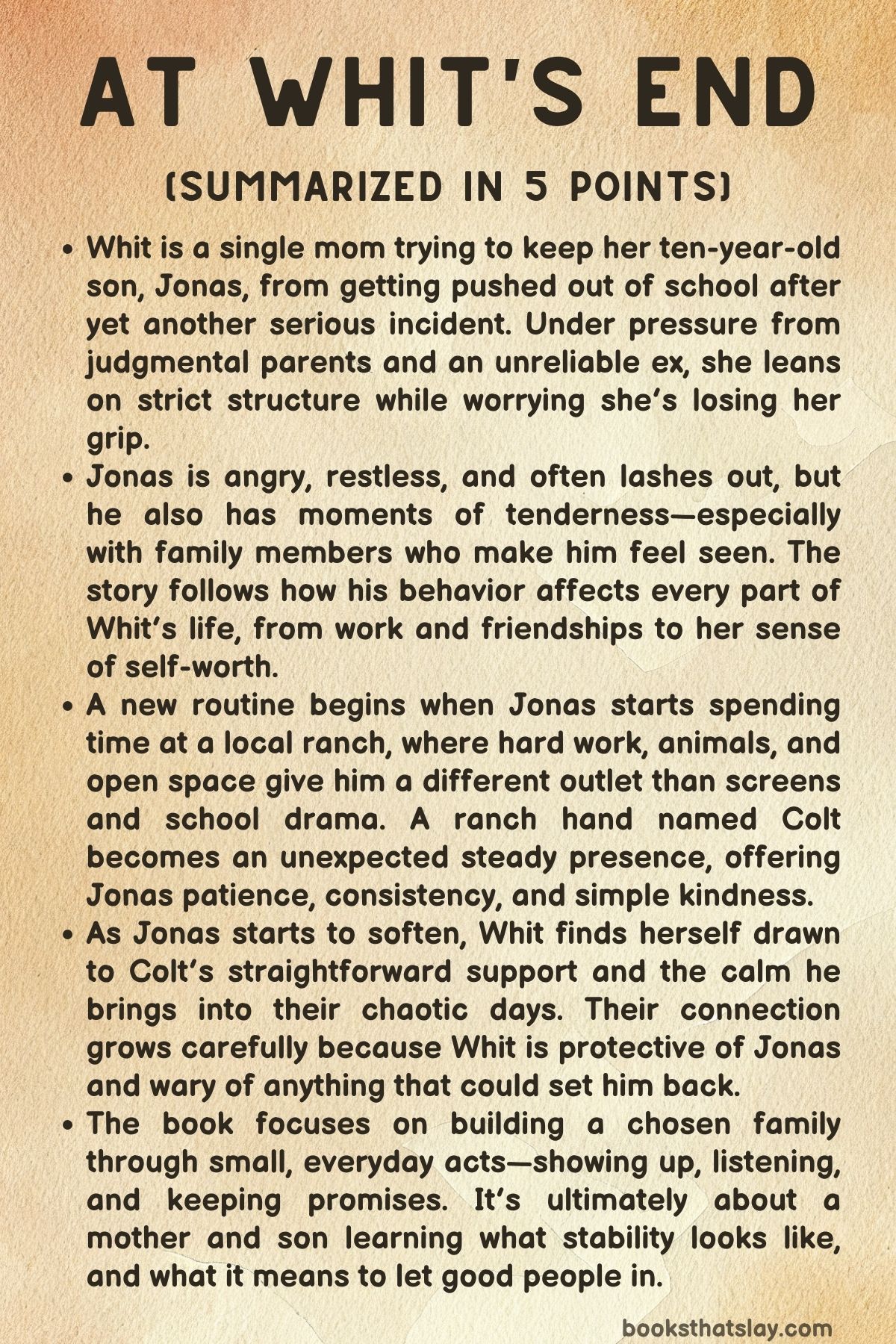
At Whit’s End by Bailey Hannah is a contemporary small-town romance centered on Whitney “Whit,” a young single mother doing everything she can to steady her ten-year-old son, Jonas, as his behavior at school escalates and judgment from other parents closes in. Whit is exhausted, proud, and scared—especially because Jonas’s father, Alex, is inconsistent and unreliable.
When Jonas begins spending time at a local ranch, an unexpected ally appears: Colt, a rough-around-the-edges ranch hand with a soft spot for kids and a talent for showing up. What starts as practical help becomes a lifeline, then something deeper—while Whit figures out how to protect her son and still want a life of her own. It’s the 4th book in the Wells Ranch series.
Summary
Whit is summoned to the principal’s office after her ten-year-old son, Jonas, hands in an English test covered in an explicit drawing. Principal Maher is blunt about how serious it is, and he also points to Jonas’s long record of discipline problems—fights, pranks, suspensions, and getting kicked off his soccer team.
Whit holds herself together and argues that pushing Jonas out of school will only make things worse. She explains that Jonas has been seeing a counselor and that his acting out is connected to his father.
Maher agrees to let Jonas stay for the final couple of weeks of school on one condition: Jonas must spend every lunch hour in Maher’s office until the year ends.
The ride home is quiet and tense. In the kitchen, Whit tells Jonas about the daily lunch punishment.
He reacts with anger and humiliation, calling it “cringe” and refusing to do it. Whit refuses to budge, and the fight escalates.
She takes his gaming device and grounds him until summer break. Jonas screams insults through his bedroom door, calling her a bitch.
Whit doesn’t explode back, but she breaks down alone, hiding her sobs behind the sound of a running dryer. She’s tired of being judged for having Jonas at eighteen, tired of trying to look like she has everything under control, and terrified that her son is heading toward something she can’t fix.
That night, Jonas’s father, Alex, calls late and says he’s parked outside. Whit lets him in only because she doesn’t want a scene.
Alex tries to turn the visit into sex, but Whit shuts it down and tells him how close Jonas came to being expelled. Alex laughs it off as normal kid behavior and shows little concern.
Whit asks him to show up, to help, to talk to Jonas, to do something real. Alex half-agrees, then complains that Whit is “nagging.” By morning, he’s gone without a word.
On the last day of school, there’s a yard party where parents mingle. Whit catches Jonas throwing gravel at another kid and drags him away, furious and embarrassed.
A group of mothers—led by Megan—use the moment to make snide comments about Whit being a young mom and insinuate Jonas is just like Alex. Megan needles Whit with questions about suspensions.
Whit forces a smile, swallows the humiliation, and leaves. Before they go, she confiscates a makeshift spitball weapon from Jonas and reminds him they have dinner at his grandparents’ house later.
At her parents’ home, Whit warns Jonas to behave, especially because Whit’s mother is struggling with early-onset Alzheimer’s. Jonas, surprisingly, becomes a bright spot there—he makes his grandmother laugh and talks with her in a way that lifts her mood.
Whit drinks wine with her sister, Blair, and admits how exhausted she is by school incidents and constant worry. They talk about summer plans and ways to keep Jonas busy and away from screens.
Whit admits that Alex’s “help” tends to be money rather than time, and she’s left managing the emotional fallout when Jonas realizes his dad doesn’t show up.
Away from Whit’s house, Colt starts his day at Wells Ranch, working cattle with his dog, Betty. He’s a ranch hand who takes pride in the work and shrugs off jokes from the foreman and other hands.
Colt gets a message from Denny, one of the Wells brothers, telling him to pick up Jonas and bring him out to the ranch for chores. Colt drives to Whit’s house and meets her at the door dressed in a black suit.
He’s wearing a sleeveless shirt with a crude message about single moms, and Whit is instantly unimpressed. Embarrassed, Colt flips the shirt inside out and backward, then tries to sell Whit on the idea that ranch chores will be good for Jonas.
Reluctantly, she agrees.
The first ranch day is rough. Jonas complains about the smell and the work, dragging his feet while mucking stalls.
But Colt doesn’t baby him or bully him; he simply expects him to finish. Afterward, Colt takes Jonas to watch Denny attempt to ride an untrained horse.
The horse throws a fit, Denny gets tossed around, and everyone laughs. Jonas laughs too, and something in him loosens.
On the way home, Colt asks what Jonas’s summer looks like. Jonas says he mostly plays online games and hopes his dad will buy him a new one.
Colt casually invites him back to fish or swim sometime. When Colt returns Jonas, he tells Whit that Jonas did better by the end and that he’s welcome back.
Whit creates a structured summer plan—some days at home, some with family—meant to limit screen time and reduce trouble. Blair arrives early to take Jonas one morning, and later texts that Jonas wants to stay longer at the ranch.
Whit agrees. That evening, Jonas comes home and surprises Whit by talking about learning to saddle a horse and asking to go back.
He even compliments her lasagna sincerely, which feels like a small miracle to her. For the first time in a while, Whit sees a version of Jonas that looks like himself again.
Colt’s mornings start before sunrise in the bunkhouse. The ranch hands trade insults, and Rob gives Colt grief for being assigned “babysitting.” Denny confirms Jonas will be around a lot.
Colt picks Jonas up again and takes him to help tarp the silage pit, explaining how chopped hay is stored and weighted down with tires. Jonas struggles at first, embarrassed when a tire rolls away.
He blurts out a half-censored swear, then panics. Colt doesn’t shame him; he laughs and tells him to just say the word if he’s going to say it.
The moment breaks tension, and Jonas settles into the work. They spend the day hauling tires in the heat, taking water breaks, teasing each other, and falling into an easy rhythm.
Jonas ends up with a blister; Colt tells him how to clean and cover it, then promises ice cream.
When Colt brings Jonas home, Jonas impulsively invites Colt to stay for dinner so they can play a fishing video game. Whit, flustered, lets him in.
Colt asks for water instead of alcohol, and Whit awkwardly scrambles through the basics of hosting. Dinner is nothing fancy—she reheats frozen soup—but the energy is different.
Jonas is engaged, talking, joking, and acting like a kid again. The mood shifts when Jonas brings up Alex and says his dad always cancels.
Jonas storms off, angry and hurt. Whit starts to clean up, thinking about calling Alex.
Colt quietly offers to take Jonas fishing if Alex doesn’t show. Whit insists Alex will come, but Colt asks for her number anyway, saying she can call if Jonas needs a ride or if something happens.
He texts her a simple message that lands hard: it’s not too much to ask. Promise.
The next day, Whit reaches out and asks if Colt truly meant the fishing offer. Colt says he’ll pick Jonas up around noon.
Rob mocks him again, but Colt ignores it and grabs a spare rod. Colt shows up while Whit is mid-workout and wearing the kind of casual clothes she doesn’t usually let anyone see.
Colt is also wearing a crude fishing-joke shirt and fumbles through an explanation. Jonas comes down ready to go, and Whit sends him off with reminders.
At the lake, Jonas worries they don’t have a dock or boat, but Colt finds a rocky spot and teaches him anyway. Jonas botches casts, gets a lure stuck in a tree, and has to accept help.
Over time he improves. The hours are quiet and easy, with space for real talk.
Jonas mentions he used to fish with his grandpa before his grandma got sick and hints at how much he misses that steadiness. Colt agrees they can fish again, especially when Alex cancels.
Whit spends the day alone and realizes how rare that is. When Jonas comes home sunburned and happy, she can feel the difference.
Colt stays, and Whit orders pizza. Colt pays.
Jonas performs goofy reenactments of the “big catch,” and Whit watches the bond between Colt and her son grow without force.
The fragile peace cracks when Whit learns Alex has a girlfriend named Fern—and has had her for months. The news hits like betrayal because Alex has been sleeping with Whit without telling her.
When Whit confronts him, he deflects, then turns jealous and accusing, demanding to know who Colt is and acting as if he gets to police Whit’s home while still failing as a father. Whit hangs up furious and humiliated, then leans on Blair for comfort, wine, and a reality check.
As Colt becomes a steady presence, Whit and Colt grow closer. After a birthday night out, Colt drives Whit home.
In the truck, Whit admits she’s conflicted—she wants Colt, but Jonas complicates everything, and she’s terrified of hurting her son. The attraction between them boils over, and they make out intensely.
Whit tries to push it further, but Colt refuses to have sex with her when she’s been drinking. He draws a firm line to protect her, even when he clearly wants her.
They get each other off without crossing the boundary Colt set, then he brings her home, helps her inside, and stays the night.
The next morning, Whit is hungover and embarrassed. Colt is in her kitchen making coffee and breakfast.
They talk honestly: Whit is wary because Jonas has reacted badly to her dating before, and she doesn’t want to create chaos. Colt says he doesn’t want a secret arrangement; he wants to be her boyfriend and do things properly.
They agree to take it slow and keep anything romantic quiet around Jonas for now, with one exception: Colt is allowed to kiss her.
Life interrupts immediately. Whit gets a call that Jonas punched another boy at the park.
She rushes there, deals with the other parent, and punishes Jonas by making him ride his bike straight home. Jonas disappears instead.
Whit panics, searches, and finally calls Colt. Colt drops everything and helps her search the roads and the edges of town.
Whit spirals with fear until Alex texts that Jonas is with him. Whit and Colt drive to Alex’s run-down place, where Alex acts smug and blames Whit while refusing responsibility for not calling sooner.
Whit drags Jonas home, shaken. Colt warns Alex to contact them immediately if anything like that happens again.
Afterward, Colt suggests food to keep the anger from taking over. Over tacos from a food truck, Colt shares that he struggles with reading because of dyslexia, and Whit sees another part of him: someone who has carried his own quiet shame and still built a life that works.
Back at Whit’s house, Jonas locks himself in his room. Whit feels crushed, like Jonas chose Alex over her.
Colt reframes it: Jonas is testing whether the door with his dad is real, but Whit is still home base. Colt goes upstairs to talk to Jonas privately, then encourages Whit to talk to him too.
Colt asks again to take Whit on a real date, and this time she agrees.
At the next family wedding on the ranch—Blair and Denny’s—Whit arrives looking stunning, with fresh pink tips in her hair. Colt can barely keep his eyes off her, and he realizes he’s fully in love.
While venting to someone, he accidentally says it out loud within Jonas’s earshot. Jonas confronts him, asking if he means Whit.
Colt, nervous, tells Jonas the truth: he likes her and wants to take her on dates. Jonas admits he already suspected it and wants to know what it would mean.
Colt promises he’s not trying to replace Jonas’s dad. Jonas says Alex makes Whit cry a lot.
Colt promises he wants to make Whit smile and be good to both of them. Jonas gives cautious approval, mostly concerned that Colt will still play video games, bring treats, and not break Whit’s heart.
He jokingly threatens Colt and claims Betty if things go wrong.
Later, Colt tells Whit he talked to Jonas and that Jonas approves. Whit is shocked, but relief floods in.
Colt asks her to dance outside even though no one else is dancing. He apologizes for leaving before and promises he will always choose Whit and Jonas.
Whit admits she wants him too and needs him to be her person. They kiss openly, no longer hiding.
They slip away to the barn, where Colt shows Whit a cleaned-out stall Jonas prepared for a future 4-H animal project. Whit is overwhelmed with pride at Jonas’s effort and the way the ranch has given him direction.
In the privacy of the barn, Whit and Colt finally come together fully, reaffirming their love out loud.
Afterward, Whit introduces Colt to her parents. Her mother is confused in moments but cheerful.
Colt boldly calls himself Whit’s future husband. Whit braces for judgment from her father, but Colt wins him over by talking about Jonas, fishing, and asking for help with barn carpentry for Jonas’s project.
Instead of shutting them out, Whit’s father responds warmly.
The next morning, Colt arrives with cinnamon rolls and coffee. Whit admits she slept badly without him.
Jonas comes downstairs and calls them gross, but he’s clearly comfortable with what’s happening—and very interested in the pastries. Jonas asks if Colt can stay the night, and Colt says he will if Whit is okay with it.
Their routine shifts into something more open, more honest, and more stable.
Soon after, Whit learns Blair is pregnant, and the news becomes another marker of forward movement in their family. Whit supports her sister and then talks with Colt about the future, including his desire for children and how they might build a bigger family if they decide to.
Colt reassures her they are already a family and they don’t have to decide everything now.
Five years later, Jonas is fifteen and thriving in 4-H, showing a steer at the fair. People assume Colt is his father, and Colt proudly accepts it.
Colt and Whit are married, and Jonas calls Colt “Dad.” The family spends the day together—Whit, Colt, Jonas, Blair, Denny, and Blair’s daughter Odessa—teasing, celebrating, and moving through life as a solid unit built from choice, work, and the kind of love that shows up.
Characters
Whit
Whit is the emotional and moral center of At Whit’s End, carrying the exhausting weight of being both the “responsible parent” and the lightning rod for everyone else’s judgments. She has learned to survive by controlling what she can—her routines, her image, her son’s schedule—because so much of her life has been shaped by instability, especially Alex’s unreliability and the long shadow of becoming a mother at eighteen.
Under that competence, Whit is constantly afraid: afraid Jonas is becoming the version of his father people whisper about, afraid she’ll be blamed no matter what she does, and afraid that loving anyone will cost her and Jonas more pain. What makes her arc powerful is that she doesn’t transform into a “new” person; instead, she slowly allows herself to be seen—messy, angry, sexual, grieving, hopeful—and discovers that being loved well doesn’t weaken her parenting, it strengthens it.
Her relationship with Colt doesn’t rescue her from responsibility, but it gives her partnership, steadiness, and proof that she isn’t destined to do everything alone.
Jonas
Jonas is a ten-year-old acting like a kid who has been carrying grown-up disappointment for years, and his misbehavior reads less like random troublemaking and more like a loud, messy language for hurt. The penis drawing, the fights, the defiance—these are performances that force adults to look at him, because one of the adults he wants most keeps not looking.
Jonas’s anger is sharp, but so is his sensitivity; he tracks adult moods, he knows exactly where the weak spots are, and he tests boundaries because he’s trying to locate what is solid. Around his grandmother, he becomes softer and funny, showing that his sweetness is not gone—it’s simply guarded.
With Colt, Jonas finds something he can’t get from Alex: predictable attention without strings, correction without cruelty, and a model of masculinity that isn’t performative or selfish. His eventual acceptance of Colt isn’t instant or simplistic; it’s a negotiation shaped by loyalty, fear of abandonment, and his need for safety, and it culminates in the quiet, enormous moment where “Dad” becomes something earned rather than assumed.
Colt
Colt begins as the kind of person who looks unserious at first glance—crude shirts, easy teasing, bunkhouse bravado—but At Whit’s End reveals that his humor is not immaturity so much as a way to keep tenderness from showing too soon. He is, at his core, a caretaker: of animals, of routines, of kids who need a steady adult, and eventually of Whit’s overwhelmed heart.
Colt’s strength is not that he is flawless; it’s that he is consistent, and consistency becomes a form of love that both Whit and Jonas have been missing. He respects boundaries even when desire is intense, refuses to take what would be easy when Whit is vulnerable, and repeatedly chooses the harder path—clarity, patience, responsibility—because he wants something real.
His dyslexia adds depth to his quiet self-awareness and modesty, and it also reinforces a theme running through the story: worth is not determined by polish, status, or perfect performance. Colt’s love becomes most convincing when it shows up as action—rides, fishing, showing up fast when Jonas disappears, and treating Whit’s family as his own without trying to dominate it.
Alex
Alex functions as the story’s clearest source of instability: charming when he wants access, dismissive when accountability appears, and emotionally careless in a way that forces Whit to keep cleaning up the damage. He treats Jonas’s red flags as jokes until those same behaviors inconvenience him, and he treats Whit’s exhaustion as “nagging,” which reveals how deeply he expects emotional labor to be done for him rather than by him.
His jealousy over Colt is especially revealing because it isn’t rooted in protectiveness so much as entitlement; he wants the authority of fatherhood without the daily work of being a father. The revelation of Fern—combined with the fact that Whit didn’t know—exposes a pattern of selfish secrecy and confirms why Whit’s grief around him is so complicated: he’s not a villain in the theatrical sense, but he is persistently, predictably harmful.
Alex matters in the narrative because he embodies the kind of love that takes more than it gives, and Jonas’s growth depends in part on learning that disappointment is not the same thing as destiny.
Principal Maher
Principal Maher represents institutional power with a human face: firm, fatigued, and obligated to protect a school system that has limits, but not devoid of empathy. The daily lunch-hour requirement is both punitive and merciful, suggesting Maher sees Jonas as a kid who needs containment more than expulsion.
Maher’s role is crucial because he forces Whit to confront how close Jonas is to consequences that can’t be undone, while also illustrating how society often asks mothers to “fix” what is actually a family fracture. He is less a fully developed personal character than a structural one, but his presence sharpens the stakes and amplifies Whit’s fear of public failure.
Blair
Blair is Whit’s most stabilizing peer relationship: part sister, part sounding board, part practical co-parent when Whit is drowning. She can tease Whit without cruelty, and she can tell the truth without making Whit feel small, which is a rare safety in Whit’s world.
Blair’s value in At Whit’s End is that she doesn’t romanticize Whit’s struggle or minimize it; she helps build a scaffolding around Jonas’s summer and offers Whit emotional oxygen. Her pregnancy later in the story expands the theme of family not as a fixed structure but as something that grows and rearranges, and Blair’s steadiness provides a quiet contrast to Alex’s chaos.
Megan
Megan and the cluster of judgmental schoolyard mothers embody the social cruelty Whit cannot control: the whispers, the coded comments, the smug certainty that they understand her life from the outside. Megan’s pointed questions are less about curiosity and more about enforcement—an attempt to place Whit in a hierarchy and keep her there.
She matters because her judgment echoes Whit’s internal shame, intensifying Whit’s fear that Jonas’s behavior is not just a phase but a public verdict on her worth. Megan is not complex in the way the protagonists are, but she is realistic as a force: a reminder that parenting happens under surveillance, and that mothers—especially young mothers—rarely get the benefit of nuance.
Denny
Denny serves as a bridge between worlds: the ranch environment where Jonas can be useful and supervised, and the family network that gives Whit support outside her isolated home life. His request to bring Jonas to the ranch might be practical on the surface, but it becomes a pivot that introduces structure, mentorship, and a place where Jonas can burn off energy in a way that earns pride instead of punishment.
Denny’s wedding also functions as a communal stage where secrets can’t stay hidden, and where Colt and Whit’s relationship transitions from private coping mechanism to something acknowledged. He is steady without needing spotlight, and that steadiness is exactly what the story keeps arguing matters.
Kate
Kate appears briefly but meaningfully as a caretaker presence within the ranch household, offering Jonas snacks, water, and the kind of small attentions that tell a child, “You’re welcome here.” In a book where so much hinges on whether Jonas feels wanted, Kate’s practical kindness is a quiet reinforcement of the ranch as a safe environment. She helps normalize Jonas’s presence there, not as a burden or a charity case, but as part of the day’s rhythm.
Rob
Rob is the voice of bunkhouse mockery and masculine posturing that Colt must push against, even when Colt seems like he fits that world on the surface. By ridiculing Colt for “babysitting,” Rob highlights the cultural expectation that men should avoid caretaking and emotional responsibility.
His presence makes Colt’s choices clearer: Colt is not kind because it’s convenient, but because he is willing to be judged for it. Rob is less an antagonist than a social pressure, and Colt’s indifference to that pressure signals maturity beneath the jokes.
Betty
Betty, Colt’s blue heeler, is more than comic relief; she mirrors Colt’s instincts—loyalty, work ethic, and a protective presence that becomes familiar to Jonas. Through Betty, the ranch feels alive and safe, and Jonas’s comfort around her reflects his gradual comfort in that environment.
Betty also softens Colt’s rougher edges in Whit’s eyes, making visible the tenderness Colt might otherwise keep hidden, and she becomes part of the family texture that makes the eventual “we’re already a family” feel emotionally believable.
Fern
Fern’s role is largely offstage, but she is a catalyst that detonates Whit’s remaining illusions about Alex. The shock is not just that Alex is dating someone; it’s that he kept it hidden while still pursuing intimacy with Whit, proving that his version of “being involved” is often performative and self-serving.
Fern represents the outside life Alex is building while still trying to keep a claim on Whit, and her existence forces Whit to stop negotiating with Alex’s potential and start responding to his reality.
Themes
Motherhood under scrutiny and the fear of failing in public
Whit is constantly aware that her parenting is being evaluated, not just by the school but by other adults who feel entitled to turn her life into a cautionary story. The meeting with Principal Maher is humiliating in a specific way: it reduces Jonas to a file and Whit to a problem to be managed, even though she is doing the work of counseling, meetings, rules, and consequences at home.
That pressure follows her outside the office, into the schoolyard party where other mothers frame her as “that young mom,” using social judgment as another form of discipline aimed at her rather than at Jonas. What makes this theme sting is that Whit has internalized the gaze; she measures herself by how “responsible” she looks and how well she can keep her face composed when people needle her.
Her fear is not abstract. She is terrified of what it would mean for Jonas to be expelled, for the label of “bad kid” to harden, and for the community to decide she created him and deserves the outcome.
That fear drives her into harsh parenting moments—confiscating devices, grounding, escalating consequences—followed by private collapse, because she has no safe place to be messy. The laundry room scene captures the loneliness of parenting when you are the only consistent adult and you can’t afford to lose control.
The story keeps returning to how mothering becomes both love and performance: she protects Jonas fiercely, advocates for him, tries to structure his summer, and still feels she is one incident away from being judged as irredeemable. Her exhaustion is not just physical; it is the exhaustion of being watched.
Acting out as communication and the search for a stable attachment
Jonas’s behavior reads like a running argument with the world, but the story steadily shows it as a language he uses when words fail. The test drawing is not simply a crude joke; it is a boundary-push with consequences that finally feel real, and his blowup at home shows how deeply he resents being controlled while also needing someone to hold the line.
His fights, insults, and refusal to cooperate are less about aggression for its own sake and more about testing whether anyone will stay present once he becomes inconvenient. The book repeatedly places Jonas at the edge of abandonment: a father who cancels, a school that is tired of him, peers who provoke and label, and adults who gossip about what his family “must be.” In that context, acting out becomes a way to prove a theory—if I behave badly, will you still come get me?
Whit’s response is complicated because she is both the steady base and the person he can safely rage at. When Jonas disappears after the park fight, Whit’s panic exposes the real stakes of their dynamic: she can survive his anger, but not the possibility that he chooses a parent who will not reliably choose him back.
Colt’s insight that Jonas is “testing the door” with Alex captures how a child can keep reaching for the absent parent, hoping to change the outcome. Over time, Jonas’s energy shifts when he experiences predictable care: hard work at the ranch, shared fishing trips, consistent follow-through, and a sense that his presence is welcomed rather than merely tolerated.
The theme is not that Jonas becomes perfect; it is that his nervous system responds to reliability. The small changes—eating dinner without sulking, asking to return to the ranch, showing pride in learning skills—suggest a child learning that connection doesn’t have to be earned through chaos.
The damage of inconsistency and the quiet cruelty of minimization
Alex’s impact is most destructive not because he is openly monstrous, but because he repeatedly treats Whit and Jonas as optional. He shows up late at night for comfort, expects sex, laughs off Jonas’s crisis, promises involvement without real commitment, and then leaves without goodbye.
His pattern communicates that Whit’s needs are “nagging” and Jonas’s behavior is a punchline until it becomes someone else’s inconvenience. That minimization is a kind of cruelty because it denies the emotional reality Whit is living every day.
Jonas absorbs it too: he learns that disappointment is normal, that promises can be a trick, and that attention comes in unreliable bursts. Even when Alex takes Jonas without calling, he turns it into a power play, blaming Whit while dodging the basic responsibility of coordination.
The reveal of Fern adds another layer: Alex’s push to be involved is not driven by parental awakening but by someone else’s expectations, which makes his parenting feel performative rather than relational. For Whit, this is betrayal stacked on betrayal—sleeping with him while he hides a new relationship, and then being attacked for allowing another man near their son when Alex himself has repeatedly failed to be present.
The story uses Alex to show how inconsistency destabilizes a family system: it forces Whit to become stricter, more anxious, more controlling, because she cannot trust backup to exist. It also forces Jonas into emotional whiplash—hope when Alex texts, rage when he cancels, shame when he disappoints again.
Against that backdrop, the book argues through events rather than speeches: children do not just need love; they need love that arrives when it said it would. The harm of minimization is that it trains everyone else to doubt their own feelings, and Whit’s private crying becomes the price of constantly being told she is “overreacting” to realities she can’t escape.
Mentorship, masculine care, and learning through doing
Colt’s role in Jonas’s life demonstrates a form of care that is practical, consistent, and quietly transformative. He doesn’t arrive as a savior with speeches; he offers work, structure, teasing that isn’t cruel, and praise that is earned.
The ranch tasks are important because they give Jonas a different identity: not the “problem kid” in a school file, but a capable helper who can move tires, muck stalls, saddle a horse, and learn skills adults respect. That shift matters because it gives Jonas dignity without requiring him to perform emotional maturity he doesn’t yet have.
Colt models masculinity that is calm and accountable—he corrects Jonas without humiliation, encourages honesty, and treats effort as something to be proud of. The scene where Jonas blurts out “fuck—fridge” and Colt invites him to just say the word is surprisingly tender: it signals that Jonas doesn’t have to be perfect or pretend, and that honesty won’t get him rejected.
Over time, Colt becomes a steady adult who doesn’t disappear when Jonas is difficult. Even when Jonas is angry about Alex, Colt doesn’t compete for loyalty; he simply offers an alternative experience of being chosen.
That matters for Whit as well. Colt’s presence reduces the emotional load Whit carries alone, not by replacing her authority but by reinforcing it.
When Jonas vanishes and Colt joins the search immediately, it shows care as action rather than claims. The mentorship theme is also about the environment: the ranch is a space where competence is visible, where kids can be loud and messy and still belong, and where respect is built through shared effort.
Jonas’s later dedication to 4-H completes the arc: learning through doing becomes the pathway to steadier self-worth, and masculine care becomes safe when it is consistent, non-performative, and anchored in responsibility.
Consent, boundaries, and intimacy that refuses to be careless
The romance between Whit and Colt is charged, but the book emphasizes boundaries as a form of respect rather than restraint for its own sake. Whit is lonely, starved for tenderness, and furious at the ways men have disappointed her, which makes her desire feel urgent and at times reckless.
The truck scene shows her trying to take control of something—pleasure, attention, being wanted—at a moment when she otherwise feels powerless in her life with Jonas and Alex. Colt’s refusal to have sex with her while she’s been drinking is not framed as moral superiority; it is framed as care for her future self, her dignity, and the kind of relationship he wants to build.
That choice changes the emotional rules Whit is used to. She expects men to take what is offered and leave the consequences to her; Colt insists on safety and mutual respect even when he wants her intensely.
Later, their agreement to keep physical intimacy limited, and to take things slow because of Jonas, turns restraint into a shared project rather than a punishment. Whit’s embarrassment the next morning is met with reassurance, not judgment, and Colt’s line that she never has to feel ashamed with him creates a different foundation for intimacy: one where desire can exist without self-disgust afterward.
The theme also extends beyond sex into emotional consent. Colt asks for a real date, asks to be her boyfriend, and repeatedly brings Jonas into the conversation as a person with feelings rather than an obstacle.
Whit, in turn, learns to accept care without immediately paying for it with performance or apology. Intimacy becomes something they build with attention to context—her motherhood, her vulnerability, his values—rather than something that happens and then gets justified later.
Family as a chosen structure built from daily reliability
The story’s idea of family grows out of repeated small choices: showing up, feeding people, driving them home, keeping promises, and taking a child seriously. Whit begins surrounded by family in the biological sense—parents, sister, shared dinners—but she is also emotionally alone in the parenting trenches.
As her mother’s Alzheimer’s progresses, Whit is reminded that even the most foundational relationships can become unstable through no one’s fault, which heightens her craving for something dependable. Colt becomes part of the family not through dramatic declarations but through integration into routines: fishing trips, pizzas, cinnamon rolls, helping with searches, talking to Jonas privately, and earning the trust of Whit’s father by focusing on Jonas’s well-being.
The turning point at the wedding, where Jonas confronts Colt and effectively negotiates what this relationship would mean, is a powerful example of family being constructed with the child’s voice included. Jonas’s cautious “approval” is not cute window dressing; it is the emotional contract that makes the new structure possible.
The book is careful to show that this does not erase Alex. Colt explicitly says he won’t replace Jonas’s dad, and Jonas’s longing for Alex remains real even as he grows closer to Colt.
That realism keeps the family theme grounded: chosen family doesn’t require pretending the past didn’t happen, it requires building a present that is safer than what came before. In the epilogue, when Jonas is older and people assume Colt is his father, the pride Colt feels is tied to earned belonging.
Jonas calling him “Dad” is not a title taken; it is one given after years of consistency. The family that forms includes Whit’s sister, her brother-in-law, their children, and the ranch community, suggesting that stability is often communal rather than isolated.
Family becomes less about biology and more about who keeps showing up when life gets hard, who handles the unglamorous parts, and who treats each other as worth the effort.