Audition by Katie Kitamura Summary, Characters and Themes
Audition by Katie Kitamura is a psychological literary novel about performance, marriage, motherhood, art, and the strange instability of identity. It follows an unnamed actress whose controlled life with her husband, Tomas, is disrupted by Xavier, a young man who first claims he may be her son and later becomes part of an unsettling domestic arrangement.
The book studies how people perform roles not only onstage, but also inside family, love, ambition, and memory. Its tension comes from quiet shifts in perception, where ordinary gestures begin to feel staged, false, or dangerously real.
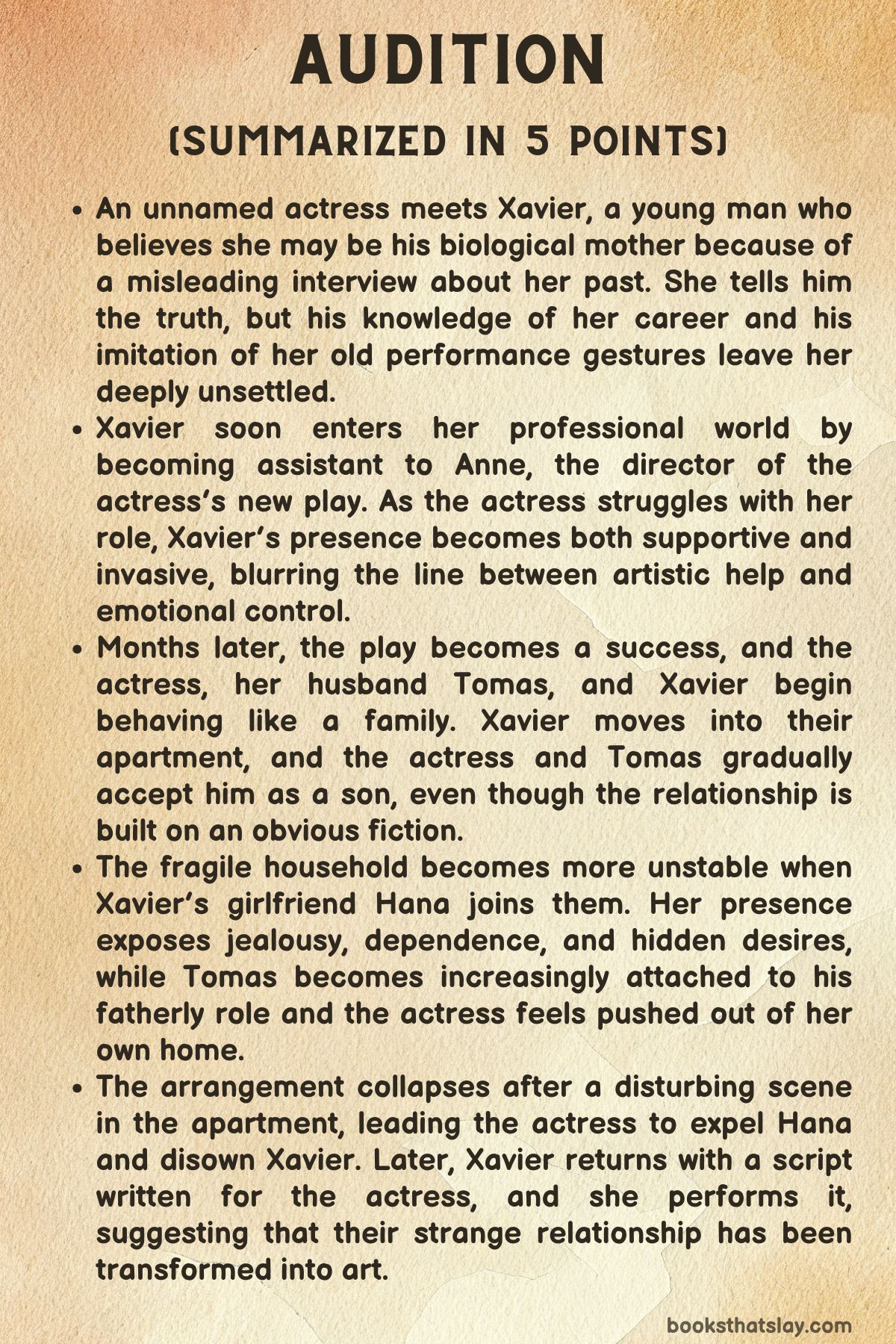
Summary
The book begins with an unnamed actress meeting a young man named Xavier at a crowded restaurant during lunch. She is uneasy about the meeting before it even begins, partly because Xavier has already unsettled her during an earlier encounter.
He apologizes for things he said previously, but the apology does not make his intentions clearer. The actress tries to keep the conversation practical and polite, asking about his classes and his interests.
Xavier mentions Murata, a director with whom she worked many years earlier on a film called Parts of Speech, a role that had changed her career and her understanding of acting.
As the meal continues, the actress becomes aware of how she and Xavier must look to others. A waiter’s suspicious gaze reminds her of a memory from her youth, when she had lunch with her father in Paris.
During that meal, her father gave her an emerald necklace bought by her parents in Rome. Yet the memory is damaged by the waiter’s behavior, because he seemed to assume she was a sex worker and later gave her his phone number.
That experience marked a painful shift in how she understood herself as a young woman. In the present, the restaurant waiter and another diner appear to judge her for being with a much younger man, and this intensifies her discomfort.
The actress tells Xavier that no relationship between them is possible. Before Xavier can say what he came to say, her husband Tomas unexpectedly enters the restaurant.
She freezes, unsure whether to call him over and explain Xavier as a student connected to the theater. Tomas sees them, pauses, and leaves abruptly.
Filled with guilt and confusion, the actress does not immediately follow him. Xavier then repeats a gesture she recognizes from one of her own old performances: sitting back and softly exhaling.
The gesture feels invasive, almost like a theft of her private artistic language, and she leaves.
At home, she waits for Tomas and grows suspicious. He eventually returns and claims that he was meeting their friend Said, then says he entered the wrong restaurant by mistake.
His explanation is vague in places, but it calms her. The tension remains, however.
Tomas finally asks whether she is having another affair. She says no, and he accepts the answer, yet the question reveals a history of infidelity and mistrust within the marriage.
The actress then remembers how Xavier first appeared in her life. He came to the theater during rehearsals for her new production and asked to speak with her.
She assumed he wanted professional help, but instead he told her he believed he was her son. He had read a profile in which she was described as having given up a child.
The actress knows that the profile was misleading. She had not given up a child for adoption; she had terminated a pregnancy before her marriage.
Xavier, however, had built a fantasy from this public fragment of her life. His use of her old performance gesture made her feel that he had studied her too closely.
She denied being his mother and returned to rehearsal, but when he later emailed asking for another meeting, she agreed despite knowing she should not.
After the restaurant incident, Xavier becomes harder to avoid. The actress sees him near her apartment after Tomas turns back from walking her to work.
Xavier explains that Anne, the director of the play, has hired him as her assistant. This puts him inside her professional world.
He says he wanted to make sure she was comfortable with this, but the actress feels trapped by the news. They walk together, and she tells him that the article he read distorted the truth about her pregnancy.
Xavier accepts the correction, then asks whether she ever wanted children with Tomas.
The question touches a hidden wound. She remembers becoming pregnant with Tomas’s child and miscarrying in the eleventh week.
Tomas had been quietly excited, even using an app to track the embryo’s growth, while she had remained uncertain. After the miscarriage, she began having affairs, not out of simple dissatisfaction but from restlessness and emotional disorder.
In response to her guilt, she started making breakfast for Tomas, and this small ritual became a way of recommitting to the marriage, though not permanently.
As rehearsals continue, the actress struggles with her role. She explains to Xavier that acting requires her to lose herself inside an idea until she can reach the other side of it.
She has often felt that the roles offered to her are thinner than her actual inner life, especially as a woman of color in an industry that reduces and categorizes her. Parts of Speech had mattered because it allowed her to feel fully human as an artist.
Her new role, written by Max and directed by Anne, had seemed promising, but during rehearsals she cannot find her way into it. Xavier’s closeness to Anne makes his observations feel threatening, because he seems able to see where she is weak.
At the theater, Anne jokingly calls the actress and Xavier a perfect mother and son. The phrase lands strangely because Anne does not know what Xavier has claimed.
The actress senses Anne’s fondness for Xavier and feels envy. Anne is optimistic about the production, but Max’s explanation of a difficult scene frustrates the actress.
Max seems to have written the scene as a bridge between two versions of the character rather than from a deep understanding of the role. The actress feels stranded.
Xavier tells her a disturbing joke about a man pretending to love his wife until he actually does, revealing more about his own family and his view of performance. Before the actress can tell Anne about Xavier’s claim, Tomas texts asking if they can talk about their relationship.
Rehearsal prevents her from calling him.
The narrative then shifts forward. Months later, the actress, Tomas, and Xavier dine together at the same restaurant.
The play, now called Rivers, has become a major success. The actress’s performance is widely praised, and the scene she once feared has become the part where she feels closest to a true alignment between self and role.
Xavier has helped her through the final days of rehearsal, and she has grown emotionally dependent on him. More strikingly, she now thinks of herself as Xavier’s mother.
Tomas also accepts him as a son. The earlier uncertainty has somehow been replaced by a shared performance of family life.
At dinner, Xavier announces that he will be working with Anne on her debut film and may defer his final semester of graduate school. Tomas advises caution, but the actress defends Xavier.
Xavier then says his lease is ending and asks whether he can move into their apartment for a few months. Tomas leaves the decision to the actress, and she agrees quickly, even saying he can stay as long as he wants.
Tomas accepts this on the condition that Xavier finish his degree.
Once Xavier moves in, the actress begins reshaping reality around him. She thinks of the second bedroom as his old room, imagining a childhood history that never happened.
She prepares the apartment as though welcoming a son home. Xavier arrives with many belongings, and Tomas helps him settle.
The actress is unsettled by the physical reality of him moving in and leaves to buy breakfast. When she returns, Xavier and Tomas already seem intimate, like father and son.
Xavier soon leaves to work with Anne, disappointing the actress.
A domestic routine forms. Xavier wakes early, buys breakfast, washes dishes, and does laundry.
The actress and Tomas take pride in his independence, even though the actress notices that he does not seem truly at home. He often asks where things are, as though he has no childhood memory of the apartment.
She creates memories for him anyway, especially around books and reading. When she asks why he no longer carries books as he supposedly did as a child, Xavier is confused, then begins filling his room with books to satisfy the role she has assigned him.
Tomas also adjusts. He orders Xavier a desk and expensive chair, giving him a place to write.
Xavier uses the space, and Tomas becomes more productive by working near him. The actress realizes Xavier has restored energy to Tomas.
Before Xavier, Tomas had been quietly unhappy, and his presence now gives Tomas a renewed purpose. This changes the balance of the marriage.
The actress had once been the disruptive one because of her affairs, but now Tomas is the one who welcomes something from outside the marriage.
The arrangement becomes more strained when Xavier brings Hana, his girlfriend, to stay in his room. Hana is confident, attractive, and subtly challenging.
She praises the actress’s old work in a way that feels sincere but also invasive. The actress tries to remain gracious, but she senses that Hana is testing her.
During a walk, Hana speaks as if she understands Xavier better than the actress does. She suggests that Xavier depends on the actress’s approval and that the relationship between them has been volatile.
The actress denies this and insists that her relationship with her son is fine.
Hana’s arrival changes the apartment further. She takes over breakfast preparations, works at Xavier’s desk, and seems to occupy the space with ease.
Xavier spends his days reading and looking at his phone while Tomas cooks and cleans for them. Tomas behaves almost like a servant, bringing champagne and crackers when asked.
The actress becomes angry at Tomas’s submission, but Tomas defends Xavier and Hana as young people pursuing ambition. The actress feels both contempt and fear as her home becomes a stage for a family role that no longer serves her.
As the play nears its end, Tomas and Xavier stop coming to meet the actress after performances. She grows anxious about losing the role that has given her structure.
One evening, after dinner with colleagues, she returns home unexpectedly. Looking from outside, she sees every light in the apartment on and feels repulsed by how transformed the home has become.
Inside, she finds Xavier, Tomas, and Hana playing a chaotic game. Xavier is stomping around with a pillow, Tomas is crawling on all fours, and Hana is hiding in a closet.
The scene is childish, strange, and humiliating.
When Hana falls out of the closet, Tomas touches her in a way that the actress finds disturbing. Hana pushes his hand away playfully, but the moment exposes the unstable energies inside the household.
Xavier looks to the actress for help, as though expecting her to act as his mother. Instead, she pulls Tomas away from Hana so forcefully that he hits his head, then drags Hana out of the apartment.
Xavier is furious and calls her crazy. The actress hears the artificiality in his use of “Mom” and disowns him.
Tomas tries to defend Xavier, but finally tells him to leave. The actress claps and says it is over, as though ending a performance.
Xavier realizes Tomas will not leave the actress for him, laughs, gathers his belongings, and exits.
After Xavier leaves, the apartment becomes silent. Tomas remains in contact with him so Xavier can collect the rest of his things.
The actress’s play ends, and she wonders whether Xavier might return. He does return, but not to resume the family arrangement.
He gives Tomas a bundle of papers for the actress: a monologue written for a woman like her, someone who can no longer tell what is real from what is not. The actress understands that both Tomas and Xavier are submitting to her judgment.
She takes the script.
In the final movement, time moves forward to the actress performing Xavier’s play. She reflects on performance as an act in which one mind overlays another, allowing the performer to choose actions while watching their effect on the audience.
She recognizes that Xavier shares her ambition and hunger for attention. His play gives her the kind of artistic charge she has long needed, while also launching him into visibility.
She knows that attention fades, and that Xavier will have to learn that truth himself. The book closes with art, identity, and family roles still unresolved, suggesting that performance can expose truth even when it is built from illusion.
Characters
The Unnamed Narrator
The unnamed narrator is an actress whose identity is built around control, observation, and performance. She is highly intelligent and sharply aware of how others see her, yet she is also vulnerable to the roles she performs in private life.
Her meeting with Xavier unsettles her because he seems to have studied her from the outside and turned her own artistic gestures against her. As the book develops, she becomes less able, or less willing, to separate reality from enactment.
Her transformation into Xavier’s “mother” is not simply a delusion but also an act of artistic and emotional participation. She knows, at some level, that this family structure is false, yet she enters it because it offers a way to touch grief, regret, vanity, and desire all at once.
Her miscarriage, earlier abortion, affairs, racialized experience in the acting world, and strained marriage all shape her hunger for a role that can contain her whole self. In Audition, she is both the person most aware of performance and the person most seduced by it.
Her final acceptance of Xavier’s script shows that she has not escaped the pattern; she has converted it into art.
Xavier
Xavier is one of the most unsettling figures in the book because his motives remain unstable. At first, he appears to be a confused young man searching for his biological mother, but his close study of the actress’s performances makes him seem calculated.
His claim that she may be his mother is based on a misunderstanding, yet he keeps pressing into her life even after she corrects him. Xavier is ambitious, watchful, and skilled at taking on roles that satisfy others.
With Anne, he becomes the attentive assistant. With Tomas, he becomes the son who restores paternal purpose.
With the narrator, he becomes both child and rival. His power comes from his ability to sense what people lack and then offer himself as the answer.
Yet he is not merely manipulative. He is also a young artist trying to find form, recognition, and authority.
His final gift of a monologue reveals that he has been shaping the whole experience into material. In Audition, Xavier becomes a disturbing mirror of the narrator: both are performers, both need attention, and both understand that invented roles can produce real consequences.
Tomas
Tomas is the narrator’s husband, and his quietness makes him easy to underestimate. At first, he seems like the wounded spouse, aware of the narrator’s history of affairs but unwilling to confront the full disorder in their marriage.
His reaction at the restaurant shows pain, suspicion, and avoidance. Yet Tomas is not passive in a simple way.
Once Xavier enters their life, Tomas embraces the role of father with startling eagerness. Xavier gives him a renewed sense of usefulness, and Tomas begins to thrive in the presence of this imagined son.
His ordering of a desk and chair for Xavier suggests a desire to sponsor and nurture someone’s future, perhaps the future he and the narrator never had with their lost child. Tomas’s care later becomes servility, especially when Hana also enters the apartment.
He cooks, cleans, and accommodates the young couple until the narrator sees him as diminished. Still, Tomas’s attachment to Xavier is emotionally real, even if the family structure is false.
His final choice to side with the narrator shows that his marriage remains his deepest bond, but the loss of Xavier leaves him exposed as a man who had briefly found meaning through an invented parenthood.
Anne
Anne is the director of the play and an important force in the professional world surrounding the narrator and Xavier. She is exacting, influential, and confident in her judgments.
Her decision to hire Xavier as her assistant brings him directly into the narrator’s artistic life, increasing the narrator’s anxiety and giving Xavier institutional access. Anne’s remark that the narrator and Xavier look like a perfect mother and son is casual on the surface, but it becomes charged because it accidentally names the false relationship that will later take over the story.
Anne also serves as a rival maternal or mentoring figure. The narrator senses that Anne is drawn to Xavier and is shaping his artistic future.
This produces jealousy, because the narrator wants Xavier’s attention and loyalty even while knowing the relationship is unstable. Anne’s mentorship gives Xavier legitimacy and a path beyond the narrator’s household.
She is not malicious, but her presence sharpens the narrator’s insecurity. She represents the theater world’s power to assign roles, encourage attachments, and transform private instability into professional opportunity.
Hana
Hana enters the book as Xavier’s girlfriend, but she quickly becomes a disruptive presence in the apartment. She is perceptive, self-possessed, and socially bold.
Unlike Xavier, who often adjusts himself to fit the needs of others, Hana openly tests boundaries. Her admiration for the narrator’s performance in Parts of Speech sounds sincere, yet it also unsettles the narrator because it positions Hana as someone who can read and evaluate her.
Hana’s relationship with Xavier threatens the narrator’s claim over him, and she seems to understand that access to Xavier now requires negotiating with her. During the walk with the narrator, Hana suggests that Xavier needs to grow up and that his bond with the narrator is volatile.
This makes Hana both an outsider and an accurate observer. Inside the apartment, she occupies space freely, uses Xavier’s desk, and helps turn the home into a place where the narrator feels displaced.
Her teasing interaction with Tomas near the end intensifies the narrator’s sense that the household has become morally and emotionally corrupted. Hana’s pity toward the narrator after being dragged out suggests that she understands more than she says.
Max
Max is the playwright whose work gives the narrator her major stage role. She is important because her script becomes the field on which the narrator’s artistic crisis plays out.
The narrator initially wants to work with Max because she sees her as an emerging talent and believes the role may become one of her finest. However, during rehearsal, Max’s explanation of a difficult scene reveals a weakness in the writing.
The narrator senses that Max has grown bored with the character and has written the scene to connect two versions of the role rather than to express a fully realized emotional truth. Max’s character is therefore tied to the limits of authorship.
She creates the role, but the narrator must make it live. Max is not presented as incompetent; rather, she represents the gap between written intention and performed reality.
Her script only becomes powerful when the narrator finds a way to inhabit its broken or incomplete parts. Through Max, the book shows how an actor can discover depth where the writer may have left uncertainty.
Lou
Lou is Anne’s assistant before Xavier replaces her. Although Lou appears briefly, her role matters because she marks Xavier’s entry into the professional space of the production.
Lou is the one who tells the narrator that Xavier has come to see her, not Anne, during rehearsal. This small moment redirects the narrator’s assumptions and begins Xavier’s movement from stranger to insider.
Lou’s replacement also shows how quickly positions in the theater world can shift. Once Xavier becomes Anne’s assistant, he gains proximity to power, information, and the narrator’s creative vulnerability.
Lou does not receive extended development, but her presence helps establish the ordinary structure of the rehearsal environment before Xavier disturbs it. She stands for the normal professional order that Xavier quietly displaces.
Said
Said is a mutual friend of Tomas and the narrator, and he appears mainly through Tomas’s explanation after the restaurant incident. Tomas claims he was meeting Said and that they had planned to eat at a restaurant in which Said had invested.
Said’s importance lies less in his own actions than in how Tomas uses him as part of a story. Because Tomas’s account is vague, Said becomes connected to the uncertainty in the marriage.
The narrator initially suspects Tomas may be lying or concealing a secret life, and Said’s name functions as a shield against direct confrontation. Even though Tomas later explains that he entered the wrong restaurant by mistake, the awkwardness around Said exposes how fragile trust has become between husband and wife.
Said is therefore a minor character who helps reveal the couple’s habit of partial truth, avoidance, and suspicion.
Murata
Murata is the director of Parts of Speech, the film that brought the narrator major recognition and shaped her understanding of acting. Though he is dead before the main events, his influence remains strong.
Xavier’s mention of Murata signals that he knows the narrator’s career deeply and has studied the work that made her visible. For the narrator, Murata is connected to a role that allowed her to feel human in a way many other parts did not.
His film gave her a breakthrough not only professionally but personally, because some of that character’s gestures and habits stayed with her after filming ended. Murata’s importance is therefore artistic and symbolic.
He represents the kind of work that can alter an actor’s sense of self. Because Xavier copies gestures from that period, Murata’s legacy becomes part of the strange invasion of the narrator’s private and creative identity.
The Narrator’s Father
The narrator’s father appears in memory, especially through the lunch in Paris where he gives her the emerald necklace. He is associated with tenderness, elegance, and one of the narrator’s happiest memories of her parents.
The gift suggests care and a desire to mark a special moment between father and daughter. Yet that memory is also damaged by the waiter’s sexualized misunderstanding of the narrator.
Her father does not seem to notice the waiter’s assumptions, which leaves the narrator alone with the shock of being seen in a degrading way. His role is therefore double.
He represents family affection and protection, but also the limits of that protection. The narrator’s memory of him shows how girlhood can end not through a dramatic event, but through a sudden awareness of how the adult world looks at a young woman.
The Narrator’s Mother
The narrator’s mother appears indirectly through the emerald necklace that she and the narrator’s father bought in Rome. She is not developed as an active figure, but her presence is tied to family memory, beauty, and inheritance.
The necklace carries both parents’ affection, making the mother part of a moment the narrator treasures. Because the memory is later complicated by the waiter’s behavior, the mother also belongs to a lost world of parental safety that the narrator can no longer fully inhabit.
Her absence from the main action matters because the book is so concerned with motherhood, failed motherhood, imagined motherhood, and chosen performance. The narrator’s own mother remains distant and largely idealized, which contrasts with the unstable maternal role the narrator later performs with Xavier.
The Paris Waiter
The Paris waiter is a minor but psychologically important figure. During the narrator’s lunch with her father, he flirts with her and gives her his phone number, apparently assuming she is a sex worker.
His behavior transforms what should have been a cherished family memory into a moment of humiliation and awakening. The narrator understands that she has been seen not as a daughter at lunch with her father, but as a sexualized young woman.
This experience marks a boundary between girlhood and womanhood. The waiter matters because he teaches the narrator something brutal about perception: other people’s interpretations can impose identities that feel false but still wound.
This prepares the ground for the book’s larger concern with being misread, watched, cast, and judged.
The Restaurant Waiter
The waiter at the restaurant where the narrator meets Xavier echoes the Paris waiter from her memory. His suspicious look makes the narrator feel judged for sitting with a much younger man.
She imagines that he assumes the meeting is romantic or sexual, and this makes her more conscious of the social performance taking place at the table. He does not need to say anything openly; his gaze is enough to shape the narrator’s discomfort.
Like the Paris waiter, he represents the power of spectatorship. He turns a private meeting into a scene being interpreted by others.
His presence also shows how the narrator, despite being an experienced actress, remains vulnerable to the audience of everyday life.
The Other Diner
The other diner in the restaurant is another minor observer whose gaze intensifies the narrator’s discomfort. This person repeatedly looks at the narrator and Xavier, reinforcing her fear that the meeting appears improper.
The diner’s importance lies in the way they become part of the invisible audience surrounding the narrator. The narrator is trained to perform before spectators, yet here spectatorship becomes invasive rather than professional.
The diner helps create the sense that identity is socially produced: the narrator may know why she is meeting Xavier, but the people around her may assign a different meaning to the scene. This small figure contributes to the book’s steady pressure around shame, judgment, and appearance.
The Actor from Salvation
The actor from Salvation appears in the narrator’s reflection on performance, professionalism, and interpretation. She had admired his performance in the film and expected to find him extraordinary in person, only to discover that he behaved unprofessionally on a later project.
A director suggests that his great performance may have been strengthened by his confusion and inability to learn lines, possibly because of dementia. This changes how the narrator sees the film.
What once looked like artistic mastery begins to seem like an accidental exposure of decline. The actor matters because he complicates the narrator’s belief in agency.
She wants performance to involve craft and control, but his example suggests that audiences may value effects produced by suffering, illness, or loss of control. He becomes a troubling case study in the relationship between artifice and reality.
The Director Connected to Salvation
The director who explains the actor’s behavior on Salvation gives the narrator information that changes her understanding of a performance she once admired. This character is minor, but their insight has a strong effect.
By suggesting that the actor’s confusion may have served the role, the director forces the narrator to confront an uncomfortable question: can a performance be great if the performer does not fully command it? This challenges her need to see acting as an intentional art.
The director’s role is therefore interpretive. They do not simply describe a production problem; they alter the narrator’s theory of performance and expose her anxiety about losing agency in her own work.
Xavier’s Father
Xavier’s father appears through the joke Xavier tells the narrator. In the joke, a man who has fallen out of love with his wife is advised to pretend he loves her until the feeling becomes real.
Xavier then reveals that the story is really about his father. This makes Xavier’s family background feel emotionally cold and performative.
His father becomes an example of someone who treats love as a role that can be practiced into truth. This idea deeply connects to Xavier’s later behavior, because he too enters roles and waits for others to accept them as real.
Xavier’s father is not present directly, but his influence appears in Xavier’s understanding of intimacy as something that can be acted until it becomes socially valid.
The Therapist in Xavier’s Joke
The therapist in Xavier’s joke is a small but meaningful figure because they give the advice that performance can produce emotion. By telling the unhappy husband to pretend he is in love, the therapist turns sincerity into a practice rather than a starting point.
This idea resonates throughout the book’s family arrangement. The narrator, Tomas, and Xavier all behave as though acting like a family might generate the emotional truth of family.
The therapist is not a developed character, but the advice attributed to them becomes a miniature version of the book’s central experiment: if people perform a bond long enough, does it become real, or does it simply reveal the emptiness beneath the role?
Themes
Performance as a Way of Living
Performance in Audition is not limited to theater. It becomes the basic language through which people test identity, desire, and power.
The narrator is a professional actress, but the book shows that her skill onstage cannot be separated from the roles she takes on in private life. She performs wife, artist, mother, host, rival, and judge, often with partial awareness of what she is doing.
Xavier’s arrival exposes how easily a role can be offered and accepted. He first appears as possible son, then assistant, then dependent young artist, then writer.
Tomas also enters performance, becoming the patient father whose care gives him renewed purpose. What makes the theme complex is that these performances are not merely fake.
They create real emotions, real loyalties, and real injuries. The invented family produces comfort before it produces disgust.
The narrator’s stage work improves as her private life becomes less stable, suggesting that art can feed on uncertainty. The book asks whether acting is a form of lying or a way of reaching truths that ordinary speech cannot hold.
Motherhood, Loss, and Invented Family
The narrator’s relationship with Xavier is shaped by absences: the terminated pregnancy before her marriage, the later miscarriage with Tomas, and the child who never existed. Xavier enters through a misunderstanding about adoption, but the misunderstanding attaches itself to real grief.
The narrator knows he is not her son, yet the role of mother offers access to feelings she has never resolved. Tomas also responds to Xavier as a son, suggesting that he too has carried a buried longing for parenthood.
Their apartment becomes a stage where a missing family is temporarily imagined into being. The tragedy is that the arrangement cannot remain tender because it is built on denial, need, and control.
Xavier is an adult stranger, not a child returning home, and every attempt to create a shared past produces strain. The narrator invents childhood memories for him; Xavier adjusts himself to satisfy them; Tomas supplies material support.
This theme shows how grief can search for form. When loss has no stable object, people may attach it to whatever figure appears capable of carrying it.
Marriage, Guilt, and Emotional Evasion
The marriage between the narrator and Tomas is marked by love, fatigue, avoidance, and old wounds. They know each other deeply, but they often refuse direct confrontation.
Tomas suspects the narrator’s affairs, yet he asks about them with a calmness that suggests long practice in restraint. The narrator tries to compensate for betrayal through domestic rituals like breakfast, turning guilt into care.
Their marriage survives not because it is honest in any simple sense, but because both have learned how to manage silence. Xavier’s arrival reveals what the marriage lacks.
Tomas becomes livelier when he can care for Xavier, while the narrator becomes possessive, jealous, and afraid of being displaced. The false family does not destroy the marriage from the outside; it exposes needs that were already inside it.
Tomas wants purpose and tenderness. The narrator wants recognition and control.
Both want some repair for what they lost. The final expulsion of Xavier restores the marriage, but not innocently.
Tomas chooses the narrator, yet the experience has revealed how eager he was to belong to another emotional structure.
Reality, Illusion, and the Need for Recognition
The book repeatedly tests the border between what is real and what is acted. Xavier’s first claim is false, but the emotional structure that grows from it becomes real enough to alter lives.
The narrator’s invented memories of Xavier’s childhood are untrue, yet they influence how she behaves toward him. Tomas’s fatherly care begins as acceptance of a role, then becomes a genuine attachment.
This uncertainty is tied to the need for recognition. The narrator wants to be seen fully as an artist and as a person, not reduced by race, gender, age, or public image.
Xavier wants attention as an artist and uses the narrator as both subject and audience. Hana wants to be acknowledged as the person closest to Xavier.
Even minor acts of watching, such as the gaze of waiters and diners, shape how characters understand themselves. Recognition gives power, but it also distorts.
To be seen by others is to risk being misread, cast, or used. The final performance of Xavier’s monologue suggests that illusion may not be escapable.
It may be the very medium through which people seek truth, approval, and artistic life.