Austerlitz Summary, Characters and Themes
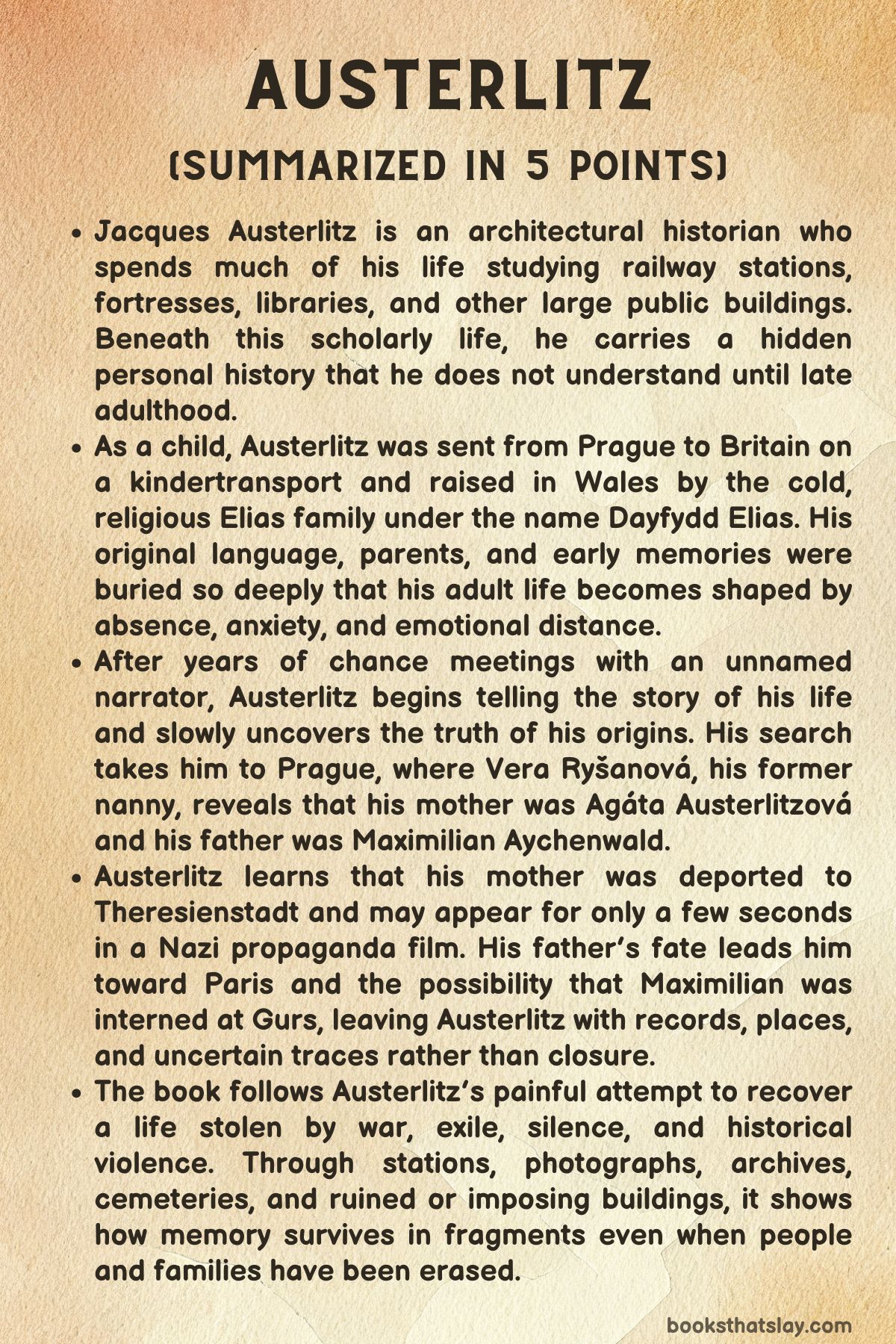
Austerlitz by W.G. Sebald is a meditative novel about memory, exile, architecture, and the long shadow of the Holocaust. It follows an unnamed narrator’s encounters with Jacques Austerlitz, an architectural historian whose carefully ordered life begins to collapse when he recovers the truth of his childhood: he was sent from Prague to Britain on a kindertransport and cut off from his parents, language, and origins.
The book moves through railway stations, fortresses, libraries, cemeteries, photographs, and half-recalled rooms, showing how places preserve what people try to forget. Its power lies in its quiet, searching attention to loss.
Summary
Austerlitz begins with an unnamed narrator recalling a series of meetings with Jacques Austerlitz, a man he first encounters in Antwerp in 1967 and then continues to meet, by chance and design, across several decades. The narrator has arrived in Antwerp feeling unwell, and after resting he visits the nocturama, where nocturnal animals stare out from their dim enclosures.
Their watchful eyes stay with him when he later returns to the great concourse of Antwerp’s Centraal Station. In that station, under its enormous dome, he notices a solitary man taking notes and photographs.
This man is Jacques Austerlitz.
Austerlitz speaks with unusual intensity about architecture, history, and power. He explains how Antwerp station was built as a monument to Belgium’s colonial wealth and how its decorative program replaces religious authority with the authority of capitalism, industry, and time.
The great clock above the station becomes, in his reading, the true ruler of the place, forcing travelers to submit themselves to its demands. This first conversation establishes Austerlitz as a brilliant observer of buildings, but also as someone whose attention to stone, glass, railways, and fortresses conceals deeper wounds.
The narrator later visits Breendonk, a fortress Austerlitz had mentioned. The site had been used by the Nazis as a penal colony, and the narrator is disturbed by its brutal concrete mass and the memory of the suffering inflicted there.
He struggles to imagine the prisoners’ agony, though he can easily imagine the guards’ ordinary gestures. This contrast between what can be pictured and what resists imagination becomes central to the book.
History is everywhere, but it is not always accessible; places hold traces, yet they do not speak unless someone tries to listen.
The narrator meets Austerlitz again in Liège and Brussels. Their conversations continue without the usual social transitions, as if they are resuming an argument that has never stopped.
Austerlitz discusses industrial settlements, failed social plans, railway stations, and grand public buildings. He believes that monumental architecture reveals insecurity rather than strength.
The largest fortresses and palaces often announce their own future ruin. These ideas are not merely academic.
They foreshadow the way Austerlitz’s own life, outwardly ordered and intellectual, is built around an absence he does not yet fully understand.
Years pass. The narrator visits Austerlitz in London, where his office is crowded with books and papers.
Austerlitz has devoted his life to studying the architecture of the capitalist era: railway stations, prisons, courts, stock exchanges, psychiatric institutions, and other buildings of control. Then the two men lose touch.
After many years, in 1996, the narrator unexpectedly finds Austerlitz again at the Great Eastern Hotel in London. Austerlitz seems strangely unchanged, carrying the same rucksack and speaking as though no time has passed.
He has come there to look at the hotel’s abandoned spaces, including a Masonic temple. He tells the narrator that, earlier that day, he had wished for someone to hear his story.
Their meeting gives him the chance to begin.
Austerlitz tells the narrator about his childhood in Wales, where he was raised by the Methodist preacher Emyr Elias and his wife Gwendolyn. As a boy he was known as Dayfydd Elias, not Jacques Austerlitz.
The Elias household is cold, loveless, and severe. Emyr’s religion is marked by fear, punishment, and visions of judgment.
Austerlitz grows up emotionally starved, with only vague images from an earlier life troubling the edges of his mind. He becomes fascinated by the drowned village of Llanwddyn, submerged to create a reservoir.
He imagines people still living under the water, silent and wide-eyed. This image mirrors his own buried past: a life sunk beneath another identity.
When Gwendolyn becomes ill, Austerlitz is sent to Stower Grange, a boarding school. Though the school is harsh in its own way, it gives him books, learning, and a route away from Bala.
His talent at rugby protects him from bullying, and his imagination expands through reading. After Gwendolyn dies and Emyr loses his faith and sanity, Austerlitz learns from the headmaster that his real name is Jacques Austerlitz.
The revelation unsettles him deeply. He knows nothing of this name or its origin.
A teacher named André Hilary later introduces him to the history of the Battle of Austerlitz and becomes a crucial mentor. Through Hilary, Austerlitz receives intellectual encouragement and practical help, but his true origins remain hidden.
At school, Austerlitz befriends Gerald Fitzpatrick, a younger boy suffering from homesickness. Gerald introduces him to photography, which Austerlitz comes to see as akin to memory: images emerge from darkness but can vanish or distort when held too long.
Gerald’s family home, Andromeda Lodge, offers Austerlitz a refuge unlike anything he has known. Its rooms, specimens, plants, birds, and strange atmosphere give him a sense of wonder and temporary belonging.
Gerald’s relatives, Evelyn and Alphonso, also shape this world. Alphonso teaches the boys to look closely at nature, especially moths, while Evelyn’s fragile body suggests another form of vulnerability.
Later, the deaths of Alphonso and Evelyn, the sale of Andromeda Lodge, and Gerald’s fatal plane crash in the Alps mark the beginning of Austerlitz’s increasing withdrawal from the world.
After retiring from teaching in 1991, Austerlitz tries to turn his lifelong research into a book. Instead, he loses faith in language itself.
His papers seem false to him, and he buries them in his garden compost. He begins wandering London at night, drawn especially to Liverpool Street Station.
There, in a disused waiting room, he experiences a breakthrough. He sees, or believes he sees, his adoptive parents waiting with the small child he once was.
He realizes that this station is connected to his arrival in England in 1939. He has lost not only his parents but also his language, name, and childhood memories.
This revelation sends him into dreams, illness, aphasia, and a mental collapse. While recovering, he hears a radio program about children evacuated from Europe to England and recognizes his own story in their words.
The mention of Prague sends him there in search of his origins.
In Prague, Austerlitz visits the state archives and meets Tereza Ambrosová, who helps him search the records. He finds an address connected to Agáta Austerlitzová, a former opera singer.
At the apartment, he meets Vera Ryšanová, who had been his nanny and his parents’ friend. Vera recognizes him and reveals the truth: his mother was Agáta Austerlitzová, and his father was Maximilian Aychenwald.
They were Jewish, cultured, politically aware, and deeply connected to Prague’s artistic life. Maximilian fled to Paris before the German occupation, while Agáta stayed behind with her child and later managed to send him away on a kindertransport.
She herself was eventually deported.
Vera’s memories awaken Austerlitz’s own. He remembers fragments of language, rooms, sounds, and his mother returning from the theater.
He visits places from his childhood, including the theater where Agáta performed and the gardens where he walked with Vera. Yet the recovery of memory brings pain rather than peace.
Vera gives him an old photograph of himself as a boy in costume, but he cannot recognize himself in it. The child in the image seems both intimate and unreachable.
Austerlitz travels to Terezín, the site of the Theresienstadt camp where his mother was interned. The silent town, the gates, the museum, and the history of the ghetto confront him with what he had avoided all his life.
Later, he studies H.G. Adler’s work on Theresienstadt and learns about the camp’s administration, its elderly prisoners, its forced labor, and the grotesque deception staged for the Red Cross. The Nazis made the camp appear humane, with gardens and cultural activity, before producing a propaganda film called The Führer Gives the Jews a City.
Austerlitz searches for this film, hoping it might contain a trace of his mother. In a slowed version, he studies every face and thinks he sees a woman who may be Agáta, visible for only a few seconds.
The uncertainty is almost unbearable: recognition and doubt arrive together.
Austerlitz also retraces his kindertransport route through Germany to England. Passing through cities, stations, forests, and the Rhine Valley, he experiences confusion between past and present.
Germany’s tidiness disturbs him because it seems to have erased visible signs of catastrophe. The journey does not heal him.
Back in England, he suffers severe anxiety attacks and eventually falls into a coma. After recovering, he works for a time in a nursery garden, where simple labor and the company of other wounded people give him some stability.
The later part of the book moves to Paris, where Austerlitz searches for his father, Maximilian. He rents a room near his father’s last known address and imagines him still present in the city.
Records suggest Maximilian was interned at the Gurs camp in the Pyrenees, but Austerlitz has not yet completed that search. Paris also brings back memories of his earlier life there as a student, his work in the old Bibliothèque Nationale, and his relationship with Marie de Verneuil, a fellow architectural historian.
Marie had recognized his isolation and tried to reach him emotionally, but Austerlitz had been unable to accept intimacy. His fear of attachment came from the buried trauma he did not yet understand.
Austerlitz criticizes the new Bibliothèque Nationale as another failed monument, a building that obstructs rather than preserves memory. Through Henri Lemoine, an old library employee, he learns that the site once held warehouses where the Nazis stored property stolen from deported Parisian Jews.
Once again, a modern building stands over buried violence. By the end, Austerlitz plans to continue searching for his father and gives the narrator the key to his London house.
The narrator later revisits Antwerp and Breendonk, carrying Austerlitz’s story with him. The book closes not with resolution, but with linked histories of loss, migration, memory, and the dead whose traces survive in photographs, buildings, cemeteries, and names scratched into walls.
Characters
Jacques Austerlitz
Jacques Austerlitz is the central figure of the book and one of its most searching portraits of damaged memory. For much of his life, he believes he is a Welsh-raised orphan named Dayfydd Elias, and even after learning his true name, he does not immediately understand what has been taken from him.
His career as an architectural historian looks, at first, like a purely intellectual vocation, but it gradually becomes clear that his study of railway stations, fortresses, libraries, courts, and prisons is a displaced inquiry into his own past. Buildings become substitutes for memories he cannot reach.
His mind is disciplined, exact, and analytical, yet beneath that order lies terror, grief, and a lifelong sense of rejection. In Austerlitz, he is not presented as someone who simply recovers a lost identity and becomes whole.
Instead, recovery exposes the scale of the loss. His brilliance cannot protect him from the pain of learning what happened to his parents, nor can knowledge restore the childhood erased by exile.
The Unnamed Narrator
The unnamed narrator is quiet, observant, and receptive, functioning less as a conventional protagonist than as a witness. His personality is defined by attention: he notices buildings, animals, weather, rooms, faces, and the strange emotional charge of places.
He does not dominate Austerlitz’s story; he receives it, remembers it, and later records it. This makes him morally important, because the book treats listening as a serious act.
His own experiences, especially his visits to Antwerp, Breendonk, London, and Paris, show that he too is haunted by European history, though his wounds remain less directly explained. He often questions the reliability of memory and admits when something has become indistinct.
That uncertainty gives the narration its ethical force. Rather than claiming full mastery over the past, he preserves fragments, hesitations, and secondhand accounts.
His relationship with Austerlitz is based on a rare form of patience: he allows another person’s buried life to emerge without forcing it into a neat shape.
Emyr Elias
Emyr Elias, the Methodist preacher who raises Austerlitz in Wales, is a severe and emotionally barren figure. He represents a form of religion built on fear, judgment, and punishment rather than comfort or love.
His sermons thrive on terror, and his worldview interprets suffering as divine retribution. As Austerlitz’s adoptive father, he fails almost completely in the duties of tenderness and truth.
He gives the child shelter but not belonging, discipline but not warmth, a name but not an identity. His silence about Austerlitz’s origins becomes an act of erasure, even if he may believe he is protecting the boy or obeying some grim duty.
After Gwendolyn’s death, Emyr collapses inward, loses his faith, and ends in a psychiatric hospital. This breakdown complicates him slightly: he is not merely cruel, but also spiritually ruined.
Still, the emotional coldness of his household leaves a deep mark on the child he raises.
Gwendolyn Elias
Gwendolyn Elias is Austerlitz’s adoptive mother, and like Emyr, she offers him little affection. Her presence in the book is associated with cold rooms, silence, illness, and emotional suffocation.
She does not actively torment Austerlitz in a dramatic sense, but her failure to nurture him is devastating because it turns childhood into a place of deprivation. Her physical decline seems inseparable from the household’s emotional climate.
The detail of her coating herself in talc gives her suffering a strange, almost ghostly quality, as though she is slowly being covered over before death. Her final question to Emyr about what darkened their world suggests that she herself does not fully understand the misery in which they live.
That question makes her more than a cold guardian; it shows a woman trapped in a life drained of joy, unable to name the cause of her own desolation.
Evan the Cobbler
Evan the cobbler appears briefly, but his influence on the young Austerlitz is significant. Unlike Emyr, he offers an alternative explanation of suffering.
Where Emyr sees punishment and divine justice, Evan suggests that those who die unjustly return as flickering ghosts. This idea matters because it gives the child a way to imagine the persistence of the dead outside the preacher’s harsh theology.
Evan’s words also prepare the book’s larger treatment of history: the dead do not simply vanish, and injustice leaves presences behind. His belief is not presented as doctrine but as folk wisdom, a quiet resistance to the cruelty of Emyr’s worldview.
In a childhood almost empty of comfort, Evan gives Austerlitz a different language for loss, one closer to memory, haunting, and moral unease.
André Hilary
André Hilary is one of the few genuinely sustaining adults in Austerlitz’s youth. As a teacher, he recognizes the boy’s intelligence and gives it direction.
His lectures on history are vivid, but he also warns that historical images can mislead, that what people think they know may conceal a truth lying elsewhere. This idea shapes Austerlitz’s intellectual life and also describes his personal condition.
Hilary’s response to Austerlitz’s real name is generous and practical: he helps him through school, handles Emyr’s estate, and works to secure his citizenship. In a book filled with failed guardians, Hilary stands out as a mentor who does not possess all the answers but understands the importance of care.
He helps Austerlitz enter the life of the mind, though even his support cannot unlock the hidden past.
Gerald Fitzpatrick
Gerald Fitzpatrick is Austerlitz’s closest school friend and one of the people who gives him a temporary sense of companionship. Homesick, restless, and vulnerable, Gerald first appears as a boy who wants to burn the school down, a gesture that reveals both anger and desperation.
Austerlitz watches over him, but Gerald also gives Austerlitz something crucial: an introduction to photography and access to the world of Andromeda Lodge. Through Gerald, Austerlitz encounters a home filled with curiosity, natural history, birds, specimens, and eccentric relatives, all in sharp contrast to Bala.
Gerald’s later passion for flying reflects a desire for freedom and movement, and his death in a plane crash becomes a turning point in Austerlitz’s withdrawal from ordinary life. Gerald is not simply a lost friend; he is linked to one of the few periods when Austerlitz felt wonder without immediate fear.
Evelyn Fitzpatrick
Evelyn Fitzpatrick, Gerald’s uncle, is marked by bodily fragility and restless motion. Though only middle-aged, he suffers from a spinal disease and keeps moving to delay further decline.
His presence at Andromeda Lodge adds a note of unease to what might otherwise seem like an enchanted refuge. Gerald’s belief that Evelyn’s stinginess caused his condition gives him a faintly comic edge, but the deeper impression is of a man living under the threat of physical collapse.
In the book’s wider pattern, Evelyn’s body becomes another structure under strain, like a fortress, station, or house that cannot hold against time. His death, alongside Alphonso’s, contributes to the ending of the Andromeda Lodge world and to Austerlitz’s sense that places of safety are temporary.
Alphonso Fitzpatrick
Alphonso Fitzpatrick is one of the gentlest and most luminous figures in Austerlitz’s youth. He paints, studies nature, and teaches Gerald and Austerlitz to look closely at moths, light, landscape, and small living things.
His gray silk-lensed glasses soften the world visually, and that detail captures something essential about him: he mediates reality through patience and sensitivity. Alphonso’s lessons about moths stay with Austerlitz long after, especially when moths enter his London home and die unless he releases them.
Alphonso therefore becomes associated with fragile lives, rescue, and attention to beings that most people would ignore. His death while picking apples has a quiet naturalness, but it also helps end the period of refuge that Andromeda Lodge represents.
He remains one of the book’s strongest examples of humane perception.
Gerald’s Mother
Gerald’s mother appears mainly in connection with the sale of Andromeda Lodge after the deaths of Alphonso and Evelyn. Her decision to sell the house and move to the United States marks the dissolution of a world that had mattered deeply to Austerlitz.
She is not heavily developed as an interior character, but her action has emotional weight. Andromeda Lodge had offered Austerlitz a rare alternative to the coldness of Bala, and its sale turns that refuge into another lost place.
Her departure also severs Austerlitz’s connection to Gerald’s family history. In this sense, she functions as an agent of historical change on a domestic scale: houses are sold, families scatter, and the places that once held memory pass into other hands.
James Ashman
James Ashman is the owner of an old country house explored by Austerlitz and Hilary. His house, partly decayed and partly sealed against time, gives the book one of its clearest examples of memory preserved in rooms.
The reopened billiards room, almost untouched for 150 years, suggests that spaces can escape ordinary time, while Ashman’s hidden nursery reveals how childhood emotion can remain intact beneath years of adult life. When he finds the toy Noah’s Ark and the notches he carved before being sent to boarding school, he is overtaken by the old fury of separation and fires at the clock tower.
Ashman’s episode mirrors Austerlitz’s own buried trauma. He shows that childhood abandonment can remain active long after the event, waiting for the right object or room to release it.
Tereza Ambrosová
Tereza Ambrosová, the archivist in Prague, plays a brief but essential role in Austerlitz’s recovery of his past. She is calm, practical, and compassionate at the exact moment when he is overwhelmed by language, bureaucracy, and fear.
Her office becomes the first institutional space in the book that helps rather than obstructs him. Unlike the monumental buildings Austerlitz studies, the archive under Tereza’s guidance becomes a place where records can reconnect a person to a stolen history.
She does not solve the emotional wound, but she opens the path that leads him to Vera and to the truth about Agáta and Maximilian. Her kindness matters because Austerlitz’s search depends not only on documents but also on people willing to help him read them.
Vera Ryšanová
Vera Ryšanová is one of the most important preservers of memory in the novel. She had been Austerlitz’s nanny in Prague and a close friend of his parents, and unlike institutions, she remembers him as a living child.
Her apartment, unchanged since his childhood, is almost a chamber of preserved time. Through Vera, Austerlitz regains not only facts but sensations: language, rooms, sounds, his mother’s presence, and the patterns of daily life before exile.
Vera’s role is deeply tender, but it is also painful, because every recovered memory confirms the scale of what was lost. She has carried these memories in solitude for decades, and her recognition of Austerlitz gives both of them a moment of reunion across catastrophe.
In Austerlitz, she embodies the human memory that survives when official history has failed or destroyed families.
Agáta Austerlitzová
Agáta Austerlitzová, Austerlitz’s mother, is present largely through Vera’s memories, theatrical records, photographs, and the possible image in the Theresienstadt film. She is an opera singer, cultured, affectionate, and connected to Prague’s artistic life.
For Austerlitz, she becomes both a recovered mother and an unreachable figure. He remembers the smell of the theater on her when she kissed him goodnight, a detail that carries more emotional force than any formal biography could.
Her decision to send him away on a kindertransport is an act of desperate love, but it also creates the separation that shapes his life. Her later deportation to Theresienstadt and disappearance in the machinery of Nazi destruction make her one of the book’s central absences.
The uncertainty over whether the woman in the film is Agáta captures the cruelty of historical loss: even recognition cannot be trusted.
Maximilian Aychenwald
Maximilian Aychenwald, Austerlitz’s father, is politically alert, anxious about fascism, and more pessimistic than Agáta about Europe’s future. His horror at German nationalism shows a man who understands the collective danger before many others do.
He flees Prague for Paris before the German occupation, but this flight does not save him from persecution. Austerlitz’s later search suggests that Maximilian was interned at Gurs, though the final details remain uncertain.
As a father, he exists for Austerlitz almost entirely as a missing person, a figure imagined turning a corner in Paris or leaving traces in records. His absence drives the final movement of the book.
Through Maximilian, the story shows how exile splits families into separate routes of disappearance, leaving survivors to reconstruct lives from addresses, camp records, and speculation.
Marie de Verneuil
Marie de Verneuil is Austerlitz’s colleague, companion, and unrealized chance at intimacy. She is intelligent, perceptive, and emotionally open, sharing his interest in architectural history but also seeing the loneliness beneath his discipline.
Her story about the paper mill reveals her sensitivity to places where labor, light, water, and peace briefly come together. She tries to reach Austerlitz directly, especially during their visit to Marienbad, asking why he believes he must be alone.
At the time, he cannot accept what she sees. His emotional withdrawal is not indifference but self-protection rooted in trauma he has not yet recovered.
Marie’s importance lies in the life Austerlitz might have had if he had been able to trust attachment. She is not merely a lost lover; she is the sign of a possible healing he could not then receive.
Henri Lemoine
Henri Lemoine, an employee connected with the old Bibliothèque Nationale, becomes an important commentator on memory, data, and historical erasure. When he recognizes Austerlitz in the new library, he offers both companionship and knowledge.
His critique of the new library is not only architectural but moral: the building represents, to him, a culture that stores information while weakening genuine memory. His revelation that the site once held warehouses used by the Nazis to sort goods stolen from deported Parisian Jews connects modern Paris to buried crimes.
Lemoine’s role is to expose the false innocence of new structures. He understands the city as layered, diseased, and haunted by what it has covered over.
His conversation with Austerlitz strengthens the book’s argument that institutions devoted to memory can also participate in forgetting.
Amélie Cerf
Amélie Cerf is Austerlitz’s former Parisian landlord, remembered through the Jewish section of the Cimetière de Montparnasse and the family mausoleum he discovers there. She is not developed through direct action, but her family history becomes part of the book’s wider meditation on extinction, inheritance, and memorialization.
The names in the mausoleum connect her to ancestors and to parents who died after deportation. Austerlitz wonders whether she was the last of her family and whether anyone remained to remember her.
Her character therefore stands for countless lives reduced to traces in stone. Through Amélie, the story shows that the work of memory is not limited to one family.
Every grave, inscription, and missing descendant points to a larger field of vanished lives.
Gastone Novelli
Gastone Novelli appears in a secondhand account connected to the torture practiced at Breendonk. After surviving the Nazi method of suspension that broke prisoners’ shoulders, he becomes unable to bear the sight of Germans and so-called civilized people, fleeing to the Amazon to live among an Indigenous tribe.
His later drawings of repeated letter As resemble an endless cry. Though he is a brief figure, he gives physical and artistic form to trauma that exceeds ordinary speech.
His repeated letter is not language in the usual sense; it is pain turned into mark, sound, and visual rhythm. Novelli expands the book’s concern with testimony by showing that some experiences cannot be calmly narrated.
They return as broken signs.
King Leopold
King Leopold appears through Austerlitz’s discussion of Antwerp’s Centraal Station and Belgium’s colonial prosperity. He is not a character in the dramatic sense, but he matters as a historical force behind monumental architecture.
The station’s grandeur is linked to imperial wealth and the desire to convert power into stone, ornament, and public authority. In this role, Leopold represents the political violence hidden inside architectural beauty.
His presence reminds the reader that buildings admired as civic achievements may be founded on exploitation elsewhere. The king’s function in the book is therefore symbolic and historical: he stands behind the structures that Austerlitz reads as monuments to power, domination, and insecurity.
The SS Guards at Breendonk and Theresienstadt
The SS guards are presented less as individualized people than as agents of organized cruelty. At Breendonk, the narrator finds it easier to imagine them playing cards or writing home than to imagine the prisoners’ suffering.
That disturbing ease suggests how ordinary habits can coexist with extreme violence. In Theresienstadt, the SS administration turns imprisonment, forced labor, propaganda, and murder into a system of schedules, improvements, inspections, and staged appearances.
Their power lies not only in brutality but in bureaucratic control and theatrical deception. They force prisoners to create the image of humane treatment for outside observers, making the victims participate in the lie imposed on them.
As figures in the book, they embody the terrifying normality of evil when it is given uniforms, offices, and procedures.
The Red Cross Inspectors
The Red Cross inspectors who visit Theresienstadt are minor but morally significant figures. They follow the route prepared for them and accept the staged version of the camp, seeing gardens, cultural activity, and apparent order rather than the machinery of suffering behind it.
Their failure is not described through private motives, but through the consequences of their limited seeing. They represent the danger of inspection without understanding, of humanitarian observation that can be manipulated by power.
In a book concerned with looking, evidence, and memory, their role is deeply troubling. They show that seeing is not enough when the field of vision has been arranged by perpetrators.
Pavel Haas
Pavel Haas appears as the composer of the music performed in the Theresienstadt propaganda film. His presence is brief, yet the context makes it powerful.
Music, which has rarely moved Austerlitz, becomes tied here to imprisoned cultural life under coercion. The performance is not free artistic expression in any simple sense, because it is captured within a Nazi film designed to deceive.
Yet the existence of the composition also testifies to human creativity under impossible conditions. Haas’s role in the book marks the tension between art as survival and art as something the oppressor can exploit.
His music becomes part of the few seconds in which Austerlitz thinks he may see his mother.
Robert Schumann
Robert Schumann appears through Marie’s account and Austerlitz’s imagination during the Marienbad episode. Austerlitz pictures Schumann after his mental health crisis, confined in an institution and watched through a door slot.
The image disturbs him because it mirrors his own fear of psychic collapse. Schumann becomes less a biographical figure than a projection of Austerlitz’s dread: the artist isolated, observed, and trapped inside illness.
His presence also links music, madness, and confinement, themes that recur in Austerlitz’s own hospitalization. Through Schumann, the book suggests that the mind can become a locked room, and that others may stand outside unable to enter.
Honoré Fragonard
Honoré Fragonard, the anatomist whose flayed human and horse figures Austerlitz sees in a veterinary museum, represents the desire to defeat decay through preservation. Austerlitz imagines that Fragonard, who did not believe in an immortal soul, may have transformed bodies into glasslike specimens as a way of granting them a kind of permanence.
This figure matters because the book is full of attempts to preserve what death and time destroy: photographs, archives, buildings, films, graves, and memories. Fragonard’s specimens are disturbing because they preserve structure while stripping away personhood.
He therefore becomes a dark parallel to the book’s own archival impulse, raising the question of whether preservation can honor life or merely expose its remains.
The Bastiani Family
The Bastiani family, the traveling circus troupe seen by Austerlitz and Marie, offers one of the book’s rare moments of communal beauty. Their final musical performance beneath a canopy of painted stars affects Austerlitz deeply, despite his usual distance from music.
The family appears as a self-contained world of movement, performance, and shared existence, accompanied by the strangely solemn white goose. Yet even this scene is shadowed by fate, because the goose seems aware of its future and the future of its companions.
The Bastiani family matters because they briefly create an atmosphere of wonder, but not an escape from mortality. Their tent later disappears beneath the site of the new library, another example of a living world replaced by monumental construction.
The White Goose
The white goose in the Bastiani circus is a small but memorable presence. It stands among the performers with an almost human seriousness, as though aware of itself and of what will happen to those around it.
In a book filled with animals that seem to look back at human beings, the goose belongs with the nocturama animals, moths, cockatoos, squirrels, and birds that carry symbolic weight. It suggests innocence, witness, and mute knowledge.
Its silence is important: like many beings in the book, it cannot explain what it knows, yet its presence changes the emotional meaning of the scene.
Dan Jacobson
Dan Jacobson appears through the book the narrator reads near Breendonk, Heshel’s Kingdom. He is a writer searching for his grandfather and family history, and his quest mirrors Austerlitz’s search for his own lost parents.
Jacobson’s account of migration, death, Lithuania, South Africa, fortresses, and mass killing widens the book’s historical field. Through him, Austerlitz’s story is linked to other Jewish histories of displacement and destruction.
He also becomes a double of the narrator and Austerlitz: someone trying to reconstruct the dead from places, records, and inherited absence. His presence near the end prevents the story from closing around one man alone.
It reminds the reader that the same work of recovery must be repeated across many broken lineages.
Heshel
Heshel, Dan Jacobson’s grandfather, is a Lithuanian rabbi whose early death leads his widow and children to emigrate to South Africa. He is absent from the main action, but his memory becomes the object of Jacobson’s search.
Heshel represents ancestral loss before the Holocaust, a reminder that family histories can be broken by poverty, migration, illness, and political violence across generations. His photographed presence and the places connected to him echo the way Austerlitz seeks his own parents.
As a figure in the book’s final movement, Heshel extends the meditation on memory beyond one biography. He stands for the dead whose lives remain only in fragments but still shape descendants who never knew them fully.
Menuchah
Menuchah, Heshel’s wife, appears in the account of her emigration with her children to Kimberley after her husband’s death. She represents survival through movement, a form of practical endurance that follows bereavement.
Her relocation to South Africa connects European Jewish history to colonial and mining landscapes, especially the abyssal pits of Kimberley that Jacobson sees as symbols of irrecoverable loss. Menuchah is not developed at length, but her decision to leave with her children marks the kind of family rupture that recurs throughout the book.
She carries the family line forward, yet that survival is inseparable from displacement.
The Young Austerlitz in the Photograph
The child in the photograph Vera gives Austerlitz is both Jacques himself and, to the adult Austerlitz, almost a stranger. Dressed in an elaborate costume for a masked ball, the boy looks out from a time just before catastrophe.
Adult Austerlitz cannot identify with him, which shows how thoroughly exile and suppression have severed him from his early self. The photograph seems to ask him to prevent what is coming, though the adult can do nothing.
This image is one of the book’s most painful forms of character doubling: the survivor faces the child who was saved physically but robbed of continuity. The boy is not only a memory; he is an accusation, a question, and a lost self.
Themes
Memory as Fragment, Trace, and Burden
Memory in Austerlitz does not return as a clean narrative. It appears through fragments: a station roof, a theater smell, a Czech word, a photograph, a waiting room, a toy ark, a river valley, a moth on a wall.
The book treats memory as something stored unevenly in bodies, buildings, objects, and landscapes. Austerlitz has spent most of his life suppressing the facts of his origin, but the past has not disappeared; it has displaced itself into his obsessions, fears, and patterns of movement.
His fascination with railway stations is not accidental, because a railway station was the site of his childhood separation. His distrust of clocks is not merely intellectual, because ordinary time cannot account for the way the past remains active inside the present.
Memory is also a burden because recovery does not restore what was lost. When Austerlitz learns who his parents were, he gains knowledge but not reunion.
The photograph of himself as a child does not give him wholeness; it deepens his awareness of rupture. The book therefore presents memory as morally necessary and emotionally dangerous.
To remember is to resist erasure, but it is also to suffer the return of what survival required one to bury.
Architecture, Power, and Hidden Violence
Buildings in the book are never neutral. Railway stations, fortresses, hotels, courts, libraries, hospitals, and archives all carry the marks of the societies that built them.
Austerlitz reads architecture as a language of power, and his readings often reveal insecurity beneath grandeur. Monumental structures try to impose order, permanence, and authority, but they also anticipate ruin.
Antwerp’s Centraal Station reflects colonial wealth and the rule of clock time. Breendonk’s fortress becomes a site of Nazi punishment.
Liverpool Street Station hides the key to Austerlitz’s arrival in England. The new Bibliothèque Nationale, meant to honor national memory, stands on ground connected to the theft of Jewish property.
These buildings show how modern civilization often conceals violence beneath polished surfaces. Architecture can preserve traces, but it can also bury them.
The book is especially suspicious of large, rationalized projects, because their scale often depends on abstraction: people become numbers, routes, functions, prisoners, readers, workers, or bodies in transit. Against this, the book values small acts of attention, such as noticing a doorway, a photograph, or a half-forgotten room.
The built world becomes an archive, but one that requires moral effort to read.
Exile, Identity, and the Theft of Childhood
Austerlitz’s life is shaped by a rescue that is also a wound. Being sent to Britain saves him from Nazi persecution, but it also separates him from his parents, his language, his name, and his earliest memories.
The book refuses to simplify this contradiction. Survival does not cancel loss.
Raised as Dayfydd Elias in Wales, he grows up inside an identity imposed by others. The silence surrounding his origins is not a blank space; it becomes an active force that shapes his personality.
He learns to live through study, discipline, and detachment, but these habits are built on an absence he cannot name. His later search in Prague reveals how much of identity depends on recognition by others.
Vera remembers him before he remembers himself. Czech returns to him through her voice.
His mother and father become real through stories, addresses, photographs, and records. Yet identity cannot be fully recovered because childhood was not simply misplaced; it was interrupted.
The adult Austerlitz faces the boy in the photograph and cannot bridge the distance. Exile here is not only geographical.
It is a state of being separated from one’s own beginnings, moving through life with the feeling that one belongs nowhere on earth.
The Failure and Necessity of Testimony
The book is deeply concerned with the difficulty of telling what happened. Many events at its center resist representation: torture at Breendonk, life in Theresienstadt, deportation, family separation, and the disappearance of Agáta and Maximilian.
The narrator often admits that imagination fails before suffering. Austerlitz himself avoids the history of the Holocaust for most of his life, not because it is unimportant to him, but because approaching it threatens psychic collapse.
Yet the book also insists that testimony is necessary. Vera’s memories, Tereza’s archival help, Adler’s historical work, the Theresienstadt film, Jacobson’s family search, and the narrator’s act of recording all become ways of pushing back against oblivion.
None is complete. Archives are partial, films deceive, photographs are uncertain, memory falters, and language can feel false.
Still, the alternative is worse: silence allows destruction to continue as erasure. The book’s method accepts brokenness rather than pretending to overcome it.
It gathers fragments, repetitions, hesitations, and indirect accounts because that may be the only honest way to approach historical trauma. Testimony fails when it claims total understanding, but it remains essential when it preserves traces of the dead and acknowledges what cannot be restored.