Autobiography Of Red Summary and Analysis
Autobiography Of Red by Anne Carson is a novel in verse that reimagines the ancient Greek myth of Geryon, the red winged monster killed by Herakles. Carson turns that myth inside out by making Geryon not a defeated creature in someone else’s heroic story, but a sensitive, observant boy trying to understand shame, desire, art, family, and memory.
The book moves between classical fragments, lyric prose, photography, travel, and modern queer coming-of-age. Its style is sharp, strange, and emotionally spare, making Geryon’s inner life feel both mythic and painfully ordinary.
Summary
Autobiography Of Red begins by placing itself in conversation with the ancient poet Stesichoros, a Greek lyric poet born around 650 B.C. near Sicily. Carson presents him as a writer who changed the old story of Geryon by shifting attention away from Herakles, the conventional hero, and toward Geryon himself.
In the surviving fragments of Stesichoros’s Geryon story, Geryon is a red winged monster who lives on an island, tends red cattle, and is killed by Herakles. Carson treats these fragments not as dead classical material, but as a broken doorway into a different kind of life story.
She also includes accounts of Stesichoros being blinded by Helen of Troy after speaking badly of her, then regaining sight after writing a correction. These opening sections establish questions that will matter throughout the book: who gets to describe whom, what counts as truth, what can be repaired by art, and how a monster might tell his own life.
The central story begins with Geryon as a child. He is red, winged, deeply inward, and often frightened by ordinary experiences that others barely notice.
At school he is overwhelmed by the distance between the main door and kindergarten, and he clings to small rituals for safety. His older brother escorts him at first, then abandons him with contempt.
Geryon learns to move through fear alone, waiting outside the building until someone lets him in. He is already marked by difference, not only because of his body but because of the way he experiences the world: intensely, visually, and with an almost painful sensitivity to sounds, smells, colors, and small objects.
His home life is both tender and threatening. His mother is one of the few people who sees him with care.
She comforts him, talks with him, praises his strange artistic work, and tries to strengthen him without fully understanding him. At the same time, Geryon’s brother abuses and intimidates him.
The brother’s cruelty is sexual, physical, and psychological. He uses shame, threats, and bargains to control Geryon, leaving Geryon with confusion about the body, desire, power, and silence.
These childhood experiences shape Geryon’s later sense of himself as someone who must hide, endure, and record rather than speak directly.
Geryon begins making an autobiography as a child. Instead of writing a conventional life story, he collects images, objects, facts, and private meanings.
He records “inside things” and leaves out “outside things.” This becomes one of the book’s central ideas: autobiography is not merely what happened, but how a person survives what happened by arranging it into images. Geryon writes down mythic facts about himself: he is a red monster, his mother is a river, his father is gold, he has wings, Herakles will come and kill him.
Yet Carson places these mythic facts inside a modern childhood of school, family dinners, babysitters, cameras, and loneliness. The ancient and modern versions of Geryon exist at the same time.
At fourteen, Geryon meets Herakles at a bus depot, and his life changes. Herakles is older, confident, restless, and magnetic.
Their attraction is immediate. They spend time near railroad tracks, in cars, and around town at night.
Herakles touches Geryon with an ease that both excites and unsettles him. For Geryon, love is not simple comfort.
It fills him with longing, fear, bodily awareness, and emotional exposure. He becomes less able to speak.
His mother notices the change and asks about Herakles, but Geryon cannot explain what Herakles means to him. He says Herakles knows about art and that they have good discussions, but the truth is far larger and less manageable.
Geryon and Herakles travel to Hades, Herakles’s hometown, where Geryon meets Herakles’s grandmother. Hades is associated with volcanoes, heat, family stories, and old photographs.
Herakles’s grandmother owns a photograph called “Red Patience,” showing the aftermath of a volcanic eruption. Geryon becomes fascinated by the image, especially by the question of how a photograph captures time, light, and disaster.
The grandmother’s comments about photography challenge him, particularly when she tells him he is confusing subject and object. This matters because Geryon often struggles to separate what he sees from what he feels.
Photography becomes his way of holding the world at a distance while also admitting how deeply it affects him.
During the trip to Hades, Geryon’s relationship with Herakles grows more intimate but also more painful. Herakles enjoys Geryon’s attention and desire, yet he does not meet Geryon with equal seriousness.
He criticizes Geryon’s art, jokes about his designs being about captivity, and eventually begins to create distance. When he suggests that Geryon should return home and says they will always be friends, Geryon understands that the relationship is ending or changing beyond his control.
He returns home devastated after a long bus trip. His mother receives him in silence, and the two share a strange, comic moment over an empty fruit bowl.
The joke does not erase his pain, but it allows them to breathe together inside it.
After Herakles, Geryon tries to build a separate life. He works in a library basement shelving government documents, takes photographs, spends time alone, and continues to think about Herakles with anguish.
Herakles calls him once and describes a dream in which Geryon saves a drowned bird and throws it into the air, where it revives. Herakles calls it a freedom dream.
For Geryon, the call reopens longing and panic. He looks at his body in the mirror, cries, wakes in the night, and imagines Herakles far away, living without him.
The mythic pattern of Herakles destroying Geryon has become emotional rather than literal: Herakles has not killed him with an arrow, but he has wounded his sense of self.
Years later, at twenty-two, Geryon travels to South America. In Buenos Aires, he sits in cafés, writes postcards, wanders the city, and attends a philosophy lecture after meeting a yellow-bearded man interested in skepticism.
The city exposes his isolation. He does not speak Spanish and feels watched by waiters.
He remembers his childhood science project about the noise that colors make, a project that revealed how differently he perceives the world. He meets philosophers, listens to talk about doubt, death, politics, madness, and distance, and takes photographs that show bodies awkwardly placed in rooms, people too large for their settings, and himself as a winged figure on a bed.
One night in Buenos Aires, Geryon enters a tango bar and meets a singer who is also a psychoanalyst. Their conversation circles around tango, whales in captivity, guilt, and what living beings think about when trapped.
Geryon’s thoughts return to beluga whales he saw as a child, floating in tanks. The whales become mirrors of his own captivity: alive, thinking, contained, and misunderstood.
Later, in a bookstore, Geryon hears kissing sounds made by a worker to a bird. The sound leads him toward an unexpected encounter with Herakles, whom he has not seen in years.
Herakles is now traveling with Ancash, a young Peruvian man. They are recording the sounds of volcanoes for a documentary connected to Emily Dickinson.
Geryon is stunned by the reunion and by Ancash’s presence. The three begin spending time together.
Herakles remains charming and careless, while Ancash is more attentive, quieter, and rooted in another cultural world. Geryon is drawn to Ancash but is also painfully aware that Ancash and Herakles are traveling together, sharing a life from which Geryon feels excluded.
Herakles still knows how to unsettle him with a touch, a memory, or a glance.
The three travel to Peru, where they stay with Ancash’s mother on a roof in Lima. The setting is cold, exposed, and politically tense.
Geryon observes the city from above: police, workers, animals, children, streets, ocean, and waiting people. Ancash notices Geryon’s wings when he helps him wrap himself against the cold.
Instead of mocking or fearing him, Ancash recognizes him through an Andean legend about red winged people who return from inside a volcano after their mortality and weakness have been burned away. He calls Geryon “Yazcamac” and tells him that in the mountains people may still be looking for eyewitnesses, beings who have seen inside the volcano and returned changed.
This recognition alters Geryon’s sense of himself. His wings, which he has hidden and managed as a private burden, become part of a sacred or legendary identity in Ancash’s eyes.
The group travels to Huaraz and then toward volcanic regions. Along the way, political danger appears through soldiers, checkpoints, and stories of violence.
Geryon takes photographs under difficult conditions: a glowing pipe, a pant leg when his camera is pushed down, burros waiting in a field, a dead guinea pig staring up from a plate, Herakles’s back after sex, Herakles’s aged-looking face. The photographs are not simple records.
They are attempts to catch time, pain, shame, distance, and moments when people briefly seem to possess themselves.
Geryon and Herakles have sex again in Peru, but the old longing is mixed with degradation and sadness. Geryon cries afterward, aware of how people can be together and apart at the same time.
Ancash confronts him, asks whether he loves Herakles, and asks what sex with him is like now. Geryon admits that his love belongs to dreams of the past and that the present act feels degrading.
Ancash’s response is not cruel; he is hurt, but he also wants to see Geryon’s wings. This request matters because it is not only sexual or curious.
Ancash wants Geryon to reveal the hidden truth of his body and being.
Near the end, Geryon wakes Ancash early and asks about the battery life of his tape recorder. He decides to fly over the volcano Icchantikas and record it for Ancash.
Though he has not flown for years, he rises over the volcano and looks down into its fiery center. He does not take the photograph he imagines, titled “The Only Secret People Keep.” Instead, he gives Ancash a recording, an act that combines flight, art, love, risk, and self-recognition.
The final scene returns to the volcano, where people bake bread in openings that reveal fire within the earth. Geryon looks at the volcano in the wall and thinks that human beings are amazing.
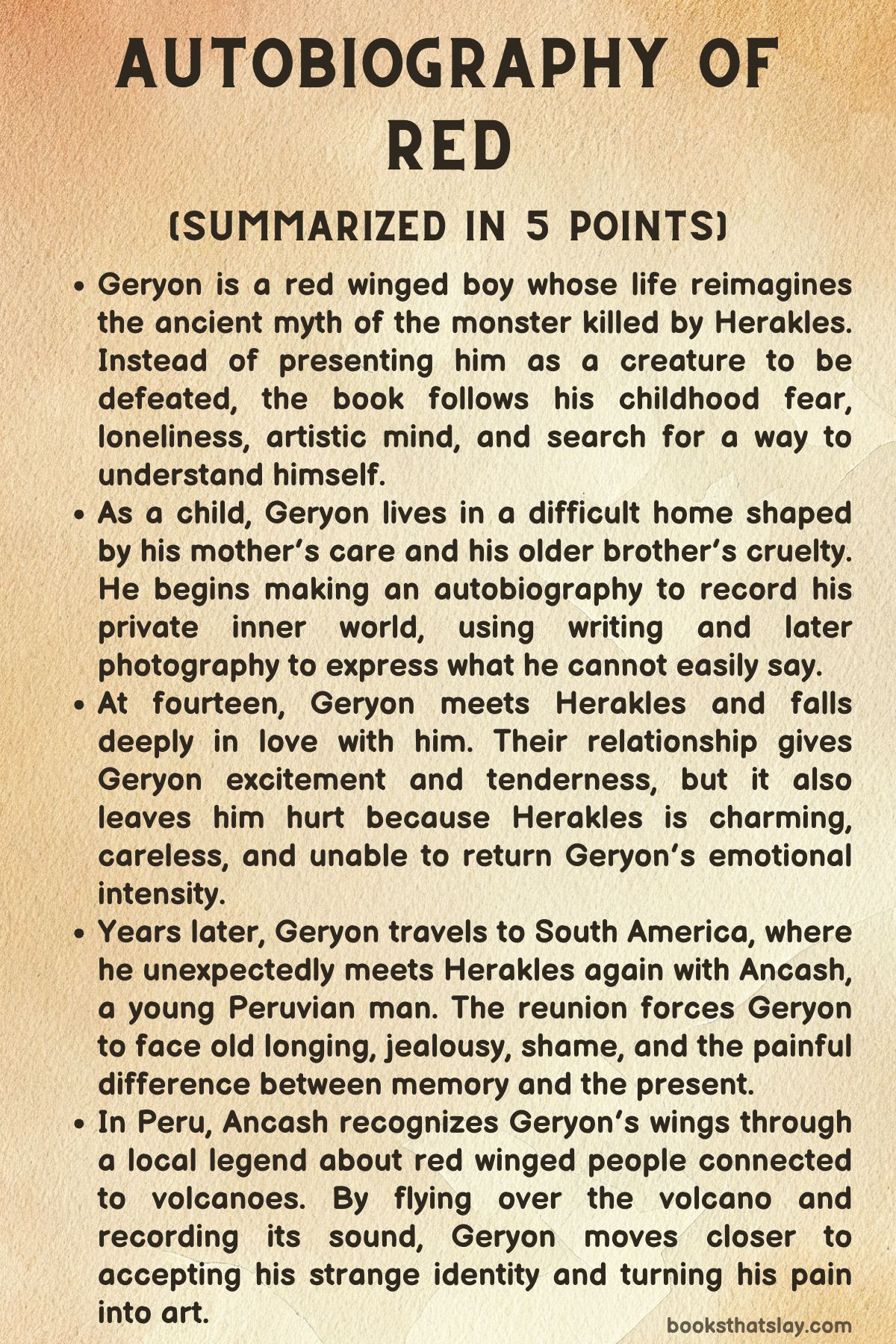
The book closes not with a neat cure for his pain, but with a moment of wonder. Geryon has not escaped history, desire, or loneliness, but he has moved from hiding his red wings to using them.
Key Figures
Geryon
Geryon is the emotional and imaginative center of Autobiography Of Red. He is a red winged boy modeled on the monster from Greek myth, but Carson makes him a modern child, lover, artist, traveler, and witness.
His monstrosity is never only physical. It is also the name given to his difference, his shame, his sensitivity, and his inability to fit the forms other people expect.
As a child, Geryon is frightened by school corridors, family tension, and the violence of his brother, yet he also has an extraordinary ability to perceive the world. He notices smells, colors, textures, light, objects, and emotional atmospheres with unusual force.
His autobiography begins as a private method of survival, a way to record what cannot be safely said. As he grows older, photography becomes his main artistic language.
Geryon often cannot speak directly about trauma or desire, but he can frame an image. His love for Herakles wounds him because it repeats the mythic structure in emotional terms: he becomes vulnerable to someone who cannot protect him.
By the end of the book, Geryon’s flight over the volcano suggests a movement toward self-possession. He does not become simple, healed, or ordinary.
He becomes more able to inhabit his own strangeness.
Herakles
Herakles is charismatic, restless, clever, and emotionally dangerous. In the ancient myth, Herakles kills Geryon and steals his cattle; in the modern story, he does not murder Geryon physically, but he harms him through carelessness, desire, and emotional imbalance.
As a teenager, Herakles appears to Geryon as a figure of freedom. He arrives by bus, gives Geryon change, takes him into the night, and seems to open a world of movement, sex, art, and rebellion.
He is funny, physical, and daring, yet his charm often masks a lack of responsibility. He enjoys intensity but resists the weight of another person’s need.
His relationship with Geryon is passionate, but he often treats Geryon’s inner life as inconvenient or strange. Later, when he returns with Ancash, he still has the power to disturb Geryon.
He touches old wounds without fully acknowledging them. Herakles is not drawn as a flat villain.
He can be playful, intelligent, and affectionate, but he remains fundamentally self-centered. The book shows how someone can be loved deeply and still be unsafe for the person who loves them.
Geryon’s Mother
Geryon’s mother is one of the book’s most important figures of care. She is not perfect, and she does not fully understand the depth of Geryon’s suffering, but she loves him with a steady, practical tenderness.
She sends him to school, makes ordinary meals, smokes, talks on the phone, notices his moods, and tries to give him courage. When he is young, she tells him he is not weak, and this statement carries both comfort and pressure.
She wants him to survive, but she cannot always see what survival costs him. Her bond with Geryon is marked by small domestic moments: canned peaches, buttered toast, cigarettes, conversations at the kitchen table, and her praise of his strange sculpture.
When Geryon returns from Hades devastated by Herakles, she does not force confession. Their exchange about the empty fruit bowl becomes a quiet act of repair, allowing humor to enter pain.
She is also associated with language and voice; Geryon asks the babysitter to read a book his mother usually would not read because he wants to protect words that belong to her. She represents home as both limited and necessary, a place that cannot save Geryon completely but can still receive him.
Geryon’s Brother
Geryon’s brother is a source of fear, humiliation, and early trauma. He is older, physically stronger, and skilled at using shame as a weapon.
At school, he begins as Geryon’s guide but quickly becomes impatient and cruel, calling him stupid and leaving him to manage fear alone. At home, his abuse is more severe.
He coerces Geryon sexually, threatens him emotionally, chokes him, mocks him, and treats his vulnerability as an opportunity for control. His violence is often mixed with ordinary brotherly settings: bunk beds, swimming trips, sandwiches, TV, jackets, and kitchen scenes.
This mixture makes the abuse more disturbing because it shows how harm can hide inside daily family life. Yet Carson does not make him present only as a monster.
Later memories show moments of casual kindness, such as complimenting Geryon’s borrowed jacket and inviting him to watch a movie. These moments do not erase the harm; rather, they show how confusing abuse can be when it comes from someone who is also part of one’s family.
Geryon’s later difficulty with sex, shame, speech, and bodily exposure is connected to this early betrayal.
Geryon’s Father
Geryon’s father is a comparatively distant figure in the book. He appears mainly through absence, routine, and family structure rather than deep emotional presence.
He goes to hockey practice with Geryon’s brother, creating the Tuesday evenings when Geryon and his mother can share a peaceful private ritual at home. This absence becomes meaningful because it allows one of Geryon’s safest domestic spaces to exist.
At the same time, the father’s limited presence suggests a household in which Geryon’s suffering is not closely noticed or prevented. In the mythic facts Geryon records about himself, the father is described in strange symbolic terms, connected to gold or a divine cutting tool.
This makes the father feel more like an abstract origin than a nurturing person. His importance lies in what he does not provide: protection, understanding, or emotional language.
The book’s family world is shaped by his distance, the mother’s partial care, and the brother’s domination.
Geryon’s Dog
Geryon’s dog belongs to both the mythic and emotional structure of the book. In the Stesichoros fragments and in Geryon’s own childish facts, the dog is part of Geryon’s world before Herakles destroys it.
The dog does not answer Geryon when he asks whether many little boys think they are monsters, but its presence gives him companionship without judgment. When Herakles kills the dog in the mythic material, the act intensifies Herakles’s violence.
It is not enough that Geryon is killed; the creature close to him is also destroyed. In the modern story, the dog returns through memory and absence.
Geryon looks for the family dog at one point before realizing they have not had a dog for years. That small moment shows how grief and memory can blur time.
The dog represents lost innocence, wordless companionship, and the vulnerability of those attached to Geryon.
Stesichoros
Stesichoros is both a historical poet and a strange guiding presence behind the book. Carson presents him as the ancient writer who made a major shift by telling Geryon’s story from Geryon’s side rather than from the victorious hero’s side.
This act matters because it changes the moral arrangement of myth. Stesichoros becomes a figure for artistic revision, for the power of adjectives, and for the question of whether description can alter reality.
His rumored blinding by Helen introduces another concern: language has consequences. If he misdescribes Helen, he loses sight; if he corrects himself, he may regain it.
The later mock interview with Stesichoros makes him playful, elusive, and impossible to treat as a stable authority. He says he was once in charge of seeing for the world and that there is a connection between geology and character.
Through him, the book asks whether a poet sees more clearly by inventing, correcting, fragmenting, or admitting uncertainty.
Helen of Troy
Helen appears mainly through the story of Stesichoros’s blinding and his palinode. She is less a fully dramatized character than a force attached to reputation, beauty, blame, and correction.
In the testimonies, Helen punishes Stesichoros for speaking falsely or abusively about her, then restores him after he retracts the claim. Her role is powerful because she refuses to remain a passive object of male description.
She can strike the poet blind, making him answer for his language. The palinode, which states that the earlier story was not true and that Helen never went to Troy, turns her into a figure of contested truth.
Helen’s presence near the beginning of the book prepares the reader for Geryon’s own problem: what happens when someone is trapped inside a story told by others? Helen, like Geryon, is linked to the need to correct inherited narratives.
Zeus
Zeus appears briefly in the translated ancient fragments, looking down from Heaven with Athena and singling out Geryon. His presence places Geryon’s life under divine observation, as if the forces above already know or determine his fate.
Zeus does not become a psychologically developed character, but his role matters symbolically. He represents the old mythic order in which gods watch, classify, and permit mortal suffering.
From that height, Geryon is seen not as a child with feelings but as a being within a destiny. Carson’s modern treatment of Geryon challenges this kind of distant authority by bringing the narrative down into Geryon’s own sensations.
Athena
Athena appears beside Zeus in the early fragmentary material. Like Zeus, she belongs to the mythic frame rather than the modern plot.
Her presence suggests intelligence, divine strategy, and the old heroic world surrounding Herakles’s labors. Yet she does not intervene to save Geryon.
Her silence is important because it reflects how myth often supports heroic achievement without attending to the victim’s inner life. Athena’s brief appearance helps establish the contrast between gods who observe from above and Geryon, whose experience must be reconstructed from below.
Herakles’s Grandmother
Herakles’s grandmother is eccentric, talkative, intelligent, and closely connected to photography, volcanoes, and memory. She tells stories that seem to cross history, literature, and fantasy, including references to Virginia Woolf, Freud, Argentina, and the Lava Man.
Her photograph “Red Patience” becomes one of the key objects in the book because it teaches Geryon to think about exposure, time, disaster, and the difference between what is seen and what is understood. She challenges Geryon’s assumptions when she says he is confusing subject and object.
Unlike Herakles, she often takes Geryon’s questions seriously, even when her answers are cryptic. She also connects the domestic world of Hades to volcanic catastrophe.
Through her, the book links art to survival: she witnessed or inherited disaster, preserved it in an image, and gave it a title that continues to disturb Geryon.
The Babysitter
The babysitter appears during a childhood scene when Geryon’s mother is away. Her role is brief but revealing.
She reads to Geryon in a “wrong voice,” which makes him choose a book not usually associated with his mother so that his mother’s words remain protected. This shows how sensitive Geryon is to voice, intimacy, and emotional ownership.
The babysitter also intervenes when Geryon’s brother snaps a rubber band against his leg, but her intervention is limited. Her conversation about weapons, especially her answer that her favorite weapon is the garrote, adds a strange darkness to the scene.
She is an adult presence, but not a source of full safety. Her scene highlights how exposed Geryon feels when his mother is absent.
Geryon’s Teacher
Geryon’s teacher appears most clearly during Parent-Teacher Day, when she asks where Geryon gets his ideas. The question reveals the adult world’s inability to understand the seriousness of Geryon’s imagination.
His writings about Herakles killing Geryon and the red cattle are not merely childish oddities; they are his way of mapping identity, fear, and fate. The teacher’s concern about whether he writes happy endings places pressure on Geryon to make his inner life more acceptable.
In response, Geryon adds a beautiful ending about red breezes going on around the world. This moment shows both his compliance and his quiet resistance.
He can produce beauty on demand, but the beauty comes from the same red world that adults find troubling.
The Yellow-Bearded Philosopher
The yellow-bearded philosopher meets Geryon in Buenos Aires and brings him into a world of academic skepticism. He is talkative, intellectual, and somewhat comic, interested in emotionlessness, doubt, and the search for truth.
For Geryon, he becomes a temporary guide into a social and philosophical setting, but not a deep emotional companion. His lecture fails to hold Geryon’s attention fully, partly because Geryon is overwhelmed by the room, the cold, the students, and the marks of political violence around the university.
The philosopher’s ideas about doubt contrast with Geryon’s lived uncertainty. For the philosopher, skepticism is a topic; for Geryon, uncertainty is bodily and constant.
This difference gives the character a useful function: he shows the gap between abstract thought and lived experience.
Lazer
Lazer appears in Buenos Aires at the bar after the philosophy lecture. He speaks with Geryon about his daughter and about noticing moments of death when he is with her.
His reflection on standing on a hill while his daughter climbs it gives Geryon a language for distance between people. Lazer is gentle and briefly intimate.
He and Geryon touch hands before Lazer leaves, a small gesture that carries warmth without demand. In a book where touch is often charged with danger, longing, or shame, this moment stands out as quietly humane.
Lazer helps articulate one of Geryon’s recurring perceptions: people occupy different positions in time, even when they are together.
The Tango Singer
The tango singer in Buenos Aires is sharp, unsentimental, and self-contained. She performs in a nearly empty tango bar and later talks with Geryon after he wakes there.
She tells him that tango is not for everyone and later says tango is a fossil. Her work as a psychoanalyst adds another layer to her character.
She interprets Geryon’s concern for captive whales as guilt, which annoys him, but her comment is not entirely careless. She sees that Geryon’s questions about whales are also questions about captivity, thought, and blame.
Their conversation is awkward, dry, and revealing. She does not comfort Geryon, but she gives him resistance, and that resistance forces him to clarify what he believes: to be alive is not to think of nothing.
Ancash
Ancash is one of the most important later characters in the book and one of the few people who sees Geryon’s wings without reducing him to shame. He is Peruvian, connected to Quechua language, Huaraz, volcanoes, and stories of red winged survivors.
Compared with Herakles, Ancash is more observant and careful, though he is not free from jealousy or pain. He notices Geryon’s cold, helps him with blankets, and recognizes his wings through the legend of Yazcamac.
This recognition gives Geryon a new way to understand himself. Ancash does not treat the wings as a deformity or secret disgrace; he sees them as evidence of a powerful, dangerous, sacred passage.
His relationship with Geryon is complicated by Herakles. He is Herakles’s companion, yet he is drawn to Geryon and hurt by Geryon’s continued attachment to Herakles.
When he asks whether Geryon loves Herakles and what sex with him is like now, he is asking from pain, jealousy, and concern. In Autobiography Of Red, Ancash becomes the character who offers Geryon a possible identity beyond the wound Herakles left.
Ancash’s Mother
Ancash’s mother is practical, bold, humorous, and shaped by economic and political hardship. She works as a cook for American employers in Lima and lives on their roof, where she also grows marijuana to supplement her income.
Her life shows the social and economic conditions around Ancash’s world without turning her into a symbol only. She speaks Quechua, comments bluntly, and often understands more than she explains.
Her line about burros waiting to inherit the earth gives Geryon one of those odd, memorable statements that stay with him. She is also connected to Huaraz and the danger of the mountains, soldiers, and local stories.
Her presence grounds the Peru section in daily survival: work, food, roofs, roads, language, and adaptation.
The Americans in Lima
The Americans in Lima never become central personalities, but they matter as part of the social background. They employ Ancash’s mother, own the roof space where the travelers sleep, and keep many birds, including a destructive gold parrot.
Their presence suggests foreign privilege and distance. They shape the living conditions of Ancash’s mother while remaining mostly offstage.
Their birds, especially the violent parrot, create an atmosphere of noise, captivity, and danger. Through them, the book hints at unequal arrangements of money, space, labor, and ownership.
The Soldiers
The soldiers who stop the group on the mountain road bring political tension directly into the journey. They surround the car with guns, take Ancash and Herakles away, and force Geryon into a moment of helpless observation.
Later they host the group for a meal of guinea pig and talk about the volcano Icchantikas and the village of Jucu. Their behavior shifts between threat and hospitality, which makes them unsettling.
They belong to a world where state power, local fear, and ordinary life exist side by side. For Geryon, they are also photographic subjects, but his camera cannot freely capture them; Ancash’s mother pushes it down for safety.
The soldiers show that seeing can be dangerous, and that witnessing is never neutral.
Lava Man
Lava Man is a story told by Herakles and his grandmother, and he functions as a legendary figure of survival. He was trapped during a volcanic disaster and lived, though badly burned, later becoming a sideshow act.
He is important because he anticipates the later Andean idea of people who enter or encounter volcanic fire and return changed. Lava Man is both survivor and spectacle.
His suffering becomes something others look at. This connects him to Geryon, who fears being seen as monstrous yet also uses images to understand himself.
Lava Man’s story asks what happens when survival itself becomes a form of exposure.
The Interviewer
The interviewer who questions Stesichoros near the end is anonymous and understated, but the role is important. The interviewer tries to make Stesichoros explain blindness, seeing, description, Geryon, Helen, and the red dog.
The exchange is playful and strange, with Stesichoros resisting clear answers. The interviewer represents the critical impulse to organize meaning, while Stesichoros represents the artist’s refusal to be pinned down completely.
Their conversation closes the book by returning to questions of sight, description, redness, geology, character, and the unfinished quality of Geryon’s story.
Themes
Rewriting Myth from the Wounded Side
The old myth places Herakles at the center and treats Geryon as an obstacle to be killed. Carson reverses that arrangement by giving emotional, artistic, and sensory life to the figure called a monster.
This change is not only a literary trick; it changes the ethical weight of the story. When the reader sees Geryon as a child afraid of school, a boy harmed by his brother, a teenager overwhelmed by first love, and an adult trying to understand memory through photography, the heroic structure of myth becomes unstable.
Herakles is no longer simply the victorious hero. He becomes someone whose charm and force can damage another person.
The theme asks who has been silenced by inherited stories and what happens when the supposed monster becomes the narrator. In Autobiography Of Red, myth is not rejected; it is remade so that the emotional truth of the defeated figure can stand at the center.
This approach gives Geryon dignity without making him ordinary. His wings and redness remain, but they become signs of a full inner life rather than proof that he deserves destruction.
Art as Survival and Self-Definition
Geryon’s autobiography begins as a child’s private project, but it becomes the central method by which he survives experience. He writes facts, makes sculptures, records images, and later turns to photography.
His art does not explain everything clearly, nor does it cure his pain. Instead, it gives form to what might otherwise remain unbearable.
Because Geryon often cannot speak directly, images become his way of thinking. A fruit bowl, a fly in water, shoes in a library, a self-portrait with wings, a glowing pipe, a dead guinea pig, Herakles’s back, and the face of Herakles caught in a moment of age all become part of his effort to understand time and feeling.
Photography especially matters because it holds a moment while also showing that the moment is already gone. Geryon is fascinated by exposure, duration, and the difference between what an image shows and what it means.
Art allows him to be both subject and observer. It lets him frame himself without surrendering completely to other people’s definitions.
His final gift to Ancash, the recording of the volcano, extends this artistic survival beyond sight into sound, risk, and flight.
Desire, Shame, and Emotional Power
Desire in the book is never presented as simple romance. From childhood onward, Geryon’s understanding of the body is shaped by secrecy, coercion, and shame.
His brother’s abuse confuses intimacy with fear and teaches Geryon that exposure can be dangerous. When he later falls in love with Herakles, desire brings wonder but also repeats patterns of imbalance.
Herakles is exciting because he seems free, physical, and fearless, but his freedom often depends on not taking responsibility for Geryon’s vulnerability. Geryon wants to be seen and touched, yet being seen and touched can also make him feel degraded.
Years later, when he has sex with Herakles again, he recognizes that the act belongs partly to dreams of the past and partly to a painful present where the old feeling no longer protects him. Ancash’s presence sharpens this theme because Ancash asks more honest questions about what Geryon feels and what the old attachment costs him.
The book treats queer desire with seriousness and complexity, showing its beauty, hunger, awkwardness, danger, memory, and power without reducing it to either liberation or suffering.
Seeing, Witnessing, and the Limits of Understanding
Sight is everywhere in the book: Stesichoros’s blindness, Geryon’s photography, Herakles’s gaze, the grandmother’s volcanic image, the beluga whales in tanks, the soldiers’ guns, and Ancash’s warning that people in Huaraz may check Geryon’s shadow. To see is not always to understand, and to be seen is not always to be known.
Geryon is intensely visual, but he repeatedly faces the limits of vision. He can photograph people’s shoes and miss their identities; he can look at “Red Patience” and fail to understand how such an image is made; he can see Herakles and still not know what Herakles thinks.
The book also treats witnessing as dangerous. Political violence appears through disappeared professors, soldiers, guerrillas, and fearful towns, suggesting that looking can carry risk.
Ancash’s legend of eyewitnesses gives the theme a mythic form: some people see inside the volcano and return changed, red, winged, and no longer merely mortal. Geryon’s final flight over Icchantikas becomes an act of witnessing that cannot be fully translated into a photograph.
Some experiences can be recorded only partially; others change the witness more than the record.