Awake by Jen Hatmaker Summary and Analysis
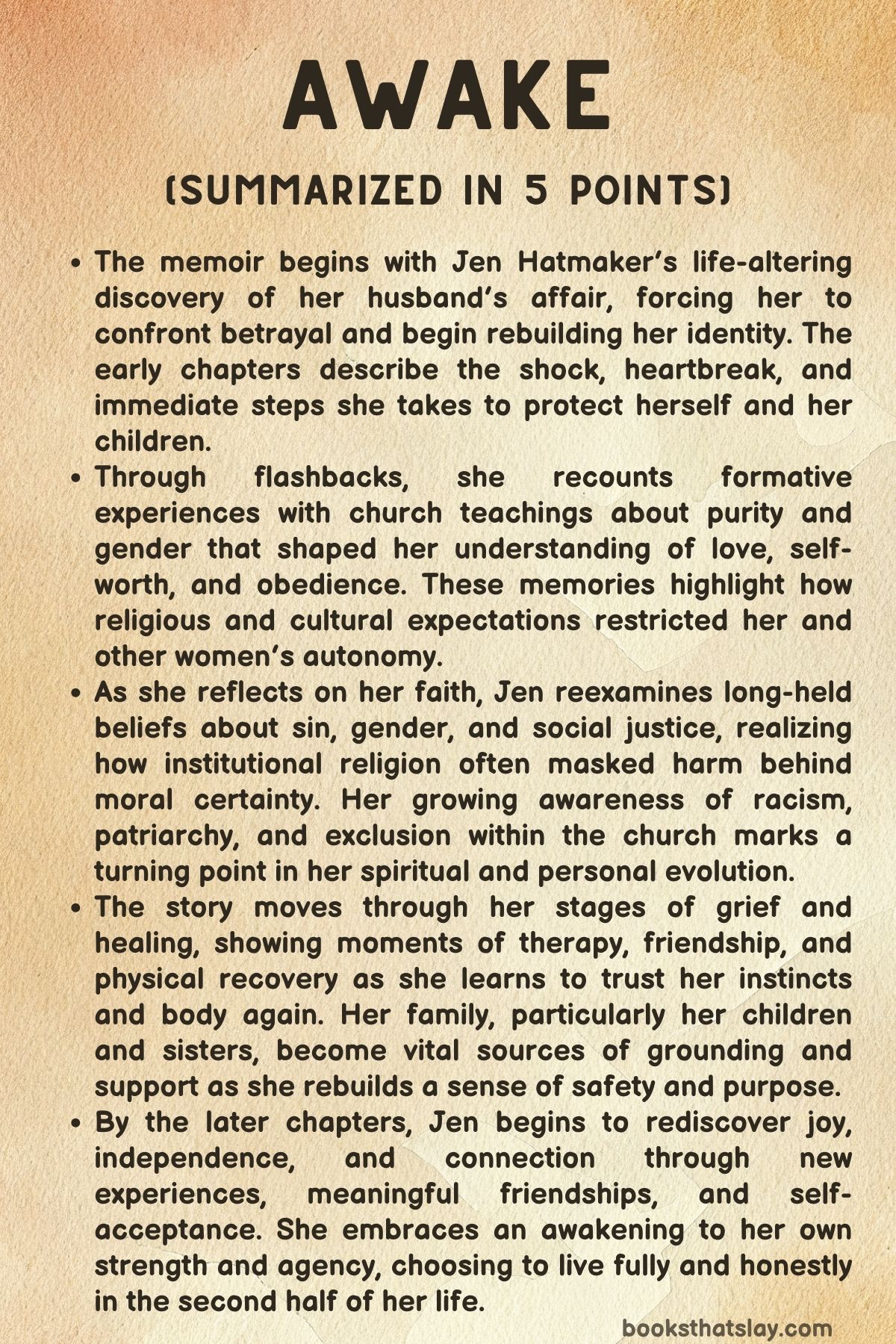
Awake by Jen Hatmaker is a candid and deeply introspective memoir about dismantling illusions, reclaiming identity, and awakening to truth after the collapse of a life built on certainty. It chronicles Hatmaker’s journey through betrayal, divorce, faith deconstruction, and personal rebirth.
With unflinching honesty, she examines the systems that shaped her—evangelical purity culture, patriarchal faith, and societal expectations—and the courage it took to leave them behind. Through grief, therapy, family, and self-discovery, Hatmaker rebuilds a life anchored in honesty, compassion, and embodied trust. The book stands as both a reckoning and a declaration of renewal.
Summary
The story begins in the early hours of July 11, 2020. Jen Hatmaker, after twenty-six years of marriage, wakes at 2:30 a.m. to the sound of her husband whispering to another woman.
Frozen with disbelief, she uncovers on his computer a parallel life of deception. As he sleeps beside her, she reads messages, files, and exchanges that confirm betrayal.
At dawn, she confronts him, demands the truth, and when he refuses, tells him to leave. It becomes the last night he spends in their home.
The next morning, shattered, she gathers her family, collapses in her mother’s arms, and screams in pain as her life fractures.
The narrative shifts between this moment and memories that shaped her understanding of womanhood, love, and worth. In ninth grade, she sits through a church purity class where girls are told that sexual experience makes them “dead roses.” She absorbs the message that her value lies in purity and compliance. At nineteen, she and her college sweetheart plan their marriage around ministry and moral ideals.
On December 30, 1993, she marries him, believing in a shared devotion to faith and service, unaware that the frameworks guiding her life would one day betray her as deeply as her husband’s actions.
Interspersed memories reveal a pattern of internalized shame and suppression. As a sixth grader, she learns humiliation when a teacher calls her domineering; in eighth grade, she senses danger in a teacher’s inappropriate attention to girls, only to later learn he abused a friend.
These formative experiences teach her to distrust her instincts and conform to authority. Yet moments of parental love—her father defending her, her mother’s comfort after cruelty—plant early seeds of safety and belonging that resurface decades later during her healing.
After discovering the affair, Hatmaker moves swiftly toward self-protection. She consults an attorney, guided by an instinct she finally allows herself to trust.
Her five children, ranging from college-aged to teenagers, learn the truth, and grief ripples through their household. Amidst sleepless nights and relentless pain, she recalls Jeremiah 17:9, a verse long used to teach her that her heart was deceitful.
Sitting on her porch one night, she reclaims that heart. Remembering her father’s comfort after a childhood humiliation, she tells herself, “I am my own best friend.
I am home. ” For the first time since discovery, she sleeps.
The following days bring confrontation and revelation. Her husband admits to the affair’s full extent: its duration, money spent, shared places, and web of lies.
Friends wait nearby in their car, ensuring she is safe. The truth devastates her, yet clarity marks the first step toward rebuilding.
Hatmaker reflects on earlier teachings that now feel hollow. In ministry, she had preached ideals of faith and purity, but her experiences of betrayal and loss force her to reconsider what holiness truly means.
As her marriage collapses, so does her confidence in the religious systems that shaped her. Her crisis becomes both personal and spiritual, leading her to question every structure that once promised certainty.
Through parallel essays and vignettes, she revisits moments of motherhood, friendship, and awakening. She remembers sending her children to a church camp she believed progressive—until her son reveals he was shamed for not confessing to watching pornography.
The revelation forces her to confront how purity culture harms boys as much as girls. She realizes she had guarded her daughters’ autonomy but overlooked her sons’ vulnerabilities.
In the aftermath of the affair, grief engulfs her. Encouraged by friends, she experiments with new forms of healing: therapy, meditation, and even energy work.
During a visualization exercise, she imagines herself drowning until loved ones pull her ashore. This becomes a metaphor for her recovery—allowing help, trusting her body, and choosing life over despair.
She revisits memories of family joy: her son’s laughter after crashing a car into a fence, her daughters’ sharp humor, shared moments of chaos and warmth. These fragments of ordinary happiness become her lifeline, reminders that love and laughter once existed freely.
As the months unfold, friends and siblings form a protective circle around her. A friend compares her healing to sailors spotting a distant lighthouse—a sign that home will come into view, even through storm.
When she rebuilds her front porch, once abandoned by her husband mid-renovation, she and her friends create something stronger and more beautiful. It becomes a tangible emblem of reclaiming her life.
She travels to Colorado with her children, finding solace in mountains and fresh air. There, amidst bike rides and quiet evenings, she begins to believe in joy again.
She faces practical fears too—financial insecurity, independence, and motherhood alone. Meeting with a financial advisor, she admits she has never handled money on her own.
Step by step, she learns to manage accounts and reclaim control.
Spiritual questions persist. Her faith, once rooted in evangelical tradition, has unraveled under the weight of exclusion and hypocrisy.
When she publicly supports same-sex marriage, her publishing career collapses overnight. She loses followers, income, and community, but she chooses integrity over approval.
This moment mirrors her later personal awakening: truth over belonging.
Her emotional recovery is uneven. Some days bring gratitude and clarity; others bring despair.
Therapy teaches her to allow both. She learns that healing is nonlinear, that grief and joy can coexist.
Her children, resilient and loyal, become her grounding force.
Gradually, she redefines love—not as endurance through suffering but as peace and honesty. She learns detachment not as withdrawal but as choosing serenity over chaos.
She practices forgiveness for her ex-husband, acknowledging shared immaturity and broken systems that shaped them both. She even extends compassion to the woman who entered his life after their separation.
Her healing includes reclaiming her body. After decades of shame rooted in purity culture, she begins to trust her physical instincts and reject the idea that her body is a source of sin.
A ritual called “Closing the Bones” helps her release years of stored trauma. Wrapped in blankets and prayer, she feels panic dissolve into peace—a rebirth into her own skin.
Eventually, she opens herself to love again. A chance meeting in New York with a man named Tyler marks a quiet new beginning.
It’s not a fairytale but a sign of possibility, proof that she can love without losing herself.
In the book’s closing scene, Hatmaker revisits the time—2:30 a. m.
—that once symbolized her life’s collapse. Awake in a quiet room, she no longer trembles in fear.
Instead, she feels her body’s calm wisdom reminding her of survival. She vows never to outsource her truth again.
Awake ends not with triumph but with peace—a woman standing in the light of her own awareness, her life no longer defined by betrayal or belief systems, but by the steady, conscious act of being alive and free.
Key People
Jen Hatmaker
In Awake, Jen Hatmaker stands as both the narrator and the central figure through whom the story unfolds. Her character evolves from a devout young woman shaped by evangelical purity culture into a self-aware and liberated individual reclaiming her voice, body, and spirit.
At the beginning, Jen’s identity is tightly bound to faith, marriage, and motherhood, molded by doctrines that taught her to suppress instinct and desire in favor of obedience and moral order. The discovery of her husband’s betrayal fractures this constructed identity, leaving her face-to-face with the dissonance between what she was taught and what she feels.
Her grief is deep and physical, expressed through raw bodily reactions, sleepless nights, and primal cries. Yet, even within devastation, Jen demonstrates fierce resilience.
Her healing journey is rooted in rediscovering the body she was once told to distrust. She gradually learns to listen to her instincts, to honor her emotions without shame, and to rebuild a sense of safety from within.
By the end, Jen transforms into a figure of autonomy and grace—someone who forgives but does not forget, who honors her past but refuses to live by its constraints. Her awakening represents both a personal and cultural reckoning, challenging inherited systems of patriarchy and religious control while embodying the courage to live “awake” in one’s own truth.
Jen’s Husband
Jen’s husband serves as both a catalyst and a symbol within the narrative. His affair triggers the unraveling of a twenty-six-year marriage and propels Jen’s spiritual and emotional rebirth.
Initially presented through the shock of betrayal—voice-texting another woman beside his sleeping wife—he embodies secrecy, denial, and emotional detachment. Even when confronted, he refuses full accountability, revealing a pattern of dishonesty that mirrors the toxic silence embedded in their faith-driven marriage.
Through Jen’s reflection, he comes to represent more than a single act of infidelity: he is a manifestation of an entire system that prioritizes appearance and control over authenticity. Later, when he confesses and apologizes, the gesture does not erase the damage but allows for a quiet, mature form of forgiveness.
Jen’s eventual peace with him underscores her evolution from dependence to self-possession. Her ability to forgive without reconciliation redefines love as a boundary rather than an obligation.
Jen’s Children
The five children of Jen and her husband occupy the heart of the story’s emotional landscape. They represent innocence, continuity, and the ultimate stakes of Jen’s transformation.
Each child reacts differently to the collapse of the family, reflecting varying degrees of confusion, anger, and empathy. Their presence reminds Jen of her responsibility not only to mother them but also to model healing and truth.
They serve as mirrors of her growth—her early vigilance toward her daughters, shaped by purity teachings, contrasts with her later realization that her sons too suffered under the same shame-based system. Through parenting, Jen reconciles her past indoctrination with her present clarity.
The family’s shared moments of humor, such as the “Jeep and fence” story, reveal their enduring bond amid loss. Ultimately, the children are symbols of both her greatest grief and her greatest hope—the living proof that love, though altered, remains.
Jen’s Parents
Jen’s parents provide the foundation of security and unconditional love that allows her to endure trauma. Her mother is a steady, nurturing force, the first person Jen runs to after discovering her husband’s betrayal.
The image of collapsing into her mother’s arms captures both regression and renewal—the adult woman finding refuge in the safety of childhood care. Her father, protective and principled, embodies a fierce moral compass.
His defense of young Jen against humiliating teachers and his gentle rituals—like making Coke floats after moments of pain—anchor the narrative in tenderness. They represent the best of faith untarnished by dogma: love that protects without judgment.
Their presence in Jen’s darkest hours reaffirms the power of familial compassion to restore a fractured soul.
Lindsay
Lindsay, Jen’s sister, reflects a parallel and instructive journey. Her canceled wedding becomes a narrative of courage and integrity.
Where Jen once endured for the sake of image and duty, Lindsay’s decision to walk away before vows are exchanged exemplifies truth-telling over performance. Her story becomes a lesson Jen carries into her own divorce—that liberation is not failure but self-honesty.
Lindsay’s strength underscores a generational shift among women learning to trust intuition over expectation. She is both mirror and mentor, embodying the bravery that Jen learns to claim for herself.
Remy
Remy, Jen’s youngest daughter, serves as the book’s moral compass of authenticity. Her inability to navigate pretense or social disguise challenges Jen’s learned patterns of people-pleasing.
Where Jen once equated goodness with compliance, Remy’s straightforwardness models a kind of purity untouched by shame. Through therapy, Jen comes to see that Remy’s directness is not defiance but truth lived without fear.
In Remy, the reader sees the uncorrupted version of what Jen fights to recover—a spirit unafraid of honesty or vulnerability.
Amy
Amy, the spiritually attuned friend who “smudges” Jen’s house, symbolizes the communal and ritualistic dimension of healing. Her presence bridges the physical and metaphysical, guiding Jen through cleansing ceremonies that transform her home from a site of betrayal into one of peace.
Amy represents the wisdom of embodied spirituality, where healing involves both ritual and friendship. Her role illustrates how recovery often requires witnesses—those who help carry pain until it becomes bearable.
Andrew
Andrew’s appearance in the “Lighthouse” episode provides one of the book’s most poignant metaphors. His reassurance—that more lights will appear across the dark sea—captures the essence of communal hope.
Andrew embodies the gentle strength of friendship that steadies grief without rushing it. His words illuminate the recurring theme of navigation—how one finds direction again after the map of life has been torn apart.
Tyler
Tyler enters at the close of Awake, marking a quiet but profound turning point. His arrival represents renewal and possibility, not as rescue but as resonance.
Meeting him in New York after her long journey of healing, Jen experiences the stirrings of affection without dependency. Tyler’s presence signals that love, once destructive, can be reimagined as partnership between equals.
His role in the final scene—arriving at the same hour that once symbolized betrayal—reverses trauma into transcendence. Through him, the book closes on hope, showing that awakening is not only survival but also the courage to begin again.
Themes
Betrayal and the Shattering of Illusions
In Awake, Jen Hatmaker captures the raw devastation that follows the collapse of a long marriage built on faith, loyalty, and shared ideals. Betrayal in this story is not only the breaking of a promise between two people but the dismantling of a lifelong narrative.
The discovery of her husband’s affair becomes the moment when every structure she had trusted—her marriage, her church’s teachings, her faith in certainty—begins to disintegrate. What follows is not simply heartbreak but the loss of a constructed identity.
Hatmaker portrays betrayal as an earthquake that forces her to examine every inherited belief about love and obedience. The pain is intensified by years of conditioning that taught her to distrust her own heart, to suppress instinct in favor of submission.
Her awakening begins when she recognizes that her pain is also evidence of her aliveness, that truth, however brutal, is preferable to illusion. This theme expands beyond romantic betrayal to include the betrayal of spiritual systems that privilege appearances over truth.
By facing the wreckage head-on, she begins to reclaim a sense of moral and emotional clarity that had long been suppressed beneath duty and denial. Betrayal thus becomes a strange form of liberation, the violent opening through which she finally steps into authenticity.
Patriarchy, Purity Culture, and Religious Conditioning
Throughout Awake, Hatmaker exposes how the religious structures of her youth confined women within rigid frameworks of purity, modesty, and silence. Her recollections of the “True Love Waits” purity class reveal a theology of shame that equates a woman’s worth with her sexual history.
This conditioning continues to shape her adult life—how she interprets her body, her desires, and her role within marriage and ministry. The purity narrative taught her that holiness required repression and that her body was an object of potential contamination rather than a vessel of intuition and joy.
Hatmaker critiques this deeply gendered system that absolves men while disciplining women for the same impulses. Even in adulthood, she witnesses how such teachings deform both sons and daughters, producing shame, confusion, and distance from self.
Her eventual rejection of these doctrines marks a profound act of spiritual rebellion. By naming purity culture as psychological and spiritual abuse, she uncovers the moral bankruptcy of institutions that prize obedience over compassion.
Her healing begins when she learns to trust her body again—when she understands that intuition, desire, and pleasure can coexist with holiness. The journey away from patriarchal control becomes central to her awakening, revealing that faith divorced from embodiment is hollow and oppressive.
Grief and the Body as a Site of Healing
Grief in Awake is neither abstract nor solely emotional—it manifests in the body. Hatmaker’s descriptions of collapse, sleeplessness, trembling, and physical exhaustion translate spiritual disorientation into tangible sensations.
The turning point in her recovery comes when she stops intellectualizing pain and allows her body to lead. Through meditation, breathwork, and energy healing, she learns that release is physical before it becomes spiritual.
The body, once treated as an enemy under purity culture, becomes her guide back to safety and self-trust. Scenes such as screaming beneath a pecan tree or wrapping herself during the “Closing the Bones” ritual demonstrate that healing requires surrender to what the body already knows.
The memoir reframes grief as a natural, necessary response rather than a failure of faith. Hatmaker’s body carries memories of violation, suppression, and endurance, yet through intentional care it becomes a sacred site of resurrection.
The narrative insists that wholeness is not achieved through denial or transcendence but through deep inhabitation of the self. This reorientation—from viewing the body as suspect to recognizing it as wise—transforms grief into a path toward embodied freedom and peace.
Feminine Selfhood and Reclamation of Identity
A central current of Awake is the reconstruction of identity after decades of self-erasure. Hatmaker’s life before the crisis was marked by service to roles—wife, mother, pastor’s spouse, public figure—all performed within expectations of perfection.
When those roles collapse, what remains is an uncertain but authentic self. The memoir follows her gradual redefinition of womanhood not as submission but as sovereignty.
Through friendship, therapy, and spiritual experimentation, she learns to distinguish between caretaking and self-sacrifice. Her realization that she is “home” in herself represents a radical reversal of years spent seeking validation through others.
The rebuilding of her porch alongside her friends serves as a concrete symbol of this renewal—a reclaiming of both physical and emotional space. As she reenters the world through travel, work, and new love, she celebrates autonomy without bitterness.
Hatmaker portrays selfhood as an evolving, relational process: it requires community but not dependency, vulnerability without self-abandonment. The rediscovery of her voice and desire marks the triumph of authenticity over performance, and the recognition that loving others well begins with loving herself without apology.
Faith, Doubt, and Spiritual Reconstruction
Faith in Awake is not lost but transformed. Hatmaker’s spiritual evolution unfolds alongside her personal collapse, revealing how deeply intertwined belief and identity can be.
Raised in a world that prized certainty, she learns through suffering that real faith cannot coexist with denial of truth. Her confrontation with injustice, exclusion, and hypocrisy within the church forces her to reconsider what holiness means.
When her advocacy for inclusion leads to public rejection, she experiences both exile and liberation—the end of belonging to a system that demands silence in exchange for acceptance. The memoir portrays this spiritual reconstruction not as rebellion against God but as reconciliation with a truer understanding of the divine.
Freed from dogma, she begins to experience spirituality through compassion, justice, and embodied presence rather than adherence to rigid doctrine. She learns that doubt is not the enemy of faith but its beginning—the place where honesty and love meet.
In rediscovering her own worth outside institutional validation, Hatmaker finds a God who is gentle, expansive, and unconcerned with punishment. Her awakening is therefore both theological and personal: a return to grace rooted in truth rather than fear.
Forgiveness, Acceptance, and the Possibility of Renewal
By the close of Awake, forgiveness emerges not as moral obligation but as liberation from the past. Hatmaker’s forgiveness of her ex-husband is not an erasure of pain or reconciliation of the marriage but an act of self-release.
Through understanding, she reframes the story of her marriage as one of two people shaped by the same limiting systems. This perspective allows compassion without minimizing the harm.
The memoir presents forgiveness as an internal movement toward peace, a letting go of resentment to make room for life. Acceptance becomes equally essential—acceptance of imperfection, of emotional volatility, of life’s unfinishedness.
Her eventual openness to love again signifies that renewal is possible without forgetting what was lost. The transformation from despair to gratitude encapsulates the book’s ultimate vision: awakening is not a single revelation but an ongoing practice of truth-telling, gentleness, and courage.
By trusting her instincts, honoring her body, and embracing the unknown, Hatmaker steps into a future grounded not in fear but in awareness. In doing so, she reclaims not only her story but the right to live it fully awake.