Away to Me Summary, Characters and Themes
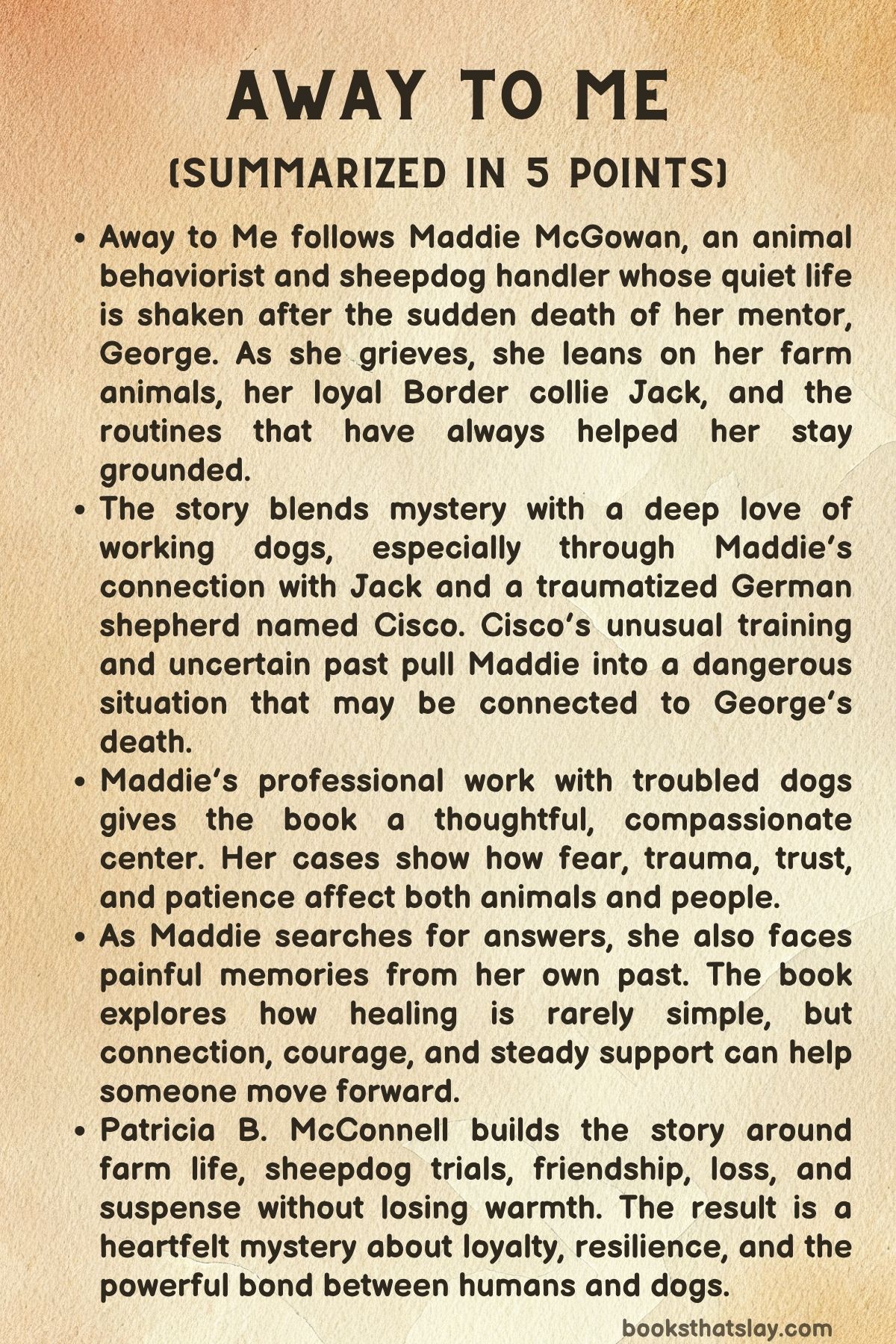
Away to Me by Patricia B. McConnell is a mystery rooted in the world of sheepdogs, animal behavior, and rural Wisconsin farm life. The novel follows Maddie McGowan, an animal behaviorist whose quiet existence is shattered when her mentor is murdered during a sheepdog trial.
As Maddie cares for wounded dogs, frightened animals, and her own damaged heart, she is drawn into a dangerous case involving trained dogs, drugs, betrayal, and old trauma. The book blends suspense with a deep understanding of human-animal bonds, showing how courage can come from trust, work, friendship, and the loyal presence of dogs.
Summary
At a sheepdog trial in Portage, Wisconsin, Maddie McGowan watches her mentor and dear friend George work his young Border collie, Jess. George has seemed tense lately, and before the trial he gives Maddie a strange warning, telling her to take care of herself.
During Jess’s run, the dog handles a difficult ewe with skill and bravery. Then a rifle shot breaks across the field.
George falls, shot in the chest, and dies before anyone can save him. The shocked handlers first assume a hunter may have made a terrible mistake, but the circumstances soon feel too exact to be accidental.
Maddie sits beside George’s body until the authorities arrive, shaken by grief and by the fear that something much darker has happened.
Maddie returns to Lonely Owl Farm, where her animals wait for her: Jack, her Border collie; Clementine, her elderly dog; Bo Peep, her livestock guardian; Old Horse; sheep; ducks; and cats. Caring for them gives her something to hold on to.
She remembers meeting George when she bought Jack as a puppy. George had suggested that Jack’s calmer sister, Jess, would be a better fit, but Jack chose Maddie by escaping his stall and running to her.
George agreed to sell him only if Maddie allowed him to help train them. That decision grew into a close friendship, making George’s death even harder for her to accept.
As Maddie tries to return to work, her life as an applied animal behaviorist continues around her grief. She consults on difficult cases, including Harpo, a large dog who keeps attacking other dogs because his owners do not manage him responsibly, and Ranger, a police K9 with severe thunder phobia after a storm caused him to jump through a second-story window.
Ranger’s handler, Officer Ryan Conners, is desperate to save the dog’s career. Through Ryan, Maddie learns that George’s death is being investigated as a homicide.
At the humane society, Maddie becomes interested in a badly traumatized German shepherd named Cisco. He was found near a highway, starved and wounded, and he reacts aggressively to shelter staff.
Maddie notices that Cisco behaves differently when a male volunteer named Chris approaches. The dog seems to sit and look at her as if trying to communicate.
Maddie begins to suspect Cisco may have been trained. Tom, George’s business partner and a K9 trainer, doubts her theory, but Maddie tries German police-dog commands.
Cisco responds at once. He allows her to enter his kennel, drinks water, and accepts food.
Maddie takes him home to foster.
Cisco bonds quickly with Jack, but his background remains a mystery. Ryan tests Cisco with a heroin scent sample, and Cisco identifies it correctly, proving he has narcotics detection training.
This makes Maddie wonder why such a valuable trained dog was abandoned and why Cisco reacted to Chris. Ryan and Kevin, another K9 officer, warn that drugs and organized crime could be involved.
Kevin’s cold manner unsettles Maddie.
Then danger comes directly to Maddie’s farm. She returns from a house call to find Jack loose, Cisco gone from his crate, and Bo Peep unconscious in the grass.
At the veterinary clinic, Bo Peep is diagnosed with probable fentanyl poisoning and revived with naloxone. Maddie realizes someone broke into her house, drugged Bo Peep, and stole Cisco.
Sheriff Wallenberg investigates and advises her to improve her locks and security. Dorothy, Maddie’s loyal friend, comes to stay with food, puppies, and a gun.
Maddie searches for Cisco through flyers, calls, and leads, but finds little comfort.
Maddie and Chris visit the industrial area where Chris says he found Cisco, but the story does not fit. Maddie notices the spot behind the dumpster could not have been seen from the road.
Her suspicion grows. At George’s memorial gathering, Tom announces that investigators found a likely sniper position far from the field, confirming George was murdered intentionally.
The news deepens the fear around everyone who knew him. Joan, Tom’s wife, says H & H Working Dog Center will continue, while Maddie asks people to contact her if they hear anything about Cisco.
Chris later comes to Maddie’s farm with Cisco’s old leather collar. He relaxes around her animals and seems especially comfortable with Bo Peep.
He talks openly about his loneliness, his anxiety, and his lack of support. Maddie feels drawn to him, partly because of his vulnerability and partly because he seems to understand wounded animals.
He helps with chores, watches Jack work sheep, and spends more time at the farm. After years of guarding herself because of her abusive ex-husband, Tyler, Maddie lets herself become close to Chris.
The relationship becomes complicated when Chris admits he is a recovering cocaine addict. Maddie worries because Cisco once alerted on him at the shelter, but Chris says the dog smelled an old stash in his jacket.
Maddie decides to believe him. She also shares more about Tyler and the fear that still lives inside her.
But Chris later admits he lied about where he found Cisco. The dog was not found near Milwaukee; Chris found him in Chicago, badly injured in a drug dealer’s warehouse.
He believes Cisco may have been used by a drug operation and then discarded. Maddie fears that Chris’s old connections may have led someone to her farm and to Cisco’s theft.
She asks Chris to leave.
Maddie speaks with Ryan, asking general questions about Cisco and drug trafficking. Ryan warns her not to involve herself with an informant and to let the police handle it.
Chris begs Maddie to come to his apartment so he can show her what he knows. There, he gives her maps connected to warehouses involved in the drug operation.
Maddie leaves but realizes she forgot Cisco’s collar. When she returns, she finds Chris shot dead in his bedroom.
The police question her and take the collar and maps as evidence. Because Maddie knew both Chris and George, investigators begin to consider whether the murders are connected.
Detective Garcia tells Maddie that Tyler, her violent ex-husband, has stopped checking in with parole and may be a suspect. This frightens Maddie, but she keeps thinking through the case.
She begins to suspect Tom because Cisco’s collar resembles the collars used by dogs trained at H & H. Tom denies any wrongdoing. Later, Jack leads Maddie back to Tom’s property and into the woods, where she finds Cisco locked in a hidden cage.
He is wearing a shock collar that has injured his neck. Maddie frees him and hides when Tom arrives, then calls 911.
The investigation reveals that Tom was involved in illegal dog sales. He admits he sold Cisco to a Chicago cartel through Kevin and then stole him back, planning to sell him again.
Kevin is arrested for Chris’s murder, and Tom is arrested after evidence connects H & H to George’s murder. Still, Maddie doubts Tom killed George.
His crimes are real, but the murder does not feel right to her.
After a sheepdog trial, Maddie visits Joan and accidentally takes a box containing Joan’s shooting trophies. Joan follows her to the farm with a gun and reveals the truth.
She killed George because he discovered that she and Tom were selling dogs illegally. She also killed Chris because he knew too much, then worked to frame Tom and Kevin.
Joan shoots Maddie in the arm. Maddie hides in the root cellar, where terror brings back memories of Tyler trapping her in a freezer years earlier.
Jack and Cisco break through a window to reach her, and Cisco attacks Joan, holding her down long enough for Maddie to get the gun and call the police. Joan is arrested and confesses.
Maddie survives surgery and returns home to recover with help from Dorothy, Vince, Liam, Ryan, and her dogs. Cisco and Jack also begin healing from what they have endured.
Months later, Maddie runs Jack at another sheepdog trial. The run is not perfect, but she accepts it with a calmer heart.
Life remains uncertain, yet Maddie is no longer frozen by fear. With her animals, friends, and work around her, she moves forward, open to trust, love, and whatever comes next.
Characters
Maddie McGowan
Maddie McGowan is the emotional and moral center of Away to Me. She is introduced as a skilled animal behaviorist, a devoted sheepdog handler, and a woman whose life is built around animals, routine, and hard-earned independence.
Her relationship with George shows her capacity for loyalty and deep affection, while her connection with Jack reveals how much she understands animals not as tools, but as thinking, feeling companions. Maddie is practical and competent, yet the book also shows how vulnerable she remains beneath that competence.
George’s murder shakes her badly, and the later disappearance of Cisco pulls her into a dangerous mystery that forces her to confront fear, grief, and uncertainty.
Maddie’s strength is not presented as fearlessness. Instead, her courage comes from continuing to act even when she is frightened.
She investigates Cisco’s past because she cannot ignore what she has seen, even though everyone around her warns her to be careful. Her instincts about Cisco, Chris, Tom, and Joan are often correct, but she also makes emotional decisions that place her at risk.
Her trust in Chris, for example, grows from loneliness, compassion, and a desire to believe in someone who appears damaged but sincere. This makes her human rather than merely heroic.
Her past with Tyler adds another layer to her character. Maddie is not only solving an external mystery; she is also living with the aftereffects of abuse.
Her fear of enclosed spaces, her guardedness around men, and her difficulty trusting herself all come from trauma that has shaped her life. The final confrontation with Joan in the root cellar becomes powerful because it forces Maddie back into the emotional terror of her past, yet she survives it.
By the end of the book, Maddie has not become untouched by pain, but she has become more open to connection, healing, and future possibility.
Jack
Jack is Maddie’s Border collie and one of the most important figures in the story. From the memory of his puppyhood, when he chose Maddie by escaping his stall to reach her, Jack is shown as unusually bonded to her.
He is energetic, sensitive, loyal, and deeply responsive to Maddie’s emotions. His fear after the gunshot at George’s trial shows that he is not simply a working dog in the background; he is affected by violence and stress just as the human characters are.
Jack’s role in the book grows beyond companionship. He often senses danger or hidden truths before Maddie fully understands them.
His insistence near the barn and woods, which Maddie initially dismisses, shows how closely he reads the environment. Later, his return to Tom’s property and his ability to lead Maddie toward Cisco make him essential to uncovering the truth.
Jack functions as both a working partner and an emotional anchor for Maddie.
As a sheepdog, Jack also represents Maddie’s connection to discipline, instinct, and trust. Their work together requires communication without force, which mirrors the healthier relationships Maddie is trying to rebuild in her human life.
By the end of the story, Jack’s imperfect trial run becomes meaningful because Maddie accepts it without bitterness. Through Jack, the book suggests that healing does not mean perfection; it means continuing to work, trust, and move forward.
George
George is Maddie’s mentor, friend, and one of the most influential characters despite dying early in the story. His death launches the central mystery, but his importance reaches far beyond the crime itself.
George is the person who brought Jack and Maddie together, helped train them, and became a steady figure in Maddie’s life. His advice, knowledge, and kindness shaped her confidence as a handler and deepened her connection to the sheepdog world.
George’s final behavior, especially his tension and his strange warning to Maddie to take care of herself, suggests that he knew more than he could safely say. This makes him both a victim and a guardian figure.
He appears to have discovered the illegal dog-selling operation, which makes his murder not random but the result of his integrity. He is killed because he becomes a threat to people willing to exploit working dogs for profit and criminal use.
In the emotional structure of the book, George represents trust, mentorship, and the good side of the working-dog community. His murder damages Maddie’s sense of safety, but his influence continues through her choices.
Her determination to find Cisco and understand the truth is partly an extension of what George taught her: to observe carefully, respect dogs, and pay attention when something does not feel right.
Jess
Jess is George’s young Border collie, and her presence at the opening trial is significant. During her run, she stands up to a stubborn ewe, proving her courage and skill just before George is shot.
This moment creates a painful contrast between the beauty of trained partnership and the sudden brutality of human violence. Jess’s successful work makes George’s death feel even more shocking because it happens in a setting devoted to trust, control, and tradition.
Jess is also important because George had originally suggested that Maddie choose her instead of Jack. She represents the calmer, more sensible option Maddie might have taken.
Jack’s choice of Maddie changed that path, but Jess remains tied to the beginning of Maddie and George’s friendship. Through Jess, the book quietly reminds readers that the lives of dogs and humans become intertwined through choices that can seem small at the time but later become life-changing.
Cisco
Cisco is one of the most tragic and compelling animal characters in Away to Me. When Maddie first encounters him at the humane society, he is traumatized, defensive, and nearly impossible for shelter staff to handle.
His aggression is not simple viciousness; it is the behavior of a dog who has been badly used, abandoned, and forced to survive. Maddie’s ability to read him differently from others shows both her professional skill and her compassion.
Cisco’s response to German police-dog commands reveals that he is not an ordinary stray but a trained working dog with a dangerous past. His ability to alert to narcotics connects him to the criminal world behind George’s and Chris’s deaths.
Because he has been treated as property by criminals, trainers, and corrupt handlers, Cisco becomes a symbol of exploitation. He is valuable to many people not because they love him, but because he can be used.
Yet Cisco’s character is not defined only by suffering. Once Maddie brings him home, he bonds with Jack and begins to show trust.
His rescue from the hidden cage on Tom’s property is one of the most important turning points in the story because it proves Maddie’s suspicions and exposes the cruelty behind the dog-trafficking operation. In the final confrontation, Cisco protects Maddie from Joan, turning from victim into defender.
His recovery parallels Maddie’s own: both are wounded, both are afraid, and both slowly learn that safety and attachment are possible again.
Bo Peep
Bo Peep, Maddie’s livestock guardian dog, is a steady and protective presence at Lonely Owl Farm. She represents the home Maddie has built for herself and the animals who depend on her.
Her role is not glamorous, but it is deeply important: she guards, watches, and belongs to the rhythm of the farm. When she is drugged during the break-in, the violation feels especially cruel because it attacks one of the beings responsible for keeping Maddie’s world safe.
Bo Peep’s fentanyl poisoning raises the stakes of the story. It proves that the people searching for Cisco are dangerous, prepared, and willing to harm animals to get what they want.
Her near-death experience also intensifies Maddie’s fear and guilt, because the attack happens inside the space Maddie considers home. Bo Peep’s survival, aided by veterinary care, becomes one of the early signs that violence can be resisted and damage can be repaired.
Her gentle bond with Chris also adds complexity to Maddie’s view of him. Chris’s ability to relax around Bo Peep and help groom her makes him seem softer and more trustworthy.
Because animals are often Maddie’s best judges of character, Bo Peep’s comfort with him helps Maddie lower her guard, even though the truth about Chris remains complicated.
Clementine
Clementine, Maddie’s elderly dog, helps establish the emotional atmosphere of Lonely Owl Farm. She represents age, continuity, and the tender obligations that shape Maddie’s daily life.
Maddie’s care for Clementine shows that her devotion to animals is not limited to skilled working dogs or dramatic rescues. She also values the old, the vulnerable, and the ordinary.
Clementine’s presence deepens Maddie’s characterization by showing the quiet side of responsibility. While the mystery involves murder, drugs, and betrayal, Clementine belongs to the domestic world that Maddie is trying to protect.
She reminds readers that Maddie’s life is not only about solving a crime; it is about feeding, tending, comforting, and showing up every day for those in her care.
Old Horse
Old Horse is another part of the farm’s living community. Though not central to the mystery, he contributes to the portrait of Maddie as a caretaker whose identity is rooted in responsibility toward animals.
His very name suggests familiarity, endurance, and affection. He is part of the ordinary world that continues even when Maddie is grieving or afraid.
Old Horse also helps ground the story in farm life. The presence of horses, sheep, ducks, cats, and dogs makes Lonely Owl Farm feel like a real place rather than simply a setting for suspense.
Through animals like Old Horse, the book shows that Maddie’s healing is tied to routine and place. The work of caring for animals gives her structure when human events become chaotic.
Dorothy
Dorothy is Maddie’s close friend and one of the strongest sources of practical support in the story. She brings food, puppies, protection, and emotional steadiness when Maddie is frightened after Cisco is stolen and Bo Peep is poisoned.
Dorothy understands that comfort is not only verbal; it can come through presence, meals, action, and refusing to let a friend face danger alone.
Dorothy’s role is especially important because Maddie is often isolated. Maddie’s independence is admirable, but it can also leave her vulnerable.
Dorothy counters that isolation by stepping directly into Maddie’s life when support is needed. She listens when Maddie is confused about Chris, advises caution, and helps Maddie think more clearly without dismissing her emotions.
She also represents a kind of grounded female loyalty that contrasts sharply with Joan’s deception. Dorothy is protective without being controlling, honest without being cruel, and brave without needing attention.
In a story full of people hiding motives, Dorothy is one of the characters whose care is direct and trustworthy.
Chris
Chris is one of the most complicated human characters in the book. At first, he appears to be a shy, socially anxious shelter volunteer who has a special connection with Cisco.
His awkwardness and vulnerability draw Maddie’s sympathy, and his gentleness around animals makes him seem safer than other men she has known. His growing relationship with Maddie offers her a brief sense of intimacy after years of guardedness.
However, Chris’s character is marked by secrecy. His history as a recovering cocaine addict, his lie about where he found Cisco, and his connection to a Chicago drug operation make him difficult to trust completely.
At the same time, the book does not present him as purely dishonest or malicious. He seems to be a damaged person trying, imperfectly, to separate himself from a dangerous past.
His fear and evasions come partly from shame and partly from real danger.
Chris’s murder turns him from a suspicious figure into another victim of the larger conspiracy. He knows too much, and his attempt to give Maddie maps and information places him in fatal danger.
His death is tragic because he appears to be on the edge of confession and possible redemption. For Maddie, Chris also becomes a painful reminder that compassion and trust can be both necessary and risky.
Ryan Conners
Officer Ryan Conners is a police K9 handler whose relationship with his dog Ranger introduces another major strand of the story. He comes to Maddie because Ranger has developed a severe thunder phobia, and his concern for the dog shows that Ryan is not merely interested in Ranger as a professional asset.
He is desperate to protect his partner from being removed from service, which makes him sympathetic and emotionally invested.
Ryan also becomes a bridge between Maddie and law enforcement. Through him, Maddie learns that George’s death is being treated as homicide, and he later helps test Cisco’s narcotics-detection training.
His warnings about drugs and cartels are meant to protect Maddie, though they sometimes also leave her feeling shut out. Ryan’s role is partly protective, partly informative, and partly a possible future emotional connection.
Unlike Chris, Ryan represents a more stable possibility for Maddie. He is not without complications, especially because his world includes dangerous police work and people like Kevin, but he generally behaves with concern and restraint.
By the end of the story, Maddie’s cautious openness toward Ryan suggests that she may be ready to consider relationships that are not built on secrecy or crisis.
Ranger
Ranger, Ryan’s police K9, is a working dog damaged by trauma. His thunder phobia after jumping through a second-story window shows that even highly trained dogs can be overwhelmed by fear.
Ranger’s condition parallels several other forms of trauma in the story, including Maddie’s memories of Tyler and Cisco’s abuse. The book treats fear as a real injury rather than a weakness.
Ranger’s presence also allows Maddie’s professional skills to shine. Her work with him shows her patience, knowledge, and respect for the emotional lives of animals.
He is important because he expands the story’s view of working dogs: they are brave and capable, but they are not machines. They can break down, need help, and depend on humans to understand them.
Tom
Tom is George’s business partner and a K9 trainer, and for much of the story he occupies a suspicious position. His knowledge of working dogs, his connection to Cisco’s collar, and his access to the world of trained detection dogs all make Maddie wonder whether he is involved.
Eventually, it is revealed that he is indeed guilty of serious crimes: he sold Cisco to a cartel through Kevin, stole him back, and kept him imprisoned in cruel conditions for resale.
Tom’s character exposes the corrupt side of professional dog training. He understands the value of dogs like Cisco, but his understanding is commercial and exploitative rather than humane.
He treats Cisco as an object to be bought, sold, hidden, and controlled. The hidden cage and shock collar reveal his moral emptiness more clearly than any confession could.
At the same time, Tom is also used as a false center of guilt. His crimes are real, but he is not the ultimate murderer Maddie first suspects him to be.
This makes him an important misdirection in the mystery. He is guilty enough to seem like the main villain, but the truth is even darker because Joan is the one who uses his guilt to cover her own violence.
Joan
Joan is one of the most dangerous characters in Away to Me because she hides ruthlessness behind apparent normalcy. As Tom’s wife, she initially appears connected to the working-dog community through marriage, business, and social gatherings.
Her announcement that H & H Working Dog Center will continue after George’s death makes her seem practical and composed. That composure later becomes chilling when the truth is revealed.
Joan’s crimes are calculated. She kills George because he discovers the illegal dog-selling operation, kills Chris because he knows too much, frames others, and uses Tom’s guilt as cover.
Her ability to manipulate the investigation shows intelligence, nerve, and a complete willingness to sacrifice anyone who threatens her. Unlike characters whose mistakes come from fear or weakness, Joan acts with deliberate self-protection.
Her final confrontation with Maddie reveals her true nature. Armed and desperate, she invades Maddie’s farm and shoots her, forcing Maddie into the root cellar.
This moment strips away Joan’s social mask and shows her as violent, controlling, and predatory. Her defeat by Maddie, Jack, and Cisco is fitting because she is overcome by the very bonds of loyalty and trust that she has violated throughout the story.
Kevin Thompson
Kevin Thompson is Ryan’s detective friend and another corrupt figure tied to the criminal use of working dogs. From Maddie’s first impression of him, his cold and unsettling stare suggests danger.
That instinctive discomfort matters because the story repeatedly values careful observation, especially when people reveal more through behavior than through words.
Kevin’s role in the illegal dog trade connects law enforcement to corruption. His involvement in selling Cisco to a cartel is especially disturbing because he should belong to the side protecting people and animals from crime.
Instead, he uses his position and connections for profit. His arrest for Chris’s murder appears to solve part of the case, but it is ultimately another layer of misdirection because Joan has framed him.
Kevin is important because he broadens the conspiracy beyond one bad trainer or one criminal group. He shows how systems built around trust can be abused from within.
His presence also complicates Ryan’s world, making Maddie’s caution around law enforcement understandable even when some officers are trying to help.
Detective Garcia
Detective Garcia is a law-enforcement figure who brings structure and official investigation into the story. She questions Maddie after Chris’s murder, gathers evidence, and later reveals important information about Tyler’s disappearance from parole supervision.
Her role is not emotionally intimate like Dorothy’s or George’s, but she is important because she represents the formal process of connecting crimes, testing evidence, and narrowing suspects.
Garcia’s interactions with Maddie also increase the pressure on her. When George’s and Chris’s murders become linked through Maddie, Maddie is no longer only a grieving friend or witness; she becomes a person standing at the center of multiple dangerous connections.
Garcia’s information about Tyler intensifies Maddie’s fear by dragging her past into the present. Even though Tyler is not the final villain, the possibility that he might be involved deepens the psychological tension.
Sheriff Wallenberg
Sheriff Wallenberg appears after Cisco is stolen and Bo Peep is poisoned, bringing an official response to the invasion of Maddie’s home. He investigates the scene, notices signs of a vehicle, and advises Maddie to improve her locks and security.
His role is practical and procedural, but it matters because the break-in marks a shift from distant danger to direct threat.
Wallenberg also helps confirm that Maddie is not imagining the seriousness of what is happening. His investigation validates her fear and gives the attack a criminal frame.
In a story where Maddie often has to trust her own instincts before others believe her, Wallenberg’s response provides a brief but important form of external confirmation.
Tyler
Tyler, Maddie’s abusive ex-husband, is a shadow over the story even when he is not physically present. His past violence explains much of Maddie’s guardedness, her fear of men, and her traumatic reaction to confinement.
The memory of being trapped in a freezer is especially important because it returns during the final confrontation with Joan, when Maddie hides in the root cellar.
Tyler functions as a psychological antagonist. He is not the main criminal behind the murders, but the damage he caused continues to shape Maddie’s choices and fears.
When Detective Garcia reveals that he is missing from parole check-ins, the possibility of his return makes Maddie’s world feel unsafe all over again. His presence in the story shows that trauma does not end simply because the abuser is absent.
By surviving Joan’s attack while reliving memories of Tyler, Maddie symbolically resists both the immediate villain and the older terror that has haunted her. Tyler’s role is therefore essential to understanding Maddie’s emotional journey.
He represents the past she cannot erase, while her survival shows that the past no longer has complete control over her.
Liam
Liam appears near the end as part of Maddie’s circle of recovery and possible future connection. His role is quieter than Ryan’s or Chris’s, but his presence matters because he belongs to the world Maddie returns to after violence and surgery.
He helps suggest that Maddie is not alone and that her life can continue with supportive people around her.
Liam also represents possibility rather than immediate romance or certainty. The ending does not force Maddie into a neatly resolved emotional future.
Instead, her cautious openness to Liam and Ryan shows that she is beginning to imagine connection again. This is important because Maddie’s healing is gradual.
Liam’s character supports the sense that recovery is not a single event, but a widening of trust.
Vince
Vince is part of the supportive community that helps Maddie recover after the final violence. Though he is not a central figure in the mystery, his presence contributes to the book’s emphasis on chosen community.
Maddie survives not only because of her own courage and her dogs, but also because people around her step in when she needs help.
Vince’s role is especially meaningful in the aftermath. After a story filled with betrayal, hidden motives, and danger, characters like Vince help restore a sense of ordinary human decency.
He belongs to the network that allows Maddie to return home and begin healing.
Joe
Joe is one of the boys who arrives with Clyde and Marvin to collect materials for Harpo’s fence. His role is small, but he contributes to the practical, community-based side of the story.
The fence-building scene interrupts Chris’s attempted confession, which makes Joe’s arrival narratively important even though he is not personally involved in the mystery.
Joe also helps show Maddie in a social and working context. Her life is not limited to crime-solving or private grief; she is surrounded by people who help with chores, repairs, and animal-related responsibilities.
Through Joe and the others, the story shows the everyday cooperation that supports rural and farm life.
Clyde
Clyde, like Joe and Marvin, is part of the group that helps with the fence for Harpo. His presence reinforces the practical nature of Maddie’s world, where problems are often addressed through labor, tools, and people showing up.
While he is not deeply developed, he helps create the sense of a community that exists beyond the central murder plot.
Clyde’s arrival also delays a moment of possible truth from Chris. This matters because timing is crucial in the book.
Secrets remain hidden not always because people refuse to speak, but sometimes because ordinary life interrupts at the wrong moment. Clyde’s small role therefore has a larger effect on the pacing of Chris and Maddie’s relationship.
Marvin
Marvin completes the group with Joe and Clyde during the fence-building episode. His function is similar: he helps bring the story back to physical work and everyday responsibilities.
The fence itself is connected to Harpo, a dog whose owners have failed to manage him properly, so Marvin’s presence also belongs to the book’s larger concern with responsibility toward animals.
Although Marvin is minor, he contributes to the realism of Maddie’s environment. Not every character needs to carry the mystery directly.
Some characters exist to show the texture of daily life, and Marvin helps do that by being part of the practical support system surrounding Maddie’s work.
Harpo
Harpo is a large dog who repeatedly attacks other dogs because his owners fail to contain him properly. His behavior case allows the book to explore one of Maddie’s central professional beliefs: animal behavior problems are often tied to human responsibility.
Harpo is dangerous, but the danger is not presented as existing in isolation. His owners’ failure to manage his environment is a major part of the problem.
Harpo’s case also contrasts with Cisco and Ranger. Cisco’s aggression comes from trauma and abuse, Ranger’s fear comes from a terrifying accident, and Harpo’s attacks are linked to poor containment and inadequate owner action.
Together, these dogs show the range of Maddie’s work and the complexity of animal behavior. Harpo helps establish Maddie as a professional who looks beyond the surface of a dog’s actions to the systems around the dog.
Themes
Grief, Loss, and the Slow Return to Life
Maddie’s grief is not shown as a single emotional moment but as a condition that changes the way she moves through ordinary life. George’s death removes far more than a friend from her world; it breaks a source of steadiness, guidance, and trust.
Her return to the farm after his murder shows how loss can make even familiar routines feel heavy. Feeding animals, caring for dogs, and keeping the farm running become acts of survival rather than comfort.
In Away to Me, grief also affects Maddie’s judgment. Exhaustion and sadness make her miss signs that Jack is trying to show her something important, and her longing for connection partly explains why she lets Chris close despite warning signals.
Yet the story does not treat grief as weakness. Maddie keeps working, keeps caring, and keeps thinking even when she is frightened.
By the end, healing is not complete, but it is real. Her return to the sheepdog trial shows that life after loss is not about forgetting the dead; it is about learning to carry sorrow while still choosing movement, community, and purpose.
Trust, Betrayal, and the Danger of Misreading People
Trust is tested constantly, especially because Maddie’s world depends on relationships that appear close, practical, and familiar. George, Tom, Joan, Ryan, Chris, and Kevin all occupy positions that should carry some form of safety, yet the truth beneath those roles is often unstable.
Maddie wants to believe Chris because he is vulnerable, kind with animals, and honest enough to reveal painful parts of his past. At the same time, his lies about Cisco show how trust can become complicated when affection and danger exist together.
Tom and Joan represent a harsher betrayal because their crimes grow out of a world Maddie already knows: working dogs, training, trials, and friendship. Their guilt suggests that evil does not always arrive as an obvious outsider; it may stand inside a trusted circle.
Maddie’s suspicion of Tom is partly right and partly incomplete, which makes the theme more realistic. Human beings are difficult to read, and trauma can make judgment both sharper and more fearful.
The novel shows that trust must be balanced with attention, evidence, and the courage to question even familiar people.
Trauma, Fear, and Recovery
Maddie’s past with Tyler shapes her present long before the final attack forces those memories into the open. Her fear is not limited to direct danger; it lives in her body, her choices, her relationships, and her hesitation around intimacy.
The root cellar scene becomes powerful because it connects the current threat from Joan with Maddie’s earlier experience of being trapped and abused. The past is not simply remembered; it returns through panic, physical sensation, and the fear of helplessness.
This theme is also mirrored through animals. Ranger’s thunder phobia, Cisco’s aggression after abuse, Jack’s fear after the gunshot, and Bo Peep’s poisoning all show how trauma changes behavior.
The story respects these responses instead of treating them as irrational. Recovery comes through patience, safety, routine, and trusted bonds.
Maddie helps damaged animals by observing them carefully rather than forcing them to behave normally, and the same principle applies to her own healing. By the end, survival does not erase fear, but it gives Maddie proof that she can act under pressure and come back to herself afterward.
Human-Animal Bonds and Mutual Rescue
The bond between people and animals is central to Away to Me, not as sentimental decoration but as a serious form of communication, labor, and emotional rescue. Maddie’s animals are not treated as background companions; they shape the plot and reveal truths that humans miss.
Jack chooses Maddie as a puppy, later warns her through behavior she does not immediately understand, and finally helps save her life. Cisco begins as a frightening, traumatized dog, yet Maddie’s ability to read his signals allows her to recognize his training and his need for protection.
Their relationship shows that care is not one-sided. Maddie rescues Cisco from fear, injury, and exploitation, but Cisco also rescues her when Joan attacks.
The sheepdogs’ work also reflects discipline, partnership, and trust built through attention rather than control. Animals in the story often respond honestly to danger, kindness, and fear, while people hide motives behind polite behavior.
This contrast gives the animal relationships moral weight. Through them, the novel suggests that healing often begins when someone is seen accurately, treated patiently, and allowed to trust again.