Babylonia Summary, Characters and Themes
Babylonia by Costanza Casati is a historical novel that reimagines the rise of Semiramis, a girl born far from power who becomes the most talked-about woman in the Assyrian world. Set amid civil war, palace politics, and brutal campaigns, the story follows her hunger to escape poverty and shame, her quick reading of danger, and her talent for turning other people’s rules into tools.
Around her stand men who claim to own violence and legacy, and women who guard dynasties with iron discipline. As Semiramis moves from village walls to royal halls, myth and rumor trail her, shaping how others fear her, desire her, and try to control her.
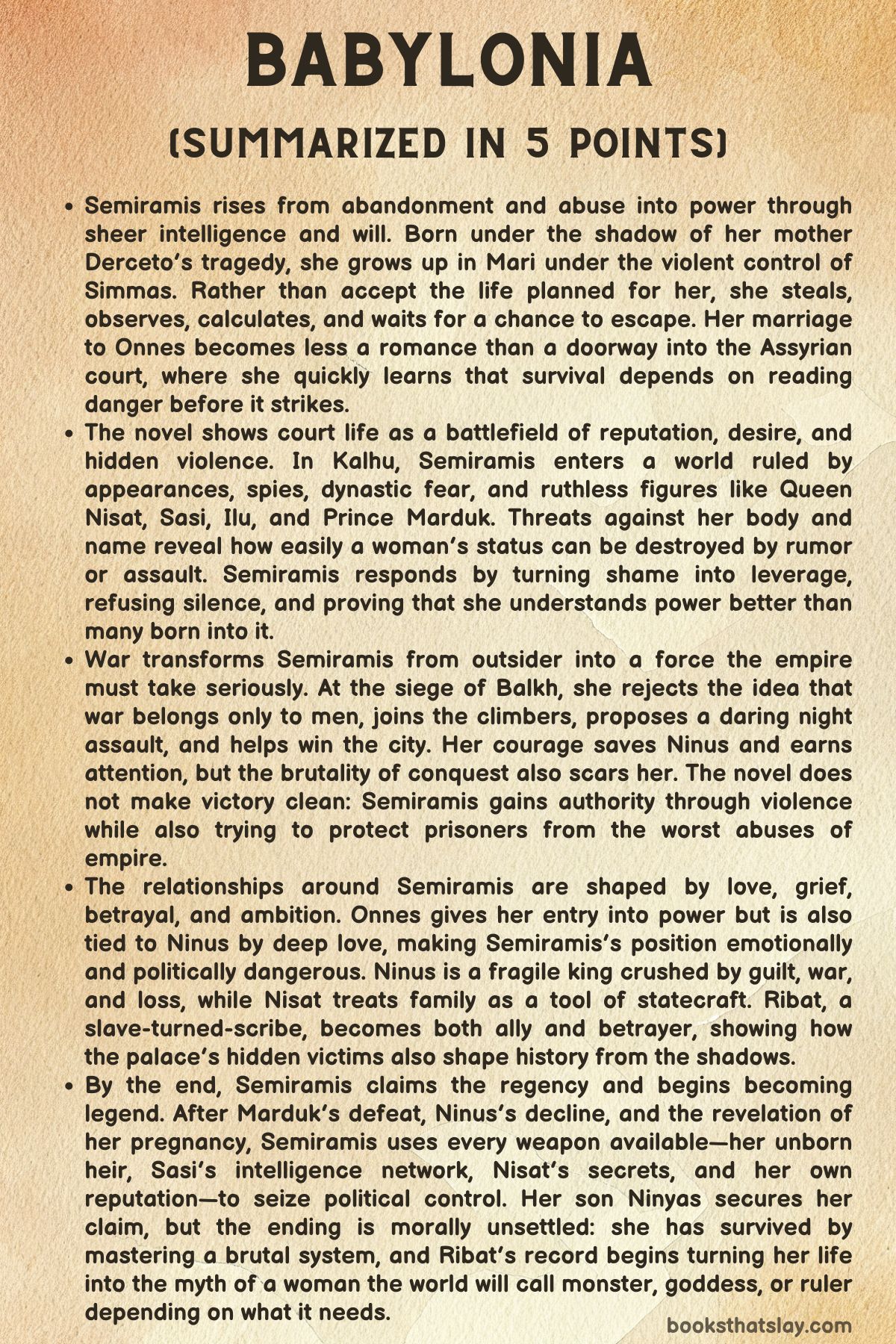
Summary
Long before Semiramis is known by any title, a woman named Derceto is driven to ruin by abandonment. She takes her infant to a sanctuary at dusk to confront the man who left her, a devotee who tends the altar of Aphrodite.
She demands he acknowledge the child. He denies her.
In a burst of fury and despair, she forces the baby into his arms and stabs him with a sacrificial knife. Afterward, believing there is no mercy in the world for either of them, she carries the infant to the lake where she once met him.
She ties herself to a stone and drowns, leaving her child to whatever fate will come. The story of Derceto and the child survives as rumor and legend, and it will later be used as a weapon in a royal court.
Years later, in the Assyrian province of Eber-Nari, a teenage girl named Semiramis lives in Mari under the control of Simmas, a brutal guardian who treats her as property. Semiramis steals whenever she can, not for thrill but for a plan: she is building a hidden hoard as the price of escape.
When she hears men hunting a wounded noble after an ambush, she approaches him and offers help only if he pays. The man, richly armed and adorned, agrees—then dies when soldiers’ arrows find him again.
Semiramis barely escapes the hunters, hiding so close to the roots of trees that she becomes part of the ground. She returns home with the dead man’s rings and adds them to her secret cache.
The village soon learns the dead man was the province’s governor, accused of treason in a civil conflict. Soldiers impale the corpse as a warning.
Semiramis, who understands how fear is staged, returns to the body at night and quietly cleans the blood from it, then burns the rag, as if erasing the spectacle’s hold over her. The war ends when Shamshi-Adad claims the throne and sends a new governor to restore order.
The village prepares lavishly, eager to survive the attention of power.
The new governor arrives with troops: Onnes. Semiramis watches from the walls, intent on being noticed.
Before dawn she slips out and finds Onnes bathing in the river. When he catches her spying, he does not punish her.
Instead he studies her and says she resembles Ishtar. The remark lands like a hook in her mind—part compliment, part warning, part invitation.
During a feast, Onnes speaks with her again and treats her like a person rather than a shameful girl from a minor place. Semiramis pushes further, seeking a diviner to tell her future.
She receives a prophecy: a woman arrayed in purple and gold, holding a cup, who will be as great as Babylon. The diviner refuses to explain, leaving Semiramis with a promise and a threat wrapped together.
Her chance to break free arrives in violence. Simmas discovers her stolen treasure.
He beats her and demands confession. Bruised and bleeding, Semiramis chooses survival over silence.
She sneaks into Onnes’s camp at night and forces herself into his protection by revealing just enough truth to make action unavoidable. In public, Onnes accuses Simmas of theft and makes him answer for it.
Semiramis stands in the square, refuses to retract her words, and watches Onnes cut off Simmas’s hand. The village turns on her.
Even her brother Amon, gentle but trapped by custom, condemns her. Onnes tells Semiramis she cannot remain in Mari and offers her a way out: she will come with him, and they will marry.
Semiramis accepts, understanding that marriage is not romance here but a door.
In Kalhu, the Assyrian capital’s scale and wealth shock her—monumental gates, crowded streets, palace corridors thick with listening servants. She is dressed, bathed, and remade into a governor’s wife, yet she senses she is still being measured as novelty.
She meets the court’s sharper edges: Queen Nisat, the king’s mother, who moves like a judge; Sasi, a eunuch spymaster who speaks with the calm of a man who knows everyone’s secrets; and the young king Ninus, haunted by death and the recent civil war. Ninus and Onnes share an intimacy that is deeper than friendship, and it shapes how everyone around them treads.
Semiramis learns quickly that status can be destroyed as easily as flesh. Prince Marduk corners her when Onnes is away, forcing proximity and threat.
A slave named Ribat intervenes with a lie—claiming the spymaster is waiting—giving Semiramis the opening to escape. She realizes Ribat did more than save her body; he protected her position.
Soon afterward, someone smears pig’s blood on her palace walls, writing an insult that brands her a whore. Semiramis identifies Marduk as the source and refuses to hide.
She confronts his sister, Princess Taria, and makes the threat plain: if Marduk tries again, she will respond with violence and scandal.
War then pulls the court outward. News comes from Balkh: Assyria’s forces are trapped in a grinding siege, and they need climbers to scale the city.
Semiramis understands Onnes and Ninus are in danger and decides she will go, even as men insist war is not for women. She joins the climbers, crosses burned lands, and reaches the siege camp.
There she finds Onnes exhausted and wounded, and Ninus strained by command and loss. In council, generals sneer at her presence, but she speaks with tactical clarity.
She proposes an assault through a ravine at night, targeting archer posts and the acropolis, using fire as diversion. Ninus approves her plan.
The attack is chaos and cruelty. Onnes leads men through a foul tunnel and fights inside the city at dawn.
Semiramis climbs with the night party, kills guards at close range, and watches comrades fall. When the moment comes, she sets the acropolis ablaze.
The fire turns the city into panic. Amid the collapse, she saves Ninus’s life, dragging him to cover and binding his wounds while enemy soldiers spear corpses around them.
When she searches for survivors, she is struck by an arrow and nearly dies. She wakes in a tent, wounded, while the aftermath unfolds: looting, impalements, mutilations, and the cold machinery of conquest.
Horrified, Semiramis pushes for a different kind of control. She asks Ninus for the right to claim women and children prisoners so soldiers cannot abuse them, and he grants it, marking her as both useful and dangerous.
Back in Kalhu, the household has suffered famine and strain while she was away. Ribat’s story expands: once a slave, he taught himself to read by studying brands and signs, collecting knowledge like stolen bread.
He listens at doors and stores what he learns. He also carries the buried trauma of his mother’s death and a secret tied to the queen’s household.
When the army returns, Semiramis is no longer merely a rescued village girl; she has war’s mark on her body and the king’s attention on her face.
As court life resumes, rumor sharpens. A popular song circulates about an Assyrian king who desired his governor’s wife and drove the husband to suicide.
It hits too close to what the palace suspects and what Semiramis fears. Onnes is dead, and Ninus is broken by grief.
Semiramis tries to reach him, but he recoils, accusing her of endless hunger and blaming her for the losses around him. She turns to training, forcing the ruthless general Ilu to teach her, even when he mocks her and boasts of his own brutality.
Ilu also reveals a dangerous affair with Queen Nisat, a secret that explains the tension beneath the palace’s ceremonies.
Political pressure tightens. Nisat pushes Ninus to secure the dynasty through marriage arrangements, including for his daughter Sosanê.
Ninus resists, then is forced into acceptance. Sosanê is married to Ilu’s son, Sargon, a union meant to anchor power.
Meanwhile threats gather: Urartu raids the north, and Babylon’s king dies. Marduk takes Babylon’s throne and declares war, assembling allies.
Semiramis urges defense and restraint, but Ninus insists on marching to strike early. Their argument turns vicious.
He lashes out, accusing her ambition and tying his pain over Onnes to her presence.
Semiramis rides after the army, refusing to be left behind. Battle at Dur becomes a massacre in mud and rain.
Ninus is badly wounded. Marduk is captured alive, and Semiramis goes to him.
He taunts her, naming what others only hint: that she wants the throne. Semiramis kills him with her own hand, removing Babylon’s king and changing the war’s shape in a single act.
Ninus returns to Kalhu with a festering wound and fever. Semiramis tries to keep him alive and summons Ribat, now used as a scribe and attendant, to help guard him and deliver medicine.
In a crucial moment, Ribat hesitates and withholds the willow-bark remedy, guided by memories of his mother’s poisoning and the secret that ruined her. Ninus worsens.
Babylonian envoys arrive asking for stability, and Semiramis speaks with the authority of someone already stepping into command. Ninus dies after she reveals she is pregnant with his heir.
His death leaves the court exposed: Nisat threatens execution and exile, intending to rule through Sosanê and Sargon, but the pregnancy changes the math.
Semiramis fights for regency. She argues that if she bears a son, the child must inherit, and that Nisat cannot trust Ilu and Sargon to hold power without turning it against her.
Sasi aligns himself with Semiramis, offering the court’s hidden mechanisms. Ilu tries to intimidate her; her leopard bites him, and she corners him with the threat of exposing his affair with Nisat.
Semiramis then summons the court, announces she carries a boy, and claims rule as regent until her son comes of age. She lays out plans for control, expansion, and rebuilding, beginning with Babylon.
In the end, Semiramis gives birth to a son, Ninyas. Sasi suspects Ribat’s betrayal, but Semiramis protects Ribat publicly, understanding that he is both useful and bound to her story.
Privately, she confronts him, seeing the link between his mother’s death and the palace’s corrupt center. She does not forgive him, not yet.
Ribat returns to his tablets and begins writing the account of how a girl from Mari became the ruler of an empire—and how the world would call her monster, myth, or goddess depending on what it needed.
Characters
Derceto
Derceto is introduced as a woman pushed to the edge by abandonment, public shame, and the brutal arithmetic of survival. Her early tenderness—seen in the way she once believed in nightly promises and a private life by the lake—has curdled into a rage that is not random but targeted: she wants recognition, legitimacy, and a future for her child in a world that offers her none.
When she kills the sculptor-priest at the sanctuary, the act reads as both revenge and indictment, a refusal to accept that a man can create beauty for a goddess while discarding the living woman beside him. Her suicide is not framed as weakness so much as a final verdict on the society around her; she concludes mercy is absent, and her last thought—wondering who her daughter might become—reveals that even in despair, she is still oriented toward the child’s fate.
Derceto’s presence then lingers like a mythic undertow through the later narrative, because the rumor that Semiramis is her daughter recasts personal history as divine genealogy, turning one woman’s private tragedy into political and religious weaponry within court gossip.
The Sculptor-Priest of Aphrodite
The unnamed man in the sanctuary functions as both lover and symbol: a person who makes sacred beauty with his hands yet cannot withstand the consequences of intimacy. His devotion to Aphrodite is real—he polishes the altar with care and speaks of punishment—suggesting a psyche split between spiritual fear and human desire.
His secrecy about his name and his dread of divine retribution also imply that his relationship with Derceto was never simply romance; it was transgression in his own worldview, and pregnancy exposes the cost of that contradiction. The brief softening when he holds the baby hints he is not purely cruel, but his refusal is definitive, and that final cowardice becomes the spark for Derceto’s violence and the child’s abandonment.
Because he dies insisting on a narrative—“the baby is not mine,” “the goddess punishes me”—he also represents how institutions (temple, gods, purity) can be used to deny responsibility, leaving women to bear the consequences in blood.
Semiramis
Semiramis is the novel’s central engine: a survivor whose intelligence is as sharp as her hunger, and whose hunger is never merely for comfort, but for exit, leverage, and control. From the beginning she learns to treat danger as terrain—hiding between roots rather than choosing the obvious cave, calculating the value of rings before she touches a dying man, building a secret hoard as a literal map out of captivity.
Her moral universe is pragmatic and evolving: she can cleanse a traitor’s corpse with quiet reverence, yet also sabotage Baaz’s protections out of revenge; she can brutalize Simmas through a public accusation while still insisting later that women and children prisoners deserve protection. What makes her compelling is that she is not softened into innocence or hardened into cruelty as a single fixed identity—she is adaptive, and her adaptation produces both creation and ruin.
In court she rapidly grasps that reputation is power’s bloodstream, and when threatened by Marduk’s assault and the blood-lettering, she responds not as a victim seeking comfort but as a political actor forcing witnesses, setting boundaries, and turning humiliation into a display of defiance.
In war she becomes decisive in a way the male commanders underestimate: she sees the terrain, proposes the ravine climb, executes violence with her own hands, and saves the king’s life, but afterward she also bears the sickness of what victory costs.
Her rise to regency is therefore not a sudden transformation but the culmination of her lifelong pattern—refusing the role assigned to her, reading the real rules of the world faster than everyone else, and then using those rules to seize a place where she cannot be discarded again.
Simmas
Simmas embodies domestic tyranny disguised as guardianship, using social rules—marriageability, female purity, paternal authority—as instruments of ownership. His control over Semiramis intensifies as soon as he perceives her body has changed, which reveals that his violence is not only about discipline but about possession and the trading of her future for his benefit.
The moment he discovers the rings, he does not investigate; he escalates to torture, beating her until she faints, because the confession he wants is not truth but submission. His punishment—losing a hand publicly—mirrors his private threat to cut off Semiramis’s hand for theft earlier in the story and turns his own logic back onto him.
Yet the narrative also makes his defeat costly: it severs Semiramis from her village and even from Amon, showing how abuse can poison the social fabric so thoroughly that the victim’s escape is treated as betrayal.
Amon
Amon is Semiramis’s emotional anchor and the closest thing she has to a safe familial bond, which makes his eventual rejection one of the story’s crueler turns. He is gentle where Simmas is brutal, and his affection suggests that Semiramis’s hardness is not innate; it is learned under pressure.
He also serves as a moral counterweight, reacting with genuine horror when Semiramis participates in Simmas’s maiming, not because he loves Simmas, but because he fears what Semiramis is becoming and what their community will unleash in response. When he tells her she is no longer welcome, it underlines the novel’s recurring theme that survival often demands choices that shatter belonging, and that even love can become conditional when power and fear enter the room.
Baaz
Baaz functions as the village’s petty cruelty made personal—an ordinary boy whose insults about Semiramis’s mother expose how easily misogyny becomes communal sport. His role is not primarily political but social: he helps establish that Semiramis grows up in a world where her reputation is always under assault and where shame is a weapon anyone can pick up.
Semiramis’s revenge—stealing and discarding his protective seals—shows how she learns early to strike at what others value, not to win an argument but to inflict consequence. Baaz therefore helps shape her method: if a society will not protect her dignity, she will protect herself through leverage and retaliation.
Onnes
Onnes is both rescuer and gatekeeper, a man whose calm authority attracts Semiramis because it offers what her village never did: choice. He sees her clearly enough to name her resemblance to Ishtar, and that naming matters—he elevates her from “girl under a guardian” to someone with mythic possibility, even if it begins as flirtation.
His protection of her from Simmas and his decision to marry her reveal a complex ethics: he wants justice, but he also wants possession, and his “rescue” comes with a new structure of dependence—palace walls instead of village walls. He is perceptive enough to deduce Semiramis’s deception about the gold, yet instead of punishing her, he admires her resilience, which suggests he is drawn to strength even when it is dangerous.
Over time, his bond with Ninus and his knowledge that “anyone can be killed” place him at the heart of a court defined by paranoia, and his death becomes a turning point not only for Ninus’s stability but for Semiramis’s political trajectory. In a sense, Onnes is the bridge that brings Semiramis into empire, and when the bridge collapses, it leaves behind both grief and opportunity—especially because the popular song about a king desiring a governor’s wife weaponizes their relationship into scandal and myth.
Ninus
Ninus is a king shaped by inheritance of violence more than by appetite for it, a ruler haunted by dead relatives, palace shadows, and the knowledge that his crown is soaked in family blood. His inner life is defined by exhaustion and fear—he reads of divine punishment, dreads sleep, and seeks safety not in power but in proximity to his child—yet his position demands spectacle, and his mother teaches him to perform controlled cruelty as governance.
His relationship with Onnes reveals the tenderness he cannot safely display elsewhere; their bond is presented as devotion that deepens into love and kinship, and the later revelation that Onnes is his half-brother intensifies the tragedy, because it means the palace’s family violence was always cannibalizing its own. Ninus’s instability is not simply weakness; it is the human cost of ruling within a system that rewards brutality and punishes doubt.
In war, he swings between resolve and disgust, participating in massacre, vomiting at impalements, and clinging to Semiramis as both desire and refuge. His conflict with Semiramis grows from recognizing in her the competence and hunger he fears in himself—she is capable of steering the state while he is still mourning inside it.
His death is therefore both personal collapse and political opening, and the fact that Semiramis must argue for legitimacy beside his corpse shows how little room the empire gives a grieving man, let alone a woman, to be human.
Queen Nisat
Nisat is the novel’s purest expression of court power: strategic, ruthless, and terrifyingly intimate in the way she speaks to her son. She frames love as weakness and survival as dominance, and she does not merely advise Ninus—she scripts his rule, ordering pardons and executions like stage directions.
Her contempt for grief and her insistence that she “ensured” the succession make her both mother and architect, implying that family bonds in this palace are instruments, not sanctuaries. Her affair with Ilu exposes hypocrisy in her moral posture and also clarifies her real ideology: desire and power are intertwined, and she feels entitled to both without apology.
Nisat’s threat to replace Ninus reveals she believes legitimacy comes not from divine right but from whoever can hold the knife behind the curtain. When Semiramis challenges her after Ninus’s death, Nisat becomes the primary obstacle—not because she doubts Semiramis’s intelligence, but because she recognizes it, and she knows an ambitious regent can dismantle the queen mother’s control.
In that sense, Nisat is not merely an antagonist; she is the mirror of what Semiramis may become, minus the empathy Semiramis still struggles to preserve.
Sosanê
Sosanê represents what power costs the innocent, a child positioned as both beloved and bargaining chip. Her loneliness in Nisat’s household and her attachment to myths suggest she survives the palace the way many children do—through stories that give shape to fear.
Her bond with Ninus reveals his capacity for gentleness, and her marriage to Sargon shows how quickly her personhood is overridden by alliance-making. Sosanê’s continued affection for Assur despite betrayal highlights a child’s ability to love without political calculus, which becomes tragic in a world where affection is dangerous.
As Semiramis rises, Sosanê also becomes a test of Semiramis’s values: whether she will treat the girl as a pawn like the others do, or as a human being worth protecting within the machinery of empire.
Ribat
Ribat is introduced as someone who learns to read through pain, turning the brands and scars of slavery into an alphabet and transforming observation into power. His role in the palace is deceptively small—errands, preparation, overheard secrets—but the narrative makes clear that servants are the nervous system of court life, carrying information where nobles assume silence.
His rescue of Semiramis from Marduk is not heroic in a romantic sense; it is calculated protection of a political asset, because he understands that reputation is survival and that her fall would drag him down as well. His discovery of Nisat and Ilu’s affair reframes his entire existence: his mother’s death is tied to elite corruption, and his later betrayal of Ninus by withholding medicine becomes an act of vengeance disguised as hesitation.
What complicates Ribat is that he is not simply loyal or treacherous—he is shaped by a lifetime of being used, and when he finally gains a chance to tilt fate, he does so, even if it costs a king. Semiramis’s choice to protect him publicly despite suspecting the truth shows her grasp of the political value of a capable scribe—and also her willingness to live with unresolved moral debt, because forgiveness is a luxury rulers rarely afford themselves.
Ana
Ana appears as part of Semiramis’s household survival network, a practical presence during famine and scarcity when glamour collapses into logistics. Her importance lies in what she represents: that empire is not sustained only by kings and generals, but by those who stretch dwindling resources, negotiate with healers, and keep bodies alive while elites make speeches.
Ana’s quieter labor makes Semiramis’s later authority feel grounded; even the most mythic ascent still depends on ordinary endurance behind the scenes.
Sasi
Sasi is the court’s listening ear made flesh, a spymaster who speaks with unsettling frankness because he already knows what others try to hide. He treats Semiramis not as an oddity but as a usable force, hinting early that he sees kinship in her appetite for survival and ascendancy.
His personal history—deportation, choosing eunuchhood to live, losing a lover—gives him a philosophy of shedding grief and sentiment like skin, and he pressures Semiramis toward that same hardening. Yet he is not merely cynical; he understands that narratives rule empires, and he watches how rumors about Derceto can destabilize legitimacy just as effectively as armies.
When he pledges support to Semiramis after Ninus’s death, it is both alliance and warning: he will back the winning structure, but he will also keep accounts. Sasi’s presence reinforces that the greatest battles in the palace are fought with information, not swords.
Prince Marduk
Marduk is violence wrapped in entitlement, using status and sexual threat as a way to remind Semiramis that in the palace, power is gendered and predatory. His attack in the courtyard is not only personal assault; it is a political strike meant to reduce her to scandal and thereby neutralize her influence.
The blood-lettering on the palace wall extends that strategy into public language, attempting to brand her identity before she can define it herself. Later, when he becomes Babylon’s king and declares war, the predatory impulse becomes geopolitical—he is still the man who takes and humiliates, only now with armies.
Semiramis killing him is therefore more than battlefield necessity; it is the culmination of her refusal to be defined by his narrative, cutting off both the personal threat and the political one in a single ruthless act.
Princess Taria
Taria functions as the palace’s mechanism of denial, the kind of figure who protects her male relatives by refusing to see what is directly in front of her. When Semiramis forces her to face the blood insult, Taria’s resistance shows how complicity often looks like disbelief rather than open cruelty.
She is important because she demonstrates the social insulation of aristocratic women: even when they are adjacent to danger, they may choose the safety of pretending it is not real. Semiramis’s threat—sending the leopard—exposes the only language that can pierce that insulation in this world: fear of consequences.
Bel
Bel arrives as the messenger of desperation, recruiting “climbers” with promises that barely cover the stench of impending slaughter. His value is in his competence and adaptability; he resists Semiramis joining out of conventional assumptions, then accepts her under conditions that acknowledge her capability while still treating her as a risk.
In the Balkh assault, Bel becomes one of the story’s clearest examples of war’s indifference—his death is abrupt and grotesque, and it underlines that courage and skill do not guarantee survival. For Semiramis, Bel’s arc also matters because he is the gate she forces open: by making him take her seriously, she enters the traditionally male space of military glory, and she does it not through permission but through insistence.
Ilu
Ilu is the empire’s brutality given voice, a general who believes terror is not a side effect of war but its instrument. He mocks mercy, treats impalement as policy, and measures kings by their willingness to stomach atrocity.
His intimacy with Nisat reveals that the most violent men often thrive not despite court politics but because of them; cruelty is rewarded with access. Ilu’s interactions with Semiramis are a contest of ideologies: she seeks power but also insists on selective protection for prisoners, while he ridicules that as weakness.
When Semiramis forces him to train her, she is effectively compelling the empire to teach her its own language of violence, so she can speak it better than those who would use it against her. His eventual vulnerability—bitten by her leopard and threatened with exposure—shows that even the most feared enforcer can be controlled if you find the right pressure point.
Assur
Assur exists largely through memory, accusation, and absence, which is fitting because his death is one of the palace’s foundational wounds. He is labeled traitor by Nisat and treated as the justification for Ninus’s guilt, but the emotional truth is more complicated: he is a brother whose murder haunts the living, a reminder that royal legitimacy can be built on fratricide.
Assur’s presence in the story is therefore less about his personal actions and more about what others do with his name—Nisat using it to discipline Ninus, Ninus using it to measure his own corruption, and Sosanê remembering him with a child’s loyalty that ignores political verdicts.
Shamshi-Adad
Shamshi-Adad appears as the figurehead of stability after civil war, the king whose victory allows roads to feel safer and governance to reassert itself. His relative distance from Semiramis, and the way court debates happen around him, suggest a ruler who presides over a machine already full of competing agendas.
His significance is structural: he represents the empire as an inheritance that new players—Onnes, Ninus, Semiramis—must navigate, and he is part of the backdrop that makes Semiramis’s later regency plausible, because the state already knows how to accept strong centralized command, regardless of who is speaking.
Mannu, Luqa, and the Other Climbers
The climbers around Semiramis are sketched through action and death rather than backstory, but they matter because they show the human cost that makes Semiramis’s triumph morally heavy. Their falls and arrow-struck ends are not simply scenery; they are the price paid for the plan Semiramis proposes and executes.
By placing nameless or lightly named soldiers beside a protagonist who will later wear power, the story keeps insisting that empire is built not only by singular greatness but by many extinguished lives that history will barely record.
Themes
Abandonment, belonging, and the fear of being left behind
In Babylonia, abandonment is not just a personal wound; it behaves like a social sentence that decides who deserves shelter and who can be discarded without consequence. Derceto is pushed outside every circle that could have protected her—lover, sanctuary, village—and the brutal logic is consistent: a woman without recognized ties is treated as a problem to be removed rather than a person to be helped.
Her last choices are shaped by that reality, and even her tenderness turns into something desperate, because affection without safety becomes another form of danger. Semiramis grows up inside a different version of the same problem.
She is technically “kept” by a household, but her guardian’s control makes belonging feel like captivity. The moment her body signals adulthood, she becomes property to be transferred, and the threat of forced marriage is framed as normal order rather than violence.
Her obsession with a hidden stash of stolen objects reads as a substitute for family protection: if no one will keep her safe because they love her, she will try to buy distance from those who can harm her. Even Ninus, surrounded by palace walls and servants, moves through a private abandonment—dead relatives, betrayed brother, and a mother who treats affection as weakness.
His loneliness is not solved by power; it is sharpened by it, because the throne turns intimacy into risk and grief into political liability. Across these arcs, belonging is portrayed as conditional, earned through obedience to a system that is willing to reject people the instant they stop fitting its needs.
That is why relationships in the story keep carrying a threat beneath them: love can vanish, loyalty can be demanded, and care can be weaponized. When characters reach for attachment, they are also reaching for protection, legitimacy, and a place where they cannot be thrown away.
The tragedy is that the world they live in keeps confusing those things, so the search for home becomes entangled with bargaining, performance, and force.
Power as a language that replaces love
Power in Babylonia functions like a dialect everyone must speak to survive, even when they would rather communicate in trust, affection, or honesty. Semiramis learns early that vulnerability invites punishment, and she reshapes herself into someone who can negotiate danger with daring, calculation, and the ability to read what others want.
Her first exchanges—gold for aid, silence for safety, blame turned back onto an abuser—show that influence is not presented as a moral reward but as a tool for staying alive. The court intensifies this lesson.
The palace offers luxury and status, but it also demands constant interpretation: who is watching, who is testing, who is waiting for an error. Semiramis begins to treat her reputation like armor, because a single label can ruin her more thoroughly than a knife.
That is why she refuses to erase insults quietly; she understands that public perception is a battlefield where surrender becomes permanent. Ninus illustrates a different face of power: authority that exists on paper but feels hollow inside.
His mother pushes him to perform strength through ritualized cruelty, teaching him that rule is theater and punishment is messaging. Even his acts of mercy are framed as strategy rather than conscience.
This creates a ruler who is haunted by what he must do to appear secure, and who becomes increasingly reactive when he senses he is being managed by stronger personalities. Onnes and Nisat embody political intimacy—relationships that carry emotional heat but also function as leverage, access, and protection.
The story repeatedly shows that affection can be present, but it does not exempt anyone from the rules of domination; it simply changes how those rules are enforced. Semiramis’s rise is therefore not a simple tale of ambition.
It is a portrait of someone recognizing that in her world, love is unreliable while authority can be made tangible through decisive action, spectacle, and control of narrative. The tragedy is that once power becomes her most stable form of safety, stepping away from it would feel like stepping back toward the helplessness she escaped.
Her growth into leadership is tied to an unsettling insight: to be treated as fully human, she may have to become someone the system fears.
Gender, bodily autonomy, and the costs of being seen
Gender in Babylonia is presented as a set of expectations enforced through shame, threat, and ownership of women’s bodies. The story does not treat these pressures as background detail; they shape every major decision.
Derceto’s pregnancy becomes a public verdict that strips her of community, transforming what could have been a private experience into a weapon used against her. The rejection she faces is not framed as personal cruelty alone; it is institutional, supported by religious spaces, village norms, and male refusal to acknowledge responsibility.
Semiramis inherits the consequences of that system in a more prolonged form. Menstruation triggers a shift in how others look at her: from troublesome girl to tradable woman.
Simmas’s violence is both physical and symbolic, because it attempts to force her into a role where obedience is her only acceptable identity. Even after she enters the palace through marriage, the scrutiny does not soften.
Instead, it grows more complex: she is sexualized as an outsider, mocked as a novelty, and threatened by men who treat access to her body as proof of their rank. The attempted assault by Marduk is especially telling because it is not only about desire; it is about humiliating her position and proving that her status can be violated if the right man decides to test it.
The blood message on her wall makes the same point with a different weapon: reputation as social violence, designed to isolate her and reduce her political credibility. Semiramis’s response reveals how autonomy is pursued in this environment.
She trains, she strategizes, she makes threats, and she forces witnesses into the open, because silence is what allows the system to keep repeating itself. Yet the theme is not limited to women.
Ninus is also trapped by gendered expectations of kingship: he must be decisive, violent when required, and emotionally sealed. His grief is treated as feminine weakness, his exhaustion as failure, and his relationships as vulnerabilities to be exploited.
That contrast reinforces the central point: the society’s rules injure everyone, but they concentrate harm on those whose bodies are treated as resources. When Semiramis becomes pregnant, her body again turns into a political object—proof of legitimacy, a bargaining chip, and a reason she can claim authority.
Autonomy is therefore depicted as partial and conditional: characters can seize it through power and strategy, but the world keeps trying to repossess it through law, rumor, and force.
Violence as governance, and the moral injury it leaves behind
In Babylonia, violence is not merely a burst of chaos; it is a deliberate method of ordering society, enforcing loyalty, and producing fear that can be managed. The early scenes establish how quickly a person can be pushed from desperation into irreversible action, and how institutions fail those who need protection.
Later, the story widens to imperial scale, showing violence as policy: impalements, mutilations, massacres, and the use of spectacle to warn both enemies and allies. What makes this theme potent is that the narrative repeatedly shows the psychological cost of participating in such systems, even for those who benefit from them.
Semiramis enters war with confidence in her capability, but the aftermath forces her to face what competence can enable. The burning of a city, the deaths of civilians, and the organized cruelty inflicted on defeated leaders confront her with a question she cannot escape: if terror is effective, does effectiveness become its own excuse?
Her attempt to protect women and children prisoners is important not because it cleanses the campaign, but because it reveals a struggle to retain a part of herself that can still recognize suffering as real rather than as strategy. Onnes embodies the rationalization that sustains empire.
He explains brutality as tradition, deterrence, even mercy compared to worse histories, which is how violent institutions preserve themselves: they normalize extremes by comparing them to something even more horrific. Ninus represents moral injury in a ruler’s body.
He authorizes and witnesses cruelty, then responds with nausea, rage, and sleeplessness, suggesting that his mind cannot fully convert killing into an abstract act of rule. The court also uses violence in subtler forms—sexual threat, rumor, coercion, and the quiet removal of inconvenient people—showing that governance does not always need open bloodshed to be cruel.
The theme culminates in the way killing becomes a political solution, from battlefield decisions to the execution of a rival king. Semiramis stabbing Marduk is framed as removing a threat, but it also demonstrates how the story’s world trains leaders to treat death as a tool for stability.
The lingering impact is that violence does not stop once it achieves its immediate goal. It continues inside the survivors as fear, guilt, and distrust, shaping future choices and making tenderness feel dangerous.
The narrative suggests that an empire built on terror eventually requires everyone, even its victors, to live inside terror’s shadow.
Prophecy, myth, and the stories people use to justify authority
Prophecy and myth in Babylonia function as public language for explaining private ambition and public fear. Characters do not treat divine narratives as distant folklore; they experience them as forces that can be invoked, feared, or manipulated.
Semiramis is repeatedly linked to Ishtar, first through resemblance and later through the ways she embraces qualities associated with a powerful goddess: audacity, appetite for risk, and refusal to accept the limits assigned to her. That association is not only spiritual; it becomes political shorthand that others can use to elevate her or to accuse her of transgression.
The diviner’s vision of a woman “arrayed in purple and gold” positions Semiramis’s desire as something larger than personal escape, which can be empowering but also dangerous. Once a person is wrapped in prophecy, their choices can be framed as destiny rather than agency, and rivals can claim the gods are on their side of the story.
The rumor that Semiramis is descended from a fish goddess demonstrates how quickly myth becomes propaganda. Even when Semiramis denies it, the tale spreads because it serves a social need: people want an explanation that makes a shocking rise feel comprehensible.
A commoner becoming queen can look intolerable unless the world can pretend she was always meant for it. Ninus’s relationship with myth is more anxious.
He reads about divine punishment and catastrophe as if searching for rules that might make his guilt legible. His dreams turn into a courtroom where he is both judge and condemned, suggesting that belief systems can intensify trauma rather than heal it.
Nisat uses the language of strength and fate in a different way, treating outcomes as proof that her choices were correct, as if survival itself is the gods’ endorsement. The tension between these approaches reveals how myth operates: it can be comfort, threat, explanation, and weapon, depending on who is speaking and what they need.
The story also shows that prophecy can become self-fulfilling because people act differently once they believe a certain future is “real.” Semiramis hears a grand prediction and becomes more determined; others hear rumors and become more suspicious; the court shifts its behavior around the idea that she is extraordinary. In that sense, the gods matter not only as supernatural beings, but as social instruments.
Belief gives authority a sacred sheen, and sacred sheen makes brutality easier to defend. Yet the narrative keeps space for ambiguity: whether destiny exists is less important than the fact that people behave as if it does, and that behavior reshapes the world.
Memory, guilt, and who gets to write the truth
Memory in Babylonia is portrayed as both burden and currency. Ninus is surrounded by the dead, not only through literal loss but through the way violence creates unresolved accounts that follow him into waking life.
He cannot separate kingship from the murders that brought him to the throne, and he experiences his past as a presence in rooms, dreams, and silences. This is not nostalgic remembrance; it is haunting responsibility, made worse by a court culture that treats grief as weakness.
Semiramis carries a different kind of memory: the knowledge of what she has endured and what she has done to survive. Her past with Simmas does not disappear when she becomes powerful; it becomes the template she uses to recognize danger quickly and to refuse quiet submission.
At the same time, her later actions in war produce new memories that challenge the identity she wants to keep. Saving a king and burning a city can coexist in the same person, and the story insists that such coexistence creates internal conflict rather than neat resolution.
Ribat embodies memory as record. His ability to read, learned through scars and stolen study, turns knowledge into resistance against a world that expects him to remain invisible.
His private motive—tied to his mother’s death and the secrets of the palace—shows how the oppressed are often forced to carry the truth of elite cruelty without being allowed to speak it openly. When he withholds medicine and helps a death along, the act is shaped by memory as much as by malice: a calculation formed from years of witnessing what power does to people like him.
The final movement toward writing Semiramis’s story raises questions about authorship and control. History is not presented as neutral; it is something produced by someone with access, motive, and fear.
Semiramis’s decision to protect Ribat publicly while admitting she cannot forgive him privately captures how rulers manage narrative: they choose which truths become public, which become private, and which are buried for stability. The theme also illuminates the mechanics of reputation throughout the court—songs, rumors, and public performances shape what people “know,” sometimes more than events themselves.
When a boy sings a ballad that echoes Semiramis’s situation, the court’s reaction shows how art can threaten authority by reminding everyone of an uncomfortable pattern. Memory therefore becomes political.
It can be weaponized by enemies, suppressed by leaders, or preserved by scribes who decide what will outlive them. The story suggests that survival is not only about staying alive, but about controlling which version of your life is allowed to endure after you are gone.