Bad Bishop Summary, Characters and Themes
Bad Bishop by LJ Shen is a dark and gripping novel set in the brutal world of organized crime. The story centers on Tiernan Callaghan, a ruthless mobster whose calculated violence and sadistic nature make him feared and respected.
His world collides with that of Lila Ferrante, the daughter of a powerful Mafia family, when he is forced into an arranged marriage with her. Lila, scarred by a traumatic event and her family’s ruthless control, finds herself trapped in a complex and dangerous situation. As their lives become intertwined, the story explores themes of power, betrayal, and emotional turmoil, all while navigating the perilous underworld of crime and family loyalty.
Summary
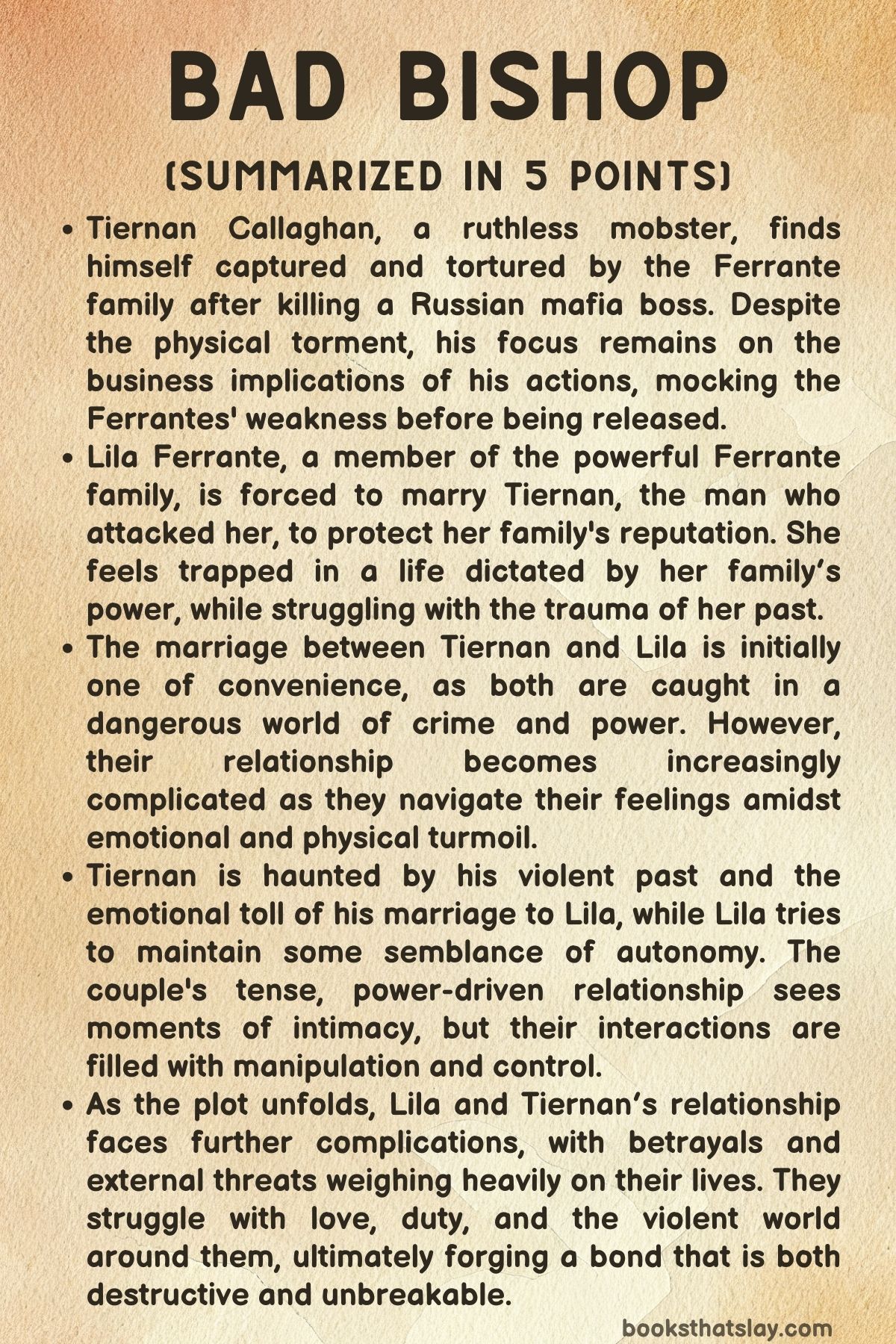
Tiernan Callaghan, a brutal mobster with a sadistic streak, finds himself in a tense situation with the Ferrante crime family. After he kills Igor Rasputin, the leader of the Russian mafia, he becomes a target for the Ferrantes.
They capture him, intending to extract information about his actions and punish him for disrupting their operations. However, Tiernan is more irritated by their incompetence than the physical torture.
With his typical coldness, he mocks the Ferrantes and remains unbroken, focusing only on the impact his actions will have on business. After enduring their attempts to break him, Tiernan is released, though warned of future repercussions.
He is injured, but remains defiant, unfazed by the Ferrantes’ threats.
Lila Ferrante, a member of the Ferrante family, is introduced as a central figure. One night, she sees a bloodied, scarred man lurking in her yard.
Initially mistaking him for someone else, she soon realizes that the man is Tiernan. He threatens her with violence, considering whether to kill, kidnap, or assault her.
Despite his menacing demeanor, Lila stays calm, understanding the danger she’s in. Eventually, she manages to escape into the house, though the encounter leaves her shaken.
Lila’s life is one of strict control, dictated by her father, Vello Ferrante. At her brother Luca’s wedding, Lila is forced to play the role of a mentally disabled person, her autonomy stifled by her family’s expectations.
She longs for a moment of freedom, symbolized by a dance with a man named Tate Blackthorn, but instead, she becomes obsessed with Tiernan, the very man who had attacked her. To her dismay, her family plans to marry her off to him.
Her father, driven by the need for power and control, views the marriage as a strategic move to further the family’s influence, regardless of Lila’s trauma. She feels trapped, unable to escape the life her family has chosen for her.
The story takes a darker turn as Lila is left to deal with the aftermath of her assault. She becomes pregnant, and her mother, though devastated, does her best to support her.
However, her father insists that Lila marry Tiernan to protect the family’s reputation and avoid public scandal. Despite the emotional turmoil, Lila’s father sees this as a necessary step to maintain their power.
Lila, crushed by the situation, is forced to accept her fate, though it is clear that her trauma will haunt her for the rest of her life.
The Ferrantes approach Tiernan with a proposition: marry Lila to solidify their power and protect their interests. Though Tiernan initially rejects the idea, seeing it as beneath him, he is eventually convinced to marry Lila, primarily for the business advantages it offers.
Tiernan’s reputation for ruthlessness makes him an ideal match for the Ferrantes, who are desperate to maintain their influence. He agrees to the marriage but remains emotionally distant from Lila, planning to use the union strictly for business purposes.
He also demands that he be allowed to seek revenge on the person responsible for Lila’s assault, vowing to hunt down her rapist.
Meanwhile, Lila is caught between her family’s expectations and her own trauma. The marriage is a strategic move, but for Lila, it is a prison.
Her family forces her into a life she didn’t choose, and her relationship with Tiernan, marked by cruelty and power struggles, becomes even more complicated. Despite her suffering, Lila holds on to some semblance of dignity, using her intelligence to navigate the harsh realities of her life.
She remains defiant, trying to retain control over what little she can.
The wedding night brings more tension and violence. Lila, desperate and emotionally scarred, shoots Tiernan in a moment of rebellion, but her bullet only grazes him.
This intensifies the power dynamics between them, with Tiernan finding pleasure in the struggle for control. The night ends with him overpowering her, setting the tone for the difficult and dangerous relationship that lies ahead.
As time passes, Lila’s situation becomes more unbearable. She is constantly surveilled, manipulated, and belittled.
Her attempts to assert some autonomy, including pretending to have intellectual disabilities to avoid further exploitation, are met with resistance. Her relationship with Tiernan is filled with emotional manipulation, cruelty, and tension.
However, despite his disregard for her feelings, Tiernan becomes obsessed with Lila, sensing that she is hiding something. He grows determined to break her, even as he suspects that she might be faking her disability.
Tiernan’s cold, calculating nature contrasts sharply with his growing fixation on Lila. He is driven by a need to dominate her, but he also becomes more emotionally involved, despite his initial intention to keep his distance.
Lila, for her part, grapples with the emotional and physical toll of her life with Tiernan, struggling to maintain her sanity amidst the chaos. The power dynamics in their marriage are ever-shifting, with Lila caught between submission and resistance.
The narrative takes a deeper turn as Tiernan’s violent past resurfaces. Flashbacks to his childhood reveal the trauma he endured, including his escape from a Siberian labor camp and his complex relationship with his sister, Tierney.
These past experiences shape Tiernan’s current actions and provide insight into his cold, ruthless persona.
Lila’s emotional turmoil deepens as she navigates her pregnancy, complicated by the uncertain paternity of the child. She is torn between her feelings for Tiernan and the reality of their violent, dysfunctional relationship.
Her pregnancy becomes a symbol of both hope and despair, as she contemplates the future for herself and her child in a world ruled by crime and violence.
The tension reaches a boiling point when Lila learns the true identity of her rapist—Fintan, Tiernan’s brother. The revelation is devastating for both Lila and Tiernan, and the betrayal cuts deep.
Tiernan, in a fit of rage and sorrow, confronts Fintan and ultimately kills him, taking justice into his own hands. The murder is framed as retaliation for past wrongs, but the emotional and moral consequences are far-reaching.
In the end, Lila and Tiernan’s bond is solidified through their shared trauma and the intense emotions they have experienced together. They are left to navigate their uncertain future in a world defined by violence, power, and betrayal.
Their relationship, though marked by pain and darkness, is unbreakable as they face the challenges ahead, knowing that their past will always haunt them.
Characters
Tiernan Callaghan
Tiernan Callaghan, the main protagonist in Bad Bishop, is a complex and cold character shaped by a brutal world of organized crime. A ruthless and sadistic mobster, Tiernan thrives on power, control, and violence.
His past is marked by an unrelenting survival instinct, honed through a childhood spent in a Siberian labor camp, and his experiences have turned him into a man who thrives on pain, both inflicting and enduring it. Despite his cruelty, Tiernan is not entirely devoid of depth.
He is manipulative and calculating, always assessing situations for their strategic value, yet a strange obsession with Lila begins to emerge, complicating his emotions. He is a man at war with himself, struggling between his cold exterior and the flickers of feelings for Lila that slowly surface throughout the story.
His relationship with her evolves from one of indifference to an increasingly twisted form of attachment, where control and dominance blend with an unacknowledged need for connection.
Lila Ferrante
Lila Ferrante, the daughter of the powerful Ferrante family, is a victim of circumstance, trapped in a world of family control, violence, and manipulation. Forced into an arranged marriage with Tiernan after being raped by him, Lila’s life is one of constant tension and fear.
Despite being subjected to trauma and subjugation, Lila shows remarkable resilience. Her ability to keep her composure, even in the most terrifying moments, speaks to a strength that contrasts sharply with the trauma she endures.
Lila’s vulnerability is both her burden and her strength. Her role as a pawn in the power struggle between the Ferrantes and Callaghans forces her to navigate a life where her desires, hopes, and identity are stifled.
As her relationship with Tiernan develops, Lila finds herself caught between her fear of him and the flickering emotional connection she develops, making her journey one of survival and, eventually, a search for agency in a world that has systematically robbed her of it.
Vello Ferrante
Vello Ferrante, the patriarch of the Ferrante crime family, is a man driven by power and status. Cold and calculating, he views people, including his own daughter, Lila, as tools to be used for family gain.
His obsession with preserving the family name and expanding their influence blinds him to the emotional toll that his decisions take on those around him, particularly his daughter. Vello is a figure of unwavering authority, wielding control over the family with a firm, sometimes oppressive grip.
His decision to force Lila into a marriage with Tiernan after her rape is a stark representation of his priorities—family honor and power—over personal trauma or morality. Though Vello’s actions are harsh and cruel, they also reflect the nature of the world he inhabits, where decisions are made for the sake of survival and supremacy rather than compassion or justice.
Fintan Callaghan
Fintan Callaghan, Tiernan’s brother, serves as a tragic figure whose actions provide a shocking betrayal. He is introduced as a secondary character who, despite his familial ties, engages in dark, often morally ambiguous behavior.
Fintan’s deep-seated resentment towards Tiernan, stemming from a complicated and painful past, eventually leads him to commit the unthinkable: the rape of Lila. His reasons for this act are deeply rooted in revenge and a desire to harm Tiernan, revealing the toxic dynamics that run through the Callaghan family.
His death, at the hands of Tiernan, is a culmination of years of fractured brotherhood, where betrayal and violence had always simmered just beneath the surface. Fintan’s demise represents the destructive cycle of violence that defines the world of organized crime—where the bonds of family are just as likely to be broken by betrayal as they are to be reinforced by loyalty.
Tierney Callaghan
Tierney Callaghan, Tiernan’s sister, is a character whose past and personal struggles bring complexity to the family dynamic. While not a central figure in the plot, Tierney plays a pivotal role in influencing the actions of those around her, particularly through her relationship with Angelo Bandini.
Her affair with him complicates the already fraught relationship between the Callaghans and the Ferrantes. Tierney represents the emotional turmoil and fractured relationships within the Callaghan family, where personal grievances often interfere with the larger power struggles at play.
Her character provides a contrasting layer to the more dominant, violent personas in the story, offering a glimpse of the vulnerability and complications that can arise even within a family built on power and corruption.
Achilles
Achilles is a secondary character who serves as a source of tension within the story. His relationship with Tierney, marked by conflict and emotional complexity, adds another layer to the chaotic family dynamic.
Achilles, caught in a turbulent emotional battle with Tierney, is entangled in the web of betrayal and family loyalty. His role is essential in highlighting the emotional undercurrents that ripple beneath the surface of the Callaghan family’s violent and ruthless world.
Though his screen time is limited, Achilles’ presence underscores the larger theme of family dysfunction and the personal vendettas that often complicate the already fraught relationships in organized crime.
Themes
Power and Control in a Corrupt World
Bad Bishop is a vivid exploration of how power is wielded and manipulated in a world where violence and crime dictate every facet of life. The characters, particularly Tiernan and Lila, find themselves at the mercy of those who hold power, yet their paths are shaped by their responses to that power.
Tiernan is the embodiment of ruthless control, using fear, intimidation, and violence to maintain his position in the criminal underworld. His cold indifference to the suffering of others contrasts sharply with his desire to maintain his power and influence, even when it comes at the expense of personal relationships.
His decision to marry Lila is rooted in a desire for business advantage rather than love, and this calculated approach to relationships highlights the way in which power dynamics shape his every move.
Lila, on the other hand, is a pawn in the power struggle between families. Forced into a marriage with a man who brutalized her, she is caught between her trauma and the manipulation of her family.
Her father’s insistence on using her as a tool for maintaining the family’s power exposes the darker side of the Mafia world, where individuals are often seen as nothing more than assets. Despite the oppressive environment, Lila attempts to assert some level of control over her life, whether by faking intellectual disabilities or resisting Tiernan’s dominance.
However, this resistance is met with more force and manipulation, and it becomes clear that, for both characters, power does not equate to freedom but rather to further entanglement in a web of control and violence.
Trauma and Survival
Trauma is a central theme in Bad Bishop, both in the characters’ pasts and their present lives. Lila’s experience of assault and her subsequent forced marriage to her rapist highlight the devastating emotional and physical toll of trauma.
Her mother’s attempts to comfort her are overshadowed by the family’s decision to marry her off to her attacker, which underscores the callous nature of a world that values reputation and control over human suffering. Lila’s attempts to regain some autonomy, even in the face of overwhelming trauma, are both heart-wrenching and powerful.
Her emotional survival is portrayed through her determination to maintain her dignity in the face of constant manipulation and control.
Tiernan’s past trauma also plays a significant role in shaping his character. His harsh upbringing, escape from a Siberian labor camp, and subsequent survival tactics demonstrate the deep scars left by his childhood.
The trauma he endured is not only a key motivator for his violent actions but also a source of emotional conflict as he grapples with his growing obsession with Lila. His actions towards her are informed by a mixture of desire for control and the unresolved trauma from his past, which complicates his feelings for her.
Their relationship, built on power and pain, is a constant reminder of the lasting effects of trauma and how it manifests in both the way people treat others and how they cope with their own suffering.
Family Loyalty and Betrayal
Family plays a pivotal role in Bad Bishop, acting as both a source of strength and a breeding ground for betrayal. The Ferrante and Callaghan families are intertwined through criminal ties, and their actions are often dictated by the need to maintain family honor and legacy.
Lila’s forced marriage to Tiernan is a clear example of how family loyalty is demanded at the expense of personal well-being. Her father’s decision to marry her off to the man who assaulted her demonstrates the brutal expectations placed on family members to uphold the family’s name, regardless of the emotional and moral cost.
In this world, the bonds of family are not based on love or mutual respect but on the strategic positioning of power.
Tiernan’s relationship with his own family is marked by a complicated mix of loyalty and disdain. His dealings with his brother, Fintan, reveal the fragility of familial ties in the criminal underworld.
Fintan’s betrayal of Tiernan, committing the unforgivable act of raping Lila, leads to a tragic confrontation that highlights the fragility of brotherhood when personal vendettas are allowed to overshadow familial bonds. Tiernan’s decision to kill Fintan, despite their blood relation, is a harsh testament to the limits of family loyalty in a world where power and retribution take precedence over kinship.
This act of betrayal and revenge is a pivotal moment in the narrative, illustrating how loyalty can be warped and even destroyed by greed, vengeance, and the insatiable need for power.
Love and Its Complicated Nature
In Bad Bishop, love is a complex and often destructive force, shaped by the toxic environment in which the characters live. Tiernan and Lila’s relationship begins under the worst possible circumstances—one marked by violence, manipulation, and power struggles.
Their marriage, born out of necessity and the cold calculations of their families, is far from a traditional love story. However, as the story progresses, the emotions between them grow more complicated.
Tiernan’s sadistic tendencies clash with his growing obsession with Lila, while Lila grapples with her own feelings of attraction and repulsion towards him. What begins as a forced union between two people who are victims of their circumstances slowly evolves into something more intricate, as they navigate the complexities of their feelings and the power dynamics between them.
The moments of intimacy between Tiernan and Lila are filled with tension and contradiction. While Tiernan is emotionally distant and uses his physical dominance over her, there are hints of vulnerability and a deepening connection that neither of them fully understands or can control.
Lila, in turn, finds herself emotionally invested despite the cruelty she experiences, as her feelings become tangled with the need for survival and a sense of belonging in an otherwise cold and hostile world. Their love is not a romantic ideal but a survival mechanism—a way to cope with the overwhelming pain and betrayal that surround them.
In a world dominated by violence and manipulation, their relationship is one of both passion and toxicity, making it impossible to discern where love ends and control begins.
Redemption and Consequences
The theme of redemption in Bad Bishop is tightly interwoven with the characters’ attempts to reconcile their violent pasts with their present lives. Tiernan, who has spent his life building a reputation as a ruthless and feared figure, faces a deep inner conflict as he begins to feel something for Lila, despite his cold, calculating nature.
This desire for redemption—whether it is for himself or for the harm he has caused others—is shadowed by his inability to escape the consequences of his actions. His growing obsession with Lila, as well as his violent tendencies, makes it clear that redemption, in the traditional sense, may be beyond his reach.
Instead, his actions, especially towards those who have wronged him, are driven by a need to assert his power and control over the world around him.
Lila, too, seeks redemption in her own way. As she endures the trauma of her marriage, she tries to retain some semblance of control over her destiny, but she is constantly reminded that her past and present are inextricably tied to the violence and cruelty of the world she inhabits.
Her moments of resistance, whether through her emotional defiance or her attempt to escape her family’s control, represent her fight for autonomy and redemption. However, like Tiernan, the consequences of her family’s actions weigh heavily on her, and the idea of true redemption seems increasingly out of reach in a world where survival often comes at the cost of one’s soul.