Bad Date Summary, Characters and Themes
Bad Date by Ellery Lloyd is a tense psychological thriller about fame, friendship, and the dark edges of survival. The story follows Fay Roper, a once-celebrated British actress and single mother whose glamorous public life hides a desperate struggle to protect her teenage son and preserve her reputation.
With the help of her loyal assistant and podcast co-host, Poppy Blake, Fay constructs a world of false alibis, hidden crimes, and elaborate lies—all while confronting the ghosts of her past. Lloyd crafts a chilling exploration of manipulation, control, and how far someone will go to maintain safety and secrecy.
Summary
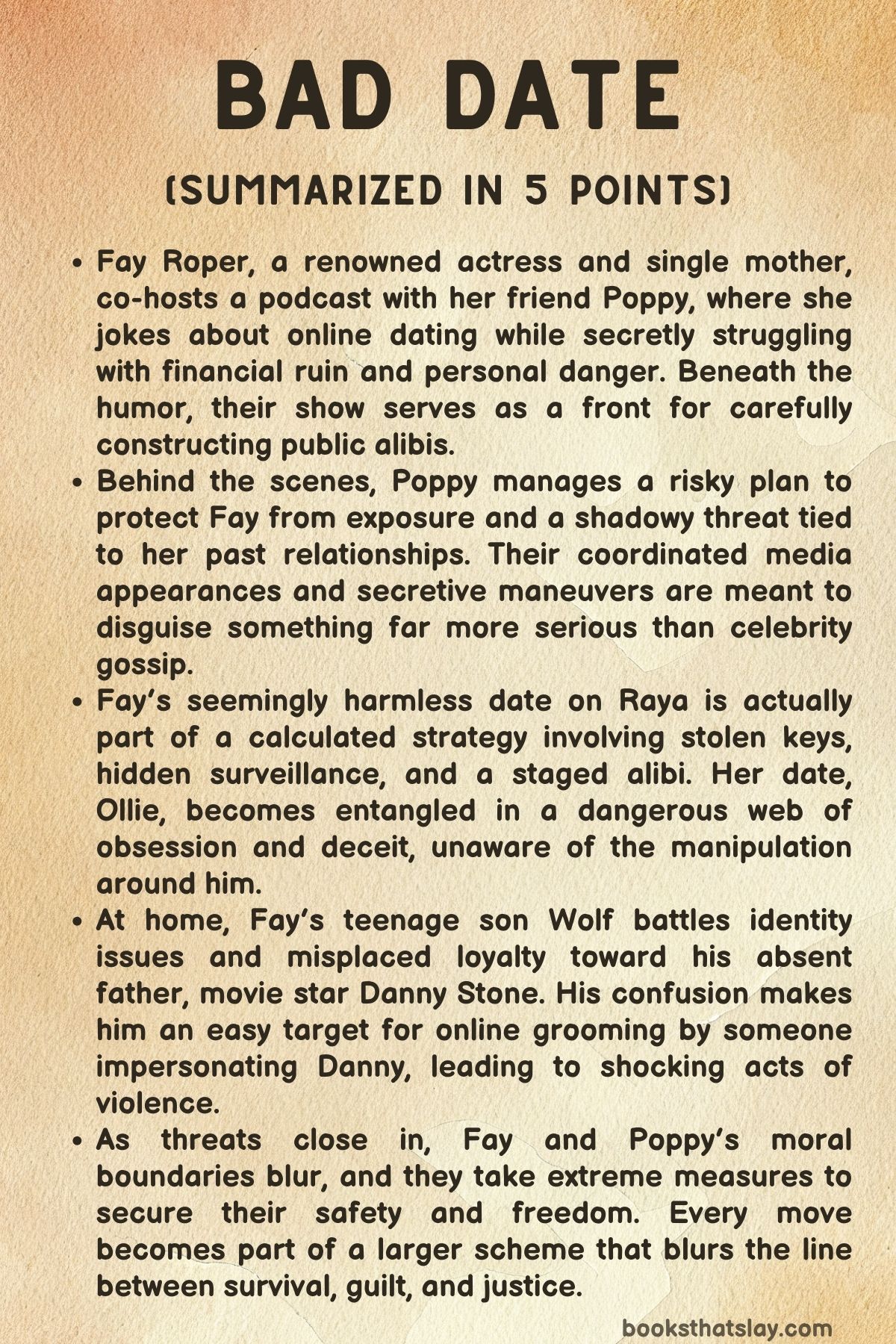
Fay Roper, a well-known British actress, co-hosts the popular podcast “Ride or Die” with her lifelong friend and assistant, Poppy Blake. On the show, Fay plays up her celebrity charm, joking about joining the exclusive dating app Raya under a fake name and teasing the idea of finding love outside the world of fame.
What the audience doesn’t know is that Fay’s life is falling apart. She’s six weeks from eviction after bankruptcy, and her friend Poppy is helping her execute a risky plan that intertwines reputation management with survival.
Poppy reveals that Fay’s glamorous life is a cover for deeper troubles. Years earlier, after a series of threats, Fay bought an isolated country house to protect herself and her son, Wolf.
Her marriage to actor Danny Stone—an alcoholic with a volatile temper—ended when Wolf was still a baby, and a gag order has kept father and son apart ever since. Now fourteen, Wolf is unpredictable, muscular, and obsessed with the father he’s never met.
His fascination with Danny drives him to dangerous behavior, fueled by steroids and online manipulation.
To protect Fay’s public image while setting the groundwork for something larger, Poppy arranges a plan. Fay will attend the National Television Awards to be photographed by the press, then secretly leave early to meet a man from Raya named Ollie at a suburban Pizza Express.
Fay’s alias, “Francesca,” helps her maintain anonymity. The meeting, however, is not about romance.
It’s part of a calculated scheme to build a public alibi and lure a man they believe poses a serious threat.
During the date, Fay plays the part of a nervous but flirty woman, spilling wine “accidentally” and stealing a key from Ollie’s jacket while noticing a Swiss Army knife he carries. Ollie appears harmless, even awkward, but there’s something unsettling about him.
Afterward, he emails a paparazzo with a tip about a weekend walk at Stelhurst Abbey, hoping to make his new “relationship” with Fay public. Behind the scenes, Ollie maintains an online connection with Wolf through the video game Mortal Kombat, posing as Danny Stone.
It’s part of a long-running catfishing scheme designed to manipulate Wolf emotionally and psychologically.
Back at home, strange incidents begin to occur—alarms triggered without cause, windows broken, objects moved. Fay discusses these on the podcast, shaping a public story about a stalker.
In reality, Poppy’s investigations reveal that Ollie, full name Oliver Sharpe, has a history of harassment and restraining orders. His digital footprint shows obsessive behaviors, from fake reviews to gaming accounts and social media profiles.
Things take a darker turn when Poppy discovers that Ollie, pretending to be Danny, has been grooming Wolf online, urging him to “protect” his mother by harming her boyfriends.
This revelation ties into a series of suspicious deaths. Fay recalls three of her past partners who died under mysterious circumstances: Theo, a tree surgeon whose van’s brakes failed; James, a yoga teacher found drowned in her pool after being drugged; and Kieran, who died later under unclear conditions.
Fay never confronted Wolf but quietly disposed of the bodies to prevent scandal and protect him from legal consequences. The moral and emotional weight of these acts sits heavy between Fay and Poppy, who are bound by secrecy and survival instinct.
As their financial troubles deepen and repossession looms, Poppy decides to turn the tables on Ollie. Using the key Fay took from him, she breaks into his dismal apartment—a space filled with Fay’s photos and creepy memorabilia—and plants incriminating items: the empty GHB bottle from James’s death, personal effects linking Fay to the scene, and a van repair manual marked on the pages about brakes.
She hides one of the bodies in a suitcase and submerges it in Ollie’s garden pond, returning later to deposit another. Her goal is simple: make Ollie look like the stalker and killer, tying the past deaths to him.
Meanwhile, Fay follows through with the staged abbey walk. She brings Wolf and their trained dog, King, as protection while Poppy monitors from a drone.
When a paparazzo—tipped off by Ollie—appears, Poppy texts Fay to lead him deeper into the woods. Fay collects items like Ollie’s food trash and flask, intending to plant them later as evidence.
Ollie leaves believing the relationship is genuine.
Later that day, Ollie impulsively goes to Fay’s home, expecting a romantic “minibreak. ” Fay isn’t there, but Wolf is.
Gullible and angry, the boy invites Ollie in. Their interaction quickly turns violent.
In the gym, Wolf challenges him to lift weights, then drops the barbell on Ollie’s throat, accusing him of betrayal and manipulation. Fay, returning from her evidence-staging mission, finds the aftermath and reacts swiftly.
She hides the picnic trash near the fence to imply a break-in and smashes a window to simulate forced entry. Seeing that Ollie is still alive, she orders Wolf into the panic room and commands King to attack.
As the chaos unfolds, Fay locks herself and Wolf inside the panic room. There, she confronts him about everything—the men’s deaths, the manipulation by Ollie pretending to be Danny, and the lies they have both lived under.
Wolf, confused and terrified, begins to grasp the enormity of his actions. Fay tells him that the story they’ll give police is simple: a stalker broke into the house and attacked them.
Ollie will be found surrounded by incriminating evidence that paints him as the murderer of her boyfriends and the current intruder.
With her plan complete, Fay dials 999 and calmly reports that there’s a violent man in her home. Every detail has been prepared—the alibis, the evidence, the public narrative.
As sirens approach, Fay’s voice remains steady. She has orchestrated everything to protect Wolf and preserve their fragile safety, even if it means living forever behind a lie.
In the end, Bad Date closes on an unsettling note. Fay’s world is secured, but only by manipulation and deceit.
The story questions how truth, fame, and love can become weapons in the hands of those who fear losing control—and what survival truly costs when morality becomes negotiable.
Characters
Fay Roper
Fay Roper, the protagonist of Bad Date, is a complex blend of vulnerability and control, fame and secrecy. Once a celebrated British actress, she is now a single mother navigating the debris of her own celebrity.
Publicly, Fay projects glamour and resilience through her podcast “Ride or Die,” yet beneath that veneer lies desperation—she faces eviction, financial ruin, and the haunting consequences of a violent past. Fay’s life is defined by performance; she manipulates narratives both for the media and for survival, crafting alibis and shaping perceptions like a director orchestrating a scene.
Her relationship with her son Wolf is both fierce and tragic—she protects him from the truth even as her deceptions warp his understanding of morality. Fay’s intelligence, quick adaptability, and ruthlessness make her a master strategist, but they also isolate her.
Her actions blur the boundary between justice and manipulation, revealing a woman hardened by trauma yet still tethered to maternal instinct and survivalist cunning.
Poppy Blake
Poppy Blake serves as Fay’s confidante, co-host, and moral compass twisted by loyalty. Though she begins as a supportive assistant and friend, Poppy becomes complicit in the elaborate cover-ups that sustain Fay’s fragile world.
She is the operational mind behind the schemes—planting evidence, managing appearances, and fabricating stories to preserve Fay’s innocence. Her devotion borders on obsession, reflecting a lifelong attachment to Fay that fuses admiration with dependence.
Poppy’s moral flexibility grows in tandem with her desperation; she rationalizes deception as protection, murder as justice. Through her, Bad Date explores how love and loyalty can become vehicles for corruption, and how proximity to fame erodes boundaries between right and wrong.
Poppy’s meticulous nature and quiet intensity contrast with Fay’s dramatism, yet her actions reveal equal capacity for darkness.
Wolf Roper-Stone
Wolf, Fay’s fourteen-year-old son, embodies the psychological damage of secrecy and manipulation. Growing up in isolation within a fortress-like home, he idolizes the father he never knew, movie star Danny Stone, whose image dominates his imagination.
The revelation that Ollie has been posing as his father online ignites the rage simmering within him, turning him from victim to perpetrator. Wolf’s steroid use, volatility, and aggression expose a young mind warped by neglect and falsehood.
Yet beneath his violent tendencies lies confusion—a boy desperate for love and identity in a world where both have been fabricated. Wolf’s eventual murder of Ollie, though horrifying, is the product of years of emotional exploitation, failed parenting, and blurred moral codes.
He represents the cyclical nature of violence and the cost of secrets passed from parent to child.
Ollie Sharpe
Ollie Sharpe is the obsessive stalker whose life revolves around intrusion, control, and fantasy. His initial charm conceals a pathological need for dominance, manifesting through digital manipulation and deception.
By catfishing Wolf as his father Danny and ingratiating himself with Fay, Ollie blurs reality and fiction, much like Fay does—but his motives are malicious rather than defensive. He becomes a mirror image of Fay’s own duplicity: both curate false identities to fulfill emotional voids.
Ollie’s shrine-like flat, the Swiss Army knife, and his constant surveillance reveal the mind of a man who sees love as possession. His end—killed by Wolf and framed by Fay and Poppy—feels both retribution and irony, the predator undone by the very manipulations he inspired.
Through Ollie, the novel examines obsession in the digital age and the collapse of boundaries between virtual control and physical violence.
Danny Stone
Danny Stone, though largely absent, casts a long psychological shadow across Bad Date. As Fay’s ex-husband and Wolf’s estranged father, his mythic persona shapes both mother and son’s lives.
To Fay, Danny represents the intoxicating allure and destruction of fame; to Wolf, he is the unreachable ideal of masculinity and power. Danny’s alcoholism, volatility, and the legal gag order following their separation underscore the dangers of celebrity life and its toll on personal relationships.
Even in absence, Danny functions as a ghostly presence—his identity stolen by Ollie, his name invoked in manipulation, his image haunting his son’s sense of self. He is less a man than a symbol: the destructive charisma that drives the novel’s cycle of deception and violence.
King
King, the trained guard dog, symbolizes the raw, instinctive loyalty missing in the human characters. His obedience to Fay contrasts with the moral chaos around her.
When commanded to attack Ollie, King becomes the literal instrument of her final deception, embodying both justice and brutality. The dog’s presence in the panic room scenes underscores themes of control, fear, and protection, revealing how even loyalty can be weaponized in Fay’s desperate struggle for survival.
Themes
Fame and Its Discontents
In Bad Date, the world of fame is not portrayed as glittering or aspirational, but as an intricate web of exposure, manipulation, and fear. Fay Roper’s life demonstrates how public visibility corrodes personal boundaries and turns every relationship into a performance.
Her celebrity status isolates her, making genuine connections almost impossible. Even her supposed control over her image—through podcasts, interviews, and red-carpet appearances—is revealed as a desperate act of self-preservation.
Fame here is both armor and vulnerability; it grants her a platform but strips her of authenticity. The novel shows how Fay’s life becomes a continual balancing act between managing her public persona and safeguarding her private trauma.
Every action she takes—joining a dating app, maintaining her podcast, or fabricating alibis—is a strategic move to control a narrative that fame has already hijacked. Public attention becomes indistinguishable from surveillance, and Fay’s efforts to manipulate media optics reflect her understanding that in her world, truth is irrelevant compared to perception.
Her downfall and eventual survival both stem from this paradox—she has mastered the performance but lost the possibility of sincerity. Through Fay, the novel explores how fame corrodes morality, intimacy, and even motherhood, transforming ordinary emotional needs into acts of strategic self-defense.
Maternal Obsession and Protection
Fay’s relationship with her son Wolf sits at the emotional core of Bad Date, exposing the extremities of maternal protection. What begins as a mother’s fierce instinct to safeguard her child becomes a pattern of concealment, deception, and moral compromise.
Fay’s entire existence revolves around Wolf’s safety—first from his father Danny Stone’s destructive influence, and later from the manipulative stalker Ollie. Yet the narrative forces the reader to question whether her love ultimately protects or destroys him.
Wolf grows up in an atmosphere of secrecy and paranoia, absorbing his mother’s fears and weaponizing them. The boy’s violent behavior and obsession with his absent father are direct reflections of the emotional damage produced by Fay’s controlling protection.
She hides bodies, manufactures lies, and constructs elaborate alibis not only to preserve their freedom but to preserve a fantasy of maternal competence. Fay’s love manifests as control; her fear becomes prophecy.
When she commands the dog to attack Ollie, it is both an act of defense and a tragic repetition of the violence she has long been running from. The theme reveals motherhood as a consuming force, where love and guilt merge into moral blindness.
Bad Date transforms the maternal archetype from nurturer to strategist, showing how survival instincts can eclipse ethical boundaries when a mother believes she is the only one standing between her child and annihilation.
Deception and Identity
Throughout Bad Date, deception functions not merely as a plot device but as the structural foundation of every relationship. Almost every character exists behind an alias, mask, or digital façade.
Fay becomes “Francesca” on the dating app, Ollie impersonates Danny Stone online, and even Poppy orchestrates lies to protect and manipulate her employer. The constant layering of falsehoods turns the story into a meditation on how identity is weaponized in the digital age.
The lines between authenticity and fabrication vanish; personas are constructed not for deceit alone but for survival. Fay’s fame has already fragmented her identity—she performs one version for her audience, another for her son, and a third for herself.
In this world, truth is dangerous because it exposes vulnerability. The novel captures how deception becomes second nature to those who live under scrutiny, showing that identity in such a context is no longer something possessed but something performed.
Each lie builds a new level of entrapment, culminating in Fay’s final manipulation of the crime scene—a moment where deceit becomes indistinguishable from justice. In the end, deception no longer functions as a tool to hide guilt; it becomes the only possible means to maintain coherence in a world that punishes authenticity.
Violence, Control, and Retribution
Violence in Bad Date is never random or gratuitous; it is the language through which power and control are exercised. Fay’s life is marked by cycles of male aggression and retaliation—first through Danny’s destructive behavior, then through Ollie’s predation, and finally through Wolf’s internalization of both.
Each act of violence emerges from a distorted attempt to reclaim agency. The deaths of Fay’s lovers are not accidents but byproducts of emotional manipulation, jealousy, and misplaced loyalty.
The domestic sphere—traditionally associated with safety—becomes a site of death and concealment. Fay’s country house, fortified with security systems and panic rooms, symbolizes this transformation: protection morphs into imprisonment.
Even Poppy’s actions, though framed as loyalty, reflect a ruthless pragmatism that blurs moral lines. By the conclusion, violence becomes Fay’s means of restoring control over a life long dominated by external forces.
The command to her dog encapsulates this transformation—a woman once victimized now orchestrates her own narrative through calculated brutality. The theme underscores how violence in the novel is not merely physical but psychological, embedded in systems of fame, gender, and manipulation.
Every act of harm doubles as a desperate assertion of control in a reality where power has always belonged to those who exploit others.
Surveillance and Paranoia
The world of Bad Date operates under constant observation—by paparazzi, stalkers, fans, and technology. Surveillance is not just external; it seeps into personal spaces and relationships.
Fay’s every move is monitored or recorded, whether through security cameras, spyware, or public appearances. Even intimacy becomes a performance for unseen watchers.
This omnipresent gaze fuels paranoia that shapes every decision she makes. The novel captures the psychological toll of living without privacy, portraying how external scrutiny transforms into internalized fear.
Fay begins to anticipate intrusion, constructing elaborate scenarios to preempt it. Her friendship with Poppy and her relationship with Wolf are built on mutual mistrust and concealment, proving that surveillance erodes genuine communication.
What makes the theme compelling is that surveillance here is self-inflicted as much as imposed. Fay uses the media, podcasts, and staged sightings to control her narrative, yet these acts only reinforce the same system that confines her.
The novel exposes how a culture obsessed with visibility produces its own cycle of fear and fabrication. By the end, Fay’s final act of staging Ollie’s death within her own home becomes the ultimate paradox—she turns surveillance against her oppressor but remains trapped within its logic.
Bad Date thus paints a haunting picture of modern existence where privacy has become an illusion and paranoia the only path to survival.