Bad for Business Summary, Characters and Themes
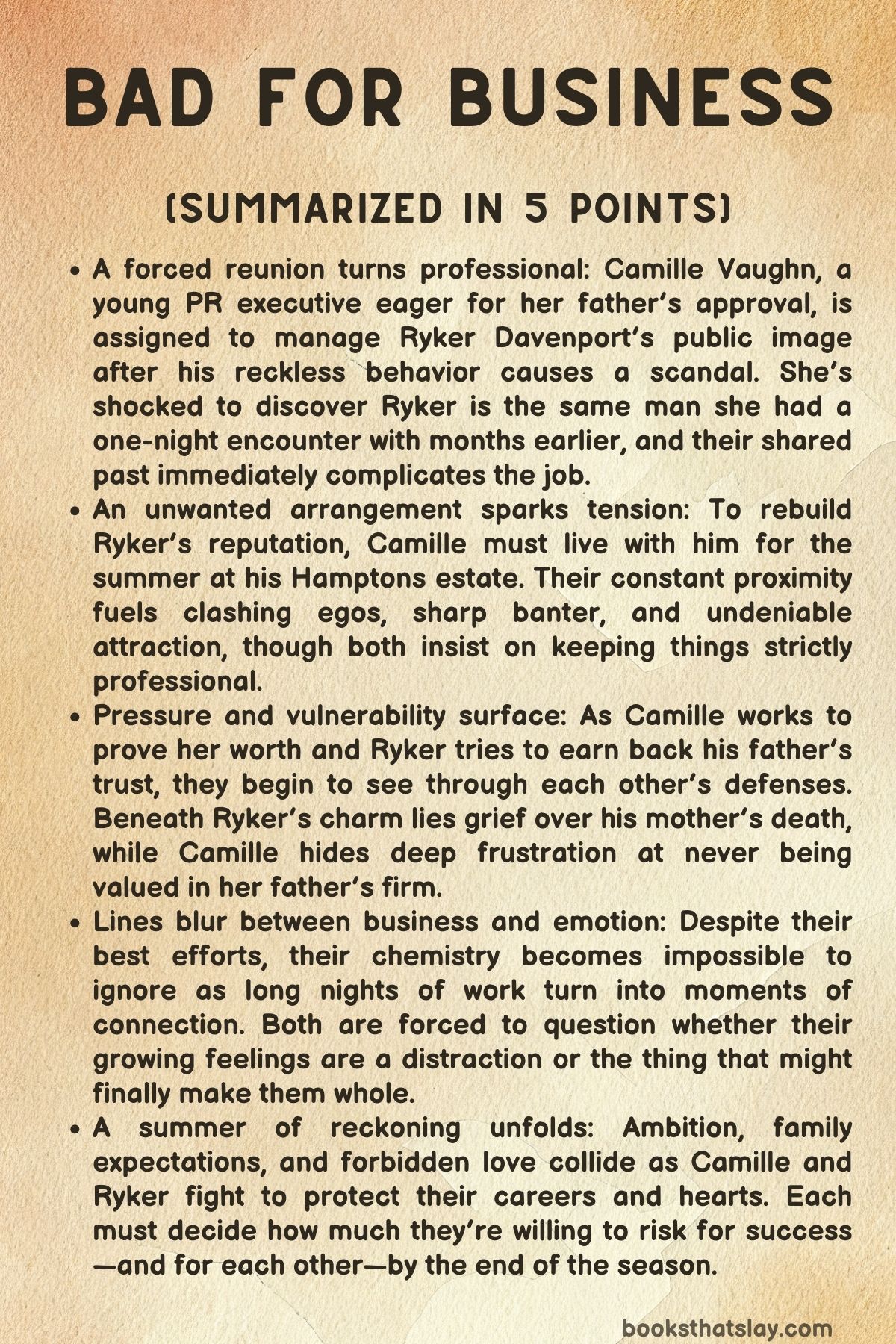
Bad for Business by Kat Singleton is a contemporary romance about ambition, redemption, and unexpected love between two people caught in their fathers’ shadows. Camille Vaughn, a driven young publicist desperate to earn her domineering father’s respect, is forced to rehabilitate the image of Ryker Davenport, a billionaire heir infamous for his reckless behavior.
Their professional arrangement becomes complicated when Camille must live with him for the summer in the Hamptons. As work, pride, and buried emotions collide, both confront the insecurities and family expectations that define them—and discover that sometimes the messiest partnerships lead to genuine connection.
Summary
Camille Vaughn works at her father’s powerful Manhattan PR firm, constantly striving for approval he never grants. One evening, she’s pulled from a rare pleasant date when her father demands she return to the office for an emergency.
There she discovers their newest client: Ryker Davenport, heir to a vast media empire who has just created a scandal. A leaked video shows him drunkenly revealing insider information about a pending acquisition, threatening his credibility with the board and worsening his reputation as a careless playboy.
The firm must contain the fallout, and Troy Vaughn decides that Camille will personally manage Ryker’s image rehabilitation.
Camille’s professional shock deepens when she realizes Ryker is the man she spent a passionate New Year’s Eve with before disappearing without a word. Both recognize each other instantly but hide it in front of her father.
The proposed strategy is unorthodox: Camille will spend the summer living with Ryker at his family’s Hamptons estate, keeping him out of trouble and reshaping his public image. Though they both protest, their fathers are unyielding.
Camille’s father adds cruel motivation—if she can restore Ryker’s reputation, he’ll make her a partner in the firm. She knows he doesn’t believe she can do it, but she accepts, determined to prove him wrong.
The next day, Camille and Ryker reunite for the flight to the Hamptons. She lays down strict professional rules: he must follow her instructions and never mention their past night together.
Ryker, amused, immediately teases her, breaking both rules. Their exchanges are sharp and charged, a mix of irritation and unspoken attraction.
At the Hamptons house, Camille’s attempts at control collide with Ryker’s laid-back defiance. She insists on managing her own luggage, falls, scrapes her elbow, and blames him.
Beneath his easy confidence, Ryker is haunted by grief over his mother’s recent death. The house is filled with memories of her, a reminder of how much he’s lost.
Camille, unaware, focuses on schedules and structure, trying to treat him as a client rather than the man she once desired.
Their working relationship begins with resistance. Ryker skips her meetings and tests her patience, but when she confronts him at a country club, sparks fly.
Her no-nonsense attitude intrigues him, while his charm both frustrates and fascinates her. During a tense dinner with Ryker’s friend Jude, Camille insists they discuss recovery plans.
She has analyzed his negative headlines and points out that his worst behavior began after his mother’s death. For the first time, Ryker opens up, admitting that grief pushed him into self-destruction.
Camille, who lost her own mother young, hides her empathy behind professionalism. They agree on a plan: Ryker will focus on winning back the trust of key board members vacationing nearby, and Camille will guide his every move.
Late that night, Camille’s father calls and coldly asks for updates, caring only about profit, not her success. She realizes he never intended to make her a partner and likely assigned her to Ryker expecting her to fail.
Furious but resolute, she vows to succeed anyway. The next morning, Ryker tries to escape his work obligations, but Camille catches him.
Their sarcastic banter continues as she insists he stick to her schedule. At the golf club, he becomes jealous when Jude flirts with her, revealing a hint of possessiveness.
When he learns her father doubts his potential, he’s hurt, but her encouragement restores his determination.
Their interactions are marked by humor, irritation, and growing chemistry. At a brunch with board members, Ryker performs well under her guidance, but jealousy brews again when he sees her laughing with Jude.
Their arguments intensify, showing that their professional tension is masking personal attraction. Later, when Camille confronts him for skipping meetings and flirting publicly, Ryker deflects with arrogance, but guilt soon follows.
During a lunch with businessman Beck Sinclair, their arguments amuse the older man, who advises Ryker to listen to Camille’s guidance. Ryker starts realizing she might be the only person who truly challenges him.
As the summer continues, their connection deepens in subtle ways. At a yacht party hosted by a board member, Camille, terrified of boats, forces herself to attend to maintain appearances.
Ryker teases her but admires her courage. When he brings her a drink made exactly to her preference—a detail from their past night together—it stirs memories and attraction they can no longer ignore.
Their tension becomes undeniable, though both keep pretending to focus on business.
Soon after, their professional façade begins to crumble. Camille avoids Ryker after an intimate moment, afraid of complicating things, but Ryker refuses to let her retreat.
When she denies their growing feelings, he’s hurt and turns to drinking. She ends up dragging his drunken self home, annoyed yet concerned.
The next day, their constant friction continues during a charity event, but their mutual care starts showing beneath the bickering. Friends notice, especially Jude, who teases Ryker about clearly liking Camille.
Their relationship reaches a turning point when Camille falls seriously ill while Ryker is away in Manhattan. When she doesn’t respond to calls, he panics and rushes back to find her weak with fever.
He takes care of her all night, feeding and comforting her until she recovers. When she wakes the next morning, she kisses him, and both finally admit their feelings.
The days that follow are peaceful and intimate; Ryker cooks for her and cherishes the quiet companionship they share. Their bond strengthens, and the emotional walls between them start to fall.
Their happiness is shattered when their fathers arrive unexpectedly. Troy Vaughn finds Camille in Ryker’s bed and erupts with fury, accusing her of breaking professional rules and implying she used sex to advance her career.
Ryker defends her fiercely, and his father, seeing how much he’s changed, reveals that Ryker has been officially approved to lead Davenport Media. Ryker credits Camille for his success.
Troy dismisses her work and orders her to leave. Ryker begs her to stay, but she insists she must face her father.
On the flight back, Troy’s cold contempt confirms what she already knows—he never planned to make her partner. When he mocks her again, she finally quits his firm, freeing herself from his control.
Camille rushes back to the Hamptons to find Ryker. At the club where he’s sitting with Jude, she declares her love for him and tells him she quit her job.
He sweeps her into his arms, and they begin a new chapter together, no longer pretending or hiding. Ryker asks her to be his girlfriend, and she says yes.
They make plans for her to start her own PR firm and live with him while building it. Both feel that, for the first time, their futures are their own.
Six months later, the epilogue returns to Manhattan on New Year’s Day. Ryker wakes Camille with his mother’s favorite tradition—unique donuts to start the year.
Nervous but smiling, he kneels with his mother’s diamond ring, explaining that he wanted to wait until summer but realized their story began on New Year’s. Overwhelmed, Camille says yes.
As they embrace, she reflects on everything they’ve built together—her new firm, his leadership at Davenport Media, and the love that grew from the very chaos they were meant to fix.
Characters
Camille Vaughn
Camille Vaughn, the twenty-four-year-old protagonist of Bad for Business, is a woman driven by ambition, shaped by loss, and shadowed by the impossible standards of her father, Troy Vaughn. As a publicist at her father’s elite Manhattan PR firm, she has spent her career yearning for his approval—a validation that is continually withheld.
Camille’s character arc is one of transformation from self-doubt and emotional restraint to empowerment and self-worth. Her professional competence is evident from the start: she’s strategic, methodical, and unflinchingly organized.
Yet beneath this control lies deep vulnerability—stemming from both her mother’s death and her father’s emotional neglect.
When assigned to manage Ryker Davenport’s scandal, Camille initially approaches the task as a make-or-break career opportunity, not realizing it will also test her emotional boundaries. Her interactions with Ryker reveal her complexity: she is strict and demanding in her work, but compassionate and deeply human beneath the surface.
As the story progresses, Camille’s guarded professionalism gradually gives way to warmth and emotional honesty, particularly as she learns to trust Ryker. Her decision to quit her father’s firm symbolizes her liberation from patriarchal control and her emergence as an independent woman who defines success on her own terms.
By the end, she is no longer the anxious daughter seeking approval, but a confident partner and entrepreneur capable of standing beside Ryker as his equal.
Ryker Davenport
Ryker Davenport, heir to the Davenport Media empire, initially embodies the archetype of the spoiled playboy—but Bad for Business quickly complicates that image. Beneath the charm and arrogance lies a man burdened by grief, loneliness, and unrelenting expectations.
His mother’s death has left him emotionally fractured, and his reckless behavior—drinking, partying, and self-sabotage—serves as a coping mechanism for the unresolved pain and guilt he carries. When his scandal brings him under Camille’s supervision, Ryker’s easygoing façade begins to crack, revealing the vulnerability of someone desperate to prove his worth beyond his surname.
Ryker’s relationship with Camille becomes the catalyst for his growth. Her determination, emotional intelligence, and moral clarity challenge him to evolve.
Though he initially mocks her rigidity, he grows to admire her discipline and begins to mirror her sense of responsibility. His transformation—from a man defined by his reputation to one defined by integrity and purpose—is gradual and authentic.
Importantly, Ryker’s redemption is not solely professional; it is deeply personal. By confronting his grief, repairing his relationship with his father, and learning to communicate openly with Camille, he reclaims control of his life.
In the end, Ryker stands as a man who has reconciled privilege with humility and desire with devotion.
Troy Vaughn
Troy Vaughn, Camille’s father and the domineering head of Vaughn PR, represents the cold, transactional world of corporate power that the novel critiques. To Troy, success is a matter of control and image, and he treats his daughter not as family but as an employee who constantly fails to meet his impossible expectations.
His emotional detachment and manipulative tactics—such as assigning Camille an unwinnable project under false pretenses—expose his moral bankruptcy. Troy’s character functions as both antagonist and mirror: he embodies the professional ruthlessness that Camille has internalized, and her journey is one of breaking free from his influence.
Despite his authority, Troy’s behavior reveals deep insecurity and hypocrisy. He undermines Camille while exploiting her competence, demonstrating the patriarchal dynamics that define his relationship with both his daughter and his clients.
His eventual loss of control—when Camille defies him, quits the firm, and finds success independently—serves as poetic justice. Troy’s inability to evolve underscores the contrast between his generation’s power-driven worldview and Camille’s emotionally intelligent leadership.
Ryker Davenport Sr.
Ryker’s father, though a secondary presence, plays a pivotal role in the story’s emotional core. Initially appearing as a stern, disappointed patriarch, he represents the weight of legacy and expectation that has defined Ryker’s life.
His grief over his wife’s death manifests as distance from his son, creating the emotional void that fuels Ryker’s recklessness. Yet, by the novel’s end, Ryker Sr.
undergoes quiet redemption through reconciliation. His conversation with Ryker near the conclusion—marked by apology, honesty, and mutual recognition—signals healing not only for their relationship but also for the generational wounds of emotional repression.
He stands as a foil to Troy Vaughn: where Troy remains domineering and unyielding, Ryker Sr. learns to listen and empathize.
This contrast underscores one of the book’s key themes—the transformative power of vulnerability in relationships, both familial and romantic.
Jude Kensington
Jude Kensington serves as Ryker’s loyal friend and an essential supporting character who provides both comic relief and emotional perspective. A charming, perceptive confidant, Jude acts as Ryker’s moral compass at times, often calling out his immaturity or emotional avoidance.
His teasing rapport with Camille and his observations about her effect on Ryker help illuminate the evolving dynamics between the protagonists. Though not deeply explored, Jude’s consistent decency and humor balance the intensity of Camille and Ryker’s relationship, grounding the narrative in camaraderie and realism.
Themes
Power, Control, and Autonomy
In Bad for Business, the struggle for control defines nearly every relationship and decision, making autonomy a central tension that propels both the plot and the emotional development of the characters. Camille Vaughn’s life is shaped by her father’s dominance—both as her employer and as the figure whose approval she seeks.
Troy Vaughn treats her not as a daughter but as a subordinate, withholding validation and using professional success as a means of manipulation. This control extends beyond the office, infiltrating her identity and self-worth.
Her assignment with Ryker Davenport becomes both a test and an act of defiance—an attempt to claim power in a world that constantly undermines her. Ryker, on the other hand, wrestles with a different form of control: the crushing expectations of legacy.
As the heir to a media empire, he is haunted by his father’s authority and the constant scrutiny of the board. His defiance through recklessness is less rebellion and more a cry for freedom from roles he never chose.
When Camille and Ryker collide, their relationship becomes a battleground of wills, each trying to command the situation yet slowly learning that real strength lies in vulnerability and trust. Their eventual partnership—romantic and professional—marks a reclamation of agency.
Camille walks away from her father’s firm, no longer seeking validation, while Ryker finally leads his company on his own terms. Control, once a tool of oppression, transforms into a shared empowerment that defines their growth.
Ambition and Self-Worth
Ambition drives both Camille and Ryker, but beneath their professional facades lies a more personal pursuit: the need to feel worthy. Camille’s careerism is born from her desire to earn her father’s respect, yet his continual dismissal erodes her confidence.
Her fixation on the partnership offer represents not greed, but a desperate attempt to prove she is enough. Ryker’s ambitions are equally fraught—his wealth and status fail to shield him from doubt.
The scandal that launches the story exposes how easily reputation can crumble, forcing him to confront whether he has achieved anything truly meaningful. Their dynamic reframes ambition not as a ladder to climb, but as a mirror reflecting their insecurities.
Through working together, Camille learns that success detached from self-respect is hollow, while Ryker discovers that genuine leadership requires humility rather than charm. The transformation culminates when Camille quits her father’s firm, choosing independence over recognition.
That act redefines ambition as self-definition rather than external validation. Ryker’s eventual success with the board similarly stems not from manipulation or lineage but from accountability and sincerity.
By the end, ambition evolves from a force of pressure to one of purpose, reshaping both characters into individuals who succeed not because of others’ approval, but because they finally value themselves.
Grief and Healing
The undercurrent of grief in Bad for Business gives emotional depth to what might otherwise be a romantic workplace story. Ryker’s behavior throughout much of the novel is driven by the unprocessed loss of his mother.
His recklessness, detachment, and reliance on distraction reflect an attempt to numb pain rather than face it. The Hamptons estate, filled with memories of her, becomes both a prison and a sanctuary—every room a reminder of what he’s lost.
Camille, who also grew up without her mother, recognizes that wound even as she hides from her own. Their shared experiences with loss create an unspoken connection that slowly bridges their hostility.
Ryker’s healing begins when he allows himself to be cared for—first through Camille’s professionalism, then through her compassion. For Camille, the process unfolds in reverse; caring for Ryker forces her to confront how her father’s emotional neglect mirrors her own unresolved grief.
When Ryker’s father finally acknowledges his failures and expresses pride, it becomes a generational release of pain and denial. The book positions healing not as sudden forgiveness but as emotional honesty—the willingness to face love and loss without fear.
Their eventual intimacy, both physical and emotional, symbolizes recovery: two people learning to live fully after years of suppressing the parts of themselves that hurt most.
Love, Trust, and Emotional Intimacy
The evolution of Camille and Ryker’s relationship embodies a journey from guarded professionalism to genuine emotional intimacy. Their initial connection is built on denial—Camille hides behind structure and control, while Ryker masks vulnerability with charm and provocation.
Their banter, laced with tension and sarcasm, is a defense mechanism against their growing feelings. What makes their romance compelling is its foundation in mutual recognition: they see each other’s flaws and still choose to stay.
When Ryker cares for Camille during her illness, the power dynamic shifts completely; it is no longer about image management or workplace boundaries but human connection. That moment of caretaking crystallizes their emotional bond—love expressed through protection rather than possession.
Trust becomes the defining force that replaces fear, allowing them to communicate honestly for the first time. Their eventual confrontation with their fathers cements this growth: both stand up for one another, not as saviors, but as equals.
The proposal in the epilogue completes this arc—not as a fairytale ending, but as the natural culmination of love that has endured trials, miscommunication, and vulnerability. In a narrative steeped in performance and deception, love functions as truth—the one arena where neither character hides.
Family Expectations and Identity
Family expectations shape every major decision in Bad for Business, casting long shadows over Camille and Ryker’s identities. Camille’s life is dictated by a father who values image over affection.
His manipulative promise of partnership traps her in a cycle of obedience and emotional deprivation. Her entire sense of worth becomes contingent on his approval, and only through failure—or what appears as failure—does she finally free herself.
Ryker faces a similar burden under his father’s corporate expectations. As the heir to a vast media empire, he is constantly compared to an idealized standard of success.
His mother’s death removes the one person who offered unconditional love, leaving him to navigate ambition and grief under his father’s scrutiny. Both characters must unlearn the belief that familial love is conditional upon achievement.
When Camille resigns from her father’s firm and Ryker reconciles with his own, the parallel arcs reach resolution. Identity, once defined by others, becomes self-owned.
The story ultimately critiques the generational cycle of emotional neglect and transactional love, showing how independence from family control—both emotional and professional—is necessary for authentic selfhood. Their union symbolizes not rebellion, but renewal: the creation of a family built on respect, empathy, and choice rather than duty or dominance.