Barbieland Summary and Analysis
Barbieland: The Unauthorized History by Tarpley Hitt is a nonfiction investigation into the hidden history and corporate machinery behind one of the most famous toys ever made: Barbie. The book follows the doll’s origins from Ruth Handler’s risky idea in the 1950s to Mattel’s rise as a global powerhouse built on branding, secrecy, and relentless expansion.
Moving through decades of marketing battles, legal warfare, and cultural controversy, Hitt shows how Barbie became more than a doll—she became a symbol shaped by business ambition, consumer psychology, and the shifting politics of American life.
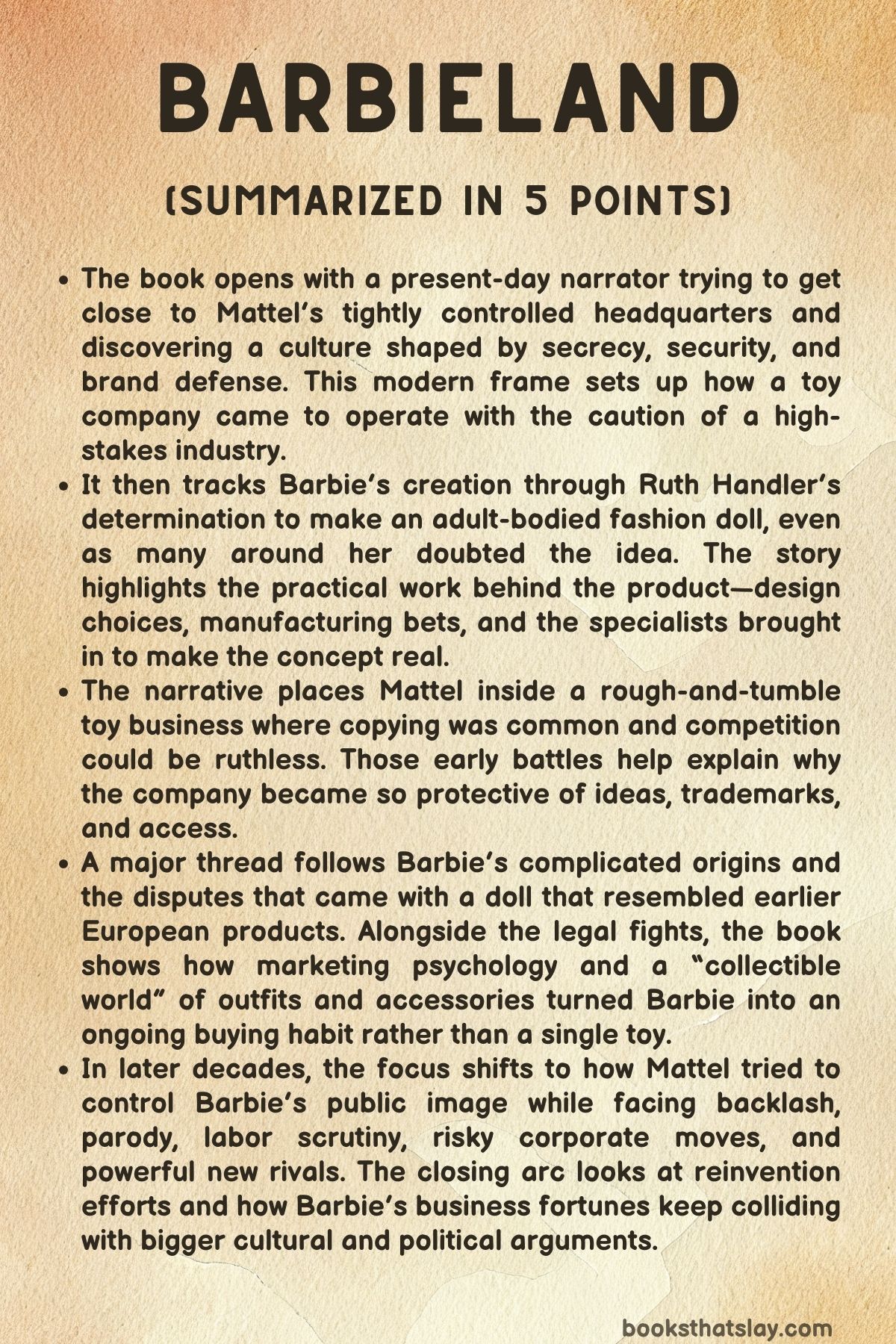
Summary
Barbieland opens with the narrator visiting Mattel’s corporate headquarters in El Segundo, California, a heavily guarded complex that feels more like a restricted government site than a toy company campus. With the Barbie movie about to be released, Mattel has set up bright pink promotional displays outside, but access remains tightly controlled.
The narrator describes how the company refuses to cooperate with unapproved projects and maintains strict secrecy around its operations. Attempting to enter anyway, the narrator uses a false name and observes an atmosphere of exclusivity, security checkpoints, and hidden private showrooms.
Mattel’s culture of control is presented as something long ingrained, shaped by decades of aggressive protection of the Barbie brand.
The story then shifts back to March 1959, when Ruth Handler prepares to introduce Barbie at the New York Toy Fair. Ruth, who cofounded Mattel with her husband Elliot Handler, has spent years pushing for an adult-shaped fashion doll, despite widespread skepticism.
Many in the toy industry believe dolls should represent babies, not grown women. Ruth insists she has seen something different in her daughter Barbara, who prefers imagining adult lives through paper dolls rather than playing mother to infant dolls.
Ruth wants to create a three-dimensional doll that allows girls to project themselves into the future.
Ruth’s vision requires innovation and careful planning. She organizes overseas manufacturing to keep costs low, experiments with plastics, and builds a fashion system around the doll.
She hires experts to refine every aspect: designers for miniature clothing, makeup professionals for the face, and Jack Ryan, an engineer with experience in military missile design, to perfect the doll’s body structure. The prototype that emerges is slim, stylized, posed in high heels, and designed to be displayed with a wardrobe of outfits.
The book then explores the earlier history of Ruth and Elliot Handler. Both come from immigrant Jewish families and settle in Los Angeles, where they begin selling plastic products.
Mattel starts with items like picture frames before shifting into toys. Early in their toy career, the Handlers experience the harsh reality of competition when a rival copies one of their products and undercuts them in price.
This event helps shape Mattel’s later obsession with protecting its designs and guarding information.
Another major figure enters the narrative: Louis Marx, the dominant “Toy King” of mid-century America. Marx builds an empire on cheap mass production and has little hesitation about copying competitors.
While Marx initially resists television advertising, the Handlers embrace it boldly, staking their company’s future on sponsoring children’s programming. Their strategy succeeds, and Mattel becomes a pioneer in marketing toys through television, helping fuel Barbie’s later rise.
The narrator then travels to Berlin in 2023 to research Bild Lilli, a German doll that closely resembled Barbie and existed before her. Lilli originated as a tabloid comic character created in 1952 for Bild Zeitung.
She quickly became a mascot for the publication, appearing in merchandise and publicity. By 1955, Lilli was turned into a plastic doll, initially marketed more to adults than children and sold in places like tobacco shops and newsstands.
Bild promoted Lilli heavily, even producing a film in which the character becomes involved in crime and intrigue.
Back in the United States, questions arise about how Ruth Handler first encountered Lilli. Official accounts shift over time, but evidence suggests Ruth purchased several Lilli dolls during a 1956 trip to Europe and later bought more.
Mattel used Lilli as a model, sending one to Japan where manufacturers could reproduce the concept more cheaply using PVC materials. This connection complicates Barbie’s origin story, suggesting that the doll was not entirely an original invention but an adaptation shaped by global sourcing.
Barbie’s debut at Toy Fair in 1959 is initially disappointing, leaving Ruth devastated. To strengthen Barbie’s appeal, Ruth turns to Ernest Dichter, a psychologist famous for “motivational research,” a method rooted in Freudian ideas about consumer desire.
Dichter conducts extensive interviews and observations with parents and children. He finds that many girls are fascinated by Barbie’s glamorous, adult appearance, but parents often react with discomfort, calling the doll too sexualized.
Dichter’s key insight is that Barbie’s wardrobe is the bridge between children’s excitement and parents’ approval. Mothers may hesitate about the doll’s body, but they admire the clothing and the way fashion play can be framed as teaching grooming and proper appearance.
Dichter advises Mattel to market Barbie not as provocative but as aspirational, a tool for girls to imagine growing up. This strategy helps Barbie gain traction, and sales soon surge.
Mattel then expands Barbie into an entire consumer system. Barbie becomes less a single purchase and more an entry point into “the World of Barbie,” with endless outfits, accessories, vehicles, friends, and branded merchandise.
Ken is introduced, along with an expanding cast of characters. Mattel licenses Barbie widely, creating a flood of related products that transform the doll into a global franchise.
Barbie’s success sparks legal conflict. Louis Marx partners with the German makers of Lilli, claiming Barbie is a copy.
Lawsuits erupt between Mattel and Marx, with both sides accusing each other of unfair competition. Eventually, Mattel quietly settles and later buys worldwide rights to Lilli’s patents, ensuring control over that part of Barbie’s history and preventing further production of Lilli.
As decades pass, Mattel works hard to shape Barbie’s public image. In the 1990s, it promotes only approved “Barbie art,” censoring works that show aging, imperfection, or uncomfortable themes.
Barbie is also used in marketing spectacles, such as the release of President Barbie during the Clinton–Bush election year. Barbie’s commercial dominance grows, nearing a billion dollars annually, and executive Jill Barad rises within the company during this boom.
Mattel expands aggressively through acquisitions, supporting free trade policies that enable cheap overseas manufacturing. Reports of sweatshop labor and unsafe conditions emerge, prompting Mattel to announce manufacturing principles and monitoring efforts, though these are often contested and imperfect.
Mattel also becomes increasingly aggressive in intellectual property enforcement, suing over songs like Aqua’s “Barbie Girl,” targeting fan sites, and battling online parodies. These efforts often backfire, making Mattel appear censorious while Barbie becomes an unavoidable cultural reference.
In the late 1990s, Mattel makes a disastrous business decision by acquiring The Learning Company, a deal that collapses quickly and leads to financial losses, lawsuits, and Jill Barad’s forced departure.
The early 2000s bring a new threat: MGA Entertainment’s Bratz dolls. With bold fashion and attitude, Bratz captures a multiracial, modern identity that Barbie struggles to match.
Mattel views Bratz as an existential danger and launches massive litigation claiming the concept was stolen by a former Mattel designer, Carter Bryant.
The legal war between Mattel and MGA becomes one of the biggest corporate battles in toy history. Initial rulings favor Mattel, nearly handing Bratz over to the company.
But appeals overturn sweeping judgments, and evidence emerges of Mattel’s own espionage operations, including undercover tactics at toy fairs. In a retrial, the jury ultimately sides with MGA, finding Mattel guilty of stealing trade secrets.
The book closes by reflecting on Barbie’s cultural shifts. By the mid-2000s, many children view Barbie as outdated, even disposable.
Mattel attempts reinvention through new storylines, branding strategies, and eventually major diversification in body types, skin tones, disabilities, and role model dolls. Barbie’s future becomes tied not just to toys but to entertainment, licensing, and global politics, as Mattel continues navigating cultural conflict and economic pressure.
Through this long arc, Barbieland portrays Barbie not simply as a doll, but as a corporate creation shaped by ambition, psychology, legal warfare, and the evolving demands of society.
Key People
Tarpley Hitt
In Barbieland, the narrator Hitt functions as both investigator and guide, moving through corporate campuses, court records, archives, and cultural memory to uncover the hidden machinery behind Barbie’s creation and dominance. Their presence is marked by persistence and skepticism, especially when confronting Mattel’s secrecy and carefully managed public image.
By using a false name and physically entering guarded spaces, the narrator embodies the theme of intrusion into closed systems, showing how difficult it is to access truth when a corporation controls its own mythology. More than a neutral observer, the narrator is emotionally attuned to the strangeness of Barbie’s world, highlighting the tension between childhood fantasy and the industrial, militarized, and legalistic structures that sustain it.
Ruth Handler
Ruth Handler emerges as one of the most pivotal figures in Barbieland, portrayed as ambitious, visionary, and relentlessly determined. She is driven by the belief that girls want to imagine adult lives, not just care for baby dolls, and this insight becomes the foundation of Barbie.
Ruth’s character is shaped by contradiction: she is both a creative entrepreneur and a corporate strategist, willing to borrow, replicate, and industrialize ideas in order to make her product succeed. Her emotional investment is immense, especially when Barbie’s first Toy Fair debut goes badly, yet she refuses to abandon her gamble.
Ruth represents the force of invention, but also the complicated ethics of commercial ambition, as she helps build a brand that will become both iconic and controversial.
Elliot Handler
Elliot Handler is depicted as Ruth’s partner in both marriage and business, contributing technical skill and manufacturing sensibility to Mattel’s rise. While Ruth drives the conceptual vision, Elliot’s work in plastics and design grounds the company’s ability to produce at scale.
His character reflects the mid-century American industrial mindset, where creativity is inseparable from production logistics. Though less publicly central than Ruth, Elliot’s presence is crucial in showing that Barbie was not just an idea, but a manufactured object made possible through engineering, tooling, and wartime-era resourcefulness.
Jack Ryan
Jack Ryan stands out as one of the most unusual and symbolically rich figures in Barbieland. An ex–missile designer from Raytheon, Ryan brings military-industrial expertise directly into the shaping of Barbie’s body.
His role underscores one of the book’s most striking themes: the overlap between toy production and defense-style engineering. Ryan is portrayed as someone who refined Barbie’s physical mechanics with obsessive precision, helping transform a doll into a perfectly engineered consumer product.
His character represents the unsettling fusion of innocence and militarized technical control, suggesting Barbie’s form was never merely aesthetic, but the result of calculated design systems.
Louis Marx
Louis Marx, the so-called “Toy King,” is portrayed as ruthless, politically connected, and unapologetic about copying competitors. In Barbieland, he embodies the brutal realities of capitalism beneath the cheerful toy industry.
Marx’s resistance to advertising at first, followed by his aggressive pivot into television marketing, positions him as both old-guard titan and adaptive rival. His later involvement with Bild Lilli and legal threats against Mattel reveal him as a figure who understands toys not as fantasies, but as weapons in corporate warfare.
Marx represents the competitive ecosystem that shaped Mattel’s paranoia and legal aggression.
Bild Lilli
Bild Lilli is not a human character, yet she functions as one of the most haunting presences in Barbieland. As Barbie’s clear predecessor, Lilli symbolizes the uncomfortable truth that Barbie was not born purely from American invention, but from adaptation and appropriation.
Lilli’s origins in a German tabloid world, marketed initially to adults, add layers of sexuality and satire that complicate Barbie’s later positioning as a children’s icon. Lilli becomes a ghost in the Barbie story, a suppressed ancestor whose existence threatens the purity of Mattel’s official narrative.
Paul Guggenheim
Paul Guggenheim appears as a behind-the-scenes facilitator, linking Ruth Handler to European doll supply chains and later helping Mattel expand internationally. His character represents the global infrastructure that made Barbie possible, showing how the doll’s success depended not only on American marketing but also on overseas sourcing, manufacturing networks, and import channels.
Guggenheim’s role highlights Barbie as an international commodity from the very beginning, shaped by transnational movement of goods and ideas.
Ernest Dichter
Ernest Dichter is one of the most intellectually provocative figures in Barbieland, portrayed as both psychological innovator and manipulative architect of consumer desire. As a pioneer of motivational research, Dichter brings Freudian theory into toy marketing, reframing Barbie not as a scandalous object but as a tool of grooming, aspiration, and “womanhood.” His character embodies the book’s critique of advertising as psychological engineering, where products are sold not through function but through unconscious longing.
Dichter’s work reveals how Barbie’s acceptance depended on reshaping parental discomfort into approval, making him a key figure in the doll’s cultural normalization.
Ken
Ken appears less as an individual character and more as a corporate solution to Barbie’s expanding universe. His introduction reflects Mattel’s understanding that Barbie could not remain a standalone product but needed a supporting cast to sustain endless consumption.
The controversy over his anatomy underscores how even the smallest design details become battlegrounds between childhood innocence, adult projection, and manufacturing cost. Ken’s presence reveals Barbie’s world as carefully engineered, not organically imagined.
Jill Barad
Jill Barad represents the late twentieth-century corporate Barbie era: aggressive expansion, globalization, and executive spectacle. In Barbieland, she is portrayed as a powerful figure who helped push Mattel into massive growth through acquisitions and branding, but also into catastrophic missteps like The Learning Company deal.
Barad embodies the tension between ambition and overreach, showing how Barbie’s empire became inseparable from Wall Street logic. Her eventual downfall reflects the fragility of corporate success, even for a seemingly unstoppable cultural icon.
Nancy Burson
Nancy Burson appears as an artist whose work exposes Mattel’s intolerance for unflattering truth. Her “Aged Barbie” is rejected because it disrupts the fantasy of eternal perfection.
Burson represents the outsider perspective that Barbie is not merely a toy but a symbol loaded with anxieties about aging, femininity, and mortality. Her removal from the exhibit illustrates Mattel’s obsession with controlling Barbie’s image and denying any interpretation that introduces realism or decay.
Judge Alex Kozinski
Judge Alex Kozinski functions as a rare voice of cultural restraint within the legal chaos of Barbieland. By rejecting Mattel’s attempt to suppress Aqua’s “Barbie Girl,” he recognizes Barbie as more than corporate property: she is a cultural reference open to parody.
Kozinski represents the idea that Mattel cannot fully own what Barbie has become in public imagination. His presence highlights the limits of trademark power when confronted with free expression.
Mark Napier
Mark Napier symbolizes the early internet’s rebellious creativity against corporate control. His “Distorted Barbie” project becomes a flashpoint where Barbie shifts from product to contested symbol.
Napier’s refusal to comply, and his escalation of distortion, portrays him as an artist-activist challenging censorship. Through him, Barbieland explores how digital culture destabilized Mattel’s enforcement strategies, turning Barbie into an arena of resistance.
Christian Crumlish
Christian Crumlish plays the role of amplifier and organizer, helping transform Mattel’s crackdown into a wider cultural moment. By spreading awareness and encouraging replication of Napier’s work, he represents how communities can undermine corporate intimidation.
Crumlish embodies the internet-era shift from centralized authority to decentralized pushback, where enforcement becomes futile through collective action.
Isaac Larian
Isaac Larian, CEO of MGA, is portrayed as bold, opportunistic, and mythmaking in his own right. In Barbieland, he mirrors Ruth Handler as another entrepreneur willing to gamble everything, even borrowing against his home, to build a rival doll empire.
Yet he is also evasive, reshaping Bratz’s origin story to suit corporate needs. Larian represents the new generation of toy capitalism: faster, flashier, and deeply attuned to identity branding.
Carter Bryant
Carter Bryant is one of the most tragic human figures in Barbieland, caught between two corporate giants. As the designer linked to Bratz’s conception, he becomes the legal and emotional battleground for ownership, contracts, and creative labor.
Bryant’s deterioration during litigation reflects the human cost of corporate warfare, where individual creativity is consumed by lawsuits and power struggles.
Sal Villaseñor
Sal Villaseñor embodies Mattel’s darker underside: the covert intelligence operations that mirror espionage rather than play. His testimony about fake identities and infiltration reveals how deeply Mattel’s paranoia shaped its corporate culture.
Villaseñor represents the militarization of competition, where toy companies behave like spy agencies to protect market dominance.
Jennifer Keller
Jennifer Keller appears as a transformative figure in the Bratz retrial, reframing the conflict as a moral narrative of bullying versus survival. In Barbieland, she represents the power of legal storytelling, showing that courtroom outcomes depend not only on facts but on which narrative captures the jury’s imagination.
Keller becomes a counterforce to Mattel’s institutional power, helping expose evidence of spying and corporate misconduct.
Judge Stephen Larson
Judge Stephen Larson is portrayed as a decisive early authority whose rulings initially favored Mattel, granting sweeping remedies that nearly destroyed Bratz. His interpretation of contracts reflects how legal systems can amplify corporate advantage.
Larson represents the institutional structures that often protect incumbents, showing how law can become an extension of market power.
Judge David O. Carter
Judge David O. Carter serves as a corrective presence, pushing for transparency and allowing broader evidence of Mattel’s misconduct. He represents the possibility of accountability within systems designed for corporate conflict.
His courtroom becomes the space where Mattel’s secrecy is finally challenged, and where the narrative shifts away from Mattel’s control.
Kevin O’Leary
Kevin O’Leary appears as a symbol of corporate risk and speculative overconfidence through The Learning Company acquisition. His role highlights how Barbie’s empire sought digital reinvention, only to stumble into financial disaster.
O’Leary represents the late-1990s belief that technology could endlessly expand profit, even when the underlying business reality was unstable.
Rolf Hausser
Rolf Hausser’s later lawsuits reflect the unresolved moral and historical tensions around Barbie’s origins. His continued challenges suggest that the story of Bild Lilli never fully disappeared, even after Mattel bought rights and tried to bury the past.
Hausser represents the persistence of suppressed history, reminding readers that corporate narratives can never completely erase their origins.
Themes
Corporate Secrecy, Control, and Surveillance Culture
From the guarded Mattel campus to the company’s long history of closed-door practices, Barbieland presents secrecy as a defining corporate instinct rather than a temporary strategy. The narrator’s attempt to access the headquarters shows how Mattel treats its brand not simply as a product line but as a protected state-like asset, surrounded by security protocols, restricted entry, and a constant awareness of outsiders.
This atmosphere is not portrayed as accidental; it grows from the company’s early experiences with copying and competition, where the Handlers learned that ideas in the toy business could be taken quickly and cheaply. Over time, that fear hardened into policy, shaping everything from trade show behavior to aggressive legal enforcement.
What makes the theme sharper is the contradiction between Mattel’s outward claims of innocence and the later accusations that it operated its own corporate spying apparatus. The “Market Intelligence” team, using fake identities and undercover tactics, reveals how a company can justify extreme behavior while claiming it is only defending itself.
The book shows that secrecy becomes self-reinforcing: once a corporation defines the world as hostile, it begins to act with hostility, and those actions create even more distrust. The Barbie brand, marketed as cheerful and harmless, is thus supported by an internal culture that often resembles the logic of espionage and containment.
This theme also connects to Mattel’s desire to manage not only competitors but the public itself. From tightly curated “Barbie art” exhibits to censorship of online parodies, the company repeatedly tries to control how Barbie can be seen or discussed.
The result is a portrait of a corporation that does not merely sell toys but attempts to police meaning, protecting its icon through surveillance, legal pressure, and constant image management.
Consumer Manipulation and the Psychology of Desire
The involvement of Ernest Dichter brings forward the unsettling role of psychology in modern marketing, showing how Barbie’s success was not just about design but about engineered desire. Dichter’s “motivational research” treats consumer choices as expressions of unconscious needs, and Mattel’s willingness to pay for this expertise reveals how deeply the company understood the stakes.
Barbie was controversial from the beginning, provoking discomfort among parents who saw the doll as sexualized or inappropriate. The book demonstrates that this discomfort was not an obstacle Mattel avoided but a problem it studied scientifically, searching for ways to reframe anxiety into acceptance.
Dichter’s conclusion that “the clothes sell the doll” becomes more than a marketing slogan. It represents a strategy of shifting Barbie from a potentially troubling symbol into a tool of grooming, aspiration, and social preparation.
Mothers could be persuaded to see Barbie not as a threat but as practice for femininity, respectability, and adulthood. This reframing shows how advertising can reshape moral reactions by providing a socially acceptable story.
The theme extends beyond Barbie’s launch into the larger consumer ecosystem Mattel built, where Barbie becomes a never-ending purchase cycle rather than a single toy. The “World of Barbie” operates like an early form of lifestyle branding, training children into patterns of collecting and constant acquisition.
Barbieland suggests that Barbie’s cultural power rests partly in this psychological infrastructure, where identity, aspiration, and consumption are bound together. The doll is not only an object of play but a mechanism through which desire is studied, guided, and monetized.
Gender, Sexuality, and the Construction of Womanhood
Barbie’s adult-bodied form places gender expectations at the center of the narrative. Ruth Handler’s vision was shaped by her daughter’s preference for imagining adult lives, yet the doll that emerged carried a heavy symbolic charge.
Barbie offered girls a figure of glamour, elegance, and independence, but she also introduced a narrow template of femininity defined through beauty, fashion, and bodily stylization. The reactions of parents—embarrassment, laughter, accusations that Barbie was “too sexy”—show how the doll exposed cultural tensions about what girlhood should contain and what adulthood should look like.
The theme is complicated by the way Mattel attempted to justify Barbie as preparation for “proper appearance” and grooming. Barbie was framed as educational, a way to initiate girls into womanhood through dress-up.
This reveals how femininity is presented as something learned through consumer rituals: clothing, accessories, and self-presentation become moralized practices. Barbie’s body becomes less important than the lifestyle surrounding it, where being a woman is associated with endless aesthetic labor.
At the same time, Barbie’s cultural role evolves, facing challenges from dolls like Bratz, which offered attitude, identity, and a different kind of femininity. Mattel’s panic over Barbie’s “blankness” suggests that gender ideals are not fixed; they must be updated to remain commercially effective.
Later reinventions, including body diversity and disability representation, show the brand adapting to criticism and shifting norms. Barbieland portrays Barbie as a site where femininity is continuously negotiated, marketed, and contested, reflecting broader struggles over sexuality, empowerment, and the limits placed on women’s bodies and identities.
Global Capitalism, Labor, and the Hidden Costs of Production
Behind Barbie’s glossy image lies a global system of manufacturing and trade shaped by cost-cutting and corporate expansion. Ruth Handler’s early decision to pursue overseas production reveals how quickly the toy industry became dependent on international labor markets.
Barbie’s creation required not only design innovation but also the exploitation of cheaper materials, contractors, and manufacturing hubs abroad. This global orientation became central to Mattel’s business model, tying the doll’s success to the realities of postwar capitalism and outsourcing.
As Mattel grew, the book shows how trade policy and corporate lobbying became inseparable from Barbie’s continued dominance. Executives defended free trade agreements and opposed restrictions tied to human rights concerns, arguing that cheap imports were necessary for American industry.
Yet layoffs followed, and reports of sweatshop conditions surfaced, exposing the human cost behind low-priced consumer goods. Mattel’s “Global Manufacturing Principles” appear as both a response to scandal and an attempt to manage public perception, raising questions about whether ethical monitoring can truly function when profit pressures remain.
This theme underscores the contradiction between Barbie as a symbol of carefree childhood and the adult economic systems that sustain her. The doll exists because of complex global supply chains where labor exploitation, regulatory avoidance, and corporate power often remain invisible to consumers.
Barbieland insists that Barbie is not just cultural but economic, a product of globalization’s promises and harms. The fantasy of Barbieland depends on factories, trade deals, and workers whose lives are far removed from the polished world Barbie represents.
Intellectual Property, Ownership, and the Battle Over Cultural Icons
Barbie’s rise is marked by constant disputes over originality, copying, and ownership, revealing how cultural icons are often born from contested ground. The discovery of Bild Lilli as a predecessor complicates Mattel’s official origin story, showing that Barbie was shaped through adaptation, borrowing, and corporate repackaging.
The legal conflicts with Louis Marx and the Haussers demonstrate that the toy industry thrives on imitation while simultaneously condemning it. Ownership becomes less about creativity and more about who has the legal resources to claim and enforce rights.
Mattel’s aggressive intellectual-property strategy expands beyond corporate rivals to include artists, musicians, and internet creators. The lawsuit over Aqua’s “Barbie Girl” illustrates the company’s desire to prevent Barbie from being associated with sexuality or parody, even as Barbie herself carries those cultural meanings.
The Ninth Circuit’s rejection of Mattel’s censorship attempt signals that once a brand becomes culturally embedded, it cannot be fully controlled by its maker. Barbie belongs partly to the public imagination, where she can be mocked, distorted, or reinterpreted.
The Bratz war intensifies this theme, showing IP law used as a weapon of corporate survival. Mattel’s attempt to claim Bratz through employment contracts and sweeping injunctions reveals how ownership disputes can become existential battles.
The trials expose espionage, intimidation, and the blurred line between protecting innovation and crushing competition. Barbieland portrays intellectual property not as a neutral safeguard but as a battlefield where corporations fight for dominance over cultural symbols, shaping what creativity is allowed and who gets to profit from it.
Cultural Relevance, Reinvention, and the Fragility of Mass Icons
Barbie’s long history in Barbieland is also a story of instability, showing that even the most famous icons can lose their grip on culture. Barbie’s early success created euphoria within Mattel, but the book repeatedly shows that dominance invites backlash, parody, and boredom.
Children’s shifting attitudes, including treating Barbie as disposable or uncool, reveal how fragile brand meaning can be. Barbie is not timeless by nature; she must be constantly reintroduced, updated, and defended.
Mattel’s efforts to sanitize Barbie’s image through curated exhibits and approved art demonstrate anxiety about what Barbie represents beyond corporate messaging. At the same time, novelty products like President Barbie show how easily politics becomes marketing spectacle, turning leadership into another costume.
The company’s later failures, such as the disastrous Learning Company acquisition, highlight how corporate overreach can threaten even a powerful franchise.
The rise of Bratz shows that cultural relevance depends on responding to new forms of identity and expression. Barbie’s “blankness,” once a strength that allowed projection, became a weakness when audiences wanted specificity and attitude.
Mattel’s later moves toward diversity and representation suggest an attempt to keep Barbie aligned with contemporary values, though always within the logic of commerce.
This theme suggests that mass icons are never secure. Barbie survives not because she is fixed, but because she is endlessly adjustable, shaped by lawsuits, consumer psychology, cultural critique, and corporate reinvention.
Barbieland ultimately presents Barbie as both powerful and precarious, a symbol that must constantly be rebuilt to remain meaningful.