Becoming Ted Summary, Characters and Themes
Becoming Ted by Matt Cain is a contemporary queer coming-of-age story about starting over in midlife. Ted Ainsworth thinks he has a settled, decent life in a fading seaside town: a husband, a dog, and the safety of routine in the family ice-cream business.
Then his marriage ends overnight, and the version of himself he’s been keeping small can’t survive the shock. What follows is Ted’s messy, funny, anxious push toward the person he wanted to be long before he learned to hide it—onstage, in drag, and finally in his own skin.
Summary
Ted Ainsworth is moments away from stepping onstage in Manchester, hidden behind a curtain in total darkness, shaking with fear and trying to convince himself he can do this. The silence outside feels loaded: friends, strangers, and maybe people who would love to see him fail.
He clings to one thought—this could be the night his life changes—and forces himself to wait for his cue.
Not long before, Ted’s life looked simple. In St Luke’s-on-Sea, he wakes on a Sunday morning beside his husband, Giles, with their rescue dog, Lily, curled nearby.
Ted watches Giles sleep and feels lucky, though part of him also feels lesser—too ordinary, too soft, too predictable. Wanting to capture the calm, Ted grabs Giles’s phone to take photos.
A swipe too far takes him into Giles’s camera roll, where he finds explicit pictures of a man he doesn’t know. Then a selfie: Giles and the man pressed close, smiling like a couple.
Giles wakes, sees what Ted has seen, and admits the truth without much hesitation. He has been seeing someone from work for nine months.
The man is Javier, and Giles says he is in love. Before Ted can process the words, Giles is packing a bag.
Ted begs for time, for counselling, for any chance to repair what they had. He offers to change—gym, excitement, “adventures”—because he thinks that’s what Giles wants.
Giles tells him he doesn’t want a quieter life anymore, and he doesn’t want to keep choosing comfort. He leaves that same morning, while Lily barks and Ted stands stunned in the hallway, trying to understand how a marriage can end in a few sentences.
The next day Ted walks Lily to the beach, moving through town as if he’s not fully inside his body. The guesthouses and gardens look the same, but everything feels altered.
On the sand he remembers happier moments, especially Giles’s proposal in Italy during a picnic that felt like the start of a future. Now Ted rewrites the timeline in his head: lockdown restlessness, Giles commuting to a new job in Manchester, Ted stuck holding together the family ice-cream business after Covid hit hard.
Alone among dunes, he breaks down until Lily nudges him back to himself.
At Ainsworth’s, Ted tries to hide inside work. Coworkers gossip, tease, and complain; his supervisor Derek jokes about relationships, unaware Ted has been left.
Ted takes on extra tasks, partly to stay busy and partly because saying “no” has never been his strength. When a colleague, Bella, is dumped by text and falls apart, Ted agrees to cover shifts again.
Everyone else’s drama feels easier to carry than his own.
Around town, another story runs alongside Ted’s. Oskar Kozlowski, a Polish immigrant, works jobs that don’t match his ambitions.
He’s thoughtful and creative, but he’s also used to being dismissed. When he questions a design choice on a refurb project, he gets sneered at by the interior designer, then walks home past familiar landmarks, keeping his head down and his dreams private.
In the evenings Ted’s loneliness grows. He considers a grand gesture to win Giles back and sneaks into the factory to make Giles’s favourite chai ice cream, hoping to deliver it to the Manchester hotel and reopen contact.
He remembers the early days of their relationship, when flirting in the factory felt exciting and easy. But the new batch turns out wrong—too sweet, ruined—mirroring how helpless he feels.
When his parents catch him in the building, thinking there’s a break-in, Ted finally blurts out what happened. They rage at Giles and insist Ted stop humiliating himself.
Ted’s parents push him into taking time off, but the quiet is brutal. He drifts through days in Giles’s leftover shirt, barely managing meals and laundry.
His best friend, Denise, and his sister, Jemima, message him, but he can’t find the right words. His parents keep checking in, trying to help, though their concern comes with pressure: the business is struggling, and they expect Ted to keep carrying it.
Hilary, Ted’s mother, decides action is better than pity and signs him up for a dance fitness class at the community centre. Ted sits in the car outside, panicking—he hasn’t danced in years, and he’s the only man in the class.
Inside, the instructor, Shelly Topper, makes the room feel safe. When the music starts—Kylie Minogue, loud and confident—Ted’s body remembers what his mind forgot.
He stops measuring himself against everyone else and moves. For the first time since Giles left, he feels genuinely alive.
Denise, meanwhile, worries about Ted’s silence. At her makeup counter job, she manages customers and a chaotic trainee while constantly checking her phone.
When Ted finally agrees to their usual Friday night, Denise resolves to lift him up. Over drinks, she shows him Giles’s social media: Giles is openly posting loved-up photos with Javier, as if Ted never existed.
Ted is humiliated, but Denise is blunt. She points out how often Giles mocked Ted’s interests and shrank his confidence.
She calls this moment a pivot: Ted should start choosing himself.
A childhood memory surfaces for Ted—on holiday in Spain at nine years old, he saw a drag queen perform in sequins and a big wig. The crowd laughed, cheered, and treated her like a star.
Ted never forgot the thrill of it. That night, sitting in Denise’s living room, he finally says it aloud: he wants to be a drag queen.
It’s a secret he’s carried for decades. Denise is stunned she didn’t know, then instantly all-in.
They make plans: clubs, outfits, makeup, heels. Ted worries he’s too old at forty-three.
Denise tells him it’s not too late.
Ted begins changing in small ways: a sharper haircut, bolder clothes, a slightly straighter spine. He also receives an anonymous letter warning that his family isn’t as perfect as he thinks, hinting at a secret.
The note rattles him, especially because Ted’s family image matters to him; he has relied on it as proof that life can be stable.
Ted’s world expands when he meets Stanley Openshaw, an elderly man in flamboyant clothes living in a care home. Stanley speaks to Ted with cheeky warmth and references to queer history.
He’s had a hard life and refuses to fade quietly. Ted leaves the encounter thinking: if Stanley can still insist on joy and visibility in his nineties, Ted can stop postponing his own.
Denise takes Ted to Blackpool, where they find a cabaret venue, Queen of Clubs, with drag performers who feel like a door opening. Ted meets queens Peg Legge and Pussy Squat, and Denise, unable to help herself, announces Ted is going to perform.
The queens encourage him to sign up for an open-mic night in a few months. Ted agrees, terrified but excited, and starts building a persona: Gail Force.
He practises makeup with Denise and learns the brutal truth about heels.
Ted’s personal life shifts too when he goes on a date with Oskar. Over fish and chips they joke easily, and Oskar talks about his creative ambitions.
But Oskar flinches when affection might be seen. On the beach he admits why: as a boy he watched his father be exposed as gay, then disappear after public cruelty.
Oskar’s mother became intensely religious and taught him to fear being “like his dad.” He trained himself to act tough and dated women to stay safe. Ted, who has spent years sanding down his own edges, understands more than he expects.
They agree to go slowly, and their connection grows into intimacy.
Ted also begins to see how Giles shaped him. Memories return: Giles mocking Ted’s singing, dismissing his desire to join a gay choir, warning him not to be “showy.” What Ted once called teasing now looks like control.
As Gail Force starts to take shape, Ted realises he is recovering parts of himself that were never meant to be negotiable.
To prepare for the bigger stage, Ted performs at Stanley’s care home. At first the jokes don’t land, and Ted feels panic.
With Stanley’s help and some quick adjustments, he finds the room, handles hecklers, and discovers a new kind of courage: answering discomfort with humour and refusing to apologise for existing. By the end, he has the audience singing along and cheering.
The success makes the Manchester open mic feel possible.
Then Ted’s private life explodes. More anonymous letters arrive, now accusing Ted’s father, Trevor, of infidelity.
Ted confronts Denise after spotting a tell-tale spelling mistake and learns the truth: Denise wrote the letters, and she had an affair with Trevor twenty years earlier. Denise claims she did it because she thought Ted was trapped by guilt and duty and needed a push to break free.
Ted feels betrayed and walks away, convinced his closest friend has been manipulating him.
Shaken, Ted turns to Stanley, who responds with a painful story about the cost of living for “duty” when being gay was illegal. Stanley describes police raids, punishment, forced “treatment,” and a man he loved who chose family expectations and was destroyed by shame.
Stanley’s message is clear: guilt can waste a life. He also urges Ted, when the anger cools, to remember that people can be decent and still make selfish choices.
Ted starts seeing his parents differently. He confronts Trevor and Hilary about the affair, expecting denial.
Instead, Trevor admits it. Hilary reveals she knew and stayed anyway, partly for stability and appearances.
She also admits her own mistake—kissing someone once—and that after her cancer, she demanded the cheating stop. For Ted, the revelation is oddly freeing.
His parents aren’t a perfect standard he must live up to; they’re flawed humans. That loosens the grip of obligation that has kept him in a life he never fully chose.
Ted tells them the truth he has avoided: he won’t take over the ice-cream business, and he doesn’t even like ice cream. He is becoming Gail Force, and he’s performing in Manchester.
He also declares he will not take Giles back—because he’s in love with someone else.
Oskar, dealing with his own past, travels to Manchester to meet his father, Andrzej. The reunion is emotional and tender: Andrzej hugs him and insists he has always loved him.
For Oskar, it’s a release from years of fear and disgust. He begins to believe his own life doesn’t have to be built around hiding.
On the night of the show, Ted arrives at the venue for rehearsal with Peg and Pussy, guided by Seraphina Blush. Another queen appears—Fanny Spank—who recognises Ted from a night in Dublin years earlier when someone first put him in drag.
She tells him she always suspected he’d end up onstage, and Ted takes the encouragement like oxygen.
Then we return to where the story began: Ted in the dark behind the curtain, shaking and ready to run. When he steps out as Gail Force, he delivers.
The jokes land, the room is with him, and the songs hit hard. He spots Stanley and Alison glowing with pride.
He sees his parents cheering. Giles is there too, alone, clapping loudly.
Denise arrives and shouts support from the back. Oskar watches with Andrzej.
Ted finishes to roaring applause, then gives an encore that feels like a declaration: he is no longer waiting for permission to be himself.
Afterward, Giles apologises for leaving and admits he held Ted back. Ted thanks him, but refuses reconciliation.
Denise apologises again; Ted forgives her, acknowledging that even her terrible choices pushed him toward the stage. Denise’s own life begins to reopen as she starts seeing someone new, cautiously hopeful.
Oskar introduces Ted to Andrzej, who praises the show warmly. Oskar and Ted step outside and finally speak honestly about their fight, their fear, and what they want.
They both say “I love you,” agree to try again slowly, and choose each other in the open, among Manchester’s rainbow lights. Ted feels more like himself than he ever has—not because everything is fixed, but because he has stopped shrinking.
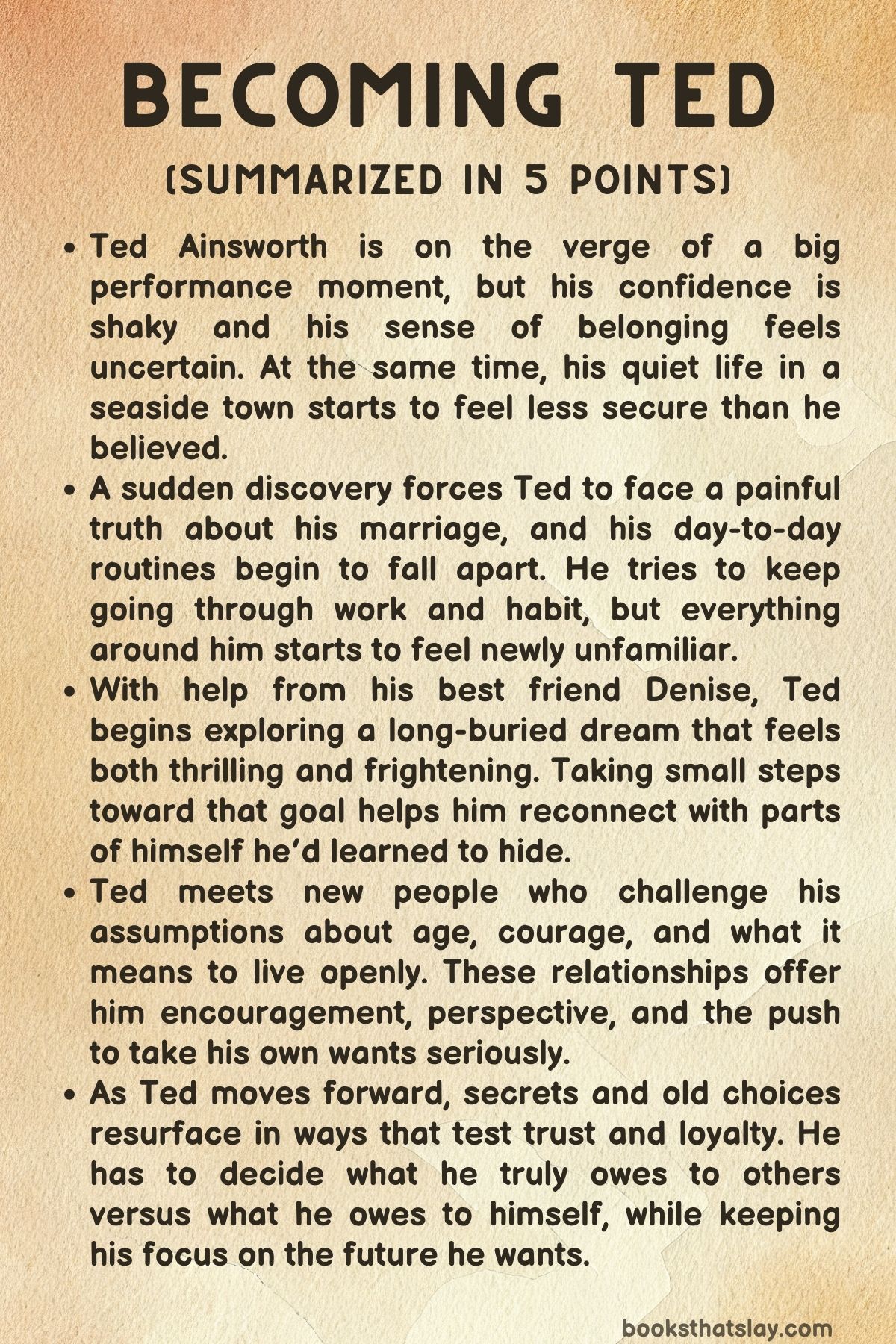
Characters
Ted Ainsworth
Ted is the emotional centre of Becoming Ted—a man who has spent most of his adult life shrinking himself to keep other people comfortable, then gets forced into growth when that “safe” life collapses. At the start he reads himself as ordinary and unremarkable next to Giles, and that insecurity becomes the crack Giles exploits—sometimes subtly, sometimes cruelly—until Ted has internalised the idea that wanting attention, glamour, or a bigger life is somehow embarrassing.
The betrayal doesn’t just end a marriage; it exposes how much of Ted’s identity has been outsourced to duty: duty to his husband, duty to the family ice-cream business, duty to the small-town version of himself that everyone expects. His journey isn’t a neat “new man” makeover—it’s a messy rebuilding, where grief, humiliation, and loneliness sit alongside genuine exhilaration.
Drag—Gail Force—works because it isn’t a costume that hides him; it’s the first thing that lets him tell the truth loudly, turning shame into material, turning a midlife fear of being “too late” into a stage-ready superpower. By the end, Ted’s biggest transformation is not romantic; it’s ethical and personal: he stops confusing love with obligation, stops bargaining for crumbs of approval, and chooses a life where his voice is allowed to take up space.
Giles
Giles functions as both catalyst and cautionary tale: a man hungry for novelty who reframes his own restlessness as Ted’s failure, making abandonment sound like self-actualisation. He doesn’t just leave; he narrates the leaving as inevitable—calling their life “convenient,” insisting he needs “adventure,” and implying Ted could have prevented it if he were fitter, louder, more exciting.
What makes Giles emotionally sharp is that he isn’t portrayed as a cartoon villain; he can be charming, attractive, and capable of tenderness, which is exactly why his undermining comments land so deeply. Across Ted’s memories, Giles repeatedly polices Ted’s expression—mocking the choir idea, discouraging “showy” choices, turning Ted’s joy into something to hide behind closed curtains.
When Giles later reappears after being dumped himself, his timing reveals the uncomfortable truth: he wants the security Ted provided more than he valued Ted as a whole person. His apology at the end matters, but it also underlines the real damage—he normalised a dynamic where Ted’s confidence was treated as a threat.
Giles’s role in the story is to embody a specific kind of intimacy that looks functional from the outside but quietly erodes someone’s selfhood from within.
Javier
Javier is less a fully rounded figure than a mirror reflecting Giles’s impulsiveness and Ted’s humiliation, yet his presence is structurally important because he represents the fantasy that seduces Giles: youth, excitement, and a life that photographs well. The social-media openness—romantic pictures and performative hashtags—turns Ted’s private grief into public spectacle, making the breakup feel not only painful but ridiculous.
Javier’s eventual dumping of Giles exposes the fragility of relationships built on adrenaline and novelty, and it clarifies that Giles didn’t leave because Ted was inherently lacking; Giles left because Giles was chasing a feeling. In that sense Javier becomes the story’s proof that Ted was never the real problem—even if Ted needed time, friendship, and drag to believe it.
Denise
Denise is Ted’s chosen-family anchor, but she’s written with enough shadows to feel human rather than saintly. She is loyal, funny, blunt, and the first person to recognise that Ted’s heartbreak is also an opening—an opportunity to reclaim the parts of himself he buried.
Her love language is pushy encouragement: she nudges, dares, drags him (sometimes literally) toward the life he wants but is afraid to admit. At the same time, Denise’s storyline insists that support doesn’t automatically equal purity.
Her history with Karl shows why she fears intimacy and why “safety” can start to look like isolation, while her affair with Trevor reveals a capacity for self-sabotage and secrecy that complicates her moral posture. The anonymous letters are her worst impulse dressed up as help: she wants to free Ted from duty, but she chooses manipulation to do it, weaponising truth as a lever.
What ultimately redeems Denise is not that she was “right,” but that she is accountable; she admits what she did, accepts consequences, and still shows up. By the end, her reconciliation with Ted reads like a mature friendship earned twice—first through laughter and solidarity, and then through honesty after betrayal.
Oskar Kozlowski
Oskar arrives as an outsider in St Luke’s-on-Sea, observant and careful, carrying the particular exhaustion of someone who has learned to scan rooms for danger. His early interactions—especially the condescension he faces at work—set him up as a man whose talent and sensitivity are constantly being tested by other people’s smallness.
But his deeper conflict is internal: his childhood trauma made homosexuality feel like a curse he must outwork and out-macho, and his fear of being “seen” is not vanity but survival training. That’s why his date with Ted carries two currents at once—real tenderness and real panic—especially when public visibility threatens to expose him.
Oskar’s growth is gradual and believable: he doesn’t become fearless overnight, but he does begin choosing honesty, first in small admissions, then in the larger act of seeking out his father. His relationship with Ted is compelling because it isn’t built on rescuing; it’s built on recognition.
Ted understands what it means to live smaller than your desires, and Oskar understands what it means to rehearse a role to stay safe. When Oskar accepts Ted’s drag dream, even with caution, it signals a turning point: he is not only accepting Ted; he is accepting the idea that visibility can be joyful rather than fatal.
Meeting Andrzej becomes Oskar’s emotional release valve—proof that the story he inherited about shame doesn’t have to be the one he lives by.
Lily
Lily, the rescue dog, is more than comfort scenery; she is the story’s steadying presence and a quiet measure of Ted’s wellbeing. When Ted collapses into grief, Lily keeps him moving—onto the beach, through the dunes, back toward the world—without needing him to explain anything.
Her loyalty also marks emotional safety: she senses Oskar’s warmth, gradually accepts him, and helps the home stop feeling like a museum of Giles’s absence. Lily represents uncomplicated attachment in a novel crowded with conditional love, secrets, and negotiations, and that simplicity is exactly why she matters.
Hilary Ainsworth
Hilary initially reads as the classic “busy, well-meaning mum” who tries to fix pain with action—daily visits, enforced rest, a dance class enrollment—yet her character deepens when the family’s polished image cracks. She embodies a generational pattern where endurance is treated as virtue and appearances are treated as protection, even when they cost someone their emotional truth.
Her history with cancer shows how family unity can become both real love and a mechanism that traps people in roles. When the affair revelations surface, Hilary’s lack of shock reframes her not as naïve but as pragmatic: she has lived with disappointment long enough to turn it into a managed fact.
What ultimately makes Hilary important to Ted’s arc is that she represents the gravitational pull of duty—especially the kind that disguises itself as love. Her apology and honesty allow Ted to see her as a flawed person rather than a standard he must meet, and that shift helps him stop living as the caretaker of the family narrative.
Trevor Ainsworth
Trevor is the novel’s clearest portrait of how “duty” can be used as both excuse and weapon. He is not simply the lovable dad with a shop; he is a man with his own abandoned dreams who chose stability and then resented the weight of that choice.
His infidelity is significant not only because it betrays Hilary, but because it reveals how the family’s moral authority over Ted has been partly performance. When Trevor admits he cheated more than once, Ted’s world doesn’t just darken; it loosens.
The perfection Ted was trying to repay turns out to be imperfect, and that frees Ted from the feeling that he must earn his place by sacrificing himself. Trevor’s later steadiness—agreeing he changed, accepting Ted’s truth, turning up proud at the show—doesn’t erase harm, but it does create room for a more adult relationship, where love isn’t leverage and the son isn’t a replacement for the father’s unfinished life.
Jemima
Jemima sits slightly to the side of the main emotional battlefield, but she plays an important structural role as a sibling who shows there are multiple ways to belong to the family without being consumed by it. Her distance—missed calls, less day-to-day involvement—contrasts with Ted’s entanglement and makes his sense of being trapped feel sharper.
When she and Raj suggest investing and modernising the business, Jemima becomes proof that Ted isn’t the only possible saviour of Ainsworth’s and that family responsibility can be shared or redesigned rather than dumped onto the most compliant person. She helps reframe the business from “Ted’s life sentence” into “one part of the family’s evolving story.”
Raj
Raj functions as a stabilising, practical presence, someone who looks at the family business with solutions rather than nostalgia. His willingness to invest and help redesign the shop shifts the emotional math for Ted: it reduces the guilt pressure and makes Ted’s refusal to take over feel less like abandonment.
Raj’s role also supports one of the novel’s quieter themes—that family can expand through partners who bring fresh perspective, and that “staying loyal” doesn’t have to mean staying stuck.
Dorothy
Dorothy represents the everyday social machinery of Ted’s world: workplace chatter, assumptions, small pressures that seem harmless until someone is breaking. Her wedding talk and gentle coercion to stay late show how Ted has been trained to say yes even when he is emotionally empty.
Dorothy isn’t malicious; she’s part of the environment that makes Ted’s suppression normal. In a story about reclaiming agency, characters like Dorothy matter because they demonstrate how often people are drained not by grand villains but by constant minor demands that go unquestioned.
Derek
Derek, the supervisor, embodies casual workplace insensitivity—the joking masculinity and thoughtless needling that lands hardest on someone already wounded. His teasing about being “loved up” becomes painful precisely because it’s uninformed, exposing how invisible Ted’s private life is within the rough camaraderie of the factory.
Derek’s interactions highlight Ted’s reflex to absorb discomfort rather than correct people, and they underline why Ted’s later confidence on stage is such a radical shift: he moves from silently taking hits to controlling the room with his own words.
Bella
Bella’s dumped-by-text crisis parallels Ted’s heartbreak in a younger, sharper-edged form, and it shows Ted’s automatic caregiving instinct in action. When Bella breaks down and Ted covers her shifts, the moment reinforces how Ted responds to chaos by fixing other people’s problems, often at his own expense.
Bella also reflects a generational contrast: Ted’s marriage ends with secrecy and shame, while Bella’s relationship drama is blunt, digital, and public. Her role helps underline the novel’s theme that pain is universal, but the stories we attach to it—and the ways we recover—depend on how much permission we give ourselves to be seen.
Shelly Topper
Shelly is a key turning-point figure because she provides Ted with a controlled space where performance is framed as empowerment rather than embarrassment. As an ex musical-theatre performer returned to St Luke’s, she brings big energy into a small-town hall and makes it safe to be dramatic on purpose.
Her “judgment-free” ethos functions like an antidote to Giles’s shaming tone, and the class becomes Ted’s rehearsal for the larger identity leap into drag. Shelly’s importance lies in how she models confidence as something you can practise—through movement, through posture, through pretending until it becomes real.
Stanley Openshaw
Stanley is the novel’s moral memory: living proof of what it cost to be visibly gay in an earlier Britain, and a reminder that joy can be an act of defiance. His flamboyance in old age isn’t comic garnish; it’s a statement that he refuses to fade politely.
By speaking Polari, sharing stories of underground life, and acknowledging the homophobia still present in supposedly “modern” spaces like the care home, Stanley connects Ted’s personal reinvention to a longer history of survival. His account of arrest, punishment, and the fate of Tom Bracewell gives Ted a new frame: choosing a full life isn’t selfish when people before you were denied even the chance.
Stanley also brings emotional wisdom, especially in urging Ted toward forgiveness—not as excusing harm, but as refusing to let betrayal become another cage. He is mentor, witness, and—crucially—an audience member who understands that stepping into the spotlight can be more than entertainment; it can be liberation.
Alison
Alison is the practical enabler of Ted’s first real test as Gail Force, using her role at Memory House to create a low-stakes stage that still carries social risk. She stands for organised, everyday allyship: the kind that doesn’t just say “be yourself” but actually makes space for it to happen.
By pushing for Ted to perform at the care home, she ties personal expression to community impact, turning Ted’s drag into something that can challenge prejudice where it lives. Alison’s presence also reinforces that Ted’s transformation isn’t only about nightlife and big venues; it’s about learning to exist proudly in ordinary places too.
Misty
Misty serves as a concentrated example of casual prejudice and classed snobbery, particularly toward Oskar as a Polish immigrant worker. Her snide remarks and ignorance show how easily people in power dismiss others’ expertise, and how that everyday contempt shapes the emotional climate of the town.
She is not a complex antagonist, but she is an effective one because she represents a realistic kind of hostility—smug, uncurious, and socially permitted—which helps explain why Oskar has learned caution. In the broader narrative, Misty’s function is to underline that “being seen” can feel dangerous for reasons that go beyond sexuality alone.
Lauria Grimshaw
Lauria operates as a comedic-pressure figure in Denise’s work life, but she also highlights Denise’s competence and protective instincts. Denise doesn’t simply mock Lauria’s mistakes; she manages customers, smooths conflict, and keeps the workplace running—skills that mirror how she manages Ted’s emotional crises too.
Lauria’s presence shows Denise in her natural habitat: quick-thinking, socially strategic, and exhausted by having to hold everything together, which quietly contextualises why Denise sometimes makes reckless personal choices when she is off the clock.
Mrs Barclay
Mrs Barclay appears briefly but effectively as the type of customer who polices behaviour and decorum, triggering Denise’s performance of charm and flattery. She represents the small humiliations of service work, especially in spaces where respectability is currency and mistakes are treated like moral failure.
Her role is to show how Denise has learned to survive by reading people fast and saying the exact thing that keeps her safe—an emotional skill that becomes both her strength and her burden.
Peg Legge
Peg Legge embodies drag as craft, community, and invitation. She is confident enough to treat Ted’s nervous joke not as a throwaway but as material worth using, which signals to Ted that he might genuinely belong in this world.
Peg’s guidance is practical and slightly tough, the kind that respects Ted by expecting him to do the work. She helps frame drag not as fantasy dressing-up but as a performance discipline with opportunities, deadlines, and a ladder to climb—open-mic nights, sets to refine, audiences to win.
Pussy Squat
Pussy Squat brings the physical, high-voltage side of drag into Ted’s imagination: dance, spectacle, sexual confidence, and the unapologetic ownership of the room. Watching her perform helps Ted understand drag as freedom through excess—being louder and bolder than the self he was taught to keep hidden.
Alongside Peg, she forms part of Ted’s new peer circle, making the drag scene feel like a real ecosystem rather than a one-off epiphany. Her encouragement matters because it comes from someone who has nothing to gain by flattering him; she sees potential and treats it as normal.
Seraphina Blush
Seraphina Blush functions as the gatekeeper of a bigger stage, representing professionalism, standards, and the seriousness of queer performance spaces. Under her direction, Ted’s leap becomes real: rehearsal schedules, stagecraft, and the transition from a brave hobby into a public identity.
Seraphina’s presence also symbolises legitimacy—Ted isn’t just playing at drag; he’s being inducted into a lineage and a venue where audiences expect excellence.
Fanny Spank
Fanny Spank is the story’s long-arc connector, linking Ted’s present reinvention to a buried past where he once brushed up against drag and possibility. Her recognition of Ted, and her certainty that he would eventually become a queen, reframes his dream as something persistent rather than sudden—a truth that waited for the right time to surface.
She provides Ted with a kind of blessing from the community: not permission from family or exes, but recognition from someone who knows the art and can see the performer inside him.
Karl
Karl is the novel’s clearest portrait of coercive control in a supposedly ordinary relationship, and his presence explains why Denise’s confidence about other people’s lives can coexist with fear about her own. He is charming in public and punishing in private, using accusation and gaslighting to keep Denise off balance.
The pregnancy and abortion pressure reveal the deepest cruelty: he tries to seize authority over her body and then continues to torment her afterward. Even when Karl is offstage, he haunts Denise’s choices—her reluctance to date, her panic when she sees his profile, her instinct to retreat.
Karl’s function is not to compete with Ted’s romantic plot but to broaden the book’s emotional landscape: love can harm in different ways, and recovery often means unlearning the idea that pain is the price of being chosen.
Andrzej
Andrzej’s role is brief but transformative, because he represents the possibility that the story Oskar was taught—shame, disappearance, disgust—was incomplete. His reunion with Oskar offers the kind of emotional repair that doesn’t come from speeches but from presence: a hug, an insistence on love, a refusal to treat the past as proof that Oskar is tainted.
Andrzej’s acceptance helps Oskar accept himself, and it strengthens Oskar’s ability to love Ted without flinching at visibility. In narrative terms, Andrzej is the answer to a long-held fear: that being like his father means being abandoned, when in fact it can mean being loved.
Tom Bracewell
Tom Bracewell appears through Stanley’s memory, but his impact is heavy because he embodies the tragic endpoint of living under duty and shame with no safe exit. As a married man who cannot choose an honest life, Tom becomes the cautionary echo that Stanley offers Ted: the danger isn’t only heartbreak, it’s self-erasure.
Tom’s punishment by the state and society—and his eventual suicide—turn Stanley’s advice into more than motivational talk. Tom is the story’s reminder that the freedom Ted is reaching for was once denied with brutality, and that choosing authenticity now is not frivolous; it is, in a real historical sense, survival rewritten as joy.
Themes
Reinvention after betrayal
Ted’s life shifts from stability to free fall the instant he sees those photos on Giles’s phone, and what follows is less about repairing a marriage than about deciding who he is when the person closest to him stops choosing him. The breakup doesn’t just remove a partner; it removes the routine that had quietly defined Ted’s days, the shared story that made his compromises feel worthwhile, and the illusion that being “settled” is the same as being safe.
In the aftermath, Ted tries the most human response: he attempts to bargain. He offers self-improvement, excitement, anything that might persuade Giles to stay.
But the more he begs, the clearer it becomes that his old identity was built around being agreeable—easy to live with, low-maintenance, grateful. The shock forces him to confront an uncomfortable truth: he has spent years shrinking his own wants to avoid rocking the boat.
That’s why the drag dream matters so much. It isn’t a random hobby he picks up to distract himself; it’s the version of Ted that existed before he learned to be careful.
Becoming “Gail Force” gives him permission to be visible, loud, and emotionally truthful in a way his ordinary life never allowed. Even his initial panic backstage shows how high the stakes feel: this is not just performance anxiety, it’s fear of stepping into the open as the person he once hid.
Over time, his reinvention stops being reactive. He no longer measures his worth by Giles’s attention, and when Giles later circles back after being discarded himself, Ted can finally see the pattern without being trapped by it.
The betrayal becomes a brutal kind of clarity: it reveals what Ted had been tolerating, and it pushes him to build a life that doesn’t depend on anyone else’s approval.
Visibility, performance, and the right to take up space
Ted’s journey is framed by stages, literal and social: the ice-cream shop floor where he is expected to be useful and unremarkable, the community centre where he fears being judged as the only man, the care home where an audience might dismiss him, and finally the Manchester venue where he claims the spotlight. Across these spaces, the story keeps asking what it costs to be seen.
Ted has spent years managing how others perceive him—being the “nice” son, the reliable worker, the steady husband, the person who won’t embarrass anyone. Drag flips that arrangement.
In drag, he isn’t trying to disappear into a respectable background; he’s choosing to be looked at. That choice is radical for him because it challenges the old rules he absorbed: don’t be showy, don’t draw attention, don’t make life harder for the people around you.
The dance class is a turning point precisely because it breaks the spell of shame. Shelly’s insistence that the room is judgment-free gives Ted a taste of what confidence feels like when it isn’t earned through perfection.
He discovers that liberation can begin as something physical—moving your body without apology, letting yourself be ridiculous, realising the world doesn’t end when you look silly. The care home performance shows the next step: visibility isn’t guaranteed to be welcomed.
Ted bombs at first, meets discomfort and hostility, and then learns he can shape the room with timing, courage, and wit. Instead of retreating, he adapts, answers back, and finds power in responding to prejudice without begging for permission.
By the time he performs at the club, the applause isn’t just validation that he is funny or talented. It is proof that he can occupy space on his own terms.
The story also complicates the idea of performance by showing how everyone performs in ordinary life too: Giles performs a curated romance online, Ted’s parents perform a version of family respectability, and even Ted performs “fine” when he is falling apart. Drag becomes the honest performance—the one that stops him from acting small.
Duty, family expectation, and the trap of gratitude
Ted’s family and their business represent a kind of inherited script: you stay close, you pitch in, you don’t create drama, you keep the story tidy. The ice-cream shop is not just a workplace; it is a symbol of how Ted’s life has been organised around obligation.
Even his grief gets swallowed by duty when he covers shifts, accepts extra tasks, and tries to keep functioning so other people don’t have to deal with his mess. That instinct to protect others is part of what makes him lovable, but it is also what makes him easy to pressure.
His parents’ response to his breakup shows this tension. They care, but their care arrives as control—forcing time off, managing what he should do next, deciding what is dignified.
Their fear of him leaving St Luke’s disguises itself as concern for his wellbeing, and Ted has to learn the difference. The anonymous letters expose how fragile the “perfect family” story actually is, and when the affair is revealed, Ted experiences a complicated relief.
His father’s failure breaks the pedestal his parents have been standing on in his mind. Ted realises he has been living as though he must repay acceptance with obedience, as though love is something that can be lost if he disappoints them.
The theme sharpens when Hilary admits she stayed for appearances and stability, and when Ted recognises that feeling “grateful” for basic acceptance is itself a kind of emotional debt. The confrontation in the shop becomes a declaration of adulthood: he refuses the inheritance of duty as a life sentence.
He also refuses the false choice between family and self. By inviting his parents to the show, he offers them a new relationship—one where he isn’t a prop in their idea of a good family, but a person with his own direction.
The story doesn’t paint family as the enemy; it shows how love can become possessive, how support can come with strings, and how stepping away from the script can be the only way to keep love from turning into a cage.
Shame, internalised limits, and learning self-compassion
Ted’s shame is not loud; it is practical. It shows up in the way he stops dancing after Giles teases him, in the way he worries about being ridiculous, in the way he assumes everyone will notice his discomfort and judge him for it.
The story tracks how shame grows when it is reinforced by small moments—an offhand comment, a mocking look, a casual dismissal of what you enjoy. Giles doesn’t need to forbid Ted from pursuing joy; he only has to make it feel embarrassing, and Ted will police himself.
That pattern extends beyond Giles. Ted is constantly bracing for humiliation: coworkers teasing him, townspeople gossiping, strangers seeing him fail.
The fear becomes a habit of shrinking. What changes him isn’t a single pep talk, but repeated experiences of surviving exposure.
The dance class shows him that other people are too busy with their own lives to obsess over his flaws. Denise’s blunt support gives him a mirror that reflects not just his pain but his potential, reminding him that he once had an outrageous, playful self before he learned to be cautious.
Stanley’s presence matters because Stanley models a life lived without asking permission, even while carrying the scars of a harsher era. When Stanley shares what was done to him—punishment, coercion, the cruelty of shame turned into policy—it reframes Ted’s private embarrassment as something with a history.
Ted begins to see that his small acts of hiding are connected to larger systems that taught queer people to minimise themselves for survival. That doesn’t make his feelings disappear, but it makes them easier to hold with compassion rather than disgust.
Even Ted’s relationship with his body is part of this theme: his instinct to “fix” himself to keep Giles reveals how quickly shame turns into self-rejection. Over time, self-compassion replaces self-correction.
He stops treating his desires as embarrassing secrets and starts treating them as valid. His confidence on stage isn’t arrogance; it’s the relief of no longer fighting himself.
Friendship, betrayal, and the messy work of forgiveness
Ted and Denise’s friendship begins as a lifeline—shared routines, sharp humour, someone who can pull Ted out of isolation without forcing him to perform happiness. Denise is the one who holds the practical parts of Ted’s reinvention together: she pushes him to imagine a future, coaches him through early steps, and offers a space where he can admit the dream he has carried since childhood.
That makes her betrayal hit differently from Giles’s. Giles leaving is devastating, but it fits a familiar story of romantic loss.
Denise’s secret reshapes Ted’s understanding of his own history, because it suggests his world has been built on omissions. Her anonymous letters are especially painful because they weaponise intimacy: she knows where to strike, what he fears, how to destabilise him.
Yet the story refuses to make Denise a simple villain. Her confession reveals a person who acted out of loneliness, desire, and poor judgment, and who then lived with a long, silent consequence.
When she writes the letters, she believes she is helping Ted escape the grip of duty, but she chooses manipulation instead of honesty. Ted’s anger is justified, and the rupture shows an important truth: forgiveness is not a moral performance; it has to include accountability.
Stanley’s advice to forgive “for human reasons” doesn’t dismiss Ted’s pain—it invites him to see that people can do real harm without being monsters. By the end, forgiveness becomes a choice Ted makes for his own freedom, not a gift he gives to erase the past.
When Ted tells Denise that the letters pushed him toward the stage, it is not gratitude for the cruelty; it is an acknowledgment that he can take something broken and still build. Their reconciliation also restores one of the story’s core beliefs: chosen family matters, and it can survive conflict when honesty replaces control.
The friendship is strengthened not by pretending nothing happened, but by accepting that love between friends can include disappointment, rage, shame, and still be real.
Queer history, generational contrast, and the inheritance of courage
Stanley’s presence widens the story beyond Ted’s personal crisis. Through Stanley, the novel insists that queer joy is not merely personal expression; it is something carried forward from people who paid a heavier price for visibility.
Stanley’s stories of Manchester’s underground world, Polari, arrests, and conversion practices place Ted’s fear of embarrassment in a longer timeline of survival. The point isn’t to shame Ted for struggling; it’s to show him that courage is learnable and that his life is connected to others.
Stanley’s account of Tom Bracewell is especially devastating because it shows what “duty” can do when paired with shame and legal persecution. Tom’s refusal to live openly isn’t framed as cowardice; it is framed as a trap built by social consequences.
That story becomes a warning for Ted: if you keep choosing duty over self, you can lose your life while still being alive. At the same time, the novel offers hope through contrast.
Stanley is in his nineties and still refuses to disappear. He dyes his hair, paints his nails, attends shows, and insists on taking joy seriously.
That insistence gives Ted permission to stop treating desire as something that must be justified. The younger characters show different versions of the same struggle: Oskar hides because he internalised the terror created by his father’s scandal, and Giles curates a glossy romance online as if visibility without depth can replace truth.
Ted’s arc suggests a healthier inheritance: taking what previous generations fought for—space, language, community—and using it not just to survive, but to flourish. When Ted stands on stage and sees Stanley in the front row, the moment becomes bigger than career ambition.
It becomes a handoff: one queer life witnessing another, affirming that becoming yourself is not selfish, and that joy can be a form of respect for the people who never got to have it.
Intimacy, fear of exposure, and choosing honest love
Ted’s relationship with Oskar develops alongside his drag journey, and both are shaped by the same question: what happens when being seen feels dangerous? Oskar’s instinct to pull his hand away in public tells a whole story in one motion.
He has trained himself to equate exposure with punishment, because the chaos around his father taught him that being associated with queerness could ruin a family. That fear doesn’t make him cold; it makes him cautious, sometimes clumsy, sometimes unfair.
Ted, meanwhile, is learning intimacy from scratch. He has been with one man for most of his adult life, and the breakup leaves him unsure whether he can be desired outside that history.
With Oskar, Ted is forced to practice honesty in small increments: admitting he doesn’t even like ice cream, admitting he feels duty-bound, admitting he is afraid too. Their bond grows because Ted listens without trying to rescue Oskar in a way that erases him.
When Ted suggests finding Oskar’s father, it isn’t presented as a neat solution; it’s presented as an act of care that respects Oskar’s pain and his need for closure. Drag complicates the romance because it introduces another kind of visibility.
Ted worries Oskar might be ashamed of him, and he initially withholds the care home show, which mirrors the very fear he is trying to outgrow. Oskar’s eventual reunion with Andrzej becomes a mirror of Ted’s own liberation: both men have to separate love from shame, and both have to stop treating queerness as a stain passed down through family history.
By the end, when Oskar praises Ted in drag and chooses to be present, the romance becomes more than comfort after divorce. It becomes evidence that Ted can be loved in his fullness, not despite his true self.
The story treats “I love you” as meaningful because it arrives after conflict, apology, and reality-checks, not as a fantasy. Honest love here is not the absence of fear; it is the willingness to walk through fear without demanding the other person stay hidden.
Public image, social media, and the difference between attention and belonging
Giles’s online posts with Javier add a modern cruelty to Ted’s heartbreak: private grief becomes public content for someone else’s happiness narrative. The hashtags and curated photos are humiliating not only because they show Giles moving on, but because they suggest Giles wants to be witnessed moving on.
The story draws a sharp line between being loved and being displayed. Giles’s new romance is broadcast like proof of vitality, as if the visibility itself confirms the relationship’s value.
For Ted, who has spent years trying not to be “showy,” that public performance is both painful and revealing. It shows how Giles frames life as a constant pursuit of excitement and validation, and how Ted had been made to feel lesser for wanting comfort and steadiness.
Yet the novel doesn’t suggest Ted’s answer is to reject visibility. Instead, it contrasts shallow attention with real belonging.
When Ted eventually steps onto the stage, he is also seeking an audience, but the emotional texture is different. His visibility is grounded in truth: jokes drawn from his life, vulnerability turned into art, fear acknowledged rather than denied.
The crowd’s response matters because it is earned through connection, not curated through images. The people who come to support him—Stanley, Alison, his family, Denise, Oskar—represent community, not spectatorship.
Even Giles’s presence in the audience becomes part of this contrast. Giles can whoop and clap, but that doesn’t grant him access back into Ted’s life.
Ted learns that public approval cannot substitute for private respect. The theme is ultimately about choosing the kind of visibility that feeds you rather than empties you.
Ted stops chasing the attention of the person who abandoned him and starts building belonging among people who see him clearly and stay.