Before I Forget Summary, Characters and Themes
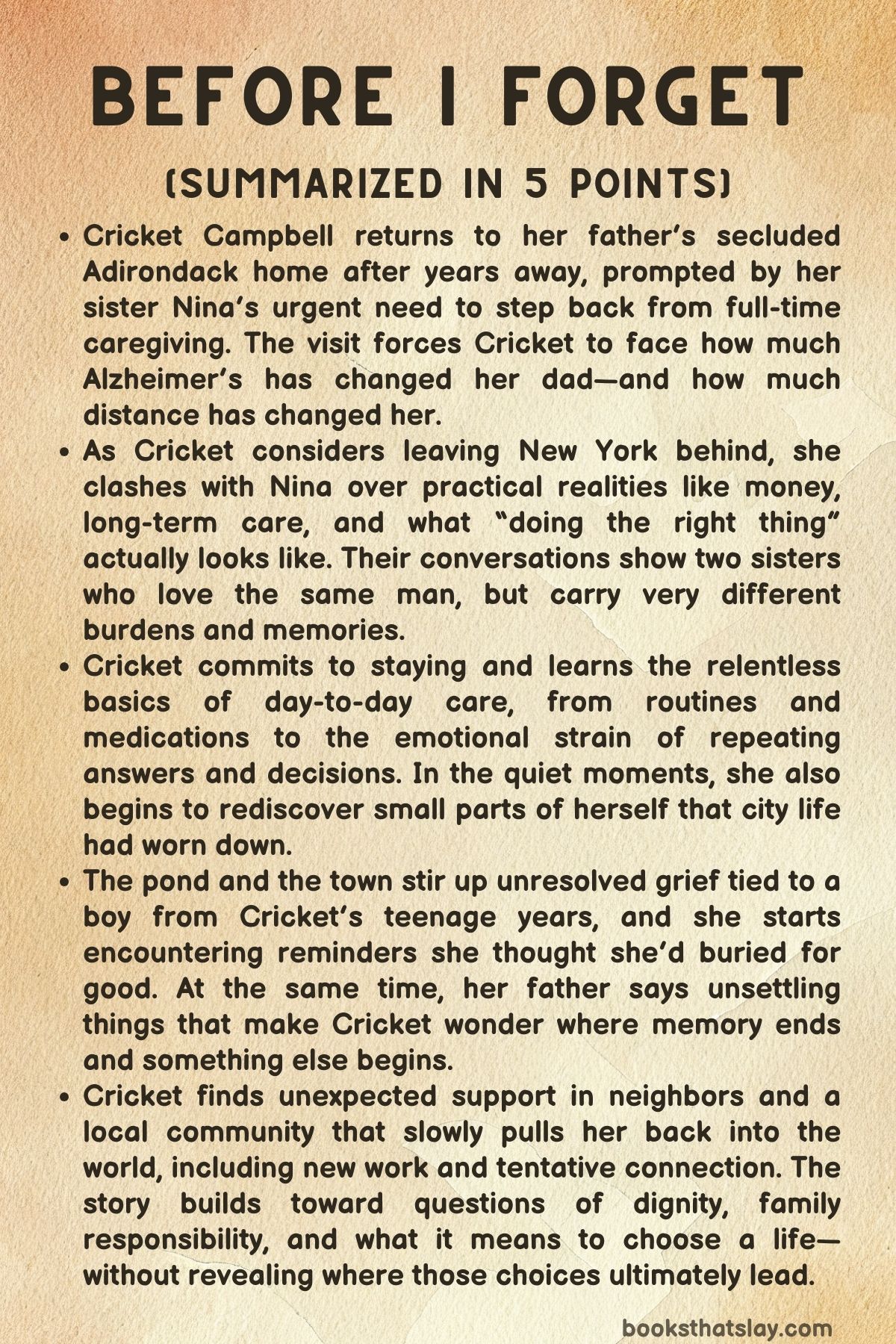
Before I Forget by Tory Henwood Hoen is a contemporary literary novel about family, memory, and the complicated love that remains even as illness changes everything. The story follows Cricket Campbell as she returns to her childhood home in the Adirondacks to help care for her father, Arthur, whose Alzheimer’s is steadily worsening.
As Cricket steps into the daily realities of caregiving, she is also forced to face the grief, guilt, and unfinished history she left behind years ago. The novel explores how the past continues to shape the present, and how healing can begin in unexpected ways.
Summary
Cricket Campbell drives from New York City to her father’s isolated house in the Adirondacks for the first time in nine years. Her car gets stuck in deep mud before she reaches the property, and with no cell service, she walks the rest of the way through the woods at dusk.
The familiar landscape brings back memories she has tried hard to avoid, especially the half-frozen Catwood Pond.
Cricket’s sister, Nina, is waiting at the house. Nina has been caring for their father, Arthur, as his Alzheimer’s has progressed, but she has been offered a postdoctoral position in Stockholm and can no longer stay.
Nina has already arranged tours of memory-care facilities and plans to sell the house to fund Arthur’s care unless Cricket agrees to take over. Cricket initially refuses, overwhelmed by the responsibility and the emotional weight of returning.
When Arthur greets Cricket, it is clear he does not recognize her. He is polite, almost as if she is a guest rather than his daughter.
Nina manages the household with strict routines, and Cricket witnesses firsthand how much caregiving has consumed her sister’s life. That night, Cricket finds childhood keepsakes upstairs, including a photograph of a teenage boy named Seth, which unsettles her.
The mention of Seth is tied to something painful Cricket has never fully faced.
Over the next day, Cricket and Nina take Arthur to tour two memory-care facilities. Arthur cannot understand why he would need to move and objects to being surrounded by “old people.” The experience leaves Cricket shaken, and she begins to realize how quickly her father’s independence is slipping away.
Back at home, Arthur makes strange remarks, including mentioning Seth as if he still appears around the pond, which both frightens and softens Cricket.
A neighbor named Carl helps tow Cricket’s car out of the mud. He is kind, grounded, and familiar with Arthur’s condition.
After returning briefly to Manhattan, Cricket feels disconnected from her city life, her shallow job at a wellness company, and her casual relationship. In a moment of clarity, she quits her job and calls Nina to say she will not let the house be sold.
Cricket decides she will move back to Locust and care for Arthur herself, at least for one year.
Cricket returns to the Adirondacks in mid-May and begins learning the daily realities of caregiving. Nina has created schedules, lists, and systems to keep Arthur stable, and Cricket struggles with how repetitive and exhausting the work is.
Yet she also feels a sense of purpose in being present for her father. As Nina prepares to leave for Stockholm, Arthur repeatedly asks where she is, unable to hold on to the truth.
The novel shifts into Cricket’s memories of childhood and her parents’ marriage. Her mother, Tish, was ambitious and restless, while Arthur was an engineer whose inventions brought financial security.
Summers at the Adirondack camp were once a source of joy, but over time the tension between Cricket’s parents grew, and their marriage eventually collapsed when Cricket was a teenager.
After Nina leaves for Stockholm, Cricket becomes the sole caregiver. She experiments with gentler explanations when Arthur asks about Nina, realizing that emotional comfort matters more than factual accuracy.
Cricket begins to settle into life at the pond again, even as financial worries loom. Arthur’s licensing income will not last forever, and Cricket has no clear career path.
Cricket reconnects with the town and takes small steps toward building a life. She meets Paula Garibaldi, her former dance teacher, who offers her work helping with marketing and invites her to adult dance classes.
Cricket also grows closer to Carl, who checks in on her and helps when Arthur needs supervision.
As summer deepens, Cricket’s memories of 2015 return more vividly. At sixteen, she met Seth Seavey, a calm presence amid the showy cruelty of his cousin Greg.
Cricket and Seth fell in love during a season filled with possibility. But Seth’s death, which occurred that winter, became the event that shattered Cricket’s world.
Though no one directly blamed her, Cricket carried the belief that she was responsible. After Greg accused her publicly, Cricket fled Locust and stayed away for nearly a decade.
In the present, Arthur begins making uncanny “predictions,” noticing things before they happen and speaking of Seth as though he is still near. Cricket becomes obsessed with the idea that her father may be sensing something beyond dementia.
Nina, however, insists these are coincidences and warns Cricket not to build fantasies around illness.
Cricket’s former boss, Gemma, reenters her life and becomes fascinated by Arthur’s strange insight. Cricket stages an “oracle” experience at the pond, blending ritual, performance, and her father’s spontaneous remarks.
The session unexpectedly moves Gemma, and soon word spreads. Visitors begin arriving, donating money, and treating Arthur as a mystical figure.
The town benefits financially, and Cricket feels she has found a way to support her father while giving him moments of engagement.
But the attention grows out of control. Nina is furious that Cricket has turned their father’s dementia into a public spectacle.
Cricket refuses to commercialize it further, rejecting Gemma’s pressure to scale it into a brand. Around this time, Cricket begins a relationship with Max, an arborist who offers companionship without demanding she abandon her caregiving role.
The fragile balance breaks when Arthur suffers a mini-stroke after wandering away during an outing. Cricket cancels the oracle sessions immediately, realizing his health is declining faster than she wanted to admit.
More strokes follow, leaving Arthur weaker and quieter.
One evening, Seth’s mother, Jill Atwater, visits Cricket. She offers her photos of Seth and reassures her that his death was not her fault.
Jill’s compassion gives Cricket something she has lacked for years: permission to release her guilt.
Arthur’s condition worsens rapidly. He develops pneumonia and a blood infection, and doctors tell Cricket he is in late-stage dementia.
Hospice care begins, funded by Cricket’s mother. Cricket stays by her father’s side, reading to him, giving medication, and whispering gratitude as he fades.
Arthur dies early one morning, and Nina returns with her newborn son too late to say goodbye.
In the aftermath, Cricket, Nina, and their mother finally speak honestly about the past, including the divorce and the long silence after Seth’s death. Cricket admits her fears that she caused the family’s unraveling, and her mother assures her she did not.
Cricket decides she wants to remain at Catwood Pond and pursue her childhood dream of becoming a veterinarian, opening an animal hospital rooted in real care rather than performance. Her mother offers to help pay for her education.
In a final dream, Cricket imagines her father young again, telling her that a new heart is forming. She finds an old inscription from him reminding her that the future is still hers to shape.
Before I Forget ends with loss, but also with the possibility of renewal, as Cricket steps forward carrying both memory and hope.
Characters
Cricket Campbell
Cricket Campbell is the emotional center of Before I Forget, a woman caught between the life she built in New York and the life she abandoned in Locust. Her journey begins with reluctance and avoidance, but quickly becomes one of reckoning, as she returns to care for her father after nearly a decade of distance.
Cricket’s character is shaped by grief, guilt, and unfinished love, especially surrounding Seth’s death, which lingers like an unhealed wound beneath everything she does. Over time, caregiving becomes both her burden and her redemption, giving her a sense of purpose even as it forces her to confront the limits of control, memory, and forgiveness.
Cricket evolves from someone running away from the past into someone brave enough to remain present through pain, ultimately choosing connection, responsibility, and the possibility of rebuilding her future.
Nina Campbell
Nina is Cricket’s older sister, defined by discipline, competence, and self-sacrifice. For years, she has been the one holding their father’s life together, managing his care with scientific precision and relentless routine.
Nina represents responsibility taken to its furthest edge, but she is also exhausted, and her decision to leave for Stockholm reflects both ambition and survival. Her relationship with Cricket is complicated by resentment and love, as Nina struggles to trust that Cricket can step into the role she herself has carried alone.
Despite her practicality, Nina is deeply emotional beneath the surface, and her pregnancy and shifting personal life reveal her vulnerability. Nina’s character embodies the tension between duty to family and the need to claim one’s own life.
Arthur Campbell
Arthur, Cricket and Nina’s father, is both a beloved figure and a heartbreaking presence as Alzheimer’s steadily erases pieces of him. He is gentle, humorous, and often childlike in his confusion, yet still capable of surprising insight and tenderness.
Arthur’s decline forces those around him to adapt, grieve, and redefine what connection looks like when memory fails. His moments of apparent prophecy and visions of Seth blur the boundary between illness and mystery, unsettling Cricket while also offering her strange comfort.
Arthur ultimately becomes the symbol of impermanence in Before I Forget, showing how love can persist even when recognition fades, and how presence can matter more than understanding.
Tish Campbell
Tish, Cricket’s mother, is a driven and complex woman whose ambition shaped the family’s fractures. Her career success contrasts sharply with her emotional distance, particularly in moments when Cricket needs comfort rather than solutions.
Tish’s choices, including relocating to London, reflect her desire for reinvention, but they also highlight her difficulty in staying rooted in painful realities. She carries her own regrets and justifications about the divorce and the family’s unraveling, and her conversations with Cricket reveal the generational divide between pragmatism and emotional need.
In the end, her willingness to support Cricket’s schooling suggests that even her love, though imperfect, remains present.
Seth Seavey
Seth is one of the most haunting figures, even though he exists largely through memory. He represents Cricket’s first love, her sense of youthful possibility, and the life that might have unfolded differently.
Seth is gentle, calming, and quietly confident, offering Cricket a refuge from chaos and insecurity. His death becomes the central trauma of Cricket’s adolescence, shaping her guilt, her estrangement from home, and her inability to return for years.
Seth’s presence continues through Arthur’s visions and Cricket’s longing, making him not only a person but a symbol of unfinished grief and the enduring power of memory.
Carl
Carl is the steady, grounded neighbor who becomes an unexpected pillar in Cricket’s life. Practical and kind, he bridges the gap between isolation and community, helping Cricket both literally, by towing her car, and emotionally, by offering support without judgment.
Carl understands the realities of caregiving and provides a sense of stability as Cricket navigates uncertainty. He also becomes a protector when the oracle phenomenon spirals beyond control, acting as a gatekeeper for Arthur’s well-being.
Carl’s character reflects the quiet strength of ordinary kindness and the importance of local community in healing.
Dominic
Dominic, the family cat, is more than a pet in Before I Forget, serving as a symbol of continuity and home. His presence ties Arthur to his familiar world and becomes one of the reasons the idea of institutional care feels so painful.
Dominic’s aging and need for dental work mirror Arthur’s decline, reminding Cricket that care extends beyond people to all vulnerable beings. Dominic also represents Cricket’s return, as his recognition of her signals that she is no longer just visiting but truly coming back.
Gemma
Gemma, Cricket’s boss at Actualize, embodies the aggressive commodification of wellness culture. She is performative, self-serving, and constantly seeking profit in personal suffering, even suggesting dementia-focused products as a marketing opportunity.
Gemma’s pursuit of turning Arthur’s “oracle” into a scalable brand highlights the ethical conflict between care and exploitation. Though she initially appears almost absurd, she becomes a serious antagonist, representing the modern tendency to monetize vulnerability.
Gemma forces Cricket to define her values and refuse to let her father become a product.
Paula Garibaldi
Paula is flamboyant, dramatic, and deeply rooted in the town’s artistic spirit. As Cricket’s former dance teacher, she reconnects Cricket to embodiment, joy, and creativity after months of caregiving repetition.
Paula provides Cricket with both employment and a reminder that life can still contain pleasure. Her role in the oracle ritual blends performance with sincerity, showing how art and ritual can offer comfort even in uncertain circumstances.
Paula represents reinvention and the possibility of community support through unconventional means.
Dylan
Dylan, Cricket’s casual boyfriend in New York, reflects the emptiness of the life Cricket is leaving behind. Self-involved and emotionally shallow, he cannot meet Cricket in her grief or responsibility.
His quick pivot toward taking over her room symbolizes how little permanence their relationship held. Dylan is less a love story than a contrast, showing Cricket how disconnected she has become from her city life.
Greg Seavey
Greg is Seth’s cousin and one of the most openly cruel presences in Cricket’s past. Showy, harsh, and accusatory, he becomes the voice that externalizes Cricket’s deepest fear by blaming her for Seth’s death.
Greg represents the way trauma can be compounded by public judgment and cruelty, turning grief into shame. His accusation becomes one of the defining moments that pushes Cricket into isolation and exile from home.
Chloe
Chloe is a figure from Cricket’s adolescence who reappears unexpectedly later in the narrative. Her return suggests that the past is never fully gone, no matter how far Cricket runs.
Chloe represents the social world Cricket once belonged to, and her reemergence underscores how healing requires facing what was left unresolved.
Max
Max enters Cricket’s life as a gentle, grounded romantic possibility during a time of immense strain. His steadiness contrasts with the chaos of caregiving and the exploitation surrounding the oracle.
Max listens, supports Cricket’s boundaries, and offers companionship without demanding she abandon her responsibilities. Their relationship is not portrayed as a rescue but as a reminder that intimacy and future hope can still exist alongside grief.
Nils
Nils, Nina’s boyfriend, provides a glimpse into Nina’s separate life abroad. Playful and affectionate, he represents the future Nina is building, but also the uncertainty within it, as Nina later questions their compatibility.
Nils is part of the widening distance between the sisters’ paths, even as family ties continue to bind them.
Jill Atwater
Jill, Seth’s mother, brings one of the most powerful moments of closure. Her visit forces Cricket to confront the weight of guilt she has carried for years.
Jill’s compassion, her rebuilding of her own life, and her gratitude toward Cricket offer forgiveness that Cricket could not grant herself. Jill becomes a figure of grace, showing how healing sometimes comes from the very people one fears most.
Anita
Anita, the sick woman who visits the oracle, represents the raw human desire for comfort in the face of death. Her presence shifts the oracle from spectacle to something intimate and sacred, as Arthur offers her reassurance rather than performance.
Anita’s storyline underscores the deep emotional stakes beneath the town’s fascination, reminding Cricket that vulnerability is real, not content.
Anders Arthur Gunnarsson
Anders, Nina’s baby boy, symbolizes renewal and continuity after loss. Arriving near the end of Arthur’s life, he represents the family’s future even as they grieve its fading past.
Anders’ presence reframes Cricket’s world, reminding her that life continues forward, carrying both memory and possibility.
Themes
Memory, Identity, and the Reality a Family Agrees to Live In
Arthur’s Alzheimer’s forces everyone around him to confront a daily question that has no clean answer: who is a person when their memory no longer reliably holds them together? Before I Forget treats memory not as a private archive but as a shared environment that loved ones must enter, adjust to, and sometimes redesign in order to survive.
Cricket arrives expecting to “see her father,” but instead meets a version of him who can be charming, polite, funny, and emotionally present while also missing basic recognition. That gap creates a new kind of relationship—one that cannot lean on shared history in the usual way and therefore must be built out of what still works in the moment: tone, routine, safety, warmth.
Cricket’s choice to play along when Arthur mixes truth and invention shows how caregiving often becomes a practice of protecting dignity rather than enforcing facts. Even simple decisions—how to answer “Where’s Nina?”—become moral and emotional calculations about what reduces fear and confusion.
The novel also suggests that memory loss doesn’t erase the need for meaning; it intensifies it. Arthur may not track a timeline, but he still experiences attachment, expectation, and the comfort of familiar patterns.
For Cricket, being seen as a “friendly visitor” is quietly devastating, yet it also reveals how identity is not only about being remembered; it is also about being cared for, listened to, and treated as real in the present tense. The family ends up living inside two realities at once: the factual one where Nina moved to Stockholm and decline will worsen, and the workable one where a softer explanation keeps Arthur calm.
That dual living isn’t framed as deception so much as adaptation, a way to preserve the personhood that remains when memory frays.
Grief, Guilt, and the Long Aftermath of a Teenaged Loss
Cricket’s return to Catwood Pond is not only a logistical response to Nina’s departure; it is a confrontation with a grief she has kept at a distance for years. Seth’s death sits inside her like a verdict, and the town’s history—especially Greg’s accusation—gives that verdict a public shape.
Before I Forget shows how guilt can become a substitute for grieving: if Cricket can believe she caused what happened, then the world is still explainable, still controllable, still capable of being made right through punishment or avoidance. Her refusal to go near the pond for years is not simply fear of a place; it is fear of what the place proves—that life can turn abruptly and that love does not protect people from accidents, bad timing, or other people’s cruelty.
The novel tracks how guilt isolates her in stages: first from the town, then from her father, and finally from her own New York life, where parties and casual relationships feel like costumes she can no longer wear convincingly. Her dream about coughing up her heart is a blunt symbol of emotional self-erasure, as if she has tried to discard the part of her that still feels.
The later shift in that dream, where her father appears young and promises a new heart is almost ready, marks a different emotional logic: grief is not solved by blame or by exile; it is carried until it changes form. Jill Atwater’s visit matters because it breaks the closed loop of Cricket’s self-condemnation.
When Seth’s mother tells her the accident wasn’t her fault and thanks her for making Seth happy, it offers Cricket a way to hold the past without turning it into a life sentence. The theme is ultimately about what it takes to stop rehearsing a tragedy and start living beside it—still aware, still tender, but no longer governed by it.
Sisterhood, Unequal Burden, and the Politics of Care
The relationship between Cricket and Nina is defined by love, resentment, and the exhausting arithmetic of who gave what and when. Nina has carried the daily, unglamorous weight of Arthur’s decline—diapers, flossing, schedules, appointments—while Cricket lived elsewhere, and Before I Forget refuses to treat that imbalance as a simple misunderstanding.
It becomes the emotional engine of their conflict. Nina’s strict routine is not portrayed as coldness; it reads like a coping method, a way to impose order on a disease that unorders everything.
Cricket, arriving late to the responsibility, initially underestimates how consuming this work is, then feels the shock of its repetitiveness and its constant vigilance. Their arguments about memory-care facilities and selling the house are not really about real estate; they are about whose life gets paused and whose life gets to continue.
Nina’s Stockholm postdoc represents earned movement forward, and Cricket’s sudden decision to take over can look, from Nina’s angle, like guilt-driven improvisation that may collapse when reality hits. Yet Cricket’s insistence—“I simply want to be with my dad”—adds another layer: caregiving is not only duty; it can also be a form of love that the caregiver needs for herself.
The novel also illustrates how siblings can carry different versions of the same childhood and therefore judge each other through incompatible lenses. Nina’s later pregnancy intensifies this theme because it introduces a new center of gravity: the next generation.
Cricket’s caretaking of Arthur becomes, at the same time, Nina’s attempt to build a new life with support systems in Sweden. Both choices are practical and emotional.
What makes the theme land is that reconciliation doesn’t come from a perfect apology or equal repayment; it comes from recognition—Nina acknowledging Cricket is doing the job, Cricket acknowledging Nina’s years of sacrifice without trying to erase them with one dramatic gesture.
Uncertainty, “Premonitions,” and the Human Hunger for Signs
Arthur’s apparent “predictions” create a charged ambiguity: are these coincidences, heightened pattern-recognition by Cricket, or something the story wants the reader to hold as possible? Before I Forget uses this uncertainty to explore what happens when a family is desperate for reassurance.
Cricket is carrying guilt about Seth and dread about losing her father; in that emotional state, signs become seductive because they suggest the world is not random. Arthur saying Seth “comes by,” predicting blueberries, noticing the loons, hinting at Nina’s pregnancy—each moment offers Cricket a small dose of order.
Nina’s skepticism provides an important counterweight, not because she is heartless, but because she recognizes how easily magical thinking can become a trap, especially when dementia is already bending reality. Yet the book doesn’t treat Cricket’s belief as foolish.
It treats it as a coping strategy and as a way to keep a connection alive when ordinary connection is slipping away. The “oracle” episode makes this theme practical: people arrive craving certainty, and Cricket creates a ritual that meets that craving without fully claiming authority over truth.
The carved maxims, the dance meditation, the bibliomancy—these are tools for reflection disguised as prophecy. The irony is that Arthur, in moments, offers startling clarity and comfort that feels “bigger” than his diagnosis would predict, especially with Anita, the woman facing death.
Whether or not anything supernatural is happening, the emotional function is clear: people need language for fear, and they need permission to imagine that they are not alone in it. The theme ultimately argues that certainty can be dangerous—hence the sign “CERTAINTY BRINGS TROUBLE”—but meaning-making is unavoidable.
The healthiest version of it, the book suggests, is the version that keeps you compassionate and present rather than controlling and obsessed.
Bodily Care, Mortality, and Love at the Edge of the End
Caregiving in Before I Forget is depicted as intensely physical: diapers, flossing, medication routines, feeding, bedtime rituals, the slow shift from independence to dependence. The book insists that love is not only emotion or memory; it is labor performed on the body of someone who can no longer manage their own.
This theme becomes sharper as Arthur declines—TIAs, hospital visits, pneumonia, blood infection, hospice, morphine, the vigil at the bedside. Cricket’s role transforms from daughter to caretaker to witness.
The story shows how death is not a single moment but a process that reorganizes time: days become measured by doses, breathing patterns, small comforts, and the effort to keep a dying person unafraid. Cricket reading stories and poetry to Arthur is significant because it suggests language still matters even when comprehension is unclear; it is a way of honoring him as a person who has been more than his illness.
Nina’s late arrival with her baby and their mother’s unexpected appearance create a layered portrait of family at the end: the old life leaving, the new life arriving, the middle generation trying to make peace with what they did and did not do. The theme also includes the financial reality of dying—hospice costs, the need to ask for help—and how money can suddenly become a form of care, even when emotional care has been inconsistent.
After Arthur’s death, the conversation about the divorce and Cricket’s fear that she caused it becomes part of this mortality theme too, because death makes unfinished narratives feel urgent. The inscription in James Herriot’s All Creatures Great and Small gives the ending its emotional philosophy: truth and future belong to Cricket, not as a command to “move on,” but as permission to live without being trapped by the past.
Choosing to pursue veterinary school and an animal hospital returns the story to embodied care in a new form—still about tending to vulnerable bodies, but with agency rather than emergency. It turns the end of Arthur’s life into the start of Cricket’s capacity to build a life that is not organized around running away.