Behind Closed Doors Summary, Characters and Themes
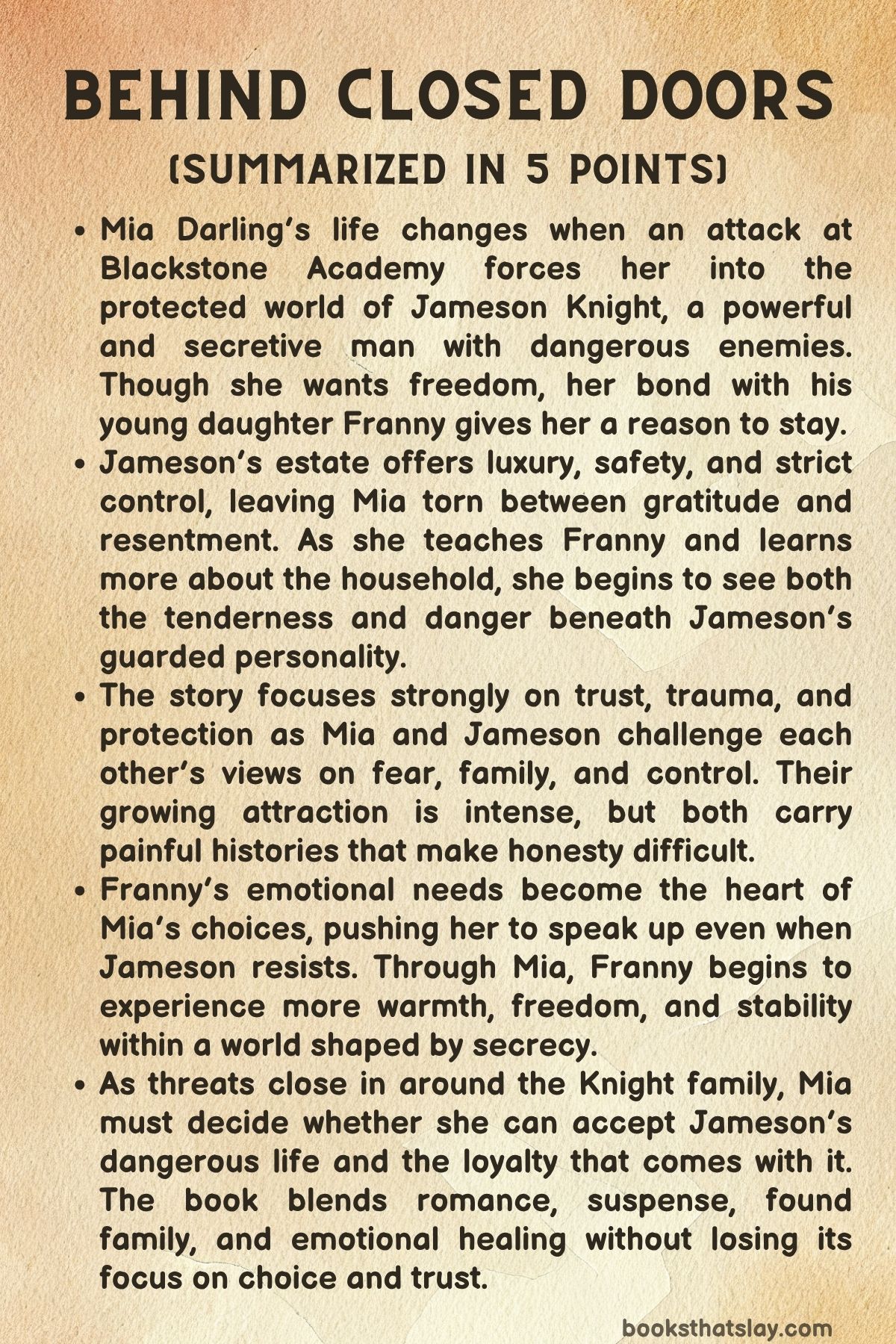
Behind Closed Doors by Shain Rose is a dark romantic suspense novel centered on danger, control, loyalty, and the uneasy bond that forms between a sheltered teacher and a ruthless man with a violent secret world. The story follows Mia Darling, a teacher pulled into Jameson Knight’s guarded life after an attack at Blackstone Academy threatens his daughter, Franny.
What begins as forced protection slowly becomes a complicated connection shaped by fear, attraction, trauma, and trust. The book blends mafia-style danger, family drama, and romance while focusing strongly on Mia’s protective love for Franny and Jameson’s struggle to balance power with vulnerability.
Summary
Mia Darling’s life changes when she is waiting with Franny Knight outside Blackstone Academy. Franny is anxious because her father, Jameson Knight, has not arrived on time, and this frightens her because her mother once failed to pick her up and never came back.
Mia tries to calm her, but before the school can get answers, several cars speed toward the academy. The guards react immediately and rush Mia and Franny inside.
Archer, one of the guards, leads them through the building while pretending they are playing hide-and-seek so Franny will not panic. Gunfire breaks out, and Archer hides them in a secret panic room beneath the floor.
Mia locks herself inside with Franny and watches the security cameras while Franny wears headphones and watches a tablet. Armed men enter the room above them, but Archer attacks them.
When Jameson arrives, he questions one attacker about whether Franny was the target. After receiving no answer, Jameson kills him and orders Mia to open the panic room.
Jameson takes Franny to safety, but Mia insists she can go home because she is only Franny’s teacher. Jameson refuses, saying she has seen too much and is no longer safe.
Mia resists, but Jameson has her taken to his estate. She wakes in a luxurious room, handcuffed to a bed, furious and terrified.
Jameson tells her she must remain under his protection, partly because she is a witness and partly because Franny needs her. Mia fights him, injures her wrist, and only calms when Jameson warns that her screaming might upset Franny.
Franny soon rushes into Mia’s arms, relieved she is alive. Mia hides her injury and comforts the child.
Franny admits she saw more violence than anyone realized and begs Mia to stay and teach her at home. Mia does not want to be trapped, but Franny asks for a promise, and Mia agrees to stay for a while.
Jameson and his men investigate the attack. They suspect O’Connor’s Irish mob and possibly Paolo’s cartel.
Jameson is determined to punish anyone who threatened Franny. Meanwhile, Mia begins negotiating the terms of her stay.
She wants pay, some freedom, combat training, contact with Archer, and a measure of control over her life. Jameson offers her two million dollars to teach Franny through the summer.
Mia settles uneasily into the Knight estate in Paradise Grove. The house is wealthy, heavily guarded, and filled with secrets.
She meets Rosy, the warm house manager, Hades, Jameson’s trusted associate, Malek the protective Doberman, and Mrs. Knight, Jameson’s cold mother. Mia builds a classroom for Franny and slowly creates a routine.
She also bonds with Rosy and Archer, refusing to behave like a spoiled guest even though she is living among luxury.
Jameson is controlling, intense, and possessive, but Mia constantly challenges him. He objects when she breaks his rules, especially when she insists on giving Franny small joys like chocolate, outdoor lessons, and more ordinary childhood experiences.
Mia believes Franny is suffering from being kept inside and protected from every truth. Jameson believes isolation is necessary because of the enemies surrounding them.
Their arguments reveal both his fear and Mia’s fierce love for Franny.
Mia also begins learning that Jameson’s life is far more dangerous than she imagined. She discovers a hidden surgical facility in the basement where Jameson treats wounded men connected to criminal groups.
He finally admits he is tied to the Diamonds, a powerful secret society connected to Paradise Grove. He also tells her that Franny’s mother, Lex, abandoned them and was later believed dead.
Mia argues that Franny deserves honesty and freedom, not a life built on silence.
As Mia spends more time with Jameson, the tension between them grows. She is drawn to him despite his violence and control, and he is equally drawn to her despite trying to keep distance.
Their connection becomes more complicated when Mia overhears Jameson’s encounters with Valerie, Franny’s psychiatrist, through a vent connected to his office. Mia becomes jealous but tries to deny it.
Jameson begins softening in small ways. He rearranges kitchen glasses so Mia can reach them, takes Franny to the country club, plays tennis with her, and starts spending more time as a present father.
Mia sees that beneath his harshness, he loves Franny deeply but fears leaving her unprepared if he dies. Mia tells him that Franny needs him now, not only survival lessons for the future.
Mia’s friendships with Rosy, Pink, and Olive grow stronger. The women know about Jameson’s world and accept Mia into their circle.
They take her out for a girls’ night, though Jameson tries to forbid it. He eventually allows her to go with security.
At the club, Mia dances with Archer, which triggers Jameson’s jealousy. Jameson arrives, punches Archer, and later confronts Mia.
Their fight turns emotional and passionate, exposing how much they want each other and how afraid they are of losing control.
The night turns violent when O’Connor’s men attack the club. Jameson shields Mia, kills attackers, and gets her to safety.
Back home, he gently helps her recover from shock. Mia later tells him more about her past: a predatory tennis coach abused his power over her, and her family failed to protect her properly.
Jameson believes her immediately and wants revenge, but Mia wants him to understand her strength rather than reduce her to a victim.
Jameson also reveals the truth about Lex. She was manipulative, cold toward Franny, and abandoned the family to run off with Paolo, hoping to protect her family’s business through cartel ties.
Jameson also shares darker truths about his past, including killing his father after discovering betrayal, trafficking, and corruption. Mia does not turn away from him.
Their relationship deepens, and for a while, their home life becomes almost happy. Franny thrives, Mia and Jameson grow closer, and Jameson even agrees to let Franny have a rabbit named Wednesday.
Then Valerie’s betrayal causes more trouble. Jameson confronts Valerie for speaking to Trent and endangering Mia and the women at a Diamond event.
Mia misunderstands and thinks Jameson may still be involved with Valerie. Their jealousy leads to another confrontation, and Jameson admits Mia is not just an employee to him.
He has made her a Sanctum, meaning she is untouchable in his world. He warns her not to fall for him because his life is too dangerous, but Mia already loves him.
The biggest betrayal comes when Franny announces that her mother is home. Lex appears alive, shocking Mia.
Lex reveals that she and Jameson are still legally married and that Jameson suspected she was alive. Mia is devastated because Jameson kept this from her.
Feeling deceived, she resigns and leaves the estate with Archer’s help after saying goodbye to Franny.
At a hotel, Jameson calls and texts Mia repeatedly, desperate for her return. Archer tells Mia that Jameson truly loves her, but Mia is hurt because he did not trust her with the truth.
Jameson sends flowers and even a pink car, while also preparing to destroy Paolo for threatening his family. He kills Paolo, but Lex escapes with Xavier’s help and goes after Mia.
Lex confronts Mia at the hotel and reveals the full extent of her plan. She arranged the school attack, wanted Mia dead, and planned to use Franny as leverage for power.
Xavier quietly gives Mia a gun, giving her a chance to defend herself. When Lex raises her weapon, Mia shoots her through the heart to protect Franny and the family she has chosen.
Jameson arrives and comforts Mia, telling her she did what he could not. He brings her home.
After Lex’s death, Jameson tells Franny that her mother is gone, and Mia helps comfort the child. Jameson apologizes for hiding the truth and promises never to shut Mia out again.
He tells her he loves her, and Mia forgives him.
By the end, Mia has become part of Jameson’s family and the Diamond world. Jameson treats her as his partner and plans to marry her.
Their life remains dangerous, imperfect, and full of conflict, but it is also built on loyalty and protection. When Mia’s sister Marian calls after losing her baby and suffering abuse from Felix, Jameson immediately arranges a rescue.
Mia, Jameson, Archer, and Cal fly to help her. Marian arrives bruised but alive, and Mia understands that her new life is not safe or simple, but it is chosen, real, and filled with people willing to fight for one another.
Characters
Mia Darling
Mia Darling is the emotional heart of Behind Closed Doors, and her character is built around survival, resistance, tenderness, and the difficult process of learning to trust again. At first, Mia appears to be an ordinary teacher who is simply trying to protect one of her students during a terrifying attack, but the story quickly reveals that her courage is not accidental.
She is someone who has already endured control, fear, and violation in her past, which makes Jameson’s decision to confine her especially painful for her. Her anger toward him is not just stubbornness; it comes from a deep fear of being trapped again by a powerful man.
This gives her character a strong moral and emotional foundation, because even when she is frightened, she refuses to surrender her sense of self.
Mia’s relationship with Franny shows her most nurturing side. She instinctively protects Franny, comforts her, teaches her, listens to her, and recognizes that the child needs more than physical safety.
Mia understands that Franny needs honesty, freedom, routine, affection, and emotional presence. This makes Mia more than a teacher in the book; she becomes the person who sees the child’s loneliness most clearly.
Her love for Franny is sincere and active, and it often pushes her to challenge Jameson even when doing so is dangerous. Mia’s bravery is not only shown through physical danger but also through emotional confrontation.
She tells Jameson uncomfortable truths about his distance from his daughter, his controlling behavior, and the damage secrecy can cause.
Mia is also a character shaped by contradiction. She wants freedom, but she stays for Franny.
She distrusts Jameson, but she is drawn to him. She fears his world, yet she eventually asks to understand it fully.
Her attraction to Jameson does not erase her judgment; instead, it complicates it. She is jealous, curious, angry, compassionate, and vulnerable all at once.
Her past with the predatory tennis coach explains why she refuses to let others decide what she can handle. She wants ownership over her choices, including her desire, her fear, and her future.
By the end of the story, Mia has transformed from an unwilling witness into a chosen member of Jameson’s family and world. Her final act of shooting Lex to protect Franny proves that her softness is not weakness.
Mia’s strength lies in her ability to love deeply without becoming passive.
Jameson Knight
Jameson Knight is one of the most powerful and morally complicated figures in the book. He is introduced as Franny’s father, a man whose absence makes his daughter panic because he is never late, but he is quickly revealed to be much more than a wealthy parent.
Jameson is a doctor, a syndicate leader, a protector, a killer, and a man carrying enormous guilt. His violence is frightening, especially in the way he responds to threats without hesitation.
At the same time, his brutality is tied to his role as someone who believes danger must be destroyed before it reaches the people he loves. This makes him both protective and dangerous, often in ways that are difficult to separate.
Jameson’s deepest emotional conflict centers on Franny. He loves his daughter intensely, but he also keeps distance from her because he believes he is preparing her to survive without him.
This belief reveals his fear of death, betrayal, and instability. However, Mia challenges this logic by showing him that Franny does not need emotional training for abandonment; she needs her father.
Jameson’s growth begins when he starts listening to Mia about Franny. He takes Franny to play tennis, becomes more present, and allows small moments of joy into a life dominated by security and control.
His love for Franny is unquestionable, but the book shows that love must be expressed, not merely protected from a distance.
Jameson’s relationship with Mia exposes his possessiveness, vulnerability, and longing. He wants to control her environment because he sees danger everywhere, but Mia forces him to confront the difference between protection and imprisonment.
He is jealous of Archer, territorial around other men, and often reacts with violence before reflection. Yet he also shows tenderness in private moments: bandaging Mia’s wrist, moving the glasses so she can reach them, caring for her after trauma, watering her plants, and trying awkwardly to please her with gifts.
His confession about Lex, his father, and the corruption inside his family reveals a man who has been shaped by betrayal. His greatest flaw is secrecy.
He hides too much, even from the woman he loves, and nearly loses Mia because of it. By the end of Behind Closed Doors, Jameson becomes more honest and emotionally open, though still dangerous.
His development is not about becoming gentle in every way; it is about learning that love requires trust, truth, and partnership.
Franny Knight
Franny Knight is the emotional center around which many of the story’s major choices revolve. She is a child surrounded by wealth, guards, rules, and danger, but beneath that protected life is a deep fear of abandonment.
Her panic when Jameson is late shows that her mother’s disappearance left a lasting wound. Franny’s memories and fears shape her attachment to Mia, because Mia offers the warmth, patience, and consistency that she desperately needs.
Franny is innocent, but she is not unaware. She sees more than the adults realize, including violence and emotional tension, and she tries to make sense of it in a childlike way.
Franny’s bond with Mia is one of the most important relationships in the story. She trusts Mia quickly because Mia treats her feelings as real.
The heart-in-pinkie promise reflects Franny’s need for security, but it also shows how seriously she takes emotional bonds. Mia becomes a teacher, comfort figure, and almost maternal presence for her.
Franny’s desire for Mia to stay and teach her at home is not only about fear of school; it is about wanting to keep close the person who made her feel safe during a traumatic moment. Through Franny, the book explores how children in dangerous families may be protected physically while still being emotionally isolated.
Franny also serves as a catalyst for change in the adults. Mia stays largely because of her.
Jameson softens because Mia makes him see Franny’s loneliness. Even the dangerous people around Jameson become gentler when Franny is involved.
Her request for a rabbit, her love for Malek, her enjoyment of tennis, and her innocent comments create moments of ordinary childhood inside an otherwise violent world. The revelation that Lex planned to use Franny as leverage makes Franny’s vulnerability even more painful.
By the end of the story, Franny loses the illusion of her mother but gains a more honest family structure with Jameson and Mia. Her character represents both the damage caused by secrecy and the healing that can begin when love becomes consistent.
Archer
Archer is one of the strongest supporting characters in the novel because he represents loyalty, steadiness, and quiet emotional intelligence. From the beginning, he protects Mia and Franny during the attack at the academy, even using playfulness to keep Franny calm while leading them to the panic room.
His ability to remain composed during violence shows that he is trained and capable, but his gentleness with Franny and Mia shows that he is not merely a guard. He understands fear and responds to it with patience.
Archer’s relationship with Mia develops into a careful friendship. He wakes her from nightmares, drives her into Paradise Grove, helps her set up the classroom, and becomes someone she can speak to without the same intensity she feels around Jameson.
This friendship matters because Mia needs someone in the estate who does not constantly overpower her. Archer gives her space, respect, and practical support.
However, his closeness to Mia also exposes the danger of Jameson’s possessiveness. When Jameson punches him and threatens him, Archer’s loyalty is tested, but he remains calm and insists that his role in Mia’s life is protective, not romantic.
Archer’s character also highlights the difference between loyalty and blind obedience. He serves Jameson, but he does not seem cruel.
He helps Mia leave when she feels betrayed, even though it goes against Jameson’s desires. That choice shows that Archer understands loyalty in a broader sense: he protects the people Jameson loves, even from Jameson’s own mistakes.
In the epilogue, his presence on the mission to rescue Marian reinforces his place as part of the chosen family surrounding Mia and Jameson. Archer is not the loudest character, but his reliability makes him essential.
Lex
Lex is the main source of betrayal and manipulation in the story. At first, she exists mainly as an absence: Franny’s mother who left and supposedly died.
This absence shapes Franny’s abandonment fears and Jameson’s guarded personality. When Lex finally appears alive, her return destabilizes everything because she reveals that the past was not as settled as Mia believed.
Lex’s beauty, composure, and calmness make her dangerous because she does not need to appear chaotic to be cruel. She understands how to use information as a weapon, especially when she tells Mia that she and Jameson are still legally married.
Lex’s role as a mother is one of the darkest parts of her character. She does not treat Franny as a child to love but as a tool for power.
The revelation that she helped orchestrate the school attack and intended to use Franny in cartel arrangements shows the full extent of her moral emptiness. She is not simply a woman who abandoned her family; she is someone willing to endanger her daughter for ambition and survival.
This makes her a direct contrast to Mia. Mia has no biological claim to Franny, yet she protects her with everything she has.
Lex has the biological role of mother, but she lacks the emotional and moral substance of motherhood.
Lex also exposes Jameson’s greatest weakness: secrecy. His failure to tell Mia the full truth about Lex creates the emotional rupture that drives Mia away.
In that sense, Lex is dangerous not only because of what she does directly, but because of the mistrust she creates between others. Her death at Mia’s hands is significant because Mia does what Jameson emotionally could not.
Mia protects Franny and the family they have built, while Lex’s final actions prove that she was never truly part of that family in any loving sense.
Valerie
Valerie is a character who brings jealousy, rivalry, and betrayal into the story. As Franny’s psychiatrist, she should represent care and professionalism, but her behavior is territorial and emotionally inappropriate.
Her interest in Jameson complicates her role, especially because Mia hears her encounters with him through the vent and becomes increasingly disturbed by them. Valerie’s presence intensifies Mia’s insecurity, not because Mia is weak, but because Valerie occupies a space connected to Jameson’s private life and Franny’s care.
Valerie also functions as a social gatekeeper in Paradise Grove. She judges Mia’s clothing, behavior, and place in Jameson’s world, implying that Mia does not belong among the wealthy and respectable people around them.
Her insult about Mia’s dress is especially revealing because it shows how appearance and status are used as weapons. Mia’s response, made for Franny’s sake, shows the difference between the two women.
Valerie uses respectability to belittle; Mia uses the moment to teach Franny that worth comes from character.
Valerie’s betrayal confirms that she is not merely jealous but dangerous. By speaking to Trent and endangering Mia and the women, she crosses from emotional antagonist into active threat.
Jameson’s decision to remove her from his world shows how seriously betrayal is treated in the syndicate. Valerie’s character adds tension because she represents the polished, socially acceptable danger of Paradise Grove: someone who appears professional but acts from possessiveness and self-interest.
Rosy
Rosy is one of the warmest figures in the household and serves as a grounding presence for Mia. As the house manager and cook, she understands the rhythms, secrets, and emotional undercurrents of the estate.
Her kitchen becomes a place where Mia feels less like a captive guest and more like a person with some control. Rosy’s warmth matters because the Knight estate can feel intimidating and restrictive, but Rosy gives it a sense of home.
Rosy also acts as a quiet guide for Mia. She warns her about Valerie, hints at Jameson’s danger, and advises her to demand the truth only if she is prepared to face it.
This shows that Rosy is observant and wise, not merely domestic support. She understands Jameson’s world and does not romanticize it.
At the same time, she seems to care for the people inside it, especially Franny and Mia. Her approval when Mia gives Franny chocolate shows that Rosy appreciates Mia’s ability to bring warmth and normalcy into the house.
Rosy’s role may be quieter than the roles of Mia, Jameson, or Lex, but she is important because she helps create emotional community. She is one of the first people in the estate to treat Mia with real kindness.
Through Rosy, the book shows that family is not only built through romance or blood, but also through everyday care, food, advice, and loyalty.
Hades
Hades is part of Jameson’s dangerous inner world, but he is also woven into the more domestic side of the estate. He participates in discussions about attacks, enemies, and retaliation, which establishes him as someone trusted in Jameson’s circle.
At the same time, his interactions around Franny and Malek show a protective, almost familial role. He belongs to the violent world of the syndicate, but he is not presented as emotionally detached from the household.
His presence helps Mia understand that Jameson’s world is larger and more organized than she first realized. Hades is one of the people who make the estate feel like a guarded community rather than just a rich man’s home.
He also helps reveal the strange normalcy of this world: danger, loyalty, pets, breakfast routines, security, and family life all exist together. Hades’s character strengthens the sense that Jameson is surrounded by people who are both feared and trusted.
Hades also contributes to Franny’s protected environment. Though he may object to small things like chocolate or treats, his concern reflects the household’s constant watchfulness over her.
He is not developed as deeply as the central characters, but he is important as part of the protective structure around Franny and Jameson. His loyalty helps define the world Mia eventually chooses to enter.
Callahan Knight
Callahan, often referred to as Cal, is Jameson’s brother and an important balancing presence. He understands the syndicate world, but he is also willing to challenge Jameson when necessary.
One of his most important moments comes when he points out that Mia is an employee, not a prisoner. This statement matters because it cuts through Jameson’s possessive logic and acknowledges Mia’s autonomy.
Cal’s role is not to oppose Jameson completely, but to remind him when his control has gone too far.
Cal also represents family loyalty within the Knight world. He attends discussions about threats, supports Jameson’s actions against enemies, and joins the final trip to rescue Marian.
His presence in the epilogue shows that Mia’s circle has expanded beyond romance. She is becoming part of a network of people who act quickly when one of their own is in danger.
Cal’s loyalty is practical and active, not sentimental.
Although he is not as emotionally central as Jameson, Mia, or Franny, Cal helps reveal another side of the Knight family. He shows that power in this world is not held by Jameson alone; it is maintained through trusted relationships.
Cal’s willingness to speak honestly to Jameson also makes him valuable, because very few people can challenge Jameson and remain close to him.
Mrs. Knight
Mrs. Knight is cold, formal, and emotionally distant. Her presence helps explain some of the emotional atmosphere surrounding Jameson and Franny.
She is part of the old world of status, control, and appearances, and her manner contrasts sharply with Mia’s warmth. Franny may be physically safe around her grandmother, but the story does not present Mrs. Knight as the kind of figure who can meet Franny’s emotional needs.
Her coldness also helps Mia understand why the household avoids formal family spaces like breakfast with Jameson and his mother. Mrs. Knight’s presence makes the estate feel less like a home and more like an institution governed by hierarchy and discomfort.
She represents the kind of family structure where wealth and power exist without tenderness.
Mrs. Knight’s character is important because she helps show what Mia changes in the household. Mia brings informality, honesty, warmth, and emotional attention.
Mrs. Knight represents the opposite: distance, judgment, and control. Through this contrast, the story makes Mia’s influence on Franny and Jameson more visible.
Marian
Marian is Mia’s sister and represents the life Mia still feels responsible for outside Jameson’s estate. Her marriage to Felix is controlling and unsafe, which mirrors some of the broader themes of power, abuse, and escape.
Mia’s phone call with Marian reveals that Mia’s motivation for staying with Jameson is not only about Franny or money for herself. She also hopes the money can help both sisters escape damaging circumstances.
Marian’s role becomes more urgent in the epilogue when she calls after losing her baby and reveals that she is unsafe with Felix. This moment expands the story beyond Mia’s romance with Jameson and reminds the reader that Mia’s past and family responsibilities have not disappeared.
Marian’s suffering shows that abusive control exists outside the syndicate world too, in ordinary domestic life.
Her rescue also reveals how Mia’s new chosen family operates. Jameson does not hesitate to arrange the jet, and Archer and Cal join them.
Marian’s arrival, bruised but alive, confirms that Mia’s new world is dangerous, but it is also filled with people who act decisively to protect one another. Marian’s character gives Mia’s ending a larger emotional meaning: Mia is not just rescued; she gains the power and support to rescue someone she loves.
Felix
Felix is Marian’s controlling husband and one of the book’s examples of domestic danger. He does not need to be physically present for much of the story to feel threatening.
His presence during Mia’s phone call with Marian creates pressure and fear, showing that Marian is being monitored. This makes him a quieter but still serious antagonist.
Felix’s importance lies in how he reflects Mia’s fears about power and control. Mia has already suffered because of a predatory man in her past, and Marian’s situation shows that such control can take different forms.
Felix’s abuse is not part of the syndicate conflict, but it belongs to the same emotional world of coercion, fear, and trapped women seeking a way out.
By the end of the story, Felix becomes the reason Mia’s new family must act. His violence and Marian’s loss push Jameson, Mia, Archer, and Cal into motion.
Felix’s character reinforces the idea that danger is not limited to criminal organizations. Sometimes the most frightening threats are hidden inside homes and marriages.
Paolo
Paolo is a major criminal threat connected to Lex and the cartel world. His importance comes through his relationship with Lex and the danger he represents to Jameson’s family.
Lex ran to him because of his cartel connections and because she believed aligning with him could serve her ambitions. Paolo therefore represents the external criminal power that intersects with the personal betrayal inside Jameson’s family.
Paolo’s threat is especially significant because it reaches Franny. The possibility that Franny could be used as leverage in cartel partnerships makes Paolo’s world feel deeply predatory.
He is not just a rival in business or crime; he is connected to a network that sees people, including children, as bargaining tools. This makes Jameson’s rage against him understandable within the moral logic of the story.
Jameson’s decision to kill Paolo is both revenge and protection. Paolo’s role is not emotionally intimate in the way Lex’s is, but he expands the danger surrounding the family.
He shows that Lex’s betrayal is not isolated; it is tied to larger systems of power, trafficking, cartel influence, and organized violence.
Xavier
Xavier is a threatening and unstable figure whose loyalty proves deeply questionable. Early in the story, he points a gun at Mia when she tries to run, showing how quickly Jameson’s world can turn coercive and violent.
Jameson’s reaction to Xavier also reveals that even within a dangerous organization, there are boundaries when Franny or someone important to Franny is involved.
Xavier later becomes more significant when he helps Lex escape. This betrayal places him directly on the side of the person who endangered Franny and Mia.
However, his decision to secretly leave Mia a gun complicates him slightly. That action suggests either guilt, divided loyalty, or a desire to prevent Lex from fully succeeding.
He is not presented as noble, but that moment gives him a more ambiguous place in the conflict.
Xavier’s character shows how dangerous internal weakness can be. Enemies outside the estate are frightening, but betrayal from someone within the security structure is even more destabilizing.
His actions help Lex reach Mia, but they also unintentionally give Mia the means to survive. This makes Xavier a character tied to both danger and consequence.
Bane
Bane is another syndicate leader and represents the wider network of criminal power surrounding Jameson. His conversation with Jameson after the school attack shows that Jameson does not operate alone.
There are alliances, leaders, strategies, and rules behind the violence. Bane’s role helps widen the world of Behind Closed Doors beyond the Knight estate and Paradise Grove.
Although Bane does not receive as much emotional development as the central characters, his presence matters because he reinforces Jameson’s status. Jameson is not simply a dangerous wealthy man; he is part of a larger system of leaders who negotiate, retaliate, and move carefully when threats arise.
Bane’s agreement to move quietly shows that this world values strategy as much as force.
Bane also helps establish the stakes of the conflict. The attack on Franny is not treated as an isolated crime but as a move within a larger criminal landscape.
Through Bane, the reader sees that Jameson’s choices are watched and influenced by other powerful figures. His character adds scale to the story’s danger.
Olive
Olive is one of the women who helps Mia feel less alone inside Jameson’s world. She is connected to the syndicate environment, but she is also part of the female friendship circle that forms around Mia.
Her presence during the girls’ night shows Mia that the women around Jameson’s world are not merely decorative or passive. They understand the danger, the rules, and the men, and they still create their own space within it.
Olive helps normalize Mia’s transition into this hidden world. Through conversations with Olive, Pink, and Rosy, Mia learns that other women already know the truth about the syndicate and have found ways to live with it.
This does not make the danger disappear, but it gives Mia companionship and perspective. Olive’s friendship matters because Mia has spent much of the story feeling trapped, watched, or judged.
Her role is also important in creating moments of levity and feminine solidarity. The girls’ night, the dress, the teasing, and the encouragement around Mia’s jealousy all give the story emotional variety.
Olive helps show that even in a violent world, friendship, humor, and loyalty can exist.
Pink
Pink, like Olive, is part of the supportive female circle that helps Mia adjust to Jameson’s world. She brings energy, confidence, and insider knowledge.
Her closeness to the syndicate world allows Mia to see that danger is not only managed by men. Women in this environment know more than they first appear to, and Pink is one of the characters who helps reveal that.
Pink’s importance lies in her acceptance of Mia. She does not treat Mia as an outsider to be mocked, unlike Valerie.
Instead, she helps pull Mia into friendship and shared experience. When Mia admits jealousy over Valerie, Pink and the others do not shame her; they encourage her to go out, enjoy herself, and claim space.
This support helps Mia feel seen as a woman, not just as Franny’s teacher or Jameson’s obsession.
Pink also contributes to the story’s contrast between false respectability and real loyalty. Valerie may appear polished and proper, but Pink and the other women prove more honest and caring.
Pink’s character helps make the dangerous world feel socially alive, filled with bonds that are messy but genuine.
Malek
Malek, Franny’s protective Doberman, is not a human character, but he has symbolic importance in the story. He represents protection, loyalty, and Franny’s need for comfort.
His presence beside Franny makes her feel guarded in a world where adults are constantly worrying about threats. For a child like Franny, a loyal dog can provide a kind of steady reassurance that armed guards cannot.
Malek also helps soften the atmosphere of the estate. The Knight household is filled with weapons, secrets, surveillance, and strict rules, but Malek brings in a more ordinary form of companionship.
He belongs to Franny’s world of pets, treats, affection, and routine. Alongside Wednesday the rabbit, he helps show Franny’s longing for a normal childhood.
His protectiveness also mirrors the larger emotional structure of the book. Nearly everyone around Franny is trying to protect her, though not always in healthy ways.
Malek represents the purest version of that instinct: loyal, uncomplicated, and affectionate. He adds warmth to Franny’s character and to the household as a whole.
Wednesday
Wednesday, Franny’s black bunny, represents a small but meaningful victory for Franny’s childhood. Her desire for a rabbit shows that she wants more than safety.
She wants joy, responsibility, softness, and something of her own to love. Jameson’s eventual agreement to let her have Wednesday shows that Mia’s influence is changing the household.
The estate begins to make room not just for protection, but for happiness.
Wednesday also reveals Franny’s ability to use charm and emotional intelligence to get what she wants. With Mia’s help, she persuades Jameson in a playful way.
This moment is light, but it matters because it shows the family becoming more relaxed and emotionally connected. Jameson is no longer only the distant protector; he becomes a father who can be persuaded by his daughter’s happiness.
As a symbol, Wednesday shows the possibility of ordinary family life inside extraordinary danger. A child with a bunny may seem simple, but in this story, it marks progress.
Franny is not merely surviving behind walls; she is beginning to live.
Jacques
Jacques is important because he helps reveal the hidden medical and criminal side of Jameson’s life. When Mia discovers Jameson operating on him in the basement, she sees proof that the estate contains far more than luxury and security.
The private surgical facility shows that Jameson’s role as a doctor is tied directly to his syndicate responsibilities. Jacques’s presence turns suspicion into undeniable reality for Mia.
Although Jacques is not deeply developed as an individual, his injured body becomes a turning point in Mia’s understanding. Before this moment, she knows Jameson is dangerous, but she does not fully understand the structure of his world.
Seeing Jacques treated in the basement forces Jameson to admit more truth. This moment leads to revelations about the Diamonds, Lex, and Franny’s confinement.
Jacques therefore functions as a plot-revealing character. His importance is less about personality and more about what his presence exposes.
Through him, Mia sees the hidden machinery behind Jameson’s power: violence, loyalty, injury, secrecy, and medical skill operating under one roof.
Trent
Trent is a threatening figure connected to Valerie’s betrayal and the danger at the Diamond event. His importance lies in the fact that Valerie’s communication with him endangers Mia and the other women.
This makes him part of the wider network of threats closing in around Jameson’s household. Even if he is not as central as Lex, Paolo, or O’Connor’s men, he still plays a role in proving that information leaks can be deadly.
Trent’s character also helps expose Valerie’s selfishness. By speaking to him, Valerie crosses a boundary that Jameson cannot forgive.
The danger that follows shows that in this world, betrayal is not emotional drama alone; it has immediate physical consequences. Trent’s presence strengthens the atmosphere of paranoia and danger surrounding the syndicate.
He also contributes to Mia’s growing realization that she is already involved whether she chooses to be or not. Once people connected to Jameson’s enemies know about her, she cannot remain merely Franny’s teacher.
Trent’s role helps push Mia toward demanding the truth and claiming a more active place in Jameson’s world.
Themes
Protection, Control, and the Cost of Safety
Safety in Behind Closed Doors is never simple because protection often comes with control. Jameson’s world is built around guarding Franny from enemies, betrayal, and violence, yet the methods he uses also limit the freedom of the people he loves.
Franny is kept inside the estate, Mia is taken there against her will, and every movement is monitored in the name of security. This creates a conflict between physical safety and emotional well-being.
Jameson believes danger justifies strict rules, secrecy, and force, but Mia challenges that thinking by showing him that a child cannot grow through fear alone. Franny needs protection, but she also needs honesty, sunlight, play, and her father’s emotional presence.
Mia’s role is important because she refuses to accept safety as an excuse for isolation. The theme becomes more complex as Mia herself begins to understand the real threats around them.
The story suggests that protection has value only when it preserves life without destroying choice, trust, and personal dignity.
Chosen Family and Emotional Belonging
Family in the story is defined less by blood and more by loyalty, care, and daily acts of presence. Franny’s biological mother, Lex, fails her completely, using motherhood as a tool for power rather than love.
In contrast, Mia enters Franny’s life as a teacher but gradually becomes the person who listens to her fears, supports her growth, and gives her the warmth she has been missing. Jameson also learns that fatherhood cannot mean preparing Franny to survive without him; it must mean being available to her while he is still there.
The household around them, including Archer, Rosy, Hades, Pink, Olive, and others, shows that belonging can form in dangerous and imperfect circumstances. These people may live by harsh rules, but they protect one another with fierce commitment.
Mia’s acceptance into this family is not only romantic; it is emotional and moral. She chooses Franny, Jameson, and their complicated world because, for the first time, she finds people who act when someone they love is in danger.
Trauma, Trust, and Healing
Mia’s past shapes her reactions to captivity, authority, and desire. Her fear of being trapped is not stubbornness but a survival response built from earlier abuse by a powerful man who controlled and harmed her.
This makes her situation at Jameson’s estate deeply unsettling, especially when she wakes handcuffed and realizes decisions have been made for her. Yet the story does not present healing as instant comfort.
Mia heals by demanding terms, naming boundaries, telling her story when she is ready, and refusing to let others define her strength. Jameson’s trauma also matters.
Betrayal by his father, Lex’s abandonment, and the constant threat against Franny have made him secretive and emotionally guarded. Their relationship grows because both are forced to trust beyond fear.
Mia does not excuse Jameson’s violence or secrecy, but she sees the pain beneath them. Jameson, in turn, believes Mia when she reveals her past.
Healing becomes an active process: speaking truth, being believed, making choices, and learning that vulnerability does not have to mean weakness.
Secrecy, Betrayal, and the Need for Truth
The emotional conflict in Behind Closed Doors depends heavily on what characters hide and why they hide it. Jameson conceals the full truth about his syndicate life, Lex, and the dangers surrounding Franny because he believes secrecy protects Mia and his daughter.
However, each withheld truth creates more damage when it finally surfaces. Mia can handle danger better than dishonesty; what breaks her trust is not simply that Jameson lives in a violent world, but that he decides what she is allowed to know.
Lex represents betrayal in its most destructive form. She hides her motives behind beauty, motherhood, and wounded innocence, while secretly planning to use Franny for power.
Valerie’s betrayal also shows how dangerous divided loyalty can become. Against this, Mia becomes a force of truth.
She asks direct questions, challenges false comfort, and pushes Jameson to stop treating love as something that can survive secrecy. The story ultimately argues that trust cannot grow where truth is controlled, even when the lies are meant to protect.