Belladonna Summary, Characters and Themes
Belladonna by Adalyn Grace is a supernatural fantasy that blends mystery, romance, and dark magic. The story follows Signa Farrow, a young woman with an unusual gift — the ability to sense death.
After the mysterious death of her mother at a lavish party, Signa’s life becomes a series of unfortunate events, with her guardians dying under strange circumstances. At nineteen, Signa is sent to Thorn Grove, where she uncovers the haunting secrets of her new family and their estate. As she faces her connection to Death, Signa must navigate the complexities of life and death, uncover family secrets, and protect the ones she loves.
Summary
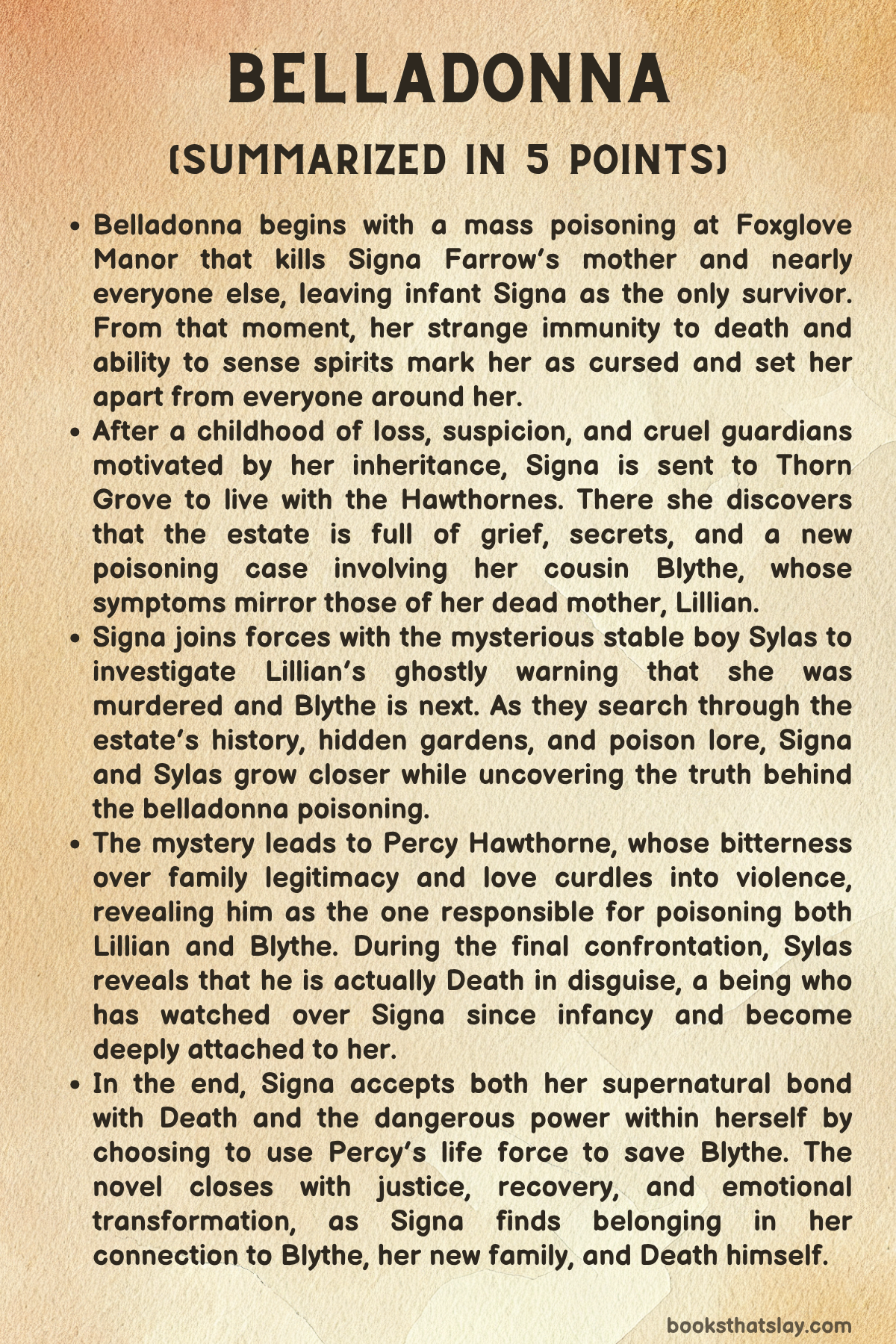
The story opens with tragedy. As an infant, Signa is presented by her wealthy mother, Rima Farrow, at a lavish party at Foxglove Manor.
The wine has been poisoned with belladonna, killing nearly everyone in attendance, including Rima. Death arrives to collect the souls but pauses at baby Signa.
He senses something unique about her—she is immune to his touch—and spares her life, leaving her as the sole survivor amid the corpses. This event marks Signa forever.
From then on, guardians pass Signa between them, each drawn by her substantial inheritance (which she will fully claim at age 20). Each guardian dies under mysterious or tragic circumstances, fueling rumors that Signa is cursed by Death.
She can sense death and see spirits, and she repeatedly tests her own mortality—attempting suicide multiple times—but always survives. At five, after breaking her neck, Death appears and restores her.
Signa grows up resenting this entity, viewing him as the source of her isolation and misfortune. She studies poisonous plants obsessively, finding both fascination and control in them.
At nineteen, living with her cruel Aunt Magda (who only tolerates her for the money), Signa reaches a breaking point. In a fit of desperation and anger, she eats deadly belladonna berries to summon Death and demand answers.
When Death appears but offers little explanation, Signa lashes out. In the chaos, she accidentally kills Aunt Magda with a touch—her first intentional taking of a life.
Horrified by this emerging power, Signa is soon summoned to live with distant relatives: her uncle Elijah Hawthorne and his family at the grand but eerie Thorn Grove estate. A stable boy named Sylas Thorly arrives to escort her.
Thorn Grove is a place heavy with secrets and grief. Elijah, the patriarch, copes with the recent death of his wife Lillian by throwing extravagant parties.
Their daughter Blythe is gravely ill, exhibiting the same mysterious symptoms that killed Lillian—weakness, hallucinations, and a wasting sickness. Their son Percy is distant and erratic.
Signa quickly senses that something is deeply wrong. Lillian’s spirit haunts the estate and directly appeals to Signa, insisting she was murdered and that Blythe is next.
Signa, who can communicate with ghosts, teams up with the enigmatic Sylas to investigate. They research antidotes in the library (aiding a helpful ghost librarian named Thaddeus) and discover that Blythe is being poisoned with belladonna—the same toxin that killed the guests at Signa’s infancy party and now Lillian.
Signa finds a risky antidote derived from the Calabar bean and helps administer it, buying Blythe time. As they dig deeper, Signa grows closer to Sylas, sharing quiet moments and a budding, charged attraction despite his aloof demeanor and mysterious knowledge of the estate.
The family dynamics add layers of tension. Elijah is consumed by grief and appearances, often absent or distracted.
Percy behaves strangely, sneaking into the woods and obsessing over family legacy. Marjorie, the governess (and Lillian’s former companion or a maternal figure in the household), adds another layer of complexity.
Signa feels a genuine bond with her cousin Blythe, who is strong-willed, sarcastic, and defiant against societal expectations for women—especially the pressure to marry. Their growing sisterly relationship becomes one of the emotional anchors of the story.
As Signa and Sylas investigate, they uncover hidden family tensions. Lillian’s spirit reveals more about her death.
The trail leads to a secret garden once tended by Lillian. In a tense confrontation, Percy’s true role emerges.
Motivated by resentment over his illegitimacy (he is revealed as a bastard) and a desperate, misguided desire to preserve or regain his father’s attention and the family legacy, Percy poisoned a tea meant for Marjorie. Lillian accidentally drank it instead.
Rather than stopping, Percy continued poisoning Lillian to cover his tracks and then began poisoning Blythe as well, believing it might somehow draw Elijah closer or “fix” the family.
Percy confesses without remorse during the climax. In the ensuing struggle in the garden (which catches fire), Percy attempts to kill Signa.
Sylas intervenes, getting stabbed—but the blade passes harmlessly through him. Sylas then transforms, revealing his true identity: he is Death.
He has been disguising himself as the stable boy Sylas (visible primarily to Signa and animals) to stay close to her, first out of curiosity about her unique nature, and later out of genuine care and desire.
Death offers Signa a profound choice that tests her morality and growing acceptance of her powers: she can let Percy face public trial and execution, or she can claim his remaining life force herself and transfer those years to save Blythe. Signa chooses the latter.
With Death’s guidance, she embraces her reaper-like abilities, trapping Percy in the burning garden and sealing his fate. Lillian’s spirit, now at peace, says her final goodbyes to Elijah and moves on.
Blythe begins a slow recovery.
In the aftermath, Death fully explains himself to Signa. He has watched over her since infancy, intervening at times because of his fascination and eventual affection.
Signa, who has spent her life fearing and resenting him, confronts her feelings. Their romance—built on shared loneliness, mutual understanding of death, and electric tension—deepens.
Signa accepts that she cannot live a ordinary mortal life and instead finds purpose in her powers: helping spirits cross over and wielding life-and-death responsibility with care. The story closes on a note of tentative hope and connection.
Signa is no longer alone; she has Blythe’s friendship, a complicated but healing family tie, and a profound bond with Death. Marjorie returns briefly to collect her things, underscoring the shifting household.
Characters
Signa Farrow
Signa Farrow stands at the center of Belladonna as a heroine shaped by survival, abandonment, and a deeply unusual intimacy with mortality. Her life begins in catastrophe, and that beginning determines nearly every part of her emotional development.
Because she is the lone survivor of a mass poisoning and then passes from one dying guardian to another, she grows up with the belief that she is somehow marked, unwanted, and dangerous to those around her. This history explains why she often appears guarded, morbid, and emotionally conflicted.
Her repeated attempts to test the limits of her own death are not simply acts of recklessness; they reveal a young woman desperate to understand the rules governing her existence. She wants certainty in a life that has offered her only instability.
Her fascination with poisons also comes from this same desire for control. Where others fear death as an unknown boundary, Signa studies it, names it, and tries to force it into something understandable.
What makes her compelling is that she is neither a passive victim nor a conventional chosen one. Her powers do not make her feel special in an empowering way at first; they isolate her further.
She must learn to live with an ability that makes ordinary domestic life almost impossible, and this struggle gives her character emotional weight. Her movement through Thorn Grove shows a major shift in her identity.
Instead of merely enduring strange circumstances, she begins to act with purpose. She investigates Lillian’s death, protects Blythe, challenges secrets, and confronts the frightening truth of what her own power can do.
That shift from reactive to active is central to her development.
Her emotional growth is equally important. Signa begins with resentment toward Death, fear of herself, and a deep hunger for belonging.
By the end, she does not simply gain romantic attachment; she gains a more stable understanding of who she is. She stops defining herself only through curse, rumor, and loss.
Her choice regarding Percy is especially revealing because it shows that she is willing to carry moral responsibility rather than remain innocent at a distance. She becomes a figure who can hold tenderness and danger in the same body.
That complexity is what makes her memorable. She is not purified by suffering; she is sharpened by it.
Death / Sylas
Death is one of the most layered figures in the novel because he functions at once as supernatural force, romantic counterpart, mystery figure, and mirror to Signa’s inner life. His earliest role in the story presents him as something vast and unknowable, an entity associated with endings, fear, and cosmic judgment.
Yet from the beginning, his encounter with Signa introduces a disruption in that role. He is intrigued by what he cannot explain, and this curiosity develops into a long emotional attachment.
His choice to remain near her reveals that he is not simply an abstract embodiment of mortality but a being capable of fascination, patience, possessiveness, and care. These qualities complicate the expectation that Death must be cold or detached.
His disguise as Sylas is especially important because it allows his character to exist on two levels. As Sylas, he can participate in human interactions, observe Signa more closely, and become legible to readers as someone with humor, intelligence, restraint, and desire.
His aloofness under that identity is not just part of a mystery; it reflects the difficulty of a powerful immortal trying to enter the world of human feeling without fully surrendering his nature. Even before the reveal, his presence suggests hidden knowledge and hidden vulnerability.
After the reveal, those earlier moments gain greater significance because they show that his connection to Signa was not a game or temporary disguise, but something emotionally genuine.
He is also crucial because he redefines what death means in the narrative. He is not written solely as destruction.
He is part of order, passage, and truth. Through him, mortality becomes something more morally complicated than simple loss.
He can be compassionate, but he also remains dangerous. That balance prevents him from becoming sentimental.
His love does not erase the fact that he belongs to a realm beyond ordinary human ethics. This tension gives the romance its charge.
Signa is drawn not to a softened imitation of darkness, but to a figure who still carries its full weight. His final significance lies in how he helps Signa accept her own nature.
He does not rescue her into normalcy; he welcomes her into difference. In doing so, he becomes both lover and witness to her transformation.
Blythe Hawthorne
Blythe provides emotional grounding and moral clarity within a house crowded by deception, grief, and performance. Though she begins as the endangered cousin whose life must be saved, she quickly becomes much more than a fragile victim.
Her illness places her in a vulnerable position, but her personality resists any easy reduction into weakness. She is sharp, skeptical, and often more perceptive than the adults around her.
She understands that the world expects her to perform femininity and obedience, and she meets those expectations with resistance rather than submission. This makes her one of the most refreshing presences in the story because she offers a clear contrast to Signa’s initial longing for conventional acceptance.
Blythe has less interest in pleasing society and more interest in retaining her independence, even while physically endangered.
Her relationship with Signa is one of the strongest emotional threads in the narrative. At first, the connection between them is shaped by distance, suspicion, and the unfamiliarity of family.
Over time, however, it develops into something resembling sisterhood. This bond matters because it gives Signa a form of love that is not romantic and not transactional.
For someone who has spent her life being passed between guardians motivated by money or obligation, Blythe’s presence offers the possibility of genuine attachment. Their differences make this relationship richer.
Signa is often cautious, inward, and shaped by loneliness, while Blythe is more openly defiant and expressive. Together they create a dynamic that broadens the emotional range of the story.
Blythe also has symbolic importance. She represents what is still worth saving inside Thorn Grove.
The estate is full of death, secrets, and corruption, but Blythe embodies a future that has not yet been destroyed. Her slow recovery at the end is therefore not only a personal victory but also a sign that the cycle of hidden harm can be interrupted.
She survives attempted erasure, and that survival carries emotional force because she has never been passive in spirit, even when her body has been failing. Her character reminds the reader that strength is not measured only by physical action.
Sometimes it appears as wit, refusal, endurance, and the determination to remain oneself when others have already begun to treat you like a ghost.
Elijah Hawthorne
Elijah Hawthorne is a study in the failure of patriarchal authority, not because he is purely cruel, but because he is emotionally absent in moments that require moral presence. As head of the household, he should provide structure, protection, and truth.
Instead, he becomes a man consumed by image, grief, and avoidance. After Lillian’s death, he responds not by confronting the emotional reality of his family’s suffering but by burying himself in lavish social performance.
His parties function almost like denial made visible. They allow him to preserve the illusion of control and prestige even as his household is quietly collapsing.
This makes him an important figure because he shows how damage can spread not only through active malice but through negligence and self-absorption.
His love for his family is not absent, but it is distorted by weakness. He mourns Lillian, yet his mourning becomes another way of retreating from responsibility.
He worries about Blythe, yet he fails to recognize what is happening in his own home. He is also central to Percy’s resentment, since Percy’s desperation for recognition grows in part from Elijah’s inconsistent or conditional care.
This does not excuse Percy’s crimes, but it helps explain the emotional ecosystem in which those crimes become possible. Elijah is a father whose blindness has consequences.
He does not intend catastrophe, but he helps create the silence in which catastrophe thrives.
What makes him effective as a character is that he is neither villain nor hero. He represents the weakness of men who have power without emotional courage.
He can host, command, inherit, and symbolize family legacy, yet he cannot adequately protect the people who depend on him. In this sense, his role in the novel is deeply ironic.
He appears to be the center of the household, but he is not its moral center at all. Others carry that burden instead: Signa investigates, Blythe resists, Lillian’s spirit demands justice, and even Death becomes more emotionally honest than Elijah in key ways.
His eventual confrontation with truth is painful precisely because it exposes how much of his identity rested on not seeing clearly. He is a tragic figure of failure, and his tragedy lies in how ordinary that failure is.
Percy Hawthorne
Percy Hawthorne is one of the darkest characters in the novel because his violence emerges not from supernatural corruption but from wounded entitlement, resentment, and a distorted hunger for recognition. He first appears strange, distant, and unstable, but the later revelations show that this instability has long been curdling into cruelty.
His illegitimacy shapes his inner life in a fundamental way. He occupies a tenuous position within the family, close enough to desire its approval and legacy, yet insecure enough to believe that he can never truly belong.
Instead of transforming that pain into self-knowledge, he lets it become grievance. He comes to see other people not as family members with their own suffering, but as obstacles, symbols, or tools within his private emotional drama.
What makes Percy especially disturbing is that his actions are intimate. He poisons within the domestic sphere, turning acts associated with care and household order into vehicles of betrayal.
That method suits his character because he does not seek open confrontation or honorable conflict. He operates through secrecy, manipulation, and cover-up.
His crimes begin in one direction and then widen as he tries to conceal them, showing how self-protective wrongdoing can escalate when the guilty person lacks conscience. His willingness to continue harming Blythe after Lillian’s death reveals a chilling moral emptiness.
He is not merely panicked by exposure; he becomes committed to a logic in which other lives are expendable if they do not serve his emotional needs.
Percy also functions as a foil to Signa. Both characters are shaped by family instability, outsider status, and closeness to death.
The difference lies in what they do with that suffering. Signa’s pain makes her guarded but compassionate; Percy’s pain makes him possessive and destructive.
This contrast strengthens the moral structure of the story because it shows that trauma does not erase accountability. The climax confirms him as a character who has moved beyond remorse.
His confession is powerful because it strips away ambiguity and reveals the full ugliness of his worldview. He does not merely commit evil acts; he rationalizes them as necessary.
In the end, his fate feels appropriate because he has been living like a hidden rot within the household. Once exposed, he cannot be reintegrated into ordinary family life.
He stands as the clearest example of how the desire to control love can become a form of annihilation.
Lillian Hawthorne
Lillian Hawthorne, though dead for much of the narrative, remains one of its strongest shaping presences. Her ghost is not included simply to add atmosphere; she is the voice that insists the truth must be faced.
In life, she seems to have been a stabilizing force within Thorn Grove, someone who brought care, cultivation, and emotional coherence to a house later overtaken by secrecy and decline. Her connection to the garden reinforces this impression.
She is associated with nurturing spaces, hidden knowledge, and a quieter form of order than Elijah’s public displays. After death, that role changes, but it does not disappear.
She becomes an active moral force, refusing to vanish until what happened to her and Blythe is understood.
Her ghostly presence carries both maternal urgency and unresolved pain. She is not at peace because her death was not natural and because her daughter remains in danger.
This makes her haunting purposeful rather than merely eerie. She reaches toward Signa because Signa is one of the few people capable of hearing what the dead still need.
In this sense, Lillian forms an important bridge between the living and the dead worlds of the novel. Through her, the story presents death not as silence but as unfinished truth.
She represents the idea that injustice leaves residue and that the dead are part of the moral life of the living, especially when their stories have been suppressed.
Lillian also influences the emotional arc of several other characters. For Elijah, she is the lost wife whose absence he cannot properly metabolize.
For Blythe, she is the mother whose protection has been violently taken away. For Percy, she becomes an early victim whose death reveals the scale of his corruption.
For Signa, she is both a guide and a warning. Lillian’s story shows what happens when beauty, status, and domestic comfort hide danger rather than prevent it.
Her eventual peace matters because it signals that the truth has finally been honored. Even after death, she retains dignity, agency, and emotional authority.
She is proof that a character need not remain physically alive to shape the deepest movements of plot and conscience.
Marjorie
Marjorie occupies a more ambiguous place in the story, and that ambiguity makes her useful. She exists at the edge of familial roles, neither fully inside nor outside the Hawthorne household, and that uncertainty helps sustain the atmosphere of suspicion.
Because the poisoning was initially meant for her, she becomes central to the mystery even when she is not always at the center of the action. Her relationship to Lillian and the family suggests layers of intimacy, loyalty, and tension that the household itself has not fully processed.
She carries the weight of hidden histories and unspoken feelings, which makes her presence quietly charged. Characters like Marjorie are important because they reveal that the emotional life of a grand house is never as simple as its formal family tree.
She also helps expose how vulnerable women can be within systems governed by appearance and inheritance. Her proximity to danger comes not from reckless behavior but from the fact that her existence matters in the wrong way to the wrong person.
Percy’s choice to target her shows how women in the household can become objects of projection, resentment, or control, regardless of their actual conduct. Marjorie’s function in the plot therefore extends beyond suspicion.
She represents the hidden casualties and near-casualties created by a family structure built on concealment and unequal power.
At the same time, her character contributes to the sense that Thorn Grove is a house organized by absences as much as by presences. She is tied to what has been displaced, misnamed, or carefully managed out of public view.
Her return at the end to collect her things feels emotionally significant because it underscores that the household cannot simply revert to its earlier state. The revelation of truth has altered every relationship inside it.
Marjorie’s departure or transition marks that change. She is not the most dramatic character, but she is one of the figures through whom the novel communicates its deeper concern with the costs of secrecy.
Aunt Magda
Aunt Magda appears for a comparatively brief section of the narrative, but her role is crucial in establishing the emotional conditions from which Signa departs. She represents the cold opportunism that has defined much of Signa’s upbringing.
Rather than offering care, she tolerates Signa for material reasons, treating her less like family than like a future inheritance temporarily under supervision. This attitude reinforces Signa’s lifelong belief that guardianship has never meant safety.
Magda’s home is therefore not just another unpleasant residence; it is a final expression of the pattern that has governed Signa’s life before Thorn Grove. In that space, affection is absent, cruelty is normalized, and Signa’s emotional desperation reaches a breaking point.
Her death is significant because it marks a turning point in Signa’s relationship to her own power. Up to that moment, mortality has largely been something that surrounds Signa, stalks her, or refuses her.
With Magda’s death, Signa becomes an agent rather than merely an observer of life and death. That shift is frightening because it destroys any illusion that her unusual connection to death is passive.
Magda’s role in the story is therefore larger than her page presence might suggest. She helps trigger the moment when Signa can no longer imagine herself as separate from the dangerous force within her.
Magda is also useful as a character because she lacks the emotional complexity of some others. Her harshness is not especially layered, but that simplicity serves a structural purpose.
She embodies a world that has already failed Signa so thoroughly that the move to Thorn Grove, despite its dangers, can also feel like entry into a more meaningful life. Magda is part of the emotional wasteland Signa must leave behind.
Her presence reminds the reader that before mystery and romance, there was plain neglect.
Themes
Death as Intimacy, Power, and Knowledge
Death in Belladonna is not treated as a distant event that appears only at the edge of life. It becomes a constant presence that shapes identity, emotion, and desire.
The story refuses to keep death in a purely symbolic or tragic role. Instead, it brings death close enough to become conversational, relational, and even tender.
This choice changes the emotional logic of the narrative. For Signa, death is not merely something that took her mother and repeatedly reshaped her life through the loss of guardians.
It is a force that has watched her, answered her, frustrated her, and defined the boundaries of what she can understand about herself. Because of this, death becomes inseparable from self-knowledge.
Every time Signa confronts mortality, she is also confronting the truth of her own difference.
This theme is powerful because it unsettles ordinary assumptions about what should be feared. Signa begins by viewing death as the source of her suffering, but over time she learns that death is not identical to cruelty.
The novel draws a distinction between mortality itself and the human choices that weaponize suffering. Percy poisons; secrecy protects wrongdoing; negligence allows harm to spread.
Death, by contrast, often appears as witness, inevitability, and passage. This does not make it harmless, but it does make it more morally complex than the violence committed by the living.
The story asks readers to recognize that fear of death can obscure the more immediate dangers posed by greed, denial, and control.
The romantic dimension intensifies this theme further. Signa’s connection with Death is compelling not simply because it is supernatural, but because it links eros with existential recognition.
She is loved most fully by the being who understands what she is at the deepest level. Their bond suggests that intimacy requires being seen without disguise, even when what is seen is unsettling.
To be known by Death is, for Signa, to be known beyond performance, beauty, and social expectation. This gives the romance philosophical weight.
It is not just attraction to danger, but attraction to absolute witness.
By the end, death is no longer only an outside force imposing itself on Signa’s life. It becomes part of the responsibility she must carry.
She learns that proximity to death grants not freedom from morality, but greater moral burden. She must choose how to use power that crosses the line between life and extinction.
In this way, the theme moves from fear to understanding and then to ethical action. Death becomes a language through which the novel examines love, isolation, justice, and identity all at once.
Family as Inheritance, Performance, and Damage
Family in this story is never a simple refuge. It is presented as a structure that can pass down wealth, names, expectations, secrets, and wounds with equal force.
Signa’s life demonstrates this from the start. Though she is linked to privilege through inheritance, that same inheritance turns her into an object of calculation for a series of guardians.
She is wanted and unwanted at the same time, valued for what she possesses rather than who she is. This creates a sharp tension between the ideal of family and the reality she experiences.
Kinship is supposed to mean belonging, but in her life it often means exposure to people who see her as burden, curse, or opportunity.
Thorn Grove extends this theme by presenting a household that looks respectable from the outside while quietly collapsing within. Elijah maintains grand social rituals, but those rituals cannot hide the fact that his family is fragmented by grief, silence, and resentment.
The house becomes a stage on which family performance is maintained even as trust breaks down. This matters because the novel shows that damage within families is often sustained by appearance.
People continue playing their roles long after those roles have stopped protecting anyone. The father remains patriarch, the daughter remains decorative invalid, the son remains heir-adjacent, the household remains grand, and the guests continue arriving.
Yet beneath that surface, poisoning, suspicion, and emotional abandonment flourish.
Percy’s role deepens this theme by exposing how inheritance is not only material but psychological. His illegitimacy creates a crisis of place.
He is close enough to the family to crave its affirmation, yet distant enough to feel permanently denied. That wound becomes destructive because he treats belonging as something that can be secured through elimination and control.
His violence reveals how family systems can produce distorted forms of desire when love is conditional, unevenly distributed, or entangled with status. At the same time, Blythe and Signa show that family can be remade through chosen loyalty rather than blood alone.
Their bond develops not because tradition demands it, but because mutual care makes it possible.
The theme becomes especially meaningful because it does not reject family altogether. Instead, it separates genuine connection from inherited structure.
Biological ties alone do not guarantee safety, honesty, or love. Real family in the novel emerges through protection, recognition, and shared truth.
Signa’s ending suggests that healing is possible, but only once illusion is stripped away. A household cannot become whole by preserving its image.
It must survive exposure first. Family, then, is shown as both wound and possibility: a place where harm is often learned, but where belonging can still be rebuilt under more honest terms.
Female Agency in a World of Control and Expectation
The women in Belladonna are repeatedly placed in positions where others try to define their bodies, futures, and meanings for them. This makes agency one of the novel’s most important concerns.
Signa, Blythe, Lillian, Marjorie, and even the briefly seen Magda all occupy different positions within systems shaped by inheritance, social reputation, and patriarchal authority. Yet the story refuses to leave them as passive figures inside those systems.
Again and again, women act, interpret, resist, survive, or insist on truth, even when formal power belongs to others.
Signa’s journey is central here because her struggle is not only against external threat but against the pressure to become legible on conventional terms. She has been taught to desire a form of ordinary femininity that would make her acceptable: security, social ease, a life untouched by strangeness.
But her reality never fits that model. Her body resists death, senses spirits, and eventually carries lethal force.
She cannot enter adulthood by performing normalcy, because normalcy was never available to her. Her development therefore becomes a story of agency through self-acceptance.
She gains power not by becoming less strange, but by refusing to let others define that strangeness as shame. This is important because the novel does not present empowerment as simple confidence.
It presents it as the painful process of claiming a self that the surrounding culture cannot easily contain.
Blythe offers a different but related form of resistance. Though physically weakened, she rejects the script that expects sick or marriageable young women to remain compliant and ornamental.
Her wit and defiance keep her from becoming merely an object of rescue. Lillian, too, continues to exert agency after death by demanding justice and refusing erasure.
Even as a spirit, she will not allow the story of her life to be closed falsely. Marjorie’s place in the household further shows how women’s lives can be shaped by rumor, vulnerability, and invisibility within elite domestic spaces.
The poisoning motif sharpens this theme in a revealing way. Poison works through intimacy, consumption, and hidden access, all of which are linked to domestic life.
The fact that women become targets within these private spaces highlights how danger often appears where social ideology claims they should be safest. Against this, the women create counter-forces of perception and action.
They read signs, test truths, form alliances, and refuse silence. The novel shows agency not as absolute freedom, but as the ability to act meaningfully inside structures designed to limit that action.
That makes its portrayal of female power both emotionally satisfying and politically sharp.
Secrecy, Truth, and the Moral Cost of Concealment
Secrecy governs the emotional and narrative structure of the novel. Characters hide motives, identities, family histories, illnesses, and crimes, and the resulting atmosphere is one where perception itself becomes unstable.
Thorn Grove feels haunted not only because spirits are present, but because truths have been withheld so long that the house has become saturated with distortion. The story suggests that concealment is rarely neutral.
Secrets do not simply wait in the background; they actively shape behavior, relationships, and moral failure. In this sense, secrecy is not just a plot device for suspense.
It is a condition that allows harm to continue.
The poisoning of Lillian and Blythe is the clearest example. Because the truth remains hidden, illness can be misread as frailty, grief can be manipulated into distraction, and danger can continue under the appearance of ordinary household life.
Percy’s crimes depend on concealment, but the novel makes clear that he is not the only one sustained by silence. Elijah’s refusal to see clearly, the household’s investment in appearance, and the broader social culture of performance all create the environment in which truth becomes difficult to name.
This is why the mystery has moral force. Solving it is not just an intellectual exercise; it is an ethical necessity.
To uncover the truth is to interrupt violence.
Signa’s abilities position her as someone uniquely suited to this work. She hears from the dead, notices what others dismiss, and cannot easily accept polished surfaces as complete explanations.
Her supernatural gift therefore aligns with a moral function: she becomes a reader of hidden realities. The dead themselves participate in this theme through Lillian, whose haunting makes secrecy impossible to maintain forever.
The novel suggests that truth has pressure. It may be delayed, buried, or denied, but it leaves signs behind.
Bodies, spirits, symptoms, and emotional fractures all testify to what official narratives try to suppress.
The theme also operates on the level of identity. Death’s disguise as Sylas creates a more complicated form of concealment because it is not purely malicious.
His secrecy protects, observes, and tests. Yet even here the story insists that true intimacy requires revelation.
Love cannot remain indefinitely inside masks. The same principle applies more broadly across the book’s emotional landscape.
Relationships built on silence remain unstable, while those that survive truth gain depth. The cost of concealment is therefore not only danger, but emotional impoverishment.
People become trapped in roles, performances, and assumptions that prevent genuine connection. By contrast, revelation is painful but liberating.
It destroys illusion, yet it also makes healing possible. The novel finally argues that truth is disruptive because it must be.
Anything less would leave the house, the family, and Signa herself imprisoned inside stories designed by fear.