Below Zero Summary, Characters and Themes | Ali Hazelwood
Below Zero by Ali Hazelwood is a compelling romantic thriller set against the backdrop of space exploration. The story revolves around Hannah Arroyo, a brilliant engineer at NASA, and Ian Floyd, a former colleague with whom she shared a complicated past.
The book delves into their intense, on-and-off connection as they navigate personal insecurities, professional tensions, and life-threatening situations. Amidst a NASA mission to simulate life on Mars in the Arctic, the story weaves through their rekindled relationship, unexpected dangers, and emotional confrontations. Set in the high-stakes world of space exploration, Below Zero explores themes of love, career challenges, and overcoming personal barriers.
Summary
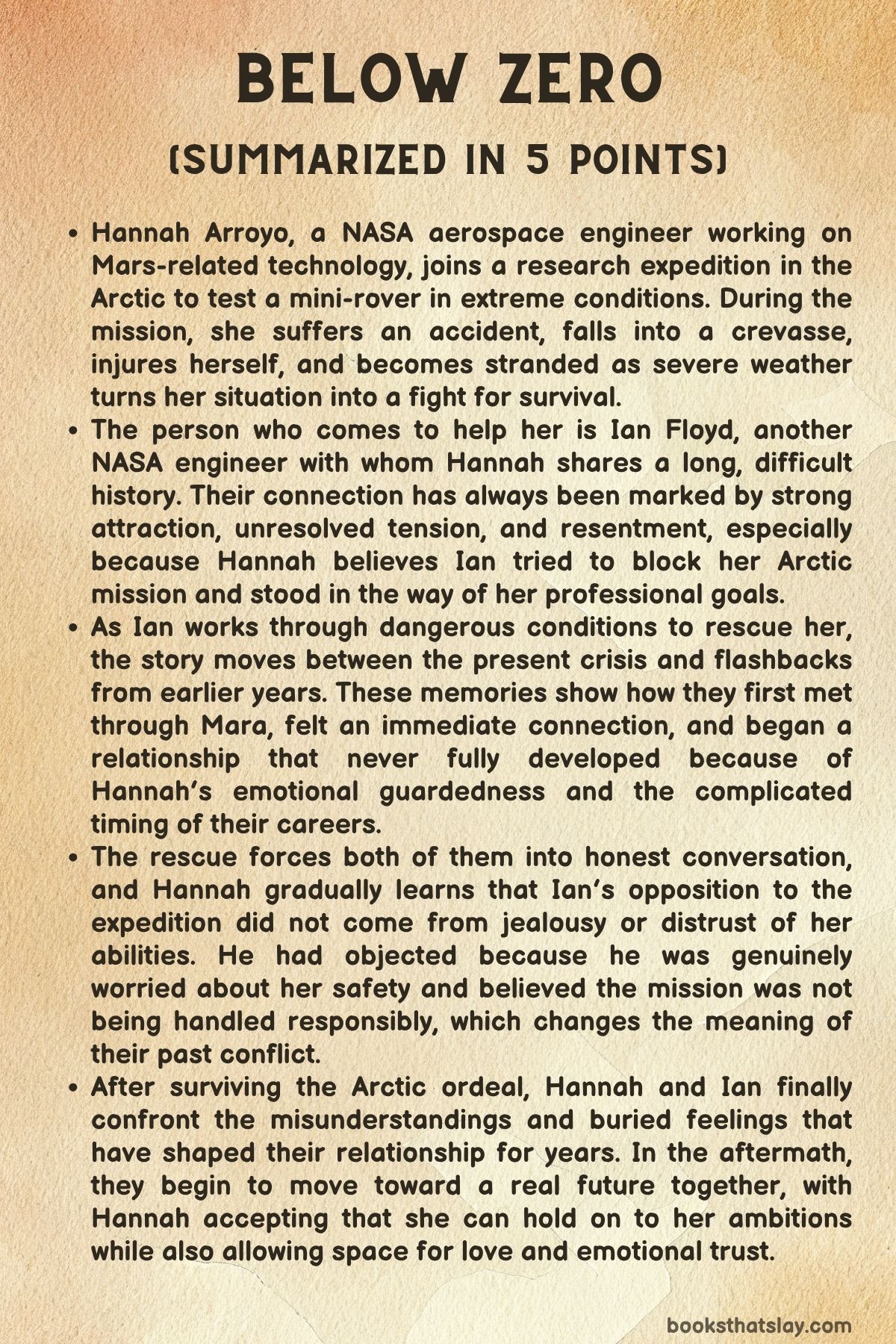
Dr. Hannah Arroyo is a NASA aerospace engineer with a passion for Mars exploration and rover technology. Unlike many of her colleagues who dreamed of space from childhood, Hannah’s interest ignited somewhat unexpectedly in high school after witnessing a Mars rover landing.
She worked hard to earn her Ph.D. and land her dream job at NASA, though she often battles imposter syndrome and feels she doesn’t quite belong among her more “destined” peers. She is close friends with fellow scientists Mara and Sadie (the heroines of the previous two novellas in the series).
The story unfolds in dual timelines. In the present, Hannah is on a high-stakes research expedition in the remote Arctic (Svalbard, Norway), testing a prototype mini-rover designed to simulate Mars conditions.
During the mission, things go wrong: she falls into a crevasse, injures her ankle, and becomes stranded as a dangerous storm approaches. Hypothermic and alone, her situation turns life-threatening.
Help arrives from the last person she expects—or wants: Ian Floyd, a brilliant NASA engineer (and Mara’s cousin) with whom she has a complicated history. Ian has been many things to Hannah—professional rival, the man who tried to veto her Arctic expedition (claiming it was too risky and questioning aspects of the proposal), and the star of her most intense, steamy fantasies.
He has never been a hero in her eyes. Yet here he is, risking his own life by venturing into the blizzard to rescue her.
As Ian works to reach and extract Hannah from the crevasse, they communicate via satellite phone. The forced proximity and high stakes force them to confront their past while the Arctic storm rages.
Flashbacks reveal how their connection began about five and a half years earlier. As a grad student at Caltech, Hannah needed to conduct an informational interview for a class assignment.
Her friend Mara sets her up with her cousin Ian, who was already working with NASA’s Mars rover team (including Curiosity). What starts as a professional meeting quickly sparks undeniable chemistry and attraction.
They spend time together, banter, and share a passionate encounter, but Hannah—guarded and commitment-averse—pulls back before things can develop further.
Years later, when Hannah joins NASA, their paths cross again. Old sparks fly, but professional tensions arise.
Ian opposes Hannah’s risky Arctic mission proposal, leading her to feel betrayed and view him as an obstacle to her career. She confronts him angrily, believing his veto stems from personal animosity or doubt in her abilities.
In the present-day rescue, as they huddle for safety and eventually make it out (with Ian having positioned himself nearby on a boat in anticipation of trouble), the truth emerges. Ian vetoed the proposal not out of malice or sabotage, but out of genuine concern for Hannah’s safety—he didn’t trust the mission leadership to protect her adequately.
He even used his vacation time to stay close by, ready to intervene if needed. His actions reveal deep, long-held feelings for her, despite their miscommunications and her emotional walls.
After the rescue, the pair shares quiet, intimate moments in the aftermath (including time on the boat). They finally address their misunderstandings, past hurts, and lingering attraction.
Hannah grapples with her insecurities, fear of vulnerability, and reluctance to prioritize relationships over her career. Ian proves patient, steady, and devoted, showing a softer, protective side beneath his sometimes aloof or stubborn exterior.
The novella builds to an emotionally satisfying resolution where Hannah and Ian acknowledge their mutual feelings, clear the air on professional and personal levels, and take tentative steps toward a real relationship. Their chemistry—always hot beneath the rivalry—ignites fully in the forced-proximity tension of the Arctic.
The story ends on a hopeful note, with Hannah embracing both her ambitions at NASA and the possibility of love, while Ian supports her without trying to hold her back.
Characters
Hannah Arroyo
Hannah Arroyo stands at the emotional and intellectual center of Below Zero, and her character is shaped by a constant tension between achievement and self-doubt. She is highly competent, deeply committed to aerospace engineering, and genuinely passionate about Mars exploration, yet she does not move through her professional life with complete confidence.
Instead, she carries a persistent sense that she has entered a world where others seem more naturally suited than she is. That feeling gives her character a strong internal conflict: outwardly, she is accomplished and capable, but inwardly, she is still trying to prove that she belongs.
This gap between how others likely see her and how she sees herself creates much of her emotional complexity. Her intelligence is never presented as effortless perfection.
It comes with pressure, discipline, and the fear that one mistake will confirm her worst assumptions about herself.
Her emotional life is similarly guarded. Hannah is not someone who easily trusts intimacy, even when attraction is strong and genuine.
Her connection with Ian shows that she feels deeply, but she tries to manage those feelings by creating distance, controlling the terms of attachment, or convincing herself that vulnerability is a threat to stability. That makes her more than a standard romance protagonist.
She is not simply resisting love because of a misunderstanding; she is resisting the loss of control that love might demand. Her career matters to her not only because she loves the work, but also because it gives her structure, identity, and measurable success.
Emotional uncertainty, by contrast, places her in a position she cannot fully engineer or predict.
The Arctic crisis sharpens all of these qualities. In that setting, Hannah is physically vulnerable, but the more important revelation is psychological.
Stranded, injured, and forced into direct dependence on someone she has tried to keep at emotional arm’s length, she can no longer hide behind professional irritation or private rationalizations. Her survival depends on accepting help, and that situation mirrors her larger emotional struggle.
She has to confront the fact that strength does not always mean independence. Sometimes it means allowing another person to care for her without interpreting that care as interference, pity, or control.
This shift is what makes her arc satisfying. She does not abandon ambition or soften into passivity.
Instead, she grows into a fuller version of herself, one who can remain brilliant and driven while also making room for trust, affection, and mutual support.
Ian Floyd
Ian Floyd is written as a character whose strongest emotions are often hidden behind restraint, competence, and apparent opposition. At first glance, he can seem frustrating, severe, or even obstructive, especially from Hannah’s perspective.
He challenges her proposal, appears to stand in the way of her goals, and carries the kind of emotional reserve that makes his motives hard to read. Yet this opacity is exactly what gives his character force.
He is not careless with emotion; he is careful to the point that his concern is often misread as distance or judgment. That creates a version of masculinity built less on display and more on endurance, patience, and quiet commitment.
His significance lies not simply in the fact that he loves Hannah, but in the way he has continued to care for her even when that care has not been welcomed or understood.
Ian’s intelligence and professional seriousness place him on equal footing with Hannah, which makes their relationship especially compelling. He is not defined only as a love interest who exists to admire her.
He has his own expertise, his own judgment, and his own standards for risk and responsibility. When he opposes the expedition, that action initially reads as controlling, but the later revelation changes the moral meaning of his decision.
He is not trying to diminish Hannah’s ability. He is reacting to a system he believes may fail to protect her.
That distinction matters because it shows that his conflict with her is not rooted in condescension, but in fear and care. He does not doubt her brilliance.
He doubts the conditions around her.
What makes Ian especially effective as a character is his consistency. He does not need a dramatic transformation to become worthy of trust; rather, the story gradually reveals that he has been more dependable than Hannah realized.
His rescue effort confirms this in the clearest possible way. He acts decisively, places himself at risk, and does so without demanding emotional reward.
This gives him moral solidity. He is not performing heroism for admiration.
He is responding because he cannot stand aside while she is in danger. At the same time, he is not reduced to a stoic protector figure.
His long-held feelings, his persistence, and his willingness to remain emotionally available despite years of confusion show real tenderness. He becomes convincing because strength and gentleness are not treated as opposites in him.
They operate together, making him both emotionally appealing and thematically important.
Mara
Mara occupies a smaller role in the plot, but she still carries structural and emotional importance. Her connection to both Hannah and Ian places her in a unique position within the story’s interpersonal framework.
She is the bridge between the two leads in the past, the person whose relationship to both of them helps create the opportunity for their first meeting. That role could have been purely functional, but she also represents something more meaningful in Hannah’s life: friendship, community, and a reminder that professional women in demanding fields do not exist in total isolation.
Even when she is not at the center of the action, her presence suggests a wider network of emotional support around Hannah.
Mara also helps define Hannah by contrast and companionship. The fact that Hannah is close to her indicates that Hannah is not emotionally incapable, only selective and defended.
Through friendships like this one, the story suggests that Hannah can form strong bonds, but romantic vulnerability triggers different fears. Mara therefore becomes part of the context that clarifies Hannah’s complexity.
She is a marker of trust already achieved, while Ian represents trust still being negotiated. That distinction adds depth to Hannah’s emotional world.
Because Mara is Ian’s cousin, she also indirectly complicates the dynamic between the two leads. Her presence links personal and professional spaces in a way that prevents the relationship from feeling disconnected from the rest of their lives.
Ian is not just an abstract object of attraction or rivalry; he exists within Hannah’s social circle, with history, ties, and a place in a shared world. Mara’s role reinforces that sense of continuity.
She helps make the relationship feel lived-in rather than accidental. In a novella, where space is limited, characters like Mara are especially valuable because they add emotional context efficiently.
She stands for friendship, continuity, and the broader social reality surrounding the central romance.
Sadie
Sadie, though less central in the immediate conflict, contributes to the emotional architecture of the narrative by reinforcing the importance of female friendship and solidarity. Her presence alongside Hannah and Mara shows that the protagonist’s life is not defined solely by romance or work.
She belongs to a network of women who are intellectually serious, professionally ambitious, and personally supportive. That matters because it broadens the emotional scope of the story.
Hannah’s journey is not taking place in a vacuum; it is unfolding within a circle where shared understanding and mutual respect exist.
Sadie’s importance also lies in what she represents symbolically. In stories centered on high-achieving women, friendships can sometimes be sidelined in favor of romantic development, but here they help establish a fuller picture of emotional life.
Sadie’s presence suggests a world in which women can be collaborators, confidantes, and stabilizing influences for one another while still pursuing demanding careers. This strengthens the narrative’s treatment of ambition because it shows that success is not only individual.
It is often sustained by relationships that provide encouragement, perspective, and emotional grounding.
Even in limited appearances, Sadie helps frame Hannah’s character more clearly. The fact that Hannah has meaningful friendships with women who understand the pressures of scientific work indicates that her alienation is not absolute.
She is not disconnected from everyone; she is specifically struggling with certain forms of intimacy and self-belief. That distinction is crucial.
Sadie’s role, then, is subtle but important. She contributes to the sense that Hannah’s world includes loyalty, trust, and companionship outside the central romance, which keeps the story emotionally balanced and prevents it from reducing Hannah’s identity to only her relationship with Ian.
Themes
Love and Vulnerability as Forms of Risk
The relationship between Hannah and Ian is shaped by the fact that emotional exposure feels dangerous to Hannah in much the same way that the Arctic mission is physically dangerous. This parallel gives the romantic arc its real depth.
The issue is not simply that two people are attracted to each other and keep missing their chance. The larger issue is that Hannah experiences vulnerability as a threat to her hard-won stability.
She has built a life around expertise, discipline, and measurable accomplishment. Those things reward effort and skill.
Love does not operate under the same logic. It asks for uncertainty, patience, honesty, and the willingness to be seen in moments of weakness.
For someone who already struggles with belonging and self-worth, that kind of openness can feel intolerably exposing.
Ian, by contrast, becomes significant not only because he desires Hannah, but because he remains present despite her defensiveness and misreadings. He is persistent without becoming emotionally theatrical.
That patience changes the meaning of romance in the story. Love is not presented as instant clarity or overwhelming destiny.
It is shown as endurance, steadiness, and a repeated choice to care even when communication fails. This gives the emotional conflict a mature quality.
The problem between them is not lack of feeling. It is the fear that feeling will lead to loss of autonomy, loss of control, or pain.
The survival scenario in the Arctic makes this theme impossible to ignore. Hannah cannot survive alone, and that reality forces her into dependence at the exact moment when emotional resistance is hardest to maintain.
Her physical vulnerability mirrors the emotional vulnerability she has avoided for years. In both cases, she must accept that needing another person does not erase her strength.
This is one of the most meaningful ideas in the story. It pushes back against the belief that independence is the highest form of power.
Instead, the narrative argues that connection can be equally powerful, provided it is rooted in respect rather than domination.
What makes this theme especially effective is that the resolution does not ask Hannah to choose love over selfhood. She does not need to become less ambitious or less guarded overnight in order to deserve happiness.
Rather, she learns that intimacy does not have to undo ambition. Trusting Ian does not mean surrendering her identity.
It means allowing another person to know her fully, including the fears she would rather hide. In that sense, the emotional core of Below Zero is built on a simple but demanding idea: love becomes real when people stop managing each other from a distance and start facing each other honestly.
Professional Identity and the Need to Belong
Hannah’s professional life gives the story one of its most compelling thematic concerns: the difference between being qualified for a space and feeling entitled to occupy it. She has earned her place through intelligence, education, and sustained work, yet she still experiences herself as slightly out of alignment with the world around her.
Others seem to have grown up with a clear sense of scientific destiny, while her path feels more improvised, more vulnerable to doubt, and therefore somehow less legitimate in her own mind. This creates a powerful commentary on imposter syndrome, particularly within elite, highly specialized environments where competence alone does not always erase insecurity.
The story treats this insecurity seriously because it affects how Hannah interprets nearly everything around her. Professional disagreement feels personal because it collides with her fear that she is always one step away from being exposed as not good enough.
Ian’s opposition to her mission proposal wounds her so deeply not merely because it creates an obstacle, but because it appears to confirm her most painful private suspicion: that someone she respects does not believe in her capability. Her reaction gains emotional force because the conflict touches the exact place where her confidence is most fragile.
The professional sphere is never just about work. It is also where Hannah negotiates her worth.
This theme becomes richer because the story does not reduce belonging to external validation. Hannah is already accomplished.
She has the credentials, the job, and the technical expertise. The real struggle is internal recognition.
She must learn to understand her own presence in that world as earned and real, rather than conditional or accidental. The Arctic mission matters symbolically because it represents the kind of challenging, high-pressure work that she believes proves her seriousness.
Her commitment to it shows both her courage and her need to justify her place through extraordinary effort.
At the same time, the narrative suggests that professional identity can become emotionally isolating when it carries too much of the burden of self-definition. For Hannah, work is not just work.
It is proof, armor, and refuge. That is why the romantic conflict cannot be separated from the professional one.
Her fears about career, competence, and belonging influence the way she interprets care, criticism, and attachment. The story therefore presents belonging not as a prize granted by institutions, but as something a person must gradually claim from within.
Hannah’s growth lies in moving toward a more stable sense of self, one not entirely dependent on achievement or constant self-defense. That makes the theme resonate beyond the immediate plot and gives Below Zero emotional substance beneath its suspense and romance.
Miscommunication, Assumption, and Emotional Distance
A central tension in the story comes from the gap between what Hannah and Ian feel and what they are able to communicate. Their history is marked not by absence of emotion, but by failed interpretation.
This makes miscommunication more than a plot device; it becomes a theme about the damage caused when people rely on assumption instead of honesty. Hannah reads Ian’s actions through the lens of her own insecurity and hurt.
Ian, meanwhile, appears to rely too heavily on action without explanation, assuming that his concern either speaks for itself or cannot be safely voiced. The result is a relationship where deep feeling exists alongside persistent misunderstanding.
This dynamic is significant because it reflects how emotional distance is often sustained. It is rarely built from a single lie or betrayal.
More often, it grows through silence, half-explanations, and conclusions formed in moments of pain. Hannah sees Ian’s veto of the expedition as proof that he doubts or resents her.
From her point of view, this reading makes sense because she is already primed to expect skepticism. Ian, however, is acting from fear for her safety and distrust of the mission’s protections.
The tragedy is that both are responding to something real, yet neither fully understands the other’s inner logic. That disconnect allows resentment to harden.
The Arctic emergency becomes important because it strips away many of the conditions that let misunderstanding survive. In ordinary life, people can retreat, postpone, or hide behind work.
In crisis, those strategies collapse. Communication becomes urgent.
Feelings that were previously obscured by pride or anger become harder to avoid when survival is at stake. The setting therefore intensifies not just physical danger, but emotional truth.
Hannah and Ian are forced into a situation where assumption is no longer sufficient. They must speak more directly, and they must listen more carefully.
What the story finally suggests is that love cannot survive indefinitely on implication alone. Care has to be expressed in forms the other person can recognize.
Ian’s devotion is real, but until its motives are clarified, Hannah experiences it as interference. Hannah’s feelings are real, but until she admits the fears underneath her anger, Ian remains on uncertain ground.
This theme gives the narrative much of its emotional realism. People do not hurt each other only because they lack love.
They also hurt each other because they do not know how to translate that love into language, timing, and openness. The eventual reconciliation matters because it is built not just on attraction, but on the slow correction of false narratives.
Once they begin to replace assumption with disclosure, intimacy becomes possible in a more durable way.
Ambition, Safety, and the Cost of Commitment
The story places personal ambition alongside physical and emotional risk, asking what people are willing to endure in pursuit of meaningful work and meaningful connection. Hannah’s commitment to her NASA career is not ornamental background material.
It shapes her decisions, her sense of self, and the way others respond to her. The Arctic mission represents more than an exciting plot setting.
It stands for the kind of opportunity that ambitious people often feel they must seize, even when conditions are hazardous and support systems are imperfect. In this way, the narrative examines the complicated relationship between devotion to a calling and the cost that devotion may carry.
Hannah’s willingness to enter a dangerous environment underscores her seriousness. She is not casually career-driven.
She is prepared to test herself in extreme conditions because the work matters to her. That choice reflects integrity and courage, but it also raises difficult questions about how institutions manage risk and how individuals internalize the expectation that excellence requires sacrifice.
Ian’s objection to the mission introduces a conflicting ethical position. He is not arguing against her talent or right to participate.
He is responding to the possibility that passion and institutional prestige can normalize unsafe conditions. This disagreement gives the story thematic weight because both positions carry truth.
Ambition can be noble, but systems can fail the very people most dedicated to them.
This theme also extends into the romantic relationship. Hannah fears that emotional commitment might threaten her independence or dilute her professional focus.
She is wary of being placed in a position where love could become a competing loyalty. The story resists presenting that fear as irrational.
For many high-achieving people, especially women navigating demanding careers, relationships can carry the threat of compromise, redirection, or subtle diminishment. What makes Ian important is that he ultimately does not ask her to choose.
His care is not framed as an attempt to pull her away from her ambitions. Instead, his role in the resolution suggests that commitment can exist without requiring self-erasure.
The theme becomes especially resonant because safety is treated in several senses at once. There is physical safety in the Arctic rescue, professional safety in the question of whether institutions protect their people responsibly, and emotional safety in whether one can trust another person without losing autonomy.
These layers reinforce each other. The story argues that commitment, whether to work or to love, always involves exposure.
Yet it also proposes that meaningful partnership should increase a person’s safety rather than reduce it. By the end, the tension between ambition and attachment is not solved by diminishing either one.
Instead, the narrative imagines a form of balance where love becomes a source of steadiness, not limitation, and where being cared for does not mean being held back.