Beth is Dead Summary, Characters and Themes
Beth is Dead by Katie Bernet is a contemporary mystery that reimagines the March family as a famous, scrutinized household living in the aftermath of their father’s bestselling novel about them. On New Year’s morning, the sisters’ private tensions collide with public attention when Beth disappears—and is found dead in the snow.
Told through shifting viewpoints and time jumps, the story follows Jo, Meg, and Amy as they grieve, argue, and try to make sense of what happened, while police dig into threats, secrets, and the fallout of being turned into characters. It’s a fast-moving, character-driven whodunit about family, consent, and who gets to tell a girl’s story.
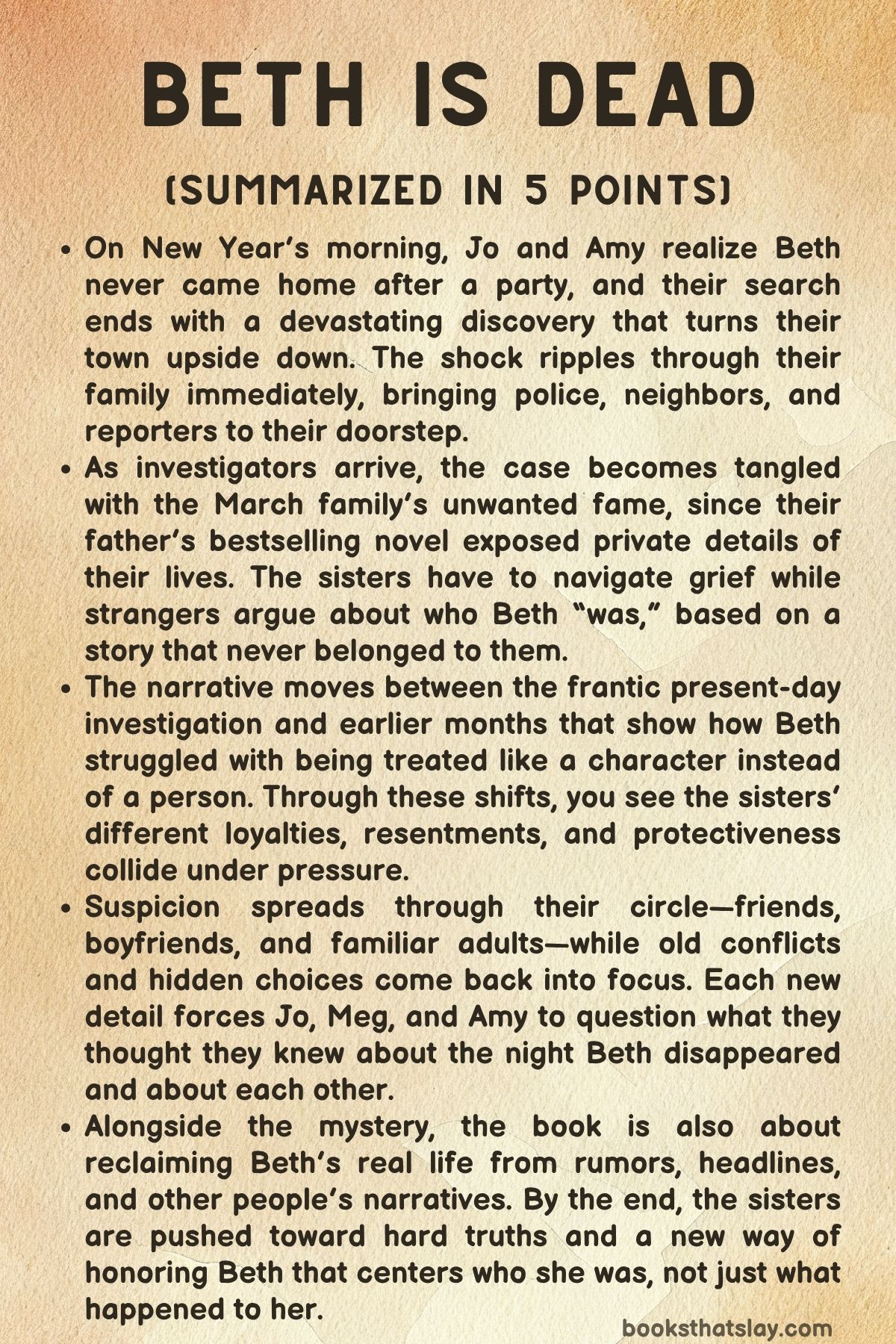
Summary
On New Year’s Day, Jo wakes to an empty bed where Beth should be. When she checks the bunk room, Amy is missing too.
Jo panics immediately; their mother worked a draining hospital shift the night before and could wake at any moment. Jo texts Amy, expecting Beth and Amy to come downstairs together—yet Amy appears alone, frightened, saying their mom’s door is open and asking where Beth is.
That’s when Jo realizes Amy didn’t even know Beth was missing. Amy calls Beth again and again, but it goes straight to voicemail.
She tries calling Sallie Gardiner, who hosted the big New Year’s Eve party, and gets nothing.
Amy claims she left the party after midnight and stayed at their cousin Florence’s house, sneaking in quietly. Jo is furious: Beth wouldn’t vanish overnight, especially with boarding school coming up.
They can’t risk starting Jo’s loud Jeep and waking their mother, so they head out on foot toward the Gardiners’ place, taking a shortcut past a bridge and through a park.
As they pass Laurie’s sleek modern home, Amy freezes, staring up the hill beside it. She insists she saw something.
Before Jo can stop her, Amy bolts into the brush and climbs toward the trees. She reaches an old tree, drops her phone, and crumples with a sound that makes Jo’s stomach turn.
Jo scrambles up after her and sees Beth lying in the snow at the base of the tree, surrounded by blood. Beth’s eyes are open, but she’s gone.
Amy throws herself toward Beth, desperate to find any sign of life. Jo holds her back and calls 911, fighting to form the words.
Laurie hears the screaming and runs outside, then up the hill. Jo tries to block his view, but he sees Beth and reels.
Sirens grow louder. Jo sprints back down to get their mother.
Their mother charges up the hill like it’s a call at work, then stops dead. She whispers Beth’s name and gathers her anyway, ignoring Jo’s pleas not to touch the body.
Beth’s head falls back unnaturally in her arms. Amy gets sick, the shock finally landing in her body.
First responders arrive and begin their work, but nothing can change what the sisters already know.
Far away at Harvard, Meg wakes hungover to Jo’s call. Jo’s voice is wrong—flat and cracked at the same time.
Meg hears the words and vomits, then rushes home, shaken by the ride back as the driver recognizes the March family. When she reaches the neighborhood, police cars, news vans, and reporters crowd the street.
A detective escorts her inside while warning her what she’s walking into. Amy clings to Meg, trembling.
Their mother sits numb in the kitchen, her hands stained with Beth’s blood, while investigators photograph her because she touched the body.
Detective Freya Kirke tells them they can’t rule out homicide. The family’s fame quickly becomes part of the investigation.
Beth is the daughter of Rob March, the bestselling author of a controversial novel titled Little Women—a book that used their lives, exposed intimate details, and made them public property. Meg argues Beth may have been targeted because of the book; Jo insists it has to do with the party and the night Beth vanished.
Meg drops a detail that chills everyone: in their father’s novel, Beth dies at the end. The detective’s attention sharpens.
Through flashbacks, the story shows how Rob March’s success poisoned the family’s sense of safety. At the launch party months earlier, protestors accused him of exploiting girlhood and turning his daughters into content.
Inside, Meg flips through the pages and finds scenes lifted from her own life. She storms out, furious, even stealing a copy because she can’t stand that it exists without her consent.
Beth, meanwhile, is forced to live under a strange kind of rumor: strangers mourn her as if she’s already dead, classmates joke about it, and even media outlets assume she’s the doomed sister. When Jo gets an interview request meant for all the sisters, the editor asks for Beth alone once they learn Beth is alive.
Beth agrees, hungry to be seen as herself, not as a character.
The police also review earlier incidents: vandalism on the garage, a break-in, and a hidden recording device planted under Beth’s piano. Rob March left in mid-June, claiming he was fleeing to the Canadian Rockies, and hasn’t been in contact since.
The case strains the department, and they bring back retired Detective Davis, who has history with the family and a tendency to suspect Jo. Their mother objects, but the town has no experience handling a death like this.
Jo refuses to trust Davis. Davis focuses on Amy, who is terrified because she’s carrying secrets.
He questions her about the party and learns Beth and Sallie weren’t actually close. Witnesses say Beth was crying late in the night and that Amy fought with her in an upstairs bathroom.
Amy admits there was an argument but frames it as stress about Beth leaving for boarding school. Davis then pushes her timeline.
Amy repeats her story about staying at Florence’s, but Davis reveals Laurie told police Amy left with him and stayed the night. Davis suggests Beth may have discovered something between Amy and Laurie and that a confrontation followed—especially since Beth was found just outside Laurie’s house.
Amy insists nothing happened beyond kissing and sleeping, but her fear grows because the real subject of the fight still sits in her throat.
While detectives work downstairs, Jo shuts herself in her room, numb and dehydrated, writing to stay upright. She remembers her editor once telling her her work lacked stakes.
Now, in a rush of guilt and instinct, she scribbles notes about the morning they found Beth—and even writes down a possible title: Beth is Dead. Meg knocks, and Jo hides the notebook like it’s contraband.
Henry Hummel arrives, frantic and pleading for the news to be false. He collapses into grief, insisting he should have been there.
The detectives question him about his movements. He says he worked at a diner until midnight, closed up afterward, and went home to care for his grandfather, Max, who has dementia.
Davis insists on visiting the grandfather to confirm. After the detectives leave with Henry, John Brooke arrives with food for the family and hugs Meg.
In private, he admits he saw Beth after midnight.
Jo forces him to say it out loud. John explains Beth called him from the party, drunk and upset, asking for a ride home and begging him not to tell anyone.
He picked her up, drove her home, and watched her go inside. Jo panics because she didn’t hear Beth come in.
John hints that Beth didn’t want Jo involved—and that the real problem was between Beth and Amy. Jo storms upstairs to confront Amy, only to find the bathroom empty.
Amy is gone.
Amy meets Laurie at the swings, shaking with memory and dread. Laurie admits he told police the truth because he needed an alibi; Amy lied and said she stayed with Florence.
Laurie urges Amy to explain what she fought with Beth about. Amy can’t.
The truth is bound up with Plumfield, an arts boarding school where Beth has an audition arranged by Aunt March. Beth has been practicing relentlessly, and Amy’s jealousy has been eating her alive.
In the past, the sisters discovered the hidden recording device under Beth’s piano—running for days—and argued about whether to call the police or their missing father. Amy raged that the big opportunity had been handed to the wrong sister.
When Amy returns home, reporters swarm. The family’s panic becomes a spectacle.
Under pressure, Amy finally admits the fight at the party wasn’t simply about leaving—it was about Plumfield and money and resentment. She told Beth she didn’t deserve the opportunity.
Amy starts spiraling into the fear that her words drove Beth toward danger, but their mother insists the injury looks like Beth was struck or shoved. The sisters want someone to blame, and they keep turning toward one another even as they try to hold together.
The investigation swings hard when forensic testing matches fingerprints on the old recording device to John Brooke. Police arrest him, and the family is wrecked by the idea that Meg’s boyfriend could be involved.
Jo panics because she knows the evidence is wrong. She confesses to Laurie: she planted the device and staged the break-in months earlier, trying to write an attention-grabbing essay that might force her father to look at what was happening at home.
Laurie tells her she has to tell the police—John can’t pay for her mistake. He also admits something else: after everything, he kissed Amy.
Jo’s confession changes the case. John is released when video doorbell footage supports his story that he brought Beth home safely.
John then reveals the night was worse than he initially admitted: his car hit a tree when Beth got sick, Beth ran off afterward near the bridge, and he chased her. She scratched him and tore his jacket before calming down.
He eventually got her back into the car and took her home. The details—his DNA under Beth’s nails, fabric found near the scene—explain why police targeted him.
Meanwhile, Amy’s guilt deepens when Aunt March confronts her about a secret deal. Amy wanted an expensive art program run by British artist Fred Vaughn.
Aunt March refused to fund it because she was committed to paying Beth’s Plumfield tuition—but promised the money would go to Amy if Beth didn’t go. Amy agreed not to tell Beth, then eventually did, and the betrayal detonated.
Flashbacks reveal Vaughn’s attention toward Amy wasn’t harmless; he flattered her, hinted at “other” ways to pay, and blurred boundaries. Beth interrupted an encounter at Vaughn’s studio and later warned Amy to be careful, trying to protect her.
As the police search for Rob March, Detective Kirke quietly asks Meg whether she has ever been afraid of her father. Investigators discover he never crossed into Canada despite saying he did.
Meg suspects he’s hiding at the family’s remote Mount Washington cabin. She checks his credit card account and finds purchases there, confirming it.
When Jo arrives with a bin of “evidence,” including Henry’s heavily annotated copy of Little Women, the sisters decide to drive to the cabin themselves, terrified of what they’ll find and what the police will assume.
The truth of Beth’s last night comes into focus. After leaving with John, Beth runs back out, desperate to make peace with Amy.
In the dark near Laurie’s house, Henry confronts her. His devotion isn’t just teenage romance; it’s control.
He admits he read Little Women and built his image of Beth around it. He warns her she’ll become the unloved sister who dies.
Beth tries to escape. Henry chases, shoves her, and she falls down the steep snowy hill, striking a boulder.
She bleeds and fades while Henry panics, strips off his jacket to erase evidence, and runs—leaving her there. Beth hears Amy and Laurie nearby, Amy’s drunken regret drifting through the dark, but Beth can’t call out.
In her final moments, she realizes she wants to live.
At the cabin, Jo and Meg find signs their father was there: his vehicle hidden, rotting food, a dead laptop, a back door ajar, an axe left out. Then Henry appears inside the house.
He demands his books and begs them not to turn them over. Under pressure, he admits Beth’s death “wasn’t supposed to happen,” then reveals something worse: he found Rob March and killed him because he believed Rob would expose him.
Henry pulls a gun, forces Jo and Meg into the living room, and makes them shut off their phones.
Amy and Laurie race toward the cabin after Amy tips off the police, but they fear help won’t arrive quickly enough. They sneak in through the attic access Amy remembers from childhood.
Jo keeps Henry talking, trying to distract him from pulling the trigger. A noise gives Amy and Laurie away; Henry panics.
Amy tackles him. The gun fires, shattering a window.
Laurie joins the struggle, stomping Henry’s hand until the weapon drops. Jo grabs it and holds him at gunpoint while Amy and Laurie restrain him until sirens arrive.
Police flood the cabin and arrest Henry.
Two months later, Henry pleads guilty to second-degree manslaughter for Beth and second-degree murder for Rob March, receiving a life sentence. The family gathers at Walden Pond to scatter ashes—first their father’s, then Beth’s.
Aunt March reveals she found the royalties, now even larger due to publicity, and offers support: funding to help the family and a Plumfield scholarship in Beth’s name. She also offers to take Amy to Europe to visit museums, and Amy accepts, trying to imagine a future that doesn’t revolve around guilt.
Meg returns to rebuilding her life with John no longer a secret. Jo completes her book, but not the sensational story the world expects.
Instead of turning Beth’s death into entertainment, she writes about Beth’s real life—small moments, private joys, and the parts that belonged only to her. Jo wants Beth remembered for living, not for how she died, and for the first time since New Year’s morning, that choice feels like a way forward.
Characters
Jo March
Jo is the engine of the story’s momentum, driven by urgency, anger, and a fierce need to make sense of what cannot be made sensible. She responds to loss the way she responds to everything: by moving, by pushing, by narrating.
From the first minutes of Beth’s disappearance, Jo’s instinct is control—locate Beth, manage Amy, avoid waking their mother, solve the problem before it becomes real. That same reflex becomes emotionally volatile after the body is found, because action can’t undo death, so her energy turns into blame, suspicion, and a ruthless insistence on truth.
Jo’s relationship with storytelling is both her strength and her moral risk: grief becomes material in her notebook, and the idea of shaping the tragedy into a book reveals a complicated hunger to reclaim agency through narrative, even when that impulse feels like betrayal. What makes Jo compelling is that she is not simply exploitative or heroic—she is both, sometimes within the same breath.
Her confession about planting the recording device and faking the break-in exposes how desperation and ambition can tangle together until even she can’t separate love from performance, safety from attention, or truth from the story she wants to tell.
Across the novel, Jo’s arc is not about becoming less intense; it’s about learning where intensity belongs—using it to protect others rather than to win an argument with the world. By the end, her decision to write Beth’s life instead of Beth’s death becomes a hard-earned ethical choice: she chooses witness over spectacle and turns authorship into care rather than control.
Beth March
Beth is the emotional center the novel keeps orbiting, even after she is gone, because her absence clarifies what everyone else has been projecting onto her. In Beth is Dead, Beth lives under a strange kind of double erasure: the public thinks she is already dead because of her father’s book, and the people closest to her often treat her as the “good” sister—quiet, safe, dependable—until her inner life becomes invisible.
The story shows Beth’s growing hunger to be seen as complicated and alive, not as a symbol or a sacrificial character, which is why opportunities like the Teen Vogue attention and Plumfield are loaded with both hope and dread. She wants to step into a future that belongs to her, but she is terrified of what leaving will cost—her family dynamic, her relationship with Henry, and even her own identity that has been flattened into “perfect Beth.”
Beth’s musical discipline and her “Hammerklavier” obsession read as more than talent; they become an act of self-definition, proof that she contains ambition and stubbornness, not just sweetness. Her final night, revealed later, reframes her as someone trying to do the brave, ordinary work of living—making peace, setting boundaries, choosing herself—right up until violence steals that possibility.
The tragedy is sharpened by her late clarity: when Beth realizes she wants to live, the reader understands that her death is not fate or symbolism, but the theft of a life that had finally begun to feel like her own.
Amy March
Amy is written with the kind of emotional honesty that makes her easy to judge and hard to dismiss. She is talented, observant, and deeply image-aware, but those strengths become weapons against herself when she feels overlooked.
Jealousy is not a side-note for Amy; it is the lens through which she interprets fairness, love, and opportunity, and Plumfield becomes the sharpest symbol of everything she fears she will never be chosen for.
Her resentment toward Beth is fueled by shame as much as envy—Amy cannot bear the idea that Beth might be “better,” not only in talent but in deservingness, and so she tries to rewrite the moral math in her favor. The deal with Aunt March and the secrecy around it trap Amy inside a private competition that turns her relationship with Beth into a bargaining table, and her worst moment—telling Beth she doesn’t deserve the money and wishing her dead—lands with such force because it comes from the ugliest corner of sibling love: the place where longing curdles into cruelty.
Yet the novel refuses to let Amy remain a villain. Her terror during the investigation, her spiraling guilt, and her eventual confrontation with what really happened show a girl realizing that rage does not make her powerful—it makes her dangerously blind.
Amy’s later courage is different from Jo’s: it’s not about charging forward, but about facing what she said, what she wanted, and what that wanting cost. By the end, her movement toward Europe and art is not framed as a reward; it feels like a fragile attempt to rebuild a self that is no longer organized around resentment, and to carry Beth with her without turning Beth into either a ghostly judge or a convenient excuse.
Meg March
Meg functions as both an older sister and a pressure valve, absorbing chaos while trying to keep the family from splintering in public. She returns from Harvard into a house that has become a crime scene and a media spectacle, and she immediately occupies the role of mediator—between Jo’s fury and the investigators, between their mother’s shock and the practical demands of survival, between the family’s private grief and the world’s appetite for an “explanation.”
Meg is also the character most directly confronted with how their father’s book violated them; she recognizes, with sick clarity, how exposure turns pain into entertainment, and her protective instincts sharpen because she knows what it is to be watched and mislabeled. Her loyalty, however, is complicated by denial: she clings to Sallie’s goodness longer than Jo thinks is reasonable, and she hides her suspicion about their father’s cabin because she cannot bear the possibility that a parent could be implicated.
Meg’s love expresses itself through caretaking—rides home, soup deliveries, small rituals like tea—but the novel makes clear that caretaking can be another form of control, a way to avoid acknowledging how powerless she feels. Her relationship with John also highlights this tension: she wants stability, but stability looks suspicious when the world is searching for a culprit.
By the end, Meg’s resilience is quieter than Jo’s transformation but equally significant; she chooses to keep living in the aftermath without turning numb, recommitting to school and a future in medicine as a way of insisting that tragedy will not be the family’s only storyline.
Rob March
Rob March is a haunting presence precisely because he is absent, and his absence is not neutral—it is a wound that shapes every decision the girls make. He is the author of Little Women, and that authorship becomes a kind of original violence in the family’s life: by turning their girlhood into a commodity, he invites strangers into their home, provokes public rage, and rewrites the sisters as characters who can be debated rather than people who can be protected.
Rob represents the dangerous gap between intention and impact. Even if he believed he was honoring his daughters or making art, the result is that Beth becomes “dead” in the public imagination long before she dies, and the family is forced to live inside a narrative they did not consent to.
His disappearance compounds this betrayal, because it removes the one person who could fully answer for what he created.
When his fate is revealed—killed and buried—his death becomes both consequence and catalyst: it is the ultimate proof that stories have teeth, that exposure can invite predators, and that a father’s choices can put his children in the crosshairs. Rob is not explored as a single-note monster or martyr; he is a complicated symbol of adult failure—someone who made something powerful, then lost control of who it empowered.
The March Mother
The mother is defined by exhaustion and competence colliding with the unimaginable. Coming off a hospital shift on New Year’s Eve, she embodies the kind of working-parent resilience that keeps a household running—until the moment she sees Beth in the snow and that resilience snaps into raw animal grief.
Her decision to lift Beth’s body, even as Jo begs her not to, is one of the novel’s most devastating acts because it is not rational—it is maternal refusal, the body insisting on care even when care cannot help.
Afterward, she becomes both a participant in the investigation and a victim of it, forced to have her hands photographed because she touched her daughter, treated as a procedural problem when she is barely still a person. She also carries the long-term cost of Rob’s choices, trying to protect the girls from the fallout of fame while also being abandoned by the partner who set the fire and then walked away.
What makes her portrayal powerful is that she is not a perfect source of comfort; she is shaken, sometimes numb, sometimes fierce, and her insistence that Beth’s wound suggests she was struck or shoved reads as a mother’s refusal to let the world reduce Beth’s death to a misunderstanding. She becomes the anchor of what little structure remains, pushing routines like school not because she is cold, but because routine is the only tool she has left to keep her surviving children tethered to life.
Laurie Laurence
Laurie is the character who lives at the intersection of intimacy and suspicion, and Beth is Dead uses him to explore how closeness can become incriminating when tragedy hits. He arrives at the hill not as a bystander but as someone whose proximity to the sisters makes him instantly entangled in their pain and in the investigation’s logic.
His support of Amy in the immediate aftermath shows genuine steadiness—he moves her body away from Beth when she cannot move herself—but the story also reveals how his private choices have public consequences, especially when his kiss with Amy and his shifting alibis become fuel for Detective Davis’s narrative. Laurie’s history with Jo is crucial because it shows a long-standing pattern: he wants to be chosen, Jo refuses the script he offers, and that rejection leaves a bruise that never fully disappears.
The novel does not frame Laurie as owed anything, but it does show how wounded affection can lead to poor judgment, secrecy, and the kind of half-truths that invite disaster. His willingness to tell the police the truth about Amy’s whereabouts, even when it makes him look suspicious, suggests a moral core that is stronger than his impulse to protect himself.
By the climax, his partnership with Amy—racing to the cabin, entering through the attic, helping restrain Henry—recasts him not as a romantic prize or a suspect, but as someone learning that love is measured by risk taken for others, not by possession or entitlement.
Henry Hummel
Henry is constructed as the novel’s most chilling study of how devotion turns into entitlement and how entitlement turns into violence. At first, he appears as the one person who sees Beth as a person rather than a public artifact: he doesn’t recognize her at the pizzeria, he is outraged on her behalf when he learns the book kills her, and he offers her a future in California that sounds like escape.
The story carefully builds the seduction of that dynamic—Beth’s relief at being known privately, Henry’s intensity reading as sincerity—before revealing the darker pattern underneath. His backstory about his mother’s overdose and his grandfather’s illness adds emotional texture, but it also explains why he clings so hard: he treats love as something that must not leave, because leaving feels like death.
The turning point is not simply jealousy; it is Henry’s belief that he is the author of Beth’s fate, that he can “protect” her by controlling her choices, and that her identity is inseparable from the tragic version of her in Little Women. When Beth resists, Henry’s obsession exposes itself as coercion, and his violence—chasing, shoving, fleeing, refusing to get help—shows a person prioritizing self-preservation and narrative control over Beth’s life.
His later murder of Rob March deepens this portrait: Henry does not just lash out; he eliminates threats to the story he needs, and then tries to make Jo and Meg part of the same erasure. The horror of Henry is that he is not a stranger who arrives from nowhere—he is a boyfriend who learned to speak the language of love, then used it as a leash.
John Brooke
John is portrayed as a man caught in the blast radius of other people’s secrets, and the novel uses him to show how quickly suspicion attaches to the convenient target. His connection to Meg and his history with the family make his involvement feel plausible to police, and the detail that Beth called him drunk and asked for a ride creates the kind of morally ambiguous scenario tragedy thrives on: he tried to help, but he also agreed to keep it quiet.
John’s role becomes especially complex when he is arrested and then released, because the story forces the reader to sit with the uncomfortable space between innocence and liability. Even if he did not kill Beth, the night includes a crash, a chase, Beth scratching him, and his jacket leaving trace evidence—facts that make him look guilty in a system that builds stories from fragments.
His fear that he might have been the last person to see Beth alive reads as genuine, but it also highlights the ethical weight of secrecy: choosing not to alert the family creates a gap where disaster can grow. John’s relationship with Meg mirrors this tension; she wants to believe him because love requires trust, yet trust becomes a risk when the stakes are a dead sister and a town desperate for answers.
Ultimately, John represents the collateral damage of misdirected narratives—how investigations, gossip, and grief can turn a flawed but caring act into a near-destruction of someone’s life.
Detective Freya Kirke
Detective Kirke operates as the story’s steadier investigative presence, and her characterization is defined by restraint, empathy, and quiet perceptiveness. She frequently becomes the human face of a system that otherwise feels invasive: she escorts Meg through the chaos, speaks gently with Henry early on, and asks questions that suggest she is not satisfied with easy answers.
Her most revealing moment is when she asks Meg if she has ever been afraid of her father, because it shows Kirke thinking beyond the immediate crime scene and into the family’s broader context of power, secrecy, and possible harm. Unlike Davis, she does not seem driven by pride or by the need to pin the case to the most dramatic narrative; she appears motivated by pattern recognition and by the discomforting possibility that the family’s public story has masked private dangers.
Kirke also represents institutional limits—she is still part of the machinery that photographs a grieving mother’s hands and floods the house with observers—but her presence suggests that systems are made of people, and some of those people are trying, within constraints, to do less damage.
Detective Davis
Detective Davis embodies the novel’s critique of how authority can turn uncertainty into accusation, especially when a community is inexperienced with homicide and hungry for closure. His return to the case brings an old antagonism back into the house, and the story positions him as someone who prefers a clean theory to a messy truth.
He leverages Amy’s fear, corners her with contradictions, and quickly frames motives that fit the most sensational interpretation—secret romance, jealous fights, convenient proximity to Laurie’s house—because those narratives are easy to sell. His handling of the recording device is especially telling: when fingerprints point to John, Davis uses it as leverage without acknowledging alternative explanations, and his refusal to share details reads like power used to control rather than to clarify.
Davis is not portrayed as purely evil; he is believable precisely because he resembles real institutional behavior—defensive, authoritative, and unwilling to admit earlier mistakes. Yet the story also makes clear that his rigidity harms people: it almost destroys John, destabilizes the sisters further, and pushes Jo toward a confession that should have happened sooner.
Davis functions as a cautionary figure about what happens when investigators treat grief-stricken families as adversaries and when suspicion becomes a substitute for understanding.
Sallie Gardiner
Sallie is a portrait of performative proximity, someone who moves close to tragedy because closeness offers both attention and protection. As the party host and the organizer of the vigil, she places herself at the center of the community’s mourning, and the novel asks the reader to question whether her gestures are sincere, strategic, or both.
Jo’s disgust at the vigil highlights how grief can be turned into spectacle, but Sallie’s tears and insistence that she cared also complicate a purely cynical reading; she may genuinely feel guilt, fear, and attachment, even if she is also curating her public image. Sallie’s deeper significance comes through Meg: Sallie is part of Meg’s Harvard life and therefore part of the family’s expanded social exposure, and the suggestion that she took advantage of Meg’s labor hints at a pattern of exploitation that mirrors Rob March’s larger exploitation of the sisters’ lives.
Whether or not Sallie directly knows more about the night Beth died, she symbolizes how social worlds reward performance—how the right speech, the right framing, the right public sadness can protect someone from scrutiny while also feeding on someone else’s pain.
Florence
Florence is the quiet accelerant of Amy’s most destructive emotions, a cousin who understands exactly which desires to water and which resentments to keep alive. She repeatedly appears near the edges of crucial moments—sheltering Amy as an alibi, attending Beth’s Plumfield audition in secret, and positioning herself close to the money conversation—suggesting a person who watches others as if they are competitors in a private game.
Her confession that she attended the audition hoping Beth would fail is particularly revealing because it shows how thoroughly opportunity has been turned into scarcity; she is not merely curious, she is invested in Beth losing. Florence also functions as a bridge between Amy and the adult world that preys on ambition, especially through the Fred Vaughn connection and the strange, deleted-text trail that implies someone used Amy’s phone to coordinate plans.
Even when Florence claims she talked Henry into leaving the audition area, the novel encourages skepticism about her motives; she consistently chooses the version of events that keeps her hands clean while still shaping outcomes. Florence’s role underscores one of the book’s bleakest truths: cruelty is not always loud, and manipulation often arrives disguised as friendship.
Aunt March
Aunt March represents power that wears tradition like armor: she is wealthy, blunt, and used to deciding what is best for other people, especially when money is involved. She is not simply a benefactor; she is a pressure point, because her financial promises turn the sisters’ futures into a contest and inject a transactional logic into love.
Her decision to fund Beth’s Plumfield tuition while dangling the possibility of funding Amy if Beth backs out creates a moral trap, and Amy’s secrecy becomes the fuse that later ignites the bathroom fight. Yet Aunt March also refuses to let Amy rewrite Beth as fragile; when Amy insists one fight could have broken Beth, Aunt March pushes back and insists on Beth’s strength, which reads like both defense and reminder that Amy’s guilt should not be romanticized into a story where Amy’s words had omnipotent power.
By the end, Aunt March’s actions shift toward repair—tracking royalties, offering resources for a scholarship, taking Amy to Europe—but the novel keeps the edge on her generosity: it is helpful, yes, but it also underscores how much of the family’s fate has been shaped by who controls money. Aunt March is the embodiment of how care can be tangled with control, and how even well-intended patronage can distort sibling relationships into negotiations.
Nan Dashwood
Nan Dashwood functions less as a constant presence and more as the voice of the publishing world inside Jo’s head. Her critique—calling Jo’s work “boring” and pushing toward drama—becomes a psychological trigger after Beth’s death, because it tempts Jo to treat catastrophe as career fuel.
Nan symbolizes an industry logic that rewards trauma packaged as narrative, encouraging writers to sensationalize rather than to honor. She is not shown twisting Jo’s arm directly in the present, but her influence is evident in the way Jo’s mind leaps toward title-making and structure even while her body is still in shock.
Nan’s significance lies in what Jo ultimately rejects: the easy version of the book that would sell because it is scandalous. When Jo chooses to write Beth’s life, Nan becomes a silent foil—proof that Jo’s final authorship is not just talent but moral decision.
Fred Vaughn
Fred Vaughn is the novel’s clearest depiction of predatory power wrapped in glamour. He appears as Amy’s idol, an older artist whose attention feels like validation, and the story shows how quickly that validation can become leverage.
His invitation to an expensive program creates a financial cliff Amy cannot climb without help, and his suggestion that they can “work something out” if she cannot pay reveals the transactional threat beneath the charm. Vaughn’s role is not simply to be a villain in the background; he is part of the ecosystem that turns young ambition into vulnerability, especially when money and status are used as bait.
Beth’s instinct to protect Amy from him shows Beth’s perceptiveness and care, and Vaughn overhearing their argument highlights his entitlement—his expectation that he belongs inside their family dynamics because he has offered Amy a dream. Even when the plot’s main violence comes from Henry, Vaughn remains an important shadow: he shows how danger can be normalized when it arrives in the form of opportunity.
Hannah
Hannah’s presence is brief but thematically important because she represents a different kind of adult attention—care that is not extractive. As the nurse who calls Henry and gently teases Beth afterward, she gives Beth a moment of recognition that isn’t tied to the family’s fame or to someone’s desire to possess her.
That small exchange matters because it reinforces Beth’s craving for a life that is hers, where she can be seen as a teenager making choices rather than as a character being watched. Hannah also highlights the contrast between systems: the hospital as a place of care and procedure versus the investigation as a place where procedure can feel like violation.
She is a reminder that not all adult authority is dangerous, and that Beth’s world contained pockets of ordinary kindness that make her loss feel even more brutal.
Themes
Grief, shock, and the body’s refusal to accept loss
Jo’s first hours after discovering Beth’s body show how grief starts as a physical emergency before it becomes an emotion with words. She keeps moving—calling 911, sprinting to get their mother, repeating instructions—because stillness would force her to accept what she has seen.
Amy’s reaction is more openly bodily: she reaches for Beth, searches for a pulse, vomits, and then collapses into a stubborn refusal to leave Beth in the snow.
Their mother’s response sharpens this theme because she behaves like a medical professional and a parent at once, lifting Beth even when it contaminates the scene and horrifies Jo. That action captures a truth grief often carries: logic becomes secondary to the need to hold on, even for a few seconds, even if the person is already gone.
Meg, arriving to police lights and news vans, experiences a second wave of unreality because she must grieve while strangers narrate her sister’s death as a public story. Across the family, grief becomes a force that scrambles appetite, sleep, memory, and judgment.
It also creates a hunger for certainty. When a death has no immediate explanation, the mind grabs at any available structure—an argument, a party, a boyfriend, a missing father—anything that can turn chaos into a sequence.
The book presents grief as both private and contagious: one person’s panic triggers another person’s anger, silence, or blame. Even the family ritual of making tea is revealed as a survival tool, not a quaint habit, because it provides a small, repeatable action when everything else is unmanageable.
Grief, here, is not only sorrow; it is disorientation, a shattered sense of time, and the painful knowledge that the person you miss has already become evidence in someone else’s investigation.
Public exposure, celebrity, and the theft of a private life
Because their father’s bestseller turns the March family into an object of public consumption, Beth’s death is treated as content almost immediately. Reporters crowd the neighborhood, strangers recognize Meg in an Uber, and the story becomes a spectacle with a headline-ready angle: a famous author’s daughter found dead in the snow.
The cruelty of this exposure is that it begins before Beth dies. The family already lives in a reminder that their lives have been packaged, marketed, and argued over.
Protesters accuse their father of exploitation, readers feel entitled to the sisters, and even a media outlet assumes Beth is dead because the novel ends that way. Beth’s identity is reduced to a plot point others think they already understand, and she feels watched, replaced by the “dead girl” version of herself circulating online.
This theme becomes sharper when the vigil appears. On the surface it looks like community support, but it also functions like a performance where grief is staged and reputations are protected.
Jo’s disgust is not only teenage contrarianism; it is a refusal to let Beth’s life be turned into a comforting communal moment that erases uncomfortable questions.
Public attention also alters the police response: a small town without homicide experience brings in a retired detective, and suspicions harden quickly because the case is already a narrative people want solved in a particular way. The family’s private pain is constantly interrupted by cameras, rumors, and institutional procedures that treat them like characters.
The deeper point is that exposure changes what is possible inside a family. Secrets become riskier, confessions become strategic, and even a sincere memory can be weaponized by outsiders looking for motive.
In this environment, Beth’s death is not only a tragedy; it becomes a battleground over who controls the story of the Marches, and whether Beth can be remembered as a person rather than a symbol.
Sisterhood under pressure: loyalty, rivalry, and the need to blame
The relationships among Jo, Amy, Meg, and Beth are shaped by a constant tension between closeness and competition. The crisis magnifies this because the family’s love is real, but so are the resentments that have been accumulating for years.
Jo’s first instinct is to control the situation and assign responsibility, which quickly becomes anger at Amy for leaving Beth at the party. That anger is not purely moral; it is also a desperate attempt to locate a single point where things could have gone differently.
Amy’s jealousy about Plumfield, and the money attached to that opportunity, reveals how scarcity can distort affection. She wants to be seen, chosen, funded, celebrated, and Beth’s talent becomes an obstacle in Amy’s mind.
The fact that Aunt March’s support is framed as a transfer—Beth’s tuition or Amy’s program—turns sisterhood into a contest with a prize, and Amy’s worst words come out in that pressure.
Meg’s role is equally complicated: she is protective, more willing to see nuance, but also capable of denial when the truth threatens her social world, especially where Sallie is concerned. Beth sits at the center of these dynamics as the sister who makes space for others, absorbs their moods, and tries to keep peace, which can look like strength until the cost becomes visible.
The book shows how love inside a family can exist alongside cruelty, and how tragedy exposes both at once. After Beth’s death, the sisters cling together, apologize, laugh briefly, and then break down again.
That cycle is important: it suggests that sisterhood is not a stable emotion but an ongoing practice under stress.
The need to blame is especially damaging here because it turns inward. Jo wants a culprit, Amy wants punishment, and Meg wants protection from the unbearable idea that their conflict mattered.
The story argues that sibling bonds are not sentimental guarantees. They are relationships shaped by power, attention, insecurity, and deep devotion, and when something irreversible happens, the family must decide whether those bonds will become a source of healing or another site of harm.
Control of narrative: writing, truth, and the ethics of turning life into material
Jo’s relationship with writing is not presented as a cute ambition; it is an organizing force in her identity, and the book forces her to confront what that means when real violence enters her life. Her first impulse to write after Beth’s death arrives with shame because it feels like a betrayal, but it also exposes a truth about how she processes experience.
Writing is how she makes events legible. The problem is that legibility can easily become exploitation.
Jo remembers an editor pushing her toward dramatic material, and in her grief she recognizes that tragedy is culturally rewarded. That recognition sits beside the family’s larger conflict with their father’s book, which used intimate details without permission and invited public judgment into their home.
The parallel is intentional: Jo is not immune to the same hunger for attention she condemns in others, and her confession about planting a recording device shows how far she has been willing to go to create a story that will be noticed.
That device is not a minor plot twist; it is a moral test. She staged danger to feel seen, to reach her absent father, and in doing so she created evidence that nearly destroys someone else’s life.
The theme becomes even more complex when Jo chooses, at the end, to write Beth’s life instead of the sensational account of her death. That choice is not framed as purity; it is a hard-earned decision to set boundaries around what she will take from her sister’s story.
In this sense, Beth is Dead asks what a “true” story is. Is it the one that gets published, the one that the public already believes, the one the police can prove, or the one a family can live with?
The book argues that control of narrative is a form of power, and power without consent becomes harm. Writing can preserve, but it can also erase the person it claims to honor, turning them into an archetype.
Jo’s final direction suggests an ethic: telling the truth should not mean taking everything, and remembering someone should not require making their worst moment the center of their identity.
Absence, abandonment, and the longing for parental protection
The father’s disappearance shapes the entire emotional landscape even before his fate is revealed. He is absent physically, and his absence is also a vacuum of accountability.
His book exposes the family, and then he vanishes, leaving them to handle protests, threats, break-ins, and the daily stress of being recognized.
That abandonment helps explain Jo’s most dangerous choice: staging a break-in and planting a recording device to force his attention. It is not presented as a harmless cry for help; it is a desperate act by someone who believes the normal ways of asking for safety and care are no longer effective.
The mother’s exhaustion from hospital shifts adds another dimension. She is present and devoted, but stretched thin, and the girls experience a form of emotional homelessness even inside a loving household because the adults cannot fully protect them from the consequences of public exposure.
This theme also appears in smaller ways: Meg living away at Harvard, Beth preparing to leave for boarding school, the sisters moving between childhood closeness and adult distance. The novel suggests that transitions amplify fear when stability is already fragile.
The father’s eventual death confirms the worst version of abandonment: not only did he leave, he cannot return. That finality forces the family to confront how much they wanted him to fix what he set in motion.
The longing for parental protection becomes a trap because it delays the hard truth that the sisters must protect one another and make choices without expecting rescue.
At the same time, the book is careful not to romanticize self-reliance. The cost of adult absence is measurable: it produces secrecy, risk-taking, and a family culture where teenagers carry burdens that should not belong to them.
The ending’s focus on scholarships, rebuilding lives, and writing Beth’s real story feels like a re-creation of protection in a new form. It is not a replacement for a father or a guarantee of safety, but it is a choice to build structures—financial, emotional, narrative—that reduce the chance of another child being left to handle danger alone.