Better Than Before Summary, Characters and Themes
Better Than Before by Lynn Painter is a contemporary young adult romance about first impressions, awkward timing, and the strange ways people can matter to each other before they even understand why.
The story opens with sharp banter, instant irritation, and the kind of chemistry that is easiest to deny and hardest to ignore. Set on the edge of a new school year, it follows a group of teenagers whose lives begin crossing in unexpected ways. With humor, attraction, and a lot of emotional defensiveness, the book looks at identity, family strain, and the messy space between who someone seems to be and who they really are.
Summary
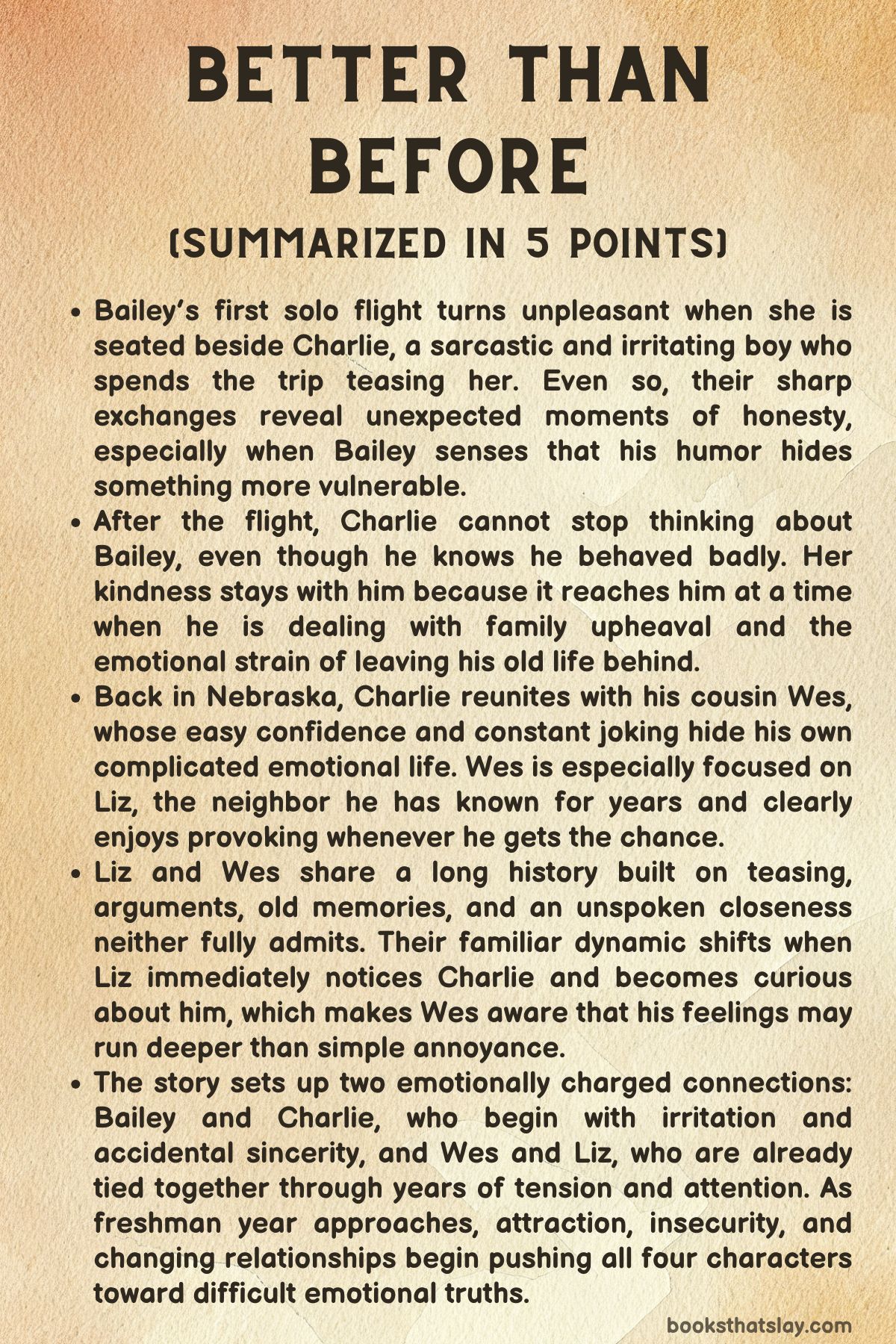
The story begins just before freshman year, when Bailey is flying alone for the first time and ends up seated beside a boy she instantly dislikes. He is smug, annoying, talkative, and far too entertained by getting under her skin. During the flight he teases her constantly, notices everything about her, and acts as if their shared row on the plane has created some kind of bond.
Bailey sees him as rude and impossible, but she also cannot ignore that he is more interesting than she wants him to be. Their exchange is full of irritation, sarcasm, and defensive energy, yet there are small moments that hint at something deeper. When he jokes about people hating him, Bailey responds with sincere kindness, and that brief moment seems to catch him off guard.
By the time they part at the airport, he thanks her for trying, which leaves Bailey confused because she realizes there may have been more honesty in him than she first assumed.
That boy is Charlie, and from his point of view the encounter feels different. He knows he behaved badly, and he knows Bailey deserved better than the way he acted. Still, he cannot stop noticing her.
He is struck by the contrast between her nervous, tightly controlled manner and the sweetness beneath it. What stays with him is not only her appearance, but the fact that she tried to comfort him when she had every reason not to. Charlie is dealing with his own private unhappiness, and that small kindness lingers after the flight ends. At baggage claim he watches her from a distance, thinking about her more than he should, even while telling himself she is exactly the kind of girl who would usually annoy him.
Charlie is in Nebraska because of family circumstances, and he is picked up by his cousin Wes, who quickly notices that Charlie has been watching a girl. Wes teases him immediately. Their dynamic shows a long history of affection, mocking humor, and familiarity. Charlie may be unsettled by the changes in his life, but Wes is one of the few people who still feels solid and known. At the same time, the conversation reveals tension in the larger family. Charlie has recently had to say goodbye to the life he knew, and there is a sense that his home situation has been disrupted in a way that makes everything feel unstable. He is not just tired from travel. He is angry, displaced, and trying not to think too hard about what comes next.
The focus then shifts to Wes, who spots his neighbor Liz sitting outside under a tree with a book, music, and a carefully arranged little setup that feels very much like her. Liz is someone he knows extremely well, and their history is full of argument, familiarity, and a kind of attention that has never gone away. Wes immediately starts creating excuses to cross into her yard. He pretends a football has landed there by accident, then keeps repeating the act so he can keep talking to her. Their exchanges are playful on the surface, but there is a lot packed into them. They know each other’s habits, old stories, embarrassing moments, and vulnerabilities. Every insult is shaped by years of closeness.
Liz meets Wes’s teasing with plenty of her own. She acts annoyed, and often she truly is, but she also understands him in ways that other people probably do not. She knows when he is performing, when he is pushing, and when there is something more genuine underneath his behavior. Wes clearly enjoys getting a reaction from her. He notices her new haircut, comments on the music she plays, remembers details about her from years earlier, and pays more attention than a casual neighbor would. He refuses to give her a straightforward compliment, but his interest is obvious. Their connection is built on constant friction, yet it also carries comfort, recognition, and history.
That balance changes when Charlie appears. The moment Liz sees him, she reacts strongly. He is attractive, charming, and new, which instantly separates him from Wes, who is familiar to the point of irritation. Charlie jokes with her naturally, and Liz responds in a way that makes Wes immediately aware of what is happening. He can read Liz too well to miss the sudden fascination on her face. The scene becomes funny on the outside, but for Wes it carries an edge. He introduces Charlie, watches Liz light up, and realizes that his cousin has become an object of interest for the girl next door.
Liz later asks questions about Charlie, trying to sound casual and failing. Wes catches on immediately and starts needling her about it. He offers to help, acting as though he could be the bridge between them, but his teasing suggests that he is not entirely comfortable with the idea.
Liz denies being interested, though not very convincingly, and their conversation becomes another back-and-forth full of provocation. Wes brings up old stories, pokes at her reactions, and keeps her off balance. Liz pushes back, reminding him of his ridiculous habits and refusing to give him the satisfaction of seeing how curious she really is.
Their exchange also reveals how long they have been orbiting each other. Liz remembers punching him when they were younger. Wes remembers her falling out of a window while trying to fix a screen. She knows the sound of his laugh well enough to identify it instantly. He knows exactly how to embarrass her, exactly when she is flustered, and exactly how to keep a conversation going even when she tells him to leave.
Beneath all the sarcasm, there is a built-in intimacy created by years of being side by side. They know each other’s patterns so well that even their arguments feel rehearsed in the best and worst ways.
Charlie, meanwhile, brings a different energy into the group. Where Wes is provocative and impossible, Charlie has a moodier, more guarded quality. He can be funny, but there is also a heaviness around him, tied to the changes in his family and the life he has had to leave behind.
Bailey sees pieces of that during the flight, though she cannot yet fully understand them. Liz sees only the appealing surface at first: the handsome cousin who seems easier to manage than the boy next door. But the story has already shown that Charlie is more complicated than he appears.
Bailey’s place in the larger plot comes through the airport encounter, which sets up a meaningful contrast. She and Charlie begin with annoyance and accidental honesty. Liz and Wes begin with long familiarity and carefully disguised attention. In both cases, the story explores how teenagers perform versions of themselves when they are uneasy.
Charlie hides uncertainty with sarcasm. Bailey hides feeling with control. Wes hides interest with constant teasing. Liz hides vulnerability by acting unimpressed. Much of the emotional movement comes from those masks slipping for a second and revealing what is underneath.
The opening section of the book lays the groundwork for a romance driven by chemistry, misreading, and emotional resistance. Charlie and Bailey are connected before they know whether they want that connection. Wes and Liz are already deeply entangled whether either of them wants to admit it or not.
Family dynamics, neighbor history, attraction, and insecurity all begin pressing these characters toward one another. What seems casual at first is not casual at all. A rude boy on a plane, a cousin at baggage claim, a football tossed over a fence, and a girl reading under a tree all become part of a larger emotional setup. By the end of this early stretch, the story has made one thing clear: these relationships are not simple, and the people involved are on the edge of changes they may not be ready for.
Characters
Bailey
Bailey comes across as intelligent, guarded, and far more observant than she first appears. Her opening reactions show someone who likes order, privacy, and emotional distance, especially when she feels uncomfortable. On the flight, she is irritated by Charlie’s behavior and clearly dislikes being drawn into his game, yet she notices everything about him anyway, from his expressions to the shift in his tone when he says something that sounds real.
That combination of resistance and attention suggests that Bailey is not cold at all; she is simply careful. She does not hand out trust easily, and when she does respond sincerely, it is almost against her own instincts. Her attempt to reassure Charlie shows a kindness that is instinctive rather than performative.
Even after he has annoyed her for hours, she still reacts to the possibility that he might be hurting. That moment reveals a softness beneath her defensive exterior and makes her feel emotionally grounded.
Bailey also seems like someone caught in the awkward space between wanting control and being pulled toward things she cannot easily control. She tries to maintain distance through sarcasm and eye rolls, but Charlie’s unpredictability keeps throwing her off balance. Her embarrassment when he catches her looking at him and her frustration when he tousles her hair show that she is highly aware of how others affect her, especially when she does not want them to.
She does not like being made flustered, and she especially does not like being seen in a way that feels too personal. At the same time, her perspective is never shallow. She is annoyed, but she is also reflective. Even while disliking Charlie, she is capable of recognizing complexity in him.
That makes her feel emotionally mature. She is not just reacting to surface-level charm or rudeness; she is trying to understand why certain moments land the way they do. Bailey’s role in the story appears to be that of someone whose emotional honesty may matter more than she realizes.
Charlie
Charlie is introduced as sarcastic, provocative, and emotionally unsettled. From Bailey’s point of view, he seems like a boy who enjoys pushing people just to see what happens, and there is truth in that.
He is quick with teasing, comfortable with deflection, and clearly used to hiding behind humor that can border on cruelty. But once the perspective shifts to him, it becomes obvious that his behavior is a shield rather than a full picture of who he is. He is arriving in a new place while carrying sadness, anger, and the disorientation of major personal change.
His mood at the airport is not just annoyance from travel. He is grieving a life he had to leave behind, and that emotional strain makes his sharpness easier to understand. He acts like someone who would rather provoke than be pitied.
What makes Charlie compelling is the gap between how he behaves and what he notices. For someone who acts detached, he is acutely attentive. He studies Bailey closely, from the way she applies lip gloss to the fact that she sincerely tried to make him feel better. He notices not only how she looks but also what kind of person she may be beneath her nerves and rigidity.
That suggests emotional intelligence, even if he does not use it responsibly all the time. He recognizes sweetness when he sees it, and he is affected by it more than he wants to admit. His thank-you at the end of the airport scene is especially important because it shows that sincerity is difficult for him but not impossible. He may hide behind humor, but he is not incapable of vulnerability.
Charlie also stands out because he seems to have a damaged relationship with belonging. His comment about people hating him may have begun as a joke, but the reaction it draws from Bailey reveals that there is real insecurity underneath it. He appears used to deflecting pain before anyone can get too close to it.
That makes him the kind of character whose charm is tied to sadness. He is attractive and funny, but the story hints that those qualities are not enough to make him feel stable. His bond with Wes shows another side of him: relaxed, affectionate, familiar. With his cousin, he does not have to perform as much.
That contrast suggests that Charlie is not naturally cruel or careless; he becomes that version of himself when he feels displaced or emotionally exposed.
Wes
Wes is confident, restless, and driven by the need to create reactions in other people, especially Liz. He enters the story with the energy of someone who fills space easily. He jokes, provokes, climbs fences instead of using gates, and turns every moment into an opportunity for banter.
On the surface, he can look like a classic cocky teenage boy who enjoys annoying the girl next door. But his behavior becomes more interesting when it is clear how much thought and attention he gives Liz.
He remembers details from years ago, notices her haircut immediately, listens when she plays the piano, and invents excuses to keep showing up in her yard. That level of awareness shows that his teasing is not random. It is attention in disguised form.
Wes seems most comfortable when he can turn feeling into performance. He rarely says anything plainly when plainness would matter.
Even when he likes something, he turns it into a joke. Even when he is complimenting Liz, he does it in a way that can be dismissed as mockery. This suggests a boy who is much better at creating noise than at admitting what matters to him. His humor protects him. As long as everything is a bit, he never has to risk sincerity. Yet the story makes it obvious that sincerity keeps breaking through anyway. He wants to talk to Liz. He wants her attention.
He enjoys their connection so much that even irritation from her seems rewarding. His repeated trips into her yard are less about football than about maintaining contact.
Another important part of Wes is his jealousy, or at least the beginning of it. The moment Liz reacts strongly to Charlie, Wes notices. He does not miss her expression, and he does not misread what it means.
That quick recognition shows how well he knows her, but it also exposes how invested he already is. He may not define his feelings in direct language, but his awareness sharpens the second another boy enters the picture. That gives his playful behavior an edge. He is still funny, still performative, but no longer emotionally neutral.
His responses suggest possessiveness, curiosity, and discomfort at the idea of losing the easy, familiar dynamic he has with Liz.
Wes also appears to be someone whose confidence may cover deeper complications. Charlie’s comment about Wes’s father being intimidating, along with Wes’s blunt agreement, hints that his home life may involve pressure and harshness.
His loud, carefree personality may be partly authentic and partly survival. He seems like the sort of person who learned to stay entertaining, fast, and impossible to pin down. That reading makes him more than just the funny neighbor. He becomes someone who may be using wit and motion to stay ahead of heavier emotions.
Liz
Liz is expressive, romantic, dramatic, and much less detached than she probably wishes she were. Everything about her presentation under the tree suggests intentionality. She is reading, listening to music, drinking soda from a wineglass, and creating a mood for herself that feels curated and personal. She seems to care about atmosphere, beauty, and emotional texture.
That does not make her shallow; it makes her someone who experiences life vividly. Her memories and reactions support that impression. She remembers childhood details, attaches meaning to places and objects, and responds openly when something or someone catches her attention. Unlike Bailey, who is guarded in a quieter way, Liz’s inner life tends to show on her face whether she wants it to or not.
Her dynamic with Wes reveals both her strengths and her vulnerabilities. She can spar with him effectively, match his sarcasm, and call out his nonsense without hesitation. She is not intimidated by him, and she knows his tricks well enough to resist being completely controlled by them. At the same time, she is readable to him, which creates a power imbalance she clearly dislikes. He notices her blushes, her curiosity, and her flustered moments almost instantly. That suggests Liz feels deeply and transparently. She may try to seem unimpressed, but she is not someone who can easily hide excitement, embarrassment, or attraction. Her responses are immediate and visible.
Liz’s reaction to Charlie is especially revealing because it shows how quickly she can shift into interest when presented with novelty and charm. She is fascinated almost at once, and the speed of that response suggests a romantic imagination that activates quickly. She does not even know him, yet she is already curious enough for Wes to pick up on it right away.
That does not make her foolish. It makes her emotionally open, perhaps even eager for a story that feels different from the one she has been living. Charlie is new. Wes is familiar. That contrast matters. Liz seems drawn to possibility, especially when it arrives with mystery and good looks.
At the same time, her long history with Wes suggests that her emotional world is more tangled than a simple crush. She knows his laugh instantly. She remembers childhood incidents with total clarity. She is annoyed by him in a way that only happens when someone matters a great deal.
Even her frustration has intimacy in it. She and Wes have a private language built from years of conflict, memory, and attention. Liz may be focused on Charlie in the moment, but the story hints that her emotional center is not as far from Wes as she might think. Her role appears to be that of someone caught between fantasy and familiarity, between the appeal of the new and the depth of what has been there all along.
Uncle Larry
Uncle Larry is only briefly present, but he leaves a strong impression through the way other characters respond to him. Charlie finds him intimidating and even asks Wes directly whether his father is an asshole, which suggests that Larry projects authority in a way that can quickly become harsh.
Wes confirms this almost casually, implying that his father’s difficult nature is an accepted fact within the family. Even without much page time, Larry functions as an important force in the background because he helps define the emotional environment around Wes. He seems to represent adult pressure, emotional stiffness, and a version of masculinity that may be more frightening than supportive. His presence helps explain why Wes might rely so heavily on humor and bravado.
Sarah
Sarah appears only in passing, but even that short mention gives some context to the family setting. She is part of the waiting scene at home, chewing gum while Charlie and Wes are around, which helps create the sense of family gathering and restless domestic life.
Her role is small in the provided material, but she contributes to the impression that these characters exist inside an active family network where everyone’s moods, delays, and habits affect one another.
Themes
First Impressions Versus Inner Reality
From its opening interactions, Better Than Before treats first impressions as incomplete, unstable, and often misleading. Bailey’s first experience with Charlie is built almost entirely on irritation.
She sees him as rude, smug, invasive, and exhausting, and the scene gives her every reason to arrive at that judgment. He needles her, watches her reactions too closely, and turns a long flight into an emotional endurance test.
Yet even within that early dislike, the narrative keeps introducing signs that his behavior does not fully explain him. His joking reference to being hated lands differently than his other comments, and Bailey instinctively recognizes a note of truth in it. Her sympathy appears before trust does, which matters because it shows that people can sense complexity in each other even when they do not yet know how to name it.
Charlie’s view of Bailey creates the same tension from the opposite direction. He initially defines her through visible traits: guarded, controlled, uptight, overprepared. He responds to those qualities by becoming even more provocative, as if her caution invites him to test it. But once he reflects on her, what stays with him is not her stiffness. It is her sincerity.
He remembers that she tried to comfort him, and that memory changes how he sees her. In other words, the story argues that surface behavior can be accurate without being complete. Bailey is tense, but she is also generous. Charlie is difficult, but he is also hurting.
This idea extends beyond them. Wes presents himself as confident and unserious, someone who lives through jokes, motion, and constant teasing. Liz appears dramatic, expressive, and easy to read. Yet their exchanges make clear that both are more layered than their outward roles suggest.
Wes hides direct feeling behind provocation. Liz’s visible reactions may make her seem emotionally transparent, but she is also proud, defensive, and careful about what she will actually admit. The theme works because it is not simply about learning that nice people are nice underneath or rude people are secretly soft.
It is about recognizing that the self presented in public is often a strategy. Characters protect themselves through attitude, style, sarcasm, or control, and the story keeps asking what becomes visible when those protections slip. That makes early attraction and conflict more meaningful, because every connection begins through misunderstanding and then slowly moves toward recognition.
Attraction, Irritation, and Emotional Denial
The emotional charge between characters comes less from open confession than from resistance. People are drawn to one another while actively refusing to admit it, sometimes even to themselves. That tension gives the relationships their energy. Bailey does not want Charlie to matter to her, which is exactly why every detail about him becomes sharper.
She notices his expressions, his voice, his appearance, and the shift in his mood, even while telling herself she wants to get away from him as quickly as possible. Her irritation is real, but it sits beside involuntary attention. The story understands that early attraction is often not graceful. It can arrive through annoyance, defensiveness, embarrassment, and an almost aggressive awareness of another person.
Wes and Liz embody a different version of the same pattern. Their entire bond is built on contact disguised as conflict. He crosses into her space repeatedly, not because he has no other way to retrieve a football, but because he wants interaction.
She tells him to go away, yet continues engaging, arguing, answering, reacting. Their familiarity allows them to hide inside performance. If every exchange is a joke or a fight, then neither has to acknowledge the possibility that the attention itself means something. The emotional denial here is not passive. It is active and creative. It generates flirtation through insult, closeness through argument, and vulnerability through mockery.
What makes this theme especially effective is that denial does not erase feeling; it intensifies it. Wes becomes instantly aware of Liz’s reaction to Charlie because he is already invested, whether or not he has admitted that to himself.
Bailey is thrown off by Charlie’s occasional sincerity because it disrupts the simpler version of him she would prefer to keep. Charlie is stuck thinking about Bailey because her kindness unsettles the defensive posture he relies on. In each case, attraction becomes more powerful because it arrives in people who are not prepared to receive it cleanly.
This creates a world in which emotional truth is constantly leaking through behavior designed to conceal it. A teasing line becomes a disguised compliment. A sarcastic remark becomes a bid for attention.
A complaint becomes evidence of care. The theme is not merely that opposites attract or that enemies can become something else. It is that many young people first encounter strong feeling through contradiction. They want connection while resisting exposure. They crave recognition while protecting themselves from it. That contradiction shapes every charged exchange and gives the romantic tension its depth.
Performance, Self-Protection, and the Fear of Vulnerability
Nearly every major character manages vulnerability by performing a version of themselves that feels safer than honesty. Charlie is the clearest example at first. He acts like the kind of boy who would rather irritate someone than let them see uncertainty. His sarcasm is not just personality; it is armor. By keeping conversation on unstable ground, he controls the emotional terms of the interaction. If he is the one provoking, then he is not the one being examined.
This matters because the little glimpse of sincerity he offers, especially in relation to feeling unwanted or disliked, lands with such force precisely because it breaks through that shield. The contrast suggests someone who has learned that emotional exposure is risky and who therefore stays one step ahead of it through wit and cruelty.
Bailey’s performance is quieter but just as important. She presents herself through caution, order, and disapproval. Her eye rolls, clipped responses, and effort to maintain composure all function as self-defense. She does not flirt openly, invite closeness, or allow herself to appear easily affected. But the fact that she is so affected reveals the limits of that control.
Her guardedness protects her from embarrassment, yet it also leaves her struggling when a situation becomes emotionally unpredictable. She wants interactions to remain legible. Charlie makes them unstable, and that instability exposes how much she depends on self-management.
Wes turns nearly everything into a joke, which makes his performance the loudest. He is charming, provocative, and always ready with a line that can shift the tone away from seriousness. Even when he notices something meaningful, like Liz’s new haircut or her piano playing, he does not speak about it directly. He transforms attention into teasing because teasing is safer.
Direct admiration would require risk. His confidence, then, may not be false, but it is certainly functional. It allows him to keep moving, keep laughing, and keep others responding without having to say what he actually feels.
Liz’s version of self-protection is different because she is more visibly emotional. She does not hide reaction well, but she still tries to manage vulnerability through dismissal, sarcasm, and romantic redirection.
When Wes embarrasses her, she pushes back. When Charlie appears, she channels attention toward the safer fantasy of someone new rather than confronting the complicated intimacy already present next door. In this sense, emotional openness and emotional honesty are not the same thing. Liz feels intensely, but she may still avoid the truths that feel most exposing.
Across these relationships, the theme suggests that teenage identity is often built through selective revelation. People show enough to remain socially active, funny, attractive, or confident, while hiding the parts that would make them feel powerless. The result is not dishonesty in a simple sense. It is emotional strategy. These characters are constantly negotiating how much of themselves can be visible without inviting hurt, and the story’s tension grows from the moments when that negotiation fails.
Change, Uncertainty, and the Uneasy Threshold of Growing Up
The emotional world of Better Than Before is shaped by transition. The story begins in the final stretch before freshman year, and that timing matters because it places every character at a threshold.
Nothing feels fully settled. Relationships are shifting, family structures are unstable, and identity itself feels unfinished. Bailey is traveling alone for the first time, which immediately signals movement into a new stage of life. Her discomfort is not only about Charlie or the flight. It is also about entering unfamiliar territory, where independence is expected before confidence is fully formed. Her desire for control reflects the larger anxiety of standing at the edge of change.
Charlie’s situation gives this theme additional weight. He is not simply entering high school; he is arriving after personal upheaval. The mention of goodbye, divorce, and displacement suggests that his life has already changed in ways he did not choose. That makes him a character marked by instability. His anger and sarcasm are not abstract personality features.
They are responses to a world that has become less reliable. He is a teenager at a moment when life is supposed to be opening outward, yet he is already carrying loss and uncertainty. That combination makes him both emotionally volatile and unusually alert to moments of genuine connection.
Wes and Liz also exist in a liminal space, though theirs is expressed through history rather than relocation. They are no longer children, but they still relate through childhood patterns. Their insults, stories, and habits come from years of proximity, yet something about those old dynamics no longer fits cleanly. Attraction, jealousy, and changing self-awareness are beginning to alter a bond once protected by routine. This is one of the most convincing aspects of the theme: growing up is shown not only as entering new places, but also as being forced to reinterpret old relationships.
The person next door is no longer just the person next door. The cousin visiting for the summer is no longer just family in the background. Familiar roles stop feeling sufficient.
The details around appearance and behavior reinforce this atmosphere of becoming. Charlie sees Bailey as someone suspended between versions of herself. Liz’s haircut, styling, and dramatic self-presentation suggest an active process of self-creation. Everyone seems to be trying out ways of being seen while also fearing what those changes might invite.
The threshold of growing up is therefore not presented as liberation alone. It is awkward, exposing, and emotionally unstable. People want to be noticed and understood, but they are still learning who they are becoming. That uncertainty gives the story its charge. The characters are not only moving toward romance or conflict. They are moving toward selves that are still in formation, and that makes every interaction feel more significant.