Bewitched by Laura Thalassa Summary, Characters and Themes
Bewitched by Laura Thalassa is a dark fantasy romance that blends ancient curses, powerful magic, and an inescapable bond between two souls fated to destroy and desire each other. The story follows Selene Bowers, a witch afflicted by a rare memory-loss curse, whose pursuit of belonging at a prestigious coven leads her to awaken an ancient warrior, Memnon, imprisoned for millennia.
As their worlds collide, the line between past and present blurs—Selene must confront the truth about her forgotten identity and the centuries-old love and betrayal that tie her fate to Memnon’s. The book explores obsession, redemption, and the haunting weight of reincarnation.
Summary
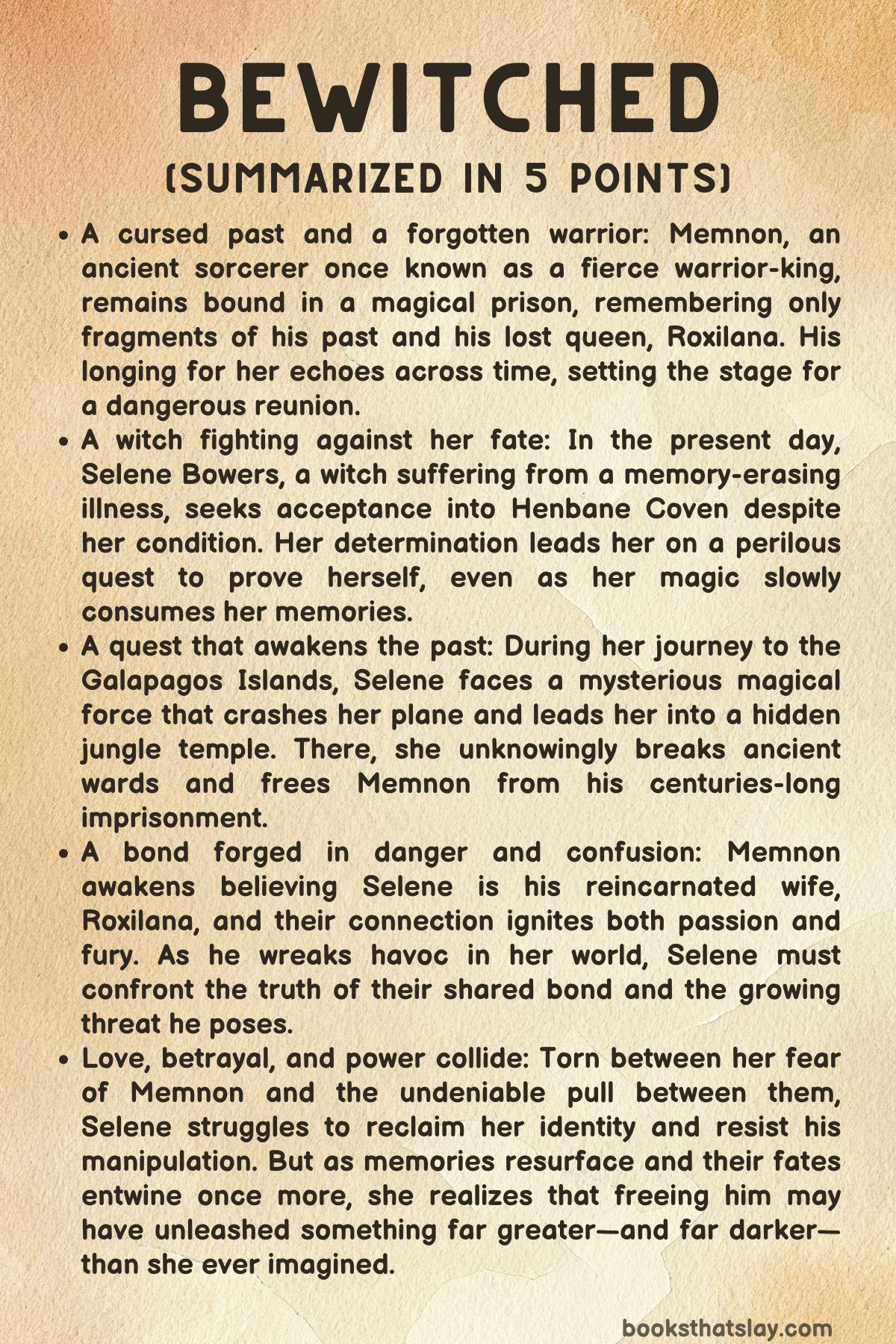
Selene Bowers, a witch suffering from a magical condition that erases her memories each time she casts a spell, travels to Henbane Coven near San Francisco for her admissions interview. She is rejected due to her illness, but a sympathetic witch, Constance Sternfallow, secretly offers her a second chance—if she can complete a “magic quest” and acquire a familiar.
Desperate to prove her worth, Selene decides to embark on a journey to the Galapagos Islands, believing such a quest might help her earn acceptance.
While flying to South America, strange forces attack the plane. A voice calls her “Empress,” and indigo-colored magic floods the cabin.
Selene uses her powers to stabilize the aircraft, sacrificing fragments of her memory in the process, but the plane crashes into a jungle. Miraculously alive, she senses that the same indigo magic is calling to her.
Compelled, she follows the mysterious energy deep into the forest, where she encounters a black panther. Instead of killing her, the creature forms a magical bond with her—becoming her familiar, Nero.
Following the pull of the indigo magic, Selene discovers an ancient, hidden palace buried beneath the jungle. Inside, she uncovers an underground chamber guarded by wards and warnings.
There, she finds a marble sarcophagus inscribed with spells warning of “Memnon the Cursed. ” Ignoring the warnings, she breaks the seals and opens the tomb.
Inside lies a man—beautiful, marked with ancient tattoos, and preserved as though asleep. When she touches him, the chamber fills with magic, and he awakens, calling her “Roxilana,” his long-lost queen.
The man—Memnon—believes Selene is his wife reborn. Though she insists she’s not, he is convinced otherwise.
His initial tenderness turns to anger when she denies her identity, and he imprisons her in magical sleep before vanishing. When Selene wakes, the tomb is destroyed, and Memnon is gone.
Horrified by what she has unleashed, she seals the ruins and escapes.
Back home, she hides the truth about the discovery, writing her “magic quest” report without mention of Memnon. Soon after, she’s invited to a Henbane party and accepted into the coven, thanks to her heroic acts on the crashed flight.
She attends with Nero, and for the first time, feels like she belongs. But her peace shatters when she hears Memnon’s voice in her head, calling her “my queen.
Memnon’s influence grows stronger. He invades her dreams, claiming that she cursed him centuries ago and that she is bound to him by soul and magic.
When he attacks her dorm one night, Selene’s friend Kane tries to defend her, but Memnon throws him out the window. Selene rushes to heal him, losing precious memories in the process.
Memnon kidnaps her, taking her into the woods and demanding she remember their shared past. He insists they were rulers of Sarmatia, bound by vows of power and passion.
Though she resists, their connection stirs a dangerous magic between them. When she breaks free and finds Kane alive, Memnon warns that if she defies him again, there will be consequences.
Determined to prove she is not his Roxilana, Selene searches through her journals and old school records, hoping to find proof she isn’t soul-bonded. Meanwhile, she is drawn into a dangerous ritual circle beneath Henbane, where witches perform dark magic on a young girl.
Realizing the ritual is corrupt, she intervenes and rescues the child, fighting through deadly enchantments and wounds. When her strength fails, Memnon’s power surges through their bond to save her, allowing her to escape into the forest.
She delivers the girl, Cara, to safety before collapsing.
Selene’s reputation suffers after the incident, and whispers spread through the coven. Her friend Sybil comforts her, urging her to attend the upcoming coven ball and “make Memnon jealous.” Beneath her fury, Selene forms a plan to end their bond. In Henbane’s hidden library, she finds an ancient grimoire containing a spell to sever soul connections.
That night, she prepares the ritual, substituting rare ingredients. Just as she begins, Memnon storms in, furious.
He destroys the cauldron and the spell, admitting he has already stolen fragments of her memory. Their confrontation turns violent and charged with emotion before he leaves, warning her that she has three days to comply with his demands.
At the ball, Selene tries to remain composed. Kane warns her that the magical authorities—the Politia—plan to arrest her, believing she’s behind recent murders.
Before she can escape, screams erupt. Memnon has crashed the event, holding a witch hostage and freezing the crowd with his magic.
He reveals that he framed Selene for the murders by moving the victims’ bodies but denies killing them himself. His demand is simple: lift the curse that binds him and marry him.
Selene fights back with spell after spell, each one draining more of her life and memories. But Memnon’s power is overwhelming.
When the guests begin to suffocate under his magic, she sacrifices everything to counter him—then finally gives in, agreeing to his terms to save everyone. Memnon releases the crowd and wipes their memories of the ordeal.
Carrying her away before the Politia arrive, he seals their pact with a blood oath.
As they chant the reversal incantation together, lost memories surge back into Selene’s mind. She recalls her life not just as Selene Bowers, but as Roxilana—the queen who once ruled beside Memnon.
She remembers their love, their empire, and the betrayal that destroyed them. The truth hits her with devastating clarity: she is the reincarnation of his wife, and the man she freed was both her lover and her doom.
When the Politia burst into her room, they arrest Selene for the crimes pinned to her name. Memnon watches calmly, knowing that the curse is broken and his freedom restored.
As she is led away in chains, Selene realizes that by awakening him, she has unleashed an unstoppable force—a sorcerer who has reclaimed his power, his memories, and his claim over her soul. Her past has come full circle, binding her once more to the ancient darkness she tried to escape.
Characters
Selene Bowers
Selene Bowers stands at the emotional and thematic heart of Bewitched, a young witch defined by the dual tragedy of her memory-loss affliction and her relentless pursuit of magic. She is a paradox—fragile yet fierce, cursed yet courageous.
Each spell she casts erodes her memories, symbolizing the cost of power and identity. Yet, despite this cruel condition, Selene refuses to surrender her purpose.
Her determination to join Henbane Coven is not just ambition but an act of defiance against fate. She compensates for her fading mind with meticulous organization—notes, journals, and labels—revealing a life structured around loss.
This methodical lifestyle exposes her fear of forgetting who she is, but also underscores her incredible adaptability.
As her journey unfolds, Selene evolves from a desperate outcast to a witch of immense power and moral complexity. Her bond with Nero, the panther familiar, mirrors her inner transformation: both are creatures of instinct and magic, embodying freedom and ferocity.
The connection between them reveals her capacity for empathy and her instinctive connection to the magical world, even when that world threatens to consume her. When she awakens Memnon, her life spirals into chaos, forcing her to confront truths buried not only in history but in her soul.
Her gradual realization that she is the reincarnation of Roxilana bridges two identities—Selene the modern witch and Roxilana the ancient queen. This duality drives the novel’s exploration of love, guilt, and destiny.
By the end, Selene is both victim and architect of her own fate, caught between love and loathing for the man who claims her soul.
Memnon
Memnon, the cursed warrior-king, emerges as both antagonist and tragic hero in Bewitched. Once a conqueror and ruler, his centuries-long imprisonment transforms him into a figure of wrath and longing.
The indigo magic that binds him symbolizes not only the curse’s physical restraint but also his emotional torment. When freed by Selene, his initial tenderness gives way to fury, rooted in betrayal and loss.
Believing Selene to be Roxilana reborn, he oscillates between devotion and vengeance, embodying a love so powerful it borders on obsession. His character blurs the line between lover and monster—an immortal man undone by passion and pride.
Memnon’s relationship with Selene is the novel’s dark core: a collision of power, memory, and fate. His possessiveness and manipulation are driven by a desperate need to reclaim a love he believes time has stolen.
Yet, beneath his cruelty lies tragedy—he is trapped in a cycle of love and rage that he cannot escape. His power, both magical and psychological, dominates every space he enters, yet his deepest weakness is emotional dependency.
When Selene restores his memories, his triumph is undercut by the knowledge that their reunion is tainted by centuries of suffering and mistrust. Memnon embodies the danger of clinging to the past and the destruction that results when love turns into a curse.
Roxilana
Though she appears primarily through memory and revelation, Roxilana’s shadow looms large over Bewitched. The ancient queen and witch was once Memnon’s wife, the Empress of Sarmatia, and their shared history is a tapestry of love, power, and betrayal.
Roxilana represents the archetype of the woman who defied her fate—perhaps out of ambition, fear, or moral conviction—and paid the ultimate price. Her betrayal, real or perceived, catalyzed Memnon’s curse and centuries of vengeance.
Through Selene, Roxilana’s essence resurfaces, suggesting that reincarnation is not merely a return of the soul but a confrontation with unresolved guilt.
Roxilana’s characterization exists in tension with Selene’s: she is the memory that haunts and defines her reincarnation. Where Selene seeks redemption, Roxilana embodies the sins of the past.
Their intertwined identities suggest a cycle of love and destruction, a pattern that both women struggle to break. In this way, Roxilana becomes a symbol of feminine power’s duality—the capacity to nurture or to ruin, to command love or ignite war.
Nero
Nero, the black panther familiar, serves as both Selene’s protector and mirror. His bond with her is immediate, primal, and deeply symbolic.
As her familiar, Nero embodies loyalty, intuition, and the untamed aspects of her magic. The merging of their essences during their first encounter signifies a spiritual awakening—Selene’s acceptance of her true self and her entrance into the deeper mysteries of magic.
Throughout the narrative, Nero acts as her anchor, grounding her when memory fails and emotion overwhelms.
More than a mere companion, Nero represents the manifestation of Selene’s soul—the part of her that remains instinctual and free despite magical and emotional bondage. His silent presence during moments of fear and transformation suggests that even in confusion and loss, some truths remain unbroken.
Nero’s unwavering loyalty contrasts sharply with Memnon’s possessive love, highlighting the difference between connection built on choice and that born of control.
Sybil
Sybil, Selene’s best friend, is the emotional constant in Bewitched, offering warmth and humanity amidst the story’s storm of magic and memory. A plant witch with an empathetic heart, Sybil represents grounding, growth, and the endurance of friendship.
She supports Selene through rejection, chaos, and heartbreak, serving as her tether to the ordinary world. Her role is crucial not for power but for presence—she is the moral and emotional center that keeps Selene from losing herself entirely to magic and obsession.
Sybil’s belief in Selene’s innocence and her willingness to stand by her even when others doubt her reveal the strength of genuine compassion. She is neither naïve nor powerless; rather, her resilience lies in her quiet conviction.
When she encourages Selene to fight back against fate—or even to flirt with vengeance—she reflects the complexity of love between friends, capable of humor, loyalty, and shared defiance.
Kane Halloway
Kane Halloway, the lycanthrope and Selene’s onetime love interest, serves as a contrast to Memnon’s consuming dominance. His presence brings out Selene’s protective and nurturing instincts, offering a glimpse of love that is grounded in respect rather than destiny.
Kane’s loyalty and courage are evident in his willingness to defend Selene despite the danger surrounding her. His near-death at Memnon’s hands becomes a pivotal moment, forcing Selene to confront the depth of Memnon’s cruelty and her own moral boundaries.
Kane embodies the theme of humanity within monstrosity. As a werewolf, he straddles two natures—civilized and feral—mirroring Selene’s struggle between control and chaos.
His compassion and pragmatism make him one of the few characters who loves Selene for who she is now, not who she was centuries ago. Through him, Bewitched explores love as choice rather than compulsion.
Themes
Identity and Memory
In Bewitched, the exploration of identity is deeply bound to the fragility of memory. Selene’s condition—losing memories every time she casts a spell—creates a profound tension between her desire for self-knowledge and her survival as a witch.
Each act of magic erases fragments of who she is, making identity a fluid and uncertain construct. Her notebooks, labels, and meticulous organization become extensions of her mind, external anchors holding together the remnants of her sense of self.
Memory, here, is not only a function of the mind but a vessel of the soul; as Selene’s memories fade, so does her understanding of her moral compass, her relationships, and her purpose. When she learns that she might be Roxilana reborn, the theme expands to question reincarnation and continuity of the self.
Is she truly the same person if her memories of that past life are absent? The revelation that her present and past selves are linked through a soul bond with Memnon challenges the notion that identity can ever be separated from history.
Memory becomes both the key to liberation and the instrument of entrapment. Selene’s journey illustrates that identity is not a static truth but a constant negotiation between who one was, who one remembers being, and who one chooses to become despite the erosion of the past.
Love, Obsession, and Power
The relationship between Selene and Memnon drives the narrative’s emotional and ethical core. Their connection oscillates between passion and violence, devotion and domination, suggesting that love and obsession can mirror each other when power distorts affection.
Memnon’s view of love is possessive—he sees Selene as both his salvation and his punishment, the embodiment of a vow that defies death. His centuries of entrapment have turned desire into obsession, and love into control.
Selene, meanwhile, experiences the magnetic pull of his presence even as she resists his authority. The magical bond between them symbolizes how love can blur autonomy; it transcends consent and becomes a supernatural compulsion.
Yet beneath the coercion lies tragedy: two souls bound by fate but fractured by betrayal. The novel treats love not as a healing force but as a destructive one when entwined with guilt, power, and immortality.
By the end, when Selene regains her memories and recalls their shared past, love becomes a weapon as much as a wound—one that Memnon wields to reclaim control and Selene must reinterpret to reclaim herself. The story thus portrays love as both a spell and a curse, capable of transcending time while corrupting those it touches.
Power, Autonomy, and Control
Power in Bewitched is never neutral; it defines hierarchy, agency, and morality. For witches like Selene, magic is both a gift and a disease.
Her powers give her purpose but also accelerate her decline, forcing her to choose between strength and survival. The coven’s rejection of her underlines how institutions fear uncontrollable power, especially when it resides in those deemed unstable.
Memnon’s arc represents the opposite extreme—a man consumed by power’s corrupting influence. His mastery over ancient magic and his ability to bend others’ will make him a symbol of domination cloaked in divine right.
The power dynamic between him and Selene mirrors broader conflicts between freedom and subjugation. Each of their confrontations becomes a test of will rather than magic alone, where Selene’s defiance affirms her autonomy against the inevitability of his control.
Even when she accepts his blood oath, it is under coercion, exposing how patriarchal and magical authority intersect. The novel’s treatment of power reveals that true mastery lies not in domination but in self-governance—something Selene continually strives for as she fights to reclaim her agency, even at the cost of memory, love, and safety.
Fate, Rebirth, and the Burden of the Past
Reincarnation and destiny form the metaphysical spine of the story. The revelation that Selene is the reborn Roxilana transforms the narrative from a tale of discovery into one of reckoning.
Her life becomes a continuation of unfinished history, suggesting that fate operates in cycles rather than lines. Memnon’s centuries of imprisonment and his obsession with finding Roxilana’s soul reflect the haunting persistence of the past.
Fate in the novel is not benevolent—it is punitive, binding characters to their mistakes across lifetimes. The soul bond between Selene and Memnon is less romantic than karmic, forcing them to confront consequences that transcend death.
Yet, fate also becomes a battlefield for choice. Selene’s defiance, her insistence that she is not bound by her former life’s sins, introduces moral agency into the otherwise deterministic framework.
The past may dictate origins, but it does not define destiny. Through this struggle, Bewitched questions whether rebirth offers redemption or merely repetition, and whether breaking free from fate requires forgetting it—or fully remembering it.
Guilt, Redemption, and Moral Ambiguity
Every character in Bewitched navigates shades of moral grayness. Selene’s choices—to free Memnon, to wield dangerous spells, to manipulate magic despite the cost—are driven by survival and yearning rather than purity.
Her guilt accumulates with every memory lost and every life endangered by her actions. Memnon’s own pursuit of redemption through dominance exposes the paradox of his character: he seeks to correct betrayal through control, love through coercion, and justice through vengeance.
The narrative resists clear moral binaries; both Selene and Memnon are victims and perpetrators. Redemption, in this world, cannot be achieved through apology or repentance but through painful recognition.
When Selene remembers her past as Roxilana, the weight of guilt becomes collective, spanning two lifetimes. The theme underscores that redemption is not the erasure of wrongdoing but the willingness to bear its consequences.
Bewitched ultimately portrays morality as fluid, bound to emotion, power, and the capacity to forgive—not others, but oneself.