Big Lies in a Small Town Summary, Characters and Themes
Big Lies in a Small Town by Diane Chamberlain is a compelling and intricate novel that masterfully connects two women’s lives through a mysterious mural. The narrative moves between 1940 and 2018, showcasing the experiences of Anna Dale, a young artist tasked with painting a mural in Edenton, North Carolina, and Morgan Christopher, a woman imprisoned for a crime she believes she did not commit.
When Morgan is offered the chance to restore Anna’s mural, she uncovers not just the artwork’s physical deterioration but also the hidden truths behind Anna’s life. Through art, both women find a path to redemption and healing, while facing their own personal struggles.
Summary
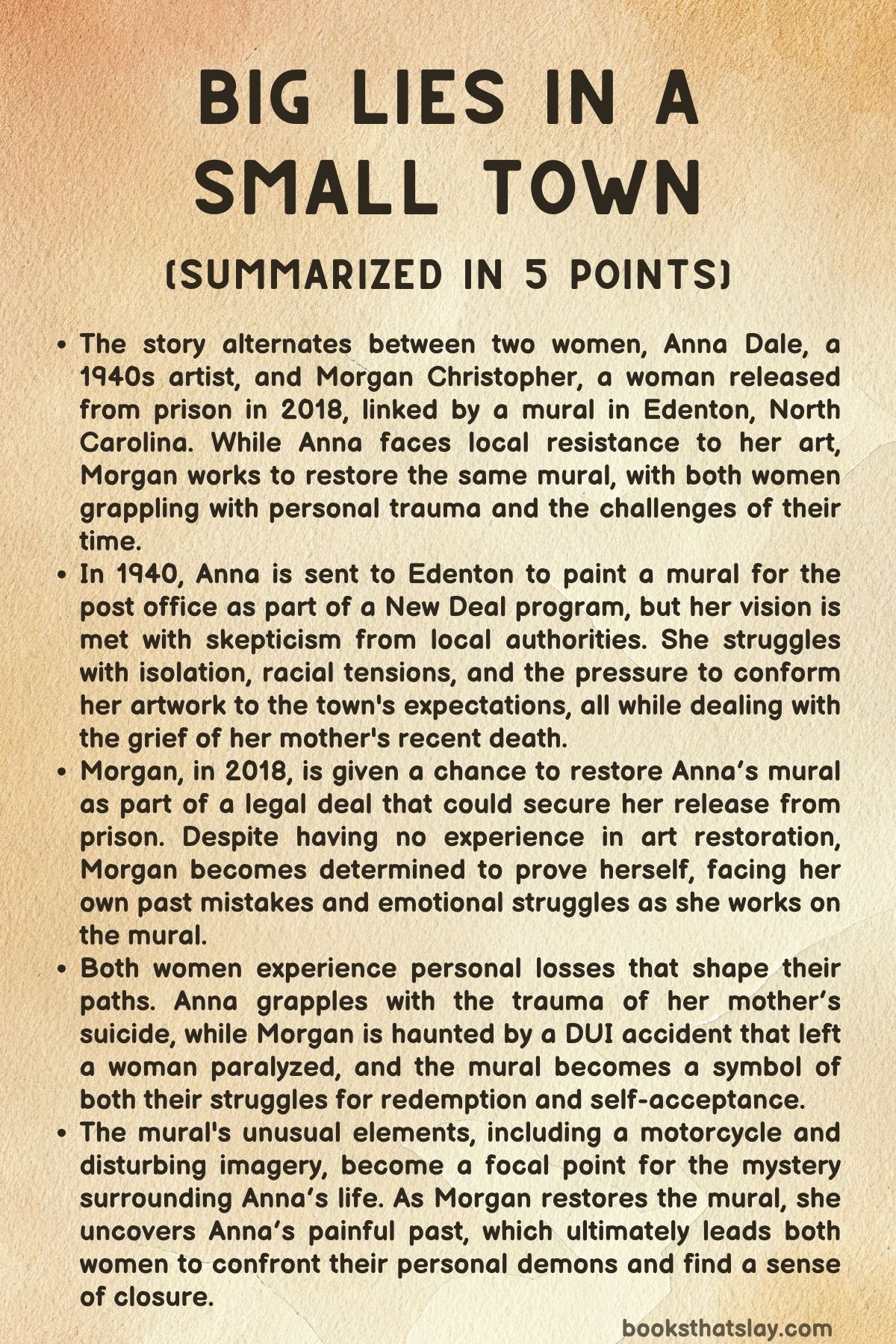
The story of Big Lies in a Small Town unfolds across two timelines, one in 1940 and the other in 2018, as the lives of Anna Dale, an artist, and Morgan Christopher, a woman wrongfully imprisoned, intersect through a mural in Edenton, North Carolina.
In 1940, Anna Dale, a young artist who had recently won a competition to paint a mural for the Edenton Post Office, travels to the small town to begin her work. She is part of a government program that employed artists during the Great Depression, and her assignment is to create a mural that captures the essence of the town’s history.
However, Anna finds herself faced with local skepticism and prejudice. The townspeople, especially the influential men, expect her to focus on a mural that highlights the town’s industrial accomplishments and local pride rather than the historical theme she envisioned—the Edenton Tea Party.
This leads to a difficult relationship with the local community, which is further complicated by racial tensions and Anna’s struggle to adapt to a small Southern town after losing her mother. Despite the pressure, Anna remains committed to her work and stays in Edenton, determined to create a mural that the town will accept and appreciate.
Meanwhile, in 2018, Morgan Christopher is serving a prison sentence for a crime she claims was a mistake. She is approached by Lisa Williams, the daughter of a wealthy man who had recently passed away.
Lisa reveals that her late father, Jesse Jameson Williams, had acquired a mural painted by Anna Dale in 1940 but had never been displayed. Lisa offers Morgan the opportunity to restore the mural in exchange for her release from prison.
Morgan, desperate for freedom, agrees, even though she has no experience in art restoration. She is released on parole and sent to Edenton, where she will live while working on the mural restoration project.
Upon her arrival in Edenton, Morgan meets with Lisa and the gallery staff, who introduce her to the mural, which is in poor condition. Despite her lack of experience, Morgan is determined to complete the task, though she faces immense self-doubt.
As she begins the restoration process, she grapples with her own past. Morgan is haunted by the DUI accident she caused, which left another woman, Emily Maxwell, severely injured and paralyzed.
Morgan’s parole officer is strict, demanding that Morgan attend Alcoholics Anonymous meetings and follow other conditions to stay out of prison. These obligations weigh heavily on her, but she remains focused on the mural, hoping that this project will be her path to redemption.
As Morgan works on restoring the mural, she discovers that Anna’s artwork is not what she expected. The mural includes strange and unsettling details, such as a motorcycle intruding into a historical scene of the Edenton Tea Party.
These bizarre elements, along with the deteriorating condition of the mural, leave Morgan questioning the artist’s intentions. Despite these oddities, Morgan pushes forward with the restoration, determined to finish the job and make a fresh start in her life.
Along the way, she receives help from Oliver, a member of the gallery staff with experience in art restoration, who offers guidance and support as she learns the necessary skills.
Throughout the restoration process, Morgan also becomes more connected to the town and its people, including Lisa and Oliver, who each have their own struggles and motivations. She also learns more about Anna’s life through her research and becomes increasingly fascinated with the artist’s story.
As Morgan uncovers details about Anna’s past, she begins to see parallels between their lives. Both women have experienced trauma, and both find solace and purpose in their artistic endeavors.
As the restoration progresses, Morgan faces emotional challenges, including the weight of her past mistakes and the pressure of living up to the expectations set by Lisa and Jesse Williams.
In parallel, the novel also delves into Anna’s history, revealing more about her personal struggles and the challenges she faced while creating the mural. Anna had been dealing with the loss of her mother, who died under tragic circumstances, and had to navigate the complexities of being a young woman in a Southern town where she was seen as an outsider.
As she works on the mural, she is determined to reflect both the town’s history and the local African American community, despite facing resistance from the townspeople. Anna’s journey is one of resilience, as she strives to complete her mural and find her place in Edenton.
As the two timelines unfold, the mural itself becomes a powerful symbol of the characters’ emotional journeys. It represents Anna’s struggle to assert her artistic vision despite the constraints of the town and the expectations placed upon her.
For Morgan, the mural represents both a physical challenge and an emotional one, as it serves as a vehicle for her to confront her past and seek redemption. As Morgan restores the mural, she uncovers deeper layers of Anna’s life, including the mysteries and hidden truths that the mural holds.
Eventually, Morgan learns about Anna’s tragic personal history, including her secret past involving a pregnancy resulting from rape and the trauma that shaped her decisions. This discovery helps Morgan understand her own emotional scars and pushes her toward healing.
In the end, both women find a sense of peace, though not without enduring emotional struggles. Through the process of restoring the mural, Morgan is able to reconcile with her past and begin a new chapter in her life.
Anna, too, finds a way to move forward, though her life and legacy continue to resonate through the mural, which becomes a symbol of both artistic achievement and personal redemption.
Big Lies in a Small Town is a powerful exploration of the lasting impact of personal trauma, the need for redemption, and the healing power of art. Through the intertwined lives of Anna and Morgan, the novel explores themes of forgiveness, self-discovery, and the complexities of the human spirit.
The mural, with its hidden details and mysterious origins, serves as a central metaphor for the characters’ emotional journeys, ultimately leading them toward a sense of closure and renewal.
Characters
Morgan Christopher
Morgan Christopher is a woman who finds herself entangled in a complex web of self-doubt, guilt, and redemption. Having served time in a correctional facility for a crime she believes was a mistake, Morgan is given a second chance when she is tasked with restoring a damaged mural created by Anna Dale in 1940.
Initially overwhelmed by her lack of experience in art restoration, Morgan feels the weight of the task ahead and the looming deadline to complete the project. Throughout her journey, Morgan struggles with the emotional scars of her past, particularly the DUI accident that severely injured another woman, Emily Maxwell.
Her road to self-forgiveness is long, marked by her need to confront her alcoholism, past mistakes, and strained relationships. While she grapples with the difficulties of the restoration, Morgan begins to uncover the connections between her own past and the mural’s history, forging a path toward redemption.
The mural becomes more than just a project—it symbolizes her attempt to rebuild her life and make amends for the mistakes she cannot erase.
Anna Dale
Anna Dale is a talented artist whose life is shaped by deep sorrow and determination. Hired to create a mural for the Edenton Post Office during the Great Depression, Anna arrives in a small Southern town where she faces skepticism and resistance, both as a Northern artist and a woman trying to leave behind the shadow of her mother’s tragic suicide.
Anna’s personal grief, especially the haunting memory of her mother’s death, propels her to find solace in her art, yet the challenges she faces in Edenton—cultural resistance, racial tensions, and expectations from local officials—create a turbulent environment for her work. Her mural, which she envisions as a tribute to the town’s history, becomes a battleground of competing interests, as some townspeople want her to depict local pride rather than the controversial “Edenton Tea Party.” Throughout her time in Edenton, Anna’s emotional vulnerability is evident, as she tries to navigate the tension between her artistic vision and the town’s pressures.
Despite these challenges, Anna’s resilience shines through, making her a complex figure—a young woman struggling with past trauma while fighting to leave behind a meaningful artistic legacy.
Jesse Jameson Williams
Jesse Jameson Williams, while not a central character in the narrative, plays a significant role in shaping Anna’s experience in Edenton. He is a young artist who works closely with Anna and provides comfort during a time when she feels isolated and alone.
As Anna faces personal struggles, including the trauma of her mother’s death, Jesse offers emotional support, helping her process her grief. Their bond deepens, and Jesse’s own growth as an artist becomes evident as he creates his own works, inspired by his personal experiences and losses.
While Anna’s focus remains on her mural, Jesse’s presence highlights the importance of relationships and support in times of hardship. His development, both as an artist and a person, serves as a reminder that growth and healing often come through shared experiences and human connection.
Lisa Williams
Lisa Williams is a pivotal figure in Morgan’s journey of self-discovery and redemption. As the daughter of Jesse Jameson Williams, she is intricately connected to Anna’s past and the mural that Morgan is tasked with restoring.
Lisa initially appears distant and cold, offering Morgan a way out of prison in exchange for restoring the mural her late father had planned to feature in a gallery. Despite her professional demeanor, Lisa’s own grief and unresolved emotions regarding her father’s legacy emerge throughout the story.
Her role in Morgan’s life is one of both practical support and emotional complexity. As Morgan delves deeper into the restoration project, Lisa’s motivations become clearer, and her relationship with Morgan shifts from that of a distant benefactor to one of mutual understanding.
Through their interactions, Lisa’s struggle with her father’s mysterious intentions and her own family’s past adds depth to the overarching theme of art as a vehicle for healing and personal revelation.
Clayton Arndt
Clayton Arndt is the postmaster in Edenton, and his interactions with Anna Dale highlight the town’s resistance to change and the biases that shape its social dynamics. Arndt expresses doubt about Anna’s ability to connect with the community, reflecting the larger skepticism that Anna faces as an outsider.
His attitude toward Anna is condescending, and his views represent the entrenched traditionalism of Edenton’s powerful men, who favor local artists like Martin Drapple over Anna. Arndt’s dismissive behavior underscores the challenges Anna faces as a female artist in a male-dominated society, and his presence in the story highlights the cultural and artistic struggles she must overcome to leave her mark on the town.
Oliver
Oliver plays an essential role in Morgan’s restoration process, providing both guidance and encouragement as she works on the mural. As a member of the gallery team, Oliver has experience in art restoration, and his advice helps Morgan learn the technical aspects of the job.
Despite her initial lack of skills, Oliver’s patient mentoring empowers Morgan to grow and take pride in the work she is doing. His support is crucial in helping Morgan gain confidence, not only in restoring the mural but also in facing her emotional struggles.
Oliver’s personal connection to Jesse Williams adds another layer of depth to the narrative, as he shares his own story of receiving help from Jesse in the past, further linking the generations of artists and the intertwined legacies of their work. Through Oliver’s mentorship, Morgan finds both practical advice and emotional insight, gradually learning to heal from her past mistakes.
Nathan
Nathan, the son of Oliver, serves as an unexpected source of connection for Morgan as she works on restoring the mural. Nathan’s curiosity about Morgan’s past and his willingness to listen to her struggles provide a moment of vulnerability for Morgan, something she has kept hidden from most people.
His openness and nonjudgmental attitude allow Morgan to confront her own guilt and trauma, particularly her struggles with alcoholism. Nathan’s role in the story is subtle yet significant, as he represents the possibility of new connections and understanding.
His gentle presence contrasts with the harsh realities that Morgan faces, offering her a chance to reflect on her past and consider the potential for healing and reconciliation. Through Nathan, Morgan begins to understand the value of trust and human connection, which ultimately helps her in her journey of personal growth.
Miss Myrtle
Miss Myrtle is a supportive and compassionate figure who plays an important role in Anna’s life as she adjusts to her new surroundings in Edenton. As Anna’s landlady, Miss Myrtle provides a sense of security and warmth that helps Anna navigate the challenges she faces in the town.
Her kindness is a stabilizing force for Anna, who is struggling with loneliness and the grief of losing her mother. Miss Myrtle’s role is also significant in the context of the community’s perception of Anna.
As a local woman, Miss Myrtle offers Anna some protection from the harsh judgment of the townspeople, providing both emotional and practical support. Her presence in Anna’s life is a reminder of the importance of human kindness and solidarity, especially when facing adversity in a foreign environment.
Themes
Redemption and Second Chances
Throughout Big Lies in a Small Town, the theme of redemption plays a central role in both Anna and Morgan’s journeys. Both characters are defined by their past mistakes and the weight of their actions, which affect their present lives.
Morgan, having been convicted of a crime she believes was a mistake, finds herself in prison, yet the opportunity to restore Anna’s mural provides her with a second chance. Her restoration work becomes symbolic of her personal healing and redemption, as she strives to prove herself capable despite her inexperience and the guilt she carries from her past.
The mural, a work fraught with symbolism and personal significance, serves as a way for Morgan to confront her past mistakes, particularly the DUI accident that left another woman severely injured. In parallel, Anna also seeks redemption, not just through her art, but through the complicated decisions she faces regarding her pregnancy and the aftermath of a traumatic event.
Both characters struggle with the concept of moving forward, but their shared experiences with the mural—an artistic creation that reflects both their personal growth and struggles—become a symbol of their efforts to atone and find peace with their pasts. This theme underscores the power of personal transformation and the belief that it is never too late to change, offering a message of hope to those who have made mistakes and seek to better their lives.
Identity and Self-Discovery
Big Lies in a Small Town examines the intricacies of identity, particularly how one’s sense of self is shaped by past experiences, societal expectations, and the search for belonging. Anna’s journey is one of self-discovery as she grapples with the trauma of her mother’s death, the pressure of creating art that will be accepted by the townspeople of Edenton, and her role as an outsider in a community that is wary of her.
Her identity is challenged not just by the tragedy of her past, but also by the expectations of others, especially in the context of her work on the mural. As she immerses herself in the town’s history and struggles to represent it through her art, Anna begins to carve out her own place in the world, navigating the complexities of being a woman in a society that constantly questions her abilities.
Similarly, Morgan’s journey in Edenton becomes a quest for self-acceptance and clarity. Having been incarcerated for a crime she did not fully understand or commit, Morgan’s identity is shaped by the perception others have of her, as well as the self-doubt she battles.
The mural restoration project provides Morgan with the chance to rebuild her sense of self-worth. However, as she works on the mural, she also confronts the emotional scars from her past—her struggles with alcoholism, her fractured relationships, and the guilt over her role in the accident.
Both women, although in different contexts, face the challenge of reconciling their past selves with their present lives. Their personal journeys of self-discovery illustrate how one’s identity is not static but is instead a product of ongoing choices and actions that can lead to change and self-empowerment.
The Influence of Art and Legacy
Art serves as a powerful tool for both expressing personal struggles and preserving history in Big Lies in a Small Town. Anna’s mural is not just a piece of art; it represents her connection to the town of Edenton and its complex history, including racial tensions, the legacy of the Edenton Tea Party, and the difficult truths of the time.
The mural becomes a battleground for Anna’s own identity as she navigates the expectations of the townspeople, who push her to create a piece that aligns with their vision of history, rather than the more controversial one she seeks to portray. The mural symbolizes the struggle for artistic integrity and the desire to make a meaningful contribution to history, despite the obstacles that stand in the way.
For Anna, the process of creating the mural is an expression of both personal healing and an attempt to leave a lasting legacy.
For Morgan, the mural is also a symbol of artistic and personal legacy. As she attempts to restore the mural, she uncovers more about Anna’s life and the historical significance behind the work, gradually discovering that it is more than just a damaged painting—it is a story of survival, identity, and history.
The restoration process represents Morgan’s attempt to fix not only the artwork but also her own life. The mural, in its damaged and imperfect state, mirrors Morgan’s own struggles with self-doubt and a troubled past.
In this sense, the mural becomes a metaphor for both characters: it is a representation of their inner turmoil, their growth, and the possibility of redemption through their work. The legacy of Anna’s art connects the two women across time, illustrating the profound impact that art can have on individuals and communities, transcending generations and offering a means of emotional and historical expression.
Social Injustice and Racial Tensions
The themes of social injustice and racial tensions are central to the narrative of Big Lies in a Small Town. Anna’s arrival in Edenton in the 1940s places her in the midst of a racially divided Southern town.
While she is determined to create a mural that reflects the town’s history, she finds herself confronted with the town’s reluctance to acknowledge certain truths. The townspeople, particularly the influential white men, seek to present a version of history that is more palatable, while Anna wants to include the African American community and other marginalized figures in her artwork.
The tension between Anna’s desire for an inclusive, truthful representation of history and the town’s resistance to these ideas highlights the deeply entrenched racial divisions of the time. Anna’s struggles reflect the broader societal challenges faced by individuals who seek to challenge the status quo and fight for a more inclusive narrative, especially in a time of great racial inequality.
In the 2018 timeline, Morgan’s experience in Edenton also touches on the lingering effects of racial tensions in the town, though these tensions are less overt. As Morgan works to restore the mural, she uncovers details that suggest Anna was aware of the town’s racial issues and sought to address them through her artwork.
The mural’s presence in the gallery, juxtaposed against the contemporary context of Edenton, forces the town to confront its past. Morgan’s personal journey intersects with the broader social issues of race, as her task of restoring Anna’s mural becomes a way of bringing the town’s history and racial tensions to the forefront.
This theme challenges readers to consider the ways in which history, art, and social issues intersect and how individuals can use their talents and platforms to effect change, even in the face of resistance.