Big Little Truths Summary, Characters and Themes
Big Little Truths by Liane Moriarty is a contemporary family drama and mystery centered on parents and teenagers in the Pirriwee community, where old secrets collide with new dangers. Years after earlier violence changed several families forever, Madeline, Jane, Celeste, Bonnie, and Renata are now dealing with aging, illness, marriage, motherhood, and increasingly independent children.
At the same time, six teenagers uncover disturbing information about a trusted teacher, turning an ordinary school project into an investigation that exposes exploitation hidden behind friendship, generosity, and respectability. The story examines how adults and teenagers understand truth, responsibility, trauma, trust, and the limits of parental protection. It’s the sequel to Big Little Lies.
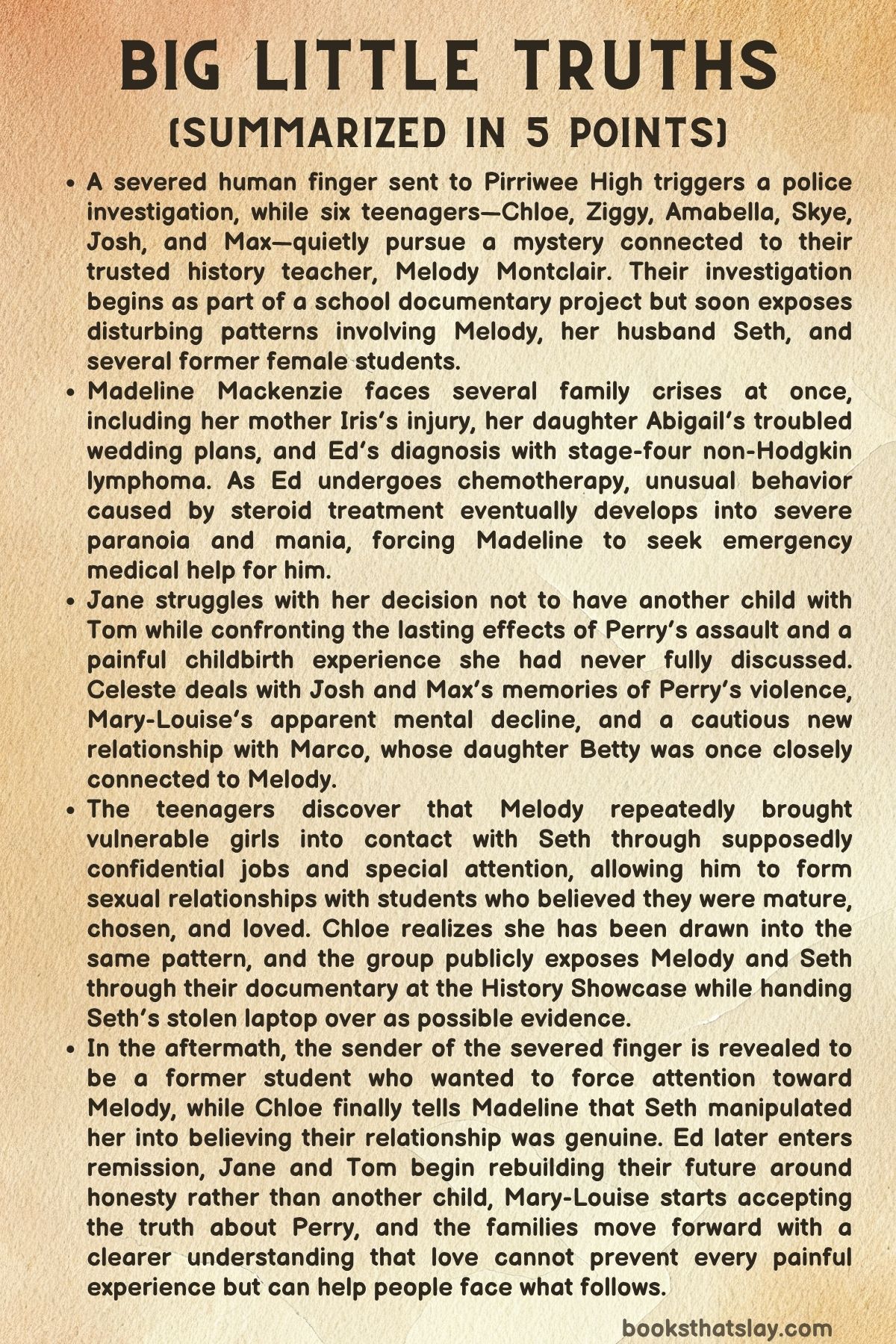
Summary
The story opens at Pirriwee High on a morning that quickly becomes known as D-Day. Six teenagers—Chloe, Ziggy, Amabella, Skye, Josh, and Max—leave school while staff members discover that a parcel addressed to principal Dr. Ferdinand Seawright contains a genuine severed human finger.
Detective Chief Inspector Adrian Quinlan arrives to investigate and is reminded of the earlier death of Perry White, another violent event connected to the school community. The finger appears to have been deliberately positioned as though pointing toward history teacher Melody Montclair, but nobody initially understands why.
The teenagers later explain that the chain of events really began months earlier at Madeline Mackenzie’s fiftieth birthday. Madeline wakes that morning already irritated by aging and her painful frozen shoulder, only to find a lump in her breast.
She hides the discovery from Ed and her friends because she refuses to let fear dominate her celebration. The birthday, however, becomes a night when nearly every family begins confronting an issue that will shape the months ahead.
Jane arrives with her son Ziggy while privately struggling with whether she wants another child with her husband, Tom. Tom hopes for a biological child, but Jane increasingly believes she cannot face pregnancy or childbirth again because of the trauma surrounding Ziggy’s conception and birth.
Celeste comes with her twins, Josh and Max, and her former mother-in-law, Mary-Louise. Mary-Louise has recently begun behaving unpredictably, spending recklessly and showing signs of confusion, though she remains as critical and sharp as ever.
At the party, Abigail’s boyfriend Luka unexpectedly proposes, forcing Madeline to confront another major change in her family. Mary-Louise also cruelly asks Bonnie whether she has killed anyone lately, causing the younger generation to learn more about Perry’s death and Bonnie’s role in pushing him from the balcony.
The teenagers also notice an unfamiliar man watching them from a green Volvo. They jokingly begin calling him “Pedo Pete,” believing he may be the suspicious man who has been appearing around local girls.
Madeline soon discovers that her mother, Iris, has fallen at home and fractured her hip. Her guilt over celebrating while her mother lay injured is compounded by anxiety over the breast lump.
Her tests eventually show that the lump is benign, but the relief lasts only moments. Ed reveals that he has stage-four non-Hodgkin lymphoma and has hidden his diagnosis while waiting for Madeline’s medical results.
Ed begins aggressive chemotherapy, turning Madeline into caregiver, organizer, mother, daughter, employee, and family crisis manager all at once. She tries to help Iris recover, manage Abigail’s wedding plans, support Chloe, and protect Ed while rarely admitting how frightened and exhausted she has become.
Other families are also struggling. Mary-Louise buys expensive Range Rovers for Josh, Max, and Ziggy, a bizarre gift that intensifies concerns about her mental condition.
When Max struggles physically with Celeste over a car key, Josh instinctively tells him not to hurt their mother. The remark reveals that the twins may remember far more of Perry’s abuse than they have ever admitted.
Jane discovers alcohol and later vapes in Ziggy’s room. When he reacts angrily to being confronted, Jane fears that he may somehow have inherited Perry’s violence, while Tom argues that an angry teenage moment does not define the boy Ziggy has become.
Bonnie is also dealing with the consequences of the past. Skye learns that Bonnie pushed Perry from the balcony and becomes furious that her parents kept the truth from her.
Bonnie admits to Jane that she no longer believes Perry’s death was purely accidental. Seeing him hit Celeste awakened memories of her own violent father, and in that moment she consciously wanted him to die.
Meanwhile, Melody Montclair becomes increasingly important to both parents and teenagers. She is intelligent, attentive, generous, and remarkably skilled at making people feel understood.
She helps Josh return to school when Celeste cannot persuade him to attend. She listens to Jane’s concerns about Tom, supports Chloe while Ed is ill, and becomes accepted into the women’s friendship group.
Jane becomes especially close to Melody. During a night out, Jane senses that Melody may want to kiss her and recognizes an attraction that seems connected not only to Melody herself but also to Jane’s desire to rediscover an identity beyond marriage and motherhood.
Melody later organizes a Blue Mountains getaway for Jane, Madeline, Celeste, Bonnie, and Renata. Most of them are deeply charmed by her, although Renata repeatedly says that Melody’s extreme helpfulness makes her suspicious.
Celeste develops an entirely different connection when she meets Marco, a man she first notices at a lecture about teenagers who stop communicating with their parents. Their attraction grows slowly, and Celeste appreciates the gentleness of a relationship that feels very different from her life with Perry.
Marco eventually reveals that his daughter Betty was once close to Melody. Betty changed dramatically afterward, and Marco has been hanging around Pirriwee High because he is trying to learn what happened to her.
The mysterious man in the green Volvo is therefore not hunting teenage girls. He is a worried father investigating the teacher he believes played a role in harming his daughter.
At the same time, Chloe becomes increasingly close to Melody while Ed’s cancer consumes much of her parents’ attention. Melody gives Chloe a supposedly confidential job helping her husband Seth, explaining that Seth cannot read and is embarrassed about his illiteracy.
Chloe feels trusted, mature, and important because of the secrecy. Madeline approves of the arrangement because she believes Melody is helping her daughter during a difficult period, while Ed becomes unusually suspicious of it.
Ed’s behavior is becoming increasingly strange during treatment. He becomes intensely protective, irritable, energetic, and paranoid, at one point believing that local gangster Bruce Tortinas has threatened Madeline even though no such threat occurred.
Madeline initially attributes these changes to the pressures of cancer. After discovering that Ed has imagined or distorted the interaction with Bruce, however, she realizes something is medically wrong.
The six teenagers are meanwhile working on a school documentary about Winston Churchill. Their project changes completely after they confront Marco and learn about Betty.
A page from Betty’s notebook contains repeated statements that she “was the gift” and that Melody knew. Chloe immediately understands the implication because Melody has placed her in the same kind of secret relationship with Seth.
The teenagers begin locating other former female students. Their interviews reveal a repeated pattern: Melody befriends vulnerable girls and their families, Seth enters the girls’ lives through school activities or confidential work, and the girls are encouraged to feel unusually mature and special.
The teenagers become convinced that Melody knowingly enabled Seth’s sexual relationships with students. Instead of immediately turning everything over to their parents, they investigate themselves because they believe the adults will take control and stop listening to them.
They even break into the Montclairs’ home and steal Seth’s laptop, intending to give it to police. Their assigned history documentary becomes a documentary exposing Melody and Seth.
At the History Showcase, parents gather expecting harmless school films. Ziggy’s group instead announces that its subject is Melody Montclair.
The film begins with praise for Melody before shifting into testimonies from former students. Betty appears on-screen, followed by other women describing how Seth entered their lives through Melody and how supposedly confidential arrangements became sexual relationships.
Madeline realizes that Chloe has been placed directly inside the same pattern. Melody quietly leaves the auditorium as parents react with shock, anger, disbelief, and fear.
Chloe has not yet admitted the full truth to her parents. The teenagers reveal the stolen laptop, which creates another legal complication but also provides investigators with possible evidence.
The severed finger mystery is soon solved as well. A former student named Clara admits mailing it after obtaining the finger from a corpse.
Clara wanted to force the school to investigate Melody. Knowing that current students were already asking questions, she arranged the finger to function as a literal accusation pointing toward the teacher.
After the showcase, Madeline, Jane, Celeste, Renata, and Bonnie confront Melody at her home. Melody calmly dismisses the allegations as misunderstandings involving teenage girls with inappropriate crushes, while Seth remains composed beside her.
The confrontation makes Jane understand how easily confident adults can create doubt around young victims. Without the number of testimonies collected by the teenagers, even people who cared about the girls might have questioned what really happened.
That same night, Ed suffers a severe psychiatric episode. He becomes paranoid, aggressive, and physically threatening, forcing Chloe to call Tom and emergency services.
Doctors later determine that the cancer has not spread to Ed’s brain. Instead, steroids used during his treatment have caused a serious psychiatric reaction marked by mania, aggression, and distorted judgment.
Melody and Seth attempt to leave after being publicly exposed but are involved in a car crash. Both survive and face investigation, while Seth’s laptop and the teenagers’ documentary become part of the evidence surrounding them.
Jane receives a strange final email from Melody recommending an art workshop and continuing to behave as if her role as a helpful friend has survived the scandal. The message nevertheless pushes Jane toward an important conversation with Tom.
Jane finally explains that her fear of pregnancy is connected not only to Perry’s assault but also to a humiliating experience during Ziggy’s birth. Tom listens without dismissing her pain and makes clear that he does not want her to leave him simply because their plans for children have changed.
Chloe eventually tells Madeline what happened with Seth. She believed she had consented because Seth convinced her that he loved her, treated her as mature, and promised her an exciting future.
The discovery that Seth repeated the same behavior with other girls destroys Chloe’s belief that their relationship was special. Madeline understands that adults deliberately manipulated her daughter’s first experience of romantic love and that no amount of parental vigilance can completely erase what has happened.
Celeste receives unexpected good news concerning Mary-Louise. Her apparent dementia may actually have resulted from taking too much allergy medication, and her confusion improves when she stops doing so.
Ironically, Melody had sent Celeste information about this medication problem shortly after being exposed. Even a woman capable of causing serious harm had sometimes offered genuinely useful help, making simplistic interpretations of her character difficult.
Celeste and Marco resume seeing one another, while Bonnie finally apologizes directly to Mary-Louise for Perry’s death. Mary-Louise begins allowing herself to acknowledge that Perry abused Celeste and caused the destruction of his own family.
Ed eventually recovers from the psychiatric effects of his treatment. On the first day of summer, he and Madeline attend an oncology appointment and learn that he is in remission.
Fred unexpectedly returns from America, emerging from a large box as a surprise for Ed, and the family reunites. Madeline accepts that she can neither protect her children from every terrible experience nor control what becomes part of their life stories.
The final scene returns to Mary-Louise on the morning after D-Day. Confused after taking too much medication, she drives while imagining her dead husband and thinking about Perry, Celeste, Bonnie, and the past.
For the first time, she angrily acknowledges to Perry that he threw away the beautiful life he had by abusing Celeste. When she accidentally crosses into the path of a silver car carrying Seth and Melody, she swerves back just in time and hears their vehicle crash behind her.
Mary-Louise does not turn around. She drives forward, leaving the road behind her as the story closes on an image of a woman finally beginning to release the past rather than allowing it to determine where she goes next.
Characters
Madeline Mackenzie
Madeline is one of the central forces in Big Little Truths, a woman whose instinct is to manage every crisis around her even when she is overwhelmed herself. Turning fifty confronts her with physical aging, her frozen shoulder, a breast lump, her mother’s declining independence, Abigail’s impending marriage, Chloe’s adolescence, and the fear that the structure of her family is changing faster than she can control.
Her greatest crisis comes through Ed’s cancer, which forces her into the role of relentless caregiver while she continues managing everyone else’s needs. Madeline can be loud, impulsive, judgmental, and controlling, but those qualities are closely connected to loyalty and an almost fierce refusal to remain passive when someone she loves is in danger.
Her confrontation with hospital staff when Ed becomes dangerously ill shows that her willingness to cause a scene can be useful rather than merely embarrassing. Yet Chloe’s exploitation forces Madeline to recognize the limits of that protective energy, because being attentive, loving, and forceful cannot guarantee that a parent will see every threat in time.
By the end, Madeline has moved toward a more difficult understanding of motherhood. She cannot prevent her children from acquiring painful histories of their own, but she can remain present when they need someone to help them survive those histories.
Jane Chapman
Jane remains shaped by what Perry did to her, but Big Little Truths shows that the consequences reach far beyond the assault itself. Her fear of another pregnancy is connected to Ziggy’s conception, years of raising him, and a separate experience during childbirth that she had minimized because it seemed less serious than other traumas.
Her marriage to Tom is loving, yet the disagreement over having another child places them in a painful position where neither person is clearly wrong. Jane understands that Tom’s longing for a biological child is genuine, while Tom eventually understands that asking Jane to become pregnant would require her to cross emotional boundaries she cannot safely ignore.
Jane’s attraction to Melody initially seems to represent curiosity about another woman, but it also expresses a broader hunger for creativity, freedom, and a self that exists outside motherhood. Melody recognizes this longing and gives Jane attention at precisely the moment she feels uncertain about the direction of her life.
After Melody is exposed, Jane does not simply dismiss everything she felt. Instead, she begins separating Melody’s manipulation from the legitimate needs that manipulation revealed, allowing her to reconsider art, travel, individuality, and her relationship with Tom on her own terms.
Celeste Wright
Celeste’s development in Big Little Truths centers on life after Perry rather than merely survival from Perry. She is raising teenage sons who carry complicated memories of an abusive father, dealing with Mary-Louise’s changing behavior, and cautiously considering whether she can risk emotional intimacy with another man.
Josh and Max are particularly difficult for her because their adolescence raises questions about masculinity, aggression, consent, and inheritance. When Josh reacts violently to the possibility of Max hurting Celeste, she understands that the twins remember elements of Perry’s abuse even though they rarely speak about them.
Her relationship with Marco represents a quieter possibility for the future. Celeste remains alert to male anger and charm, but Marco’s respect, awkwardness, patience, and willingness to speak openly make intimacy feel less like surrendering control.
Celeste also has to revise her confidence in her own judgment after Melody deceives her. Rather than proving that Celeste learned nothing from Perry, the experience shows that manipulation can succeed even against intelligent people when it arrives through generosity, friendship, competence, and apparent concern.
Ed Mackenzie
Ed begins as Madeline’s dependable husband but becomes one of the story’s most vulnerable figures after receiving a stage-four lymphoma diagnosis. His decision to delay telling Madeline while she waits for her breast-test results reflects his instinct to protect her, even when withholding the truth creates additional emotional complications.
Chemotherapy gradually changes him physically, while steroids alter his behavior in far more frightening ways. His unusual protectiveness becomes paranoia, his energy becomes mania, and his suspicion eventually develops into aggression so extreme that his family barely recognizes him.
The medical explanation prevents the episode from becoming a simple revelation of a previously hidden personality. Still, Madeline is left wondering whether some of his cruel statements came entirely from medication, demonstrating how psychiatric crises can leave emotional consequences even after their biological cause is understood.
His eventual remission gives the family relief without pretending the experience can simply disappear. Ed survives both cancer treatment and a severe psychiatric reaction, leaving him and Madeline with a future that feels far less guaranteed than it once did.
Chloe Mackenzie
Chloe undergoes one of the most painful transitions in the book. Intelligent, confident, socially aware, and increasingly independent, she nevertheless becomes vulnerable when her family’s attention is consumed by Ed’s illness and other crises.
Melody recognizes Chloe’s need to feel seen and gives her a confidential job helping Seth. Secrecy is made to feel like maturity, and Seth’s attention is framed as evidence that Chloe is unusually special rather than a teenager being targeted by experienced adults.
Chloe believes her involvement with Seth is consensual because her emotions are real. Her later recognition that Seth used the same methods with other girls destroys not only her trust in him but her understanding of her own first romantic experience.
Her importance also lies in her role within the teenage investigation. Once she recognizes Betty’s words, she connects her own experience to a pattern and helps her friends expose something that none of them could have confronted as effectively alone.
Ziggy Chapman
Ziggy has grown from a child surrounded by questions about his biological father into a teenager trying to establish an identity independent of Perry. Discussions at Madeline’s party force him to hear difficult details about his conception and confront what it means to be biologically connected to someone capable of rape and domestic violence.
Jane’s fear that Ziggy might inherit Perry’s aggression surfaces when he becomes angry over the discovery of vapes in his room. Yet the story repeatedly resists treating character as something genetically predetermined, showing Ziggy as humorous, caring, secretive, imperfect, and capable of making poor teenage choices without becoming his father.
His growing connection with Amabella and participation in the documentary show his increasing independence. He also articulates one of the teenagers’ clearest objections to their parents: adults often respond to adolescent problems by taking control rather than listening.
Tom
Tom is defined by steadiness rather than dramatic behavior. He loves Jane and Ziggy, wants a biological child, and suffers when Jane finally tells him she cannot endure another pregnancy.
His strength lies in refusing to turn that disappointment into entitlement. Even when his mother raises the possibility that Jane should release him from the marriage, Tom ultimately makes clear that he values Jane more than an imagined future family.
His reaction to Jane’s disclosure about Ziggy’s birth is especially important. Instead of comparing levels of trauma or explaining why the incident should not matter, he simply recognizes that it hurt her, allowing Jane to feel believed without having to justify the scale of her pain.
Josh Wright
Josh is quieter and more emotionally exposed than his twin brother. His refusal to attend school initially confuses Celeste because he denies being anxious or depressed in the ways adults expect, illustrating how easily adult categories can fail to match teenage experience.
His protective reaction when Max struggles with Celeste reveals buried memories of Perry’s violence. Josh may not consciously remember everything he witnessed as a child, but his body and emotions respond to the possibility of his mother being hurt.
His relationship with Skye adds another complication because their parents are connected by Perry’s death. Josh rejects Mary-Louise’s resentment and makes clear that Bonnie’s role in Perry’s death will not determine how he feels about Skye.
Max Wright
Max often appears more dismissive and provocative than Josh, especially when discussing danger, girls, or their mother. His struggle with Celeste over the Range Rover key becomes frightening because it briefly resembles the kind of male aggression that defined Perry.
Josh’s accusation devastates Max precisely because he does not want to become his father. His character therefore raises the fear of inherited behavior without suggesting that resemblance creates destiny.
Max also distrusts Melody before many adults do. Although he cannot initially explain why, his discomfort shows that teenagers sometimes notice boundary violations or unusual adult behavior long before they possess the vocabulary to describe it.
Mary-Louise Wright
Mary-Louise has one of the most significant late transformations in Big Little Truths. For years she has defended Perry because acknowledging the truth about him would require accepting that the son she loved abused Celeste and caused lasting damage to several families.
Her hostility toward Bonnie is connected to grief, denial, and a need to place responsibility for Perry’s death somewhere outside Perry himself. Her cruel question at Madeline’s birthday demonstrates how much resentment remains active beneath ordinary social interaction.
Apparent dementia adds vulnerability to a character who has often functioned as an antagonist. When the confusion is eventually linked to excessive allergy medication, her strange spending, forgetfulness, and disorientation become medically understandable rather than evidence of an irreversible decline.
Bonnie’s apology helps Mary-Louise begin reconsidering the past. In the final scene she allows herself to imagine events from Celeste’s perspective and finally directs anger toward Perry, recognizing that he destroyed his own family through his choices.
Bonnie Carlson
Bonnie carries guilt that has never been fully resolved. She originally accepted the public account of Perry’s death, but later admits that when she saw him strike Celeste, she wanted him dead because the violence activated memories of her abusive father.
Skye’s discovery of the truth destabilizes Bonnie because her daughter’s anger makes it impossible to keep separating the past from the present. Bonnie begins worrying that she is becoming like her father, especially after striking Nathan during an argument.
Her eventual apology to Mary-Louise is emotionally important because Bonnie has spent years assuming that no apology could ever be adequate. Mary-Louise’s response reveals that silence did not protect anyone; it merely prevented a necessary acknowledgment from occurring.
Skye Carlson
Skye is initially defined by distance from Bonnie after learning the truth about Perry. She experiences the secrecy surrounding his death as a betrayal and refuses to accept that her parents had the right to decide when she was ready to know.
Her relationship with Josh further complicates the situation because Josh is Perry’s son. Their affection suggests that the younger generation does not intend to inherit every hostility created by their parents’ history.
Skye also gradually recognizes that Bonnie’s behavior comes from pain rather than indifference. Seeing her mother break down in the fountain allows her to understand the emotional weight Bonnie has been carrying.
Nathan Carlson
Nathan remains connected to both Madeline and Bonnie through a complicated family structure. Although his relationship with Madeline has a difficult history, they are capable of cooperating immediately when Abigail needs them.
His marriage to Bonnie is tested by her increasing distress and conflict with Skye. When Bonnie strikes him, he recognizes how deeply the incident frightens her because she has spent much of her life trying not to reproduce her father’s violence.
Nathan is also capable of defending Madeline when Abigail accuses her of being emotionally unavailable during Ed’s illness. His response shows that their former marriage has evolved into a relationship where he can recognize the burdens Madeline carries without needing to deny their past conflicts.
Renata Klein
Renata remains forceful, intelligent, defensive, and suspicious, but her mother’s death reveals how much vulnerability exists beneath that confidence. Her history of accusing an uncle of sexual abuse as a child and being blamed for his subsequent death explains much about her lifelong determination to believe children who say something has happened to them.
Her breakdown after the funeral comes from grieving the relationship she wanted rather than simply the mother she actually had. Surrounded by friends, she finally allows herself to express emotions she normally converts into anger, ambition, or control.
Renata is also the friend least convinced by Melody. Her suspicion does not give her magical insight, but it demonstrates that excessive generosity can sometimes feel unsettling when the giver appears to gain unusual access to other people’s private lives.
Amabella Klein
Amabella has grown into an intelligent and organized teenager who becomes central to the group investigation. Once Chloe understands Betty’s notebook, Amabella helps transform the teenagers’ uncertainty into a plan to locate other former students and document what happened.
Her importance comes from treating evidence seriously rather than allowing admiration for Melody to end the inquiry. She and the others recognize that one disturbing experience may be dismissed, while a documented pattern is much harder for adults to ignore.
Her growing closeness with Ziggy also reverses elements of their childhood relationship. The novel later indicates that she likes girls, a detail Ziggy discusses naturally with Jane rather than treating it as a dramatic revelation.
Melody Montclair
Melody is the central deceptive figure in Big Little Truths because her power comes from making herself indispensable. She listens carefully, gives useful advice, notices private needs, solves problems, and provides exactly the kind of attention each person wants.
Her assistance is not entirely fake, which makes her more disturbing. She genuinely helps Josh return to school, encourages Jane’s artistic interests, organizes restorative experiences for the women, and even provides information that helps explain Mary-Louise’s confusion.
At the same time, her generosity gives her access to vulnerable teenagers and their families. She appears to create situations in which selected girls are placed near Seth, then protects the system through secrecy, credibility, and her reputation as an exceptional teacher.
Even after being exposed, Melody refuses to surrender her self-image as a helpful person. Her final messages behave as though ordinary friendship can continue, suggesting either extraordinary denial or an ability to compartmentalize harm so completely that she can still view herself as benevolent.
Seth Montclair
Seth is the direct sexual predator within the pattern uncovered by the teenagers. His attractiveness, charm, confidence, and supposed vulnerability are used to make young girls feel chosen rather than targeted.
The claim that he cannot read gives Chloe a reason to meet him privately while making secrecy seem compassionate. The arrangement turns assistance into intimacy and allows him to present dependence as trust.
His actions are especially destructive because the girls’ feelings are often genuine. Chloe’s pain comes not from discovering that she felt nothing, but from discovering that emotions she considered unique were deliberately produced through a repeated strategy.
Marco
Marco is initially misidentified by the teenagers as a possible predator because of his repeated presence near the school. His suspicious behavior is eventually revealed to come from concern for his daughter Betty and frustration that he cannot understand what happened to her.
His relationship with Celeste develops through uncertainty rather than instant certainty. Marco is not presented as a perfect corrective to Perry, but his willingness to communicate, ask permission, acknowledge flaws, and respect Celeste’s sensitivity gives her a very different experience of intimacy.
His investigation also demonstrates what happens when a parent knows something is wrong but lacks evidence. The teenagers initially interpret his watchfulness as threatening because they see his actions without knowing the history motivating them.
Betty
Betty is Marco’s daughter and one of the former students who helps expose the pattern surrounding the Montclairs. Her dramatic change after her involvement with Melody and Seth motivates Marco’s investigation.
Her notebook provides the phrase that allows Chloe to recognize what Melody has been doing. Betty’s willingness to appear in the documentary also helps move the allegations from private suspicion into public testimony.
She continues to feel shame, even though Celeste immediately tells her she has nothing to be ashamed of. Her character demonstrates how exploitation can leave victims blaming themselves long after the adults responsible have rationalized their behavior.
Adrian Quinlan
Adrian provides the investigative structure surrounding D-Day. Experienced enough to remember Perry’s death, he returns to Pirriwee because of the severed finger and gradually follows the clues from school gossip and organized-crime possibilities toward Melody.
He is curious without immediately accepting the school community’s assumptions. The eventual discovery that Clara used a corpse’s finger as a literal accusation gives him one of the strangest cases of his career.
His later encounter with Anna in a shoe shop offers a lighter ending to his involvement. Their decision to have coffee suggests that even a grotesque investigation can produce unexpected human connections.
Dr. Ferdinand Seawright
Dr. Seawright is an enthusiastic but frequently awkward principal whose communications often create confusion. His accidental mass messages and poorly judged comments make him seem comic, but his relationship with Melody gives his role greater seriousness.
He trusts her professionally and emotionally, leaving him shaken when the documentary exposes what may have happened under his authority. His accidental message after the showcase also reveals how dependent he had become on Melody’s guidance.
His failure is less deliberate corruption than misplaced trust and poor judgment. Like many adults in the story, he mistakes competence and friendliness for proof of moral reliability.
Anna Kennard
Anna is the science teacher who recognizes immediately that the object delivered to the school is a real human finger. Her scientific certainty transforms what others initially consider a bizarre joke into a police matter.
She retains curiosity and humor even while the school becomes consumed by the case. Her final coffee with Adrian gives her a small personal possibility beyond the chaos of Pirriwee High.
Abigail
Abigail’s engagement to Luka becomes one of the many changes Madeline struggles to accept. Her intense wedding planning eventually reveals itself as an attempt to create certainty while Ed is seriously ill.
When Luka suggests postponement, Abigail’s carefully controlled plans collapse. Her argument with Madeline also exposes a genuine family tension: Madeline is overwhelmed by caring for everyone but sometimes shuts people out while resenting them for not understanding what she needs.
Abigail eventually recognizes that the perfect wedding cannot guarantee a perfect future. Her relationship with Luka survives once they stop asking the event itself to solve their fears.
Luka
Luka initially faces Madeline’s suspicion because she is reluctant to believe he is good enough for Abigail. His sudden public proposal strengthens her concern that events are moving too quickly.
Over time his actions repeatedly challenge her assumptions. He responds immediately when Iris is being scammed, helps stop further financial damage, and proves that his flaws are ordinary rather than sinister.
His willingness to postpone the wedding because of Ed’s illness is motivated by concern rather than lack of commitment. By the time he returns to Abigail with flowers, Madeline is finally able to welcome him sincerely.
Iris
Iris represents the increasing responsibilities created by an aging parent. Her fall on Madeline’s birthday leaves Madeline tormented by the idea that her mother could have remained helpless while everyone else celebrated.
Her later vulnerability to an online scam creates another emergency and forces Madeline to confront the changing balance between respecting an older parent’s independence and intervening when that independence creates risk.
Iris therefore contributes to Madeline’s sense of being pulled in every direction. She is still Madeline’s mother, yet Madeline increasingly has to act as the responsible adult in their relationship.
Fred
Fred spends much of the story away from home, but Ed’s illness keeps him emotionally connected to the family. He researches survival statistics and responds to the diagnosis even from a distance.
His surprise return at the end provides the family with a moment of uncomplicated joy after months dominated by illness and fear. Chloe’s immediate reaction and Ed’s embrace reinforce the importance of physical reunion after so much uncertainty.
Clara
Clara is responsible for the severed finger that launches the police investigation. Her method is grotesque, but her intention is to force Pirriwee High to pay attention to allegations against Melody.
She views the finger as a literal sign pointing toward the person she wants investigated. Her actions demonstrate the extreme measures former students believe are necessary when conventional warnings have not produced accountability.
Lottie Wang
Lottie is the school administrator who opens the parcel containing the finger. She initially assumes the object is some strange promotional item before Anna confirms what it actually is.
Her presence helps establish the mixture of ordinary school bureaucracy and extraordinary crisis that defines D-Day. She also participates in the early speculation about who might have sent the package and why.
Adele
Adele, Perry’s sister, raises the possibility that Mary-Louise may be developing dementia. Living overseas limits the practical help she can provide, leaving Celeste in the uncomfortable position of caring for a woman with whom she has a painful history.
Her concerns about Mary-Louise’s spending, unpaid bills, confusion, and fixation on Bonnie are reasonable given the information available at the time. The later medication explanation changes the diagnosis without making Adele’s concern inappropriate.
Hannie
Hannie, Tom’s mother, enters Jane and Tom’s conflict about children from the perspective of a mother who sees her son suffering. She understands Jane’s reasons but cannot completely suppress her own wish for Tom to experience biological parenthood.
Her suggestion that Jane might let Tom go is painful precisely because it is presented as a question rather than an attack. It forces Jane to confront whether love alone is enough when two partners imagine different futures.
Brody
Brody is the women’s demanding Beach Boot Camp trainer and later becomes involved with Renata. His art exhibition becomes the setting where Jane and Melody grow significantly closer and where Celeste encounters Marco again.
Renata’s relationship with him is part of her reaction to her mother’s death. Along with learning to ride a motorcycle and getting a tattoo, it represents her decision to act on impulses she previously suppressed.
Bruce Tortinas
Bruce is a local figure associated with organized crime who briefly appears threatening only because Ed’s distorted thinking turns him into one. Madeline’s decision to confront him produces an almost absurd reversal when Bruce behaves politely and denies having any conflict with Ed.
His role becomes important because the encounter convinces Madeline that Ed’s behavior cannot be explained by ordinary stress. The imagined threat becomes evidence that medical treatment is seriously affecting Ed’s judgment.
Themes
Truth, Perspective, and the Difference Between Interpretation and Fact
Questions about perspective run through Big Little Truths, particularly because Melody teaches students to think about how different people construct different versions of events. That idea initially seems intellectually sophisticated, but the teenagers eventually discover how easily language about perspective can be misused when people want to avoid acknowledging concrete harm.
Perry’s death offers one example of competing versions: Mary-Louise sees a beloved son killed by Bonnie, Bonnie remembers an instant shaped by childhood abuse, Celeste remembers a violent husband, and the children inherit incomplete fragments of all these accounts. The story does not suggest that every interpretation is equally reliable; instead, it shows that perspective explains why people experience an event differently while evidence still matters.
The investigation of Melody and Seth makes that distinction especially important. Seth can describe his relationships with girls as romantic, some former students can remember them in complicated ways, and Melody can claim that the girls misunderstood what happened, yet the repeated pattern of secrecy, age difference, access, and manipulation gives those events a factual structure that cannot be erased by changing the language used to describe them.
The teenagers ultimately become investigators because they understand that individual memories can be dismissed more easily than a documented pattern. Their film collects separate voices until those voices reveal a consistency that personal charisma can no longer conceal.
Parenting and the Limits of Protection
The parents repeatedly discover that loving a child does not provide complete knowledge of that child’s life. Madeline does not know what is happening between Chloe and Seth, Jane does not initially understand Ziggy’s secrets, Celeste cannot get Josh to explain why he refuses school, and Bonnie cannot persuade Skye to speak openly about her anger.
This distance is frightening because each parent instinctively wants greater knowledge to produce greater safety. Yet the teenagers explain exactly why they withhold information: they expect their parents to take control, overreact, or transform a problem that belongs to the teenagers into an adult-managed crisis.
Chloe’s experience produces the harshest version of this theme. Madeline is not an indifferent mother; she is exceptionally involved, protective, and alert, but illness, aging parents, work, and family responsibilities divide her attention, while skilled manipulators deliberately exploit Chloe’s desire for independence.
The story therefore rejects the comforting assumption that perfect parenting can eliminate danger. Parents can teach, listen, intervene, apologize, and remain available, but they cannot control every encounter their children have or prevent every harmful person from entering their lives.
Madeline’s final acceptance of this reality does not mean giving up responsibility. It means recognizing that parenting older children increasingly involves helping them process experiences after they occur rather than imagining that love grants the power to prevent those experiences entirely.
Trauma, Inheritance, and the Fear of Repetition
Several characters fear that painful histories will reproduce themselves through the next generation. Jane worries that Ziggy may inherit Perry’s violence, Celeste watches Max for signs of resembling his father, Bonnie fears becoming like her abusive parent, and Mary-Louise spends years resisting the truth about the son she raised.
The novel repeatedly separates biological connection from moral destiny. Ziggy can be Perry’s biological son without becoming Perry, while Josh and Max can carry memories of domestic violence without being condemned to reproduce their father’s behavior.
Trauma does continue across generations, but it often survives through fear, secrecy, bodily reactions, and distorted expectations rather than simple imitation. Josh’s instinctive reaction when Max struggles with Celeste shows that memories can remain active even when a child insists he cannot consciously recall them.
Bonnie’s actions demonstrate another form of inheritance. Her childhood experiences with an abusive father contribute to the intensity of her response when she sees Perry strike Celeste, and years later she still worries that moments of anger prove she has become the person she feared.
Healing therefore requires more than refusing to repeat an act. It requires naming what happened, accepting responsibility where appropriate, and allowing younger people to understand family history without forcing them to carry the moral identities of previous generations.
Trust, Manipulation, and the Appearance of Goodness
The greatest danger in Big Little Truths does not arrive looking openly threatening. Melody enters people’s lives as a teacher, friend, problem-solver, listener, organizer, adviser, and apparently generous woman who repeatedly makes difficult situations easier.
That appearance is powerful because much of what she does is genuinely useful. She gets Josh back to school, gives Jane permission to reconsider her artistic identity, organizes a restorative trip, supports stressed families, and even sends Celeste information that helps explain Mary-Louise’s medication-related confusion.
The coexistence of useful actions and serious wrongdoing creates one of the story’s most unsettling ideas: a person does not need to behave badly every moment in order to facilitate harm. Good advice, charm, intelligence, generosity, and empathy can become tools for building credibility, lowering suspicion, and entering private spaces.
Seth uses a similar strategy with the girls. He does not initially frighten them; he makes them feel mature, attractive, necessary, and exceptional, turning exploitation into something they may understand as romance until the larger pattern becomes visible.
Jane and Celeste both struggle afterward with embarrassment over trusting Melody, but their trust does not prove stupidity. The story instead shows why effective manipulation works: it is designed to resemble friendship and care closely enough that reasonable people accept it until evidence forces them to reconsider what they believed they were seeing.