Billion Dollar Ransom Summary, Characters and Themes
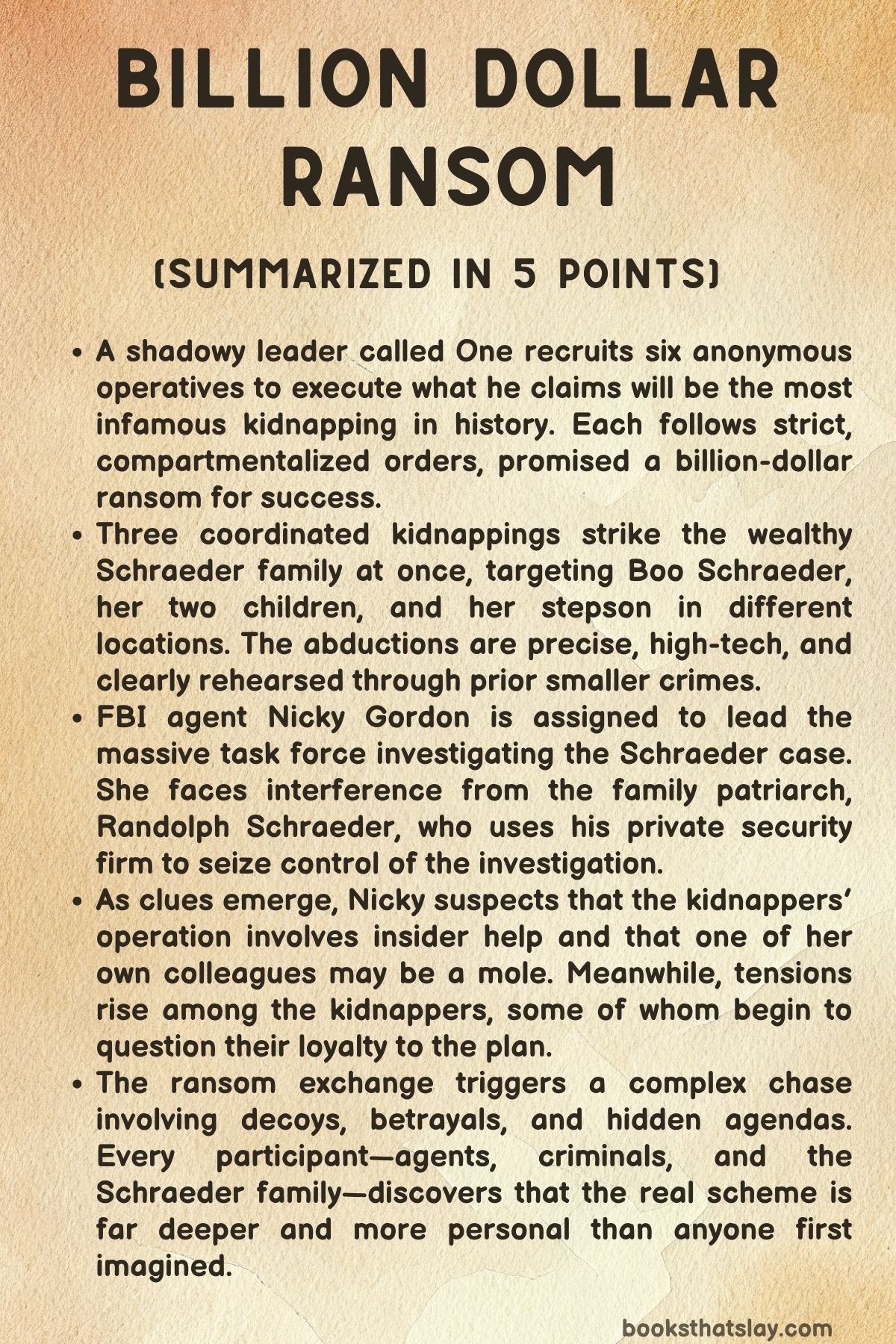
Billion Dollar Ransom by James Patterson and Duane Swierczynski is a fast-paced thriller that explores the dark world of greed, betrayal, and the intricate machinery of high-stakes crime. The story begins with a meticulously planned kidnapping involving one of the wealthiest families in America, the Schraeders.
What appears to be a series of coordinated abductions soon reveals layers of deception, double-crossing, and hidden motives. As FBI agents, private security firms, and the victims themselves become entangled in a web of lies, the story unfolds with cinematic tension, exposing the true masterminds behind the so-called “perfect crime.
Summary
A secret meeting opens the story, where a masked leader known only as “One” briefs six operatives on a daring mission — the most notorious kidnapping in history. Each participant is identified by number, their real identities hidden, and they are warned that failure or deviation will not be tolerated.
The prize: a one-billion-dollar ransom. Their mission targets the powerful Schraeder family.
The operation begins in Beverly Hills. Elizabeth “Boo” Schraeder, wife of billionaire Randolph Schraeder, is abducted by operative Two outside an exclusive salon.
Using chemical sedation and a chain of car switches, he ensures the trail vanishes. Simultaneously in Bel Air, operatives Three and Four hijack a school bus and take Boo’s two children, Cal and Finney, while keeping the rest of the passengers unharmed.
In Mexico, operative Five storms a resort villa, kidnapping Tyler Schraeder, Randolph’s son from a previous marriage, and his girlfriend, actress Cassandra Bart. The precision of the triple abduction shocks authorities.
FBI Special Agent Nicole “Nicky” Gordon is assigned to lead the case. With the simultaneous kidnappings and the billion-dollar demand, she suspects this is the culmination of earlier smaller-scale abductions.
The kidnappers send a cassette to confirm they hold the Schraeder family members and demand Randolph deliver one billion dollars. Randolph, a commanding and arrogant figure, refuses FBI oversight, bringing in his private security firm, Capital, led by James Haller and Virgil Tighe.
The FBI reluctantly continues working in parallel, with growing tension between agencies.
Meanwhile, each kidnapping group faces its own internal conflicts. Boo wakes restrained but mentally sharp, manipulating Two into revealing fragments of himself.
Their strange conversations blur the line between captor and captive. In Garden City, Three and Four treat the Schraeder children gently, disguising their actions as part of an elaborate game.
Their motives seem conflicted, driven by personal needs rather than cruelty. In Mexico, Five relies on his old criminal network to guard Tyler and Cass, creating an uneasy alliance with violent men.
As the investigation expands, Nicky learns about Rubin Padilla, a small-time criminal linked to previous test kidnappings. When Capital’s agents find him in Las Vegas, they execute him before the FBI can question him, claiming he resisted arrest.
Nicky grows suspicious of Capital’s true intentions, especially after learning Tighe is operating outside the law.
Evidence soon points to several “spotters” — people planted at abduction sites to control surveillance footage and communications. One is identified as a college student near the Bel Air school bus scene, and another as a man in a green cap at Boo’s kidnapping.
Nicky and her LAPD partner, Mike Hardy, chase these leads, but inconsistencies appear. They begin to suspect that some clues were planted to mislead them.
At the same time, whispers arise of a mole within the FBI task force feeding information to the kidnappers.
In Mexico, Tyler and Cassandra endure violent captivity under Ramiro “Little Rami” Flores, a local gangster. Rami’s compound is equipped with deadly traps, and his behavior veers between charming and brutal.
When corrupt Mexican police attempt to extort him, his defenses obliterate them. His control, however, is short-lived.
An unidentified strike team attacks his home with rockets and precision weapons, killing his men and abducting Tyler and Cass once more.
Back in Los Angeles, suspicions grow around Mike Hardy after evidence links him indirectly to Tim Dowd, a former LAPD officer thought to be dead. Nicky learns Dowd might be operative Two — Boo’s kidnapper.
When SWAT raids a house tied to him, they find it abandoned, with signs he fled moments earlier. Dowd’s emotional involvement with Boo deepens the mystery.
He decides to escape with her rather than follow orders to kill her. Soon after, Dowd’s body is found beneath a pier, his death staged as a suicide.
Boo is rescued alive, disoriented but unharmed.
The ransom operation then unfolds. Randolph Schraeder’s team transports the billion-dollar payment to a remote airstrip under instructions from the kidnappers.
Virgil Tighe oversees the delivery as FBI and SWAT units monitor from afar. A helicopter lands, loads the cash and jewels, and vanishes into the night.
Minutes later, bags of money are seen falling from the aircraft into a mountain range — a clear decoy. By dawn, none of the ransom remains traceable.
The kidnappers have disappeared, leaving chaos behind.
Soon after, Cassandra Bart is released across the U. S.
border, traumatized but alive. The Schraeder children are dropped off safely at a fire station by Three and Four, who vanish with their sick daughter.
Boo, now a free woman, appears cooperative, while Randolph begins damage control. Within days, Tyler Schraeder is confirmed dead from the explosions during the ransom aftermath.
The official investigation winds down without resolution.
Weeks later, the final twist comes to light. At the same airfield where the ransom was “delivered,” SWAT commander Jeff Penney meets secretly with Boo Schraeder and Virgil Tighe.
They open a concealed vault beneath the runway, revealing hundreds of millions in cash and gems. The entire kidnapping had been Boo’s idea, motivated by revenge against her husband, who planned to divorce her with minimal settlement.
With Penney and Tighe’s help, she had orchestrated every step, using the operatives as expendable assets. The midair money dump was a ruse to divert suspicion while they buried the real fortune.
Before they can disappear with the loot, Nicky and Mike arrive, having tracked Penney’s car. A gunfight erupts — Penney is fatally wounded, Virgil dies instantly, and Mike is shot but survives.
Boo flees in the Porsche with the jewels, but Nicky pursues her through the desert. The chase ends when Boo crashes near the ruins of Llano del Rio.
She is arrested, still defiant, as the sun rises over the wreckage of her plan.
Months later, a congressional hearing reviews the case. Nicky testifies that the FBI had an undercover operative, Cynthia Parker, who infiltrated the kidnappers as “Six.
” Her covert role helped expose the internal corruption and connect the dots between the kidnappers and their enablers. Despite major arrests, some operatives — Three and Four — remain at large.
In a quiet epilogue, the pair live peacefully in Costa Rica with their recovering daughter, enjoying a simple meal, untouched by the chaos they once helped unleash.
Billion Dollar Ransom closes on an unsettling note: justice is partial, greed persists, and the line between law enforcers and lawbreakers remains disturbingly thin.
Characters
Elizabeth “Boo” Schraeder
Elizabeth “Boo” Schraeder is at the heart of Billion Dollar Ransom, both as a victim and later as its architect. Initially introduced as a glamorous Beverly Hills socialite, Boo appears to be the epitome of wealth and privilege—married to billionaire Randolph Schraeder, living a life of luxury.
However, beneath this veneer of sophistication lies deep resentment and desperation. As the story unfolds, Boo transitions from the apparent target of a high-stakes kidnapping to its hidden mastermind.
Her motivations stem from personal betrayal and emotional devastation following her husband’s intent to discard her with minimal alimony. This betrayal fuels her transformation from passive victim to calculating conspirator.
Boo’s intelligence and composure are striking—she maintains poise even when abducted, probing her captor with disarming empathy while masking her manipulative edge. In the climactic revelation, her orchestration of the entire ransom operation reflects both her intellect and ruthlessness.
She emerges not as a wronged spouse seeking justice but as a complex, morally ambiguous strategist capable of deceit and violence to reclaim power.
Randolph Schraeder
Randolph Schraeder represents corporate arrogance and moral decay. A billionaire mogul whose control over Capital Security mirrors his dominance in every sphere of his life, Randolph is a man defined by wealth and manipulation.
His dismissive attitude toward law enforcement and his insistence on managing the kidnapping investigation himself highlight his obsession with control. Randolph’s condescension toward Agent Nicky Gordon, coupled with his readiness to override the FBI, paints him as both powerful and paranoid.
While he initially appears to be the wronged patriarch, the narrative gradually exposes his potential connections to criminal enterprises and his moral emptiness. His relationship with Boo underscores his emotional detachment—he views her as an expendable asset rather than a partner.
Randolph’s character ultimately symbolizes the corruption and emotional bankruptcy that wealth can breed, serving as a foil to Boo’s cunning emotional revenge.
Special Agent Nicole “Nicky” Gordon
Agent Nicky Gordon serves as the moral and emotional center of Billion Dollar Ransom. A seasoned FBI agent and single mother, Nicky balances maternal warmth with professional toughness.
Her immediate immersion into the Schraeder case establishes her as a force of competence and intuition in a world clouded by deceit. Nicky’s analytical brilliance allows her to connect disparate threads of the kidnappings, but her vulnerability as a mother adds emotional depth—especially when her daughter becomes a pawn in the larger conspiracy.
Nicky’s conflict with Randolph Schraeder exposes her resilience and sense of justice; she refuses to be intimidated by his power. Through her leadership, empathy, and relentless pursuit of truth, Nicky becomes a beacon of integrity in a narrative defined by moral compromise.
Her final confrontation with Boo Schraeder solidifies her as the story’s moral compass, driven not by ambition but by an unwavering commitment to justice.
Tim Dowd (“Two”)
Tim Dowd, also known as operative “Two,” epitomizes the tragedy of moral corruption. Once an LAPD officer, Dowd’s descent into criminality stems from betrayal, bitterness, and disillusionment.
His participation in the kidnapping scheme blends professional precision with personal turmoil. During Boo’s captivity, Dowd’s conflicted nature emerges—his growing attachment to her contrasts sharply with his role as her abductor.
This complex relationship blurs the line between captor and captive, revealing his humanity beneath the hardened criminal façade. However, Dowd’s attempt to break from the plan and save Boo exposes his fatal flaw: misplaced loyalty.
His eventual death under the Manhattan Beach pier serves as both punishment and redemption—he dies attempting to preserve the woman who manipulated him. Dowd’s story arc reflects the broader theme of corruption and emotional vulnerability exploited by more powerful figures.
Virgil Tighe
Virgil Tighe, a high-ranking executive in Capital Security, is both a mastermind and enforcer within the operation. Outwardly professional and loyal to Randolph Schraeder, Tighe conceals his role as “One,” orchestrating the kidnappings with precision and cold calculation.
His dual identity as both corporate fixer and criminal strategist embodies the story’s central tension between legality and crime. Tighe’s intelligence and resourcefulness make him a formidable opponent for Nicky Gordon.
However, his loyalty to Boo Schraeder—whether born of greed, manipulation, or shared resentment—leads to his downfall. Tighe’s violent end during the final confrontation with Nicky underscores the consequences of moral compromise, serving as a cautionary reflection on ambition unchecked by conscience.
Jeff Penney
Jeff Penney, SWAT captain and second identity behind “One,” represents the institutional rot within law enforcement. His outward professionalism masks deep-seated greed and moral decay.
Initially seen as a capable ally within the FBI’s response to the kidnappings, Penney’s betrayal shatters the illusion of integrity within the justice system. His alliance with Boo and Tighe reveals the seductive power of money even over those sworn to protect.
Despite his tactical brilliance, Penney’s arrogance blinds him to the inevitability of discovery. His final moments—bleeding and trapped in the pit of stolen wealth—mirror his internal descent into moral emptiness.
Penney’s character adds a chilling dimension to the novel’s theme of deception and the fragility of institutional trust.
Tyler Schraeder
Tyler Schraeder, Boo’s stepson, serves as a representation of youthful arrogance and entitlement. Living in the shadow of his father’s wealth, Tyler’s character arc transitions from spoiled heir to tragic victim.
His initial resistance during the abduction reflects his recklessness, but as the ordeal deepens, his vulnerability becomes evident. Tyler’s eventual death in Mexico marks a pivotal emotional point in the narrative—his demise symbolizes the collateral damage of greed and revenge.
Despite his flaws, Tyler’s brief moments of courage and protectiveness toward Cassandra Bart humanize him, providing a glimpse of the decency buried beneath privilege.
Cassandra Bart
Cassandra Bart, an actress and Tyler Schraeder’s girlfriend, offers a compelling portrait of survival and resilience. Initially portrayed as a glamorous figure caught in circumstances beyond her control, Cassandra evolves into one of the story’s quiet survivors.
Her experience as a hostage in Tijuana exposes her strength under duress, contrasting sharply with Tyler’s impulsivity. Cassandra’s intelligence and composure allow her to adapt and survive the chaos, and her eventual release underscores her endurance.
She functions as a witness to the extremes of cruelty and greed, embodying the cost of proximity to power and corruption.
Cal and Finney Schraeder
Cal and Finney Schraeder, the Schraeder children, are symbols of innocence amidst orchestrated chaos. Their kidnapping, carried out with eerie calm by operatives Three and Four, highlights the psychological manipulation underpinning the criminals’ methods.
The siblings’ composure and obedience during the abduction suggest both privilege and emotional detachment—traits inherited from their fractured family. Their ultimate safe return contrasts the fates of the adults, serving as a faint glimmer of hope in a narrative dominated by betrayal.
Through them, the story underscores the devastating impact of adult greed on the innocence of youth.
Sebastián (“Three”) and Valeria (“Four”)
Sebastián and Valeria, the couple behind the kidnapping of the Schraeder children, introduce a rare layer of humanity to the criminal ensemble. Unlike the other operatives motivated solely by money, their actions are complicated by desperation: their daughter Sofía’s grave illness.
Their empathy toward the children and their eventual choice to release them set them apart from their ruthless counterparts. Their relationship reflects a blend of love, fear, and moral ambiguity.
By the epilogue, living peacefully in Costa Rica, they embody survival tinged with guilt—fugitives haunted by their past yet bound by familial devotion. Their ending provides the story’s only sense of bittersweet closure, contrasting the downfall of the more corrupt conspirators.
Rubin Padilla (“Five”)
Rubin Padilla is a tragic figure defined by poverty, loyalty, and misplaced trust. Recruited into the operation for his technical skills and local knowledge, Padilla’s brief role and violent death expose the expendability of those at the bottom of criminal hierarchies.
Despite his criminal past, he is portrayed with empathy—a man seeking stability and affection with his girlfriend Julia. His demise at the hands of Capital operatives highlights the hypocrisy of a system where the powerful exploit and eliminate the powerless to conceal their own crimes.
Padilla’s character, though peripheral, deepens the story’s social commentary on class and morality.
Cynthia Parker (“Six”)
Cynthia Parker, the undercover agent codenamed “Six,” stands as a symbol of strategic brilliance and moral courage. Planted by Nicky Gordon to infiltrate the kidnappers’ ranks, Parker navigates the dangerous world of deception with remarkable skill.
Her covert operation, which even involves staging her own abduction, underscores her dedication and psychological resilience. As the final piece in Nicky’s strategy to expose the conspiracy, Parker’s role reaffirms the triumph of integrity over corruption.
Her success serves as a counterpoint to Boo Schraeder’s manipulative intelligence—demonstrating that cunning can serve justice as effectively as it serves greed.
Themes
Power, Wealth, and Corruption
In Billion Dollar Ransom, the immense power and wealth of the Schraeder family serve as both the foundation and the downfall of the characters’ lives. Randolph Schraeder’s empire is portrayed as an unshakable fortress of privilege, but this very wealth becomes the target and motivation for one of the most sophisticated kidnappings in history.
The novel explores how affluence corrupts human relationships and distorts moral judgment. Randolph’s control over his family and his willingness to use private security firms to override law enforcement display the extent to which money can replace accountability.
Boo Schraeder, the estranged wife, embodies how material excess can coexist with emotional emptiness; her revenge plot against Randolph is fueled by a mix of greed and humiliation. The ransom—the billion-dollar figure—transforms into a symbol of how wealth becomes both an object of desire and destruction.
Throughout the narrative, the line between legitimate power and criminal manipulation blurs as private security forces, government agents, and criminals operate within similar ethical shades. The climax, revealing Boo’s orchestration of the entire plot, underscores how wealth breeds a sense of invincibility and entitlement that corrodes empathy and loyalty.
Even the federal agents investigating the case struggle within systems influenced by corporate money and political pressure, revealing a world where justice bends to financial influence. Patterson and Swierczynski depict not just the ransom of people, but the ransom of morality itself in a society that measures worth by financial value rather than human integrity.
Deception and Identity
The theme of deception lies at the heart of Billion Dollar Ransom, shaping both the structure and tone of the novel. Every major character exists behind layers of secrecy—coded identities, double roles, and false loyalties.
From the beginning, the kidnappers are introduced not by names but by numbers, reducing individuality to operational efficiency and anonymity. This anonymity becomes a metaphor for moral dissociation; by erasing personal identity, the operatives justify their participation in violent acts.
As the plot progresses, deception spreads beyond the criminals. Law enforcement itself becomes ensnared in duplicity through undercover agents, false leads, and internal betrayal.
The revelation that Boo Schraeder and her allies masterminded the entire operation redefines every preceding event, exposing how appearances conceal deeper motives. Even personal relationships—such as the growing attachment between Boo and her captor Tim Dowd—reveal the paradox of emotional truth emerging from layers of deceit.
The story’s complex web of falsehoods demonstrates how deception is not limited to criminal enterprise but functions as a survival mechanism in a world governed by manipulation. Every layer of truth uncovered by Agent Nicky Gordon only exposes another lie beneath, emphasizing the instability of trust in environments dominated by power struggles.
Ultimately, the theme suggests that in a society ruled by secrecy and ambition, authenticity becomes a liability. Identity is not a fixed reality but a construct that characters use to achieve their ends, even if it means erasing their humanity in the process.
Morality, Loyalty, and Betrayal
The moral ambiguity in Billion Dollar Ransom pervades every decision made by the characters, turning the narrative into a study of loyalty’s fragility under pressure. The operatives, though initially united by greed, begin to fracture when personal loyalties and ethical doubts intervene.
Two’s relationship with Boo and Four’s desperation to help her ill daughter illustrate the tension between human compassion and criminal duty. Their defiance of orders represents fleeting moments of conscience in a world otherwise devoid of moral clarity.
On the institutional side, FBI Agent Nicky Gordon represents the struggle to uphold ethical standards amid manipulation by private power and political interference. Her investigation constantly collides with the self-serving interests of the Schraeder family and Capital Security, revealing how professional loyalty is often sacrificed for ambition or personal survival.
The betrayal within the kidnapping team mirrors the duplicity among those supposedly upholding the law. Boo’s final betrayal—using everyone, including her partners and family, to secure revenge and fortune—becomes the ultimate act of moral collapse.
Yet, it also reflects the paradox of empowerment through transgression; she reclaims agency in a world that dismissed her as replaceable. The theme underscores how betrayal becomes inevitable when loyalty is transactional.
Each character’s allegiance shifts according to self-interest, blurring the boundary between justice and crime. The novel presents morality not as a universal constant but as a negotiable currency in a world where everyone has a price.
Justice and Vengeance
The pursuit of justice in Billion Dollar Ransom is inseparable from the desire for revenge, creating a moral conflict that drives the story’s intensity. Boo Schraeder’s elaborate scheme begins as retaliation against her husband’s emotional abandonment and financial cruelty.
Her plan to stage the world’s most audacious kidnapping transforms vengeance into an art of precision and control. Yet, her revenge, masked as victimhood, also exposes the emptiness of retribution.
Once the billion-dollar ransom is secured, her supposed triumph unravels into chaos, death, and exposure. On the other side, Agent Nicky Gordon’s quest for justice evolves into a personal battle against institutional corruption.
Her pursuit of Boo becomes symbolic of law confronting moral decay. However, justice in this narrative is rarely clean or redemptive—it emerges through violence, deception, and manipulation.
The final confrontation at Sargent Field blurs the line between lawful action and personal vendetta as Nicky’s determination to capture Boo feels as driven by moral outrage as by professional duty. The theme reveals how justice, when stripped of moral grounding, mirrors the same obsession that fuels revenge.
The characters’ relentless pursuit of balance—whether emotional or legal—ultimately perpetuates the same cycles of destruction they seek to end. Patterson and Swierczynski depict vengeance as an intoxicating illusion that consumes both the wronged and the righteous, leaving behind only moral exhaustion and loss.
Family and Emotional Detachment
Family in Billion Dollar Ransom functions as both motivation and casualty. The Schraeder family’s wealth has eroded genuine affection, replacing it with calculation and resentment.
Randolph Schraeder’s dominance reduces his family to extensions of his ego, while Boo’s alienation reflects how emotional neglect breeds rebellion. The kidnapping of the Schraeder children brings into focus the contrast between biological connection and emotional estrangement.
The kidnappers’ treatment of Cal and Finney—keeping them entertained and unharmed—shows an eerie mimicry of parental care, highlighting how genuine affection has been displaced by artificial control. Similarly, Four’s conflict between her role as a mother and her duties as a criminal exposes how familial love can drive individuals toward moral compromise.
For Nicky Gordon, balancing her duty as an FBI agent and as a mother becomes the emotional center of the story. Her constant fear for her daughter mirrors Boo’s eventual exploitation of maternal sympathy for manipulation.
By the end, family bonds in the novel appear irreparably fractured, defined more by betrayal and revenge than love and loyalty. The theme suggests that emotional detachment, born from power and control, becomes the true ransom—one that cannot be repaid even after justice is served.
The family’s disintegration serves as a reflection of a broader societal decay, where success and appearance overshadow emotional truth, and where love itself becomes another casualty in the pursuit of power.