Bloodmarked Summary, Characters and Themes | Tracy Deonn
Bloodmarked by Tracy Deonn is the sequel to Legendborn, continuing the thrilling journey of Briana “Bree” Matthews, a young woman who inherits the power of King Arthur after pulling Excalibur from the stone. As Bree navigates her newfound magical abilities, she is forced to confront her ancestors’ legacies, internal power struggles, and dark forces threatening the world around her.
With her destiny as the Scion of Arthur, Bree must balance the weight of her power with the desire to protect those she loves while uncovering hidden truths about herself and the shadowy figures that pursue her. The story picks up roughly one month after the explosive events of Legendborn.
Summary
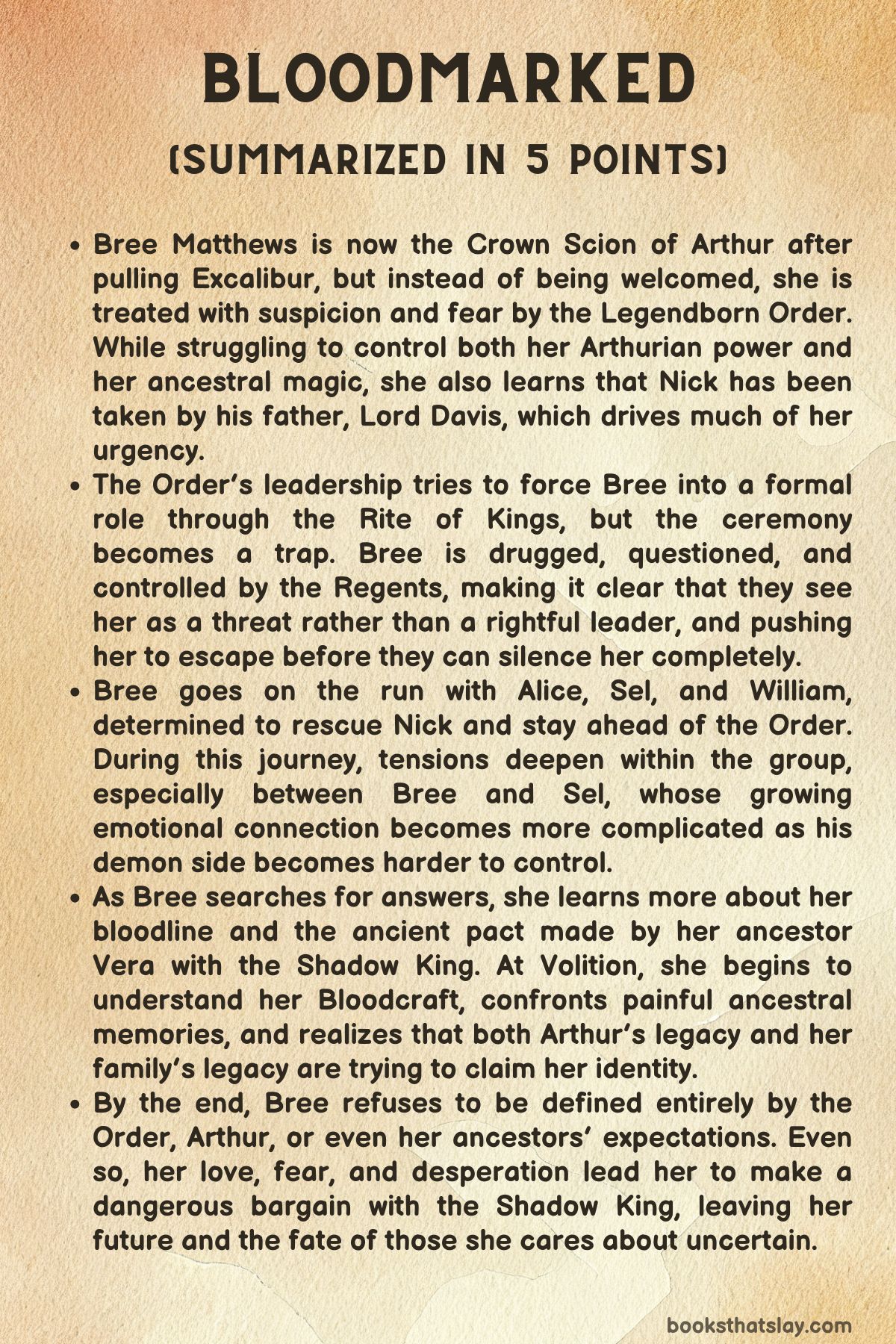
Bree Matthews, a Black teenager, has awakened as the Crown Scion of King Arthur. During a desperate battle against Shadowborn demons at the end of the first book, she pulled Excalibur from the stone, fully inheriting Arthur’s immense aether-based powers while also awakening her maternal ancestral Rootcraft (later revealed as Bloodcraft).
Nick Davis, the Scion of Lancelot and Bree’s boyfriend, was kidnapped by his father, Lord Davis. The Legendborn Order—a secret society of descendants of Arthur’s knights tasked with fighting demons—now faces the rising threat of Camlann, an apocalyptic war.
Bree finds herself confined at the Southern Chapter’s Lodge under the guise of “protection.” Her powers are volatile; she struggles to control Arthur’s aether constructs (armor, weapons) and experiences overwhelming ancestral visions. She sneaks out to train, only to be confronted by Selwyn Kane (Sel), Nick’s loyal Kingsmage (a powerful Merlin with demon heritage).
Sel acts as her de facto bodyguard, though his own grief over Nick’s disappearance is pushing him dangerously close to “going demon”—losing control and becoming fully monstrous.
The Regents (the Order’s ruling council) arrive for a memorial service honoring the Scions and Squires who fell in the previous battle. They also plan to administer the Rite of Kings, a ceremony in which Bree is expected to swear an oath and formally claim her title as Crown Scion.
However, the Regents have no genuine intention of letting a young Black girl lead their ancient, white-dominated institution. They view her as a dangerous unknown and a potential threat to the status quo.
During the Rite, Bree enters a visionary state. She sees a distorted Round Table where Nick appears in Lancelot’s place.
Rejecting the imposed oath, she connects instead to her ancestral stream and glimpses Vera, her foremother—an enslaved Black woman who was raped by a Scion of Arthur and struck a desperate blood pact with a powerful demon (the Great Devourer, also known as the Shadow King or Hunter) to protect her daughters and future line. Vera’s message is clear: the women in their bloodline have run to survive; now it is Bree’s turn to stand and fight.
The Rite proves to be an ambush. The Regents drug Bree, interrogate her repeatedly (mesmerizing her afterward to erase memories), and subject her to a power-suppressing serum while holding her and her friend William (a healer Scion) captive for days.
Sel, accused of treason (partly tied to his actions and growing instability), becomes a fugitive. Bree’s best friend Alice and others help orchestrate an escape.
Bree, Alice, Sel, and William go on the run to rescue Nick before the Regents can find him—or silence Bree permanently.
On the road, the group encounters Valechaz (Valec), a charismatic, centuries-old half-demon “crossroads child” who runs the Crossroads Lounge, a neutral ground where humans and demons broker dangerous deals. Valec provides crucial aid and information, though his motives remain murky.
Bree’s powers continue to misfire, drawing demons and attention. She also grapples with a growing, complicated attraction to Sel—intensified by shared danger, banter, and steamy moments—while still caring for the missing Nick.
Sel’s lies and mesmer use (intended to shield Bree from the worst of his declining state) strain their trust.
The fugitives discover a mysterious Bloodmark on Bree, linking back to Vera’s ancient pact. To understand her dual heritage (Arthurian aether and ancestral Root/Bloodcraft) and gain control, they head to Volition, a protected sanctuary for Rootcrafters—descendants of enslaved people who practice a reclaimed, community-based magic.
At Volition, Bree trains with ancestral guidance, experiences powerful Bloodwalks (reliving memories from her line and even Arthur’s), and celebrates her birthday amid tentative safety. She deepens her connection to her foremothers’ trauma, including generational violence and survival strategies.
Sel tries to repair their bond in a quiet clearing, leading to an emotionally charged kiss where Bree confronts her conflicting feelings.
However, safety is fleeting. The Mageguard, led by the enigmatic Erebus Varelian (Seneschal of Shadows), tracks them.
Threats escalate as demons attack and the Order’s pursuit intensifies. Bree learns more about the Shadow King’s interest in her bloodline and the high personal cost of her power.
Throughout her journey, Bree faces institutional racism within the Order, which prioritizes control and tradition over lives—especially Black lives. She questions whether she is merely a vessel for Arthur or a weapon for Vera’s line.
Arthur attempts to exert influence through visions and training, while Vera burdens her with the expectation to be the “point of the arrow” for her ancestors.
In a climactic moment of agency, Bree renounces her oaths—not only to Arthur but also to the expectations of her ancestral line. She declares she will not be anyone’s vessel or tool; she chooses to define her own path and identity.
Yet, driven by love and desperation (particularly to save Sel from fully succumbing to his demon nature, mirroring what happened to his mother), she makes a risky bargain with the Shadow King himself. The book ends on a knife-edge, with Bree stepping into an uncertain alliance that could either empower her or doom everyone she loves.
Characters
Bree Matthews
Bree stands at the center of Bloodmarked as a protagonist defined by pressure from every direction. Her struggle is not simply about learning to use power, but about deciding what that power means when other people have already assigned meanings to it.
She is treated as a symbol, a weapon, a threat, a miracle, and a political inconvenience, often all at once. That tension gives her character unusual depth, because her emotional conflict is inseparable from the larger systems around her.
She is a Black girl carrying a legacy built through white Arthurian power and Black ancestral survival, and those two inheritances do not sit easily together. Her instability with aether and Bloodcraft reflects a deeper identity fracture: she is being asked to belong to traditions that were never built to honor her fully.
What makes Bree especially compelling is her refusal to remain passive even when nearly everyone attempts to control her. The Regents want obedience, Arthur’s legacy wants embodiment, Vera’s bloodline wants purpose, and the Shadow King wants access.
Yet Bree repeatedly resists becoming a vessel for any single force. Her emotional life also adds complexity, because love, grief, guilt, rage, and desire all shape her choices.
Her connection to Nick pulls her toward rescue and loyalty, while her bond with Sel exposes a side of her that is drawn to honesty under pressure and intimacy born from danger. By the end, Bree’s most important act is not mastering power but claiming moral agency.
She chooses self-definition over inherited scripts, making her character arc one of identity, resistance, and conscious authorship of the self.
Selwyn Kane
Sel is one of the most psychologically layered figures in the story because his outward control hides profound instability. He often appears disciplined, guarded, and sharp-tongued, but that surface conceals grief, fear, and self-loathing.
His demon heritage places him in a constant state of threatened collapse, and that condition is not only magical but emotional. He fears what he could become, and this fear shapes the way he manages every relationship.
His protectiveness toward Bree is sincere, yet it is also tied to guilt, repression, and the belief that he must contain himself before he can deserve trust. That makes him a character defined by contradiction: he is dangerous but careful, loyal but secretive, affectionate but withholding.
His bond with Bree deepens his complexity because she sees both his strength and his damage. Their relationship is charged not only by attraction but by recognition.
Each of them lives with forces inside them that others fear, and each struggles with being treated as a problem to manage rather than a person to understand. Sel’s use of mesmer and concealment damages trust, but those choices emerge from panic and desperation rather than cruelty.
He wants to shield Bree and also hide his own decline, which makes his mistakes tragic rather than simple betrayal. His arc becomes a study of masculinity under pressure, especially the kind that turns pain into silence and service into self-erasure.
Sel matters because he embodies the cost of carrying monstrosity as an inheritance while still trying to remain tender, ethical, and human.
Nick Davis
Nick functions as both an absent presence and an emotional anchor. Even while physically removed from much of the action, he remains central because Bree’s memory of him affects her decisions, loyalties, and hopes.
He represents more than romance; he is tied to the life Bree had before power fully consumed her world. His kidnapping transforms him into a symbol of what has been taken from her, but the story does not reduce him to a simple rescue object.
He also stands for the emotional cost of the Order’s hierarchies and family legacies. As the son of Lord Davis and the Scion of Lancelot, Nick exists within a heritage built on duty, prestige, and masculine expectation, yet he is also vulnerable to being used by the very structures meant to elevate him.
Nick’s importance lies in how he reveals the fragility beneath nobility. He is not merely the golden boy archetype; he is someone caught between inheritance and autonomy, just as Bree is.
His absence also tests the meaning of love in the narrative. Bree’s feelings for him remain real, but distance forces those feelings to become less idealized and more painful.
The story asks whether love can survive transformation, secrecy, and the growth that happens when two people are separated by violence. Nick also serves as a contrast to Sel.
Where Sel is immediate, damaged, and visibly dangerous, Nick is remembered through affection, hope, and unresolved loss. This contrast does not lessen Nick’s role; instead, it shows how memory can preserve a person while also making them harder to know clearly.
Alice Chen
Alice provides one of the clearest expressions of friendship as action rather than sentiment. She is not positioned as a passive best friend who only offers comfort; she actively participates in Bree’s survival and escape.
Her importance comes from the way she grounds the narrative in human loyalty when magical politics become overwhelming. Alice does not possess the same mythic aura as the Scions and supernatural figures around her, yet that makes her presence even more valuable.
She reminds the reader that courage does not require ancient bloodlines or ceremonial power. Her commitment to Bree arises from choice, affection, and moral clarity, not destiny.
At a deeper level, Alice represents the possibility of relational truth in a world full of manipulation. Many institutions in the story depend on secrecy, mesmer, ritual control, and selective memory.
Against that, Alice’s role becomes stabilizing because she offers practical support without demanding ownership. She helps Bree move, think, and survive, but she does not attempt to define who Bree must become.
This makes her one of the few characters whose care is not entangled with ambition or prophecy. Alice also broadens the emotional range of the story.
Without her, Bree’s world might collapse into romance, ancestry, and institutional conflict. Alice keeps alive a different register: ordinary devotion under extraordinary circumstances.
She shows that friendship can be politically meaningful, especially when standing beside someone marked by systems of exclusion becomes an act of resistance.
William
William plays an important supporting role because he brings gentleness and ethical steadiness into a narrative often driven by force, secrecy, and domination. As a healer Scion, his abilities immediately place him in relation to pain, recovery, and vulnerability, which shapes the emotional logic of his character.
He is not defined by aggression or conquest, and that difference matters. In a story where many characters are valued for combat usefulness or political lineage, William’s function reminds us that preservation is as important as defense.
He becomes one of the figures through whom the narrative values care as labor and healing as moral work.
His captivity alongside Bree also reveals the cruelty of the Regents more clearly. Through William, the reader sees that the Order’s corruption is not only about prejudice against Bree but about a larger willingness to sacrifice people when control is threatened.
He helps expose how institutions instrumentalize even those who serve them faithfully. William’s presence among the fugitives strengthens the group dynamic because he offers a quieter form of courage.
He is not the loudest or most symbolically charged figure, yet he contributes humanity, compassion, and stabilizing intelligence. Characters like William prevent the story from becoming emotionally one-note.
He represents the people who keep others alive while receiving little glory, and that gives him significance beyond screen time. His role affirms that survival depends not only on heroes who fight, but on those who repair what violence breaks.
Vera
Vera is one of the most powerful ancestral figures because she embodies both historical trauma and survival strategy. She is not presented as a distant, sanitized foremother but as someone whose life was shaped by violence, coercion, and impossible choices.
Her blood pact emerges from an enslaved woman’s need to protect her descendants in a world that denied her safety, dignity, and control over her own body. This background gives Vera enormous symbolic force.
She represents what it means for Black maternal lineage to carry memory not as abstraction but as living burden. Her influence over Bree is therefore emotionally charged, because it comes with authority born from suffering.
At the same time, Vera is not framed as purely comforting or unquestionably right. She places expectations on Bree, asking her not merely to remember but to act as a continuation of ancestral resistance.
That demand is morally complicated. It honors survival, yet it also risks turning Bree into a function of inherited pain.
Vera’s significance lies in this ambiguity. She is both protector and pressure, legacy and weight.
Through her, the story examines how ancestral love can become obligation when descendants are told to redeem history through their own bodies. Vera’s presence pushes Bree toward truth, but it also helps create the conflict Bree must finally resolve: whether honoring the past requires surrendering personal freedom.
Vera therefore operates as a deeply meaningful but challenging force whose love is inseparable from history’s violence.
Valec
Valec introduces ambiguity, charisma, and moral fluidity into the narrative. As a centuries-old half-demon who runs a neutral meeting place, he occupies a space outside the binaries that dominate the Order’s worldview.
He is useful, perceptive, and entertaining, but he is never fully safe. This makes him an important counterpoint to institutional certainty.
The Order tends to classify beings and allegiances in rigid ways, while Valec survives by reading motives, managing risk, and exploiting the spaces between categories. His character suggests that power often belongs not only to rulers and warriors but also to brokers, interpreters, and those who understand desire.
What makes Valec memorable is that he cannot be reduced to either ally or enemy. He helps the protagonists, yet he does not do so out of pure benevolence.
His motives remain partially hidden, and that opacity is part of his function. He forces Bree and the others to navigate a world where survival sometimes requires negotiation with morally compromised figures.
Valec also expands the supernatural landscape beyond the Order’s narrow narrative about demons and heroes. Through him, the reader sees that the world contains arrangements, economies, and codes that official powers neither control nor fully understand.
His charm is therefore strategic; it softens danger without removing it. Valec matters because he embodies the unsettling truth that marginal spaces can offer refuge, information, and exploitation at the same time.
Lord Davis
Lord Davis represents the violence of patriarchal power when fused with aristocratic entitlement. His role as Nick’s father gives his actions emotional and thematic weight, because he is not simply an external villain but a figure embedded in family, status, and legacy.
He uses authority as possession, treating people as extensions of his will rather than autonomous individuals. His kidnapping of Nick reveals how deeply control operates within his worldview.
Even a son becomes an asset to manage rather than a person to protect. This transforms fatherhood into domination and lineage into ownership.
His significance also lies in the way he reflects the worst tendencies of the Order’s social structure. He does not stand apart from the institution as an aberration; he exemplifies what happens when hierarchy is left morally unchecked.
Prestige, bloodline, and masculine privilege shield him, allowing cruelty to appear rational or necessary within elite systems. For Bree, Lord Davis represents a type of power that is especially dangerous because it is normalized by tradition.
He is a reminder that evil in the story often wears the face of legitimacy rather than open monstrosity. His presence deepens the narrative’s critique of inherited authority by showing how oppression reproduces itself through family, wealth, and ceremonial status.
He is frightening not because he is chaotic, but because he is controlled, respected, and protected by the very order that claims to defend the world.
The Regents
The Regents function less as individualized personalities and more as the collective face of institutional fear. Their importance lies in what they reveal about power structures that preserve themselves by labeling certain bodies as dangerous.
They claim to act for stability, tradition, and protection, but their treatment of Bree exposes the racism, elitism, and cowardice underneath those ideals. They do not merely distrust her because she is powerful; they distrust her because her existence disrupts a system built to center white legacy and controlled succession.
Their attempt to drug, interrogate, and suppress her transforms ceremony into abuse and governance into domination.
As antagonistic figures, the Regents are especially effective because they are not wild or obviously theatrical. They are bureaucratic, ritualistic, and respectable.
That makes their violence more chilling. They speak the language of order while practicing coercion, which mirrors how institutions often justify harm through procedure.
Their role in the narrative also sharpens Bree’s character arc. She cannot mature into leadership by winning their approval because their structure is fundamentally hostile to her full personhood.
The Regents therefore become a test of whether reform within such a system is even possible. Through them, the story argues that exclusion is not accidental but structural.
Their collective character reveals how tradition can be used to disguise prejudice and how power often appears most dangerous when it insists it is only being responsible.
Arthur
Arthur’s presence operates as legacy rather than ordinary character, but he still exerts real influence over Bree’s internal and external struggle. He represents a prestigious mythic inheritance that promises strength, legitimacy, and continuity.
Yet his presence is not neutral. For Bree, receiving Arthur’s power does not mean simply joining a noble tradition; it means entering a history shaped by conquest, hierarchy, and exclusion.
Arthur becomes a force that offers capability while threatening erasure. The more Bree is asked to embody him, the more urgent it becomes to ask whether inherited greatness leaves room for her own identity.
What makes Arthur significant is that he embodies the seduction and danger of heroic myth. His legacy carries grandeur, but it also comes with assumptions about authority, gender, race, and obedience.
Bree’s visions and training experiences show that power from the past is never just a gift. It arrives with narrative expectations already attached.
Arthur therefore functions as a measure of how dominant histories reproduce themselves through chosen heirs. Bree’s eventual resistance to being anyone’s vessel is also a refusal to let Arthur define the terms of her becoming.
He matters because he represents the burden of entering a celebrated story that was never built for someone like Bree. In that sense, Arthur is not only a legendary king but a symbol of inherited structures that demand reverence while concealing their exclusions.
The Shadow King
The Shadow King is compelling because he operates as both threat and temptation. He is not merely a destructive force looming outside the story’s moral world; he is already tied to Bree’s lineage through Vera’s desperate pact.
This connection gives him a disturbingly intimate role. He is linked to survival as much as danger, which makes him more unsettling than a straightforward villain.
For Bree, he represents the possibility that power gained under oppression can preserve life while also passing down peril. His interest in her bloodline is therefore not random predation but part of a long, binding history.
His character carries enormous symbolic weight because he exposes the cost of bargains made under violence. Vera turned to him when no just system would protect her, and that origin prevents simplistic moral judgment.
The Shadow King becomes a figure through whom the story examines coercive choice, inherited debt, and the ways trauma can create ongoing ties to destructive power. When Bree finally bargains with him, the act is terrifying precisely because it is understandable.
Love, desperation, and the wish to save someone push her toward the same kind of impossible decision her ancestor once faced. The Shadow King’s role is powerful because he stands at the point where protection, corruption, agency, and doom become hardest to separate.
He is not only an enemy but the dark logic of survival under impossible conditions.
Themes
Inherited power as burden, not reward
Power in Bloodmarked does not arrive as a clean elevation of the heroine. It comes layered with debt, expectation, surveillance, and violation.
Bree inherits Arthur’s aether and her maternal bloodline’s craft, but neither legacy offers freedom by itself. Each one arrives carrying the will of the dead, the assumptions of institutions, and the memory of suffering.
This creates a vision of inheritance that is far more difficult than the usual fantasy model in which chosen power confirms specialness. Here, power isolates Bree, destabilizes her body, and invites attempts at control from every side.
The Order wants to formalize and contain it. Her ancestors frame it as a continuation of survival and resistance.
The Shadow King recognizes it as a point of leverage. Even the supposedly noble legacy of Arthur carries a demand that Bree fit herself into a story already written before she was born.
The theme gains force because the novel keeps asking whether any inheritance can be accepted without also accepting the worldview attached to it. Bree’s struggle is not just to master what she has been given, but to separate value from domination.
The gifts of the past are inseparable from histories of conquest, racial violence, and gendered expectation. That is why her final acts of refusal matter so much.
She does not reject legacy because history is meaningless. She rejects the idea that history has the right to consume the living.
In this framework, inheritance becomes an ethical problem. What should descendants keep, what should they transform, and what must they refuse even when refusal carries terrible cost?
Institutional racism and the politics of legitimacy
The conflict with the Regents and the wider Order shows how racism operates not only through personal hostility but through structures that define who is believable, who is dangerous, and who is allowed to lead. Bree’s treatment is shaped by the fact that she is a Black girl inside an ancient system built around white lineage and hereditary prestige.
Even when she proves herself through power, courage, and survival, those qualities do not secure acceptance. Instead, they intensify institutional suspicion.
Her existence threatens the social logic of the Order because she reveals that legitimacy has never been only about merit or destiny. It has always been filtered through race, tradition, and the desire of elites to preserve themselves.
What makes this theme especially strong is that the narrative does not present racism as separate from magical politics. It is embedded in ceremonies, titles, laws, and assumptions about authority.
The Rite is supposed to recognize Bree’s role, yet it becomes the setting for coercion and captivity. That transformation shows how institutions often adopt the language of honor while practicing control.
The theme also extends beyond Bree alone. The novel connects current prejudice to longer histories of slavery, sexual violence, and exclusion, making clear that the present order is built on old arrangements of power.
By doing this, the story refuses the comforting fantasy that ancient institutions are noble unless corrupted by a few bad actors. The corruption is foundational.
Bree’s struggle for recognition therefore becomes larger than personal acceptance; it becomes a confrontation with a system whose rules were never designed to protect her humanity.
Love tested by secrecy, damage, and survival
Romantic and relational bonds in the story are never allowed to remain simple sources of comfort. Love is shaped by distance, missing people, traumatic memory, divided loyalty, and the fear of becoming harmful to those one cares about.
Bree’s attachment to Nick holds emotional power because it is tied to devotion, longing, and the desire to recover what has been stolen. Yet his absence changes love into something uncertain.
Memory preserves him, but it also freezes him, making him part beloved person and part idealized loss. At the same time, Bree’s growing connection with Sel is immediate, dangerous, and emotionally raw.
Their bond develops through shared risk, friction, vulnerability, and mutual recognition. This creates a powerful emotional contrast between love associated with hope and love associated with crisis.
The theme becomes richer because the story refuses to separate romance from ethics. Secrecy repeatedly damages trust.
Sel hides truths, mesmer alters consent and knowledge, and institutions conceal motives under protective language. In such a world, love cannot survive on feeling alone.
It must confront whether honesty is possible when everyone is trying to protect, possess, or shield someone else. Friendship matters here too.
Alice’s steadfastness and William’s care show that survival depends on forms of love that are not romantic but just as vital. Together these relationships suggest that love is not proven by intensity alone.
It is tested by whether people can recognize one another clearly without turning each other into obligations, symbols, or sacrifices. The novel presents love as necessary but unstable, especially when every character is carrying secrets large enough to reshape identity.
Choosing the self against history’s demands
The deepest conflict in the novel comes from competing claims on Bree’s identity. Arthur’s power, Vera’s lineage, the Order’s rituals, and the Shadow King’s interest all attempt to tell her what she is for.
She is urged to become a king’s vessel, an ancestor’s weapon, an institution’s asset, or a supernatural bargain’s fulfillment. None of these roles leaves full room for personhood.
The novel’s insistence on self-definition therefore becomes more than a coming-of-age message. It is a serious argument about what freedom means for someone born into histories of violation and expectation.
Bree cannot simply invent herself out of nothing. She is made by the past.
But she can refuse to let the past become the only authority over her future.
This theme resonates because the narrative does not portray selfhood as easy independence. Choosing oneself carries cost, uncertainty, and risk.
Bree’s refusals do not solve the world around her, and they do not free her from love, grief, or obligation. Instead, they mark a shift in moral posture.
She will engage with history, but not surrender to it. She will acknowledge ancestry, but not become consumed by ancestral command.
She will use power, but not let power dictate identity. This distinction is crucial.
The novel imagines agency not as escape from all influence, but as the right to interpret one’s inheritances rather than merely enact them. In that sense, Bree’s struggle becomes larger than personal rebellion.
It becomes a model of how the living might honor the dead without allowing the dead to rule them.