Boleyn Traitor Summary, Characters and Themes
Boleyn Traitor by Philippa Gregory is a historical novel told through the eyes of Jane Boleyn, Lady Rochford, a woman caught inside the dangerous orbit of the Tudor court. Set in the reign of Henry VIII, the book follows Jane’s rise, exile, return, and final ruin as she serves three queens: her sister-in-law Anne Boleyn, Anne of Cleves, and Katheryn Howard
Through Jane’s shifting loyalties and private fears, the story shows how survival at court depends on reading power correctly—until power turns and even the most careful watcher is pulled under.
Summary
In 1534, Jane Boleyn lives at the center of court life as lady-in-waiting to Queen Anne Boleyn and wife to Anne’s brother George. The court is tense.
Anne is pregnant, exhausted, and surrounded by enemies who still honor Katherine of Aragon and Princess Mary. She fixates on signs of disrespect, especially from Agnes Trent, a maid of honor with ties to the old Catholic faction.
George tries to steady Anne and asks Jane to discipline Agnes quietly, showing how the Boleyn family expects Jane to act as their tool while keeping her role invisible.
Henry VIII plans a diplomatic journey to France to strengthen alliances against the pope. Anne refuses to be left behind while pregnant, exaggerating her condition and insisting the king must stay.
Cromwell and Jane support the delay, flattering Henry and making him feel needed. Henry agrees to remain, and George is sent instead.
His departure reinforces the family’s belief that their rise is secure.
With George away, Anne’s apartments feel brittle. Visits from Margaret Pole and Gertrude Courtenay underline the hostility around her.
When George returns early with gifts, the court turns to entertainment, including a tennis tournament. Henry beats George in the final and enjoys the praise.
During the festivities Agnes drops her handkerchief for Henry to retrieve, and he kisses it, a public flirtation meant to test Anne’s control. Anne hides her anger but later explodes in private.
Jane and George argue that Henry always seeks admiration elsewhere, and pregnancy leaves Anne vulnerable.
That night Anne wakes Jane in pain and bleeding. Jane alerts George, Anne’s mother, the midwife, and the Duke of Norfolk.
By dawn the pregnancy is lost. Anne is shattered and believes misfortune follows her.
Her mother orders a cover story: Anne only imagined she was pregnant and has simply suffered a late course. Jane spreads this version across court.
Henry asks no questions. Anne forces herself back into feasts and dancing, and the court pretends nothing happened, but the loss weakens her standing.
Later that autumn at a hunt, Agnes makes herself visible again. Henry holds her too long after helping her down from her horse.
At dinner he demands each man toast “the lady of his heart.” Some toast Anne, but Henry chooses Agnes, and she responds boldly. Anne confronts Henry on the ride home.
Drunk and furious, he tells her she must endure as Katherine did, and he reminds her he can cast her down as quickly as he raised her. The threat is unmistakable.
Anne orders Jane to dismiss Agnes. Jane does so, but Agnes claims protection from the Courtenays and other rivals.
Henry tells Anne privately that if Agnes causes disorder she should go, so Anne believes she has won. Almost immediately the opposite happens.
George returns escorting Agnes in new sleeves given by the king. Henry blames Jane for provoking conflict, and George insists the matter be treated like idle women’s quarrels.
To protect Anne, he forces Jane to withdraw from court. Norfolk, once Jane’s patron, refuses to help.
He warns her that any suggestion of the king’s sexual weakness is treason and makes clear she is expendable. Jane leaves court humiliated, realizing the family will sacrifice her to keep their grip on Henry.
Jane spends the winter isolated at Morley Hallingbury, stripped of influence and reduced to household labor. News arrives of the growing religious crackdown.
Men who refuse the oath recognizing Henry as Supreme Head of the Church, including Thomas More and Bishop Fisher, are imprisoned. Jane’s father returns from London with the plundered books of the condemned, confirming that their trials were staged and their deaths certain.
He warns Jane to keep her thoughts hidden if she wants to survive.
By late summer 1535, Cromwell summons Jane back to court. Anne is pregnant again, and Cromwell wants Jane inside the queen’s household as his observer.
Jane understands the bargain: she will regain status, but must report Anne’s moods, alliances, and religious views. She returns to Greenwich and finds her marriage still cold.
George is distant, and their partnership feels more political than personal.
Anne is sharp with Jane but needs her competence. Jane notices that Mary Shelton, another Boleyn cousin, has become Henry’s plaything.
The family tolerates the flirtation to keep Henry distracted during Anne’s confinement. In private Anne confesses her fear that without a son her marriage is doomed.
She speaks bitterly about Katherine and Princess Mary, suggesting they may be treated as traitors if they keep resisting her. Jane sees the danger of Anne’s anger, and Cromwell keeps pressing her for details: the truth of the pregnancy, the queen’s reading, the men around her, and whether quiet Jane Seymour might matter.
At Christmas in Eltham, Norfolk probes for Anne’s due date and maneuvers to secure Howard power through other Tudor bloodlines. Cromwell hints to Jane that Katherine of Aragon is dying and pushes her to help force Princess Mary to submit, implying that refusal could lead to charges.
Jane passes a warning through Lady Margaret Pole, but she knows Mary’s future is narrowing.
In January 1536 Katherine dies. Henry and Anne celebrate loudly, claiming England is safe from foreign threat.
A joust is held to mark the moment. Before Anne arrives to watch, Henry rides, crashes, and is knocked unconscious when his horse falls on him.
Anne faints and instantly discusses regency plans with Norfolk, showing her panic and ambition. Henry survives but is left in pain and withdrawn.
Not long after, Anne is taken to Baynard’s Castle to seize Katherine’s goods. There she begins bleeding and soon miscarries again.
When Henry finally visits, he is cold and distant. He asks if the lost child was a boy and then declares God will not grant him sons through her.
He leaves her broken, and Jane is ordered to bring George to Anne at once. The Boleyn position tilts toward collapse.
Years later, the story shifts to 1540. Jane is again at court, now navigating a new queen, Anne of Cleves, and the downfall of Cromwell.
Henry claims the marriage is unconsummated and seeks escape. Cromwell suggests that accusations of witchcraft and conspiracy could be useful if the king’s impotence needs a scapegoat.
Jane resists the cruelty of the idea but understands Cromwell’s method: threats, scripted confessions, and Parliament used as a weapon.
When arrests begin—Lord Lisle’s household targeted, Hungerford accused of sorcery—Jane recognizes Cromwell may shelter Anne of Cleves only if she cooperates. Jane warns the queen in German during mass: accept annulment, claim a prior contract, and insist the marriage was never consummated.
Anne follows Jane’s guidance. Jane arranges false testimony from women who swear Anne said Henry only kissed her and slept beside her.
The marriage is declared invalid, Anne yields peacefully, and she is rewarded with estates and income instead of death.
Cromwell, however, is arrested and executed. Henry marries young Katheryn Howard, and Jane becomes part of the new queen’s household.
Norfolk orders Jane to watch for pregnancy, hoping to secure the Howard triumph. But Katheryn carries secrets: a past with Francis Dereham and an ongoing affair with Thomas Culpeper.
The Howards attempt to contain the danger by pulling Dereham into the household, but the strategy fails.
Rumors swell, council questions begin, and Katheryn is confined. Jane tries to keep the queen calm, hoping the court will choose annulment over blood.
Katheryn denies any binding promise to Dereham and hides Culpeper’s role. Yet evidence mounts.
Cranmer extracts a confession, and Wriothesley presses harder. The queen is sent to Syon Abbey, a sign that the king has turned.
Norfolk separates Jane from Katheryn and interrogates her. Under relentless questioning, Jane breaks and admits her part in arranging secret meetings between Katheryn and Culpeper, including nights in the queen’s rooms.
Her words seal their fate. Jane is arrested for treason and taken to the Tower, placed in the same space where George once waited for death.
She hopes the case might be treated as a precontract, but Henry changes the law to ensure execution: prior lovers before marriage to the king become treason, applied retroactively, and insanity no longer protects the accused.
Jane’s mind fractures under fear and grief. She sees the machinery moving too fast for mercy.
In February 1542, Katheryn is executed on Tower Green. Soon after, Jane is led out.
Knowing the law was written to destroy her, she meets death with a calm that comes from having watched too many falls to expect another outcome.
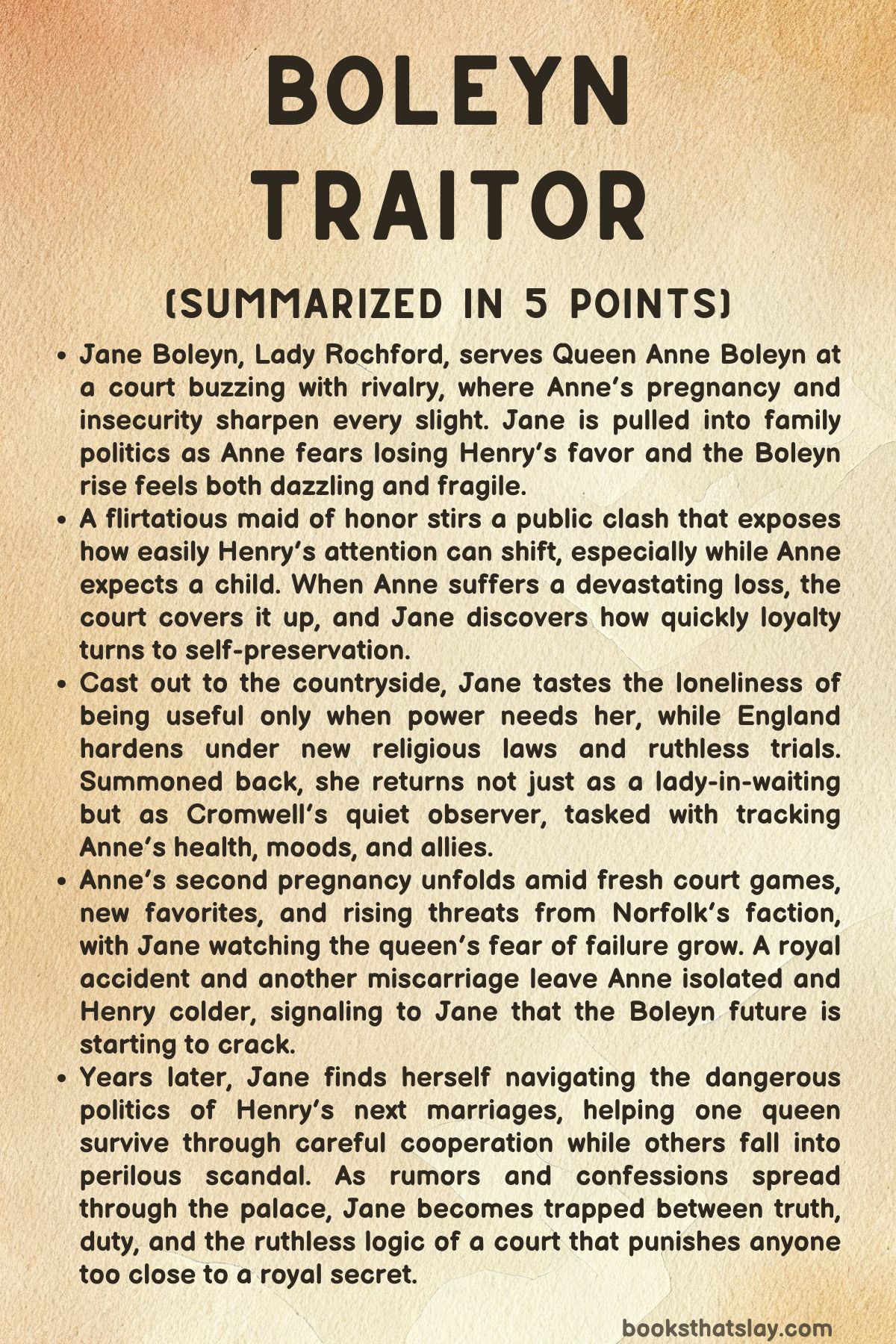
Characters
Jane Boleyn (Lady Rochford)
Jane is the emotional and moral center of Boleyn Traitor, and the summary frames her life as a long education in how power really works. She begins close to Queen Anne, dutiful in her role and still hoping that service and family loyalty will protect her.
Her early actions show a woman trained to survive at court: she smooths over Anne’s miscarriage with a strategic rumor, rebukes Agnes discreetly when asked, and tries to read shifting factions before they crush her. Yet her dependence on the Boleyn rise also makes her vulnerable.
When Henry’s flirtation with Agnes threatens Anne, Jane stands by the queen and is promptly scapegoated; her banishment exposes a brutal truth she had resisted—that usefulness, not affection, is the only currency at court.
Isolation in winter 1534–35 reshapes her. Away from the glitter, she encounters starvation in the countryside and sees the state’s cruelty in the trials of More and Fisher.
This is where Jane gains her sharper, more disillusioned voice: she recognizes that the same machinery that starves peasants and executes saints is propping up her sister-in-law’s crown, and that she, too, is a tool within it. When Cromwell recruits her back, she accepts not out of naïveté but from clear-eyed necessity.
Her role becomes double-edged—both servant to Anne and informant for Cromwell—forcing her into constant, exhausting self-control. By the time she helps steer Anne of Cleves toward an annulment, Jane has become an operator who understands that survival sometimes means collaboration with lies.
Her final arc with Katheryn Howard is tragic: she tries to steady a doomed young queen, then is betrayed by confessions extracted under terror. Her breakdown in the Tower—whether true madness or a last attempt at escape—underscores the cost of living too long in a world where truth is lethal.
Jane’s death feels less like punishment for a single act than the inevitable end of someone who has spent her life walking the knife-edge between obedience and conscience.
Queen Anne Boleyn
Anne is portrayed as brilliant, volatile, and trapped inside the very triumph she fought to achieve. In 1534 she is already tired and frightened: five months pregnant, surrounded by enemies who still love Katherine of Aragon, and painfully aware that her legitimacy hangs on producing a son.
Her conduct swings between sharp political instincts and raw emotional storms. She spots threats instantly—Agnes’s shallow curtsey, Spanish sympathy, flirtation with Henry—but her responses are often fueled by panic as much as strategy.
The miscarriages are central to her characterization: they are not just personal grief but public danger, and Anne experiences them as curses that might invalidate her marriage in Henry’s eyes. Her insistence on pretending the loss never happened shows her grasp of image as survival.
Even after her early humiliation over Agnes Trent, Anne refuses to yield psychologically. She reasserts herself in public, dances, hosts masques, and wields her queenship as a weapon against rivals.
Yet the summary makes clear that her power is precarious, dependent on Henry’s appetite and the court’s shifting alliances. Anne’s private talk with Jane reveals her deepest fear: that without sons she is replaceable, just as Katherine was.
Her bitterness toward Katherine and Princess Mary also underlines a moral hardening; Anne can imagine treason trials for those who won’t submit, because she has had to build her world on obedience to a new order. When Henry’s accident and her second miscarriage strike in quick succession, Anne collapses into desperation, not because she cannot grieve, but because she understands the political meaning of loss.
Her attempt to discuss regency shows ambition and intelligence, but Henry’s cold conclusion—that God will not grant him sons with her—signals the collapse of her dream. Anne emerges as a woman who climbed into history through courage and calculation, only to find that queenship under Henry is a seat built on quicksand.
George Boleyn
George is presented as charismatic, politically gifted, and tightly bound to the Boleyn project, but also as a man with limited power over the forces he helps unleash. Early on he is affectionate toward Anne and plays the confident envoy to France, basking in their family’s rise.
He tries to manage court dangers pragmatically, urging Jane to rebuke Agnes quietly and later framing the Agnes conflict as a petty quarrel to protect Anne from Henry’s wrath. These moments show a strategist who understands that open confrontation with the king is fatal.
Yet his loyalty to the faction overrides loyalty to his wife. When Jane is blamed and dismissed, George helps her leave with sadness, but he also admits the truth: they are sacrificing her to keep the family safe.
The gap between his tenderness and his choices defines him.
His marriage to Jane is distant by 1535; his absence when she returns makes plain that affection, if it ever existed, has been corroded by politics and perhaps personal incompatibility. George is also tied to reformist ideas and Cromwell’s machinery, benefiting from the fall of men like More.
That complicity is not explored in detail here, but it colors his character as someone willing to ride the violent wave of change for family advantage. In the summary’s later sections, George appears mostly as a haunting memory for Jane in the Tower, which is telling: his earlier death (implied rather than narrated here) becomes a symbol of how quickly the court devours even its favored sons.
George is less villain than casualty of ambition, a man who helped build a faction that could not protect its own.
King Henry VIII
Henry looms as the source of all gravity in the story: charming, vain, unpredictable, and dangerous in his wounded pride. The summary shows him as a king who demands admiration as a bodily need.
He enjoys tournaments, praise, masques, flirtation, and the illusion that he is always desired. His treatment of Anne exposes his core contradictions.
He can be sweetly attentive when flattered into staying in England, but once threatened or bored he becomes cruel, reminding her that he raised her and can humble her just as fast. His anger at Anne’s jealousy and his selection of favorites like Agnes Trent and Mary Shelton illustrate his belief that queens must endure his appetites without protest.
Henry’s obsession with a male heir drives his moral and political violence. He executes More and Fisher for refusing his supremacy, celebrating their deaths as part of a new England.
When Katherine of Aragon dies, he and Anne rejoice publicly, a scene that emphasizes Henry’s capacity to turn private events into propaganda. His accident at the joust and reopened leg wound deepen his volatility and physical suffering, and his cold reaction to Anne’s miscarriage—asking if the child was a boy, then declaring God rejects their union—reduces marriage to dynastic utility.
Later, his impotence in the Cleves marriage becomes a political trigger for witchcraft accusations, showing how any personal failing is reimagined as someone else’s treason. His final act of changing the law retroactively to condemn Katheryn Howard and remove insanity as protection reveals the full extent of his absolutism.
Henry is thus not merely a man of appetites but a monarch whose desires become national policy, crushing everyone caught in their path.
Thomas Cromwell
Cromwell appears as the cold architect of survival politics: practical, patient, and ruthless enough to prefer paperwork and attainders over the unpredictability of open trials. He initially seems cooperative with the Boleyns, advising delay on the French trip and later rewarding Jane with a return to court.
Yet his involvement is never sentimental. He recruits Jane as an informant not to help her, but to map Anne’s moods, alliances, and religious leanings.
His authority is shown in small, chilling details: sliding papers for Henry to sign, collecting them in his writing box, effectively ruling through ink and procedure. He is a man who understands that stable power lies in controlling narratives and legal outcomes.
The discussion about witchcraft and Henry’s impotence reveals Cromwell’s moral emptiness as a policymaker. He constructs a false chain of guilt with almost artistic neatness, treating lives as pieces on a chessboard.
His plan for Anne of Cleves—annulment with comfort rather than blood—shows he is not inherently bloodthirsty, but rather committed to whatever outcome best stabilizes policy. That makes his eventual arrest feel like a reminder of court reality: even the most skilled administrator is disposable if he misreads the king’s heart.
Jane’s private grief at his execution suggests Cromwell’s rare importance to her as a protector of sorts, but the summary also stresses that his protection always had conditions. Cromwell embodies the new Tudor state—efficient, legalistic, reformist on the surface, and lethal beneath.
Agnes Trent
Agnes functions as a spark in the powder room of Anne’s court. She is young, bold, and politically protected, which makes her more dangerous than a simple flirtation.
Her shallow curtsey and Spanish connections signal that she is aligned with the old faith or at least the anti-Boleyn faction, and her deliberate handkerchief drop to Henry is unmistakable court theater. Agnes understands how to translate innocence into provocation, putting Anne in the impossible position of either tolerating humiliation or appearing jealous and unstable.
Her patronage through the Courtenays shields her, and Henry’s reversal of Anne’s dismissal order proves that Agnes is less a person than a test of power. She becomes the means by which Henry and rival factions demonstrate that Anne’s authority stops where his desire begins.
Agnes’s “triumph” in the king’s new sleeves is symbolic: she literally wears Henry’s favor. Even if her personal depth is not explored in the summary, her role is crucial as a mirror of court opportunism and as an early warning of how quickly Henry’s eye can become a political weapon.
Margaret Pole (Countess of Salisbury)
Margaret Pole embodies dignified Catholic resistance and Plantagenet memory. Her presence in Anne’s rooms is inherently fraught: she is a kinswoman with old royal blood and a stubborn attachment to Katherine of Aragon and Princess Mary.
In the summary she appears as part of a quietly hostile visiting faction, making Anne’s chambers feel like contested territory. Jane’s later warning to her about Mary’s danger shows that Margaret is also seen as a potential conduit for rebellion.
Her characterization is shaped by endurance rather than action. She survives in a court that distrusts her lineage and faith, and her very steadiness highlights the contrast with the frenetic scrambling of the Boleyn faction.
Even in brief scenes, she represents an alternative moral center—one rooted in tradition and loyalty rather than survival by reinvention.
Gertrude Courtenay
Gertrude Courtenay stands for aristocratic opposition to the Boleyn regime. Alongside Margaret Pole, she brings factional coldness into Anne’s household, quietly reminding everyone that old loyalties have not died.
Her support for Agnes Trent shows her method: she advances her party through protégées and controlled flirtation rather than open defiance. The Courtenay patronage she offers Agnes underscores how female networks can undermine queens as effectively as men’s councils.
Gertrude’s significance lies in her steadiness as a rival force. She is not shown raging or scheming loudly; instead she is the kind of noblewoman whose mere approval can shield a girl like Agnes and whose disapproval can isolate Anne.
She represents the old nobility waiting for the reformist experiment to fail.
The Duke of Norfolk (Thomas Howard)
Norfolk is the family patriarch as predator: strategic, impatient, and utterly loyal only to power. He is the one Jane hopes will protect her when she is dismissed, but he abandons her instantly once she is no longer useful.
His warning that repeating any hint of Henry’s sexual failure is treason shows how he polices reality itself for political advantage. Norfolk’s ambitions are dynastic, not moral; he pressures for Mary Howard’s marriage to Fitzroy to be consummated as insurance against Anne’s failure, and later rides the Howard wave again through Katheryn Howard.
In 1540–42 Norfolk reappears as both adviser and interrogator, illustrating his adaptability. He instructs Jane on how to steer Anne of Cleves toward annulment, then later separates Jane from Katheryn and oversees her interrogation.
The summary shows him as someone who thrives on proximity to danger, using family women as ladders to climb and then stepping on their fingers if they threaten his footing. Norfolk is the clearest embodiment of aristocratic pragmatism without affection.
Mary Boleyn
Mary Boleyn is an offstage contrast to Anne and Jane. Her secret marriage to a farmer and retreat from court represent a kind of personal rebellion—choosing love and obscurity over faction and influence.
Anne’s contempt for Mary’s choice reveals how different the sisters are: Anne sees departure as betrayal of the project, while Mary’s act suggests she values private integrity over public survival. For Jane, Mary’s casting-off is part warning, part reminder that court is optional only for those willing to lose everything it offers.
Mary’s brief return at Anne’s command after Katherine’s death shows that even escape from court can be temporary, because queens and kings still pull strings. She symbolizes the road not taken, and her marginality makes her moral presence sharper despite limited page time.
Mary Shelton
Mary Shelton appears as the Boleyn family’s compromise with Henry’s appetites. She becomes the king’s favorite flirt, intentionally placed in his path so that a Boleyn mistress can distract him while Anne is pregnant.
Her role highlights Anne’s grim pragmatism: she tolerates personal humiliation to protect her crown. Mary Shelton herself seems young, lively, and willing to play her part in dynastic theater, though the summary does not show her inner conflict.
She also reveals how women at court are used as political devices. Whether she personally seeks power or is simply swept into it, her closeness to Henry proves that the Boleyns have learned to manage the king’s desire by redirecting it rather than resisting it.
Jane Seymour
Jane Seymour is introduced as quiet, watchful, and potentially significant, enough that Cromwell specifically tells Jane Rochford to observe her. Her silence and modesty contrast with Anne’s spark, making her attractive in a court weary of conflict.
In the summary she functions more as a looming possibility than an active participant: a woman whose very calmness makes her a safe vessel for Henry’s next hope of a son.
This early mention fits her historical role within the narrative logic of the book—she is the alternative queen waiting in the shadows, and the fact that Cromwell notices her so early shows how quickly new futures are cultivated at court.
Katherine of Aragon
Katherine appears mostly through memory and political aftermath, but her shadow shapes everything. She is the measure against which Anne is judged and the rallying symbol for Catholic loyalists.
Her illness and death are pivot points: Cromwell acts with urgency to force Princess Mary’s submission because Katherine’s passing could spark resistance, and Henry and Anne’s noisy celebration of her death shows how threatening her living presence had been.
Even absent, Katherine represents stability, legitimacy, and the old moral order. That is why her goods are seized and her household dismantled; the reformist court must not only remove her but erase her.
Princess Mary
Princess Mary is a figure of perilous innocence in the story’s political eyes. She is the rightful daughter of Katherine in many hearts, refusing to submit to the oath that would invalidate her mother and accept Anne.
Cromwell views her as the core of a potential treasonous network, urging her to submit or flee, while Jane—showing rare compassion—warns Margaret Pole about the danger Mary is in.
Mary’s characterization here is defined by steadfastness. She is threatened not for scheming but for refusing to lie, which makes her a quiet moral foil to those who survive by reshaping truth.
Sir Thomas More
More represents conscience against the new state. The summary depicts his trial as a foregone conclusion engineered by Cromwell to please the Boleyns, and the detail of Jane’s father being promised his library before verdicts are even delivered shows how thoroughly justice has been turned into spoils.
More’s steadfast refusal to swear the oath, even under harsh imprisonment, paints him as morally immovable.
He is not a major actor in Jane’s daily life, but the idea of him—faithful, doomed, and plundered—deepens Jane’s growing horror at what her world sustains.
Bishop John Fisher
Fisher stands beside More as another symbol of principled resistance. His imprisonment, cold conditions, and execution reinforce the regime’s willingness to kill holiness if it challenges supremacy.
In Jane’s countryside perspective, Fisher’s death is part of the winter’s bleakness, tying political violence to the suffering of ordinary people.
Fisher’s presence, though brief, underscores the high cost of refusal in a world where oaths have become weapons.
Lord Hungerford
Hungerford is used as a scapegoat in Cromwell’s constructed witchcraft-treason chain. The summary suggests he is less important as a person than as a legal container for guilt.
His arrest and condemnation by attainder demonstrate Cromwell’s preference for outcomes over evidence. By linking him to witchcraft, papist restoration, and predictions of Henry’s death, the state turns one nobleman into a narrative that justifies wider purges.
He illustrates how quickly a man can be written into villainy if his fall serves political leverage.
Mother Roache
Mother Roache is the alleged witch in Cromwell’s scheme, the perfect low-status figure to anchor a high-status treason story. Her existence in the narrative shows how superstition can be cynically weaponized by rational politicians.
Whether she practiced anything at all is irrelevant to power; her name supplies the magic needed to explain Henry’s impotence without blaming Henry.
She represents how the vulnerable are sacrificed to protect the image of kings.
Lord Lisle
Lisle becomes another pawn in Cromwell’s leverage game. His sudden silent arrest is treated as an unmistakable message, and the rippling detentions around him show how treason accusations spread like plague once unleashed.
He is tied to Plantagenet-linked households, making him politically useful as a target. His fall terrifies Jane because it proves that hypothetical plots can become lethal policy overnight.
Lisle embodies the terrifying unpredictability of accusation in the Tudor state.
Anne Basset
Anne Basset appears as collateral damage, weeping for her family as Lisle’s household is destroyed. Her grief and helplessness emphasize the human cost of Cromwell’s maneuvers.
She is a court girl caught between loyalty and fear, and her tears signal that even proximity to the queen does not protect a family from being stripped of home and dignity.
She stands in the narrative as one of the many young women whose lives are broken by male political wars.
Anne of Cleves
Anne of Cleves is portrayed as politically trapped but personally sensible. The marriage to Henry is unconsummated, and her fate hangs on how the annulment narrative is shaped.
Jane’s warning to her is urgent and practical: accept the annulment, claim innocence, never hint at impotence, and survive. Anne’s submission to the prepared script shows her intelligence; she recognizes that compliance offers life, security, and a future in England, whereas resistance risks being branded a witch or traitor.
Her calm exit contrasts with Anne Boleyn’s doom. Anne of Cleves demonstrates that survival at Henry’s court is possible only through total surrender of pride and public truth.
Katheryn Howard (Queen Katheryn)
Katheryn is depicted as dazzlingly young, impulsive, and tragically unprepared for queenship. At sixteen she draws Henry’s obsession, becoming the Howard family’s brightest gamble.
Her household initially glitters with gifts and expectation, yet beneath it lurk the secrets of her girlhood with Francis Dereham and her dangerous affair with Culpeper. Her fear once confinement begins is visceral and childlike; she runs through galleries in panic, swings between bravado and collapse, and clings to the fantasy that Henry will forgive her.
Katheryn’s tragedy is partly her own recklessness, but mostly the court’s cruelty. The summary shows her interrogations as escalating psychological siege, ending in confession and betrayal.
Her hope that a precontract annulment will spare her is shattered by Henry’s new treason law, exposing how little mercy exists once the king feels humiliated. She dies not only as a queen condemned for adultery, but as a girl who never belonged in a world where desire is politics and youth is a weapon.
Thomas Culpeper
Culpeper is the alluring, reckless male counterpart to Katheryn’s desperation. He appears confident and unaware even as danger thickens, riding out hawking cheerfully while rumors swirl.
His relationship with the queen is conducted in secrecy and thrill, suggesting a man who believes himself protected by status and charm.
Once the investigation tightens, Culpeper confesses and shifts blame onto Jane, revealing either self-preservation or coercion. In any case, he embodies the lethal arrogance of courtiers who mistake proximity to the queen for invulnerability.
Francis Dereham
Dereham symbolizes the past that cannot be buried. His earlier relationship with Katheryn becomes the thread the council pulls to unravel her queenship.
His boastfulness and the Howard family’s decision to bring him into the household to control him show how gossip and male pride endanger women. Dereham’s arrest and possible revelations turn a youthful, half-formed bond into political dynamite.
He is portrayed less as a romantic figure than as a careless man whose need for importance helps destroy a queen.
Isabel Baynton
Isabel Baynton appears as a steadying presence in Katheryn’s household. She signals the king’s movements, helps restrain the queen during panic, and participates in the anxious choreography of survival.
Her actions show a woman experienced enough to know when to act and when to keep silent.
Isabel represents the practical female solidarity that flickers within dangerous spaces, even if it cannot ultimately save anyone.
Katherine Edgcumbe and Eleanor Manners
These two ladies-in-waiting serve as instruments in Jane’s management of the Cleves annulment. They fabricate testimony that supports the claim of non-consummation, signing formal evidence to fit Cromwell’s script.
Their willingness to do so underscores how household women are drawn into political theater and forced to swear to convenient truths.
They are not deeply individualized here, but they illustrate the quiet complicity required of women to keep favor and safety.
Archbishop Cranmer
Cranmer is portrayed as a reluctant yet efficient interrogator. His early questioning of Katheryn is gentle and uneasy, almost apologetic, suggesting he is aware of the human stakes.
But when he returns the next morning, his tone hardens, and the process becomes a grinding extraction of confession. His role in drafting the queen’s letter to Henry, making it appear in “her own hand,” shows his skill at turning personal anguish into legally useful narrative.
Cranmer embodies the reformist church’s entanglement with royal power—spiritual authority used in service of state punishment.
Thomas Wriothesley
Wriothesley appears as the sharp edge of investigation. He questions Katheryn about Culpeper with methodical persistence and later interrogates Jane directly, recording her reluctant acknowledgments as proof.
His approach is bureaucratically merciless: he is less interested in truth than in statements that can be fixed onto paper and used in attainder.
He represents the machinery of Tudor justice—precise, intimidating, and designed to corner.
Dr. Butts
Dr. Butts functions as a humane whisper amid cruelty. He announces Henry’s recovery after the jousting accident, and later visits Jane in the Tower with a devastating warning about the new treason law and the removal of insanity as protection.
His manner seems quiet and compassionate, but his information makes clear he is also part of the system, conveying the king’s will as medical fact.
He is one of the few figures who treats Jane as a person rather than a pawn, which makes his warnings hit harder.
Sir Edward Baynton
Baynton is a blunt messenger of disgrace. His arrival with orders to move Katheryn’s household to Syon Abbey signals the tightening noose.
He does not argue or console; he enforces. His presence in the narrative is brief yet chilling, because he shows how swiftly royal favor converts into confinement.
He represents the court’s ability to turn domestic space into a prison with a single order.
Sir John Gage
Gage is the final functionary of death. When he comes for Jane after Katheryn’s execution, he does so with the calm certainty of a man who has performed this duty many times.
His role emphasizes the routinization of execution: once attainder is passed, a woman’s life ends on schedule.
He marks the last step in Jane’s journey from court insider to condemned traitor.
Jane’s Father (Lord Morley)
Jane’s father is the voice of stern realism from the countryside. He supports the regime enough to benefit from it, returning from Parliament with confiscated books and speaking candidly about how verdicts are decided before trials begin.
He warns Jane repeatedly to keep her thoughts to herself and accept that Cromwell and the Boleyns are shaping England.
His character blends paternal care with complicity. He wants his daughter safe, but his safety advice is essentially submission to injustice—revealing how ordinary loyalty to family can coexist with quiet participation in state violence.
Mary Howard and Henry FitzRoy
Mary Howard appears as Norfolk’s dynastic tool, pushed toward consummating her marriage to FitzRoy to produce a Tudor-Howard heir. She is less a person in the summary than a possibility—insurance against Anne’s failure.
FitzRoy, Henry’s acknowledged illegitimate son, is similarly a political asset rather than a developed character here.
Together they show how marriage and fertility are manipulated as contingency plans in a brutal succession game.
Themes
Power as a Shifting Bargain
Court life in Boleyn Traitor runs on bargains that look solid only until the next morning. Jane’s position shows how power is never owned; it is leased by the hour.
Early on she is useful because she can serve Anne’s household and absorb blame that must never touch the queen. The moment Agnes Trent becomes politically protected, Jane is expendable, and everyone who once relied on her steps away without apology.
The Duke of Norfolk’s cold dismissal is not personal cruelty so much as a demonstration of how status works: support lasts only while it yields advantage. Jane learns that loyalty at court is conditional and transactional, even when wrapped in family language.
Anne’s own authority follows the same logic. Her queenship depends on offering Henry what he most wants, and the court measures her value through her womb and Henry’s mood.
One miscarriage can erase months of confidence, not because grief is absent but because survival requires pretending nothing happened. Henry’s love is framed as favor that can be removed at will, and he says this directly when drunk, spelling out that raising someone up is the same act as threatening to destroy them.
That line is not a fit of temper; it is the constitution of the court spoken aloud.
Cromwell represents another face of bargaining power: rule by paperwork, pressure, and threats that hover just short of open violence until they do not. He courts Jane’s cooperation, not by friendship, but by offering reentry into relevance.
In his hands, legal structures are tools of leverage, adjusted to fit the outcome already chosen. When he falls, the same machinery turns on him without blinking.
The progress of power is therefore not upward or downward but circular—those who master the system today are swallowed by it tomorrow. Jane survives for a while by reading these currents, yet her final arrest proves that understanding the rules does not guarantee safety when the rules can be rewritten overnight.
Female Survival Under Patriarchy
The women in Boleyn Traitor are forced to survive by negotiating a world where men control law, religion, property, and public narrative. Their strategies differ, but each is shaped by narrow options.
Anne fights openly, using sharp intelligence and political will, yet even she cannot step outside the role of wife who must produce male heirs. Her anger at Henry’s flirtations is treated as unacceptable because pregnancy is supposed to make her patient and grateful.
When she miscarries, the event becomes not her loss but a political liability to be managed through denial. Her body is a public instrument, and when it fails to produce the desired result, the whole court behaves as if the pregnancy never existed.
Jane’s survival depends on a different skill set: observation, silence, and compliance performed convincingly enough to keep a foothold. She is not free to build power directly.
Instead she becomes a conduit—an observer for Cromwell, a messenger within women’s rooms, a scapegoat when factional storms need a safe target. Even her marriage is not a private union but a political arrangement, and George’s affection or distance follows family necessity rather than intimacy.
Jane’s internal life therefore grows in a space that is never officially acknowledged. She learns that to remain alive, a woman must often appear smaller than she is, speak less than she knows, and accept the story others tell about her.
Katheryn Howard’s arc is the most brutal expression of patriarchal survival failing. Her youth and beauty grant status, but they also invite surveillance.
Her past becomes treason retroactively, not because the facts change but because male anxiety demands punishment. The men who question her insist they are protecting the realm, while her confession is shaped for her, written by another hand, and used as a weapon.
The new treason law that crushes both queen and lady-in-waiting makes clear that women’s safety depends on male interpretation of their sexuality. Survival is never simply moral behavior; it is also luck, timing, and the ability to guess what men with power need from you at that exact moment.
Religion as a Tool of State and Conscience
Religious conflict in Boleyn Traitor is not treated as abstract theology but as lived danger. The old faith and the new supremacy are shown through bodies in prison, families breaking, and livelihoods stolen.
The executions of More and Fisher reveal a state that does not argue with conscience; it destroys it. Jane’s father describes trials already decided, and the easy distribution of condemned men’s books and lands exposes the practical motive behind moral language.
Religion becomes a crown instrument: oaths are less about belief than obedience, and refusal is automatically labeled treason.
Yet the novel does not reduce faith to cynicism. People like More and Fisher die steadfastly, suggesting that conscience can hold even when the state applies pressure.
Their deaths haunt the background as a measure of cost. Jane is not a martyr figure; she fears speaking aloud and learns to seal her thoughts.
But the narrative shows that silence itself becomes a moral compromise required for survival. Jane’s warning to Margaret Pole about Mary’s lack of safety is rooted in this climate.
She cannot rescue Mary or reverse policy, yet her small act acknowledges that faith-based resistance is no longer a private choice but a lethal political position.
Cromwell’s approach to religion is administrative. He tracks who reads which books, which alliances might hold, and who might threaten the king’s supremacy.
For him, belief is a map of risk. Anne, by contrast, seems to hold a more emotional stake in the reform project, tying her security to the success of the new order.
Her fear that lack of sons will be read as God’s judgment reveals how religion also becomes personal torment. Henry uses divine favor as a rationale for his desires, interpreting infertility as a sign that he should change wives.
In this system, religion is both whip and shield: a way to claim moral authority for political ambition, and a genuine force shaping fear, hope, and the meaning people give to suffering.
The Politics of Sexuality and Reproductive Pressure
Sex in Boleyn Traitor is never just intimacy; it is policy. Women’s sexuality is controlled, inspected, and punished because it determines inheritance and male legitimacy.
Anne lives under the constant expectation that her worth equals the production of sons. Every pregnancy is a public event, every miscarriage a political crisis.
The repeated anxiety about Henry’s belief in male heirs turns reproduction into a courtwide referendum on divine approval. Anne’s private grief is subordinated to calculation: she must return to dances, perform confidence, and hide bodily realities because visibility invites vulnerability.
Male sexuality is treated differently. Henry’s desire is framed as natural entitlement, and his flirtations are not merely tolerated but strategically managed by the Boleyn family.
Mary Shelton’s placement near the king demonstrates a grim logic: if the king will seek admiration elsewhere, better that the alternative remains within the family’s reach. Female competition for Henry’s attention is therefore both personal humiliation and political technique.
Jane understands this, yet she also feels the emotional wreckage it causes.
The theme sharpens into open terror in the Anne of Cleves and Katheryn Howard sections. Henry’s inability or refusal to consummate marriage becomes a political emergency, and Cromwell’s hypothetical witchcraft scheme reveals how quickly sexual performance can be converted into criminal accusation.
The idea that impotence can be blamed on female or factional witchcraft turns male vulnerability into female guilt. Jane’s warnings to Anne of Cleves show the trap clearly: never suggest the king’s failure, because it will be recast as your crime.
Katheryn’s downfall pushes this further. Her youthful relationships and alleged precontract are treated not as private history but as treason.
The law that makes a queen’s prior lover retroactively criminal shows that the state claims ownership over female sexual past as well as present. Jane is destroyed because she is linked to that sexuality as facilitator and witness.
Ultimately the novel presents a system where women’s bodies are battlefields for dynastic certainty, and where sexual rumor is enough to trigger the full violence of the state.
Betrayal, Loyalty, and the Cost of Proximity
Jane’s life is defined by how close she stands to power and how that nearness warps loyalty. She begins within the Boleyn circle, required to protect Anne, support George, and serve family ambition.
But loyalty in this world is not a stable virtue; it is a currency traded for position and safety. Jane is loyal when loyalty serves others, and she is punished the moment loyalty threatens to complicate factional aims.
Her exile after the Agnes Trent conflict is a lesson in how quickly affection evaporates at court. The people she served do not even send word.
Betrayal is not a dramatic rupture; it is the quiet turning away of those who no longer need you.
Cromwell’s recruitment of Jane adds another layer. She returns to court under the guise of service to the queen, yet her actual role is to report on Anne’s body, moods, and political thinking.
Jane accepts because refusal means obscurity and danger. This is not portrayed as villainy so much as survival in a structure where truth and loyalty are incompatible.
She becomes both participant and observer, constantly evaluating what can be spoken, to whom, and with what risk. The emotional toll is large: her marriage remains cold, her friendships provisional, and her selfhood split between what she believes and what she must perform.
The later part of the narrative reverses this dynamic. Jane tries to protect Anne of Cleves by guiding her toward compliance, and she tries to steady Katheryn Howard by urging calm and denial.
Yet the court requires scapegoats, and the same intimacy that once gave Jane influence now makes her culpable. When Katheryn and Culpeper confess, their accusations land on Jane because she is the reachable target.
Her prior proximity becomes evidence against her.
The novel makes betrayal feel systemic rather than exceptional. Individuals betray because the structure rewards it and punishes those who refuse.
Even Jane’s moments of care—warning Anne of Cleves, attempting to frame Katheryn’s story as a precontract—are constrained by fear. The cost of living near the throne is therefore not only physical danger but moral erosion, where protecting oneself and protecting others rarely align.
Jane’s final clarity in the Tower comes with the recognition that loyalty in such a world is both necessary and fatal, and that betrayal is often the only available language of survival.