Bookshops & Bonedust Summary, Characters and Themes
Bookshops & Bonedust is Travis Baldree’s second novel and the follow-up to his wildly successful debut, Legends & Lattes. The story follows Viv, a young orc mercenary who suffers a serious wound in battle and is forced to recover in the quiet seaside town of Murk.
Initially restless and bitter at being sidelined from adventure, Viv gradually discovers new joys in unexpected places: a struggling bookshop, the warmth of community, and the slow rhythm of ordinary life. Through small but meaningful encounters, she begins to see that there is more to living than swinging a sword.
Summary
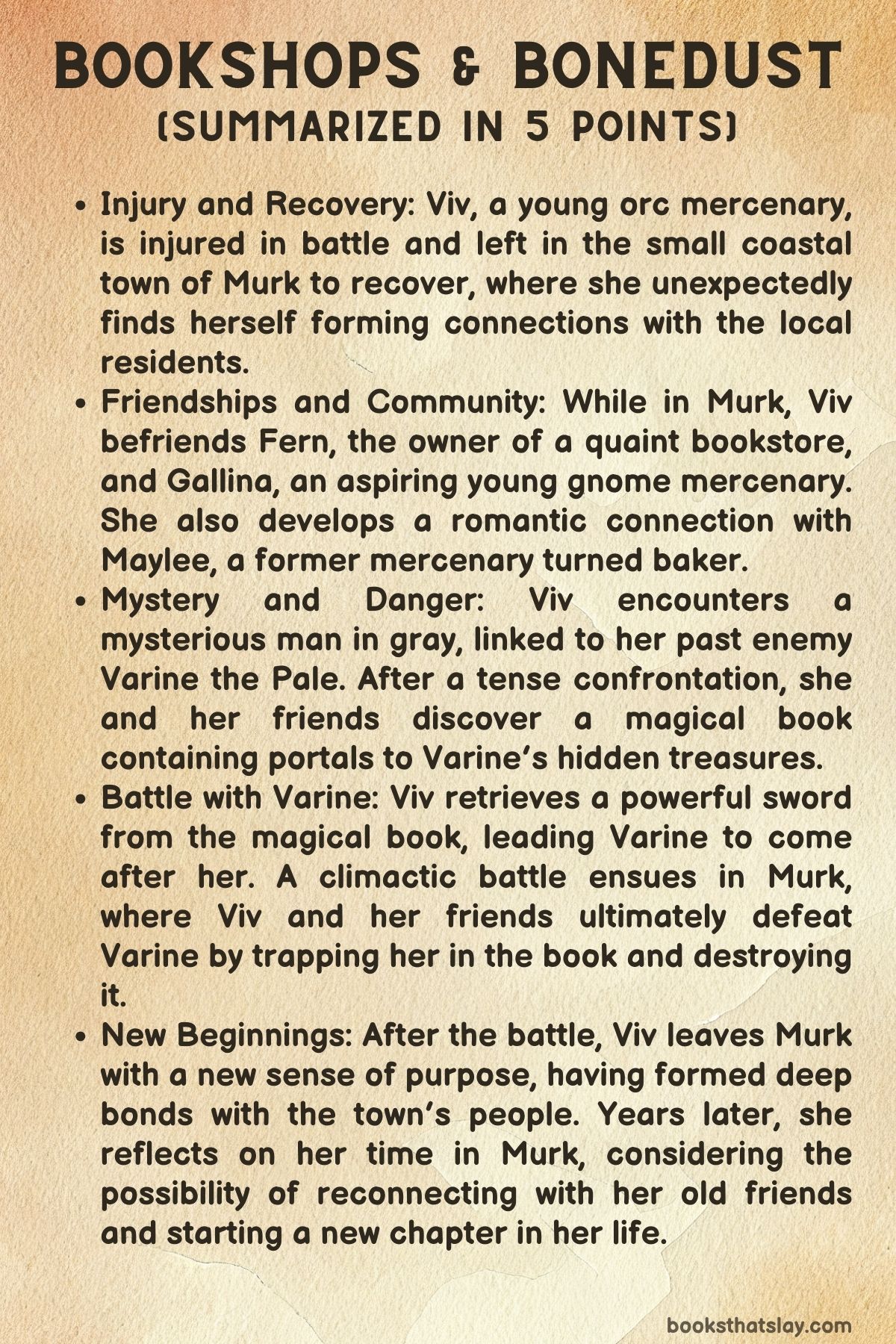
Viv begins the story as a fierce young mercenary, eagerly cutting down foes during a skirmish against Varine the Pale’s undead army. Her recklessness costs her dearly when she is struck in the thigh by a pike.
The injury cripples her, forcing her commander Rackam to pull her from the battlefield and send her to convalesce in the sleepy town of Murk while the rest of Rackam’s Ravens continue the fight.
Murk is far quieter than Viv is used to, and the forced rest chafes at her. At The Perch inn, she is tended by Brand, a kindly sea-fey who feeds her while she heals.
As she limps through town on a crutch, Viv meets the stern Gatewarden Iridia, the scarred orc Pitts, and later Fern, a prickly rattkin who runs the dusty Thistleburr Booksellers. Though their first encounter is awkward, Fern gives Viv a book to try.
To her own surprise, Viv becomes absorbed in the story and begins to read obsessively, discovering for the first time the pleasure of books as more than just tools of knowledge. Reading becomes a welcome escape from frustration and loneliness.
Meanwhile, her recovery is painful. Highlark, the surgeon, treats her with a battlefield salve that burns like fire but accelerates her healing.
Slowly, her leg grows stronger. Alongside her physical progress, Viv begins forming bonds in Murk.
She shares easy conversations with Brand, enjoys the playful warmth of Maylee the dwarf baker, and continues to return to Fern’s shop for more stories. Her friendship with Fern grows deeper as they discuss characters, reorganize the cluttered shop, and share jokes.
For the first time, Viv feels part of something steady, even if she still yearns to prove herself in battle.
Murk is not without danger. Viv notices a pale, menacing figure in a gray cloak lingering around town.
When he eventually enters Fern’s shop, the encounter erupts into violence. Viv fights him despite her injury, with unexpected help from Gallina, a brash gnome who has been pestering her for an introduction to Rackam’s Ravens.
The clash draws the attention of the Gatewarden, and the gray man is imprisoned. This incident ties Viv closer to Murk’s troubles and foreshadows the shadow of Varine’s reach.
Soon after, Viv, Fern, and Gallina come across Satchel, a skeletal homunculus once created by Varine. Bound by his magical nature to serve, Satchel unsettles Viv but proves unexpectedly useful, tidying Fern’s shop and even learning to read.
Together, they discover a powerful tome hidden by a necromancer that acts as a portal into an underspace filled with items, including a cursed greatsword that Viv claims. While the book is turned over to Iridia for safekeeping, Satchel warns that using it risks drawing Varine’s attention.
Viv cannot deny her growing bond with the weapon, which feels disturbingly right in her hands.
Despite the looming threat, life in Murk continues. Fern devises a “mystery book sale” to save her business, with Viv and Satchel helping to prepare wrapped packages.
The sale proves a success, boosting Fern’s hope and further cementing their companionship. Viv spends more time at the shop, working alongside Fern and Maylee, painting and redecorating.
Bonds of friendship and affection deepen, even as Viv struggles with her restlessness and her new sense of belonging.
Peace does not last. While investigating a farmer’s lost sheep, Viv, Gallina, and Satchel encounter spinebacks and realize Varine’s dark forces are drawing near.
Soon after, Murk is attacked by wights. Satchel urges Viv to secure the necromantic tome, and when it is unsealed, the wights suddenly halt, channeling Varine’s voice to summon Viv.
Realizing the necromancer is close, Viv arms herself and confronts the threat directly.
In Thistleburr Booksellers, Varine has taken Fern and Gallina captive. The necromancer demands Satchel and the book.
Viv agrees to trade, but secretly turns the tome against Varine. When opened, Satchel emerges from its pages to drag her inside, aided by Potroast, Fern’s small but fearless gryphet.
In the struggle, Viv slams the book shut, trapping Varine. She then destroys the tome with her greatsword, severing its power and freeing Satchel from his servitude.
The bone cages collapse, releasing Fern and Gallina, and the town is safe again.
In the days that follow, Murk enjoys a new sense of peace. Fern’s shop hosts a lively book club, Satchel embraces a new freedom, and Fern rediscovers her confidence.
Viv, however, knows her path lies elsewhere. Rackam’s Ravens return, and though the quest to hunt Varine is ended anticlimactically, Viv rejoins them.
Before leaving, she shares a tender goodbye with Maylee and exchanges heartfelt words with Fern. Her time in Murk has changed her, showing her that life beyond blood and steel holds value.
Years later, long after Viv has opened her café in Thune, she receives a letter from Fern. It carries news of Satchel’s journey, Fern’s own plans for travel, and Maylee’s happiness.
More importantly, it reminds Viv of the stories and friendships that shaped her. Inspired, she considers opening a bookstore next to Legends & Lattes, closing the circle on her journey and honoring the story that began long ago in Murk.
Characters
Viv
Viv stands at the center of Bookshops and Bonedust, embodying both the ferocity of a young mercenary and the vulnerability of someone forced into stillness. At the beginning of the story, she is reckless, hungry for glory, and desperate to prove herself against Varine the Pale.
However, her grievous injury abruptly strips her of the identity she has clung to as a warrior, forcing her into an unfamiliar rhythm of recovery. In Murk, she wrestles with frustration, longing for the battlefield, yet slowly opening herself to the quiet joys of community and reading.
Her relationship with Fern shows her capacity for empathy and companionship, even when she is uncertain how to express it. Similarly, her tender connection with Maylee hints at a softer side, contrasting her mercenary persona.
Viv’s journey is as much internal as it is external—discovering the value of stories, healing, and friendship, while also facing the lure of the greatsword Blackblood, which ties her fate back to Varine’s shadow. By the end, Viv has matured into someone who sees possibility beyond battle, recognizing that life is more than the clash of blades.
Fern
Fern, the rattkin bookseller, represents resilience wrapped in weariness. Initially sharp-tongued and defensive, Fern is a woman overwhelmed by the slow decline of her bookshop.
Meeting Viv shakes her out of resignation, and their relationship becomes one of mutual restoration. Fern encourages Viv into the world of books, introducing her to the delight of stories, while Viv inspires Fern to reimagine her shop and reconnect with others.
Her vulnerability is shown in the moments where she breaks down over the store’s state, revealing how deeply tied her sense of worth is to her livelihood. Over time, Fern’s cautious demeanor softens into trust and warmth, especially in her bond with Viv.
Through Satchel and the renewed shop, she begins to embrace possibility again, and her final letter to Viv years later shows how her life continues to unfold with courage and openness.
Maylee
Maylee, the cheerful dwarf baker, serves as a symbol of warmth and uncomplicated kindness in Murk. Her flirtations with Viv are lighthearted but meaningful, offering the orc mercenary glimpses of intimacy and acceptance she has never known.
Through her steady generosity—gifting muffins, sharing smiles, and offering encouragement—Maylee anchors Viv emotionally during her recovery. Their relationship develops quietly, culminating in a tender but bittersweet farewell.
Maylee represents the kind of life Viv might have if she chose a path of stability, one rooted in care, home, and companionship. Her presence also highlights Viv’s internal struggle between the comfort of community and the call of mercenary life.
Gallina
Gallina, the brash gnome, is at first more of a nuisance than a friend, pestering Viv for introductions to Rackam’s Ravens. Yet beneath her boldness lies a painful history of abandonment, which colors her relentless drive to belong somewhere again.
Her persistence, while irritating to Viv, masks her insecurity and loneliness. Over time, she proves herself not only resilient but also courageous, assisting Viv in battles and even saving her from the pale stranger.
Gallina is the kind of character whose bravado conceals hurt, but who grows into a surprising ally. Her relationship with Viv shifts from annoyance to respect, marking her as an important part of the temporary family that forms in Murk.
Satchel
Satchel, the skeletal homunculus bound by service, is one of the most complex figures in the story. Initially unsettling, his nature is one of servitude, compelled to obey whoever awakens him with dust.
Yet his interactions with Fern and Viv reveal glimmers of individuality, longing, and even humor. While tidying the shop or learning to read, he begins to carve an identity beyond his magical bindings.
Satchel’s final freedom, after Varine’s defeat, becomes one of the story’s most poignant moments—a creature made to serve finally able to choose his own path. His journey parallels Viv’s in some ways: both are bound by forces larger than themselves, and both seek liberation and self-definition.
Iridia
Iridia, the pragmatic tapenti Gatewarden, initially dismisses Viv as a reckless child, embodying the authority of Murk that wants no trouble. Yet as events escalate, she demonstrates resourcefulness and a willingness to adapt, pressing Viv for knowledge about Varine and ultimately aiding in the defense of the town.
Iridia is not warm or particularly affectionate, but her stern realism provides a counterbalance to Viv’s youthful recklessness. Through her, the narrative explores the responsibilities of leadership in the face of danger, and her guarded trust in Viv underscores how the orc slowly earns the respect of even the most skeptical figures in Murk.
Brand
Brand, the sea-fey barkeep of The Perch, is a steady and nurturing presence in Viv’s early days of recovery. He tends to her needs without judgment, offering food, shelter, and quiet encouragement.
Though he does not play as central a role in the story’s conflicts, his kindness exemplifies the quiet compassion of Murk, grounding Viv when she is at her most vulnerable. Brand’s importance lies less in dramatic action and more in his role as a caretaker, embodying the theme of small, sustaining kindnesses that shape Viv’s journey.
Highlark
Highlark, the town surgeon, is both healer and scolder. His brusque manner and insistence on proper care challenge Viv’s impatience, yet his skill and honesty prove vital to her recovery.
Their relationship is prickly at times, with Viv nearly strangling him in her delirium, but his presence reflects the painful, often unglamorous work of healing. Highlark reminds Viv that even the strongest warrior must rely on others and endure hardship to mend, grounding her story in the physical and emotional toll of recovery.
Varine the Pale
Varine the Pale, the necromancer, looms as the story’s central antagonist. Cold, calculating, and frighteningly beautiful, she embodies both allure and terror.
Her creations—wights, skeletal armies, Satchel—illustrate her mastery over death and her ability to bind others to her will. For Viv, Varine is not only a physical threat but also a symbolic one: a reminder of the destructive power she longs to fight against and the temptation of weapons like Blackblood that might tie her to that same darkness.
Her final defeat, engineered through Satchel and Potroast’s bravery as much as Viv’s strength, underscores the triumph of connection and ingenuity over domination and control.
Potroast
Potroast, Fern’s loyal gryphet, is both comic relief and surprising hero. His small size and constant barking make him seem harmless, but in the climax, his courage proves decisive.
By clamping onto Varine’s arm, Potroast disrupts the necromancer’s spell and enables her downfall. More than that, his bond with Fern and Viv shows how even the smallest, most overlooked creature can play a vital role.
Potroast’s sacrifice and survival add a layer of emotional weight, reminding both characters and readers of the value of loyalty and love in the face of overwhelming darkness.
Themes
Recovery and Transformation
Viv’s forced stay in Murk is framed by injury, frustration, and limitation, yet it becomes the ground for her most significant personal transformation. The wound that takes her off the battlefield at first seems like a cruel setback, a reminder of her vulnerability in a profession built on strength and speed.
Her limp, crutch, and humiliating reliance on others highlight her discomfort with fragility. Yet, this very vulnerability opens her up to experiences that would have been impossible if she had simply marched on with Rackam’s Ravens.
The quiet of Murk contrasts sharply with the chaos of war, and in this enforced pause Viv learns to navigate stillness and reflection. Recovery here is not only about healing the body but about reshaping identity.
In the absence of battle, she discovers other forms of strength—patience, openness, and the willingness to build connections. The transformation is subtle yet profound, showing that being pulled away from one’s chosen path does not necessarily mark an ending but can signal the beginning of something far more sustaining.
Companionship and Found Families
The relationships Viv forms in Murk carry the narrative’s emotional weight and emphasize how unexpected bonds can provide both solace and purpose. Brand, Maylee, Fern, Pitts, Satchel, and even Gallina in her persistent way, all represent different forms of connection that gradually knit Viv into the life of the town.
These ties lack the transactional nature of mercenary camaraderie and instead reveal the richness of friendships based on kindness, mutual curiosity, and shared vulnerability. The meals at The Perch, the flirtation in Sea-Song Bakery, the hours in the cluttered bookshop—all small moments—become building blocks of a found family that anchors Viv during her recovery.
Importantly, this companionship is not idealized or free of conflict; Fern’s sharpness, Gallina’s pestering, and Satchel’s eerie presence complicate these relationships. Yet, it is precisely through these complications that Viv learns to care, to forgive, and to contribute.
The book positions found families as both fragile and enduring, capable of sustaining individuals through loss and transition.
The Power of Stories and Reading
For a mercenary whose life had been defined by steel and blood, the discovery of books changes Viv in ways she had never imagined. Her immersion into Ten Links in the Chain marks the beginning of a lifelong relationship with storytelling, one that shifts her understanding of herself and the world around her.
Reading becomes more than mere distraction from her injury; it evolves into a new kind of battle, one fought in the imagination, filled with emotional stakes and moral complexities. Through Fern’s guidance and the growing intimacy of their discussions, books open doors Viv had never thought to approach.
The act of reading also symbolizes her move from destruction to creation, from waging war to building something meaningful with others. By the novel’s end, the hint of her considering opening a bookstore shows just how transformative this shift has been.
Stories are no longer foreign entertainment but lifelines, companions, and guides.
The Tension Between Violence and Peace
Viv’s journey constantly balances her mercenary instincts with the quieter, nurturing life she begins to build in Murk. Her battle-ready reflexes, her attraction to the greatsword, and her instinct to confront threats reveal that the warrior identity is never far from the surface.
Yet, in contrast, the bakery, the bookshop, and her friendships embody an alternative vision of fulfillment—one that does not rely on violence. The necromancer’s looming threat forces her to fight again, but even this confrontation shows how her newfound connections make her stronger.
Violence is present and even necessary, but it is not the sole measure of her worth. The tension between these two paths underscores a deeper question: whether a life must always be defined by battle or if one can choose peace without betraying who they are.
Viv does not resolve this tension entirely, but the seeds of a new life—echoed later in Legends & Lattes—suggest that choosing peace can be an act of courage in itself.
Endings and New Beginnings
Throughout Bookshops and Bonedust, endings are presented not as closures but as thresholds to something new. Viv’s injury ends her immediate campaign, but it begins her life in Murk.
Her departure from the town ends her brief but meaningful connections with Fern and Maylee, but it plants the ideas that will shape her future. Even Varine’s defeat, while dramatic, closes with quiet ripples—Satchel’s newfound freedom, Fern’s renewed hope, Viv’s bittersweet farewell.
Years later, when Viv reads Fern’s letter and contemplates opening a bookstore, the story underscores that every ending contains the seed of another beginning. This cyclical understanding of life resists finality and instead embraces change as the one constant.
The novel’s tone at the close is both wistful and hopeful, suggesting that the true adventure lies not in slaying enemies but in choosing what kind of life to create after the dust of battle settles.