Boring Asian Female Summary, Characters and Themes
Boring Asian Female by Canwen Xu is a dark campus novel about ambition, envy, racial identity, class anxiety, and the hunger to become exceptional. The story follows Elizabeth Zhang, a Columbia senior whose dream of Harvard Law becomes the center of her self-worth.
When rejection shatters that dream, she fixates on Laura Kim, a wealthy, admired classmate who received the acceptance Elizabeth wanted. What begins as comparison turns into impersonation, sabotage, and moral collapse. The book uses Elizabeth’s unraveling to examine how elite institutions reward certain kinds of identity, confidence, and suffering while leaving others desperate to manufacture a story that matters.
Summary
Elizabeth Zhang is a Columbia senior who has built her entire idea of success around escape. She comes from Brookings, South Dakota, where she grew up as the daughter of Chinese immigrants, shaped by financial pressure, family fracture, and the belief that achievement is the only reliable path toward safety.
Columbia was supposed to prove that she had left smallness behind, but by senior year, even Columbia feels like a stepping stone. The real prize is Harvard Law School.
To Elizabeth, Harvard is not just a school; it is proof that she has become important.
Her closest friend, Eunjin, is a gifted violinist from North Dakota. Their friendship began because both were rare Dakota students at Columbia, and both carried family histories marked by disappointment and sacrifice.
Eunjin’s Korean mother once dreamed of music, and her father’s alcoholism created instability. Elizabeth’s father, unable to rebuild his career in America, returned to China and left Elizabeth and her mother behind.
These backgrounds make Elizabeth and Eunjin understand each other, but they also respond to pressure differently. Eunjin feels guilt about choosing music, while Elizabeth turns ambition into identity.
At an alumni fundraiser, Elizabeth watches Eunjin perform for wealthy Columbia-connected guests and becomes fascinated by the world of prestige surrounding her. She is both repelled by and attracted to elite circles: old money, cultural polish, expensive rooms, and people who behave as if power belongs naturally to them.
Elizabeth especially resents Laura Kim, a beautiful, wealthy, socially confident Columbia student who seems to possess everything Elizabeth lacks. Laura had once publicly corrected Eunjin during an orientation discussion about identity and privilege, and Elizabeth never forgot it.
When Harvard Law rejects Elizabeth, her world collapses. The rejection triggers panic and humiliation because it destroys the future she had already imagined.
She tries to believe there has been a mistake, but other top law schools reject her too. Georgetown accepts her, but Elizabeth sees that not as success, but as confirmation that she has failed.
She meets Columbia’s prelaw adviser, Robert, hoping he will find a technical flaw in her application. Instead, he tells her the truth she most fears: her application was excellent, but it did not stand out.
She seemed like many other high-achieving Asian female applicants with strong grades, strong scores, and no distinct story. Elizabeth absorbs this as a devastating identity: a boring Asian female.
This explanation changes how Elizabeth sees Laura’s Harvard acceptance. Laura is no longer simply someone Elizabeth dislikes; she becomes the person who took the place Elizabeth believes should have been hers.
Elizabeth begins treating admissions like a hidden competition inside racial and gender categories, imagining that Harvard had limited space for Asian women and that Laura occupied Elizabeth’s spot. From there, envy turns into obsession.
Elizabeth studies Laura’s routines, social media, family background, clothes, and public image. She copies Laura’s habits and even begins wanting to inhabit Laura’s body and confidence.
Elizabeth creates a fake email identity, pretending to be a younger student from Laura’s old prep school. She hopes to flatter Laura into sharing admissions advice and eventually law school essays.
At the same time, she begins dating David, a successful young tech founder, partly because he makes her feel desirable and partly because he gives her access to experiences she associates with Laura’s world. Yet even in intimate moments, Elizabeth’s mind returns to Laura.
She asks David to call her Laura during sex, which leaves her ashamed but also reveals how deeply the obsession has altered her sense of self.
During Thanksgiving at home, Elizabeth’s mother reminds her of a different kind of love, one rooted in survival rather than status. Her mother wants her to succeed, but not because Elizabeth’s worth depends on it.
Elizabeth cannot fully accept this because her ambition has always been tied to proving that she matters. Back at Columbia, her deception continues until Laura publicly warns others about the fake email scam.
Elizabeth feels exposed, jealous, and angry, especially when Eunjin appears to support Laura’s post.
Elizabeth then discovers she is pregnant. At first, she plans to get an abortion and asks David for money so her mother will not see the procedure through insurance.
David responds awkwardly but gives her more money than she requested. While waiting at the clinic, Elizabeth rethinks her situation.
She begins to see pregnancy as a possible story, something that could transform her from ordinary to compelling. She imagines becoming a young single mother applying to law school with a mission to help vulnerable women and children.
Instead of ending the pregnancy, she decides to keep it as part of a future Harvard application.
This decision creates a new problem: Laura will still start Harvard before her. Elizabeth cannot accept remaining behind.
She decides she must get Laura’s admission rescinded. She researches scandals that cause universities to withdraw acceptances and creates an anonymous right-wing blog filled with offensive arguments.
Her plan is to plant clues pointing to Laura as the author. To avoid being traced, she manipulates a trusting student named George Reynolds into letting her use a library computer under his login.
The first post goes viral, praised by conservative media and condemned across campus. Elizabeth then secretly tips off Amala Smith-Dupont, a campus anti-racism leader, suggesting Laura as the author.
The accusation spreads quickly. Laura is publicly humiliated, and Elizabeth feeds Amala more details to make the claim seem stronger.
But Laura responds with a careful public defense, showing that the evidence is weak and that other students could fit the clues. The accusation collapses, Amala loses credibility, and suspicion shifts to George Reynolds, whose login was used for the post.
George’s reputation is ruined, and he leaves school, even though he is innocent. Elizabeth feels some guilt, but mostly she is frustrated that Laura escaped.
Elizabeth’s life grows more unstable. She hides her pregnancy, avoids medical care, and becomes increasingly isolated.
Eunjin tells her she has been accepted to a conservatory in Vienna, which makes Elizabeth feel abandoned. She begins imagining the baby as a replacement for the friendship she is losing.
After a stranger spits on her in the subway, Elizabeth buys pepper spray. Later, at a party, she learns Laura’s suite is empty and talks her way into Laura’s room by pretending to be Laura.
Inside, she steals Laura’s Hermès scarf and searches through her belongings. Laura returns unexpectedly and catches her.
During the confrontation, Laura realizes Elizabeth may be connected to the strange events surrounding her. Panicked, Elizabeth sprays pepper spray into Laura’s face and flees as Laura collapses.
For several days, Laura does not appear in class or online. Elizabeth grows terrified but avoids contacting her.
Then Columbia announces that Laura has died. Elizabeth’s first reaction is horrifyingly selfish: Laura’s death clears her path to Harvard.
That thought is immediately followed by panic over whether she caused it. She secretly researches whether pepper spray can kill someone, destroys evidence, and clings to rumors that Laura’s own possible drug use may have played a role.
Campus speculation swirls, and Elizabeth tries to act normal while traveling with Eunjin, Leah, and Alex during spring break.
Eventually, Gina Lam is charged with manslaughter in Laura’s death. Police believe Gina attacked Laura with pepper spray because of a romantic conflict.
Elizabeth realizes investigators mistook her for Gina in security footage, helped by racial misidentification. She is relieved, but the relief is poisoned by guilt.
She knows she sprayed Laura and failed to get help. Instead of confessing, she sinks further into fantasy.
She creates a fake Facebook profile as Laura and joins the Harvard Law admitted students group, craving the belonging Laura had.
Elizabeth then miscarries in her dorm. The pregnancy, which she had turned into an admissions strategy and emotional anchor, is gone.
Still, she continues pretending to be Laura online and helps organize a New York meet-up for incoming Harvard Law students. She plans to attend as herself while using Laura’s scarf and mannerisms to borrow confidence.
Eunjin notices the scarf and recognizes it from Laura’s memorial images. She becomes frightened and asks what Elizabeth did, but Elizabeth refuses to confess.
At the Harvard meet-up, Elizabeth initially succeeds in charming the admitted students. Then Antigone, a polished Harvard undergraduate, reveals that only one Columbia student was admitted: Laura Kim, who is dead.
The group realizes someone has been impersonating Laura online. Elizabeth breaks down publicly, shouting that Laura had everything and that she only wanted one thing.
Her humiliation becomes a spectacle. Outside, she is hit by a bus after walking into traffic in a dissociated state.
Elizabeth survives but is hospitalized. Doctors and loved ones believe she suffered a psychotic break.
While recovering, she learns that charges against Gina have been dropped because Laura’s cause of death is legally inconclusive. Laura had a congenital heart defect and had lived with the possibility of death for years.
Elizabeth realizes she never truly knew Laura at all. Back in South Dakota, her mother catches her still trying to write Harvard essays and tells her a video of the bar meltdown has gone viral.
Elizabeth finally begins to understand that something is wrong with her.
Therapy slowly challenges Elizabeth’s habit of ranking people. She begins to see how judging others by status also kept her trapped in self-hatred.
She admits to herself that she caused Laura’s death and failed to call for help, though she does not turn herself in. At graduation, she briefly imagines a self not governed by comparison.
Later, Eunjin leaves for Austria, and their friendship remains damaged by what both of them know but do not fully say. Elizabeth sells Laura’s scarf and donates the money after reading Laura’s Harvard essay about her heart defect and healthcare policy goals.
Then, in a final twist, Harvard Law calls. LSAC had sent the wrong LSAT score to her schools.
With the correct score reviewed, Harvard accepts her. Elizabeth checks the portal and accepts immediately.
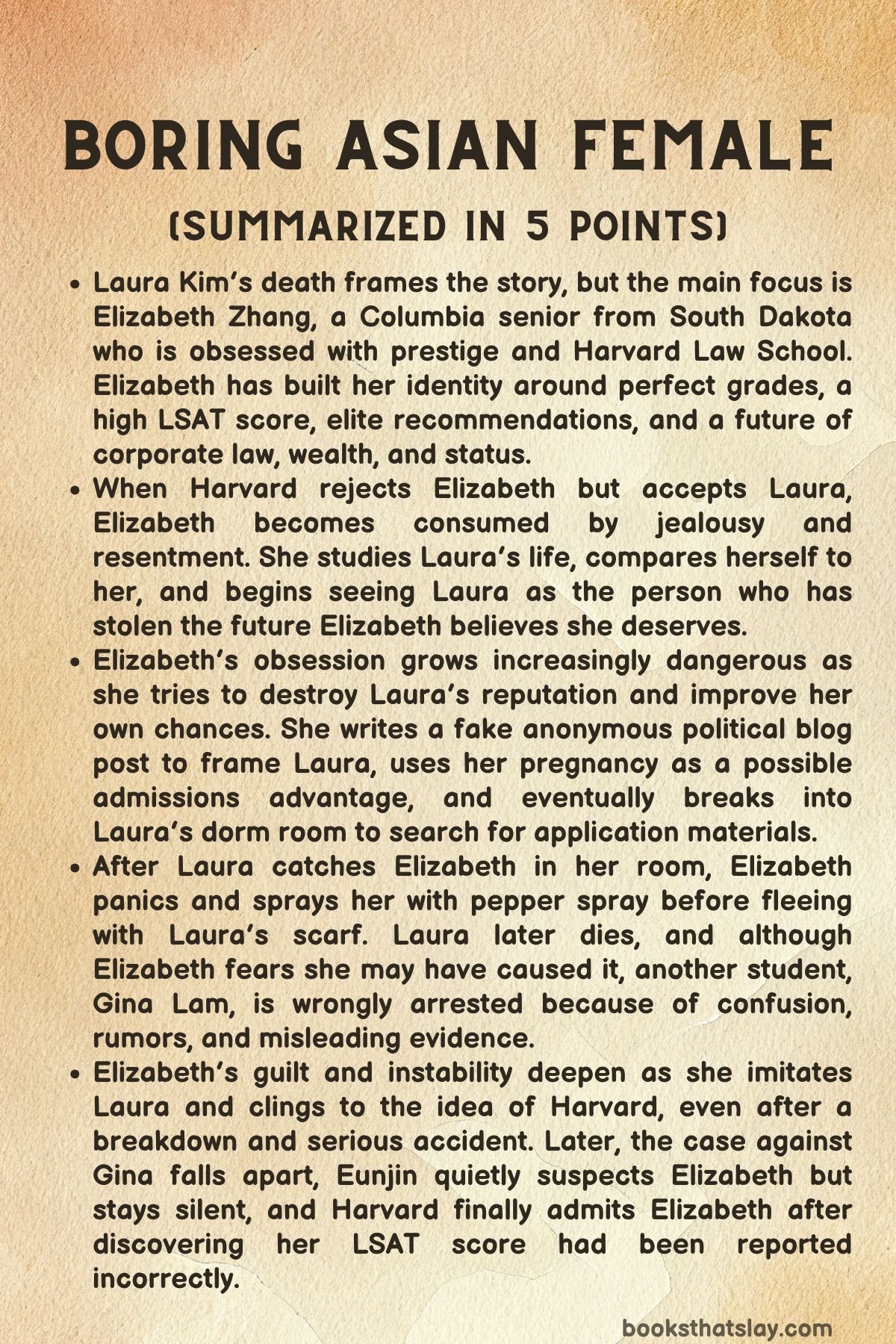
Characters
Elizabeth Zhang
Elizabeth Zhang is the central figure of Boring Asian Female, and the book builds its psychological force around her hunger to be recognized as exceptional. She is intelligent, disciplined, observant, and often sharply funny, but her gifts are bent out of shape by insecurity and comparison.
Elizabeth does not simply want success; she wants success to prove that she has escaped poverty, immigrant disappointment, racial flattening, and the fear of being ordinary. Her Harvard Law dream becomes a replacement for selfhood, which is why rejection feels like annihilation rather than disappointment.
Her most disturbing quality is not envy alone, but her ability to turn envy into logic. She can explain every cruel act to herself as strategy, justice, or survival.
She stalks Laura, creates false identities, frames innocent people, exploits pregnancy, and flees after injuring Laura, yet she continually searches for ways to see herself as the harmed party. At the same time, the book does not present her as simple evil.
Her pain is real, and her background explains why status feels like shelter. Still, her suffering never excuses her choices.
Elizabeth’s tragedy is that she longs to be seen, but she destroys others and herself in the process of trying to become visible.
Laura Kim
Laura Kim is Elizabeth’s rival, fantasy object, and projection screen, but the book gradually reveals that Elizabeth’s idea of Laura is dangerously incomplete. To Elizabeth, Laura represents everything that elite institutions reward: beauty, wealth, confidence, social grace, and a life that can be shaped into an attractive admissions story.
Laura’s Harvard acceptance becomes unbearable because Elizabeth reads it as proof that Laura has been chosen as the better Asian woman. Yet Laura is not merely a privileged antagonist.
She is intelligent, socially aware, and capable of defending herself when falsely accused. Her public response to the blog scandal shows discipline and clarity under pressure.
The later revelation about her congenital heart condition changes the moral weight of the story. Laura had lived with fear and fragility that Elizabeth never understood, and her Harvard essay suggests a serious commitment to healthcare policy rather than empty polish.
In Boring Asian Female, Laura’s role is powerful because she exposes the danger of reducing a person to a symbol. Elizabeth believes she knows Laura through posts, clothes, admissions outcomes, and rumors, but she never knows her as a full human being.
Laura’s death becomes the cruelest proof of that failure.
Eunjin
Eunjin is Elizabeth’s closest friend and one of the book’s clearest moral contrasts to her. Like Elizabeth, she comes from a Dakota background shaped by immigrant family pressure, but she responds to insecurity with vulnerability rather than conquest.
Her musical talent is central to her identity, yet she feels guilt about choosing art when stability might better serve her family. Eunjin understands class performance because she often plays music in wealthy spaces, where her labor is admired but underpaid or objectified.
Her partial access to whiteness and elite culture complicates Elizabeth’s feelings toward her: Elizabeth loves her, envies her, depends on her, and resents the ways Eunjin can move through certain rooms differently. Eunjin is also the person most likely to notice when Elizabeth is not well.
She sees changes in Elizabeth’s behavior, questions the scarf, remembers the pepper spray, and ultimately understands more than Elizabeth wants her to. Her decision not to expose Elizabeth is morally complicated, but it fits the emotional truth of their friendship.
Eunjin cares, but she also protects herself by leaving. Her move to Austria marks both personal growth and the end of the friendship’s old innocence.
Elizabeth’s Mother
Elizabeth’s mother is a quiet but essential presence because she represents a form of love that Elizabeth repeatedly fails to trust. She has endured abandonment, financial difficulty, loneliness, and the burden of raising Elizabeth largely on her own.
Her sacrifices shape Elizabeth’s ambition, but not in the exact way Elizabeth imagines. Elizabeth believes success is the only way to repay her mother and justify their suffering.
Her mother, however, wants Elizabeth to succeed without turning success into proof of human worth. This difference unsettles Elizabeth because it threatens the emotional system she has built around achievement.
The scenes at home reveal the tenderness and tension between them: food, memory, shame, and care all sit together. Her mother can be stern and shaped by social expectations, especially around pregnancy, but she is not loveless.
When Elizabeth is injured and mentally unstable, her mother becomes one of the people forced to confront the damage Elizabeth has hidden. She is important because she offers Elizabeth a route back to ordinary human attachment, though Elizabeth resists it for much of the story.
David
David is Elizabeth’s romantic and sexual distraction, but he also functions as a symbol of the social world she wants to enter. He is successful, wealthy enough to move through expensive restaurants and send money easily, and young enough for his achievements to feel especially threatening and attractive.
Elizabeth is drawn to him less as a whole person than as a source of validation. Being wanted by David makes her feel desirable, and being taken to places Laura has visited allows her to imitate the life she envies.
His reaction to the pregnancy is awkward but not cruel; he sends Elizabeth more money than she asks for, which shows a kind of practical responsibility. Yet David remains emotionally distant from the deeper crisis because Elizabeth never gives him full access to the truth.
She uses him as a prop in her attempt to become someone else. The most revealing moments involving David are less about him than about Elizabeth’s mind: when she imagines herself as Laura, asks him to call her Laura, and turns his money into a tool for reinventing her application narrative.
Robert
Robert, Columbia’s prelaw adviser, plays a brief but decisive role in Elizabeth’s collapse. He does not reject her, mock her, or intentionally harm her, but his assessment gives language to her deepest fear.
By telling Elizabeth that her application made her seem boring and too similar to other high-achieving Asian female applicants, he names the category that begins to consume her. Robert’s advice is professionally plausible, but emotionally devastating because Elizabeth hears it as a verdict on her entire existence.
He becomes the messenger of a system that claims to evaluate individuality while repeatedly sorting people through race, class, polish, trauma, and marketable stories. Later, when Elizabeth presents her pregnancy as a possible complication, Robert’s response reinforces her worst instincts.
By saying young motherhood could make her a compelling applicant, he confirms her belief that suffering can be converted into institutional value if packaged correctly. Robert is not a villain, but he is an important representative of elite admissions culture.
His words show how even neutral guidance can become dangerous when received by someone whose self-worth is already unstable.
Amala Smith-Dupont
Amala Smith-Dupont is a campus anti-racism leader whose role shows how public justice can be manipulated when urgency outruns evidence. She cares about harm, accountability, and racism on campus, but Elizabeth exploits those commitments by feeding her a false suspect.
Amala becomes the loud public face of an accusation Elizabeth engineered in secret. Her willingness to accept the tip against Laura reflects the pressure placed on student activists to respond quickly and decisively, especially when a campus is angry and searching for someone to blame.
The book does not present Amala as foolish so much as vulnerable to a narrative that fits the emotional climate around her. Once Laura dismantles the accusation, Amala becomes the one punished publicly, while Elizabeth remains hidden.
Her fall from leadership demonstrates how outrage can be redirected, how moral language can be weaponized, and how people who speak in the name of justice can be used by those with private motives. Amala’s character adds complexity because her goals may be sincere, yet her actions cause real damage.
Gina Lam
Gina Lam is a secondary character whose importance grows when she becomes the person wrongly charged in Laura’s death. Earlier, she exists around the edges of Columbia’s social world, connected to Laura, parties, and relationship tensions.
After Laura dies, Gina becomes a convenient suspect because the police believe a romantic conflict gives her motive and because security footage allows for racial misidentification. Her wrongful arrest exposes one of the book’s sharpest critiques: Asian women may be stereotyped as interchangeable even in matters of criminal guilt.
For Elizabeth, Gina’s arrest creates relief and horror at the same time. Relief, because Elizabeth may escape punishment; horror, because another person may lose her future for Elizabeth’s crime.
Gina’s role also shows how institutions that claim to seek truth often rely on weak visual assumptions, rumor, and narrative convenience. She is not analyzed as deeply from the inside as Elizabeth or Eunjin, but her function in the story is crucial.
Through Gina, the consequences of Elizabeth’s actions move beyond private guilt into public injustice.
George Reynolds
George Reynolds is one of the clearest innocent victims of Elizabeth’s schemes. He enters the story as a trusting student who lets Elizabeth use a library computer after she manipulates him with a false story.
That small act of kindness becomes the basis for his destruction. Because the blog post is created under his login, and because some details seem to fit him, suspicion shifts from Laura to George after Laura clears her name.
His denials are dismissed, his reputation collapses, and he leaves school. George’s role is important because he shows the scale of harm Elizabeth is willing to ignore when she is focused on defeating Laura.
He has no real connection to her rivalry, no role in her rejection, and no reason to suffer, yet he becomes collateral damage. His downfall also exposes how quickly communities can abandon fairness when they believe they have found a culprit.
George is a reminder that Elizabeth’s actions are not merely obsessive or self-destructive. They ruin other lives.
Alex
Alex is part of Elizabeth’s friend group and brings another layer to the book’s interest in narrative, truth, and self-presentation. Their breakup with Leah is told through conflicting versions, with Alex presenting one account and Leah another.
This disagreement matters because it mirrors the larger story’s concern with who gets believed and how easily events change shape depending on the storyteller. Alex is not central to Elizabeth’s obsession with Laura, but their presence helps create the social world Elizabeth fears losing.
They participate in the group’s care for Elizabeth, including concern when she claims Harvard corrected its rejection. Alex’s relationship conflict also shows that even outside Elizabeth’s extreme behavior, the characters are constantly interpreting one another through partial information.
Alex’s role is therefore both social and thematic. They help make the friend group feel real, messy, and unstable, while also reinforcing the idea that truth is often filtered through desire, shame, and self-protection.
Leah
Leah is another member of Elizabeth’s friend group, and her importance lies partly in how she reveals the ordinary emotional conflicts surrounding Elizabeth’s more extreme collapse. Through Leah’s relationship with Alex, the book introduces questions of boundaries, betrayal, and competing accounts of the same event.
Leah’s version of the breakup challenges Alex’s, creating a smaller-scale example of how people use narrative to protect themselves or accuse others. In the group, Leah also functions as part of the community Elizabeth wants but cannot fully trust.
When Elizabeth lies about being accepted to Harvard, Leah’s cautious reaction is not cruelty; it is concern. Elizabeth, however, interprets that concern as disbelief and betrayal because she cannot tolerate being seen as unstable or unsuccessful.
Leah’s role shows how friendship becomes impossible when one person is committed to maintaining a false self. She is not Elizabeth’s enemy, but Elizabeth’s distorted thinking turns even care into insult.
Antigone
Antigone appears late in the book, but her impact is explosive. She represents the kind of elite confidence that Elizabeth finds unbearable: polished, connected, informed, and secure in spaces Elizabeth longs to enter.
At the Harvard Law meet-up, Antigone punctures Elizabeth’s fantasy by revealing that Laura was the only Columbia student admitted and that Elizabeth does not belong among the accepted students. Her knowledge exposes the impersonation and forces Elizabeth’s private delusion into public view.
Antigone is not cruel in the simple sense; she is socially powerful, and that power makes her words devastating. To Elizabeth, Antigone becomes another version of Laura, someone who seems born into superiority and capable of excluding her without effort.
The confrontation matters because it gives Elizabeth what she has craved in the most humiliating form: attention. Everyone finally sees her, but they see the fraud, envy, and desperation she tried to hide.
Nora
Nora, Elizabeth’s therapist, represents the possibility of recovery without glamour. Elizabeth initially treats therapy with skepticism and judgment, ranking Nora as she ranks everyone else.
Yet Nora quietly challenges the mental habits that have governed Elizabeth’s life, especially the belief that people can be sorted into better and worse categories. Through therapy, Elizabeth begins to understand that her contempt for others is tied to contempt for herself.
Nora does not magically cure her, and the book avoids presenting healing as simple or complete. Instead, Nora helps Elizabeth notice the patterns that made her vulnerable to obsession: comparison, status worship, racial shame, and the refusal to accept ordinary disappointment.
The most important result of therapy is not confession to the police but inner honesty. Elizabeth finally admits to herself that she caused Laura’s death and failed to call for help.
Nora’s role is therefore grounded and realistic. She offers a space where Elizabeth can begin to think without turning every thought into competition.
Gigi
Gigi, Elizabeth’s old high school rival, appears after Elizabeth returns to South Dakota and helps complicate Elizabeth’s view of the life she wanted to escape. Elizabeth has long imagined herself as someone who needed to leave home behind in order to matter.
Gigi’s visit challenges that belief by showing that people from Elizabeth’s past saw her with more complexity than she assumed. The get-well card from classmates suggests that Elizabeth was admired, feared, or cared about in ways she never allowed herself to recognize.
Gigi’s role is modest but meaningful because she brings Elizabeth face-to-face with a version of herself that existed before Columbia, Harvard, and Laura. She reminds Elizabeth that her hunger for elite recognition may have blinded her to forms of recognition already present in ordinary life.
In that sense, Gigi helps widen the emotional world of the story beyond New York and elite institutions.
Themes
The Violence of Comparison
Comparison in Boring Asian Female is not a passing insecurity; it becomes a system through which Elizabeth measures every person, opportunity, body, school, friendship, and future. She does not simply admire Laura or feel disappointed by rejection.
She converts life into rankings, percentiles, and imagined categories of worth. This habit makes ordinary sadness impossible because every loss becomes proof of inferiority.
Harvard’s rejection wounds her not only because she wanted the school, but because it appears to confirm that Laura is the superior Asian woman. From that point, Elizabeth stops seeing Laura as a person and begins seeing her as evidence.
Laura’s clothes, meals, body, friends, and confidence become pieces in a case Elizabeth is building against herself. The danger of comparison is that it can make another person’s existence feel like theft.
Elizabeth believes Laura’s success has taken something from her, even though Laura has not personally harmed her. That belief allows resentment to harden into sabotage.
The book shows that comparison becomes violent when it strips others of humanity and turns the self into a failed product that must be rebranded at any cost.
Elite Institutions and the Performance of Identity
Elite admissions culture rewards achievement, but the story suggests that achievement alone is not enough. Applicants must also appear distinctive, passionate, resilient, and narratively useful.
Elizabeth’s crisis begins when she learns that her perfect-looking application seemed generic. This judgment is devastating because it implies that even her excellence has been sorted into a stereotype.
The book is especially sharp about how identity becomes a kind of performance under institutional pressure. Elizabeth starts to believe that her race, gender, family background, and ambition have value only if arranged into an attractive story.
Laura seems to know how to do this naturally, or at least Elizabeth thinks she does. Pregnancy then becomes horrifyingly transactional in Elizabeth’s mind.
Rather than treating it as a life-changing reality, she imagines it as an admissions advantage, a way to transform herself into a compelling candidate. The story criticizes a system that encourages people to package hardship as proof of depth while also punishing those whose hardship looks too common, too desperate, or too familiar.
Elizabeth is responsible for her choices, but the culture around her teaches her to treat identity as currency.
Race, Visibility, and Being Misread
Race shapes the book not only through open prejudice, but through subtler acts of flattening. Elizabeth fears being seen as one of many indistinguishable Asian female strivers, and that fear becomes the phrase that defines her self-loathing.
She is angry at admissions systems that appear to group people like her together, yet she also internalizes the same logic by treating Laura as a direct competitor rather than an individual. The story’s cruelest example of racial misreading comes when Gina is mistaken for Elizabeth in connection with Laura’s death.
The police and campus narrative accept the wrong Asian woman as the suspect because the visual difference between them is treated as unimportant. This misidentification turns Elizabeth’s private obsession into another woman’s public punishment.
The same pattern appears in softer forms throughout the book: assumptions about Asian proximity to whiteness, mixed-race privilege, immigrant ambition, and the model minority stereotype. Visibility becomes unstable.
Elizabeth wants to be seen, but she is afraid of being seen only as a type. The tragedy is that her own desire to escape being misread leads her to misread others with devastating consequences.
Guilt, Accountability, and the Limits of Self-Reinvention
Elizabeth repeatedly tries to escape consequences by changing the story. Rejection becomes a system failure, pregnancy becomes an application strategy, Laura becomes an obstacle, and guilt becomes something that can be postponed or explained away.
This pattern shows the dark side of self-reinvention. Reinvention can be hopeful when it allows a person to grow beyond old limits, but Elizabeth uses it to avoid moral reality.
After Laura dies, she searches for ways to divide blame among pepper spray, drugs, heart conditions, police error, and fate. Yet the emotional truth remains: she attacked Laura and left without helping her.
The book’s treatment of accountability is uncomfortable because Elizabeth does not receive a neat punishment. Gina is charged and released, George is damaged, Laura is dead, and Elizabeth eventually gets the Harvard acceptance she wanted.
That ending refuses easy justice. Instead, the real question becomes whether private recognition of guilt means anything without public accountability.
Elizabeth’s therapy helps her admit the truth to herself, but self-knowledge is not the same as repair. The theme remains troubling because the story understands that guilt can change a person while still leaving the harm unresolved.