Breathe In Bleed Out Summary, Characters and Themes
Breathe In Bleed Out by Brian McAuley is a psychological horror thriller that examines the fragile boundary between grief, guilt, and madness. It follows Hannah, a medical intern haunted by the death of her fiancé during a tragic hiking accident.
Overwhelmed by guilt, hallucinations, and addiction, she seeks healing at an exclusive desert wellness retreat with old friends. What begins as an attempt at recovery spirals into a nightmare of paranoia, death, and deceit as the retreat’s dark secrets surface. The story confronts how trauma distorts perception and how far one might go to reclaim control over a fractured mind.
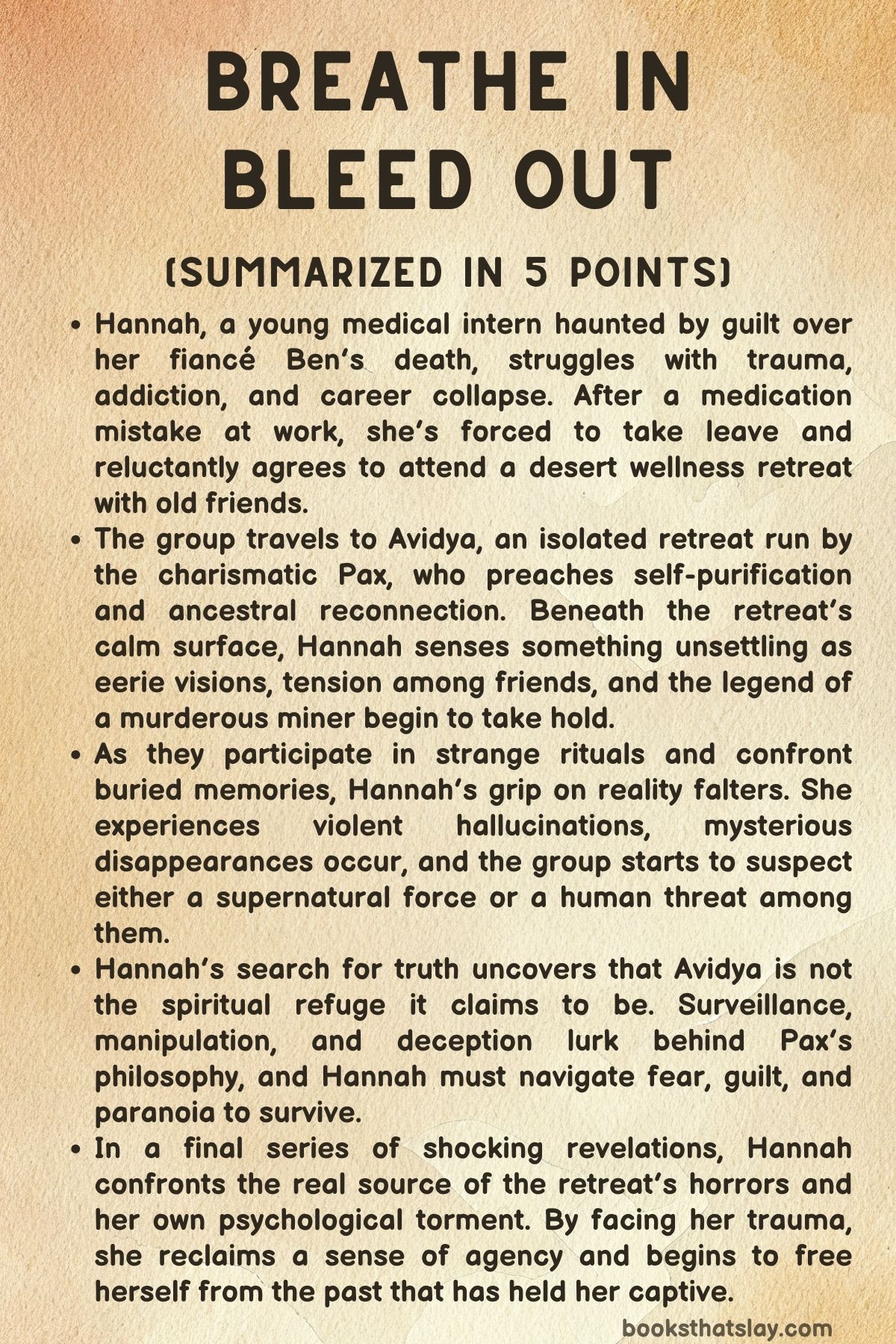
Summary
Hannah is tormented by recurring nightmares of dragging her dead fiancé, Ben, through a frozen wilderness after a disastrous hiking trip. In waking life, Ben is truly gone—he died in the mountains after an accident, and Hannah, unable to carry his body, abandoned him to save herself.
The guilt consumes her. Working long shifts as a medical intern, she struggles with exhaustion, dependency on Xanax, and vivid hallucinations of Ben’s decaying corpse.
A near-fatal mistake on the job gets her suspended, and her psychiatrist, Dr. Grady, urges her to face her trauma.
When her friend Tess invites her to a secret retreat called Avidya, Hannah reluctantly agrees, hoping it will offer peace.
Hannah joins Tess and three college friends—Luna, Jared, and Miles—for the trip. Tension simmers among them, especially with Jared’s bravado and Luna’s obsessive spirituality.
They stop in Joshua Tree, where Hannah learns about a gruesome local legend: a miner named Waylon Barlow, who killed his crew in the Dead Man’s Due mine and wore their faces. A violent run-in with a Marine named Dennings adds unease.
That night, Hannah hallucinates Ben attacking her. In a symbolic act of defiance, she throws away her medication, deciding to commit to the retreat’s promise of renewal.
The group reaches Avidya, a secluded compound led by the enigmatic guru Pax and his assistant Kimi. Phones are confiscated, and Pax preaches returning to primal authenticity.
He conducts a ritual in which everyone chooses a guiding intention: Tess seeks connection, Luna flexibility, Miles inspiration, Jared fun, and Hannah release. Pax tells Hannah she is frozen in grief and must “melt.
” That night, Hannah dreams of Ben again and hears scratching on her yurt walls. Meanwhile, Dennings, the Marine, tracks the group to the desert and is brutally murdered by a mysterious figure wielding a pickaxe.
The next morning, Hannah feels momentary calm. During a meditation, she relives Ben’s proposal and the mountain accident, only to wake convulsing as the others cry from their own painful visions.
Pax insists the land is spiritually charged. Later, in the hot springs, Miles confides childhood trauma, deepening the group’s emotional bond.
Yet the line between catharsis and delusion blurs as their experiences intensify.
During a solo “spirit walk,” Hannah gets lost and finds the abandoned Dead Man’s Due mine. Inside, she hears whispers and encounters what appears to be Waylon Barlow—a miner in a bloody mask who slashes her arm.
Terrified, she escapes to camp, but her friends dismiss her account as drug-induced hysteria. Kimi quietly confirms that Barlow’s legend is real.
That night, Hannah dreams of Ben’s death, remembering that their relationship had fractured before his fall and that guilt, not grief alone, has consumed her.
Soon after, tensions escalate when Jared goes missing. Luna blames Hannah for her outburst at Pax, while Hannah suspects something sinister.
As Luna practices yoga alone, the miner appears and kills her. Pax manipulates Hannah’s fear, claiming her nightmares are a doorway to truth, but denies her access to the retreat’s satellite phone.
Investigating further, she discovers from Kimi that the “ayahuasca” was fake—just tea and herbs. The visions, therefore, are not hallucinatory but possibly real.
Kimi hints that Pax’s operation is built on lies and surveillance, then secretly returns Hannah’s confiscated phone.
The next day, Pax leads an art therapy session. Hannah publicly exposes his deception about the drugs, but Tess and the others side with him, believing his spiritual reasoning.
Furious and frightened, Hannah storms off. Later, she and Miles find Jared’s car nearby, engraved with a Marine slogan, confirming Dennings’ connection.
Miles, unknowingly drugged, discovers Dennings’ mutilated body and is then murdered by the miner, who decapitates him using the retreat’s sound equipment.
Meanwhile, Hannah and Tess realize they are being watched through hidden cameras disguised as décor. Hannah unlocks a secret control room using a fob stolen from Pax and uncovers the horrifying truth: Pax is a fraud running a high-tech psychological experiment.
He has been filming participants, manipulating them with data-driven triggers, and selling the concept to corporate backers. Before Hannah can escape, Pax confronts her.
Their struggle ends when the miner attacks Pax, killing him in a burst of electricity.
Hannah flees into the labyrinth, disoriented, and accidentally stabs Tess in a panic. Fleeing further, she finds her friends’ mutilated bodies scattered across the retreat, including Jared in the hot spring and Miles decapitated.
In terror, she questions her sanity—perhaps she is the killer. Attempting to drive away, she hits the miner and crashes.
As the car burns, she is pulled to safety by Dr. Grady, who claims she called him earlier.
Tess arrives alive but wounded, accusing Grady of being behind the horror. Grady admits the truth: he orchestrated everything.
Obsessed with Hannah, he had followed her, murdered the Marine for his gun and face, disguised himself as the miner to terrorize her, and used Kimi as bait. Pax’s scheme was coincidental—Grady exploited it to deepen her psychological collapse, believing he could “rescue” her and make her dependent on him forever.
When Grady attacks, Kimi distracts him, and Hannah fights back using peppermint oil to blind him. Tess, still injured, gives her a torch.
Instead of shooting him, Hannah ignites the oil, burning him alive. As dawn breaks, Hannah, Tess, and Kimi limp across the desert, steal the Marine’s Humvee, and drive toward safety.
In the aftermath, Hannah visits Ben’s grave. She leaves behind her engagement ring and symbolically releases the burden of guilt that defined her.
The retreat, the deaths, and her confrontation with Grady have forced her to reclaim her agency. As she walks away from the grave, Hannah breathes freely for the first time, resolved to live without the weight of the past.
Characters
Hannah
Hannah is the emotional core of Breathe In Bleed Out, a deeply troubled medical intern whose life has been torn apart by grief, guilt, and trauma. She is haunted—both literally and psychologically—by the death of her fiancé, Ben, during a mountain trip that went tragically wrong.
Her recurring nightmares and hallucinations blur the line between memory and madness, revealing her fragmented state of mind. Beneath her professional façade as a doctor lies a woman barely clinging to stability, dependent on medication and desperate for redemption.
Her journey through the Avidya retreat serves as both a descent into horror and an allegory for confronting her suppressed guilt. As the novel progresses, Hannah evolves from a passive victim of her own psyche into an active survivor.
She learns to confront her fears, reject manipulative authority figures like Dr. Grady and Pax, and finally release herself from the haunting grip of Ben’s death.
Her story is one of rebirth through suffering, marked by the painful but necessary process of accepting loss and reclaiming autonomy.
Ben
Ben, though physically absent for much of Breathe In Bleed Out, exerts a suffocating presence throughout the narrative. In life, he was Hannah’s fiancé, an adventurous man whose fatal accident during their mountain trip shattered her world.
In death, he becomes a manifestation of her guilt and unresolved trauma, appearing in her nightmares as a decaying, frostbitten figure. Ben’s character functions as both a memory and a metaphor—he represents the part of Hannah that cannot let go of the past.
The toxic dynamic in their relationship, hinted at through his anger and Hannah’s fear during their final moments, complicates her grief. He is not just a victim but also a symbol of control and emotional entrapment.
Ultimately, Ben’s presence transforms from a tormenting ghost into a figure of release. When Hannah symbolically buries his memory and leaves his ring behind, she reclaims her agency, breaking free from the psychological and spiritual prison his death created.
Dr. Grady
Dr. Grady begins as Hannah’s psychiatrist—a seemingly well-intentioned, stabilizing influence in her life.
His clinical detachment and persistent encouragement for her to face her trauma initially position him as a voice of reason. However, as the story unfolds, Grady’s character takes a horrifying turn, evolving into the novel’s true antagonist.
He manipulates Hannah’s vulnerability, exploiting her dependency and fragile mental state for his own twisted need for control and connection. His transformation into the killer disguised as Waylon Barlow is both shocking and symbolic: the healer becomes the destroyer, blurring the boundary between therapy and domination.
Grady’s actions expose the dangers of authority figures who abuse psychological trust. His obsessive attempt to “rescue” Hannah through orchestrated trauma reveals a monstrous narcissism cloaked in therapeutic language.
In his death, burned by the fire he sought to control, Grady becomes the final embodiment of corrupted healing—an inverse of the redemption Hannah ultimately achieves.
Tess
Tess represents compassion and loyalty, serving as Hannah’s emotional anchor throughout much of Breathe In Bleed Out. A steadfast friend who refuses to abandon Hannah despite her withdrawal and instability, Tess embodies empathy in a world of deception and manipulation.
Her decision to organize the Avidya retreat stems from genuine care, a desperate attempt to help Hannah heal through connection. However, Tess’s faith in others—especially in the retreat’s promises—also becomes her weakness.
She serves as a counterpoint to Hannah: where Hannah internalizes pain, Tess externalizes hope. Her injuries and endurance in the final act highlight her strength and humanity amid chaos.
Through Tess, the story explores the limits of friendship under extreme pressure. She survives not through denial or detachment, but through persistence and love, reinforcing the novel’s theme that connection, though painful, is essential for survival and recovery.
Luna
Luna is the archetypal spiritual influencer—a woman devoted to yoga, mysticism, and self-promotion, yet hollowed by insecurity. She masks her doubts with mantras and her fears with performance, representing the commodified spirituality that Breathe In Bleed Out critiques.
Luna’s interactions with Jared reveal a pattern of seeking validation through control, mirroring her obsession with flexibility and balance. Her death—while suspended in yoga straps—serves as brutal irony: her own tools of self-expression become instruments of demise.
Luna’s character illustrates how the pursuit of enlightenment, when motivated by vanity or denial, can lead to destruction. Her arc also underscores the novel’s recurring theme of illusion versus authenticity—spirituality as a mask for pain rather than a path to healing.
Jared
Jared embodies the masculine excess of the group—the arrogant, fitness-obsessed “bro” who masks fragility with bravado. His crude humor and insensitivity make him initially unsympathetic, yet he, too, is a victim of the psychological pressures at Avidya.
Beneath his surface arrogance lies fear—of weakness, of failure, and of being exposed. His mysterious disappearance and subsequent death reflect the novel’s violent stripping away of facades.
Jared’s fate serves as a reminder that denial and repression—whether through physical dominance or mockery—offer no protection against the forces of guilt and fear that haunt the human psyche. His death marks the disintegration of the group’s superficial unity and propels Hannah further into her confrontation with death and delusion.
Miles
Miles is the most emotionally grounded of the group, a sensitive soul whose artistic nature and personal trauma make him empathetic toward Hannah. His openness contrasts sharply with the others’ posturing.
Miles’s candid discussions about childhood poverty and pain mirror Hannah’s own journey toward vulnerability and honesty. His tragic death at the hands of the disguised killer reinforces the novel’s motif that sincerity and emotional intelligence, while noble, are not shields against manipulation or violence.
Miles’s connection with Hannah carries an undercurrent of romantic possibility, one that underscores her yearning for genuine intimacy untainted by guilt or dependency. In his absence, Hannah’s path toward healing becomes even more solitary, emphasizing her need to rely on herself rather than others to find peace.
Pax
Pax, the self-proclaimed guru of Avidya, is a charismatic fraud who epitomizes the modern commodification of spirituality. With his blend of ancient rhetoric and technological surveillance, he represents the intersection of pseudo-enlightenment and capitalist exploitation.
Pax preys on the vulnerabilities of his followers, turning trauma into a spectacle for profit and self-glorification. His use of staged rituals and psychological manipulation exposes the dangers of blind faith in self-proclaimed saviors.
Yet, Pax is not purely evil—he is deluded by his own myth, convinced that his manipulation serves a higher purpose. His death at the hands of the true killer, juxtaposed with the exposure of his surveillance scheme, completes his arc as both perpetrator and victim of his own deceit.
Through Pax, the novel delivers a biting critique of the modern wellness industry and its ability to exploit pain under the guise of healing.
Kimi
Kimi is the youngest and most tragic figure in Breathe In Bleed Out, a reluctant participant in Pax’s elaborate illusion. Initially presented as a mystical assistant, she is later revealed to be a disillusioned employee coerced into maintaining the charade.
Kimi’s cynicism and quiet bravery make her one of the most human characters in the story. Her actions—returning the phones, warning Hannah, and ultimately confronting Grady—demonstrate courage born of survival rather than heroism.
Kimi’s journey from complicity to resistance mirrors Hannah’s own evolution. Both women awaken to the truth that liberation comes only through defying manipulation, even at great personal risk.
By the novel’s end, Kimi emerges as an unlikely ally and a symbol of reclaimed agency, proving that even those caught in deception can choose integrity when it matters most.
Themes
Trauma and Guilt
Hannah’s entire psychological landscape in Breathe In Bleed Out is dominated by the inescapable burden of guilt she carries from her fiancé Ben’s death. The novel treats trauma not as a single event but as an ongoing, corrosive presence that shapes every aspect of her consciousness.
Hannah’s nightmares, hallucinations, and self-destructive behavior are all manifestations of her unresolved guilt. The story exposes how trauma distorts perception, making her unable to distinguish between memory, imagination, and reality.
Her recurring visions of Ben’s decaying corpse are both a literal and symbolic haunting, emphasizing how grief freezes her in time. The guilt over leaving Ben’s body on the mountain morphs into a larger fear of moral failure—an anxiety that infiltrates her medical career, her friendships, and her sense of self.
The retreat at Avidya becomes a psychological landscape where this guilt takes tangible form, transforming hallucinations into physical threats. Through this, the novel reveals how guilt operates as both punishment and survival mechanism: Hannah clings to it because it keeps her connected to Ben, even as it destroys her.
The eventual act of burying his memory and releasing the ring marks a hard-won liberation from the psychological cycle of self-blame. Yet this release is not portrayed as total redemption—it’s a fragile acceptance that trauma leaves scars but doesn’t have to define the rest of one’s life.
The Illusion of Healing
The retreat at Avidya presents itself as a sanctuary promising spiritual renewal, yet it becomes a sinister parody of wellness culture. Through the setting, Breathe In Bleed Out critiques the commercialization of healing and the manipulation hidden behind the language of mindfulness, purity, and self-discovery.
Pax’s “spiritual experiment” is built on coercion, surveillance, and control, transforming the vulnerable into data points for exploitation. The rituals—sound baths, labyrinth walks, and detox diets—serve as metaphors for how modern society packages healing into consumable experiences while ignoring the raw human suffering beneath.
Hannah’s desperate belief that the retreat will fix her mirrors the broader illusion of quick-fix self-improvement. The irony deepens when even Pax himself becomes a pawn within a larger web of deception involving Dr.
Grady, showing that those who promise enlightenment often perpetuate harm. By contrasting the supposed sacredness of the desert with the brutality of what unfolds there, the novel exposes how false spirituality can mask psychological abuse.
Ultimately, true healing for Hannah arrives only after she escapes the artificial frameworks of wellness and confronts her pain directly. Her recovery is messy, physical, and grounded in reality, not ritual—a statement that healing is an act of courage, not performance.
Reality, Perception, and Madness
Throughout the novel, the line between what is real and what is imagined continually dissolves, immersing the reader in Hannah’s unstable perspective. Breathe In Bleed Out uses this shifting reality to explore the fragility of perception under psychological distress.
Hannah’s hallucinations—Ben’s decaying visage, the ghostly miner Waylon Barlow, and her misinterpretations of events at Avidya—illustrate how trauma fragments the mind. The uncertainty surrounding what is hallucination and what is real heightens the suspense, but it also deepens the emotional realism of her experience.
Reality becomes subjective, defined by her fear, exhaustion, and guilt. The novel suggests that madness is not a total loss of reason but a desperate attempt by the mind to make sense of unbearable pain.
The retreat’s sensory deprivation, altered environments, and manipulation by figures like Pax and Grady amplify this instability, turning Hannah’s mental illness into a weapon used against her. The final revelation—that her psychiatrist orchestrated the nightmare—forces a reconsideration of how easily perception can be exploited by authority.
In the end, Hannah’s sanity is restored not through clarity but through survival: she accepts the coexistence of trauma and truth, choosing to live with uncertainty rather than be consumed by it.
The Corruption of Authority and Trust
Authority figures in Breathe In Bleed Out—Dr. Grady and Pax—embody the dangers of misplaced trust.
Both are men positioned as healers, exploiting Hannah’s vulnerability under the guise of care. The story examines how institutional and psychological authority can turn predatory when empathy gives way to control.
Grady’s manipulation, hidden behind therapeutic concern, reflects the ultimate betrayal: a caregiver weaponizing intimacy for domination. His transformation into the literal killer underscores how authority can become monstrous when unchecked.
Pax, though less personally intimate, represents a systemic corruption—the commodification of healing and the arrogance of self-proclaimed gurus. Both characters distort Hannah’s search for recovery into a cycle of dependence, reinforcing her belief that she cannot survive without external validation.
The novel uses their deceit to critique the imbalance of power inherent in therapy, medicine, and spirituality, questioning how easily help can morph into harm. Hannah’s eventual rebellion—fighting Grady and rejecting Pax’s false guidance—marks her reclamation of agency.
Her survival is not just physical but moral: by refusing to be controlled, she redefines what trust means. The ending reclaims power from those who exploit pain, suggesting that true recovery begins when one no longer seeks salvation from manipulators disguised as mentors.
Redemption and Self-Release
At its core, Breathe In Bleed Out is a story of release—not from danger, but from the internal chains of guilt and dependence. Hannah’s journey from self-destruction to self-acceptance unfolds through cycles of fear, hallucination, and violence.
The desert setting functions as both purgatory and crucible, burning away her illusions until only raw survival remains. Redemption in the novel is not achieved through confession or forgiveness from others, but through a private reckoning with one’s own culpability.
Hannah’s final act of leaving Ben’s ring on his grave symbolizes the relinquishing of a past defined by shame. It signifies that redemption is not about undoing the past but learning to carry it without being broken by it.
Her refusal to kill Grady, despite every justification, further underscores her moral evolution—she chooses humanity over vengeance. This decision separates her from the cycles of violence that dominate the story and completes her transformation from victim to survivor.
The closing image of her walking away “lighter” encapsulates the novel’s belief that redemption is not divine or external, but a human act of will—the moment one decides to stop bleeding out and start breathing again.