Bride by Ali Hazelwood Summary, Characters and Themes
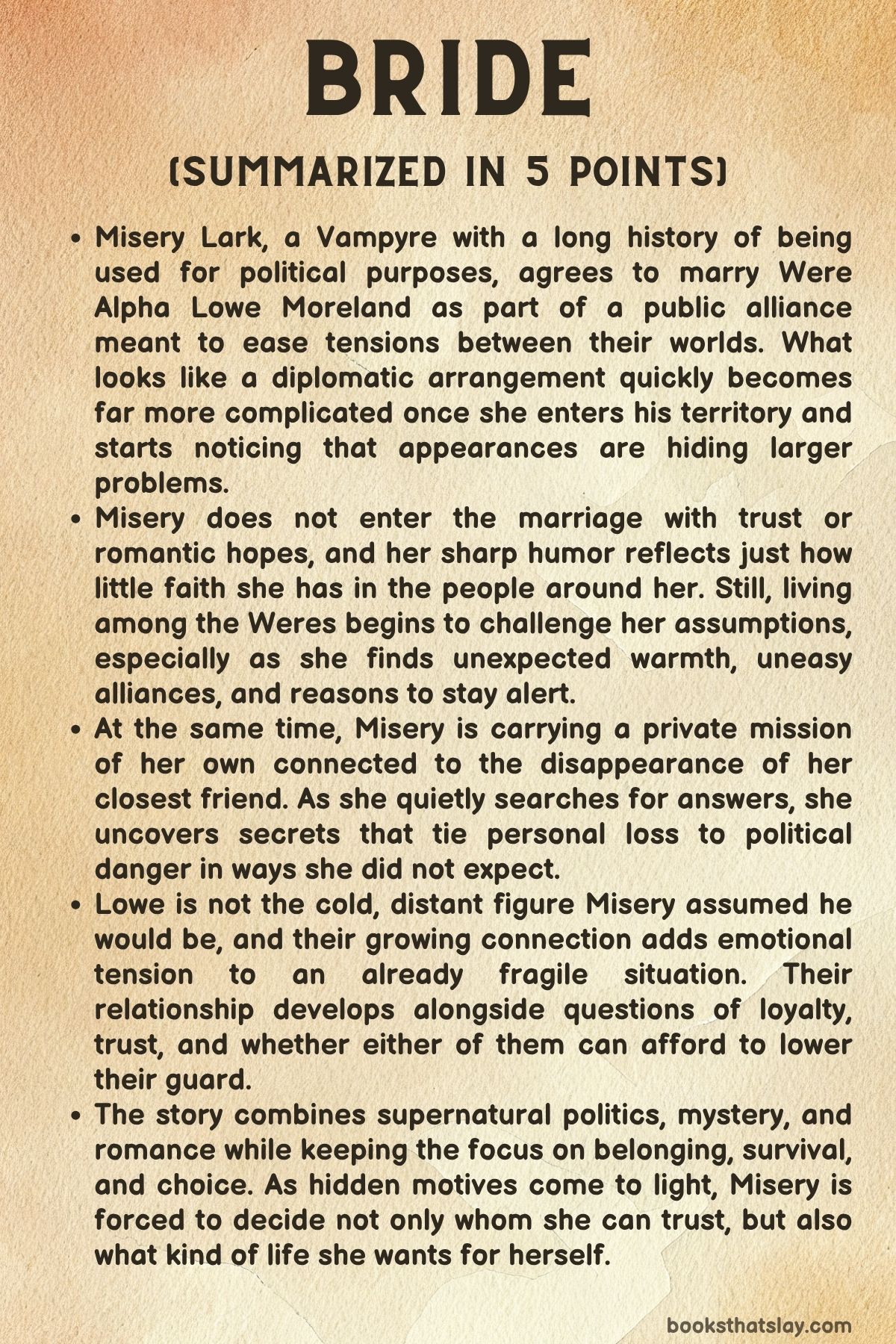
Bride by Ali Hazelwood is a paranormal romance built around a political marriage between enemies who have every reason to distrust each other. The story follows Misery Lark, a Vampyre forced into a union with Were Alpha Lowe Moreland as part of a fragile peace arrangement.
What begins as a public act of diplomacy becomes something far more personal as secrets surface, loyalties shift, and old power structures start to crack. The novel mixes danger, dry humor, sexual tension, and emotional growth, while centering on a heroine who has spent much of her life unwanted and is slowly forced to imagine a life where she is chosen, protected, and loved.
Summary
In Bride, Misery Lark is the daughter of one of the most powerful Vampyre leaders, but rank has never brought her comfort. As a child she was used as Collateral, exchanged in a political arrangement meant to preserve peace between species.
That experience left her detached from her own people, suspicious of her father, and more comfortable hiding among Humans than living inside Vampyre society. When her father orders her to marry Lowe Moreland, the Alpha of the Weres, she knows she is once again being used for diplomacy.
Still, she agrees, partly because she has her own reason for accepting the arrangement: her closest friend, Serena, has disappeared, and a clue in Serena’s planner seems connected to Lowe or his family.
At the wedding, the tension between Vampyres and Weres is obvious. Misery and Lowe have never met before, yet their first encounter is charged in a way neither expects.
Lowe reacts strongly to her scent, almost violently, and Misery is unsettled by the smell of his blood and by his intense presence. Soon after the ceremony, she learns that people assume Lowe already has a mate, which makes the marriage seem even more awkward and impersonal.
But when an assassin tries to kill her at the wedding reception, Lowe stops the attack instantly. He makes clear that, whatever the personal complications, her safety is now his responsibility.
Misery moves into Lowe’s home in Were territory expecting fear, hatred, or at best cold tolerance. Instead, she finds something unfamiliar: a household and a pack that function like a family.
She also meets Ana, Lowe’s young sister, who is curious, stubborn, and immediately attached to Misery. Misery had come to investigate Serena’s disappearance, but Ana quickly becomes just as important to her.
While trying to gather information, Misery notices tensions within the pack. There are signs of disloyalty, talk of a faction called the Loyals, and repeated hints that Lowe’s authority is being challenged.
Misery secretly investigates Serena’s trail by breaking into Lowe’s room and office and searching his systems. She is caught, but instead of throwing her out, Lowe demands the truth.
Misery tells him that Serena vanished while chasing a story and that the only clue she found was a name connected to the Morelands. Lowe, in turn, reveals a secret even more dangerous than Misery expected: Ana is half Were and half Human, something both politically explosive and biologically unusual.
That secret could make Ana a symbol of unity between groups that have long been kept apart, which also makes her a target.
Once Misery and Lowe begin sharing information, their relationship changes. They start working together, each recognizing the other’s intelligence and loyalty.
Misery helps with surveillance and hacking, while Lowe brings her into his confidence about internal threats among the Weres and about his own past. He had once wanted a life as an architect, but was forced into leadership when the old Alpha became violent and unstable.
He did not choose power for himself; he accepted it to protect others. That matters to Misery, who has spent her life surrounded by people who put power first and people second.
Their emotional bond grows through small moments as much as major revelations. Misery discovers that Lowe struggles with insomnia and can only rest with difficulty.
Ana pulls them together repeatedly, making them act like a family before either is ready to admit it. Misery, who has always guarded herself behind jokes and distance, finds that she wants to help Lowe, wants his approval, and wants to stay near him.
Lowe, for his part, notices everything about her, from the ways she hides discomfort to the ways she has been denied care all her life.
When they travel together to visit Emery, a woman they suspect may be involved in anti-Alpha plotting, the physical side of their connection becomes impossible to ignore. To pass as a true couple among suspicious Weres, Lowe marks Misery with his scent.
The act is intimate and deeply affecting for both of them. Later, while planting surveillance devices, they are forced to act even more convincingly, and Misery feeds from Lowe directly.
For a Vampyre, feeding from a live source carries emotional and biological consequences, and for Weres it is considered highly intimate. What happens between them leaves both shaken, aroused, and unable to pretend this is only politics.
Back home, Ana becomes dangerously ill, and Misery is the one who helps save her by identifying Human medicine that the Were healers had overlooked. That success deepens the trust between her and Lowe’s pack, but it also strengthens Misery’s place in Lowe’s life.
Soon she learns from her brother Owen that direct feeding can encourage attachment, something Vampyre society avoids because it creates exclusive bonds that conflict with their traditions. Misery worries she is falling for Lowe under circumstances she cannot fully trust, but the truth is simpler and more frightening: she is falling for him because he makes her feel valued.
Their investigation leads them to a former official named Thomas Jalakas, who may have been connected to Ana’s parentage and to Serena’s reporting. They discover that he died in what looks like an accident, suggesting someone has been eliminating loose ends.
Suspicion points toward Human governor Davenport and toward wider corruption. During this period Misery is poisoned, likely as part of a plan meant either to kill her or to destabilize Lowe.
He refuses to leave her side while she recovers, and when she wakes, the fear in him confirms what words still have not.
As Misery heals, she and Lowe finally act on their desire. Their first real sexual encounters are awkward, urgent, and revealing, because both are inexperienced in different ways.
Lowe tells her that full Were mating sex may not be physically possible between them, and Misery interprets his restraint as another sign that something is missing. Their tenderness is interrupted by more evidence about Serena and by a meeting with Owen.
There Misery encounters Gabi, the woman others claimed was Lowe’s mate. Watching them together, Misery realizes something is off.
Lowe is kind to Gabi, but not bonded to her. At last she understands that she has been misled.
Back at her Human apartment, Misery and Lowe give in fully and have sex, but afterward Lowe abruptly tells her she has mistaken his feelings. The rejection devastates her.
Before she can make sense of it, Mick, one of the pack members she trusted, kidnaps her. She wakes to find Serena alive and imprisoned with her.
Together they discover the truth: Misery’s own father orchestrated Serena’s kidnapping, manipulated political events, and used both Were unrest and Human corruption as cover. Serena herself is revealed to be half Were and half Human, just like Ana.
Henry Lark sees girls like Serena and Ana not as children but as threats, because they could unite communities that Vampyres have kept divided.
Lowe is brought in captive, apparently defeated, and Henry plans to use Misery and Ana to break him. But the scene is a trap in another direction.
Owen has been working against their father, and Lowe has understood more than Henry expected. In the chaos that follows, Serena shifts into wolf form, revealing powers she had only recently discovered, and the rescue begins.
Henry’s control collapses. Owen moves to take apart his father’s legacy, while Misery refuses any role that would tie her back to that old system.
Afterward, Misery and Serena begin to rebuild their friendship, and Serena starts adjusting to her new identity with help from the Weres. Misery, however, is still hurt by Lowe’s rejection.
When she finally confronts him, he admits the reason he pushed her away: he did not want her staying with him out of obligation or because the mating bond pressured her into it. He wanted her choice freely given.
Misery answers that choice clearly. She loves him.
She wants his home, his pack, Ana, and him.
They come together again, and this time Lowe stops denying what they are to each other. Misery is his mate, and he is hers.
The full physical union that he feared would hurt her instead brings pleasure and completion, proving that they truly are compatible. For Misery, who was treated as an asset for most of her life, this is more than romance.
It is belonging. In the end, she is no longer a bargaining tool or an outsider standing at the edge of every room.
She has chosen a home, and she has been chosen in return. The final note suggests that Serena’s story is not over either, as another hidden family connection comes to light.
Characters
Misery Lark
Misery Lark is the emotional and psychological center of the story, and much of the novel’s power comes from how sharply she observes the world while refusing, at first, to let the world observe her too closely. She has grown up as a political object rather than a protected daughter, and that history shapes almost every part of her personality.
Her humor is defensive, her sarcasm is often a shield, and her apparent coolness hides years of neglect, displacement, and emotional hunger. She is intelligent, highly competent, and often the quickest person in the room, but she has built her identity around self-containment because depending on other people has rarely ended well for her.
That is why her voice feels so dry and controlled even when she is under pressure. She has trained herself to survive by minimizing her own needs.
What makes Misery especially compelling is that she is not simply cynical. Under the defensive wit, she is deeply loyal and capable of intense attachment, even if she does not always know how to name it.
Her determination to find Serena is proof of that loyalty, but so is the speed with which she begins caring for Ana. The contrast matters.
Serena belongs to Misery’s old life, the one built around secrecy and emotional restriction, while Ana represents a future in which Misery begins acting out of open love instead of private obligation. Her growth comes from learning that care does not make her weak, ridiculous, or vulnerable in the way her upbringing taught her to fear.
It makes her more honest.
Her relationship to power is also central to her character. She comes from an elite Vampyre family, yet she has never truly belonged to that structure.
She understands how leadership works, how diplomacy is staged, and how fear is used, but she has no faith in the morality of those systems because she has been one of their casualties. This gives her an outsider’s clarity.
She can see the cruelty hidden beneath ceremonial language. She can also recognize, faster than most, the difference between someone who wants control and someone who accepts responsibility.
That distinction becomes crucial in how she comes to view Lowe. Misery has been surrounded by people who justify harm in the name of the greater good; Lowe is one of the first powerful people in her life who consistently uses power to protect.
Another important part of Misery’s character is her uneasy relationship with desire. She is not emotionally fluent when the story begins.
She does not trust romance, does not expect tenderness, and has little experience with being wanted in a sincere, sustaining way. As a result, much of her arc is about learning to interpret both emotional intimacy and physical intimacy without assuming there must be a hidden cost.
Her bond with Lowe unsettles her because it offers pleasure, safety, and mutual choice, all things she has rarely had together. Her eventual willingness to claim love directly is one of the clearest signs of her development.
By the end, she is no longer merely enduring life. She is choosing it.
Lowe Moreland
Lowe Moreland is written as a figure of strength whose depth comes from restraint rather than display. He is powerful, physically imposing, and clearly dangerous when necessary, but the most meaningful thing about him is how controlled that danger is.
He is not frightening because he is cruel. He is frightening because he has immense force and spends most of his energy making sure it is used carefully.
That sense of deliberate control defines him as a leader and as a romantic figure. He listens, watches, and absorbs more than he says, and when he does act, it usually comes from a place of protection rather than ego.
His leadership is shaped by sacrifice. Lowe did not rise to authority as an ambitious man chasing status; he stepped into it because someone had to protect the pack from a violent and failing system.
That history explains why there is a constant undertone of fatigue in him. He has given up the life he might have chosen, including his work as an architect, in order to become the person everyone depends on.
He is not self-pitying about that loss, but it marks him. He carries duty as something permanent and often isolating.
This is why his connection with Misery matters so much. She is one of the few people who sees the exhaustion beneath the authority.
Lowe is also defined by the tenderness he reserves for those under his care. His relationship with Ana reveals his truest self more clearly than any political scene does.
He is patient, vigilant, and emotionally invested in her safety in a way that strips away any possibility that his protectiveness is performative. The same is true, more gradually, in his treatment of Misery.
Even early on, when he claims they should keep their distance, he is studying the threats around her, anticipating danger, and learning her history. He wants information not to control her but to keep her alive.
That instinct makes him fundamentally different from the leaders she has known.
Emotionally, Lowe is generous but cautious. He feels deeply, yet he is slow to voice those feelings because he does not want affection to become another form of coercion.
This becomes one of the most revealing aspects of his character. His later withdrawal from Misery is painful, but it comes from a genuine fear that she will shape her choices around his bond, his needs, or his species’ instincts rather than her own free will.
In other words, even when he mishandles the situation, the mistake comes from respect rather than indifference. He is a man so used to responsibility that he struggles to accept happiness when it appears.
As a romantic lead, he works because his intensity is inseparable from his decency. He is possessive in instinct, but never careless with consent.
He is dominant in presence, but never dismissive of Misery’s agency. He is deeply sensual, yet the emotional core of his connection with her is not lust alone but recognition.
He sees how often she has been denied comfort, and he responds not by trying to own her but by trying to make space for her. That impulse reaches its fullest form at the end, when home itself becomes part of his love for her.
Serena Paris
Serena Paris is one of the most important characters even when she is physically absent for much of the story. Her disappearance is the plot’s first personal mystery, but more than that, she functions as the person who challenged Misery to live differently.
Serena is curious, morally restless, and unwilling to accept systems just because they are old or politically convenient. Where Misery often copes through emotional retreat, Serena pushes outward.
She asks questions, investigates what powerful people would rather leave hidden, and insists that injustice should not become normal just because everyone is used to it. That difference between them is part of what made their friendship strong, and part of what made it strained before she vanished.
Serena matters because she represents conscience. She is one of the few people in Misery’s life who expected more from her, not in the controlling sense that Henry does, but in the ethical sense.
She wanted Misery to care, to participate, to stop standing at a distance from everything. At first that expectation feels unfair to Misery, who has survived by emotionally narrowing her world.
Later, Misery realizes that Serena’s frustration came from love and from belief in her. Serena saw strength in Misery that Misery herself had not fully claimed.
Her own personal story is also significant. The revelation that she is half Were and half Human reframes her disappearance, her investigation, and even her instinct to keep digging.
She was not just chasing a story as a journalist. She was, knowingly or not, circling the truth of her own existence.
That gives her character a tragic pressure, because she is endangered not merely by what she uncovers but by what she is. Her hidden identity makes her a threat to rigid political categories, and that explains why powerful people move against her.
Even with all that weight, Serena is never reduced to a symbol. She remains lively, stubborn, and emotionally vivid.
Once she reappears, she is not written as broken beyond recognition but as someone altered by captivity who still retains sharpness and courage. Her quick thinking during the escape and her willingness to reconcile honestly with Misery show that she remains active in her own narrative.
By the end, she also becomes a bridge figure, someone whose existence points toward a different future. In Bride, she is both a catalyst and a person in her own right.
Owen Lark
Owen begins as someone who appears unserious, flippant, and even immature, but the story gradually reveals that this impression is incomplete. He uses humor, provocation, and apparent carelessness as camouflage.
Like Misery, he is the child of a ruthless political father, and like her, he has been shaped by the knowledge that family love in their household has always been conditional. The difference is that Owen performs lightness where Misery performs detachment.
His sharp jokes and irreverence mask anger, intelligence, and long-term planning.
One of Owen’s strongest functions in the story is to complicate the idea of sibling loyalty. Misery remembers him as the brother who once promised to protect her, but adulthood has put distance and mistrust between them.
Their relationship carries old tenderness buried under years of separation, and that makes their interactions feel unstable for much of the novel. Misery is never fully sure whether he is merely entertaining himself or whether he is genuinely on her side.
That uncertainty is important, because it mirrors the broader atmosphere of political manipulation surrounding the family.
When Owen’s true intentions come into focus, he becomes one of the more satisfying secondary characters. He is not just rebelling for spectacle; he is actively working to undo the damage done by his father.
His desire to remove Henry from power is rooted not only in ambition but in moral judgment and in a personal response to how badly Misery has been treated. He is one of the few Vampyres in the story willing to imagine meaningful structural change rather than cosmetic reform.
That makes him politically important, not just personally sympathetic.
He also provides an interesting contrast to Lowe. Both men are protective of Misery, but in different registers.
Lowe’s care is steady, embodied, and intimate. Owen’s is pricklier and more indirect, often expressed through logistics, information, and strategic intervention.
He may not always know how to speak plainly about love, but his actions prove that he feels it. By the end, Owen emerges as someone far more mature than his earlier presentation suggests, and his arc quietly reinforces one of the novel’s recurring ideas: people who grow up in cruel systems often learn to hide their best qualities until it is safe to reveal them.
Ana Moreland
Ana is essential not just because she is lovable, but because she changes the emotional temperature of nearly every scene she enters. She is bright, blunt, affectionate, and often unintentionally funny.
Her youth allows her to ask direct questions and form bonds without the layers of prejudice or political caution that dominate the adult world. This gives her a unique role in the story.
She is both vulnerable and clarifying. Characters reveal themselves through how they respond to her.
For Misery, Ana is the first relationship in the story that feels instinctive rather than negotiated. Misery does not have to convince herself to care for Ana; the attachment happens almost immediately, and that surprises her.
Through Ana, Misery begins acting like someone who belongs in a family long before she believes she does. Ana draws out warmth, protectiveness, and playfulness that Misery usually keeps hidden.
In that sense, Ana is not just a child in need of safety. She is one of the main agents of Misery’s transformation.
Ana also carries enormous symbolic weight within the plot. As a half Were, half Human child, she embodies the possibility that the boundaries separating communities are neither natural nor permanent.
That is precisely why so many powerful people see her as dangerous. She threatens old narratives simply by existing.
Yet the story wisely does not make her abstract. She is not only a symbol of unity or conflict.
She is a little girl with fears, needs, humor, and a fierce attachment to her brother. Her illness, loneliness, and longing to fit in among the other Weres all make her emotionally real.
Her relationship with Lowe is equally important. Through it, the reader sees that his protectiveness is not selective or strategic but fundamental to who he is.
Ana depends on him, but he also orients much of his life around her well-being. The household he builds is, in many ways, built around making a future possible for her.
By the novel’s end, Ana becomes part of the emotional answer to Misery’s lifelong displacement. Loving Lowe means loving Ana too, and that shared devotion helps turn a temporary political arrangement into a genuine home.
Henry Lark
Henry Lark is the clearest embodiment of institutional cruelty in the novel. He is not evil in the exaggerated sense of a chaotic or irrational villain.
In some ways, that makes him worse. He is disciplined, politically skilled, and entirely convinced that sacrificing individuals for collective advantage is not only acceptable but admirable.
He uses the language of leadership to excuse emotional abandonment, coercion, and strategic violence. His deepest corruption lies in how thoroughly he has moralized his own lack of empathy.
As a father, Henry is devastating because he treats his children as extensions of policy rather than human beings. Misery’s history as Collateral is not, to him, a personal betrayal but a necessary choice.
That posture defines their entire relationship. He cannot imagine why she would resent being used, because he believes usefulness is the highest possible standard.
This worldview explains why there is so little warmth in him. He has severed himself from ordinary tenderness and recast that severance as strength.
Politically, Henry represents the old order at its most calculating. He understands that peace can be manipulated, that fear can be redirected, and that emerging forms of solidarity must be crushed early.
His treatment of Serena and his obsession with controlling Ana’s fate show that what he fears most is not immediate defeat, but change. Children like Serena and Ana threaten the categories on which Vampyre dominance depends.
Henry responds by trying to eliminate them or exploit them. He does not merely defend a system; he actively engineers suffering to preserve it.
What makes him effective as an antagonist is that he is intimately tied to Misery’s internal life. He is not just an external threat to be outmaneuvered.
He is the source of many of her assumptions about worth, expendability, and love. Escaping his control therefore has emotional as well as political significance.
When Misery ultimately refuses to define herself through his structures, that refusal is one of the most important victories in the book.
Mick
Mick is one of the more tragic secondary figures because he represents compromised goodness. For much of the story, he appears to be one of the few Were pack members who treats Misery with uncomplicated decency.
He is calm, kind, and less reactive than others, which makes him feel trustworthy both to Misery and to the reader. That trust is important because it sets up the emotional force of his betrayal.
Yet Mick’s betrayal is not written as simple malice. He is acting under coercion because his son is being held hostage, and that context transforms him from villain into wounded participant in a larger system of pressure and loss.
He is a reminder that not all harm in the story comes from ideological cruelty. Some of it comes from desperation.
Mick has already lost so much, and that grief leaves him vulnerable to manipulation. He is not excused, but he is understood.
His character adds texture to the Were world by showing that loyalty inside the pack is not effortless or idealized. Even good people can be broken open by fear for those they love.
That makes the world feel more human and morally complex. Mick’s actions wound Lowe and Misery deeply, yet the novel resists flattening him into a purely hateful figure.
He is a cautionary example of what oppressive systems can do to people who are otherwise decent.
Juno
Juno begins as guarded, suspicious, and openly cold toward Misery, but her arc is one of earned revision. She is intensely protective of Lowe, Ana, and the pack, and that protectiveness initially manifests as hostility toward an outsider from a rival species.
Her first instinct is not generosity but defense. That reaction makes sense within the world of the story and gives her character credibility.
She is not there to make Misery comfortable; she is there to guard what matters.
What makes Juno effective is that she changes when presented with evidence. Once she sees Misery’s attachment to Ana and her willingness to help rather than manipulate, Juno adjusts her view.
She apologizes, trusts more, and eventually becomes one of the figures helping Serena transition into a new reality. That evolution matters because it reflects one of the novel’s central interests: not everyone is transformed by grand speeches.
Many people are changed by repeated acts of care.
Juno also contributes to the sense that the pack has memory and internal history beyond the central romance. She knows Lowe’s past, understands what his sacrifices have cost him, and views him with a mixture of loyalty and concern.
Through her, the reader gets a fuller picture of the burden Lowe carries. She may not be emotionally demonstrative, but she is deeply invested in the health of the community.
Her practical, skeptical presence strengthens the emotional realism of pack life.
Alex
Alex serves several important functions at once: comic relief, technical counterpart, and social barometer. His nervousness around Misery is often funny, especially because it contrasts with her dry amusement, but he is never reduced to a joke.
He is clearly intelligent, deeply competent with technology, and useful in the plot in ways that go beyond lightening the mood. His interactions with Misery establish one of the story’s most enjoyable forms of non-romantic chemistry: mutual recognition between two highly capable people who understand each other’s skills.
He also helps illustrate how prejudice operates through myth and distance. Alex is afraid of Vampyres partly because he has been shaped by stories rather than experience.
Once he actually works with Misery, that fear does not vanish instantly, but it becomes mixed with admiration, curiosity, and eventually trust. This makes him one of the clearest examples of how contact can destabilize inherited bias.
He is not ideologically rigid; he is simply inexperienced, and experience changes him.
Alex’s role in the investigative plot is equally important. He becomes part of the small circle assisting Misery and Lowe, which means his loyalty carries real stakes.
He is one of the people through whom trust across species becomes practical rather than symbolic. In a story full of leaders, schemes, and emotional intensity, Alex adds a grounded kind of usefulness.
He helps keep the machinery of the plot moving while also making the world feel inhabited by ordinary, likable people.
Gabi
Gabi is a clever challenge to assumption. For much of the story, Misery believes Gabi is Lowe’s mate, which turns her into a threatening offstage presence before she has truly appeared as a person.
When Gabi finally enters the story, the reality is strikingly different. She is not jealous, territorial, or dramatic.
Instead, she is perceptive, self-possessed, and far more independent than the rumors about her suggest. Her presence helps expose how often political arrangements and social gossip distort the truth.
As another Collateral figure, Gabi also mirrors Misery in useful ways. Both women have been inserted into systems meant to symbolize peace, and both have had to adapt to environments shaped by larger political goals.
But where Misery begins from alienation and emotional distance, Gabi appears to have built a quieter kind of adjustment. She is making use of her time, taking classes, and moving forward with her own life rather than existing only as a symbolic figure in someone else’s arrangement.
Her interactions with Misery are brief but important because they remove a false obstacle from the emotional plot. More than that, they show woman-to-woman generosity instead of rivalry.
Gabi understands more than Misery expects and responds with sympathy rather than hostility. That choice fits the broader pattern of the novel, which repeatedly rejects easy female competition in favor of more layered forms of connection.
Davenport
Davenport represents the polished face of Human political corruption. He is smug, ignorant in ways he does not recognize, and accustomed to speaking about other communities with the entitlement of someone who assumes his power is normal.
He is useful as a character because he embodies a different kind of threat from Henry. Henry is cold, strategic, and ideologically ruthless.
Davenport is smaller in scale, but his vanity, carelessness, and corruption still produce real harm.
His scenes are effective because he underestimates nearly everyone around him. He treats diplomacy like theater and assumes his own version of events will remain intact because he is protected by office and social status.
But once Lowe confronts him, that polished exterior cracks. He is exposed not as a master strategist but as a self-serving man willing to let other people bear the consequences of his dishonesty.
Davenport also highlights one of the story’s ongoing ideas: systems are often maintained not only by monsters but by comfortable opportunists. He may not possess Henry’s grand vision of control, yet his selfishness makes him complicit in violence.
His character helps widen the novel’s critique beyond one species or one family. Corruption is not isolated.
It appears wherever status is valued more than truth.
Max
Max is less psychologically layered than some of the other supporting figures, but he plays an important role in making internal Were conflict visible. He is reckless, volatile, and easily manipulated, the kind of person who becomes dangerous because he is driven by grievance and ego rather than judgment.
Through him, the reader sees that opposition to Lowe is not purely abstract or political. It is active, emotional, and capable of immediate violence.
Max’s attempts to harm Misery and exploit Ana reveal how children and outsiders often become pressure points in factional struggles. He is the kind of threat that emerges when authority is contested and resentment is allowed to fester.
He does not have the composure to become a mastermind, but he is exactly the sort of unstable figure larger conspiracies can use.
His presence also helps define Lowe. In scenes involving Max, Lowe’s calm, strategic patience becomes even more noticeable.
Instead of simply reacting, Lowe often waits, gathers information, and lets disloyalty reveal itself. Max therefore matters not only as an antagonist in miniature, but as a contrast device that shows the difference between raw aggression and disciplined leadership.
Vania
Vania occupies a smaller but still meaningful role as one of the enforcers of Vampyre order. She is tied to Henry’s authority and appears when that authority needs to be imposed directly.
Her presence often signals the reach of a system Misery has tried to escape. She is efficient, intimidating, and loyal to structure rather than to emotional truth, which makes her a useful extension of the world Misery distrusts.
Unlike Henry, Vania is not presented as the architect of cruelty, but she does participate in its maintenance. That distinction matters.
The story understands that oppressive systems depend not only on leaders but on capable people willing to carry out orders. Vania’s professionalism gives the Vampyre hierarchy its practical force.
At the same time, she never overwhelms the story as a major emotional figure, which suits her role. She is less a person Misery must process intimately than a recurring reminder of where she comes from and what she is trying not to become trapped inside again.
Koen
Koen enters later, but he leaves a distinct impression because he brings a different energy to the Were world. He is socially bold, outspoken, and less ceremonious than many of the other political players.
His presence adds a rougher, more informal edge to scenes that might otherwise become overly tense. He is also useful as a reminder that Lowe’s alliances extend beyond his immediate household, and that his authority is part of a broader network of relationships.
Koen’s significance increases in the ending, when his reaction to Serena strongly implies a personal connection that will matter going forward. This late revelation repositions him from colorful secondary figure to someone potentially central to future developments.
It is an efficient piece of characterization because it shows how much history can still be hidden beneath the story’s surface.
Even before that final suggestion, Koen functions as someone who can read a room quickly and adapt. He is more openly opinionated than Lowe, more likely to provoke, but not careless.
His scenes broaden the social world around the main couple and hint at how much of that world remains in motion after the central romance settles.
Emery Messner
Emery is important because she represents old power trying to preserve itself through grace, distance, and plausible deniability. She is not presented as outwardly monstrous.
Instead, she carries herself with civility and composure, which makes the tension around her sharper. The real danger in characters like Emery is that they know how to appear respectable while still standing near violence and disloyalty.
Her role in the plot is to sustain uncertainty. She may be involved, partly involved, or useful as cover for someone else’s plans, and that ambiguity keeps both Misery and Lowe in investigative mode.
Emery’s scenes show how politics often operates through implication rather than confession. Everyone senses threat, but proving it is more difficult.
As a character, she also helps underline how leadership failures persist through networks of loyalty, memory, and resentment. Even after the old Alpha is gone, the damage of his era lingers in people who benefited from it or still emotionally live within its logic.
Emery belongs to that lingering structure. She is less explosive than Henry, but she is part of the same broader pattern of clinging to old arrangements rather than allowing something better to emerge.
Themes
Chosen Love Versus Inherited Duty
Misery’s life is shaped from the beginning by decisions made for her by people who speak the language of responsibility while denying her personhood. She is treated as useful before she is treated as loved, and that early wound defines how she understands family, politics, and even her own value.
The novel builds much of its emotional force through her gradual movement away from inherited duty and toward chosen attachment. This shift is not presented as a sudden rebellion.
It happens slowly, through accumulated experiences that teach her that obligation and care are not the same thing. Her father believes sacrifice proves moral seriousness, especially when the sacrifice belongs to someone else.
Misery has internalized enough of that logic to expect pain as the price of being needed. That expectation begins to weaken only when she encounters relationships that do not ask her to disappear in order to function.
Lowe becomes central to this theme because he stands in direct contrast to the world that shaped her. He is also a leader, also burdened by communal responsibility, and also willing to give up personal comfort for others.
But his idea of protection does not require emotional erasure. He does not demand that Misery become a symbol and stop being a person.
Even when he takes responsibility for her safety, the instinct behind it is recognition rather than possession. He notices what she fears, what she hides, and what she has gone without.
The importance of this cannot be overstated. Misery has lived in systems where duty is used to justify emotional neglect, so when she meets someone who carries duty without using it as an excuse for cruelty, her entire moral landscape begins to change.
The same theme appears in smaller relationships as well. Ana’s attachment to Misery is immediate and uncalculated.
Serena’s anger at Misery before disappearing comes from care, not control. Owen’s loyalty, though disguised by humor and distance, is also based on personal devotion rather than political usefulness.
These relationships slowly teach Misery that love can be active, inconvenient, and protective without becoming exploitative. By the end, the story makes clear that chosen love is not just a romantic preference.
It is an ethical alternative to a world built on inherited structures that consume the vulnerable. In Bride, choosing someone freely becomes a radical act because it rejects the logic of systems that have always claimed the right to choose for you.
Belonging After Alienation
Belonging in this story is never simple, and that is what gives the theme its weight. Misery has spent much of her life being physically placed in one community while emotionally excluded from all of them.
She is born into power among the Vampyres, yet she is not sheltered by it. She has lived among Humans, but mostly under disguise and with the knowledge that acceptance depends on concealment.
From the opening movement of the plot, she carries the habits of someone who expects to remain peripheral. She watches carefully, jokes defensively, and assumes closeness is temporary.
Her emotional style reflects long practice at being the one who survives the room without ever fully entering it.
The move to Were territory begins to test that condition. At first, Misery expects more hostility, more evidence that she does not belong anywhere without terms and conditions attached.
Instead she encounters something stranger and, for her, more destabilizing: a household and a wider pack that are capable of warmth, memory, routine, and care. This is not a sentimental portrait of community, because there are mistrusts, factions, and betrayals inside it.
Even so, it offers a structure Misery has never truly had. Ana seeks her out.
Juno eventually revises her judgment. Alex learns to trust her.
Mick’s betrayal hurts as deeply as it does precisely because his prior kindness made it possible for Misery to feel included. The emotional stakes of all these relationships come from the fact that they create a living answer to her lifelong estrangement.
Belonging is also tied to the body. Misery has often hidden or minimized visibly Vampyre aspects of herself, adjusting her presentation according to what feels safest.
As her bond with Lowe develops, that concealment begins to lessen. The novel repeatedly links emotional safety with the ability to exist more openly in one’s own form.
This becomes especially meaningful in the closing movement, when Lowe literally starts imagining changes to physical space so that she can live more comfortably in it. Home is no longer abstract at that point.
It becomes architectural, daily, embodied. She is not being tolerated inside someone else’s structure; the structure itself is changing to receive her.
That transformation is why the theme extends beyond romance. Misery does not merely gain a partner.
She gains a place where she is not an exchange, not a disguise, not an outsider waiting to be judged. The deep satisfaction of the ending comes from that emotional settlement.
Belonging is shown not as passive acceptance but as the experience of being known, wanted, and made room for without having to bargain away the self.
Power, Control, and the Moral Failure of Political Systems
Political systems in the novel are not presented as neutral frameworks that occasionally produce bad outcomes. They are shown as structures that often depend on emotional numbness, strategic dehumanization, and the willingness to rename cruelty as necessity.
The Collateral arrangement is one of the clearest examples. It is defended as diplomacy, as peacekeeping, as prudent leadership, but its practical meaning is that children are turned into instruments of policy.
Misery’s own history proves the cost of this long before the full scale of the larger conspiracy becomes clear. She has been shaped by the knowledge that her suffering could always be explained away by adults with authority.
That understanding is one of the book’s darkest truths: systems do not become humane merely because they justify themselves in formal language.
Henry Lark embodies this theme most directly. He is terrifying not because he is chaotic, but because he is rational in a deeply corrupted way.
He has fully absorbed the belief that leadership means sacrificing individuals for strategic stability, and he sees no contradiction in treating his own children as expendable assets. The story is especially sharp in showing how this worldview extends beyond personal coldness into institutional design.
Henry is not just a bad father; he is the representative of a political order that survives by normalizing emotional violence. His manipulation of Serena’s imprisonment, his interest in controlling Ana, and his refusal to recognize the humanity of those caught in his plans all grow from the same root.
Power, for him, is the right to decide whose life matters less.
The novel does not confine corruption to one species. Human leadership is also compromised through figures like Davenport, whose vanity and self-interest help preserve harmful arrangements.
Among the Weres, internal Loyalist factions reveal that even communities built around stronger interpersonal bonds are not free from power struggles and resentment. This wider distribution of moral failure is important because it prevents the story from becoming a simple good-side versus bad-side fantasy.
The problem is not just one villain. It is the repeated temptation to value stability, status, or group advantage over actual people.
What distinguishes Lowe’s leadership is that he offers a countermodel. He exercises authority, but he remains morally answerable to those in his care.
He does not stop being dangerous; rather, his danger is disciplined by responsibility and affection. That difference matters because the story is not anti-power in a simplistic sense.
It is critical of power without accountability, power without tenderness, and power that treats vulnerability as a resource to exploit. Bride ultimately argues that any political structure that cannot recognize personhood will decay into violence, no matter how polished its official purpose may sound.
Identity Beyond Fixed Categories
The story repeatedly questions categories that the world around the characters treats as solid, natural, and politically essential. Vampyre, Were, Human, ally, enemy, family, outsider, mate, Collateral: all of these labels appear stable at first, but the plot keeps exposing how incomplete they are when faced with lived experience.
This is one of the reasons the novel’s hidden identities and biological surprises matter beyond plot mechanics. The revelations about Ana and Serena are not there only to add suspense.
They destabilize the assumptions on which the larger social order depends. If people can exist across the boundaries that the political system insists on policing, then those boundaries are not sacred truths.
They are maintained arrangements.
Misery’s own life already prepares the ground for this theme. She has spent years moving between communities, disguising herself, adjusting her presentation, and living with the sense that identity is something others interpret before she gets to define it.
Her outsider position makes her especially sensitive to the fiction of rigid social categories. She knows from experience that belonging can be denied even when lineage should guarantee it, and granted conditionally even when one is pretending to be someone else.
That instability in her own life helps explain why she is eventually able to accept truths that others find threatening.
Serena and Ana push the theme even further. Their mixed heritage is dangerous not because they are monstrous or unnatural, but because their very existence challenges inherited narratives about what kinds of bodies, bonds, and futures are possible.
Henry understands this clearly, which is why he reacts with such urgency. He recognizes that symbolic change can be politically explosive.
A child or young woman who does not fit established categories becomes evidence that the system has been lying about the permanence of its divisions. That is why their bodies are treated as sites of conflict.
What frightens those in power is not just hybridity itself, but the social imagination it might enable.
The mating bond between Misery and Lowe extends the same theme into the romantic core of the story. Even their physical compatibility becomes a site of uncertainty because both characters have inherited expectations about what should or should not be possible between them.
The relationship forces them to confront whether identity is best understood as rule or as encounter. The answer the novel keeps moving toward is that identity becomes most truthful when it is lived rather than imposed.
People are not reducible to the boxes their societies prefer. Intimacy, friendship, loyalty, and kinship all expose realities more complex than ideology allows.
In that sense, the novel’s interest in mixed lineages and unexpected bonds is not incidental. It is part of a larger argument that rigid categories are often tools of control, and that real human connection has the power to make those tools look fragile.