Buckeye Summary, Characters and Themes
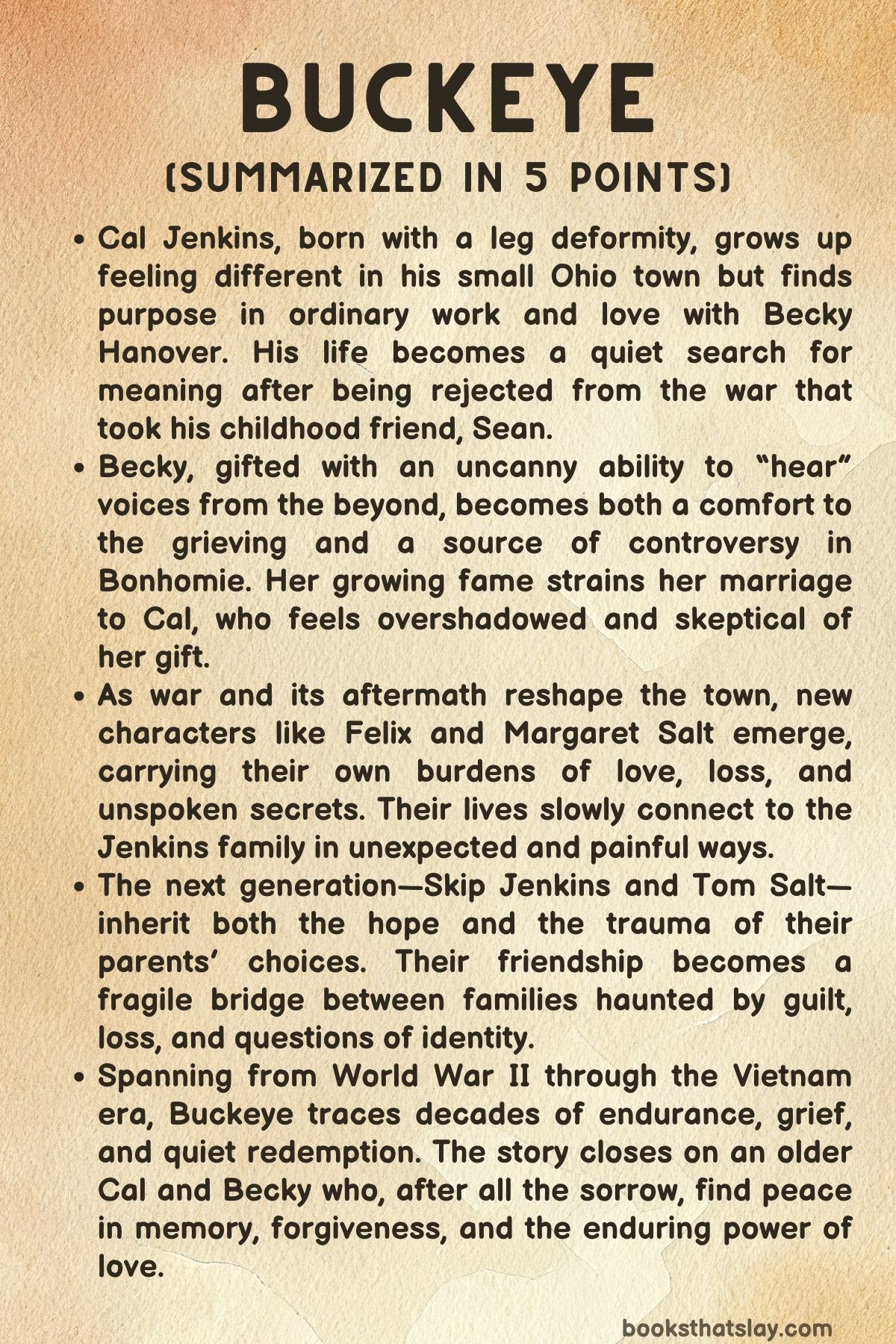
Buckeye by Patrick Ryan is an expansive, deeply human novel tracing the intertwined lives of ordinary people in the fictional Ohio town of Bonhomie across the mid-twentieth century. Through generations marked by war, love, loss, and the quiet search for meaning, the book explores how small choices and long-buried secrets shape families and communities.
At its heart are Cal and Becky Jenkins, whose marriage endures hardship, faith, and tragedy, and Felix and Margaret Salt, whose love and deception ripple through decades. Ryan captures the rhythms of American life—from the optimism of the 1940s to the disillusionment of the Vietnam era—with compassion and precision.
Summary
Cal Jenkins, born in 1920 with one leg shorter than the other, grows up in Bonhomie, Ohio, a town defined by working-class routines and the slow churn of history. His father Everett, a withdrawn veteran and hoarder, keeps the household in disarray.
Despite the challenges of his limp and teasing from others, Cal endures with quiet resilience. His closest childhood friend, Sean Robison, encourages him to believe they are both destined for something meaningful.
But when war arrives, Cal’s physical condition disqualifies him from service, while Sean is drafted and later killed overseas. Cal remains behind, haunted by survivor’s guilt and uncertainty about his purpose.
In the wake of Sean’s death, Bonhomie’s story broadens into a living portrait of wartime America. The factories hum, soldiers march off, and families wait anxiously for telegrams.
Cal works at a concrete plant before finding himself at his father-in-law Roman Hanover’s hardware store, where he witnesses the joy and sorrow of a community shaped by conflict. His life changes one afternoon when Germany surrenders.
A stranger, Margaret Salt, bursts into the store seeking a radio to hear the announcement. In the charged moment of victory, she impulsively kisses him.
The encounter is brief but leaves Cal profoundly stirred, sensing a momentary glimpse of connection beyond his routine life.
The narrative then rewinds to 1942, when Cal’s failed enlistment left him adrift. Visiting Everett’s cluttered home, he confesses his disappointment, and his father—usually cold—expresses a rare pride.
Soon after, Cal meets Becky Hanover at a drugstore counter. Lively and eccentric, Becky speaks openly about her visions and the “voices” she has heard since childhood.
Their conversation over root beer floats marks the beginning of a bond that deepens rapidly. Becky’s belief in unseen worlds contrasts with Cal’s practicality, yet they balance one another.
After weeks of courtship, Becky entrusts Cal with a sealed letter she wrote as a child, instructing him to give it back to her on her sixtieth birthday. Their affection grows, and by September 1942, they marry in a modest church ceremony.
Their early married life is joyful but precarious. They live above a barbershop, counting every dollar while Becky hosts séances with her friend Janice.
Cal joins the local defense corps, taking pride in his small contribution to the war effort. When Becky becomes pregnant, the couple’s excitement is mixed with anxiety.
Roman Hanover offers Cal steady work at his store and helps them buy a small house in Brookdale, giving them a foundation for family life. Their honeymoon to Cedar Point and Seneca Caverns marks a brief respite before the realities of adulthood return.
Becky gives birth to a son, Skip, after a difficult labor that leaves her unable to have more children. Motherhood brings her joy and renewal, while Cal struggles to adjust to fatherhood and his growing insecurity about Becky’s spiritualism.
As Becky’s reputation as a medium spreads, grieving neighbors seek her comfort. Her sessions become both a calling and a point of contention in her marriage.
Cal feels embarrassed by the gossip surrounding her séances, while Becky insists she is helping people heal. Their arguments grow sharper when a visiting scholar, Casey LaGrange, arrives to study her.
His obsession with turning her gift into a public spectacle provokes Cal and Roman to drive him out of town, an act that shatters Becky’s trust. Their relationship cools into silence, each wounded by pride and misunderstanding.
The story expands beyond the Jenkins household as the war ends. Felix Salt, a sailor recovering from trauma in a Manila hospital, wrestles with the memory of a lost comrade, Augie Varick.
Cleared for return to civilian life, he reunites with his wife Margaret—the same woman who once kissed Cal Jenkins. Their intimacy resumes hesitantly, and soon Margaret becomes pregnant.
Though Felix rejoices, Margaret secretly fears her child may be Cal’s, a consequence of that brief wartime encounter. Their son, Tom, grows up between his father’s quiet despair and his mother’s gnawing guilt.
Felix’s postwar years are marked by emotional withdrawal and occupational decline, while Margaret endures the demands of motherhood and her own isolation.
Tom’s childhood intersects with the Jenkins family when he befriends Skip, Cal and Becky’s son. Skip becomes a bright, spirited young man, while Tom struggles with confusion and anger, traits that hint at the buried truth of his parentage.
Years pass, and tragedy strikes when Skip dies in Vietnam. The loss devastates Cal and Becky, hollowing out their world.
They find fragile support from Felix, now older and more introspective, who tries to comfort them even as he battles his own sorrow and illness. Tom, now grown, visits the grieving Jenkinses and feels drawn to them, sensing a connection he cannot yet name.
The revelation arrives later, when Felix, nearing death, confides to Tom that Cal Jenkins is his biological father. The confession fractures Tom’s sense of self.
He retreats into silence and anger, cutting off contact with Felix. His disillusionment mirrors the disarray of the 1970s, a nation recovering from war and deception.
He eventually tracks down his estranged mother, Margaret, and watches her from afar, realizing the toll of the choices made before his birth.
As time passes, reconciliation comes slowly. Felix, living with lung disease, is cared for by the Jenkinses, who have learned to endure loss with quiet grace.
Cal persuades Tom to return home before Felix dies, and father and son share a final understanding before the end. Felix’s death reunites the fragments of family, though not without pain.
Margaret arrives too late to reconcile fully but exchanges a brief, meaningful embrace with Tom, suggesting the faintest trace of forgiveness.
The novel closes in the early 1980s with Cal and Becky, now elderly, reflecting on their long lives. They have lost much—friends, family, and their only child—but remain bound by enduring love.
Tom, now married and planning to adopt, visits often, carrying forward both families’ legacies. On Becky’s sixtieth birthday, Cal gives her the letter she wrote as a child.
Together, they visit Lake Erie, ride the Ferris wheel they once shared on their honeymoon, and read the words of her younger self, filled with dreams of the future. In that moment, they rediscover hope—not in grand destiny but in the quiet persistence of love and forgiveness that has sustained them through every season of their lives.
Characters
Cal Jenkins
Cal Jenkins stands at the heart of Buckeye, a man whose life becomes a meditation on purpose, endurance, and quiet resilience. Born with a leg deformity that both physically and symbolically hobbles his journey, Cal embodies the limitations imposed by circumstance and society.
His rejection from military service during World War II—while his best friend Sean dies overseas—sets the tone for his lifelong struggle with inadequacy. Cal’s existence unfolds within the borders of Bonhomie, Ohio, a town that mirrors his restrained emotional landscape.
His life as a husband, father, and laborer is marked by longing for validation and meaning. Despite moments of tenderness, such as his marriage to Becky and his devotion to their son Skip, Cal’s identity remains entangled in self-doubt and a quiet yearning for significance.
Yet his story is also one of perseverance. Through hardship and personal tragedy, Cal grows into a figure of understated strength—someone who learns that purpose is not bestowed through glory or recognition but through steadfast love, forgiveness, and endurance.
Becky Hanover Jenkins
Becky is the novel’s most enigmatic and luminous character, a woman whose spiritual sensitivity and emotional openness define both her power and her pain. Her belief in the unseen—hearing voices, conducting séances, and feeling the presence of the dead—sets her apart in the rational, workaday world of Bonhomie.
What might seem eccentricity becomes, in Buckeye, a profound representation of empathy and feminine intuition. Becky’s gift, however, isolates her; her growing reputation as a spiritualist draws ridicule and fear, even from her husband.
Despite her gentle nature, she possesses remarkable courage and conviction, refusing to suppress her own truth for the comfort of others. Her journey is one of self-assertion: she transforms from an idealistic young woman into a figure of spiritual authority, and later, a grieving mother who must reconcile faith with loss.
Becky’s evolution culminates in the novel’s final pages, where forgiveness and love transcend death—her final recognition that connection endures beyond all earthly separations.
Everett Jenkins
Everett Jenkins, Cal’s father, is a haunting presence in the story—a man consumed by the detritus of his past, both literal and emotional. A veteran of an earlier war, he has turned into a hoarder and recluse, living amid piles of scrap metal and discarded memories.
His paranoia about government seizure of his “treasures” masks a deeper trauma: an unspoken horror from his wartime experiences. Everett’s brokenness serves as both warning and mirror for his son.
Through him, Patrick Ryan exposes the silent wounds of veterans, men who return from battle unable to find peace in the ordinary world. Yet beneath his eccentric exterior lies a flicker of paternal love, revealed in rare, almost accidental moments of pride and tenderness.
Everett embodies the generational shadow cast by war, suggesting that its casualties extend far beyond the battlefield.
Margaret Salt
Margaret Salt’s life is a portrait of repression and quiet despair. Once vibrant and passionate, she is introduced in a moment of unguarded emotion when she kisses Cal Jenkins on the day of Germany’s surrender—a spontaneous act that sets in motion years of guilt, secrecy, and emotional turmoil.
Her marriage to Felix becomes an exercise in endurance rather than partnership, marked by loneliness, frustration, and the suffocating constraints of domesticity. Margaret’s pregnancy, shadowed by the fear that her child may be Cal’s, becomes the axis of her moral torment.
Throughout Buckeye, she embodies the tragedy of unfulfilled potential and the gendered expectations that bind women to silence. In her later years, working quietly behind a jewelry counter, she becomes a ghost of the woman she once was—a symbol of the many lives diminished by secrets and regret.
Felix Salt
Felix is one of the novel’s most complex and tragic figures, a man haunted by guilt, repressed love, and unspoken identity. A survivor of the USS Teague disaster, Felix carries both physical and emotional scars.
His love for Augie Varick, never confessed openly, drives his lifelong self-denial and grief. His marriage to Margaret is marked by absence—his inability to be emotionally or physically present—while his secret relationship with Bishop later in life represents both redemption and authenticity.
Felix’s internal struggle with identity and duty encapsulates the hidden toll of societal expectations on men of his generation. His revelation to Tom about his true paternity becomes both an act of courage and destruction.
By the time of his death, Felix achieves a kind of peace, reconciling with his son and embracing love, however belatedly. His life suggests that forgiveness, though painful, remains the final and truest form of grace.
Skip Jenkins
Skip represents the hope and tragedy of a generation shaped by its predecessors’ wars. The son of Cal and Becky, he inherits both his father’s quiet resolve and his mother’s sensitivity.
His death in Vietnam becomes the emotional fulcrum of Buckeye, linking the personal to the political and exposing how the cycle of loss continues across time. Skip’s absence pervades the novel’s final act, shaping the grief of everyone left behind.
To Becky, his silence from beyond the grave tests her faith; to Cal, his death becomes a mirror of paternal failure. Yet Skip’s symbolic return—through memory, love, and the faint echo of his voice—restores meaning to his parents’ lives.
He is both the victim of history and its redeemer, embodying the endurance of love across generations.
Tom Salt
Tom Salt’s story bridges two families and two eras, carrying the burdens of both truth and deception. The product of Margaret’s affair with Cal, Tom grows up believing Felix to be his father, only to have that illusion shattered as an adult.
His discovery of the truth ignites a crisis of identity, anger, and betrayal. Yet Tom’s life also reflects the broader disillusionment of the Vietnam generation—his activism, alienation, and longing for authenticity stand in contrast to the stoicism of those before him.
Through protest, reflection, and eventual reconciliation, Tom learns to navigate the complexities of love and forgiveness. By the novel’s end, his willingness to build a family of his own—alongside his wife Kathy—signals the potential for healing and renewal.
Tom emerges as the inheritor of both trauma and grace, embodying the fragile continuity of hope that defines the human story within Buckeye.
Themes
Physical Imperfection and Inner Strength
Cal Jenkins’s shortened leg in Buckeye shapes not only his outward experience but also his inward resilience. From childhood, the world defines him through the lens of physical inadequacy.
The thick-soled shoe his father builds becomes both a literal correction and a symbol of human adaptability—an act of quiet love that steadies Cal’s journey into manhood. Society’s rejection of him, especially his military disqualification, marks him as an outsider during a time when manhood and service are intertwined.
Yet, rather than allowing this rejection to diminish him, Cal learns to find meaning in the ordinary. His persistence at the hardware store, his efforts as a husband and father, and even his moments of jealousy and frustration reveal a man attempting to balance self-worth with the world’s silent judgment.
The novel reframes disability as a source of perspective rather than limitation. Cal’s imperfection mirrors the brokenness of postwar America—individuals trying to appear whole while carrying invisible damage.
His leg may mark him as different, but it also becomes the anchor of his empathy, teaching him endurance in a world that privileges perfection. His quiet strength, expressed not through heroics but through steadfast living, transforms the physical defect into moral fortitude.
By the novel’s end, the deformity that once excluded him from war has instead preserved his humanity, enabling him to confront grief and love without bitterness.
War, Loss, and the Burden of Survival
Across generations, Buckeye examines how war leaves no one untouched. The narrative stretches from World War II to Vietnam, showing the emotional debris each conflict deposits in Bonhomie.
Felix Salt’s psychological torment after surviving the sinking of the USS Teague contrasts with Sean Robison’s death before realizing his potential, while Skip Jenkins’s death in Vietnam carries the sorrow into a new era. Survival, rather than heroism, becomes the true battlefield.
Those who return—Felix, Cal’s father Everett, and eventually Tom—bear the silent ache of endurance. The novel captures how wars redefine masculinity, eroding the myth of stoic courage and exposing the emotional paralysis beneath.
Felix’s guilt over Augie’s death haunts him more deeply than physical injury, while Everett’s hoarding and paranoia represent trauma’s decay into madness. Each generation inherits both the memory and the silence of the one before.
Even those untouched by combat, like Becky or Margaret, live in the shadow of absent men, their grief shaping family life and domestic rhythms. Ryan’s portrayal of war’s legacy avoids grand tragedy, focusing instead on its quiet corrosion—marriages strained, children burdened by secrets, and communities stitched together by mourning.
By the end, survival is not triumph but endurance, a fragile persistence through sorrow, where healing arrives only when the living dare to face what the dead have left behind.
Faith, Spirituality, and the Need for Connection
Through Becky Hanover Jenkins, Buckeye explores humanity’s hunger for meaning in the face of loss. Her séances and visions, treated by others as curiosity or blasphemy, reflect a collective desperation for continuity between the living and the dead.
Her gift—or curse—emerges not as spectacle but as an emotional necessity in a town emptied by war. When she speaks to grieving mothers or widows, she channels their longing for assurance that love survives death.
Yet her power isolates her. Cal’s skepticism and the town’s mockery underscore the tension between belief and reason, intimacy and alienation.
Becky’s spirituality, while genuine, also becomes a means of asserting identity in a patriarchal environment that dismisses women’s intuition. The séances are not just about ghosts; they are about acknowledgment—of pain, of memory, of human presence.
Over time, Becky’s faith evolves from ritual to understanding. By the novel’s end, when she finally hears her son Skip’s voice urging her to let go, spirituality ceases to be communication with the dead and becomes acceptance of life’s transience.
Ryan suggests that faith is less about the supernatural than about empathy—the ability to reach beyond one’s isolation to affirm that connection persists, even when all evidence points to emptiness.
The Complexity of Love and Marriage
Love in Buckeye is portrayed not as passion fulfilled but as endurance tested. Cal and Becky’s marriage begins with warmth and curiosity but soon bends under the weight of unspoken grievances, societal roles, and personal inadequacies.
Their love matures through conflict—Becky’s independence through her spiritual practice and Cal’s insecurities rooted in masculinity and physical limitation. Their disagreements, particularly over her séances and his protective interference, reveal the constraints of gender and expectation in mid-century America.
Love here is not romanticized; it is lived in the small, sometimes cruel choices people make to preserve what remains. Similarly, Felix and Margaret’s union reflects the disillusionment of postwar domesticity.
Their marriage, shadowed by guilt, infidelity, and hidden identity, exposes how intimacy can erode under silence. The novel uses these relationships to trace love’s evolution from desire to endurance.
True connection, Ryan suggests, emerges only when illusion collapses—when Cal and Becky, in old age, rediscover companionship stripped of pretense, or when Tom embraces the complicated truth of his origins. Love, in this world, is not redemptive but sustaining: it survives disappointment, deceit, and loss, proving itself not through perfection but persistence.
Identity, Secrets, and the Search for Truth
Throughout Buckeye, identity is constructed on layers of concealment—physical, emotional, and moral. From Cal’s concealed insecurity to Felix’s repressed sexuality and Tom’s hidden parentage, truth operates as both burden and liberation.
The novel exposes how lies, even well-intentioned ones, corrode the relationships they aim to protect. Felix’s choice to raise another man’s son out of love becomes an act of deception that fractures generations.
Tom’s eventual discovery of his biological father dismantles his sense of self but also propels him toward autonomy. Secrets in the book function as emotional currencies—defining marriages, friendships, and entire lives.
Margaret’s concealment of Tom’s paternity, Becky’s guarded visions, and Cal’s unspoken guilt after Skip’s death all reveal the difficulty of honesty in a world governed by shame and social expectation. Yet, when truth finally surfaces—between Felix and Tom, between Cal and Becky—it does not destroy but clarifies.
The revelation of hidden lives becomes a form of absolution, suggesting that identity, though shaped by deception, finds completion only in acceptance. By confronting what has been withheld, the characters reclaim agency over their stories, proving that truth, however painful, is the final act of love.
Generational Cycles of Grief and Redemption
Buckeye unfolds as a chronicle of families repeating patterns of loss, secrecy, and reconciliation. The Jenkinses, Salts, and Hanovers each embody different responses to tragedy, passing emotional inheritances from parent to child.
The cycle begins with Everett’s silence after war, extends through Cal’s frustrated attempts at fatherhood, and culminates in Tom’s struggle to define himself outside the wounds of his predecessors. Death—whether on battlefields or in hospital beds—serves as the recurring pivot around which each generation seeks redemption.
Yet the novel resists despair. By its conclusion, the act of remembrance transforms grief into continuity.
Becky’s late understanding that love endures beyond death and Tom’s decision to build a new family with Kathy suggest that healing, though delayed, is possible. The past cannot be erased, but it can be acknowledged, and in that acknowledgment lies grace.
The final image of Cal and Becky on the Ferris wheel, rising above the world that has taken so much from them, encapsulates the novel’s deepest conviction: that endurance, love, and memory form the quiet architecture of redemption, carrying human life forward despite its losses.