Burnout Summer Summary, Characters and Themes
Burnout Summer by Jenna Ramirez is a contemporary romance about exhaustion, friendship, financial pressure, and the courage required to build a life outside conventional definitions of success.
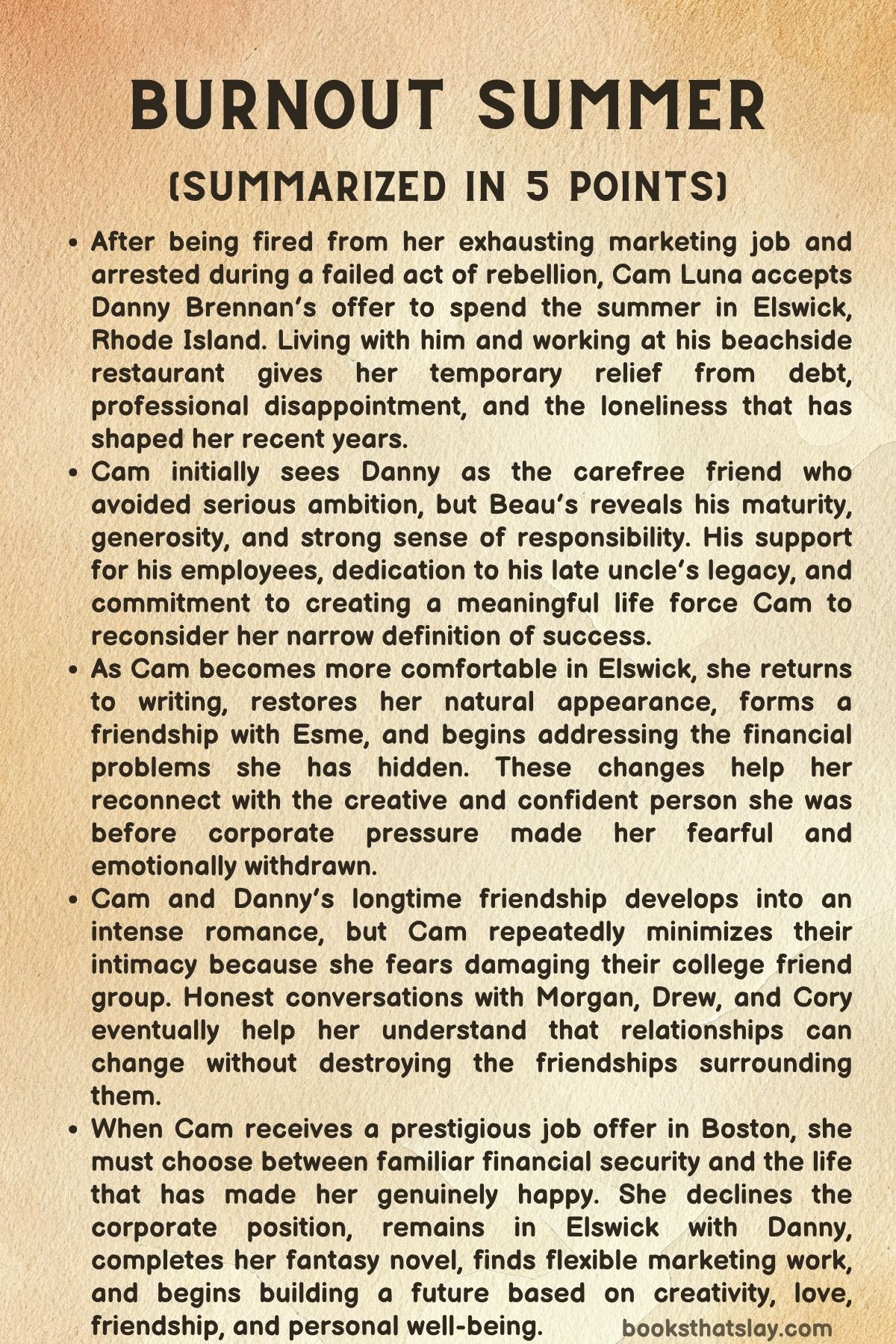
After losing her job and being arrested during an absurd moment of rebellion, Camille Luna escapes to a Rhode Island beach town where her longtime friend Danny Brennan offers her a place to recover. What begins as a temporary retreat gradually challenges Cam’s assumptions about ambition, adulthood, and happiness. Through restaurant work, renewed creativity, old friendships, and an unexpected romance, she must decide whether security means returning to a familiar career or trusting the life that makes her feel alive.
Summary
Camille “Cam” Luna’s life collapses when she is fired from her corporate marketing job in Washington, DC. Her employers tell her that her heart is no longer in the work, confirming what she already knows after years of pressure, low pay, mounting debt, and emotional exhaustion.
Angry at the system she followed so faithfully, Cam buys cigarettes even though she does not smoke. Her small rebellion becomes a disaster when she drops a lit match, starts a minor fire, argues with a police officer, and is arrested for disturbing the peace.
When Cam is released, her college friend Danny Brennan is waiting outside. He drove from Rhode Island after receiving her distressed message, and his immediate presence reminds her that their friendship remains dependable even when everything else feels unstable.
Cam admits that her financial and personal situation is worse than she has revealed. Her temporary housing ends in two weeks, her credit is poor, her debts are overwhelming, and she assumes she will have to move back into her parents’ home in Delaware.
Danny offers another possibility. He invites her to stay with him in Elswick, Rhode Island, where he operates Beau’s, the beachside restaurant he inherited from his late uncle.
Cam agrees to visit for a few days and leaves Washington with all her possessions packed into Danny’s car. During the drive, memories of their college group remind her how distant she has become from Danny, Morgan, Drew, and Cory since her breakup with Cory divided the friends.
Elswick’s coastal beauty immediately relaxes Cam. Danny’s modest apartment, rescue dog Reggie, elderly neighbors, and comfortable routines reveal that he has built a stable adult life she never fully understood.
At Beau’s, Cam meets the people who form Danny’s working community. Esme is the blunt bartender who distrusts Cam’s corporate appearance, Xavier is a welcoming senior server, Pauly is the loyal head chef, and JP is Pauly’s flirtatious son.
The restaurant awakens Cam’s long-abandoned desire to write. Danny encourages her to remain for the summer, work at Beau’s, direct her earnings toward debt, and use her free time as a writing retreat.
Cam finally tells him that her student loans have reached six figures and that credit-card debt helped her survive after rent and loan payments consumed most of her salary. Danny responds without judgment and reframes her stay as a sabbatical rather than a failure.
He also reminds her that they first met when he found her writing at college. Cam had confidently announced that she was creating the next Great American Novel, and the memory reconnects her with the hopeful young woman she once expected to become.
Working at Beau’s proves difficult. Cam spills drinks, forgets orders, burns her hand, and struggles with demanding customers, forcing a woman accustomed to academic and professional competence to accept being a beginner.
Esme also challenges Cam’s history with Danny. She points out that Danny repeatedly traveled to support Cam, while Cam never visited Beau’s during the three years he had been running it.
Cam begins recognizing how unfairly she and their college friends judged Danny. Because he rejected conventional career expectations, they treated him as immature without seeing the work, loyalty, and ethical principles behind his choices.
Xavier reveals that Danny sold a valuable inherited Volkswagen bus to create a health-insurance fund for the restaurant staff. He has also supported Xavier’s business classes and rebuilt Beau’s after his uncle’s illness forced it to close.
Danny admits that Cam’s failure to visit hurt him, though he refuses to punish her for it. The frayed bracelet he still wears from their senior-year trip to Tulum becomes evidence of how consistently he has valued their connection.
Cam’s emotional recovery begins through small routines. She cooks, works, reads, spends time with Reggie, and discusses college memories with Danny while slowly accepting that her old definition of achievement made little room for happiness.
Danny gives her a coral journal and challenges her to write two pages. She fills seven, and he rewards her by playing “Blackbird,” a song connected to her father, childhood, and several difficult moments from college.
Cam begins writing regularly and eventually develops a fantasy novel. Her creativity strengthens alongside her growing attraction to Danny, whose attentiveness and belief in her contrast with her own severe self-doubt.
Drew visits for his birthday and offers to circulate Cam’s résumé at Farley & Company, the prestigious consulting firm where he works. Cam secretly accepts his card because the possibility of a high salary and benefits seems capable of addressing her debt.
Drew’s arrival also restores part of the old college dynamic. However, Cam discovers that Danny had a serious relationship with a woman named Francesca and becomes jealous that another person knew an important side of him she overlooked.
During a karaoke event at Beau’s, Cam kisses Danny while attempting to prove that friends can kiss without changing their relationship. The kiss becomes intense, and her immediate effort to dismiss it only exposes how frightened she is by its significance.
The evening grows more painful when Cam learns that Cory is engaged to Tabitha. Danny, Morgan, and Drew have known for months, and Cory plans to hold his wedding reception at Beau’s without having invited her.
Cam’s pain comes less from romantic attachment than from realizing that her friends have been editing their lives around her. She feels pitied, excluded, and treated as though she cannot survive information about her former relationship.
Conversations with Morgan, Drew, and Danny reveal that the collapse of the friend group was not solely Cam’s responsibility. Drew’s unreturned feelings for Morgan and everyone’s divided loyalties also contributed to the strain after Tulum.
Cam begins rebuilding the friendships by listening rather than assuming closeness will maintain itself. Danny explains that burnout made her so consumed by survival that she often failed to hear what others had already tried to share with her.
Her transformation becomes visible when Esme restores her natural brunette hair. During the process, Esme describes leaving a premedical path chosen by her family and refusing to measure her life by expectations that made her unhappy.
Cam admits that she wants to write books rather than continue forcing her creativity into marketing campaigns. She also apologizes to Danny for treating his decisions as proof that he lacked ambition.
Danny explains that quitting can be a mature act when a particular path is causing harm. Together, they smoke the cigarette Cam never managed to smoke in Washington, dislike it immediately, and laugh as the symbol of her breakdown becomes a harmless shared experience.
Their attraction strengthens through an illegal nighttime swim, matching tattoo appointments, and increasingly intimate touches. Cam chooses a blackbird tattoo connected to perseverance, her father, music, and Danny’s support, while Danny chooses a sun-and-moon design that quietly refers to Cam’s surname, Luna.
Esme warns Cam that her experimentation is dangerous if she treats Danny as another temporary experience. Cam nevertheless continues denying how emotionally serious the relationship has become.
An embarrassing accident involving a vibrator leads Cam to ask Danny for help. The incident becomes sexual, and years of trust combine with long-suppressed desire as they sleep together for the first time.
The following morning, fear takes control. Cam compares their intimacy to the shared cigarette and insists that it was only an experiment, hurting Danny by erasing the feelings and vulnerability behind his actions.
Her financial anxiety soon causes a panic attack at Beau’s. Danny helps her breathe while she admits that some loans are in default and that she fears she will never afford housing, travel, marriage, or a secure future.
He encourages her to remain in Elswick rather than return to work that made her miserable. Cam admits that staying is what she wants, but she hides the fact that Drew has already circulated her résumé.
Danny later shares his grief over Uncle Beau. He feels guilty that inheriting the restaurant gave him happiness through another person’s death, and he regrets missing his final opportunity to say goodbye.
Cam reassures him that Beau chose the right person. Danny has preserved his uncle’s legacy through responsible leadership, homebrewing, community loyalty, and employee support rather than simply keeping the restaurant unchanged.
Cory visits Beau’s with Tabitha and explains why Cam was initially excluded from the wedding. He wanted to protect his fiancée and avoid complications surrounding a relationship that had once defined much of his identity.
Their honest conversation gives Cam closure. Cory also tells her that she never seemed naturally suited to corporate ambition and appears more authentic writing by the ocean and living with Danny.
Danny misinterprets Cam’s happiness after the conversation as renewed love for Cory. His jealousy leads to another argument and a second sexual encounter, making their claim of casual friendship increasingly impossible to maintain.
Soon afterward, Farley invites Cam to interview for a corporate communications position in Boston. She performs well and considers accepting because the salary, benefits, and prestige offer a recognizable route toward financial security.
Danny senses her anxiety and creates an imaginary European journey in his backyard. With carefully planned German, Spanish, and Italian food, he shows her that adventure and abundance can also arise from imagination, attention, and shared experience.
Cam is moved by the evening but still hides the interview. She knows that accepting the position could end the life she has come to love, yet uncertainty frightens her more than the misery she already understands.
On Cam’s birthday, Danny gives her a coral keyboard after noticing that the R key on her old one is broken. The personal gift supports her writing and demonstrates how carefully he observes the small difficulties she assumes no one else sees.
When the official offer arrives, Cam asks for time before deciding. She finally tells Danny, who feels betrayed that she interviewed secretly after repeatedly suggesting that she might remain in Elswick.
Their argument becomes a conflict between different definitions of adulthood. Cam emphasizes salary, benefits, and debt, while Danny argues that survival has little value when the work required destroys her health and identity.
Cam insults him by describing Elswick as a kind of Neverland. Danny explains that his goals have always included meaningful work, travel, friendship, hobbies, and memories, even if those ambitions do not appear impressive on a corporate résumé.
He finally confesses that he has loved Cam since freshman year. He stayed silent when she began dating Cory, supported her after their breakup, and continued loving her while assuming that she would never choose him.
Danny promises to support her if Boston genuinely makes her happy. He also tells her that if she chooses him, he will spend every day making sure she understands how deeply she is loved.
Morgan and Drew return for Cory and Tabitha’s wedding, recreating the warmth of the group’s college years. Their reunion proves that the friendship has survived geographical distance, romantic disappointment, and personal change.
Cam admits to Morgan that she loves Danny but fears another relationship within the group could cause permanent damage. Morgan argues that refusing happiness because of imagined future consequences would be more destructive than allowing the relationship to grow.
At Cory’s wedding, Cam realizes that she does not mourn the future they once imagined together. Watching Danny during the vows, she instead pictures writing promises about him and sharing a life in Elswick.
The reception at Beau’s confirms Danny’s talent as a business owner. Cam also discovers that the restaurant’s new designs include her blackbird symbol, revealing that Danny already imagines her as part of Beau’s future.
During a dance, he explains that the sun and moon are permanently connected, following one another through darkness and light. Cam understands that his tattoo represents their relationship and the enduring cycle through which they have repeatedly found one another.
After the wedding, Cam tells Danny that the summer restored her ability to breathe, create, and desire a future. She rejects the idea that caution should govern every decision and finally tells him that she loves him.
Danny joyfully returns her declaration, and their friends celebrate the relationship rather than treating it as a threat. Cam decides to decline the Farley offer, remain in Elswick, complete her novel, and combine restaurant work with flexible marketing assignments.
At a restored Group Breakfast, all five original college friends gather together. Danny serves beer based on his ancestor’s recipe, while Cam announces that she is choosing a life built around writing, community, love, and manageable work.
Four months later, Cam has nearly eliminated her credit-card debt, strengthened Beau’s online presence, completed her fantasy manuscript, and signed with a literary agent. Danny’s homebrewing channel is also gaining an audience, allowing them to support each other’s creative ambitions.
On New Year’s Eve, their friends reunite at Beau’s. Cam wears the old Tulum bracelet on her wrist, accepting its frayed condition as a symbol of a relationship that survived years of neglect, difficulty, and change.
The final perspective shifts to Drew, who feels lonely while watching his friends move toward marriage, love, and creative fulfillment. A conversation with Cory reveals that prestigious careers have exhausted them both, suggesting that Cam’s decision may eventually inspire others to reconsider the lives they have accepted.
Characters
Camille “Cam” Luna
Cam is the emotional and narrative center of Burnout Summer, beginning the book as a woman whose outwardly respectable life has become financially and psychologically unbearable. Her firing and arrest appear comic on the surface, but they expose years of exhaustion, shame, isolation, and anger at a system that taught her to equate obedience with future security.
Her greatest conflict is not simply unemployment or debt. She has lost the ability to recognize her own desires because nearly every major decision has been shaped by practicality, parental expectations, professional prestige, and fear of disappointing others.
Cam also carries excessive guilt over the breakdown of her college friend group. By treating the collapse as entirely her fault, she convinces herself that avoiding emotional risks will protect everyone, even though this strategy only makes her secretive and unavailable.
Her relationship with Danny exposes both her flaws and her capacity for growth. She initially takes his loyalty for granted, underestimates his work, and assumes his unconventional choices reflect a lack of maturity.
As she observes his leadership, generosity, and emotional awareness, Cam realizes that her standards for adulthood were narrow and often cruel. She learns that responsibility can include quitting harmful work, helping a community, protecting mental health, and choosing relationships over appearances.
Writing restores the part of Cam that existed before fear became her governing principle. The journal, fantasy manuscript, blackbird tattoo, natural hair, and coral keyboard each represent stages in her return to an identity she had buried.
Her romantic hesitation is believable because loving Danny requires more than admitting attraction. It demands that she reject the future she spent years preparing for and trust a life without guaranteed status or financial ease.
By the conclusion, Cam has not solved every material problem. Her student debt remains substantial, but she no longer allows unfinished progress to invalidate her happiness, creativity, or worth.
Danny Brennan
Danny initially appears to be the easygoing friend who rejected conventional ambition, but he becomes the novel’s clearest example of mature self-knowledge. In Burnout Summer, his carefree humor exists beside discipline, loyalty, business ability, grief, and a strong sense of responsibility toward other people.
His management of Beau’s demonstrates that he is not avoiding adulthood. He restores the restaurant after his uncle’s illness, supports employee education, creates a health-insurance fund, works unglamorous shifts, and searches for sustainable ways to expand the business.
Danny’s leadership is based on care rather than authority. He knows the personal lives of his employees, values their contributions, and treats the restaurant as a shared community instead of a vehicle for personal status.
His relationship with Cam is shaped by extraordinary patience. He has loved her since freshman year, respected her relationship with Cory, supported her through the breakup, and repeatedly traveled to help her while expecting little in return.
This loyalty also leaves him vulnerable. Danny is accustomed to being overlooked by friends who view his choices as less serious, and Cam’s failure to visit Beau’s confirms his fear that he matters to her only when she needs comfort.
His emotional intelligence is one of his strongest qualities. He recognizes when Cam needs humor, reassurance, silence, food, creative encouragement, or a direct challenge, often understanding her feelings before she can name them.
Danny is not endlessly passive, however. He eventually confronts Cam’s secrecy, rejects her description of Elswick as Neverland, and refuses to continue pretending their intimacy means nothing.
His grief over Uncle Beau gives greater depth to his optimism. The restaurant and homebrewing allow him to convert guilt and loss into continuity, proving that remembrance can involve innovation rather than permanent mourning.
Danny’s final relationship with Cam does not require him to rescue or financially solve her life. Instead, he gives her the emotional room to choose herself while maintaining that her decision must be freely made.
Esme
Esme enters the story as a harsh and suspicious bartender, but her bluntness is driven by loyalty rather than simple hostility. She understands how deeply Danny cares for Cam and immediately fears that Cam will use Elswick as a temporary escape before returning to corporate life.
Her early criticism forces Cam to confront facts that gentler friends have avoided. Esme points out that Danny repeatedly traveled for Cam, while Cam never took the time to visit the life he had built.
Although Esme can be abrasive, she refuses to flatter Cam or support comforting lies. She challenges Cam’s assumptions about success, warns her about the emotional consequences of sleeping with Danny, and demands that she identify what she genuinely wants.
Esme’s personal history parallels Cam’s experience. She once pursued medicine because her family valued prestigious healthcare careers, but she left when she recognized that the path did not suit her.
Her cosmetology training and work at Beau’s represent a willingness to experiment without treating uncertainty as failure. She accepts that she may not yet have one permanent vocation, showing Cam that adulthood does not require a single fixed identity.
Restoring Cam’s natural hair allows Esme to participate directly in her transformation. The process is not merely cosmetic but helps Cam reconnect with her heritage and the self she covered beneath an image designed for professional acceptance.
Esme eventually becomes one of Cam’s most important friends because she combines protection with accountability. Her final admission that Cam has truly changed confirms that Cam earned her trust through decisions rather than promises.
Drew
Drew is energetic, ambitious, generous, and often emotionally guarded beneath his humor. His promotion, expensive car, and career at Farley initially make him appear to represent the successful future Cam believes she has failed to achieve.
However, the epilogue reveals the personal cost of his professional life. Constant travel, demanding supervisors, empty apartments, and exhaustion have left him lonely despite his impressive position.
Drew’s romantic history with Morgan adds another dimension to the friend group’s collapse. His confession of feelings during the Tulum trip contributed to the tension, proving that Cam and Cory were never solely responsible for what happened.
His breakup with Aditi also reveals vulnerability. Although he jokes about being rejected for his loud and unserious personality, the experience damages his confidence and increases his fear that others will move forward without him.
Drew helps Cam reconnect with professional opportunities by circulating her résumé and later finding flexible copywriting work. His support remains valuable even when she rejects the path he initially offers.
He also acts as an observer of Cam and Danny’s attraction. His jokes about their chemistry allow him to acknowledge what both characters are trying to deny, while his eventual celebration shows that he values their happiness more than the group’s old structure.
By the end, Drew is positioned at the beginning of his own crisis. Cam’s transformation offers him evidence that leaving a prestigious but exhausting career may be an act of courage rather than failure.
Morgan
Morgan is Cam’s former roommate and one of her closest friends, but physical distance and emotional caution have weakened their communication. Her move to Copenhagen leaves Cam more isolated, while Cam’s withdrawal makes Morgan uncertain about which parts of her life are safe to discuss.
Morgan’s decision to hide information about Cory comes from protectiveness. She removes him from stories because she assumes that even casual references may reopen Cam’s pain, though the secrecy ultimately makes Cam feel excluded and underestimated.
Her honesty later helps repair their friendship. Morgan explains that everyone became trapped in divided loyalties after the breakup and that their efforts to protect Cam created new forms of harm.
Morgan also corrects Cam’s belief that relationships must remain unchanged to survive. She argues that the friend group has already endured distance, rejection, career changes, and romantic complications without disappearing completely.
Her support of Cam and Danny is especially significant because she once warned Cam not to sleep with him. After seeing the depth of their connection, she recognizes that fear of disruption should not outweigh years of genuine devotion.
Morgan represents friendship that must be actively renewed rather than passively assumed. Cam’s decision to ask about Morgan’s studies, relationships, and experiences abroad marks her return to mutual participation instead of self-absorbed survival.
Cory
Cory is initially defined through Cam’s memories as the ex-boyfriend whose breakup fractured the college group. As the story progresses, he becomes a more balanced figure with his own grief, boundaries, and right to build a future beyond their former relationship.
His decision not to invite Cam to the wedding is uncomfortable but understandable. Cam was not merely a casual girlfriend; she was closely connected to his college identity, and he wants to respect Tabitha and protect the emotional boundaries of his marriage.
Cory’s conversation with Cam provides closure because neither attempts to rewrite the past. They acknowledge that their relationship had already weakened before Tulum and that both were hurt by the loss of their friendship and shared social world.
He also recognizes that Cam followed ambition more than passion during college. His observation confirms that her life in Elswick is not a sudden reinvention but a return to qualities he noticed years earlier.
Cory’s acceptance of Danny demonstrates emotional maturity. Rather than feeling threatened, he understands that Danny’s longstanding care is different from the future he once imagined with Cam.
His conversation with Drew in the epilogue broadens the book’s treatment of burnout. Cory admits that investment banking demands extremely long weeks and has already placed strain on his new marriage, suggesting that his seemingly successful life carries serious costs.
Tabitha
Tabitha initially exists in Cam’s imagination as the woman occupying the future she once expected to share with Cory. Meeting her dissolves that symbolic rivalry because Tabitha is friendly, secure, and comfortable with Cory’s history.
Her willingness to welcome Cam to the wedding indicates confidence in her relationship. She does not demand that Cory erase his past, but she expects reasonable boundaries that allow their marriage to begin without unnecessary emotional complications.
Tabitha’s presence helps Cam recognize that Cory’s engagement is not a judgment on her worth. His ability to love someone else does not mean that Cam failed or that their former relationship was meaningless.
She also contributes to the peaceful reunion of the college friends. By allowing the wedding to take place at Beau’s and accepting Cam’s participation, Tabitha helps transform a location associated with the past into a setting for reconciliation.
Uncle Beau
Although Uncle Beau dies before the main events, his influence shapes Danny, the restaurant, and the community surrounding it. Beau’s is not merely a business inherited by Danny but a physical expression of family history, hospitality, memory, and belonging.
His decision to leave the restaurant to Danny shows that he recognized qualities others overlooked. Danny’s friends may have considered him irresponsible, but Beau trusted his loyalty, energy, and ability to connect with people.
The old ancestral beer recipe links Beau’s memory to Danny’s future ambitions. Brewing becomes a way for Danny to maintain family continuity while creating something new from the inheritance.
Beau’s unfulfilled dreams also remind Danny that a meaningful life cannot be postponed forever. The boat, World Series, Oktoberfest trip, and unfinished plans influence Danny’s determination to collect experiences rather than waiting for an ideal future.
Through Danny’s grief, Uncle Beau represents the complicated relationship between loss and opportunity. His death gives Danny a home and purpose, creating guilt that Cam helps him reinterpret as evidence of love and deliberate trust.
Xavier
Xavier is a warm and stabilizing presence at Beau’s. Unlike Esme, he welcomes Cam immediately and helps her understand the restaurant’s history without treating her inexperience as a personal failure.
His account of Danny’s leadership corrects Cam’s assumptions. Xavier explains how Danny revived Beau’s, sold a valuable inheritance to fund employee healthcare, and supported his educational goals.
Xavier’s international trips with longtime friends later trigger Cam’s panic attack, though he does nothing wrong. His experiences reveal how ordinary conversations can become painful when someone views every pleasure through the limitations imposed by debt.
He also represents the benefits of Danny’s community-centered management. Xavier is not expected to remain permanently dependent on Beau’s, since Danny actively supports his desire to study business and pursue wider opportunities.
Pauly
Pauly is Beau’s head chef and one of the restaurant’s strongest connections to Uncle Beau. His loyalty confirms that the establishment has survived because employees consider it a community rather than simply a workplace.
He helps create the continuity Danny is trying to preserve. Pauly’s knowledge and affection for Beau provide Danny with a living connection to the restaurant’s past.
His role as JP’s father also places him within the extended family structure of Beau’s. The restaurant contains multiple generations whose personal relationships exist alongside professional responsibilities.
JP
JP is younger, flirtatious, and less disciplined than the senior members of the staff. His behavior irritates Danny, but it also gives Cam opportunities to observe Danny acting as an employer rather than merely her relaxed college friend.
The illegal pool incident is especially revealing. Danny warns JP and Alice about safety and professional consequences, demonstrating that he understands when fun becomes irresponsible.
JP therefore helps expose the difference between Danny’s openness to adventure and genuine carelessness. Danny can break minor rules while still recognizing his duty to protect employees who depend on his judgment.
Francesca
Francesca is Danny’s former girlfriend and the first clear reminder that he has built a private adult life beyond Cam. Her existence unsettles Cam because it challenges her assumption that Danny has remained permanently available and emotionally unchanged.
Francesca is beautiful and friendly, refusing to behave like a romantic rival. Cam’s jealousy therefore comes from her own possessiveness rather than anything Francesca intentionally does.
The relationship also proves that Danny is capable of commitment outside the college group. His failure to tell Cam about Francesca reflects the limits of their supposedly complete friendship and the emotional distance created by Cam’s self-absorption.
Aditi
Aditi never appears directly, but her breakup with Drew reveals important aspects of his character. She reportedly viewed him as too loud and unserious, repeating the kind of judgment Danny often receives from the college group.
Her decision to end the relationship through a brief voicemail leaves Drew feeling disposable. His joking response cannot fully hide the damage caused by being rejected for qualities that form much of his public identity.
Aditi’s absence also illustrates how far Cam has drifted from her friends. Cam does not know that the relationship ended months earlier, even though she continues thinking of herself as closely connected to Drew.
Reggie
Reggie provides comfort, humor, and domestic warmth throughout the story. His presence makes Danny’s apartment feel like a home and gives Cam a form of companionship that requires no explanations or professional achievement.
As a rescue dog, Reggie also reflects Danny’s instinct to care for vulnerable lives. His daily routines with Danny reveal consistency and responsibility beneath Danny’s spontaneous personality.
Reggie becomes part of the future Cam imagines in Elswick. Her desire to remain is connected not only to romance but to the ordinary domestic life formed through walks, breakfasts, crowded furniture, and shared affection for the dog.
Axel
Axel is the tattoo artist who helps translate Cam and Danny’s emotional symbols into permanent images. His role is small, but the tattoos he creates become central expressions of identity and connection.
Cam’s blackbird represents endurance, family memory, music, and creative renewal. Danny’s sun-and-moon design quietly expresses his belief that he and Cam are linked through repeated cycles of darkness and light.
Axel later contributes artwork to Beau’s merchandise. By incorporating the blackbird into the restaurant’s visual identity, his designs make Cam’s place in Danny’s future visible before she is ready to accept it herself.
Themes
Burnout and the Cost of Conventional Success
Cam’s crisis develops from years of following rules that promise security without providing a sustainable life. Her degree, marketing position, professional clothing, and willingness to tolerate pressure create the appearance of progress while leaving her financially trapped and emotionally empty.
Her student loans are especially important because they complicate simple advice about choosing happiness. Cam cannot walk away from corporate work without considering collections, credit damage, housing insecurity, and the ordinary expenses of adulthood.
Burnout Summer does not suggest that rest alone erases these pressures. Cam’s recovery becomes possible because she combines emotional change with practical adjustments, including restaurant work, debt payments, flexible copywriting, shared housing, and careful use of her existing skills.
Danny offers an alternative model of ambition. He values memories, meaningful work, employee welfare, hobbies, community, and freedom, demonstrating that success can be measured through the quality of daily life rather than titles or salary.
Drew and Cory broaden the theme by showing that corporate exhaustion affects people who have not yet collapsed publicly. Their prestigious careers demand travel, long hours, loneliness, and strain on personal relationships, proving that visible achievement can conceal serious damage.
The story ultimately rejects the belief that suffering is proof of responsibility. Cam learns that leaving harmful work does not make her weak, especially when remaining would require the continued destruction of her health, creativity, and relationships.
Fear, Control, and Emotional Avoidance
Cam attempts to control uncertainty by reducing every choice to a calculation of potential damage. She avoids admitting her love for Danny because she believes another failed relationship within the friend group could destroy everyone’s connection.
Her guilt over Cory becomes a form of false control. By assuming that the group’s collapse was entirely her fault, she can imagine that perfect caution will prevent future pain, even though Morgan, Drew, Cory, and Danny all made independent decisions.
This mindset also shapes her career choices. Cam considers accepting the Farley position not because she believes it will make her happy but because familiar misery feels safer than uncertain fulfillment.
Her secrecy about the interview reflects the emotional cost of avoidance. She hides the opportunity from Danny because she already understands that the job contradicts her stated desire to remain in Elswick.
The relationship repeatedly suffers when Cam uses labels to deny change. Calling their kiss an experiment and their sexual encounters casual does not preserve the friendship; it wounds Danny by refusing to recognize the trust and emotion behind his actions.
Growth begins when Cam accepts that no decision can eliminate risk. Loving Danny, pursuing writing, remaining in Elswick, and declining the job may lead to disappointment, but avoidance would guarantee the loss of what she already values.
Courage therefore means acting without complete assurance. Cam’s final choice is meaningful because she does not suddenly become fearless; she decides that fear should no longer hold authority over every part of her life.
Friendship, Change, and Reconnection
The college group’s history demonstrates that friendship cannot survive through memory alone. Cam assumes that closeness will remain intact despite distance, secrecy, reduced communication, and her inability to participate in her friends’ present lives.
The breakup with Cory becomes a convenient explanation for every fracture, but later conversations reveal a more complicated situation. Drew’s feelings for Morgan, divided loyalties, protective silence, geographical separation, and individual career pressures all contributed to the group’s distance.
The decision to hide Cory’s engagement shows how care can become harmful when it denies another person agency. Morgan, Drew, and Danny want to protect Cam, but their secrecy makes her feel pitied and excluded.
Cam must also accept responsibility for her absence. Burnout narrowed her attention so severely that she missed conversations about Danny’s brewing, Drew’s breakup, and other developments in her friends’ lives.
Reconnection occurs through listening and uncomfortable honesty. Cam asks Morgan about Copenhagen, allows Drew to explain Tulum, hears Cory’s perspective on the breakup, and acknowledges the pain Danny felt when she never visited Beau’s.
Group Breakfast symbolizes the restoration of friendship without pretending that nothing has changed. Cory is married, Morgan lives abroad, Drew is questioning his career, and Cam and Danny are now a couple, yet the group can still create a shared future.
Their friendship survives because it becomes flexible enough to contain new identities. The story argues that lasting relationships are not preserved by remaining frozen but by allowing each person to grow without treating change as betrayal.
Authenticity, Creativity, and Choosing a Life
Cam’s abandoned writing dream represents the self she sacrificed while pursuing a respectable adult identity. She once approached creativity with confidence, but years of marketing work taught her to value writing only when it served clients, profit, or professional advancement.
Danny’s journal challenge begins reversing that belief. By telling her that writing does not need to become profitable or impressive, he gives her permission to create before knowing whether the work will lead anywhere.
Her physical changes accompany this creative return. Restoring her natural hair reconnects her with her heritage, while the blackbird tattoo gives permanent form to her endurance, family memories, and decision to rise after failure.
The fantasy manuscript grows as Cam becomes more honest about what she wants. Writing by the ocean is not merely a pleasant hobby but evidence that her imagination returns when her life contains rest, safety, and emotional support.
Danny’s brewing provides a parallel form of creativity. He studies recipes, keeps detailed records, wins competitions, and honors his family history without insisting that the hobby immediately become a large commercial enterprise.
Both characters resist the idea that every talent must be converted into maximum productivity. Their creative work has value because it creates joy, connection, identity, and meaning, even before it produces money or recognition.
Cam’s final arrangement balances desire with material responsibility. She continues marketing through flexible copywriting, helps Beau’s online, waits tables, pays debt, and revises her manuscript instead of treating authenticity as the rejection of all practical concerns.
Choosing a life therefore becomes an ongoing act rather than a single dramatic escape. Cam builds a future in which work supports her existence instead of consuming it, creativity is allowed to matter, and happiness is treated as a legitimate responsibility.