By the Horns Summary, Characters and Themes
In By the Horns, Ruby Dixon crafts a darkly imaginative fantasy where danger, desire, and defiance collide within the rigid walls of the Royal Artifactual Guild. The story follows Gwenna, a young woman struggling to escape the dead-end status of a repeater, who hides a forbidden gift that allows her to sense the dead.
When her path crosses with Raptor, a Taurian warrior marked by both scars and secrets, their lives become entwined in a conspiracy that threatens the entire guild. Dixon combines mystery, romance, and intrigue in a world where power and survival often come at the cost of morality and trust.
Summary
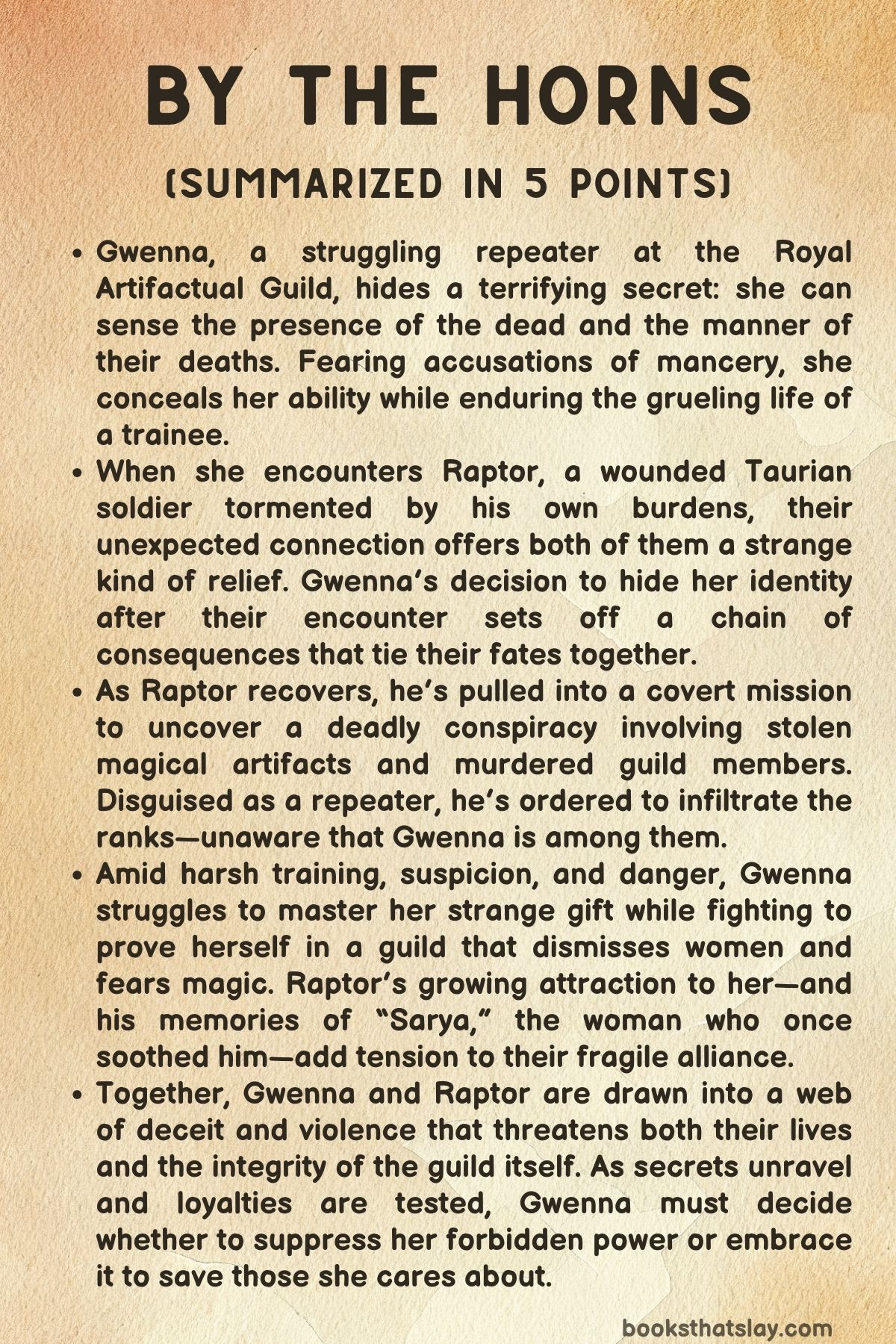
Gwenna serves as a repeater at the Royal Artifactual Guild, forced to labor in lowly tasks while aspiring to become an artificer. Her life is monotonous until she develops a strange and tormenting sensitivity to death—she can sense nearby corpses, feeling their pain and even glimpsing how they died.
This ability, tied to mancery, is outlawed, and exposure would mean execution. When she senses another murdered body near the guild, the pain nearly overwhelms her.
Seeking refuge in the hospital, she stumbles into a patient’s room where she meets a wounded Taurian male, Raptor. Mistaking her for a sex worker he requested to relieve the side effects of his unique biology, he offers a chance for Gwenna to distract herself from her agony.
She accepts under a false name, and the two share an encounter that leaves both shaken—Raptor by the tenderness of the mysterious woman, and Gwenna by the strange calm that follows.
Haunted by the murders of other repeaters and her worsening ability, Gwenna confides in her best friend Sparrow, who promises to investigate the nature of her condition. Unbeknownst to Gwenna, Raptor has drawn the attention of Hawk and Rooster, the guild’s leaders.
They reveal that valuable artifacts have been stolen, and several repeaters connected to the theft have been murdered. To uncover the culprits, they demote Raptor to repeater status, ordering him to infiltrate the lower ranks and identify the thieves.
Reluctant but bound by duty, Raptor agrees.
As Recruitment Day approaches, Gwenna hopes to finally be accepted as a fledgling artificer, but the odds are stacked against her. After facing rejection and mockery from male peers, she crosses paths again with Raptor, now posing as a fellow repeater.
Along with Kipp, her loyal friend, they form a team to find a master willing to take them in. They convince Master Jay, a gruff and difficult teacher, to accept them after proving their skills.
Unknown to Gwenna, Raptor is secretly reporting back to Hawk, monitoring his team for signs of betrayal.
Life in Jay’s dormitory is tense. Gwenna hides her identity as “Sarya,” the woman from Raptor’s hospital encounter, while trying to survive grueling tests of endurance and intelligence.
Raptor excels in every task, while Gwenna struggles, often saved by his quiet encouragement. Despite his disguise, his attraction to her grows, while she battles fear and guilt over her secrets.
Tensions within the group rise after someone defaces Gwenna’s study book with the accusation “Gwenna is a thief. ” The same message appears in her teammates’ books.
Panic spreads as suspicion divides them. Raptor, however, stands by her, tearing out the evidence and reassuring her of his belief.
The group pledges to protect one another, though mistrust lingers. They agree to investigate quietly, dividing responsibilities and keeping watch for the saboteur.
As the investigation deepens, Raptor’s feelings for Gwenna intensify, complicated by his mission. When she confides that someone is framing her, he grows protective, though he cannot reveal the truth about his undercover role.
Their partnership strengthens during harsh training sessions, and their mutual attraction becomes harder to ignore. A brief trip to visit Sparrow brings Gwenna emotional relief, allowing her to finally admit her fear that her powers make her a mancer.
Sparrow and their old friends vow to help her conceal it.
Returning to guild life, Gwenna and Raptor grow closer. He gifts her a custom weapon suited to her size—a gesture of both respect and affection.
Their relationship turns physical again, this time with trust and affection replacing anonymity. However, danger looms.
During a mission in the underground tunnels known as the Everbelow, Gwenna’s senses erupt with overwhelming visions of the dead. Losing control, she breaks from the team until Raptor finds her and calms her.
Using her abilities, she secretly guides them to the correct location of the artifact they were sent to recover, ensuring the team’s survival while keeping her secret intact.
Soon after, Gwenna’s fears prove justified when Raptor’s team is trapped underground in an ambush. Realizing the danger, Gwenna defies orders and insists on joining the rescue.
She persuades Rooster to lead a descent after revealing her knowledge of hidden tunnels used by the thieves. When the operators betray them and cut the lift ropes, they crash into the depths, surviving through sheer luck.
Gwenna, forced to reveal her necromantic sense, leads Rooster and the others through the maze of tunnels to where Raptor’s group is besieged by ratlings. She directs them precisely, enabling a daring rescue through collapsing tunnels and smoke.
In the aftermath, Gwenna wakes in the infirmary. The conspiracy is finally exposed: corrupt staff and overseers, including her former supervisor Mistress Umala, have been using the guild’s systems to traffic stolen artifacts.
The investigation confirms Gwenna’s suspicions, but her own survival now depends on secrecy. Rooster decides to protect her, publicly framing her as an undercover ally who helped expose the ring, and discreetly ignoring her forbidden magic.
In exchange, she agrees to assist the guild quietly when her abilities are needed.
That night, Raptor offers Gwenna a choice between two futures. One potion will suppress her mancer power forever, letting her live safely but powerlessly; the other will let her remain as she is.
After reflecting on her role and her growing confidence, she chooses to keep her abilities, accepting both the danger and the purpose they bring. The two finally confess their love, sealing their bond.
Months later, Gwenna stands at graduation, earning her artificer’s sash. Her team—Raptor, Kipp, Arrod, and Lark—has survived and thrived, united by shared trials.
Gwenna has mastered her connection to the dead, turning it into a strength that the guild now quietly safeguards. As she records her new guild name, Starling, she embraces a future shaped not by fear, but by courage, love, and the acceptance of her once-condemned gift.
By the Horns closes with the promise of a new beginning—for Gwenna, for Raptor, and for the guild that now protects the power it once sought to destroy.
Characters
Gwenna
Gwenna serves as the heart of By the Horns, embodying transformation, perseverance, and self-discovery within a world that punishes difference. At the beginning, she is a struggling repeater—someone who has failed the artificer trials but continues to labor within the guild in hopes of another chance.
Beneath her humility and frustration lies a profound resilience and moral courage. Her newly awakened necromantic ability to sense corpses throws her into emotional and psychological turmoil; the experience isolates her, yet it also awakens her empathy and strength.
Gwenna’s fear of exposure is constant, but it’s her compassion that defines her—her willingness to risk her life to save others and her refusal to suppress her identity even when offered an escape from it. Her journey from a terrified repeater to a self-possessed artificer named Starling represents both empowerment and reconciliation with the darker, hidden parts of herself.
Her relationship with Raptor is both grounding and redemptive, allowing her to explore vulnerability without losing her autonomy.
Raptor
Raptor, the massive white Taurian, begins as a complex blend of bravado, sensuality, and pain. Initially seen as a flirtatious and impulsive male driven by an uncontrollable libido—an aftereffect of his god-touched physiology—he evolves into one of the novel’s most emotionally layered characters.
His obsession with the mysterious “Sarya” (Gwenna’s alias) gives way to genuine devotion once her true identity unfolds. Beneath his physical power and teasing demeanor, Raptor harbors trauma from his past injuries and a longing for purpose beyond combat and lust.
His forced demotion to repeater status and secret assignment as an undercover investigator test both his pride and loyalty. Through Gwenna, Raptor learns tenderness and patience; through his trials, he regains integrity and honor.
By the story’s end, his partnership with Gwenna becomes both romantic and spiritual—a balance of protector and equal, mirroring his own internal reconciliation between beastly instinct and human heart.
Sparrow (Aspeth)
Sparrow, once known as Aspeth, represents stability and intellect amidst chaos. As Gwenna’s closest friend, she bridges the emotional and scholarly realms of the story.
Her deep commitment to research and her husband Hawk’s career is matched by her quiet defiance of the guild’s rigid structures. She becomes Gwenna’s confidante and moral anchor, risking her own safety to investigate the forbidden subject of mancery.
Sparrow’s calm, methodical nature contrasts sharply with Gwenna’s intensity, creating a bond built on trust and mutual care. Her compassion, courage, and subtle rebellion make her a quiet hero—one who enables Gwenna’s survival through wisdom rather than weapons.
Hawk
Hawk, Sparrow’s husband and a Taurian guild master, symbolizes conflicted authority and decency within a corrupt institution. Though loyal to the guild, Hawk’s moral compass often strains against its politics.
His protective instincts toward Gwenna and Raptor clash with his duty to enforce guild law, placing him in an ethical gray zone. Hawk’s respect for Raptor as both soldier and friend underscores his belief in redemption, while his partnership with Sparrow demonstrates the strength of equality within marriage—a rarity in their world.
Hawk’s nuanced role in the conspiracy shows that leadership within oppression can still harbor conscience, making him an emblem of pragmatic morality.
Rooster
Rooster, the head guild master, initially appears manipulative and cold, wielding authority with a calculating precision. Yet beneath this exterior lies strategic intelligence and an instinct for preservation—not just of the guild’s image but of its capable members.
His willingness to conceal Gwenna’s mancer identity for the greater good reveals a complex blend of ruthlessness and humanity. Rooster operates as both puppet master and protector, maneuvering pieces in a dangerous political game while quietly ensuring justice survives in some form.
His character blurs the line between villainy and pragmatism, embodying the compromises demanded by power.
Mistress Umala
Mistress Umala embodies institutional cruelty and the corrupt hierarchies that define the guild’s darker side. As Gwenna’s supervisor, she enforces the system’s gendered and classist prejudices, humiliating those beneath her to preserve her own authority.
Her involvement in the smuggling and murder conspiracy exposes her as a hypocrite—someone who weaponizes order to mask greed. Through Umala, the novel critiques how systemic oppression thrives through obedience and fear.
Her downfall is both justice and symbol, representing the necessary destruction of false order for new beginnings to rise.
Kipp
Kipp, the slitherskin repeater, brings loyalty, humor, and emotional warmth to Gwenna’s story. Despite his alien appearance and marginalized status, Kipp demonstrates humanity through friendship and quiet bravery.
He balances Gwenna’s anxiety with optimism, grounding her in companionship rather than romance. Kipp’s steady support during trials, as well as his later romance with Vik, affirms the novel’s celebration of found family and acceptance.
His success as part of the final Five underscores that merit, not origin, defines worth.
Arrod (later Cardinal)
Arrod begins as a disinterested, cocky repeater whose truancy and arrogance make him an unlikely ally. Yet his evolution reveals layers of insecurity beneath the bravado.
Over time, Arrod develops respect for teamwork and loyalty, especially toward Gwenna and Raptor. His eventual guild name, Cardinal, signifies transformation and maturity—a rebirth from selfishness into belonging.
Arrod represents the flawed but redeemable man: prideful yet capable of growth when given purpose and trust.
Lark (later Mudlark)
Lark, originally Gwenna’s friend outside the guild, reenters the narrative as a symbol of endurance and hope. Her journey from injured repeater to fully realized member of the Five mirrors Gwenna’s own arc of perseverance.
Lark’s grounded, nurturing presence balances the group’s volatility, embodying solidarity among women in hostile spaces. Her choice of the name Mudlark reflects humility and strength—the ability to find treasure in dirt, resilience in adversity.
Hemmen
Hemmen, though short-lived, plays a crucial role in shaping the group’s early dynamics. His intellectual strengths and physical frailty make him both asset and liability.
His death is tragic not only for its violence but for what it reveals—the cost of corruption within the guild and the innocence sacrificed to power struggles. Hemmen represents the archetype of the scholar crushed by the machinery of politics, his end marking a turning point that deepens the survivors’ resolve.
Naiah
Naiah is a minor yet pivotal figure whose role as Raptor’s potion supplier links the physical and moral undercurrents of the story. She moves within the shadowy margins of legality, offering both temptation and truth.
Through her, Raptor confronts the addictive reliance on suppression—whether of libido, emotion, or power. Naiah’s quiet pragmatism and ambiguous morality enrich the world’s texture, reminding readers that survival often requires bending the rules.
Themes
Identity and Self-Acceptance
Gwenna’s journey throughout By the Horns revolves around her struggle to understand and accept herself in a society that condemns the very essence of who she is. Her hidden ability to sense the dead becomes both a curse and a revelation—a secret that forces her to confront the boundaries of identity in a rigid world.
In a guild where status and conformity define worth, Gwenna’s power isolates her, making her fear discovery and punishment. Her concealment of her necromantic gift symbolizes the suppression of one’s true nature under societal pressure.
Yet, as events unfold, she begins to recognize that her ability, however frightening, grants her purpose and connection to forces beyond ordinary understanding. The conflict between fear and acceptance becomes the driving force of her transformation.
Gwenna’s eventual decision to keep her powers instead of consuming the magic-stripping draught reflects a mature embrace of her uniqueness. Rather than seeking normalcy or safety, she chooses authenticity, even when it places her in danger.
This acceptance transforms her from a terrified repeater into Starling—a woman confident enough to define her own worth. The evolution of her identity also challenges the notion of power as something purely institutional.
By choosing her path outside the guild’s constraints, Gwenna claims ownership over her abilities and selfhood. In doing so, she redefines what it means to belong—not through titles or approval, but through the courage to live truthfully in defiance of imposed limits.
Corruption and Control within Institutions
The Royal Artifactual Guild in By the Horns stands as a microcosm of systemic corruption and authoritarian control. Beneath its polished hierarchy lies a network of deceit, exploitation, and moral decay.
The guild’s leaders manipulate truth to maintain power—covering up thefts, murders, and the exploitation of repeaters to preserve their reputation. The very system that claims to foster progress and learning instead functions as an engine of fear, where secrecy and subjugation govern the lives of its workers.
Gwenna’s and Raptor’s experiences reveal how the guild consumes individuals for its own preservation, branding dissenters and outcasts as criminals or expendables. The outlawing of mancery exemplifies this obsession with control; rather than protecting society from danger, the ban ensures that those with uncontrollable, unregulated power are destroyed or silenced.
This suppression is not rooted in morality but in the guild’s fear of losing dominance. Through Rooster’s pragmatic manipulation—turning Gwenna’s exposure into a fabricated story of espionage—the novel illustrates how institutions prioritize image over justice.
Even acts of mercy are transactional. The guild’s corruption is therefore not a matter of a few bad actors but a deeply ingrained culture where loyalty is coerced, and truth is malleable.
By navigating this world of lies and emerging with her integrity intact, Gwenna exposes the fragility of authority built on deception.
Gender, Power, and Survival
From the beginning of By the Horns, Gwenna’s existence as a woman within the guild is defined by resistance. Her struggles—being undermined, harassed, and dismissed—mirror the larger dynamics of gendered oppression in patriarchal institutions.
Every interaction she faces, from Mistress Umala’s cruelty to the male students’ harassment, underscores how women must constantly prove their worth in spaces designed to exclude them. The guild’s hierarchy reinforces male dominance, and Gwenna’s persistence becomes a radical act in itself.
Her defiance against humiliation and her determination to earn her place among artificers highlight the intersection of gender and survival. Even her bond with Raptor—initially born of desperation and misunderstanding—evolves into a negotiation of power, vulnerability, and equality.
Their relationship rejects the traditional mold of protector and dependent; instead, it develops into a partnership built on mutual respect and shared defiance of societal expectations. Gwenna’s eventual success is not framed as a reward for submission but as a victory carved from defiance.
By the novel’s end, when she receives her artificer’s sash and takes on the name Starling, she does so not as a token woman allowed to succeed but as a survivor who has forced open a place for herself. Her triumph represents not assimilation but transformation of the space that sought to silence her.
The Burden of Power and Moral Responsibility
Throughout By the Horns, power is portrayed as both a gift and a burden. Gwenna’s necromantic sensitivity grants her extraordinary insight, yet it isolates her emotionally and physically, making her existence a constant negotiation between duty and self-preservation.
Her ability to sense the dead forces her into moral dilemmas—when to act, when to hide, and whether using her gift justifies the risks it brings. Raptor’s own power, embodied in his god-touched body and overwhelming libido, mirrors this tension.
Both characters are trapped by their gifts, defined and limited by what others fear in them. Their journeys converge in an exploration of how power demands moral clarity, even in a world built on compromise.
The decision to use her gift to rescue Raptor’s team, despite personal danger, demonstrates Gwenna’s growing sense of responsibility. She refuses the easier path of denial and embraces the painful knowledge that her abilities come with obligations.
Rooster’s manipulation of her powers for institutional benefit contrasts with her personal morality—where compassion and conscience outweigh political convenience. The novel suggests that true power lies not in dominance or secrecy but in the courage to act ethically when the cost is high.
Gwenna’s final rejection of the potion symbolizes this ethos: power is not something to be feared or erased but something to wield wisely and justly, even when the world condemns it.
Love, Connection, and Redemption
Amid the darkness of secrecy and corruption, By the Horns offers an emotional core rooted in love and redemption. The bond between Gwenna and Raptor grows from miscommunication and necessity into a profound connection grounded in trust and acceptance.
Their relationship is marked by imperfection—shaped by trauma, secrecy, and guilt—but it becomes a sanctuary where both can exist without judgment. Raptor, haunted by loss and the weight of duty, finds in Gwenna the first person who sees him as more than his physical strength or curse.
Gwenna, burdened by her hidden power, finds in him a partner who does not flinch from her darkness. Their intimacy, both physical and emotional, becomes a means of healing rather than escape.
The novel uses their relationship to explore redemption not as a single act but as a process of mutual recognition—learning to see one’s own humanity reflected in another. By choosing each other despite fear and uncertainty, they both defy the isolation their world imposes.
In the end, love is portrayed not as salvation from struggle but as the strength to face it together. Their union, grounded in honesty and shared defiance, restores a measure of hope in a world defined by control and secrecy.
Through them, the story affirms that connection, more than victory or magic, is what ultimately redeems the broken and gives meaning to survival.