Cage by Tia Louise Summary, Characters and Themes
Cage by Tia Louise is a contemporary romance set in Los Angeles, where championship dog grooming meets pro hockey and one shared house becomes the center of a found family. Gina Bradford is a focused, talented groomer determined to keep her emotions locked down after being hurt before.
Owen Stone is a newly traded NHL player and single dad trying to rebuild a steady life for his daughter after loss. A ruined dog-show haircut sparks their first clash, but living in close quarters keeps putting them together. Between fundraising plans, chaotic dogs, and a growing bond with a little girl who needs safety, both Gina and Owen learn what it means to choose love without losing themselves.
Summary
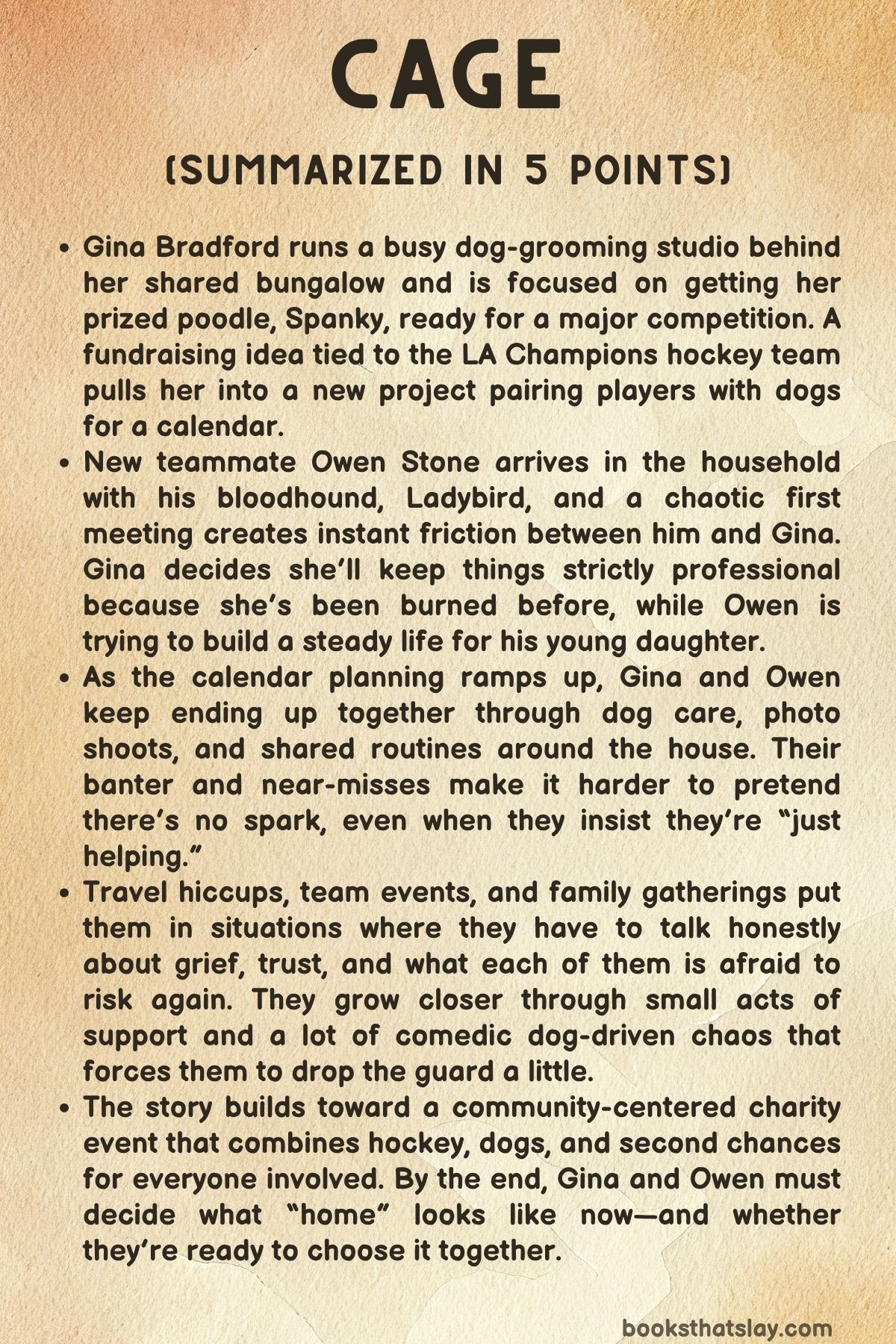
Gina Bradford runs her dog-grooming business out of a converted shed behind the Los Feliz bungalow she shares with her cousins, Haddy and Maverick. The place is busy and loud in the best way—dogs underfoot, cousins coming and going, and Haddy’s fiancé, NHL defenseman Gavin Knight, often stopping by.
Gina’s world is built on control, skill, and routine, especially when it comes to her pride and joy: Spanky, her white standard poodle. She’s preparing him for an upcoming regional competition that could qualify them for a major national show in Pennsylvania.
Spanky’s clip is detailed and demanding, and Gina is invested in getting it perfect.
Haddy, who has a background in pageants and publicity, brings a new project to the table. The LA Champions hockey team needs a fundraiser for a children’s hospital, and Haddy pitches a calendar featuring the players with dogs—either their own or foster dogs.
She calls it “Hockey Hunks and Hounds,” and she wants Gina to help find the right dogs and make sure everyone looks good and stays safe. Gina agrees, partly because the cause matters and partly because Haddy knows how to make volunteering feel like a team sport.
That decision collides with chaos when Maverick arrives at the bungalow with the team’s newest player, Owen Stone. Owen is chasing his bloodhound, Ladybird, who barrels into Gina’s grooming space at the worst possible time.
Ladybird rushes toward Spanky, and the scramble knocks Gina’s clippers off track. In a split second, a clean stripe is shaved through Spanky’s carefully sculpted pom-poms.
Gina is horrified. The show is days away, and the look can’t be fixed in time.
Owen apologizes repeatedly and offers help, but Gina’s shock turns into anger because there is nothing he can do that will replace lost time and fur.
Owen is thirty-five, a single dad, and newly traded to Los Angeles. He’s staying temporarily at the bungalow while he searches for a home for himself and his seven-year-old daughter, Maddie.
His wife Angie died years earlier, and Owen has been trying to balance grief, responsibility, and a demanding career ever since. He wants stability for Maddie more than anything, and he’s exhausted by the pressure of making the right decisions fast.
Even so, he can’t ignore Gina, who is sharp, capable, and clearly unimpressed by him.
During a patio dinner with the household, Gina explains crate training and pushes back on the idea that a crate is cruel. To her, it’s a safe space for a dog, a place that belongs to them.
Owen hates the word “cage,” and his reaction hints at the way he’s been living—always braced for loss, always afraid to trap anyone in pain, including himself. Gina listens, the others joke and tease, and for the first time Owen feels what the bungalow really is: a home built out of laughter, loyalty, and people who show up.
Gina tells herself she won’t get involved with Owen. She’s been burned before and has promised herself she will keep her heart locked up.
Owen is complicated—he has a child, a past, and a life that could pull him away at any moment. Still, small moments keep slipping past her defenses.
He helps her when an eyelash gets stuck in her eye, gentle and careful in a way that catches her off guard. They walk their dogs together, and Gina learns about Owen’s hometown in South Carolina and the family that shaped him.
Owen learns how much the dog-show world means to Gina and how hard she works for every win. He also carries guilt over ruining Spanky’s chance to qualify, and he wants to make it right even if Gina won’t accept his apologies.
Haddy’s calendar plans move forward, and Gina helps coordinate the dogs. Owen agrees to be in the shoot with Ladybird.
Their proximity creates a string of awkward, funny incidents that expose their attraction. Spanky steals Owen’s towel, and Gina accidentally walks in on Owen naked.
Owen teases her, Gina flees, and the tension lingers. Later, Gina’s private vibrator ends up in Ladybird’s mouth and lands on Owen’s bed at the exact wrong moment, leaving Gina mortified and Owen laughing so hard he can barely speak.
When the day of Owen’s calendar shoot arrives, Gina grooms Ladybird and tries to stay professional. In the grooming station, she slips and Owen catches her; they freeze in a close hold that feels too intimate to be an accident.
Before either of them can act, Ladybird shakes water everywhere and breaks the moment. The photographer, Ryan Grantham, arrives and directs Owen through hockey-themed poses.
Owen takes his shirt off for photos, and Gina struggles to keep her expression neutral. Ryan picks up on their chemistry immediately.
He even asks Gina to adjust Owen’s hair, forcing them close again while both pretend they aren’t affected.
After the shoot, teasing at the bungalow makes Gina defensive. Owen, trying to be responsible, says he can’t handle a relationship right now because of his daughter and the season.
Gina hears it as rejection and snaps back, hurt that he assumes she wants anything from him. Their argument turns sharp, and then Ladybird knocks Gina right into Owen’s arms.
Owen admits he wants to kiss her, but he pulls away, saying there are too many reasons he shouldn’t.
Not long after, Gina’s car breaks down while she’s out for a dog show. Maverick can’t get to her, and Owen volunteers.
He finds Gina stranded and suspects a serious mechanical problem that will require towing. On the drive back, traffic stops due to a bridge closure after a semi spills pillows and feathers across the road.
With no quick route home, they end up at a quirky motel called the Delve Inn, run by a manager who leans into a creepy, horror-movie vibe. There’s only one small bed.
Gina insists they share it rather than Owen sleeping elsewhere, and the forced closeness strips away some of their careful distance.
Over takeout eaten on the floor, they talk honestly. Owen speaks about loss and how it changed him.
Gina opens up about a past relationship where she waited to sleep with a man, only to be ghosted afterward, leaving her feeling foolish for trusting him. As the night stretches on, the motel’s mood turns into a kind of game: they roleplay as different people, pretending the night is separate from real life.
The flirting escalates into sex, and they agree to treat it as a one-night fantasy. In the morning, they leave with a quiet tension neither of them knows how to name.
Back at the bungalow, Maddie arrives with Owen’s younger half-sister, Heather, who claims she has psychic dreams. Owen is overwhelmed seeing Maddie again, and Gina meets her for the first time.
Gina bonds with Maddie easily, talking with her, making her laugh, and earning trust without trying too hard. The house fills with wedding plans for Haddy and Gavin, and the group suddenly decides to move the wedding to Newhope, their hometown, on short notice.
They travel, and Gina becomes distant with Owen, watching him with Maddie and feeling the ache of wanting a place in their world while fearing the cost of it.
In Newhope, family and friends rally around the wedding. The women spend an evening drinking and doing tarot readings, where Gina receives a message about perseverance and cautious hope.
It lands on her like a warning and an invitation at the same time.
Back in Los Angeles, the hockey season and the household chaos continue. A Halloween party at the bungalow brings their attraction to the surface again.
Gina shows up in a shimmering sea-creature costume, and Owen can barely keep his hands to himself. When Owen sees teammate Donovan talking closely with Gina, jealousy hits hard.
Gina pulls Owen aside and makes him swear secrecy: Donovan is gay, and Owen has misunderstood everything. Owen apologizes, embarrassed by how quickly he lost control.
The tension between them flips from anger to hunger, and they sneak into the laundry room for sex. Afterward, Owen admits he didn’t know he could feel jealousy like that, and Gina promises she isn’t going anywhere.
Their connection starts blending into the larger household plans. Gina suggests a Día de los Muertos charity event for foster dogs, and she explains fostering to Maddie in a way that clicks.
Maddie compares herself to a foster dog because her mother died, and Gina and Haddy reassure her with care and honesty. Meanwhile, the men find a nearby house for sale and decide to make an offer so Owen and Maddie can live close by.
Owen agrees because he wants to be near the people he’s grown to care about.
At an adoption event connected to the calendar, a player adopts a beagle, and the team energy feels more like a community than a workplace. Owen takes Gina to see his new house before it’s officially theirs.
It’s spacious, with vaulted pine ceilings and a backyard cottage. Owen shows Gina the cottage and hints it could become her workspace, imagining a future where her career and their lives fit together.
When Owen moves in, Heather throws a disco-themed housewarming party. Gina arrives dressed to match the theme, and Owen kisses her openly at the door.
The night goes sideways when Heather offers “Russian chocolate” that turns out to be psychedelic mushroom chocolate. Owen and Gina retreat to ride it out.
Owen’s experience becomes intense and emotional: he sees a vision of Angie, who tells him she’s at peace and urges him to stop punishing himself and take care of Maddie and his own life. Gina’s experience is stranger and more playful, full of images that leave her thinking about love and family.
When it ends, both of them feel changed, even if they can’t fully explain it.
Owen tries to move things forward on a brunch date, telling Gina he wants more than friendship but fears Maddie getting attached if Gina might leave. Gina hears it as Owen placing responsibility on her and storms out.
Owen chases her, finally catching her on the street, and admits the truth: he’s terrified because he wants her so much and it’s moving fast. Gina admits she wants him too, and they kiss with strangers cheering them on.
Soon after, Owen goes back to South Carolina for the holidays and disappears for days without handling things well. Gina feels abandoned and furious.
Owen returns to Los Angeles with a plan to apologize, coordinating with friends to cover the bungalow with flowers because Gina once said she wanted flowers “just because.” Gina doesn’t soften immediately. She calls him out for going silent and for letting his jealousy and fear turn into withdrawal.
Owen admits he was miserable, not carefree, and that he needed space because he didn’t know how to handle how strong his feelings are. Gina sets a clear boundary: she won’t stay with someone who shuts her out instead of talking.
Owen asks for a small step back toward each other and requests that Gina cut his hair. In her grooming studio, she trims it carefully, and the quiet focus helps them calm down.
Owen promises that words aren’t enough and he will prove himself through actions.
Then panic hits: Spanky is missing. The group searches the neighborhood, calling his name.
Owen arrives with Heather and Maddie, and Maddie suggests using Ladybird to help. They rush to Owen’s house and find Spanky sitting calmly in Ladybird’s crate beside her, as if he chose the place on purpose.
Gina’s relief is immediate and messy, and the moment highlights how deeply these lives have blended. Maddie also blurts out that Gina isn’t “Aunt Gina” because she isn’t with Owen—yet, making the emotional stakes impossible to ignore.
That night, Owen talks with Maddie, who admits she loves Gina and wants her to stay so she can have a mother figure in her life. With Maddie’s support, Owen goes to Gina and proposes with a ring featuring paw-print diamonds.
He tells her he even asked her father for permission. Gina says yes, crying, and they finally stop pretending this is temporary.
They prepare for a “Pucks and Pups” charity dog show at the hockey rink that combines the team, the dogs, and fundraising for fostering and adoption. Gina coaches the players through handling and presentation.
On the day of the show, Maverick fakes an ankle injury, forcing Gina to walk Spanky in his place. Gina steps into the ring, surprised by her own nerves, and performs well.
When Spanky is awarded Best in Show, the win is revealed as an official recorded victory arranged as a surprise to make up for what Ladybird’s chaos took from them earlier. Gina realizes the people around her have been quietly repairing old hurts in the way they know how: with planning, teamwork, and love.
Gina moves into Owen’s house, but she worries about leaving Maverick alone. That problem resolves when a woman named Dove arrives looking for Hayden, and it turns out she can stay with Maverick, who is immediately flustered around her.
The household shifts again, making room for new dynamics and new possibilities.
Owen invites Gina to South Carolina for Christmas to meet his family, and she goes. She’s welcomed into their traditions, their noise, and their warmth.
In a final moment that feels like a blessing, Maddie says she saw Angie and that Angie placed Maddie’s hand into Gina’s, joining them together. Owen and Gina hold Maddie close, accepting that their family is not a replacement for what was lost, but a future they are building on purpose—one chosen step at a time.
Characters
Gina Bradford
In Cage, Gina Bradford is introduced as a woman who has built a life around precision, caretaking, and control—qualities that show up most vividly in her identity as a champion dog groomer and in how fiercely she guards what matters to her. Her grooming work isn’t just a job; it’s the place where she feels competent, respected, and safe, which is why the accident with Spanky’s show cut hits her like a personal betrayal of all that discipline.
Gina’s emotional world is shaped by an earlier romantic wound that taught her to keep her feelings “caged,” and that mindset becomes both her armor and her trap: she craves connection but interprets vulnerability as a risk she can’t afford. With Owen, she oscillates between sharp self-protection and unmistakable desire, and that push-pull reveals how deeply she wants to be chosen without being made responsible for someone else’s fear.
Over time, Gina’s growth isn’t about becoming softer in personality—she stays witty, stubborn, and exacting—but about allowing her boundaries to coexist with intimacy, learning that love can be steady rather than destabilizing, and that being needed doesn’t have to mean being consumed.
Owen Stone
Owen Stone functions as the emotional counterweight to Gina: he’s steady, devoted, and deeply affectionate, yet burdened by grief that still shapes his choices years after Angie’s death. As a single father and professional athlete, Owen appears confident in public roles—hockey, team dynamics, providing for Maddie—while privately he’s cautious, almost hyper-aware of how easily happiness can be taken away.
His discomfort with the word “cage” becomes a revealing psychological marker: he hears confinement where Gina sees safety, and that difference exposes how he associates love with potential loss and guilt. Owen’s attraction to Gina is immediate, but what complicates it is not hesitation about her; it’s hesitation about himself—about whether moving forward is disloyal to the past and whether his fear will hurt the people he most wants to protect.
His jealousy, withdrawal, and “disappearing” are not framed as simple flaws so much as a grief response: when he feels emotionally out of control, he defaults to distance. The turning point for Owen is when he stops treating love like something he must earn through suffering and instead accepts that choosing Gina doesn’t erase Angie; it expands his life.
By the time he proposes, he has moved from guarded longing to active commitment, demonstrating that his healing isn’t only internal—it’s expressed through tangible, accountable action.
Spanky
Spanky is far more than a pet; he is Gina’s pride, her creative canvas, and a symbol of how much she invests in excellence. The detailed show grooming, the perfection of the clip, and the heartbreak of the ruined pom-poms all reflect the emotional stakes Gina places on competence and achievement, and Spanky becomes the living embodiment of her standards.
At the same time, Spanky has a gentleness and steadiness that contrasts Gina’s internal turmoil: his comfort in the crate underscores the story’s broader argument that what looks like limitation can actually be security. When he goes missing near the end, the panic isn’t just about losing a dog—it’s about Gina feeling, once again, that something precious can slip away despite her careful control.
His eventual choice to sit beside Ladybird in the cage like he belongs there becomes a quiet but powerful resolution symbol: he gravitates toward safety, companionship, and home, mirroring Gina’s own reluctant movement toward those same things.
Ladybird
Ladybird acts as comic chaos, emotional catalyst, and unexpected bridge between characters—especially Gina and Owen. Her exuberance is the trigger for the grooming disaster, which makes her the starting point of tension, but she also becomes a recurring agent of forced intimacy, constantly dragging private moments into the open and refusing to let the household stay emotionally “neat.” The dog’s behavior—barreling through rooms, stealing objects, causing accidents—creates situations where Gina and Owen can’t stay distant for long, and that persistent disruption mirrors the way their attraction keeps breaking through their defenses.
Yet Ladybird also carries a softer symbolism: she is Owen’s anchor and a piece of continuity for Maddie, a living comfort that travels with them through instability. Her ability to track, to settle, and ultimately to be the reason Spanky is found safely suggests that beneath the chaos is loyalty and instinctive care.
In a story preoccupied with the idea of containment and freedom, Ladybird is the wild-hearted reminder that love doesn’t always arrive politely—it sometimes charges into your life and knocks you straight into what you’ve been avoiding.
Haddie
Haddy serves as the social engine and emotional glue of the Los Feliz household, shaping the story’s community warmth and pushing the plot forward with her ideas and energy. With her background in pageants and publicity, she understands how to package people and moments—hence the calendar fundraiser—and she uses those skills in a way that’s both practical and generous, channeling attention into charity while strengthening the family’s bonds.
Haddy is also protective in a way that feels lived-in rather than dramatic: she knows Gina’s weak points, sees Owen’s intentions, and quietly nudges them toward honesty without letting either of them sink into self-sabotage unchecked. Her wedding and motherhood expand the novel’s portrait of family as something built by choice and effort, not just biology, and she helps normalize the idea that a household can hold complicated histories without being broken by them.
Even when she teases, there’s a steadiness underneath—Haddy is the person who keeps joy in the room, especially when the main characters are tempted to retreat into fear.
Gavin Knight
Gavin is positioned as both romantic partner to Haddy and a stabilizing presence in the broader group, offering an example of dependable love that contrasts with Gina and Owen’s uncertainty. As an NHL defenseman, he shares Owen’s professional world, which makes him a useful bridge for Owen’s integration into the team and the household, but his real value is emotional: he’s comfortable with intimacy, family life, and commitment, and he models what “safe” can look like.
His calm participation in the household banter and his supportive role during conflicts help keep tensions from escalating into ruptures, and his presence subtly reinforces the story’s idea that stability is not boring—it’s a choice people make daily. As a new father, Gavin also deepens the family-centered atmosphere and helps create a space where Maddie’s feelings can be handled with care rather than awkward avoidance.
Maverick
Maverick is the loud spark of the household and the friend who keeps the emotional temperature high, often through humor, competitiveness, and impulsive schemes. He brings Owen into the group dynamic through hockey camaraderie and also plays a protective cousin role around Gina, which adds pressure because Owen knows he isn’t simply dating someone—he’s entering a family system.
Maverick’s superstitions, prank energy, and party leadership create a constant sense of movement in the story, and that motion often forces characters to act instead of overthink. His staged “injury” during the charity show reveals a more tender side: he’s willing to orchestrate a whole performance if it means giving Gina and Spanky the recognition they lost earlier, which frames his teasing as love expressed through action.
Later, his flustered reaction to Dove hints at his own vulnerability and sets him up as someone who may be braver in jokes than in romance, making him a character whose charm is inseparable from the insecurity he tries not to show.
Maddie Stone
Maddie is the emotional center of Owen’s life and the clearest reason his choices carry stakes beyond adult desire. She is written as a child who is bright, imaginative, and openhearted, but also quietly navigating grief that she doesn’t always have language for, which is why her “foster dog” comparison lands with such weight: it’s her attempt to explain displacement and loss in terms she can manage.
Maddie’s bond with Gina forms quickly because Gina treats her with both warmth and respect, talking to her as someone capable of understanding rather than someone to be shielded from reality. That relationship becomes the story’s moral compass—if Owen and Gina are together, it must be in a way that protects Maddie’s need for stability without turning her into a barrier or a bargaining chip.
Maddie’s desire for Gina to stay is not portrayed as childish wish fulfillment; it’s presented as a child recognizing safety when she feels it. By the end, Maddie becomes a symbol of the family they are building—one that honors the past while allowing the future to be real.
Heather
Heather is the chaotic truth-teller who pushes emotional themes into the open, often by refusing to treat them delicately. Her belief in her own psychic abilities could easily read as comic relief, but in practice it functions as a narrative device that gives Owen permission to confront feelings he would rather rationalize away.
Heather’s relationship with Owen shows sibling intimacy mixed with friction: she resists being managed, he struggles not to protect her to the point of controlling her, and their arguments reveal Owen’s tendency to clutch tightly when he’s afraid. She also becomes a catalyst in key moments, especially when she reframes Owen’s guilt and insists that moving forward is not betrayal.
Even her mistake with the mushroom chocolate—reckless as it is—produces a turning point where Owen faces a symbolic confrontation with Angie and is forced to stop hiding behind grief as an excuse for paralysis. Heather’s role in the story is to disrupt denial; she is the character who makes avoidance difficult, and that makes her strangely essential to everyone’s healing.
Angie Stone
Although Angie is absent in the present timeline, she remains emotionally present as the gravitational force around which Owen’s guilt and fear orbit. She is not treated as a romantic obstacle in a competitive sense; instead, she is the representation of a love that ended without choice, leaving Owen with unresolved responsibility and self-blame.
Angie’s significance is most visible in the way Owen measures himself—his parenting, his readiness, his right to happiness—against the standard of what he lost. The psychedelic vision of Angie functions less as supernatural proof and more as an emotional reckoning: Owen hears what he needs to hear in order to stop punishing himself, and the story uses that moment to separate memory from imprisonment.
By the end, Angie’s presence becomes a blessing rather than a chain, especially through Maddie’s final experience, which frames the new family as something that can exist alongside love that came before, not in competition with it.
Gwen
Gwen, Owen’s step-grandmother, appears briefly but carries an outsized symbolic role as the keeper of tradition, stability, and the family rituals that help Owen and Maddie feel anchored. She represents the version of family that persists through hardship—the Friday-night tradition, the familiar structure, the sense that love can be repeated safely through routine.
In a narrative that keeps returning to the question of what “home” feels like, Gwen stands for continuity: the reassurance that a family can hold grief and still be warm, funny, and functioning. Her presence strengthens the idea that Owen’s life didn’t end with Angie’s death; it continued in community, and that community can make room for Gina.
Ryan Grantham
Ryan is the photographer whose role is partly professional and partly narrative pressure: he captures what Gina and Owen are trying not to admit. By framing their body language and chemistry as obvious, he forces them to confront the gap between what they say and what they show, which heightens the tension in a way that feels playful but also exposing.
Ryan’s work also underscores a recurring theme: being “seen” can be uncomfortable when you’re hiding from yourself. He isn’t deeply explored beyond his function, but that function matters—he acts as an external mirror, turning private desire into something that feels publicly legible, which is exactly what Gina and Owen fear.
Carla
Carla appears as Gina’s shelter connection and a reminder that Gina’s world is larger than romance and competitive grooming; it includes community care, advocacy, and practical work that changes outcomes for animals. Her presence grounds the charity elements—fostering, adoption events, the fundraiser show—in a reality beyond the household’s banter, showing that Gina’s competence isn’t only aesthetic, it’s also ethical.
Carla serves as a supporting character who reinforces Gina’s values: responsibility, compassion, and doing something tangible when you care.
Ned
Ned, the Delve Inn manager, is written as a deliberately unsettling, theatrical figure who intensifies the weird liminal energy of the motel stop. He turns a practical inconvenience into a scene that feels like a horror set, which nudges Gina and Owen into roleplay and lets them step outside their usual identities.
Ned’s primary purpose is tonal: he makes the night feel detached from their normal lives, enabling them to pretend it can be “just one night,” even as the reader can sense it won’t stay contained. He represents the story’s flirtation with fantasy—the way people sometimes need a slightly unreal space to admit what they want.
Clint
Clint is the professional planner who embodies competence under pressure, stepping into the chaos of last-minute wedding changes with calm authority. He highlights the contrast between logistical control and emotional control: while the wedding can be rearranged with enough organization, hearts are harder to schedule.
Clint doesn’t dominate scenes, but his presence underscores how intense and interconnected the community is in Newhope, where help arrives quickly and efficiently, reinforcing the novel’s theme that people are held up by networks, not just individual strength.
Dove
Dove arrives late but immediately shifts the household’s future by offering a practical solution to Gina’s worry about leaving Maverick alone, while also opening a door for Maverick’s own romantic trajectory. She is portrayed as a familiar outsider—someone connected by history but new to the current dynamic—and that duality lets her fit quickly without feeling intrusive.
Dove’s impact is subtle but meaningful: she symbolizes how the story’s world keeps expanding to make room for change. Her presence supports the ending’s sense of harmony by resolving a logistical concern while hinting that everyone, not only Gina and Owen, is moving toward connection.
Themes
Emotional Safety, Boundaries, and the Meaning of a “Cage”
Gina’s everyday work with dogs becomes a practical language for how she manages her own heart in Cage. She isn’t just grooming coats or teaching crate training; she’s translating the idea of safety into something a person can live inside.
The crate argument at dinner is a turning point because it frames “cage” as a choice rather than punishment. To Gina, a crate is a space a dog can rely on when the world is loud, unpredictable, or overstimulating.
That explanation quietly mirrors her own strategy: after being hurt before, she chooses emotional distance, calling it keeping her heart “caged,” because distance feels like control. Owen’s discomfort with the word shows he hears “cage” as loss of freedom, which matches how grief and responsibility have confined him since Angie’s death.
He is not afraid of commitment in the abstract; he is afraid of trapping his daughter in another unstable situation and afraid of trapping himself in a feeling he can’t regulate.
What makes this theme work is how often the story tests the difference between protection and avoidance. Gina’s rules—stay professional, stay platonic—initially look like self-respect, but they also keep her from being seen.
Owen’s repeated apologies, attempts to help, and push to find a home nearby are bids for steadiness, yet he still retreats when intimacy asks for clarity. Their conflicts expose how “safety” can become a shield that blocks growth.
The motel night is a controlled experiment: a one-night fantasy with pretend names and a promise that it won’t change anything. It gives them closeness without accountability, which is exactly what a cage can do when it is built for fear rather than healing.
The resolution doesn’t reject boundaries; it upgrades them. Gina learns that boundaries aren’t supposed to punish someone for being human, and Owen learns that boundaries aren’t a substitute for communication.
When Owen returns with grand gestures after going silent, Gina doesn’t accept romance as payment for emotional absence. She insists on reliability, on staying present in conflict, and on not letting jealousy justify shutting her out.
By the end, the “cage” becomes a shared symbol: not isolation, but a safe structure where love can rest without getting destroyed by panic, guilt, or old wounds.
Grief, Guilt, and Permission to Love Again
Owen’s life is organized around what he has lost, and the story treats grief as something that changes time, identity, and risk tolerance. His wife Angie is not a distant backstory; she is a living presence in how he parents, how he makes decisions, and how he interprets desire.
He carries guilt that is both practical and emotional: practical in the sense that he must keep Maddie stable, and emotional in the sense that he worries loving Gina would diminish what he had with Angie. That fear turns love into a moral problem instead of a human need.
It explains why he keeps naming reasons not to cross the line even when his body, attention, and jealousy show he already has.
The psychedelic “Russian chocolate” episode becomes important because it gives Owen a direct experience of release from self-blame. The vision of Angie telling him she is at peace functions as permission, but not in a simple, magical way.
It forces him to face the truth that he has been using guilt as a way to keep control: if he keeps suffering, he can prove he loved her enough. That kind of guilt is familiar to many grieving people because it feels loyal, but it can also become a trap that blocks new attachment.
The narrative uses this moment to shift Owen’s internal logic from “moving on equals betrayal” to “living fully honors what I had.” Heather’s belief in signs and psychic dreams adds social reinforcement; even if a reader interprets it as coincidence, it still shows how family stories can help someone build meaning after loss.
Gina’s relationship to grief is different but related. She is not grieving a death; she is grieving the humiliation of being disposable, the sting of waiting, trusting, and then being ghosted.
That experience taught her that vulnerability makes you easy to abandon, so she treats commitment as a situation where the other person holds all the power. When Owen goes silent for three days after jealousy, it hits that old bruise and confirms her worst expectation: when things get hard, the person leaves.
Her anger isn’t only about those days; it’s about what those days symbolize—being left without explanation, being denied the chance to speak, being made small by someone else’s fear.
The theme resolves through a realistic exchange of needs. Owen doesn’t “get over” Angie; he integrates that love into a larger life that includes Gina and Maddie.
The scenes where Maddie expresses wanting a “mommy here on Earth” are emotionally charged because they show grief from a child’s angle: Maddie does not replace her mother; she wants care, presence, and security now. Owen’s proposal is not framed as forgetting, but as choosing to build a stable family while holding the past with respect.
The final moment where Maddie describes a vision of her mother joining her hand with Gina’s reinforces the idea that love after loss can feel blessed rather than forbidden, especially when it centers the child’s need for safety and continuity.
Desire, Embarrassment, and the Shift from Private Fantasy to Chosen Intimacy
Physical attraction isn’t presented as a side note; it is one of the engines that forces honesty. Gina’s embarrassment—seeing Owen naked after Spanky steals the towel, the vibrator incident with Ladybird, getting flustered during the photo shoot—keeps exposing what she is trying to deny.
These moments are comedic on the surface, but they also reveal a pattern: Gina can handle competence, rules, and professionalism, yet she struggles with her own desire because desire makes her visible. She wants Owen, and wanting him makes her feel foolish, because it reminds her she can’t fully control outcomes.
Owen uses teasing as a way to keep the mood light, but it also lets him approach intimacy without having to declare an emotional plan. Humor becomes a safe wrapper around vulnerability.
The calendar fundraiser is a clever stage for this theme because it forces their bodies and their social roles into the same frame. The shoot literally positions Owen as an object of attention—shirtless, posed, watched—while Gina is asked to touch him in a “professional” way by fixing his hair.
That blurs the line between work and want, and it increases the tension because neither can pretend it’s only in their head. When Ryan says they have chemistry, Gina’s denial is not only about propriety; it’s fear of being read correctly.
Being seen as a couple would make her responsible for what happens next, and she isn’t ready for that responsibility.
The motel night pushes private fantasy into action. Roleplay allows them to step outside their real fears—his guilt, her distrust—and have intimacy without naming the future.
But the morning after shows the cost of that strategy: closeness creates emotional consequences even if you call it a one-night agreement. Later, the laundry-room sex during the Halloween party highlights how secrecy can intensify desire while also creating risk and instability.
Owen’s jealousy about Donovan, his impulsiveness, and their rushed choice-making show how desire can become messy when it replaces direct conversation. Gina’s promise that she isn’t going anywhere is tender, but it also hints at how much reassurance Owen needs and how much Gina has started to care.
What changes is not the presence of attraction but the way they handle it. Over time, intimacy becomes less about accidents, hiding, and adrenaline and more about mutual choice.
The haircut scene is significant here because it’s quiet, domestic, and controlled—touch without performance, closeness without spectacle. It communicates care and trust more than heat.
By the time Owen kisses Gina openly at the housewarming party, desire has shifted from something that happens to them into something they choose publicly. The story treats mature intimacy as a blend: the spark remains, but it is supported by accountability, communication, and a willingness to be known without turning it into a joke or a secret.
Community as a Support System and the Making of a Family
The household dynamics create a world where relationships are constantly observed, teased, and supported, and that community pressure shapes the romance in productive ways. Gina’s home is already a chosen-family setup: cousins, partners, teammates, and dogs sharing space, routines, and responsibility.
That matters because it normalizes care. Owen enters this environment as a newcomer who is searching for a house but also searching for belonging.
His exhaustion from house-hunting is not just about real estate; it reflects his uncertainty about where he and Maddie fit after loss. The group offers him something he can’t buy: an everyday network that notices when someone is struggling, makes meals together, and treats a child like a shared priority.
This theme is reinforced through events that turn private lives into communal projects. The calendar fundraiser ties the team to foster dogs and the children’s hospital, which means affection is constantly linked to service.
The adoption event, the planning for “Pucks and Pups,” the charity show at the rink—these are not background decorations. They show a community that channels energy into helping, and that gives the romance a healthier container.
Gina and Owen aren’t only attracted; they are also aligned in what they care about. Gina’s expertise becomes a resource for everyone, and Owen’s willingness to join in shows he isn’t just taking up space—he is contributing.
Community also acts as accountability when things go wrong. When Owen disappears for days after jealousy, it doesn’t happen in a vacuum.
Maverick pushes him to go upstairs and face Gina. Heather challenges his avoidance and frames his fear as something he must outgrow for Maddie’s sake.
Even Maddie, in her child honesty, forces the adults to confront what their choices mean. Her comment about not calling Gina “Aunt Gina” because she isn’t with Owen yet shows how children map relationships quickly and feel the uncertainty adults try to hide.
That pressure can be uncomfortable, but it keeps Owen from staying in emotional limbo and keeps Gina from pretending she doesn’t care.
The community theme reaches its emotional peak in the Spanky search and discovery. The neighborhood hunt is a collective mobilization of love, and Spanky being found sitting calmly in Ladybird’s cage is a visual summary of belonging: the “cage” as safety, the dogs as family, the home as a place where missing pieces return.
It’s also a moment where Gina’s fear and Owen’s fear meet in the same space—both are terrified of losing what they love. The story suggests that family isn’t formed only by romance or biology; it’s formed by repeated acts of showing up.
Owen proposing after talking to Gina’s father, the group arranging Spanky’s Best in Show surprise, and the practical solution of Dove moving in with Maverick so Gina can move forward without guilt all show family as something built through logistics, care, and shared intention. By the end, the relationship is not only “Owen and Gina” but a whole network that makes their commitment sustainable.
Identity, Competence, and Being Valued Beyond Performance
Gina’s identity is rooted in mastery. She is a champion groomer, a professional with a specialized craft, and her relationship with Spanky is partly about excellence and recognition.
The early grooming accident matters because it threatens more than a weekend win; it threatens the part of Gina that feels secure when she can control outcomes through skill. The ruined pom-poms symbolize how quickly something precious can be damaged by someone else’s chaos.
Her devastation is professional, personal, and emotional at once. It highlights a fear that even when she does everything right, she can still lose what she worked for, and no apology can restore it on her timeline.
Owen’s identity is also tied to performance, but in a different arena. He is a professional athlete joining a new team, trying to earn trust, improve plays, and build a reputation.
His rising fan rankings and jersey sightings give him external validation, yet his private life remains fragile. The contrast shows that public success doesn’t automatically create inner stability.
He can score, practice, and win, and still feel unsteady about parenting, grief, and love. Both characters live in worlds where praise is visible and failure is obvious, which makes vulnerability hard.
If you are used to being evaluated, you start to treat relationships like tests you could fail.
The fundraiser calendar adds another layer because it turns their bodies and images into content for public consumption. Gina becomes “the animal coordinator,” valued for her expertise, yet she is also pulled into the spectacle of Owen’s attractiveness and their chemistry.
That creates a tension between being valued for what she does and being wanted for how she makes someone feel. Her past experience of being ghosted after waiting for sex suggests she fears being reduced to a moment of gratification.
Owen’s fear of moving too fast with Maddie suggests he worries about choosing wrong and hurting his child. Both fears connect to identity: Gina wants to be respected, not used; Owen wants to be a good father, not a reckless man chasing comfort.
The story repeatedly asks what it looks like to be chosen in a way that honors competence rather than exploiting it. Owen asking Gina to cut his hair is not just a romantic excuse for closeness; it is a request that places her skill in the center and treats her as a person whose hands can calm and care.
Likewise, the final Best in Show surprise repairs the original grooming loss, but it does more than “make up” for it. It communicates that Gina’s dreams matter to the people around her, and that her work deserves celebration, not just quiet endurance.
When she walks Spanky in the ring, it places her publicly in the role she has earned, while surrounded by people who want her to win for herself, not for their benefit.
By ending with Gina moving in, planning a future, and being welcomed into Owen’s family traditions, the narrative affirms a shift from performance-based worth to relational worth. They are not only impressive at what they do; they are loved for who they are when they are tired, scared, jealous, embarrassed, or unsure.
The theme argues that competence can provide pride and structure, but lasting security comes from being valued beyond the roles you play and the wins you collect.