Cape Fever Summary, Characters and Themes
Cape Fever by Nadia Davids is a historical novel set in Cape Town in 1920, where a young domestic worker, Soraya, takes a live-in job at an uneasy household in the Southern Cross Colony. What begins as work—fires to light, floors to polish, meals to serve—slowly becomes a study in power: who gets to speak, who gets to read, who gets to leave.
In Mrs. Hattingh’s half-empty house, Soraya encounters loneliness, scrutiny, and the strange company of lingering presences. As weeks pass, love letters, grief, and control tighten into something dangerous, forcing Soraya to choose between obedience and survival.
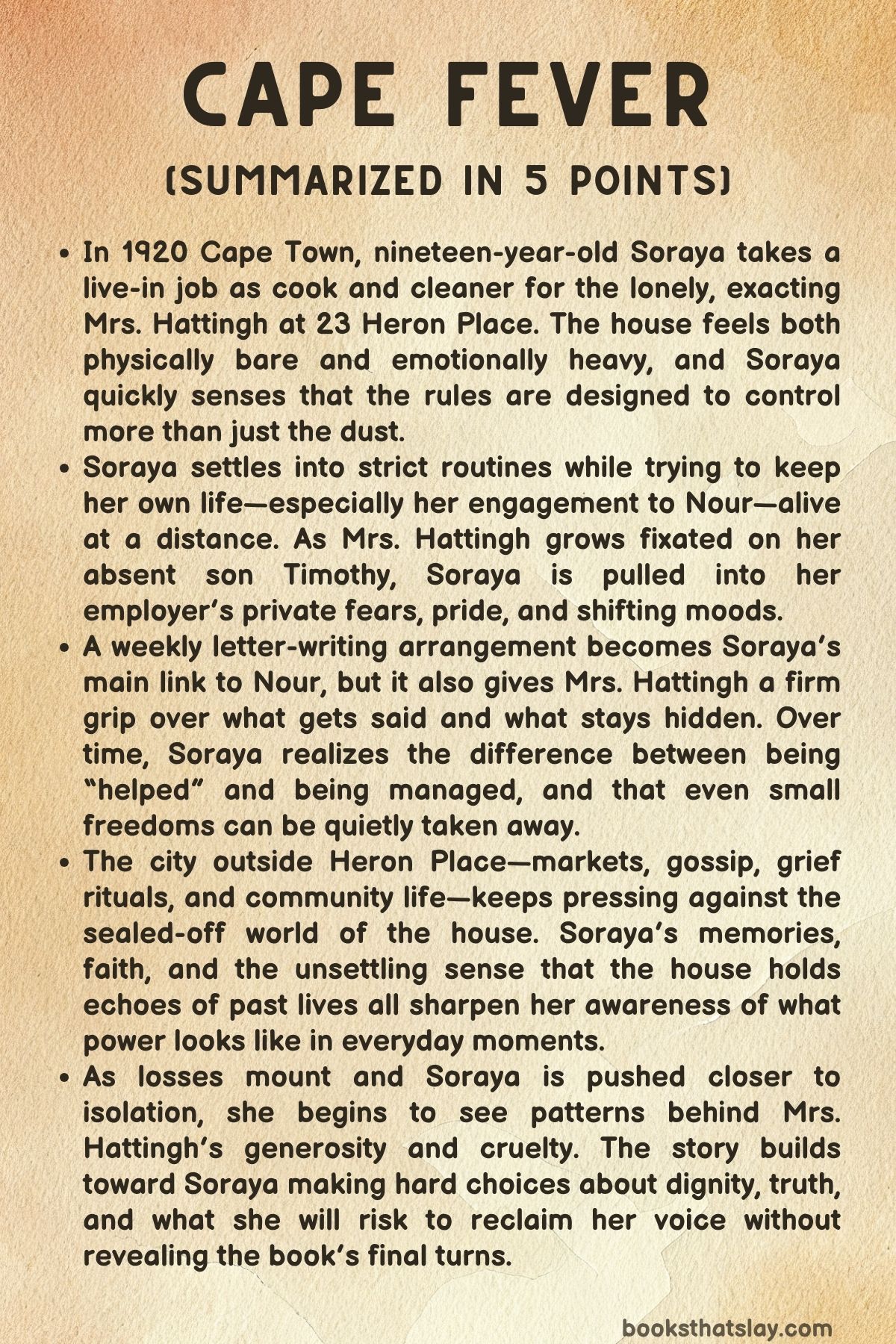
Summary
Nineteen-year-old Soraya arrives at 23 Heron Place to interview for work with Mrs. Hattingh. From the first moment, the imbalance is clear.
Soraya says she cannot read, so Mrs. Hattingh reads her reference letter aloud as if testing her. She asks pointed questions about Soraya’s age, experience, and why she left her previous post.
Soraya answers carefully, blaming her dismissal on another servant’s scheming. Mrs. Hattingh hires her as a combined cleaner and cook, pleased by Soraya’s skill with spiced dishes and sweets.
The house itself feels oddly stripped: dark marks on wallpaper hint at paintings sold off, and most rooms are sparse.
The job comes with a condition Soraya did not expect—she must live in. Mrs. Hattingh frames it as practical: she wants companionship and someone present at night.
Soraya, needing wages, agrees, though she is only permitted to visit her family one Sunday every two weeks. Mrs. Hattingh gives a strict tour of the house and its rules: dusting schedules, careful handling of floors, proper behavior at the door, and a constant warning against breakage.
Upstairs are guest rooms with bird-patterned décor that feels unsettling, and a room for Timothy, her son, which Mrs. Hattingh postpones showing. She brings Soraya into her own bedroom, preserved like a shrine—perfumed, delicate, untouched by the emptiness elsewhere.
Outside, Soraya is assigned a small freestanding servant’s room with a heavy interior bolt. Mrs. Hattingh speaks of the previous servant, Fatima, who cared for her during the influenza and later died, and her tone suggests both reliance and possession.
Work begins at once. A list of duties is pinned in the kitchen: morning tea and toast, fires, sweeping, dishwashing, weekly floors and windows, laundering cycles, silver polishing, and careful restrictions on which dishes Soraya may use.
Mrs. Hattingh says she will read the list aloud until Soraya memorizes it. Soraya’s days settle into repetition, but the nights do not.
Alone in the outbuilding, she senses a presence—one of the “Gray Women” spoken of in her community. Soraya believes the presence is Fatima, and she greets it with cautious respect.
The feeling recedes, but it does not leave her.
Soraya’s mind drifts often to the Quarter where she grew up, and to the trouble her stories once caused. As a child she gathered other children and told frightening tales—of spirits, of beings from the sea, of danger that follows curiosity.
Adults decided her stories attracted harm, and her mother punished her with scrubbing and sent her out to service. Now, in Mrs. Hattingh’s house, Soraya watches another kind of obsession: Mrs. Hattingh’s hatred of dust, worsened by wind and poorly fitting windows.
Soraya suggests repairs and offers her uncle’s help as a joiner, but Mrs. Hattingh delays, insisting she must consult Timothy in London.
While cleaning, Soraya discovers objects that reveal what Mrs. Hattingh values: an ivory elephant treated like a treasure, expensive toiletries and bottles, and—most startling—a portrait in Mrs. Hattingh’s bedroom of a brown-skinned girl named Rosa. Mrs. Hattingh says Rosa resembles Soraya and admits she once owned many portraits but sold them after her husband died, keeping only this one.
Left alone, Soraya feels the painted girl watching and, in her own way, responding. It becomes a secret companionship: Soraya speaks to Rosa, and the stillness in the room begins to feel less like silence and more like attention.
Tuesdays are for the post. Mrs. Hattingh waits for letters from Timothy, and when money arrives, she brightens as if rescued.
She speaks constantly of her son: his war service as a pilot, injuries, his law work in London, and plans to visit in September—though the date keeps slipping. Her stories grow more detailed and more insistent, and she hints Timothy needs help with basic tasks, as if the war has left him dependent.
The house becomes a waiting room for a reunion that never arrives.
Mrs. Hattingh’s attention turns toward Soraya’s personal life. Soraya is engaged to Nour, a farm laborer who hopes to become a teacher.
Mrs. Hattingh offers patronizing approval and asks intrusive questions about Soraya’s family history, slavery, and the British role in abolition. During one uncomfortable exchange, the Gray Woman presence returns, chanting in Soraya’s awareness, and even the fire seems to answer with a sudden crack.
When another letter brings news of Timothy’s delay, Mrs. Hattingh collapses into bed for days, then resurfaces with forced energy, “good works,” and sharper demands on Soraya.
On Soraya’s first day off, Mrs. Hattingh searches her bag at the door, handling Soraya’s belongings slowly to show distrust. Soraya walks back through the city toward her home, passing places tied to slavery and old markets.
Nour is away again, and Soraya returns to her family’s cramped, busy house where her mother immediately takes her wages for household needs. Soraya witnesses a ratib prayer circle among the men—a ritual of chanting, incense, drumming, trance, and a sword pressed to a man’s chest without blood.
Her father is radiant afterward, speaking of the body’s endurance under God’s care. Soraya does not tell her family about Fatima’s presence or Rosa’s responsiveness, keeping that fear inside herself.
Back at Heron Place, Mrs. Hattingh proposes a weekly letter-writing arrangement: Soraya will dictate letters to Nour while Mrs. Hattingh writes them, paying for paper and postage. Soraya agrees, eager for a line back to the man she loves.
The first session is strange—sitting opposite Mrs. Hattingh at eye level feels like a staged equality. Mrs. Hattingh beams when Soraya praises her employment in the dictated letter.
That night Soraya tells Rosa an invented story, and in Soraya’s imagination Rosa reacts as if listening with hands raised, as if in prayer.
Soon the arrangement reveals its cost. Nour’s replies arrive, but Mrs. Hattingh intercepts them, keeps them in her desk, and reads them aloud only during the sessions.
Soraya is not allowed to hold the letters, study them, or keep them. Mrs. Hattingh begins treating the writing hour as instruction, offering to teach Soraya to write her name.
She pushes into intimate territory too, asking whether Nour has kissed Soraya and suggesting “proper” ways to express desire. Then she admits she has been “rephrasing” Soraya’s words into her own style.
When Soraya insists she write exactly what is said, Mrs. Hattingh takes offense, crosses out lines, and ends the session early.
Outside the house, gossip spreads. At the District market Soraya hears warnings about Heron Place—rumors that something is wrong there, that Timothy is scarred beyond repair, that he avoids his mother, or that he might even be dead.
An Irish woman, Kathleen Turtle, advises salt and sage. Soraya storms home angry at the talk, only to be scolded because Mrs. Hattingh wanted to go out herself.
Soraya’s fear grows. Timothy’s room becomes a place she rushes through, and nightmares follow.
Mrs. Hattingh announces she will host a séance for bereaved women in her circle. On the day, Soraya discovers the “seer” is Miss Turtle, who signals Soraya not to reveal they have met.
Miss Turtle performs a ritual with candles, prayers, and props, stretching the room’s grief until one mother’s howling becomes the center of attention. She offers vague descriptions that the women mold into certainty, giving one mother the comfort of believing her son has spoken.
When the séance ends, Miss Turtle drops the performance in the kitchen and tells Soraya she once did servant work too. She warns Soraya again to protect doorways and says Mrs. Hattingh is troubled; living with her will cloud Soraya’s mind.
Soraya tries to tell her mother she wants to quit, but her mother refuses—wages are too necessary. Soraya returns to Heron Place and finds the rules tightening.
Mrs. Hattingh cuts down Soraya’s visits home, refusing a raise and threatening replacement. Soraya’s anger turns sharp.
She begins imagining Mrs. Hattingh’s death, and Fatima’s presence appears whenever these thoughts rise, trailing ash like a reminder. Soraya becomes obsessively productive—cleaning, mending, crocheting charity items—because constant motion is safer than stillness.
Mrs. Hattingh’s possessiveness slips into disturbing intimacy. One day she calls Soraya to rub ointment into her bare neck while she wears a loose gown, praising Soraya’s hands and then abruptly accusing her of scratching.
Soraya’s sleep fills with sexual and violent dreams that leave her ashamed and furious. Then an art dealer arrives, Mr. Samuel Avery, to assess the portrait of Rosa.
He names a price that is more than seven times Soraya’s yearly wage. Soraya’s rage spikes: a painting that looks like her is worth fortunes, while she is watched, searched, and treated as replaceable.
Avery remarks on Soraya’s resemblance, and Mrs. Hattingh jokes that she can look at Soraya when the painting is gone.
Nour’s correspondence falters. Mrs. Hattingh sends him a jumper that turns out to be Timothy’s, blurring boundaries in a way Soraya cannot ignore.
Then Soraya learns Nour has lost his place at teacher training for the year. She begs Mrs. Hattingh to help using her connections.
Mrs. Hattingh delays. After this, she becomes cold and punitive, and Nour stops writing entirely.
Time passes without Soraya seeing home. Then her brother Kashif appears at Heron Place with urgent news: their father has been ill for weeks and is dying.
Soraya runs home, but she arrives too late. Her father is already dead, his body being prepared as the house fills with mourners.
Soraya is swallowed by ritual phrases, incense, hands on her shoulders, kisses on her face, and one glaring absence—Nour does not come.
After the funeral, grief turns heavy and crowded. Soraya cannot cry the way people expect, and gossip shifts to her strangeness.
Her mother gives her the calligraphy piece her father made for Soraya and Nour’s future home, and then his wooden box of pens and ink. Soraya returns to Heron Place with fury: Mrs. Hattingh’s control kept her from her father’s bedside.
Mrs. Hattingh responds by tightening the cage. She forbids love letters during mourning, replaces the weekly letter hour with nightly reading lessons, and keeps Soraya at her side until bedtime.
She sends Soraya’s wages directly to Soraya’s mother. She blocks visitors.
She collects all the mail herself. Soraya’s grief hardens into numbness, and Fatima warns her to hide her tears.
In secret, Soraya uses her father’s pens to draw letters and images shaped by her old stories, as if writing can build a private door in a locked house.
The truth breaks open when Mrs. Hattingh hosts guests late at night, including Mr. Cartwright—the man tied to teacher training admissions. Soraya tries to speak to him but is dismissed.
From nearby, she overhears the conversation: Mrs. Hattingh asked Cartwright to delay Nour’s place by a year or two, and Cartwright told Nour there was no place and his marks were not good enough. Mrs. Hattingh explains it as protection—she wants Soraya settled and does not want Nour causing “to-ing and fro-ing.” Soraya understands then that Mrs. Hattingh has not merely controlled Soraya’s movements; she has reached into Soraya’s future.
Soraya plots escape and tries small acts of sabotage to force an excuse to leave, but they fail. Then Mrs. Hattingh announces a “miracle”: a letter from Nour.
She refuses to hand it over until after supper and reads it aloud herself, claiming Nour apologizes and is ending the engagement. Soraya snatches the letter and insists she can read it.
The real message is devastating: Nour believes Soraya has been sending letters for months saying she ended the engagement and loves another man. He says his own letters went unanswered and encloses “her” earlier letters as proof.
Soraya realizes the horror—Mrs. Hattingh has been forging Soraya’s correspondence and shaping Nour’s heart into the story she wanted.
Soraya’s fury erupts. She threatens Mrs. Hattingh with a fireplace poker, and Mrs. Hattingh barricades herself in her bedroom.
Soraya raids the desk and finds bundles of forged letters written in Mrs. Hattingh’s hand, all signed as if Soraya wrote them. To force confrontation, Soraya destroys Timothy’s room—ripping sheets, scattering books, breaking objects, defiling the space Mrs. Hattingh treats as sacred.
Mrs. Hattingh appears, horrified, and Soraya tells her this is what it feels like to have something precious ruined.
Soraya tries to flee, but she must return for her belongings and wages. She finds Mrs. Hattingh collapsed on Timothy’s bed with laudanum nearby.
Soraya takes her owed money and leaves a dated note listing what she took, but Fatima and Rosa seem to press her to look deeper. In the desk drawers Soraya finds letters between Mrs. Hattingh and Timothy, including medical correspondence from an institution in England.
A doctor describes Timothy’s injuries and treatment with electric shocks, and a telegram warns of deterioration, urging a visit soon—within “a month or two.” Soraya realizes Timothy has not been living an ordinary life in London at all. Mrs. Hattingh has invented the version of him she needs to survive.
Soraya brings Mrs. Hattingh downstairs and forces the final bargaining. Mrs. Hattingh claims she lied to protect her son from public judgment, and she defends the forged letters as “kindness.” Soraya corners her with the threat of gossip and ruin and makes her write two letters: one to Cartwright, insisting he rescind Nour’s deferral and admit wrongdoing, and another arranging that the proceeds from selling the portrait of Rosa go to Soraya.
Mrs. Hattingh begs Soraya not to reveal the forged love letters to Nour. Soraya refuses to promise.
Fatima’s presence fades, as if her work is done, and Soraya leaves with what she has claimed back.
Later, Soraya receives a final letter from Mrs. Hattingh after she travels to England. Mrs. Hattingh describes visiting Timothy daily as he declines, renting a small room nearby, and deciding not to return to the Cape.
Heron Place will be sold. She asks Soraya to take a cutting from Timothy’s lemon tree before it is uprooted and plant it in Soraya’s yard.
With Rosa’s money, Soraya returns to her family in the Quarter and begins remaking her life. She turns her father’s tools into her own practice, creating calligraphic artwork shaped by story, memory, and the words she was once denied.
People come to see and buy her work. In time, Soraya finds her way back to Nour, not through the false letters that broke them, but through hard truth and a shared city that is changing.
Nour works with others organizing against the newly elected settler politician Mrs. Hattingh once feared, and Soraya’s future, though scarred, is finally her own to choose.
Characters
Soraya
In Cape Fever, Soraya is a nineteen-year-old domestic worker whose sharp observation and inward fire drive the story’s emotional momentum. She arrives at Heron Place performing illiteracy as both shield and stigma—whether she truly cannot read at first matters less than how the claim is used to control her—because the household’s power hinges on who can interpret words, keep records, and decide what “truth” gets spoken aloud.
Soraya’s intelligence shows in the way she reads spaces rather than pages: she notices the missing paintings by their rectangular stains, senses the economy behind the emptiness, and understands that condescension dressed up as “kinship” is still domination. The routines of service—fires, trays, dust, laundry—become a cage, but Soraya’s interior life refuses to flatten; she carries the Quarter’s storytelling traditions, spiritual vocabulary, and bodily memory into a house that tries to erase her personhood.
Her relationship to the supernatural is not presented as a decorative quirk but as a language for what she cannot safely say in daylight: Fatima’s presence appears where fear, anger, and danger thicken, and Rosa’s “whispers” echo Soraya’s own need to be witnessed when no one living will truly listen. Over time, her hunger for contact—especially with Nour and with home—gets rerouted into the weekly letter ritual, which becomes the novel’s most intimate battleground: Soraya’s voice is literally taken down, reshaped, stored, and denied to her.
Her transformation is painful and precise; she moves from compliance as survival to strategic defiance, learning exactly how her employer’s systems work and then turning those systems against her. By the end, Soraya’s liberation is not only escape from a tyrannical home but the reclamation of authorship—she converts her father’s tools, her old stories, and the forced literacy lessons into a self-directed craft, building a life where her words cannot be ventriloquized by someone else.
Mrs. Hattingh
Mrs. Hattingh is a portrait of respectable cruelty in Cape Fever, a woman whose fragility and menace are inseparable. She presents herself as orderly, tasteful, and “civilized,” yet the house she rules is full of absences—sold paintings, bolted doors, restricted rooms—revealing a life organized around loss and secrecy.
Her obsession with dust is more than a personality trait; it becomes a theology of control, an attempt to keep the world’s disorder from entering through wind, gaps, and human unpredictability. She speaks in the language of patronage and pseudo-solidarity—calling Soraya “like us” as colonists “not really from here”—but her version of closeness is possession: live-in service, bag searches, curtailed Sundays, seized mail, and a tightening perimeter that slowly converts employment into captivity.
Her fixation on Timothy is the emotional engine of her manipulation; she sustains herself through a narrative of his competence, romance, and imminent arrival, and when reality contradicts the story, she does not adjust—she forges. The letter-writing hour makes her most legible: she wants not only to hear Soraya’s words but to curate them, embellish them, and finally replace them, because being the author allows her to be the architect of other people’s futures.
What makes her chilling is that her wrongdoing is not random; it is deliberate, sustained, and justified as “care.” She sabotages Nour’s training, isolates Soraya from grief and family, and manufactures intimacy on Soraya’s behalf, all while claiming moral high ground. Yet the novel also makes clear that her cruelty grows inside a private catastrophe: her son’s institutionalization and decline.
That knowledge does not absolve her; it reframes her as someone who, unable to bear helplessness in one sphere, exerts absolute power in another. In the end, her request about the lemon tree cutting reads like a final attempt to convert harm into sentiment, but it also exposes her belated recognition that roots, home, and belonging were never things she could command—only things she could damage.
Nour
Nour functions as Soraya’s horizon —a promise of a future that is ordinary, chosen, and shared—yet his presence is shaped largely through distance and correspondence, which makes him especially vulnerable to manipulation. He is introduced as a farm laborer with ambitions toward teaching, and that aspiration matters: it aligns him with learning, upward movement, and communal responsibility, the exact forces Mrs. Hattingh fears because they might pull Soraya out of service and into partnership.
Nour’s letters become the contested territory where love, respectability, and identity are negotiated, and because Soraya cannot possess the paper or control delivery, Nour ends up loving a version of Soraya that is partly authored by her employer. When the forged letters accumulate, Nour’s eventual withdrawal is not simple betrayal; it is the logical outcome of a system designed to make him feel ignored, replaced, and mocked.
His absence at the funeral is devastating not only as a romantic wound but as a social rupture—Soraya’s community expects men to show up, and his failure compounds her isolation and feeds gossip about her “change.” By the conclusion, Nour’s return to organizing against the newly elected settler politician positions him as more than a private love interest; he becomes part of a larger resistance, suggesting that his bond with Soraya is strongest when it is grounded in shared reality rather than mediated fantasy. The reconciliation implied at the end is therefore not a simple romantic reset but a re-entry into truth after prolonged distortion, where trust must be rebuilt in the wake of stolen words.
Rosa
Rosa is both object and presence, a painted girl whose image becomes a conduit for memory, projection, and haunting. On the surface, she is a portrait Mrs. Hattingh keeps after selling the rest, the one face that remains when other faces have been cashed out—already establishing her as a symbol of selective attachment and monetized loss.
For Soraya, Rosa is unsettling because she is made to watch: the portrait sits in the most intimate room of the house, turning the bedroom into a place where privacy is never complete and where gaze becomes power. Yet Rosa’s role quickly exceeds symbolism; she “responds” to Soraya’s stories, registers warning, and seems to form a bond that bypasses the household’s social rules.
In this way, Rosa becomes a kind of alternative witness: where Mrs. Hattingh edits, tests, and traps, Rosa receives and reflects Soraya’s imaginative life, giving Soraya a sense of being heard without being used. The financial valuation of the portrait—priced at many times Soraya’s yearly wage—sharpens the novel’s critique of what colonial households deem valuable: a brown-skinned girl can be cherished as art while a living brown-skinned girl is searched, restricted, and paid as little as possible.
Rosa’s impending sale intensifies Soraya’s rage because it mirrors how the house treats people: kept when useful, traded when convenient, sentimentalized after harm is done. By urging Soraya to look deeper into the desk drawers near the climax, Rosa becomes aligned with revelation, pushing the truth into daylight—the truth that words have been forged, lives redirected, and Timothy’s existence rewritten.
Fatima
Fatima is the most volatile moral force, a Gray Woman whose presence threads together labor, death, and warning. As the former servant who cared for Mrs. Hattingh through influenza and then declined and died, Fatima embodies the ultimate bargain of domestic work in the novel: the servant’s body is spent for the household’s survival, and even in death her story is instrumentalized by the employer as sentimental history.
For Soraya, Fatima begins as loneliness given shape—an atmosphere in the outbuilding room, a sense of not being alone—yet she develops into something sharper, appearing at moments of danger or moral tipping. Her chant of “Amok,” the trailing ash, the gestures toward rat poison, and her insistence that Soraya conserve strength suggest a presence that understands both violence and consequence.
Fatima’s interventions do not read as simple protection; they read as a grim education, as though she is teaching Soraya how the house works when politeness fails and power becomes predatory. Importantly, Fatima’s knowledge is not the genteel “spirituality” the séance guests want; it is the knowledge of servants—who sees what, who hears what through doors, who understands the private rot behind public respectability.
When Fatima disappears after Soraya forces Mrs. Hattingh to write corrective letters, it feels less like a happy exorcism than an ending of a task: the haunting was not random, it was tethered to unfinished injustice, and once Soraya claims a measure of restitution and exits the house’s web, the Gray Woman no longer needs to hover at the threshold.
Timothy Hattingh
Timothy is the novel’s central absence, a man who exists for most of the story as an arrangement of letters, photographs, rumors, and his mother’s rehearsed monologues. He is described as a former pilot, injured in war, and supposedly studying law in London, but the later revelation—that he is in an English hospital or asylum undergoing severe “treatments” and deteriorating—recasts every earlier detail as part of a protective fiction Mrs. Hattingh built to survive shame and grief.
Timothy’s rooms, possessions, and birthday function as shrine objects: his jumper becomes a tool of manipulation, his photograph a trigger for Mrs. Hattingh’s fear, his lemon tree a living relic that promises continuity even as his body cannot return home. The gossip that he may be scarred, damaged, avoiding his mother, or dead captures how communities fill informational voids with story, and that mechanism parallels how Mrs. Hattingh fills her own void with invention—except her inventions have power behind them and therefore consequences for Soraya and Nour.
Timothy’s tragedy also exposes the novel’s critique of respectable denial: a mother can be sincerely devastated and still choose methods that ruin others. When Mrs. Hattingh finally goes to England and writes that she will not return, Timothy becomes less a character who acts and more a reality that forces an ending—his decline collapses the fantasy architecture that sustained the household’s tyranny, allowing Soraya’s future to be built elsewhere.
Kashif
Kashif acts as the urgent messenger and protective sibling figure, arriving at Heron Place with the news Soraya most fears: their father is dying. His appearance punctures Mrs. Hattingh’s constructed isolation, proving that the outside world can still reach Soraya despite the locked gates and controlled errands.
Kashif also voices the community’s suspicions—people saying something is wrong with Soraya because they have not seen her cry—showing how grief becomes judged performance in tight-knit spaces, and how Soraya’s numbness reads as deviation. His conflict with Soraya on the mountain path is significant because it is one of the few places Soraya can be raw without immediate punishment; their argument captures a family trying to keep hold of someone who has been psychologically relocated by service.
Yet Kashif’s role is not simply to scold or deliver news; his willingness to search for her, follow her anger, and walk her home suggests a steadying love that counters Mrs. Hattingh’s possessive version of “care.” He embodies the kind of kinship Soraya can return to: imperfect, stressed by money and loss, but not built on ownership.
Mrs. Cunningham
Mrs. Cunningham represents grief seeking permission to become spectacle in Cape Fever. She initiates the séance because her husband forbids it, which immediately frames her as someone trapped between respectable rules and desperate longing.
Her willingness to believe details—such as the “favorite chair”—shows how mourning can make people hungry for recognition, even when the recognition is manufactured. At Heron Place, she is both guest and participant in Mrs. Hattingh’s performance of hospitality, relying on the household’s stagecraft—candles, curtains, solemn voices—to offer what ordinary life cannot.
The collapse when Harold does not “come” exposes the cruelty of false consolation: even if the séance provides temporary relief to others, it deepens her wound by making hope tangible and then withdrawing it. She is important because she shows that Mrs. Hattingh’s manipulative tendencies are not isolated; the wider settler social world is full of grief, denial, and rituals that blur comfort with exploitation.
Mrs. Lockday
Mrs. Lockday functions as a supporting pillar of the grieving set, embodying how loss becomes a shared identity among women who have “paid” for war with their sons. Her presence at the séance strengthens the group’s emotional pressure: she validates the idea that the dead can be accessed, that the attempt is normal, and that payment is appropriate.
When she insists on paying the fee, the moment reveals a moral inversion—money becomes a way to make grief feel orderly and deserved, as if purchase can guarantee meaning. She is less individualized than some characters, but her role matters because she illustrates how communal mourning can unintentionally enable charlatanry, and how the upper-class women’s rituals depend on servants like Soraya preparing the domestic stage while being treated as either nuisance or exotic “spiritual resource.”
Mrs. Ramsay
Mrs. Ramsay is the séance’s emotional rupture, the woman whose grief refuses to stay polite. Her rigid distance at first reads as self-control, but her moan and then howl tear through the room, revealing sorrow as physical force rather than genteel sadness.
Miss Turtle uses Mrs. Ramsay’s breakdown as an opening to claim a spirit has entered, and the speed with which Mrs. Ramsay latches onto the detail of “flecked” eyes shows how a single precise image can become a lifeline. In that shift—from skepticism or composure to giddy certainty—Mrs. Ramsay becomes a study of how grief can be redirected into belief when belief offers relief.
She is also a mirror for Mrs. Hattingh: both are mothers shaped by sons lost or altered by war, but where Mrs. Ramsay seeks comfort in a communal ritual, Mrs. Hattingh seeks control through private fabrication.
Miss Kathleen Turtle
Miss Kathleen Turtle is both performer and truth-teller, a woman whose livelihood depends on staging spirituality yet who also recognizes real danger when she sees it. Introduced earlier as an Irish customer warning Soraya to use salt and sage, she later arrives as the “seer,” turning the séance into theater with props, invocations, and calibrated disappointment.
Her methods are opportunistic—vague descriptions that sharpen when they find purchase—but the novel complicates her beyond simple fraud by showing her ability to read rooms, exploit the wealthy’s hunger, and simultaneously respect the servant’s knowledge. In the kitchen afterward, when she drops the act and speaks plainly about having done servant work herself, she exposes the class structure that the séance depends on: the ladies consume comfort while the help carries the costs.
Her warning that Mrs. Hattingh is troubled and that living with her will tangle Soraya’s mind is one of the story’s clearest articulations of psychological harm, and her insistence that her role is to comfort hints at a bleak ethic—she sells consolation because the world has few other forms available to these grieving women. Miss Turtle’s moral ambiguity enriches the novel’s wider argument: in a society built on unequal power, even “lies” can function as medicine, but medicine administered for profit can still become poison.
Mr. Samuel Avery
Mr. Samuel Avery is the story’s agent of commodification, the man who translates beauty into price and private attachment into market opportunity. His familiarity with the house and its history of sold portraits reveals that Heron Place has been quietly liquidating its past, turning memory into cash after the husband’s death.
When he appraises Rosa and casually notes the profit a London market could bring, he exposes the colonial art economy that can fetishize brown-skinned beauty while ignoring brown-skinned suffering. His remark that Soraya resembles Rosa—and Mrs. Hattingh’s joke that she can look at Soraya if she misses the painting—compresses the novel’s central cruelty into a single exchange: the living woman is treated as replacement object, the object as treasure, and both as property.
Avery’s role is not to mastermind the household’s abuse, but to demonstrate how systems outside the home reinforce the same logic inside it—value assigned by ownership, not by humanity.
Mr. Cartwright
Mr. Cartwright appears as a bureaucratic hinge, the figure whose institutional authority determines whether Nour can become a teacher. What makes him significant is not charisma but compliance: he accepts Mrs. Hattingh’s request to delay Nour’s place and communicates the denial in a way that frames it as Nour’s inadequacy.
Through him, the novel shows how class power moves quietly through “respectable” channels—letters, recommendations, deferred places—without needing overt violence. Cartwright’s presence at the political gathering also links personal sabotage to public ideology; the same social circle that fears certain candidates and debates elections is willing to interfere in a working man’s education to preserve domestic convenience.
He represents how institutions become instruments when gatekeepers choose allegiance to status over fairness, and how a servant’s future can be rewritten by people who will never experience the consequences.
Christine
Christine is a brief but striking figure, a woman tied to a pole in the market and labeled mad, whom Soraya perceives as accompanied by a goblinlike creature that runs errands for her. Her importance lies in what she reveals about Soraya’s vision and about the city’s relationship to women deemed unruly: Christine is restrained publicly, turned into warning and spectacle, a living example of how society punishes deviation.
The goblinlike attendant—whether supernatural reality, metaphor, or Soraya’s sharpened perception—suggests that even those treated as powerless may have unseen forms of agency or companionship. Christine’s appearance also broadens the novel’s map of haunting beyond Heron Place; the uncanny is not confined to one house but threaded through the city’s streets, illnesses, and exclusions, implying that “madness,” spirit, and survival are all languages people use when ordinary structures fail them.
Themes
Power, Control, and the Everyday Mechanics of Domination
In Cape Fever by Nadia Davids, authority is not expressed only through open cruelty but through small, daily decisions that decide who moves freely, who speaks, and who is believed. Soraya enters Heron Place for work, yet the house quickly becomes a system designed to narrow her life.
The live-in requirement shifts the job from labor into containment, and the restricted Sundays turn rest into a privilege granted by an employer rather than a right. Mrs. Hattingh’s control depends on routine: lists, schedules, inspections, and rules about which dishes can be used or who may be answered at the door.
Even literacy becomes a tool of governance. Because Soraya cannot read, written lists and letters can be used against her, creating a gap between what she thinks is happening and what is actually recorded.
That gap is exploited again and again.
The letters to Nour become the most revealing instrument of domination because they hijack a private relationship and turn it into a managed performance. Mrs. Hattingh sets the rules, holds the incoming replies, reads them aloud when she chooses, and stores them in her desk like property.
This is not simply nosiness; it is a takeover of Soraya’s voice. The moment Mrs. Hattingh admits she “rephrases” Soraya’s words, the real threat becomes clear: Soraya is being edited into a version that suits the employer’s emotional needs.
Later, the forged letters prove how complete the takeover has become. Mrs. Hattingh is not only filtering communication; she is manufacturing it, shaping Nour’s understanding of Soraya and isolating Soraya from any correction.
Control extends beyond romance into education and mobility when Mrs. Hattingh manipulates Mr. Cartwright to delay Nour’s college place, then uses the delay as a reason to keep Soraya “settled” in service. The power imbalance is economic, social, and informational at once, and the novel shows how oppression can be maintained through polite language, “concern,” and rules that appear reasonable until their cumulative effect becomes imprisonment.
Grief, Denial, and the Stories People Use to Survive
Loss sits in the rooms of Heron Place like a presence that changes the air. Mrs. Hattingh’s life is organized around waiting for Timothy, but that waiting is also a way of not facing what she already knows.
Her anxiety around Tuesdays, money, letters, and delayed ships reveals a pattern: hope is rehearsed because despair is intolerable. The house itself carries marks of grief expressed through liquidation—paintings removed, possessions sold, space emptied—yet Mrs. Hattingh insists on treating the remaining objects as proof of continuity.
The portrait of Rosa becomes a substitute for what is missing, and the obsession with dust reads like a displaced battle against decay. If everything can be kept clean, perhaps nothing truly disappears.
The séance exposes grief as both sincere and exploitable. The mothers arrive hungry for certainty, and Miss Turtle’s performance succeeds not because it is convincing in a factual sense, but because it offers emotional relief.
Their sons’ absence has turned into a daily wound, and even a vague description can become a lifeline when a grieving person needs to believe. The scene also highlights how grief creates a market: comfort becomes a service, and truth becomes less important than the temporary softening of pain.
Miss Turtle’s later honesty—saying the job is to comfort—does not remove the ethical discomfort; it clarifies it. People ask for the impossible, and someone supplies an imitation.
Soraya’s grief later runs on a different track. Her father’s death is followed by shock, crowding, duty, and the pressure to perform the expected emotions.
When people note that she has not cried, the community’s gaze becomes another kind of control, turning mourning into something that can be judged. Soraya’s numbness is not emptiness; it is overload, intensified by the fact that her employer’s restrictions kept her away from her father’s final weeks.
The novel treats grief as a force that can shrink a life, but also as a force that can sharpen moral clarity. Soraya’s rage after learning the extent of Mrs. Hattingh’s interference is inseparable from bereavement: the harm is not only romantic sabotage, but stolen time, stolen presence, stolen last moments.
Grief is therefore both a private wound and a political fact, showing who had the power to decide where Soraya could be when her family needed her most.
Voice, Literacy, and Who Gets to Author Reality
Soraya’s inability to read is not presented as a personal flaw; it is a vulnerability that others can weaponize and a reminder of how access to language shapes destiny. At Heron Place, words are everywhere—lists pinned to walls, letters arriving like verdicts, books read aloud at night.
Yet the meaning of those words is controlled by Mrs. Hattingh, who decides what Soraya hears, what she is allowed to keep, and what is “proper” to say. The letter-writing arrangement begins as a bridge to Nour, but it quickly becomes a demonstration of authorship as power.
Mrs. Hattingh does not merely transcribe; she interprets, “improves,” and eventually impersonates. Soraya’s emotional life is rewritten into something that flatters the employer’s sensibility and serves her possessiveness.
The novel also contrasts written language with spoken and crafted forms of expression. Soraya’s childhood talent for storytelling marks her as someone with voice, imagination, and social influence.
That voice, however, has been treated as dangerous since she was young: adults accuse her of attracting trouble and punish her into silence and service. At Heron Place, she continues speaking in stories—especially to Rosa—because it is a space where her words are not immediately corrected, edited, or measured for usefulness.
Those invented tales are not escapism only; they are practice in shaping meaning when her real life is being shaped by someone else.
After her father’s death, the transition to calligraphy is especially meaningful because it joins voice to visible form. Using the pens and ink from her father’s box, Soraya produces work that cannot be taken from her by someone who claims to know better how it should sound.
It is a kind of self-authorship that resists manipulation. The ending, where people come to buy her work and she rebuilds her life, does not suggest that literacy alone fixes injustice.
Instead it argues that control over one’s own words—spoken, written, and made—matters because it changes who can define the truth of a relationship, a reputation, and a future. When Soraya forces Mrs. Hattingh to write corrective letters and sign them, the act is not only practical; it is symbolic.
Mrs. Hattingh is compelled to use the very instrument she abused—writing—to undo some of the damage, acknowledging that written words can harm and can also repair, depending on whose hand holds the pen.
Race, Colonial “Kinship,” and the Violence of Patronizing Intimacy
Mrs. Hattingh’s early claim of kinship—suggesting she and Soraya share the condition of being “not really from here”—is framed as friendliness, but it is a strategy that preserves hierarchy while borrowing the language of closeness. By speaking of “your people” with admiration that is also condescension, she reduces Soraya to a category and positions herself as the one who grants recognition.
This is not neutral; it supports an order where the employer can intrude into Soraya’s private life and treat the intrusion as benevolence. Questions about slavery, abolition, and “civilizing” narratives are used to place Mrs. Hattingh on the moral high ground, while Soraya’s actual experience of vulnerability in service is ignored.
The house itself stages colonial inequality through space. Mrs. Hattingh’s bedroom is preserved as delicate, fragrant, and protected, while Soraya’s room is a separate outbuilding with must and a heavy bolt.
The bolt is a blunt symbol: safety is not assumed, it is managed, and the person who needs the bolt is not the person with social power. Even the rules about who answers the butcher and how Soraya must knock create a choreography of subordination.
Soraya’s body is constantly directed—where to stand, how to speak, when to appear, when to disappear.
The most disturbing aspect of the relationship is how domination begins to masquerade as intimacy. The dictation sessions place the women at eye level, briefly creating the appearance of equality, but the equality is staged and reversible.
Mrs. Hattingh’s insistence on “capturing the essence” of Soraya’s words is a claim that Soraya’s inner life belongs within Mrs. Hattingh’s control, as if the employer can know Soraya better than Soraya knows herself. Later, when Mrs. Hattingh orders Soraya to rub ointment into her bare neck, the boundary between labor and personal access is crossed in a way that is loaded with power.
Mrs. Hattingh’s reaction—pleasure, then accusation—demonstrates how dangerous such coerced closeness can be. The servant is compelled to be near, then blamed for the closeness.
This pattern mirrors the broader colonial logic: proximity is demanded from the subordinated, but any discomfort is redefined as the subordinated person’s fault.
Race and class also shape the way truth is believed. Gossip about Timothy circulates among working people, but Mrs. Hattingh’s social position allows her to maintain a more acceptable story.
Soraya’s later leverage—threatening gossip and fire—shows that public narrative is a battlefield. The novel makes clear that colonial society is sustained not only through law and money, but through the stories respectable people are allowed to tell and the stories others are forced to live under.
Haunting, Spiritual Presence, and the Return of Buried Histories
Supernatural elements in Cape Fever by Nadia Davids do not function as decoration; they express what the characters cannot safely state in ordinary conversation. The Gray Woman presence, the sense of Fatima’s spirit, the responsive portrait of Rosa, and the prophetic dreams all suggest that the house holds more truth than its owner admits.
Fatima’s presence, in particular, acts like a witness to the hidden record of service: years of labor, illness, neglect, and death that polite society would rather treat as an unfortunate footnote. Soraya’s instinct to greet the presence rather than flee indicates a worldview where the past remains active and where the dead are part of communal memory, not erased by property boundaries.
Rosa’s portrait is haunting in a different way because it sits at the intersection of commodity and personhood. The painting is treated as an asset with a London price, discussed by a dealer who speaks of it in the language of markets.
Yet Rosa also appears as a presence that sees and responds, as if refusing to remain only an object. Soraya’s resemblance to Rosa intensifies the discomfort: Mrs. Hattingh’s joke that she can “look at Soraya” if she misses the painting reveals a logic where brown-skinned girlhood can be substituted, possessed, and displayed.
The haunting therefore exposes an ethical contradiction: the household can sentimentalize a painted girl while exploiting a living one.
Dreams and signs repeatedly point Soraya toward what is concealed, especially the room she has not seen and the truth about Timothy. The supernatural becomes a parallel channel of knowledge that competes with official channels like letters, schedules, and polite explanations.
It is significant that the key revelation about Timothy comes through papers hidden in drawers, while Fatima and Rosa “urge” Soraya to look. The spirits function as pressure against secrecy, suggesting that buried realities insist on surfacing.
Even Miss Turtle’s moment of apparent genuine disturbance during the séance—when she mutters about unrest—hints that something in the house is not satisfied by performance. The novel uses haunting to show that denial has limits.
The past, especially the past of servants and the past of damaged sons, does not remain quiet simply because a respectable woman arranges her cushions and closes her curtains.
At the end, the request to take a cutting from Timothy’s lemon tree carries the same logic: living memory persists, but it must be transplanted and re-situated. Soraya bringing the cutting into her own yard is not an endorsement of Mrs. Hattingh’s choices; it is a refusal to let the story remain trapped in the property that enabled harm.
The supernatural and the symbolic operate together to insist that what happened in that house cannot be sealed away. It will be carried, retold, and remade into new forms—like Soraya’s calligraphic art—where the hidden record becomes visible on her terms.