Catch Her If You Can Summary, Characters and Themes
Catch Her If You Can by Tessa Bailey is a contemporary romance set between a small, judgmental Rhode Island town and the bright glare of New York baseball fame. Eve Keller has spent her life being reduced to gossip because of where her family’s money came from, so she builds her own future anyway—running a burlesque club, caring for two little kids who need her, and refusing to beg for acceptance.
Then Madden Donahue, the intense boy she noticed years ago, returns as her neighbor and becomes impossible to ignore. What follows is a messy, funny, sexy, high-stakes love story about reputation, loyalty, and choosing the life that actually fits. It’s the 5th book of the Big Shots series.
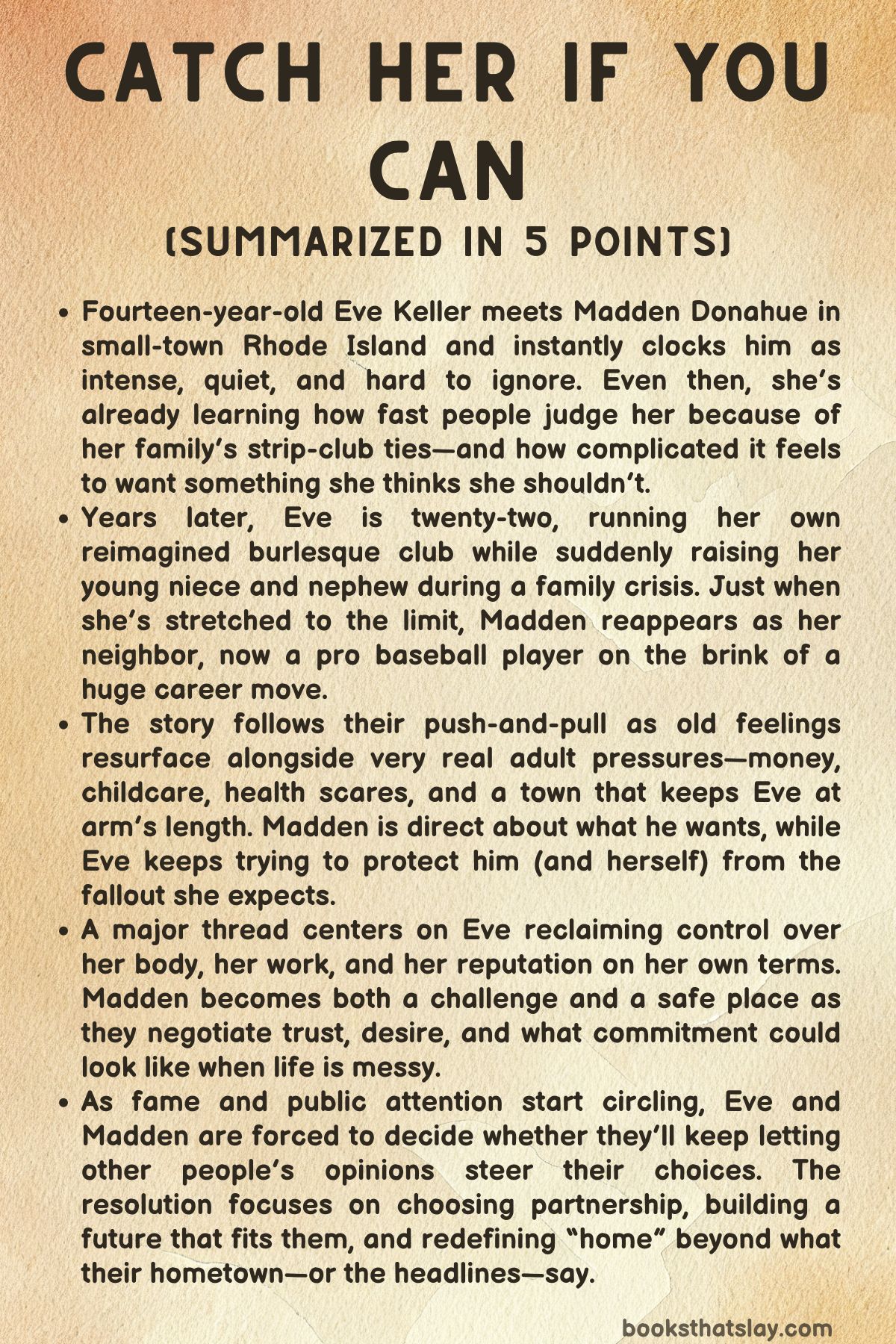
Summary
Eve Keller first sees Madden Donahue when she’s fourteen, new in town and trying to keep her head down. She’s at her friend Skylar Page’s house, and Skylar’s stepbrother Elton is outside with a visiting teen from Ireland.
Madden looks like someone who expects trouble: heavy boots, guarded posture, and eyes that don’t slide away when he’s caught staring. Skylar immediately labels him attractive; Eve rolls her eyes, but she can’t stop looking.
Inside, Elton makes crude jokes and, like so many people in Cumberland, uses Eve’s father’s strip club as a weapon. Eve is used to the comments and the assumptions, but the humiliation still lands.
Madden doesn’t laugh along. He watches, tense and disapproving, and that quiet refusal to join the pile-on sticks with her.
Years pass, and Eve grows up carrying the town’s judgment like a shadow that follows her everywhere. At twenty-two, she’s no longer just “the strip club guy’s daughter.” She owns her own place: a burlesque club called the Gilded Garden, built from the bones of the old business she inherited.
The club is her attempt to take control of her name and make something stylish and intentional from what people once used to shame her. But her life is not glamorous behind the curtain.
Her sister Ruth is in rehab, and Eve has temporary legal custody of Ruth’s five-year-old twins, Lark and Landon. Eve is exhausted, broke, and constantly outnumbered in her own apartment.
Mornings are smoke alarms, sticky hands, missing shoes, and the feeling that she’s always one step behind.
During one particularly chaotic morning, her neighbor bangs on the door because of the noise. When the door opens, Eve is hit with the shock of recognition: it’s Madden.
He’s older now—taller, broader, and sharper around the edges—but still intense, still looking at her like he can see straight through every excuse. The twins recognize him too.
Recently, at Eve’s first onstage performance at her club, a furious man interrupted the show and carried her off as if he had the right. That man was Madden.
Now he stands in her doorway, demanding a conversation, and drops another bomb: he’s leaving for New York that afternoon because the Yankees have called him up.
Their history isn’t simple. Four years earlier, Madden returned to Cumberland for Skylar’s graduation after being away for a long time.
His aunt Fiona had died, and the funeral became another moment when Eve felt her family’s reputation tightening around her throat. After that, she disappeared from the people who cared, including Madden.
At the graduation party, he finds her again and is struck by how much she’s changed. They talk more honestly than they ever have.
Madden reveals he had a kidney transplant and that he’s been searching for his anonymous donor. He asks Eve to dance, and in a quiet corner away from the crowd, their closeness turns electric.
Eve admits she’s taking over the club and transforming it into something new, refusing to be chased out by small-town cruelty. Madden admires her stubborn courage and tries to apologize for the day of the funeral, for not protecting her better.
She promises she won’t vanish again, and for a second it feels like they might actually begin. Then Skylar interrupts, thrilled to see them together.
Eve instantly backs off. She pushes Skylar toward Madden, convinced she can’t cross a line when Skylar once had a crush.
Then Eve disappears anyway, leaving Madden with unanswered questions and a frustration that never settles.
Back in the present, Madden doesn’t let Eve hide. He walks the twins to the bus stop with her and notices what she has learned to ignore: the other mothers keep their distance, polite but cold, as if Eve’s life is contagious.
When Eve returns home, Madden confronts her. He’s spoken to Skylar, and Skylar panicked when she thought Eve and Madden were on a date, not because she wants him now, but because she doesn’t want to be the reason Eve gets hurt.
Madden presses Eve to admit the truth. Eve finally cracks and confesses she’s always felt something for him—but insists she isn’t right for him.
She begs him to pretend the conversation never happened. Madden refuses.
He holds her like he’s done bargaining with her fear and tells her he’s leaving for New York, but he’ll be back.
Eve’s problems multiply the moment he’s gone. The Gilded Garden is bleeding money, auditions are tense, and the bills are relentless.
A young woman named Veda arrives with an idea about unused land behind the club, but Eve barely has time to listen before the school calls: Landon is sick and needs medical attention. Panic hits hard—money, time, childcare, everything.
Eve makes a desperate compromise: Veda will babysit for free if Eve later hears her proposal. Eve accepts because she has no better option.
In New York, Madden is miserable. The majors are cold and transactional, and he feels like a stranger inside his own success.
He checks his mailbox obsessively for news about his kidney donor and finds nothing. When he finally calls Eve, he reaches her in a clinic with two flu-ridden kids and a terrified voice she tries to hide.
She worries about costs and pretends she’s fine; Madden hears the strain anyway. He makes a decision on the spot: New York isn’t where he wants to be, not without her.
He drives back to Cumberland.
That night, Eve is alone in the club after closing and goes onstage to practice. It starts as rehearsal and turns into something more private—Eve testing what it feels like to be seen, even if the audience is imaginary.
Madden arrives silently and watches from the hallway, stunned by how much she wants it, how much she comes alive in the possibility of being wanted. When she finally notices him, she panics, embarrassed and angry.
Madden doesn’t soften. He names what he saw, pushes her to be honest, and then shocks her by proposing marriage.
Eve thinks he’s lost his mind. Madden explains his logic: his salary and health insurance could protect Eve and the twins, and he wants her safe.
He also offers something she doesn’t know how to ask for—space to explore her desire to be watched, but with him as the boundary and the person she trusts. Eve refuses at first, frightened by how quickly she could lose control of her carefully managed life.
But when she learns Landon may have asthma and realizes how fragile their situation is, she starts to see marriage not as romance, but as survival.
Before deciding, Eve calls Skylar and finally hears what she needs: Skylar is happy with her boyfriend Robbie, and her old crush on Madden is long gone. The guilt Eve has carried loses its grip.
She asks Madden to meet, and at his late aunt’s house Eve makes her offer: she’ll marry him, but it has to stay secret, and it has to be temporary. Six months.
If the club isn’t profitable by then, she’ll sell it, and they’ll divorce. Madden agrees, but only because it keeps her close.
They set Elton as their witness and plan a courthouse wedding.
On the wedding day, Eve sits in her car outside the courthouse, nervous and overwhelmed. She leaves a voicemail for Ruth, admitting she’s marrying Madden and confessing she’s loved him for a long time, even if she’s trying to treat the marriage like a contract.
Veda appears with donuts and big energy; Madden arrives in a suit with a bruised face after a fight with a teammate. He gives Eve a framed sketch he made from a photo of her, proof that he’s been holding onto her image for years.
Eve is shaken by how cherished she feels. Then they go inside and do it—quiet vows, quick signatures, a marriage that is supposed to be practical but already isn’t.
Life doesn’t slow down. Eve deals with school drama, cruel teachers, and old bullies like Steve Kirk, who tries to drag her back into the ugliest version of her past.
Madden nearly explodes protecting her, furious at the disrespect she’s expected to swallow. There are small domestic moments that feel too intimate for a “deal”: cooking with the kids, fixing a torn hat, playing catch in a field while the twins laugh and argue.
And there are moments that make it obvious their chemistry can’t be contained. One night, after flirting and restraint, they end up having sex outside in the rain, pushed close to the edge by the risk of being seen.
Afterward Madden admits he wants more than six months. Eve panics and clings to the contract because the alternative is believing she can be loved openly.
Meanwhile, Veda’s proposal begins to take shape: an outdoor music space behind the club to bring in revenue. The plan offers hope, and Eve finally sees a path that isn’t only damage control.
She also watches Veda struggle with her controlling boyfriend and begins to see Veda as more than a chaotic helper—she’s talented, hungry, and ready to build something.
Eve travels to Yankee Stadium to watch Madden play, and pride hits her in the chest when she sees him under the lights. In the suite, Skylar admits something that shifts Eve’s perspective: Madden once took Skylar for a drink just to talk about Eve.
It was always Eve. Eve blurts out the truth—they’re married, secretly, for six months.
Skylar tells her to stop letting other people’s opinions make her choices.
Then the spotlight turns harsh. In a game-saving play, Madden takes a brutal collision at home plate and ends up in the hospital.
Eve rushes to him, and the intimacy of seeing her there breaks his defenses. Teammates storm in, learn she’s his wife, and the secret starts to unravel.
The media catches the story and runs with it. Reporters dig into Eve’s burlesque club, twist it, sensationalize it, and treat her like a threat to the Yankees’ image.
Eve’s worst fear comes true: she becomes a headline, and she believes Madden will pay the price for loving her.
Eve tries to run. She slips out of Madden’s apartment, pushes through reporters, and drives back to Cumberland, convinced that if she creates distance, she can protect him.
Madden refuses that logic. In front of cameras, despite his injured shoulder, he claims her publicly—kisses her, calls her his wife, and dares anyone to come for her.
He threatens to leave the team if they disrespect her. It’s messy, loud, and exactly what Eve has never allowed herself to want: someone choosing her where everyone can see.
Back in Cumberland, Eve’s sister Ruth returns from treatment, healthier and determined. Ruth plans to move into supportive recovery housing in North Carolina and take the twins, which breaks Eve’s heart even as she knows it’s best.
Eve feels the floor shift under her life—her role as caretaker changing, her identity changing. With the club swarming with curious crowds and reporters hoping for a scandal, Eve decides, in a moment of stubborn self-destruction, to perform.
She tells herself she’ll absorb the damage and end the marriage on her own terms.
During the show, Madden arrives and watches. When Eve undresses, he sees a scar on her abdomen and finally understands what he’s been chasing for years: Eve was his anonymous kidney donor.
The realization hits him like grief and awe at once. Eve never told him because she knew he would refuse the gift, and because she couldn’t handle being seen as noble when the town preferred her shame.
Now the truth is standing under stage lights where there’s no hiding. Madden doesn’t stop her.
He joins her onstage, stays beside her, and turns the moment into partnership instead of rescue. Offstage, locked in her office, they finally say everything: she did it because she loved him, and she has for years; he stayed in America because of her; they’re done letting fear run the show.
The story breaks publicly the next day anyway, and Eve expects ridicule. Instead, something unexpected happens: people applaud her.
Not everyone becomes kind overnight, but the narrative shifts. Eve realizes she doesn’t need Cumberland’s approval anymore—good or bad.
She’s tired of living as a reaction to other people.
In the end, Eve chooses freedom. She breaks her lease and decides to move to New York with Madden, not because she’s escaping, but because she’s finally choosing.
She hands the Gilded Garden to Veda in a deal that gives Veda a real chance to lead and build. The club can thrive without Eve clinging to it as proof of worth.
Years later, life looks different than Eve ever imagined: Madden’s career takes him to new places, their home is filled with friends and family, and Eve builds a new future with her own work, on her own terms—loved, claimed, and no longer shrinking to fit anyone else’s comfort.
Characters
Eve Keller
Eve begins as a defensive, sharp-edged fourteen-year-old who has learned to anticipate cruelty because of her father’s strip club, and that early social conditioning becomes the core lens through which she interprets belonging, desire, and worth. As an adult, she turns that inherited stigma into a project of authorship by reshaping her life into something self-defined—owning the Gilded Garden, rebranding it as burlesque, and insisting that her name will not be a punchline or a sentence handed down by Cumberland.
What makes Eve compelling is the constant tension between her bravery and her self-erasure: she can walk onto a stage and claim power through performance, yet she still believes she must shrink her personal happiness so other people can stay comfortable—especially Madden. Her caretaking role with Lark and Landon reinforces this contradiction, because it highlights how competent, nurturing, and reliable she is while she privately insists she is “not right” for the man who sees her most clearly.
Eve’s sexuality is also written as character development rather than decoration: her exhibitionist fantasies aren’t presented as a flaw, but as a complicated form of self-possession that becomes healthiest when she stops treating desire as evidence against her moral worth. Ultimately, Eve’s arc resolves not with Cumberland’s approval, but with her choosing freedom from needing it, which is a more mature victory than vindication.
Madden Donahue
Madden is introduced as the kind of boy who stands like he expects impact, and that bodily readiness becomes a throughline for his entire personality: he is watchful, controlled, and built around endurance. His reserved intensity isn’t a romance pose; it’s survival—rooted in illness, displacement, grief, and the long uncertainty of a transplant recipient who is always aware the ground can shift.
Baseball gives him a container for discipline and aggression, but it doesn’t solve his underlying need, which is to be known without being reduced to a headline, a medical case, or a “problem” teammate. Eve becomes the place where he can be tender without losing his edge, and his devotion has a stubborn, almost vow-like quality: he doesn’t flirt with leaving; he escalates into commitment.
The marriage proposal reads less like impulse and more like his instinct to build structural safety—health insurance, stability, protection—because love, to Madden, is something you reinforce with action and permanence. He is also a man who refuses to let shame dictate terms, which is why he publicly claims Eve when she tries to retreat; he would rather risk consequences than let her carry the burden alone.
When he discovers Eve was his kidney donor, his intensity shifts into awe and fear, revealing that beneath the tough exterior is someone who has always been haunted by how much he owes life, and how easily it can be taken away—making his determination to keep Eve close feel emotionally inevitable.
Skylar Page
Skylar functions as both the bright social counterweight to Eve and the story’s most consistent representation of how teenage dynamics echo into adulthood. As a fourteen-year-old, she treats attraction like a shared game and labels people quickly, which is typical, but her crush on Madden becomes an emotional fact in Eve’s mind long after it has stopped being real in Skylar’s life.
That gap matters because it shows how Eve’s loyalty is shaped by fear: she would rather deny herself than risk being the “bad girl” who takes something from the “good girl,” even when no one is asking her to make that sacrifice. As an adult, Skylar is warmer and more grounded, and her relationship with Robbie gives her a different kind of steadiness than her teen self had.
Importantly, she doesn’t weaponize the past; when Eve finally tells the truth, Skylar responds with clarity and encouragement, revealing that she’s not the obstacle—Eve’s internalized guilt is. Skylar’s role, then, is not to create a love triangle, but to expose how Eve’s self-denial has been maintained by an outdated story Eve keeps retelling.
Elton
Elton initially reads like the archetypal loud teenage boy—snack-raiding, joke-throwing, casually cruel—yet his later function in the story quietly complicates that first impression. He becomes a connective hinge between eras and between groups, the person who stays in town, knows everyone, and can move between Eve’s world and Madden’s without fully belonging to either.
Serving as the witness at the courthouse wedding is symbolic: he’s present for the turning point, but he’s also a reminder of how long this has been simmering under the surface. Elton’s maturity shows up unevenly, often through accidental honesty—he reveals feelings before he’s ready to admit them, especially around Veda—and that messiness makes him feel real.
He can be thoughtless, but he’s also loyal in a practical way, showing up, helping coordinate, and acting as social insulation when the couple needs discretion. His arc runs parallel to the main romance: he begins as someone who contributes to Eve’s shame environment, and he ends as someone actively protecting the women around him.
Veda
Veda arrives as a strategic disruptor—someone who sees an underused asset (the land behind the club) and treats it as possibility rather than a problem. She is ambitious, persuasive, and direct, and she becomes a catalyst for Eve’s growth by offering a model of pragmatism that doesn’t require self-punishment.
Where Eve tends to interpret money and reputation as traps, Veda interprets them as systems you can hack, redesign, and use—crowdfunding, zoning, events, community-building—so her presence shifts the story from mere survival into rebuilding. Veda also carries her own quiet vulnerability, especially around asthma and around being minimized by Situation Smith, which mirrors Eve’s experiences of being reduced and controlled, but Veda’s response is different: she pushes, negotiates, and refuses to disappear.
Her eventual ownership of the club completes a thematic handoff—Eve doesn’t abandon her past in shame; she entrusts it to someone capable of stewarding it, which reframes the Gilded Garden not as a burden but as a legacy. Veda’s relationship with Elton also deepens her characterization, because it shows she wants partnership without losing her voice, and she won’t tolerate being chosen second or treated like an accessory.
Ruth
Ruth is largely off-page, but her impact is enormous because she embodies the costs Eve has been absorbing for years: instability, responsibility taken on too young, and the emotional labor of keeping children safe when a parent cannot. Her decision to enter rehab and then move into supportive housing is not framed as a tidy redemption, but as a realistic choice that carries grief for everyone involved—especially Eve, who loves the twins and has built her life around protecting them.
Ruth’s presence forces Eve to confront a painful truth: caretaking can be meaningful and still not be sustainable, and love does not guarantee permanence. When Ruth returns, clear-eyed and committed to recovery, she complicates the narrative that Eve must always be the rescuer; Ruth’s choice is both an act of responsibility and a break in the cycle that keeps Eve trapped.
She also acts as an emotional mirror: Eve hears herself in Ruth’s vulnerability and realizes how much of her own life has been shaped by trying to prevent the next collapse.
Lark
Lark is characterized through energy and adaptability, and she functions as a barometer for emotional safety in the household. She responds quickly to Madden’s presence, engages with the baseball practice, and generally absorbs the environment around her, which highlights how sensitive children are to stability even when they can’t name it.
Lark’s role in the story isn’t to deliver plot points so much as to anchor Eve’s identity as a caretaker and to raise the emotional stakes of every decision—money, insurance, marriage, moving—because those choices aren’t theoretical when a child is watching and depending. In the later sections, her absence with Ruth hits precisely because she has been part of the daily texture of Eve’s life, underscoring the quiet heartbreak of doing your best and still having to let go.
Landon
Landon is written as more inward and easily overwhelmed, which makes his moments of attachment—like the chef’s hat—feel especially meaningful. The hat isn’t just a cute child detail; it’s a symbol of memory and stability, a portable piece of life with his mother that he can control when other things are uncertain.
Eve’s response to the teacher’s cruelty reveals how deeply she identifies with Landon’s vulnerability: she recognizes the familiar humiliation of being dismissed and decides, fiercely, that he won’t learn the lesson she learned—that you must accept disrespect to keep the peace. Landon’s illness and possible asthma diagnosis also sharpen the story’s realism around fear and finances; he becomes the reason Eve can’t afford to romanticize struggle, and it’s what makes Madden’s practical proposal hit with such force.
Landon’s gradual confidence during practice with Madden shows the healing function of reliable adults: a steady presence can reshape a child’s expectations of himself and of the world.
Fiona Donahue
Fiona, though absent in the present timeline, is foundational to Madden’s life because she represents refuge without judgment. She provides him with stability, community access, and a sense that he can exist in America without constantly negotiating for permission, and the fact that she helped him secure a green card frames her as someone who didn’t just care—she actively built a future for him.
Her house becomes a symbol of continuity and grief: it holds Madden’s memories, his loneliness after her death, and his desire to create a home that isn’t temporary. When Madden later considers renovating the house for Eve and possibly for Ruth and the kids, it reflects how Fiona’s influence persists through his impulse to shelter and provide.
Fiona’s role is also thematic: she is a reminder that chosen family can be life-saving, and that support can be quiet, practical, and transformative.
Robbie
Robbie is a steady off-screen presence whose main purpose is to confirm that Skylar’s life has moved forward in a real, emotionally settled way. By being the relationship Skylar chooses, Robbie closes the loop on the perceived obstacle that has haunted Eve’s choices for years, and his existence makes it harder for Eve to justify her avoidance as “protecting” Skylar.
He’s also a subtle contrast to the intensity of Eve and Madden: where their connection is charged, complicated, and public-facing, Robbie and Skylar’s relationship reads as ordinary happiness, which helps reinforce the idea that Eve deserves happiness that is not contingent on perfection or permission.
Rhonda
Rhonda brings competence, confidence, and a no-nonsense performer’s energy into Eve’s orbit at a moment when Eve is doubting her entire vision. Her audition isn’t just entertainment; it’s proof that Eve’s club can attract talent and that the rebrand might still work if Eve can survive the lean period.
Rhonda’s presence also emphasizes the community aspect of performance—burlesque here isn’t framed as isolation, but as a troupe, a workplace, and a source of pride. The missing puppy subplot might look small, but it humanizes the performers and shows the club’s ecosystem as something warmer than the town’s assumptions would allow.
Alexis Asimov
Alexis appears mainly through Veda’s references and the credibility she lends to Veda’s plans, functioning as a bridge between idea and execution. She represents the infrastructure of legitimacy—permits, real estate, references, networks—that Eve has often felt excluded from, and her mention signals that Veda is not simply dreaming but building.
Even as a minor figure, Alexis strengthens the theme that Eve’s future improves when she stops trying to do everything alone and starts accepting practical alliances.
Steve Kirk
Steve is not a nuanced villain; he is a concentrated reminder of the town’s ugliest instinct—turning a young woman’s family circumstances into sexual entitlement and public humiliation. His reappearance is narratively important because it shows that Eve’s past isn’t “over” just because she grew up; the town’s memory can be cruelly selective and persistent.
Steve’s presence triggers Madden’s protective fury, but more importantly it triggers Eve’s old reflex to shrink, leave, and absorb the harm privately. By confronting him and by being defended in public, Eve is forced into a new pattern where shame is no longer handled through disappearance.
Steve exists to make visible the social violence Eve has been normalized to, so the reader can understand why her fear of publicity isn’t melodrama—it’s learned survival.
Situation Smith
Situation Smith represents a different form of control than Steve: not a stranger’s crude entitlement, but an intimate partner’s silencing. His refusal to let Veda sing lead or add her own songs is a creative cage, and his backstage aggression reveals how quickly that kind of control escalates when challenged.
His conflict with Elton also acts as a turning point for Veda’s storyline, because it forces her to decide what she will and won’t accept, and it forces Elton to confront how serious he is about protecting her. Smith’s role reinforces that the book’s conflicts aren’t only about public judgment, but also about private dynamics where power is negotiated and sometimes abused.
Ruiz
Ruiz functions as the teammate who voices what the room is thinking and turns personal news into group culture, for better and worse. When he labels Eve as “Mrs. Donahue” in front of the team, he accelerates the shift from secrecy to visibility, and his casualness shows how little control Madden actually has over what becomes public once other people are involved.
Ruiz also helps highlight Madden’s longing to belong: the teammates’ joking acceptance, even when intrusive, gives Madden something he hasn’t fully had—an uncomplicated place in a group. Ruiz is less an individual arc and more a pressure point that reveals how celebrity workplaces treat private life as shared property.
Elton’s Parents
Elton’s parents appear as practical support in the childcare logistics, and their willingness to help matters because it contrasts with the town’s tendency to exclude Eve. They represent a quieter Cumberland—people who may not understand every detail of Eve’s life but will still show up in ways that materially reduce her burden.
Their role underscores a key emotional idea in the story: acceptance doesn’t always arrive as applause; sometimes it arrives as babysitting, a spare ticket, and a willingness to treat you like you belong.
Themes
Reputation, Shame, and Small-Town Policing
Eve grows up with a label that arrives before she does, because her father’s strip club becomes a shortcut the town uses to decide what kind of girl she must be. As a teenager, she learns that even ordinary spaces—school hallways, a friend’s kitchen, community gatherings—can turn into courts where other people feel entitled to question her, sexualize her, or punish her for an adult business she didn’t choose.
That same judgment follows her into adulthood, even after she becomes an owner and visionary in her own right. The problem isn’t only gossip; it’s how reputation becomes a social weapon that limits her access to basic dignity, community, and support.
Mothers at the bus stop freezing her out matters as much as the louder insults, because it shows how exclusion can be dressed up as “values” while still doing real harm.
Eve’s attempt to rebrand the club into a burlesque space is not simply a business pivot; it’s her trying to rename herself in a town that insists on speaking over her. She’s not naïve about it, either—she recognizes she can improve the product, the atmosphere, the artistry, and still be reduced to the old story by people who benefit from keeping her in a fixed role.
The pressure intensifies once Madden’s fame brings national attention, because the same local stigma becomes a media commodity. Suddenly her private life and workplace are treated like public property, and the “concern” about Madden’s image repeats the town’s old logic: Eve’s proximity is framed as risk, as though her existence is something that contaminates men’s futures.
What changes by the end is not the town’s character as much as Eve’s relationship to its verdict. When she stops negotiating with public opinion—stops trying to earn a fair trial in a rigged courtroom—she finally becomes free to choose what she wants.
The release comes from realizing she never owed Cumberland proof that she was worthy of respect, because respect should not be conditional on fitting someone else’s comfort.
Desire, Agency, and the Right to Be Seen
Eve’s sexuality is presented as something she has had to defend, define, and ration, because other people have always tried to claim it first—through jokes, rumors, assumptions, and threats. That history makes her desires complicated: she wants control, but she also wants the thrill of being wanted; she wants privacy, but she also feels powerful when she is watched on her own terms.
Her private practice onstage captures that tension. Alone in Catch Her If You Can, she can choose the lighting, the pacing, the fantasy, and the boundary.
Nothing is taken from her; she is giving herself an experience. The intensity she feels isn’t just arousal—it’s relief at being the author of the moment rather than the target of someone else’s version of her.
Madden’s presence forces the question of whether her desire can exist with another person without becoming another form of exposure she doesn’t control. His reaction could have repeated the town’s pattern—shame, containment, a demand that she be “respectable”—but instead he recognizes the difference between exploitation and chosen display.
That recognition matters because Eve has learned to anticipate punishment for wanting what she wants. Even when she admits she likes the risk of being seen, she still tries to keep the desire locked inside a separate compartment, as if her cravings disqualify her from being loved seriously.
The story keeps returning to consent as a lived practice, not a slogan: Eve tests boundaries; Madden checks, adjusts, and insists on care even when urgency is high. At the same time, Eve’s fear shows how consent can be shaped by social conditioning.
When a woman expects judgment, she may agree to secrecy and smallness not because she prefers it, but because she believes that is the price of being tolerated. The arc becomes about integrating desire with dignity—letting sexual appetite exist alongside self-respect, partnership, and public life.
When Madden stands with her during performance rather than pulling her away, the moment becomes symbolic: Eve doesn’t have to hide the parts of herself that others misunderstand in order to be protected. Being seen stops being a threat when it happens on her terms and with someone who treats her pleasure as something worthy, not something to manage.
Caregiving, Responsibility, and Chosen Family
Eve’s life is shaped by caretaking that arrives suddenly and without negotiation. Taking custody of Lark and Landon is not framed as a neat, heartwarming setup; it’s exhausting, chaotic, and financially terrifying.
The mess in her apartment, the school calls, the urgent care decisions, the fear of specialist costs—these details show how love can be stressful labor, especially when it’s combined with limited resources and little community support. Eve becomes a guardian while also trying to run a struggling business, and the tension between those roles exposes how society praises “family values” while refusing to make caregiving sustainable.
She is expected to be endlessly competent without being offered softness in return.
What makes Eve’s situation emotionally sharp is that she isn’t only raising two children; she is also trying to protect them from the same judgment that targeted her. When Landon’s hat is shredded, the object represents how children carry memory and grief in small, concrete things.
Eve’s response—pulling them out for a “ditch day,” cooking badly but trying anyway, repairing what can be repaired—shows a caregiving style rooted in respect for their inner world. She doesn’t treat their feelings as inconveniences.
Madden’s involvement expands the definition of family beyond biology and legality. He shows up, he plays catch, he helps, he protects, and he offers tangible stability without making Eve beg for it.
Yet the story also refuses to pretend that help automatically solves everything. Eve still hesitates to let him stay overnight with the kids present, because she is trying to build safety and continuity for them, not just satisfy her own longing.
Ruth’s recovery introduces another layer: love sometimes means letting go. Eve has to accept that doing the right thing for the twins may mean losing daily life with them, and that pain sits beside pride in Ruth’s progress.
The family structure keeps shifting, which underlines a core idea: family is not merely who is related, but who reliably shows up with care, accountability, and follow-through. By the end, Eve doesn’t “win” the twins as a reward for sacrifice; she gains a broader, healthier network where support is shared—through Veda’s help, Elton’s presence, Madden’s commitment, and Ruth’s hard-earned stability.
That shift reframes responsibility: Eve is no longer the only adult carrying everything. Chosen family becomes not a replacement for biological ties, but a practical, emotional safety net built through repeated actions.
Power, Money, and Survival in a System That Doesn’t Forgive
Money is not background noise here; it shapes nearly every decision Eve makes. The club’s debt, the fear of medical bills, and the fragility of her rebrand show how quickly a dream can become a trap when you’re operating without cushion.
Eve isn’t only worried about profit; she’s worried about survival and about the twins’ access to healthcare. That context is crucial to understanding why a marriage proposal that sounds outrageous on the surface becomes emotionally plausible.
Madden’s offer is romantic, but it’s also structural: salary, insurance, stability, fewer late-night panics over an urgent care bill. Eve’s initial refusal isn’t stubbornness; it’s her awareness that accepting help can come with strings, judgment, and loss of control—especially for someone who has been treated like she should be grateful for scraps.
The story also highlights how institutions manage image. The Yankees’ concern about Eve isn’t simply personal; it’s a brand calculation.
Privacy becomes negotiable when attention turns profitable. Madden learns that the organization will benefit from the buzz while still letting the consequences fall on him and Eve, which mirrors the way Cumberland uses Eve’s reputation as entertainment while denying her respect.
Media attention turns her life into content, and content becomes currency. Eve’s impulse to “end the marriage” by leaning into scandal shows how shame can be inverted into armor: if people insist on seeing her as disgraceful, she considers choosing that role aggressively so it can’t be used to hurt her.
The land proposal and crowdfunding idea offer an alternative form of power—community-backed investment rather than approval from gatekeepers. Veda’s plan suggests that Eve can build something new without begging the town for acceptance.
Still, financial pressure keeps forcing Eve into deals, deadlines, and compromises, including her attempt to set a six-month limit on marriage. That limit is framed like a contract meant to control risk, but it also reveals how Eve tries to manage abandonment by making every attachment temporary first.
In the end, the most meaningful economic shift isn’t that money appears and fixes everything; it’s that Eve stops treating survival as something she has to earn through self-erasure. When she sells the club for a symbolic amount and chooses a different life, she is not “giving up.” She is reallocating her energy toward a future where her worth is not tied to constantly proving she can endure hardship alone.
Secrecy, Sacrifice, and the Cost of Protecting the People You Love
Eve’s most private sacrifice—the kidney donation—anchors the emotional logic of Catch Her If You Can because it reveals how far she will go to protect someone, even at the expense of being known. She doesn’t tell Madden because she believes he would refuse the gift, and because she fears the kind of obligation and attention that disclosure could create.
Her silence isn’t only humility; it is a strategy shaped by a lifetime of being misunderstood. If she reveals it, she risks becoming a story again—either a saint used to redeem someone else’s narrative, or a scandal used to sensationalize her body.
Keeping it secret lets her keep ownership of the act.
The marriage begins in secrecy for similar reasons. Eve tries to build a protective wall around Madden by hiding the connection, and she sets a timeline so she can step away before she’s blamed for his losses.
That pattern shows a specific kind of love: love that assumes it is dangerous to the beloved. Eve doesn’t imagine she can be a source of pride; she assumes she will be a source of damage, because that’s what her environment has taught her.
Madden challenges that by refusing to treat her as a liability. His public declaration—kissing her in front of cameras and insisting she is his wife—forces the conflict into the open, where Eve can no longer manage it through disappearance.
When the donor truth comes out, the story flips the meaning of exposure. Eve’s scar becomes evidence not of shame, but of generosity and courage.
The town’s applause at breakfast could have been written as the triumphant moment where she finally earns approval, but the more significant change is internal: Eve recognizes that even praise can be another form of control if she starts chasing it. She doesn’t want to be celebrated as a rare exception; she wants to live without being measured at all.
The theme ends not with secrecy replaced by publicity, but with secrecy replaced by honesty in the places that matter: between Eve and Madden, between desire and self-respect, between love and the belief that love must be paid for with pain.