Caught Up by Liz Tomforde Summary, Characters and Themes
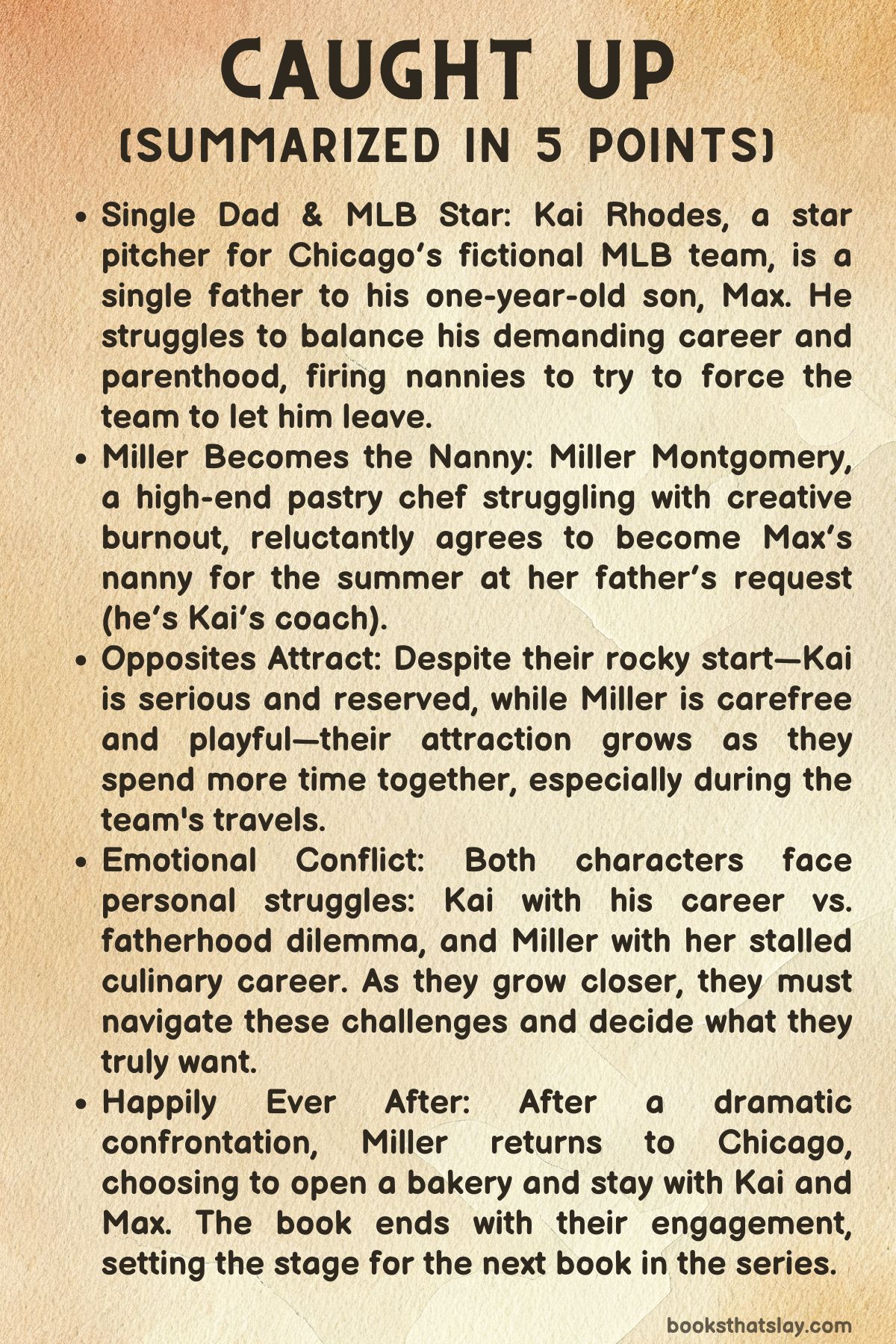
Caught Up by Liz Tomforde is a contemporary sports romance that blends themes of family, sacrifice, and second chances with the backdrop of professional baseball. At its core, the novel follows Kai Rhodes, a star pitcher for the Chicago Warriors and devoted single father, whose life is turned upside down when Miller Montgomery, a rebellious pastry chef battling burnout, becomes his unexpected nanny for the summer.
What begins as reluctant cohabitation soon develops into an intense relationship that challenges both of them to rethink love, trust, and what it means to find joy. The story explores resilience, vulnerability, and the ways love can reshape priorities.
Summary
Kai Rhodes has lived with a single-minded focus on baseball for years, but when his ex abandons their son Max, his priorities shift permanently. As a single father, Kai struggles to balance his career and raising Max, often cycling through nannies he deems unfit.
His protective instincts and high expectations make stability nearly impossible. His manager and mentor, Monty, who also raised his daughter Miller alone, warns him that this pattern isn’t sustainable.
Yet Kai insists he won’t settle for anything less than perfection when it comes to Max’s care, even while secretly questioning whether baseball still excites him the way it once did.
Meanwhile, Miller Montgomery, Monty’s daughter, faces a crisis of her own. After winning a James Beard Award, she finds herself creatively paralyzed, unable to live up to the pressure her newfound recognition demands.
Burned out and disillusioned, she quits her latest job after confronting harassment in the kitchen and decides to take the summer off. Though she initially plans to use the time for herself, her father persuades her to travel with the Warriors and help him out.
What neither she nor Kai expects is that she will end up as Max’s nanny, a decision Monty makes without consulting them both.
The arrangement is rocky from the start. Kai distrusts Miller, seeing her as reckless and unsuited for responsibility, while Miller resents Kai’s controlling nature and constant suspicion.
However, Max immediately bonds with her, surprising Kai with the depth of their connection. Miller’s playful personality and natural ease with Max break through the walls he usually puts up with strangers, and soon Kai can’t ignore how well she fits into their lives.
Tension grows as Kai tries to keep his distance, worried about Miller’s unpredictability and determined to shield his son from disappointment.
Their forced proximity leads to constant clashes, laced with banter and undercurrents of attraction. Miller challenges Kai on his overprotectiveness, reminding him that no one can live up to his impossible standards.
Kai, in turn, pushes Miller to see beyond her flightiness, recognizing her potential for depth and reliability. Slowly, their bickering turns into trust, and eventually into desire.
When they finally give in to their chemistry, their physical connection is intense and undeniable, though both try to set rules—casual only, no attachments, nothing lasting beyond the summer. Despite their promises, their growing intimacy blurs those lines, especially as Miller becomes increasingly woven into Max’s daily life.
Miller’s struggles with her career resurface throughout the summer. Though she tries to create desserts, she feels stifled and uninspired, haunted by the pressure of her upcoming Food & Wine magazine feature.
Kai encourages her to pursue joy rather than obligation, reminding her that her career shouldn’t consume her happiness. At the same time, Miller’s presence awakens something in Kai too—he begins to rediscover the joy of baseball, pitching some of his best games while Miller and Max cheer him on.
Their relationship becomes a strange mix of family comfort and secret passion, both of them trying to deny how deeply it is changing their lives.
As summer progresses, however, reality intrudes. Miller is called back to Los Angeles earlier than expected, where her demanding schedule of interviews and appearances only intensifies her burnout.
Though she tries to focus on her career, the absence of Kai and Max leaves her hollow. She clings to the little reminders of them, but loneliness consumes her.
During this time, she begins to realize that her achievements no longer bring her fulfillment—what she misses most is the sense of belonging and love she felt with them.
Back in Chicago, Kai struggles too. Without Miller, his balance falters, and even his game suffers.
He admits to friends that he’s exhausted and torn apart by her absence. Though he tries to convince himself it was only temporary, he knows he’s already given her his heart.
When he learns through Isaiah, his younger brother, that Miller has still been keeping up with Max, hope flickers, though he remains guarded against disappointment.
Miller’s turning point comes when she confronts the reality of her unhappiness during her magazine shoot. Looking at herself in the photos, she sees emptiness—except in one candid shot with Max, where her smile is genuine.
With her father’s encouragement, she decides to follow her heart instead of clinging to a career path that drains her. She publicly announces she’s leaving the high-pressure restaurant scene and choosing a new life rooted in family, love, and balance.
Her declaration is both liberating and terrifying, but she knows it’s the right choice.
The revelation comes just in time. At a wedding that Kai attends, he stumbles across Miller’s article and learns she has chosen Chicago, chosen him, and chosen Max.
When she arrives in person soon after, their reunion is heartfelt. Miller confesses she loves them both, and Max, calling her “Mama,” cements the new family they’ve created.
For the first time, Kai feels he has the family he dreamed of, no longer fractured or uncertain.
Six months later, their life together has settled into a joyful rhythm. Miller has opened her own patisserie in Chicago, balancing success with time for family.
She thrives in her new role as both chef and mother, while Kai continues to pitch with renewed energy and love for the game. At Max’s second birthday, surrounded by friends and family, Kai proposes with Monty’s heirloom ring, symbolizing their shared history and the family they’ve built together.
Miller accepts with tears and joy, completing the circle of love and belonging they both had been missing. The story closes on a hopeful, celebratory note, affirming the strength of love, family, and the courage to choose happiness over fear.
Characters
Kai Rhodes
Kai Rhodes, the star pitcher of the Chicago Warriors, is portrayed as a man torn between two worlds: the demanding life of professional baseball and his responsibilities as a single father. His character is rooted in love and fear—love for his son Max, whom he protects fiercely, and fear of failing as a father, which manifests in his inability to trust caregivers and his tendency to fire nannies hastily.
His guarded demeanor and rigid control over Max’s environment highlight his vulnerability, shaped by abandonment when Max’s mother left. Baseball, once his identity, now feels like a burden, with his heart shifting toward fatherhood as his true priority.
Yet beneath his gruffness lies a man deeply yearning for stability and love, even as he resists the pull of attachment, especially when it comes to Miller. His evolution is marked by the slow dismantling of his emotional walls, allowing both Miller and Max to heal his fears and remind him of joy beyond control.
Miller Montgomery
Miller Montgomery is introduced as a vibrant, free-spirited pastry chef, but beneath her rebellious exterior lies the weight of expectation and burnout. Her James Beard Award, though prestigious, becomes both her crown and her cage, trapping her in the image of success while stifling her creativity.
Miller’s restlessness, shown in her van life and refusal to stay tied down, stems from fear of being consumed by her career and a longing for genuine connection. Her dynamic with Kai forces her to confront stability, responsibility, and the possibility of family, while her natural bond with Max highlights her hidden nurturing instincts.
Miller’s character embodies resilience and defiance but also tenderness, as she struggles to reconcile independence with the vulnerability of love. Her eventual choice to prioritize family over fame reflects her arc of self-discovery—choosing joy and belonging over the relentless pursuit of external validation.
Max Rhodes
Max, though a toddler, serves as the emotional anchor of Caught Up. His innocent ability to sense trust and comfort in Miller before anyone else signals the undercurrent of hope and change that binds the main characters.
Max’s presence constantly challenges Kai’s fear and Miller’s resistance, drawing them together in moments of laughter, vulnerability, and shared care. His attachment to Miller, calling her “Mama,” signifies the family both he and Kai have longed for.
Despite his young age, Max’s role transcends that of a child in need; he represents healing, second chances, and the possibility of love forming in unexpected places.
Monty Montgomery
Monty, the Warriors’ manager and Miller’s father, is a quiet but firm guiding presence in the story. As a single father who sacrificed his own dreams to raise Miller, Monty embodies wisdom and patience.
His understanding of both Kai’s struggles and Miller’s restlessness allows him to serve as the bridge that binds them. He is pragmatic yet deeply compassionate, stepping in when Kai resists help and when Miller doubts herself.
Monty’s insistence on Miller becoming Max’s nanny sets the stage for the unfolding love story, but more importantly, his example as a father influences both Kai’s and Miller’s understanding of sacrifice, responsibility, and love. He stands as a figure of stability and integrity, whose legacy continues through the family Kai and Miller build.
Isaiah Rhodes
Isaiah Rhodes, Kai’s younger brother and the team’s shortstop, provides a playful counterbalance to Kai’s brooding seriousness. His flirtatious humor, especially toward Miller, lightens the tension and adds layers of sibling dynamics that enrich Kai’s character.
Isaiah’s confidence and mischief contrast Kai’s guardedness, showing the different ways the brothers navigate relationships and family. Yet beneath his charm, Isaiah’s teasing also reveals his keen awareness of Kai’s struggles, pushing him to open up and acknowledge his feelings.
His role may not carry the same emotional weight as others, but he is instrumental in softening the story’s tone and highlighting Kai’s vulnerabilities through their brotherly bond.
Emmett Montgomery
Emmett, Miller’s adoptive father, is a quieter presence compared to Monty, but his backstory of sacrifice deeply informs Miller’s journey. By giving up his own career to raise her after her mother’s death, Emmett instills in Miller an understanding of unconditional love and choice.
His influence lingers in her conscience, especially when she weighs the demands of her career against her desire for family. Emmett’s wisdom reminds Miller of what truly matters, and his role serves as a mirror to Kai’s fears of fatherhood—showing that sacrifice does not diminish but instead deepens love and legacy.
Themes
Fatherhood and Responsibility
In Caught Up, the responsibility of fatherhood is at the heart of Kai’s journey, shaping not only his personal decisions but also his professional life. His devotion to Max is evident in every choice he makes, from his relentless search for the “right” nanny to his willingness to sacrifice his career if necessary.
The fear of failing Max drives much of his overprotectiveness, creating friction between him and Miller but also highlighting the depth of his love. This theme underscores how single parenthood often comes with an overwhelming sense of isolation and pressure, particularly when Kai constantly feels that one wrong decision could harm his son.
His mistrust of others stems from abandonment—both his own experience of losing his partner and Max’s vulnerability as a child without a mother. The narrative portrays fatherhood as a balance between control and trust, teaching Kai that protecting Max does not mean shielding him from every influence but rather allowing love and stability to come from unexpected places.
His journey shows how responsibility can weigh heavily, but also how it can evolve into something lighter when shared with others willing to care as deeply as he does.
Love, Vulnerability, and Healing
The relationship between Kai and Miller unfolds as a slow revelation of how love requires both vulnerability and courage. Kai, who has hardened himself against disappointment, and Miller, who hides behind humor and independence, are both deeply afraid of attachment.
Yet, their intimacy gradually breaks down their defenses. The story illustrates that love is not simply about attraction but about the willingness to expose wounds, insecurities, and hopes.
Miller becomes the first person to see Kai as more than a player or a father—she recognizes his loneliness and the sacrifices he has made. Likewise, Kai encourages Miller to question whether her relentless pursuit of career validation is worth sacrificing her happiness.
Through moments of passion, banter, and conflict, they heal each other’s fears: his fear of loss and her fear of permanence. The novel portrays love as an act of bravery, where surrendering to emotion creates both risk and profound fulfillment.
The healing power of their bond transforms not only them as individuals but also the family they form with Max, suggesting that love can fill absences left by abandonment, grief, and doubt.
Career Versus Personal Fulfillment
Miller’s journey is defined by her struggle between ambition and happiness. Having reached a professional peak with the James Beard Award, she finds herself crippled by pressure rather than liberated by success.
The expectations tied to her career rob her of creativity and joy, leaving her questioning whether her chosen path still holds meaning. This theme contrasts her burnout with Kai’s growing detachment from baseball, illustrating how careers that once defined identity can become burdensome when passion fades.
Both characters grapple with the societal demand to equate success with prestige, while their hearts long for something more personal and grounding. Miller’s eventual choice to walk away from the competitive culinary world in favor of a balanced life with Kai and Max highlights a broader commentary on the illusion of professional fulfillment.
The novel suggests that true achievement lies not in accolades but in building a life that feels whole, filled with love, purpose, and stability. It challenges the reader to reconsider the sacrifices often made in the name of ambition, asking whether the cost of success is worth the emptiness it sometimes leaves behind.
Family and Belonging
Family in Caught Up is portrayed as something that is built through choice, love, and commitment rather than mere blood ties. Max’s quick attachment to Miller demonstrates how belonging can emerge from emotional bonds rather than biological ones.
Similarly, Monty’s role as both a father and mentor reflects the sacrifices parents make to create stability and opportunity for their children. Miller, who was raised by her adoptive father after her biological mother’s death, knows firsthand how family can be formed through love and dedication rather than traditional structures.
Her eventual acceptance as Max’s mother figure embodies the idea that family is fluid, expanding to include those who show up and stay, not those who leave. For Kai, who has lived in fear of abandonment, the formation of a new family unit with Miller and Max brings a sense of completeness he had long thought unattainable.
This theme emphasizes that belonging comes from shared love, trust, and commitment, showing that families can be rebuilt and redefined after loss, and that such bonds often become stronger for having endured hardship.
Identity, Sacrifice, and Growth
Both Kai and Miller are at pivotal points in their lives, questioning who they are outside of the roles imposed on them—athlete, chef, single parent, or award winner. Their growth lies in learning to separate self-worth from external validation.
For Kai, identity has long been tied to baseball, but the sacrifices required to maintain that identity now conflict with his desire to be fully present for Max. For Miller, the identity of a rising star in the culinary world feels suffocating, and she must decide if holding onto it is worth her well-being.
Their sacrifices—Kai considering giving up his career, Miller walking away from hers—reflect the choices many face when personal happiness collides with societal expectations. Growth comes through their willingness to redefine themselves, not through what the world demands but through what makes them whole.
By the novel’s conclusion, their new identities as partners, parents, and individuals who chose love over fear show that real growth comes from embracing change and aligning life with personal values rather than external pressure.