Chasing Home Summary, Characters and Themes
Chasing Home by Piper Rayne is a contemporary romance set on a Nebraska ranch where Romy Owens runs a wedding venue called The Knotted Barn. Her carefully managed life flips the morning she confirms she’s pregnant—especially because the father is Zander Shaw, a country music star who once disappeared from her life without explanation.
When Zander arrives at her family’s ranch to film a music video, old feelings collide with fresh resentment, and Romy is forced to balance her family’s financial needs, her own pride, and the reality of bringing a child into a messy situation. It’s a story about trust rebuilt, fear confronted, and choosing to show up fully. It’s the 6th book in the Plain Daisy Ranch series.
Summary
Romy Owens has been putting off taking a pregnancy test, even though the signs are obvious. Alone in the bathroom at The Knotted Barn—the wedding venue she operates on her family’s ranch—she finally does it.
While she waits, a video of country star Zander Shaw pops up on her phone, and the sight of him brings back the nights she spent on his tour bus and the way she once thought he truly cared. She shuts the video off, furious with herself for believing in him.
The test shows two pink lines. Romy takes a second test just to be sure, then sits with the reality: she’s pregnant, and she already knows she’s keeping the baby.
Her fear isn’t about motherhood as much as it is about the man who got her here. Zander didn’t end things with her honestly.
He cut her off through his security guard, DeSoto, without giving her a real conversation.
Before she can figure out what to do, her family keeps knocking, calling her out. When she finally steps into the barn, she finds a crowd waiting—and, to her shock, DeSoto is there with Zander.
Her cousin Scarlett announces that Zander will be filming his new music video on their ranch, a plan the family apparently made without Romy’s approval. Zander recognizes her immediately, and his confident public smile slips.
Romy refuses to give him any satisfaction. She shakes his hand like they’ve never met.
Romy tries to stay distant, but her family pushes her into the tour and introductions. She ends up seated beside Zander in a UTV, trapped in close proximity while pretending she feels nothing.
Zander, for his part, realizes he’s walked right into the one place he shouldn’t be, and he’s furious his manager, Beau, didn’t catch the connection. He watches Romy shut down around him and knows he earned that coldness.
At a stop near Daisy Hill, Romy walks away from everyone. Zander follows, hoping to talk.
Romy makes it clear she wants space and lays out the rules: the ranch is big enough for them to avoid each other, and he needs to respect her family while he’s there. Even in her anger, she automatically reminds him about his severe shellfish allergy, which only underlines how well she knows him.
Zander feels the sting of it and decides he should leave before he causes more damage. He goes to Beau demanding they move the shoot elsewhere.
Back home, Romy breaks down and finally tells her sister Lottie that she’s pregnant. She refuses to say who the father is, but Lottie doesn’t push.
Instead, she supports Romy immediately, even though Lottie has her own pain around fertility. She promises Romy she’ll help in any way she can and keep the secret for now.
Romy later sits through a family meeting and learns the truth: everyone signed the contract assuming Romy would be thrilled. She acts unimpressed and pretends she’s simply outgrown her celebrity crush.
But then she overhears Scarlett arguing with Beau and hears what’s really at stake. The ranch is having its worst year, tourism is down, and a rival ranch owner is hurting their business.
This music video is their best chance at publicity and income.
Romy swallows her pride and goes to Zander’s room. She tells him she heard he wants to leave and asks him to stay, promising she won’t reveal their past to her family.
Zander challenges her, wanting to know why she cares, and Romy snaps that she wouldn’t beg unless she had to. Zander sees the desperation behind her anger, takes her wrist to stop her from walking away, and agrees to stay because she asked.
It’s tense, restrained, and loaded—exactly the kind of moment Romy knows can ruin her if she lets it.
That night, the ranch hosts a cookout for the crew and family. Beau pressures Zander into playing music.
Zander performs a quiet acoustic song Romy recognizes—one he used to play only when they were alone. The crowd falls silent, and Zander keeps locking eyes with Romy across the fire.
Beau sits beside Romy afterward and hints that Zander struggles under the weight of his fame and that Romy asking him to stay mattered more than she realizes. Romy leaves early, but she can still feel Zander’s attention following her.
As filming preparations continue, Zander meets with Romy’s cousin Jensen, the ranch chef, to go over food. He emphasizes his shellfish allergy, and Jensen takes it seriously.
Romy walks in with her clipboard, cold as ever, and repeats the allergy warning like she’s drawing a line between them: she can keep him alive, but she won’t let him close.
Zander tries to shift the dynamic. He suggests they stop avoiding each other and be friends.
Romy agrees to be cordial, but only if he stops flirting. He offers lunch; she refuses.
She’ll do a distant wave, nothing more.
Still, Zander keeps finding reasons to be near her. In Romy’s office, he studies her wedding planning corkboard and praises her talent.
Then he asks her to design the wedding-themed set for his music video because she actually knows how weddings work. He offers payment and credit.
Romy resents how easily he turns connection into a transaction, but she agrees on one condition: it stays strictly professional.
At The Knotted Barn, Romy cuts her finger on a jagged nail while searching through décor storage. Zander insists on helping.
He follows her into the women’s bathroom, lifts her onto the counter, and bandages her hand. During the moment, he admits he grew up in foster care and learned to patch himself up after fights.
He apologizes for how he treated her before, acknowledging she didn’t deserve it. Romy refuses to get pulled into emotion, but the edge between them softens.
They even laugh together while hunting for an arch for the set.
Lottie later pushes Romy to see a doctor and to tell Zander, but Romy hesitates. She’s overwhelmed and scared of what happens once the truth is out.
Zander asks Romy to skip work and show him around the ranch for video ideas. They ride out in a UTV, visiting the lake, stables, greenhouse, bees, vineyard, and grazing land.
Romy marks Daisy Hill—the family cemetery—as off-limits, and Zander immediately agrees. She takes him to a private hilltop view, and for a while they’re simply two people eating lunch and talking about family.
Romy almost tells him the truth there, but a hidden photographer snaps pictures. Zander panics, thinking paparazzi are nearby.
He rushes them back, angry at the invasion and resigned to the cost of his fame.
The next day, Romy decides she has to tell him. She tries to corner Zander at the barn, but the crew and her mother, Darla, are everywhere.
Darla presses Romy about acting strange and tries to get into Romy’s locked office. Romy panics because the test is inside.
In the chaos, she accidentally locks her mother in the office, and with Zander watching the scene escalate, Romy blurts out the truth: she’s pregnant.
Zander walks away at first, not out of rejection, but to keep Darla from seeing his reaction. Romy follows him to the vineyard and explains she found out the day he arrived and needed time to process.
She tells him she’s keeping the baby. Zander is stunned and scared, admitting he doesn’t know what a real family looks like.
Still, he doesn’t deny responsibility. He tells her she didn’t make the baby alone.
Then he steps away to think.
Zander tells Beau, who responds with blunt frustration and immediate concern about reputation and logistics. Zander refuses to doubt Romy and insists the baby is his.
He admits he’s terrified, especially about being on tour and repeating old patterns of running. Beau shifts into support mode and promises they’ll figure it out.
Zander later shows up at Romy’s house and insists she shouldn’t isolate herself. He pushes her to go out with the family to The Hidden Cave, even though Romy worries her lack of drinking will expose the pregnancy.
At the bar, the women notice immediately. Lottie tries to cover, but the suspicion grows until Romy quietly admits she’s pregnant.
Her family cheers—then realizes Zander is the father when they spot him. Romy, overwhelmed, asks Zander to dance.
On the dance floor, she tells him everyone knows. Zander stays calm and asks if she trusts her family.
They nearly kiss, but Romy pulls back, reminding herself he doesn’t do relationships.
Wanting air and something normal, Zander asks Romy to sneak him into town. Disguised in a ranch hat and sunglasses, he begs for cupcakes from The Sugar Cottage.
They try to slip out the back, but kids recognize him. When press appears in the alley, Romy drags Zander into a janitorial closet to hide.
In the dark, their argument turns into honesty. Zander admits he never forgot her.
They kiss—until a child opens the door and catches them. The kids chant and tease, and the moment becomes public in the most ridiculous way possible.
Filming ramps up, and Zara Sloane arrives as Zander’s video co-star. Romy watches Zander act out romantic scenes with Zara and feels sick with jealousy, especially when the crew comments on their chemistry.
Zara is kind to Romy, but that almost makes it worse. Romy walks off, trying to keep her dignity intact.
Zander finds her with help from Poppy, who warns him not to treat Romy like something fragile. Zander catches Romy while she’s setting up wedding décor and finally says what he’s been holding back: he wants her, and he regrets ghosting her.
He admits she scares him because she matters. Romy admits she believed in them, protected him, and hid their connection because she thought it was real.
But she refuses to be someone he picks up and discards. She demands a promise that he won’t run when things get hard.
Zander promises he’ll try. They kiss and stop pretending.
They secretly meet in his suite, sleep together again, and wake up facing what comes next. Romy refuses to live in shadows if they’re serious.
Zander suggests they stop sneaking and be seen together, but he asks to keep the pregnancy private a little longer to protect Romy from attention. Romy agrees as long as they’re careful.
The pressure spikes when Romy goes out briefly to buy souvenirs for two kids, and someone photographs her belly. Zander spirals, convinced the photo will trigger a media storm.
Romy refuses to live hidden away, even if the truth becomes public. She suggests going home while he finishes touring and they work out a real plan.
Zander reacts badly, defaulting to control. He arranges a private flight and sends her away with security, acting cold and claiming his life won’t change.
Romy leaves devastated, sobbing through the ride back to the ranch.
At the ranch, Darla takes Romy to Daisy Hill and tells her what she sees clearly: Zander’s controlling impulse comes from fear and survival, not lack of love. She believes he’ll come back once he stops running from his own history.
Beau forces Zander to face that history by taking him back to his childhood foster neighborhood. Beau tells him the truth: Romy didn’t leave—Zander pushed her away.
Zander finally admits he loves her and decides to go to her.
Scarlett later leads Romy into The Knotted Barn for a “surprise.” Zander is waiting. He apologizes, admits he wrote his single about becoming the man Romy deserves, and confesses he hid her because he was terrified she’d leave once she truly saw his world.
Romy tells him he doesn’t get to decide for her. If they do this, they do it together—no more hiding.
Zander promises to change his schedule, slow down, and build a real life with her. Romy takes him back, and Beau steps in, already thinking about how to handle what the world will say.
They sit for a filmed interview to tell their story on their terms: how they met, the NDA, the mistake he made by cutting her off, and how he ended up back at her ranch. They don’t share every detail about the baby, but they make it clear they’re choosing honesty to shut down rumors and protect what matters.
When Romy goes into rapid labor, Zander briefly steps away and nearly misses the birth. Romy panics and refuses to push until he returns.
He rushes back just in time, stays at her side, and watches their son, Rhodes Shaw, enter the world. Holding the baby, Zander promises he’ll be present and give Rhodes the stability he never had.
In the epilogue, life settles into something real. Romy suspects her friend group has its own secrets brewing, but her focus is on what she and Zander are building.
Zander presents Romy with blueprints for a four-bedroom house on her land so she and Rhodes will always have security. Then he proposes, asking for a future that’s public, committed, and shared.
Romy says yes, surrounded by her loud, loving family as she steps into the home she’s been chasing all along.
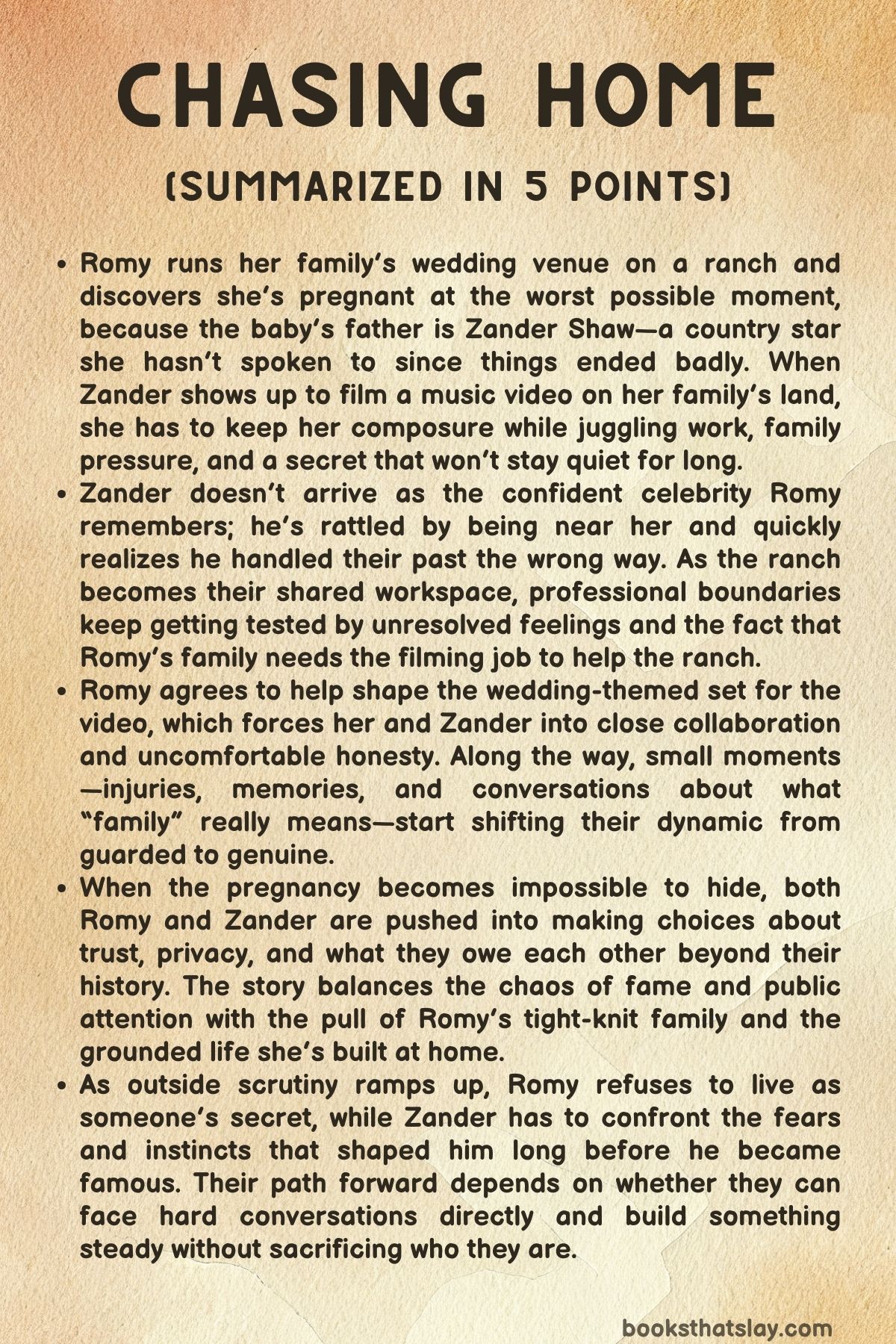
Characters
Romy Owens
Romy is the emotional anchor of Chasing Home, a woman who carries both the weight of her family’s livelihood and the private fallout of a relationship that never got a real ending. Her competence is obvious in how she runs The Knotted Barn with a planner’s brain and a caretaker’s instincts, yet her personal life is defined by delays—delaying a pregnancy test, delaying a doctor, delaying the truth—because once she names what’s happening, she has to let other people into it.
Romy’s core conflict isn’t simply “unexpected pregnancy,” but the collision between her craving for a steady, chosen love and her fear of being treated like an afterthought again. Even when she resents Zander, she remains principled: she protects her family’s chance at financial recovery, honors boundaries like Daisy Hill, and refuses to live as a hidden accessory to someone else’s life.
Her growth is the movement from managing everything alone to demanding partnership out loud—no more secrecy, no more being edited out—while still keeping her compassion intact.
Zander Shaw
Zander begins as the archetype of the untouchable star, but his real defining trait is fear disguised as control. He isn’t careless because he doesn’t feel; he’s reckless because he feels too much and doesn’t trust stability to last.
His foster-care background shapes how he interprets intimacy: closeness equals risk, and risk must be managed through distance, NDAs, security, and a carefully curated public image. When the pregnancy forces permanence, Zander’s panic shows up as protectiveness that crosses into confinement, and the story makes it clear that his “I’m keeping you safe” is also “I’m trying to keep you from leaving.” What ultimately softens him isn’t fame, money, or even the baby alone—it’s Romy’s refusal to accept a love that requires disappearing.
His arc is a slow redefinition of masculinity and responsibility: from reactive damage control to intentional commitment, from running when overwhelmed to staying present even when terrified, culminating in the choice to build an actual home rather than just a temporary safe zone.
Beau
Beau functions as both manager and moral counterweight, the person who understands the machinery of celebrity while still insisting Zander be a human being inside it. He’s blunt, sometimes abrasive, and relentlessly practical—his first instinct is logistics, reputation, and containment—but his practicality is also how he shows care.
Beau pushes Zander toward accountability when Zander defaults to escape, and he’s one of the few people who can confront Zander without being shut out. Importantly, he’s not portrayed as a cold publicist stereotype; he worries, admits fear, and ultimately helps steer Zander toward the harder, healthier choice of building a real life.
He embodies the tension between image management and emotional truth, and his presence keeps the romance from floating off into fantasy by constantly asking, “What does this mean in the real world?”
Lottie
Lottie is Romy’s safe landing spot, offering immediate support without making Romy pay for it in guilt or obligation. Her own fertility struggles add emotional complexity: she could have been written as resentful, but instead she becomes generous, steady, and protective, which highlights how love in this family can be fierce without being possessive.
Lottie’s role is also practical—she urges medical care and responsible steps—yet she never turns Romy’s pregnancy into a problem to be solved for the family’s convenience. She represents the version of intimacy Romy needs: consistent, non-performative, and rooted in trust.
Scarlett
Scarlett is the catalyst personality—dramatic, opportunistic in a way that’s not malicious so much as impulsively convinced she knows what’s best. She brings Zander onto the ranch and frames it as a blessing, initially missing (or ignoring) Romy’s discomfort because Scarlett thinks in big gestures and big outcomes.
As the financial stakes become clearer, Scarlett’s desperation makes sense: she’s fighting for the ranch’s survival and reaches for the loudest lifeline available. She also adds social pressure and comedic friction, but underneath that is a sharp instinct for publicity and momentum, which mirrors the broader theme of what happens when private lives get pulled into public narratives.
Darla
Darla is the family’s adult gravity, the mother who can be intrusive in the way loving parents sometimes are, yet who ultimately shows up when it counts. Her confrontation with Romy’s secrecy is intense because Darla’s concern is not abstract—she sees vulnerability and wants clarity.
What makes her compelling is how she reads the emotional truth behind behavior: she interprets Zander’s protectiveness through his childhood, not as villainy but as fear. Darla becomes a bridge between Romy’s hurt and Zander’s damage, insisting on empathy without asking Romy to accept disrespect.
She also symbolizes legacy—family land, family history at Daisy Hill—and frames the idea that “home” isn’t just a place, it’s a choice to stay and face hard things together.
Emmett
Emmett operates mostly as part of the family chorus, but his presence reinforces the sense that Romy is never truly alone, even when she feels isolated. He represents the protective, watchful sibling energy that quietly raises the stakes for Romy’s secrecy and Zander’s integration into the family orbit.
Even in limited moments, he contributes to the pressure-cooker environment where private truth keeps threatening to become public, making Romy’s desire for control feel understandable.
Jensen
Jensen is a stabilizing, competence-based character: calm under pressure, responsible with details, and quietly funny. His handling of Zander’s shellfish allergy shows the ranch’s hospitality as real professionalism rather than starstruck fussing, and it also underlines how the family’s world runs on care-through-work.
Jensen’s role reinforces that “home” is built from daily attentiveness—food, safety, routines—contrasting Zander’s chaotic, image-driven lifestyle. He’s also a subtle social barometer; the things he notices and the way he delivers room service become part of the story’s playful tension around who knows what, and when.
Poppy
Poppy begins as a gatekeeper, openly hostile to Zander and unafraid to show it, which makes her less “mean” than fiercely loyal. Her sharpness is protective instincts made verbal: she reads Zander as a threat to Romy’s emotional stability and refuses to sugarcoat it.
What deepens her is the shift from antagonism to conditional acceptance once the pregnancy is known; she doesn’t melt into approval, she redraws boundaries and warns Zander not to treat Romy as fragile. Poppy embodies the theme that real love includes accountability enforced by the people who care about you, not just romantic declarations.
Nash
Nash appears as a foil to the main romance, offering a parallel thread of secrecy and desire that’s more playful and less high-stakes, especially through the epilogue suspicion that he and Poppy are involved. His bickering dynamic with Poppy suggests intimacy that’s been brewing under the surface, and his presence also widens the emotional ecosystem of the ranch: people here have layered lives, not just supporting roles.
Nash’s function is to hint that love on this ranch isn’t only grand and dramatic—it can also be messy, private, and unfolding in the corners.
DeSoto
DeSoto is the embodiment of the barrier between Zander and normal life. As security, he’s physically present where boundaries matter—blocking access, driving, scanning threats—and he represents the part of Zander’s world that Romy resents most: the feeling of being managed.
Yet DeSoto is not framed as cruel; he’s professional, doing his job, and that matters because it keeps the conflict aimed where it belongs—at the choices Zander makes—rather than blaming the system’s foot soldiers. His constant proximity also heightens the tension between intimacy and exposure, making even quiet moments feel watched.
Walker Matthews
Walker is the offstage pressure that explains why the family makes choices that frustrate Romy. By hurting their business and contributing to a bad year, he becomes the practical antagonist: not a romantic rival, but a threat to the ranch’s survival.
His role underscores that for Romy’s family, this isn’t only about feelings—it’s about staying afloat, maintaining land, and protecting a legacy. Walker’s impact makes Romy’s sacrifice (asking Zander to stay) feel like a choice made from responsibility rather than weakness.
Zara Sloane
Zara represents the polished, public-facing version of romance that Romy fears she can’t compete with: the camera-ready chemistry, the easy narrative, the kind of pairing the world understands instantly. She’s portrayed as warm and professional, which is crucial—she isn’t villainized to make Romy sympathetic.
Instead, Zara’s presence forces Romy to confront jealousy that’s rooted in insecurity and history, not pettiness. Zara becomes a mirror for the story’s central question: what is real when performance looks so convincing, and how do you claim authenticity in a world that profits from illusion?
Laurel
Laurel functions as community texture and comic complication, the local who recognizes the danger of celebrity and tries to manage it with quick thinking. Her bakery becomes a stage where Zander’s fame crashes into small-town life, turning a simple cupcake run into chaos.
Laurel’s decisions—boxing cupcakes, moving them out the back, reacting to the kids—show the town’s protective instincts and the improvisational way people respond when private moments threaten to become headlines.
Ben
Ben sits at the intersection of Romy’s professional identity and her personal unraveling. His wedding is a practical storyline that keeps Romy grounded in her work even while her life shifts, and it also places her repeatedly in wedding imagery—arches, décor, romance symbolism—that contrasts with how uncertain her own romantic future feels.
Ben’s presence reinforces Romy’s competence and highlights how she can build beautiful, stable moments for others while struggling to claim stability for herself.
Gillian
Gillian, like Ben, amplifies Romy’s role as a maker of “happy endings” for other people. The wedding planning details become an emotional counterpoint: Romy is literally constructing scenes of commitment while wrestling with whether she can trust Zander not to disappear.
Gillian helps keep the story’s setting alive as a working ranch venue, not just a backdrop for celebrity drama, and that realism strengthens Romy’s characterization as someone with a life beyond the romance.
Kira
Kira, the interviewer, represents the formal negotiation between truth and narrative. She gives the couple a controlled space to reclaim the story before rumors claim it for them, and her presence marks a turning point where Zander and Romy stop trying to hide and start choosing what to share.
Kira’s function is less about personality and more about structure: she symbolizes the public-facing consequences of private choices, and the idea that fame turns intimacy into content unless you actively push back.
Leia
Leia is part of the childlike chaos that punctures adult tension and forces authenticity. By spotting Zander and screaming his name, she triggers the frantic scramble that leads to the closet scene, but she also highlights something softer: Zander’s ease with kids when the moment is real and unfiltered.
Leia represents the future pressing into the present—children as both joy and exposure—making the pregnancy feel less theoretical and more immediate.
Wren
Wren complements Leia as the other spark that turns secrecy into spectacle. The kids’ chanting and teasing reduce a highly charged romantic moment into innocent comedy, which underlines one of the book’s recurring truths: you can’t fully control how life looks from the outside.
Wren’s presence also reinforces Romy’s community ties and the town’s closeness, where everyone knows everyone and privacy is always fragile.
Uncle Bruce
Uncle Bruce appears as an extension of the family network and the ranch’s lived-in community, providing a practical space where life happens—work, setups, preparations—outside the celebrity bubble. The fact that Romy is doing physical, hands-on setup work there reinforces her grounded nature and contrasts with Zander’s world of curated appearances.
Uncle Bruce’s role is subtle but important in anchoring the story’s “home” as a multi-generational web of places and people.
Rhodes Shaw
Rhodes is the culmination of the story’s emotional promises: not simply a baby, but a symbol of permanence, accountability, and the kind of family Zander never had and Romy refuses to build alone. Even before his birth, Rhodes reshapes every decision—touring, secrecy, protection, commitment—forcing Zander and Romy to define what partnership means beyond chemistry.
After his birth, he becomes the clearest statement of the book’s theme: love isn’t proven by intensity, but by presence, stability, and the willingness to build a life that holds.
Themes
Autonomy under pressure
Romy’s life is full of people who love her and yet constantly move around her choices as if the decision has already been made. The moment she sees the positive test, her body becomes a private truth she can’t share safely, and then immediately becomes a public problem she has to manage: family members knocking, work demands at the venue, and Zander’s unexpected arrival.
What stands out is how often her consent gets treated as optional—her relatives sign a contract for the ranch without asking her, her mother pushes into her office space, and even the well-meaning excitement at The Hidden Cave turns her pregnancy into a celebration before she’s ready. Romy keeps choosing, but she’s choosing inside a crowd.
Her autonomy isn’t just about deciding to keep the baby; it’s also about deciding when information is shared, how she will be spoken about, and whether she will accept a life shaped by other people’s panic. This is why the “no more hiding” line matters later: it isn’t only romantic.
It’s Romy drawing a boundary that she will not be managed, protected, or packaged for anyone else’s comfort. Even when Zander offers money, credit, and professional opportunities, she resists the feeling that he can “solve” her with resources.
By insisting on professional terms, refusing to live locked away, and pushing back against secrecy, she claims the right to live her own reality in the open—messy, imperfect, and still hers.
Privacy versus publicity
Fame doesn’t simply create inconvenience in Chasing Home; it turns ordinary moments into risks and makes intimacy feel like exposure. Zander’s world runs on controlled narratives—contracts, NDAs, security detail, a manager who thinks in headlines—and Romy’s world runs on community visibility, where family gatherings and town routines are normal and comforting.
The conflict isn’t “spotlight bad, privacy good”; it’s that both characters are trapped in systems that demand performance. Zander’s fear spikes when a photographer appears, when kids recognize him, when press gathers outside the ranch, and when a stranger snaps a picture of Romy’s stomach.
Those aren’t random scares; they show how quickly a body can become content in a celebrity ecosystem. Romy experiences this threat differently: she’s not addicted to attention, but she refuses to surrender her life to a constant state of hiding.
When she says she’s done living like a secret, she isn’t being reckless; she’s rejecting the idea that safety must always mean shrinking. The filmed interview becomes a compromise that’s both pragmatic and emotionally significant: they decide to speak on their own terms, not because they love publicity, but because silence leaves a vacuum that other people fill with rumor.
In that way, privacy becomes something they actively design rather than passively lose. The theme lands in the tension between wanting peace and needing honesty—choosing disclosure as a strategy, not a surrender.
Fear of abandonment and the need for stability
Zander’s foster-care background isn’t presented as a simple explanation for bad behavior; it’s the engine behind how he approaches love like a threat he has to control. He isn’t just scared of being left—he is scared of being seen, fully, and then left because of what’s seen.
That fear appears in his earlier ghosting, in his reflex to run from the ranch, in his panic over press, and in the way he tries to make decisions for Romy “for her own good.” Control becomes his substitute for trust. When Romy pushes for promises—especially the demand that he not run when overwhelmed—she is asking him to do something harder than grand gestures.
She is asking him to stay present in discomfort, to tolerate uncertainty without flipping the table. Beau’s confrontation in the old neighborhood forces Zander to face that he’s been living as if escape is the only safety, even when he has choices now.
What makes the resolution satisfying is that stability isn’t treated as a feeling; it becomes an action plan. Zander talks about changing schedules, slowing down, building a home on her land, being present for the baby, and following through when things get messy.
The birth scene reinforces this theme sharply: Romy’s panic about him missing it shows how quickly fear can transfer between partners, and his return becomes less about romance and more about reliability. When he promises his son stability and love, it is also a vow to stop repeating the life pattern he came from.
The story suggests that stability is created through repeated, boring, dependable choices—especially for someone who never had it.
Work, place, and identity
The ranch and wedding venue aren’t just backdrops; they represent a kind of identity that is earned through responsibility. Romy’s sense of self is tied to the land, the family business, and the craft of building experiences for other people—weddings, gatherings, and community moments.
Even her pregnancy test happens inside a workplace bathroom, which says a lot about how little separation she has between “Romy the person” and “Romy the manager.” Zander’s world is the opposite: a life on wheels, hotels, sets, and performances where the environment changes constantly and identity has to stay marketable. When the family is desperate for the music video to help their worst year, the ranch becomes both home and economic lifeline, and Romy is pushed into a role where she must swallow personal pain for collective survival.
Her decision to ask Zander to stay isn’t weakness; it’s leadership under strain. The theme deepens as Zander shows genuine respect for her skills—specifically wanting her design eye for the video because it’s real, not manufactured.
That respect is one of the first places their relationship stops being about attraction and starts being about recognition. Place also becomes a moral boundary: Daisy Hill being off-limits is Romy protecting family history, and Zander agreeing immediately is a quiet moment of him honoring a world that isn’t built around his fame.
The planned house at the end is symbolic, but it’s also practical: it roots Zander’s future to Romy’s land rather than asking her to uproot her identity to fit his career. Home, here, is not nostalgia—it’s a chosen structure where work, family, and love can coexist without one erasing the others.
Accountability, repair, and trust-building
The relationship between Romy and Zander is not healed by a single apology; it’s repaired through a sequence of accountability moments that keep testing whether change is real. Zander’s earlier abandonment left a wound that can’t be patched with charm, and Romy repeatedly refuses to accept vague affection as proof.
She remembers the bus, the cut-off message delivered through security, and the humiliation of being treated as disposable. That memory becomes her self-protection, but also her standard: she won’t be “picked up and discarded.” Zander’s growth shows up when he stops hiding behind intermediaries and starts speaking directly, even when it makes him look bad.
His apology is specific—he acknowledges he handled things wrong and that she didn’t deserve it—and his later confession makes the pattern explicit: he pushed her away because she scares him, meaning she matters enough to threaten his defenses. Trust, however, doesn’t rebuild in private alone.
It gets tested in public pressure: filming romantic scenes with Zara, dealing with press, family scrutiny, and the logistical chaos of fame. The fight where he sends her away is the ugliest proof that growth isn’t linear; fear can still hijack him.
What matters is what happens after: he comes back, admits he was wrong, and stops trying to control the narrative by controlling her. Romy also practices accountability in her own way—she doesn’t punish him forever, but she sets terms that protect her dignity.
The interview functions as a trust exercise: they agree on what to share, what to keep private, and they stand together rather than letting other people define them. By the end, commitment is framed less as romance and more as repair—showing up, telling the truth, and building a shared life that can handle stress without collapsing into silence or flight.
Family as support system and social force
Romy’s family operates like a safety net that sometimes feels like a net thrown over her head. Their love is loud, communal, and constant: they gather, they celebrate, they pry, they protect.
Lottie’s immediate support shows the best of this system—no judgement, no competition, even with her own fertility pain. Darla’s role is equally complex: she crosses boundaries, but she also becomes the one who helps Romy interpret Zander’s fear with compassion rather than self-blame.
Scarlett’s dramatic energy and the contract decision show how family can create conflict by assuming they know what’s best, especially when money and pride are involved. The Hidden Cave scene captures how quickly private news becomes group property in a tight-knit family culture, turning Romy’s quiet confession into a public event.
Yet the same group that overwhelms her also gives her a place to land when Zander breaks things off. They meet her at the airport, surround her, and take care of her without requiring her to perform strength.
This theme is also about reputation and community economics: the rival ranch owner hurting their business, tourism being down, and the music video representing survival. Romy’s personal choices are constantly linked to collective outcomes, which is why boundaries are so difficult for her to enforce.
The family’s presence at the end—swarming them after the proposal—could be read as chaos, but it also signals belonging. In Chasing Home, family isn’t purely comforting or purely controlling; it’s a living force that shapes decisions, amplifies consequences, and also provides the resilience that makes new beginnings possible.